
Discovering a puncture can leave drivers wondering whether a DIY tyre plug kit offers a quick and reliable solution. These compact kits are designed to insert a rubberised string or rope plug into a puncture from outside the tyre. Although they may temporarily reduce air loss, they cannot establish whether the tyre remains structurally sound. A puncture that looks minor from the outside can sometimes conceal serious internal damage. Understanding the limitations of these kits is essential before deciding whether a tyre is safe to use. The difference between a temporary seal and a professional permanent repair matters for every UK motorist.
Imagine finding a screw in your tyre after returning home from work. The tyre still appears inflated, and a DIY repair kit in the boot seems like a convenient option. However, removing the screw and inserting a plug would not reveal whether the inner casing has been damaged. A tyre that holds pressure immediately after plugging may still be unsuitable for normal road use. UK tyre repair standards require a more thorough assessment before a repair can be considered permanent. Knowing what these requirements involve can help you avoid unnecessary risks and make better decisions about tyre safety.
What Are DIY Tyre Plug Kits and How Do They Work?
DIY tyre plug kits are products intended to seal certain punctures without removing the tyre from its wheel. Many contain rubberised strings or ropes that are inserted into the puncture opening from the outside. The material is intended to obstruct the path through which pressurised air escapes. Some kits are marketed for roadside emergencies, while others are described as convenient puncture solutions. However, their advertised purpose does not establish that the resulting repair meets recognised UK standards for permanent tyre repair.
Most modern passenger cars use tubeless tyres, which retain air through an internal liner and a seal against the wheel rim. When a sharp object penetrates the casing, it can create a channel through which air escapes. A rope plug attempts to block that channel without exposing the internal surface of the tyre. Understanding how tubeless tyres work helps explain why stopping air loss is only one part of addressing a puncture. The condition of the surrounding reinforcing materials is equally important.
What Is Inside a Typical String or Rope Tyre Plug Kit?
A typical DIY tyre plug kit contains several lengths of rubberised repair cord and tools intended for preparing and plugging a puncture opening. Some products also include adhesive or other materials intended to help the cord remain in position. The basic approach is to introduce the plugging material through the damaged area from the outside. This differs from a professional repair because the tyre remains mounted on its wheel. As a result, the person using the kit cannot inspect the entire internal structure.
For example, a driver might purchase a compact tyre plug kit to keep alongside other emergency equipment. Its small size makes it convenient to store, particularly in a car without a spare wheel. However, having the equipment does not mean every puncture is suitable for plugging. The kit cannot determine whether reinforcing cords have been damaged or whether the tyre has previously been driven while underinflated. Those questions require an appropriate professional assessment before normal driving resumes.
Why Can an External Plug Appear to Stop a Tyre Losing Air?
A string or rope plug works by filling part of the puncture channel and restricting the escape of air. When the material occupies the opening, the tyre may retain inflation pressure more effectively. This can make the puncture appear resolved, particularly when the original leak was relatively slow. However, an airtight result does not demonstrate that the surrounding tyre structure remains undamaged. The plug addresses the visible air path rather than establishing the tyre’s complete condition.
Imagine noticing that a plugged tyre holds pressure during an initial check. It may seem reasonable to assume the repair has been successful. However, the puncturing object could have damaged internal reinforcing materials that remain hidden behind the tread. The puncture may also have developed an irregular internal channel rather than a simple opening. Without removing the tyre and examining it properly, these possibilities cannot be reliably excluded.
Why Is a DIY Tyre Plug Usually Considered a Temporary Repair?
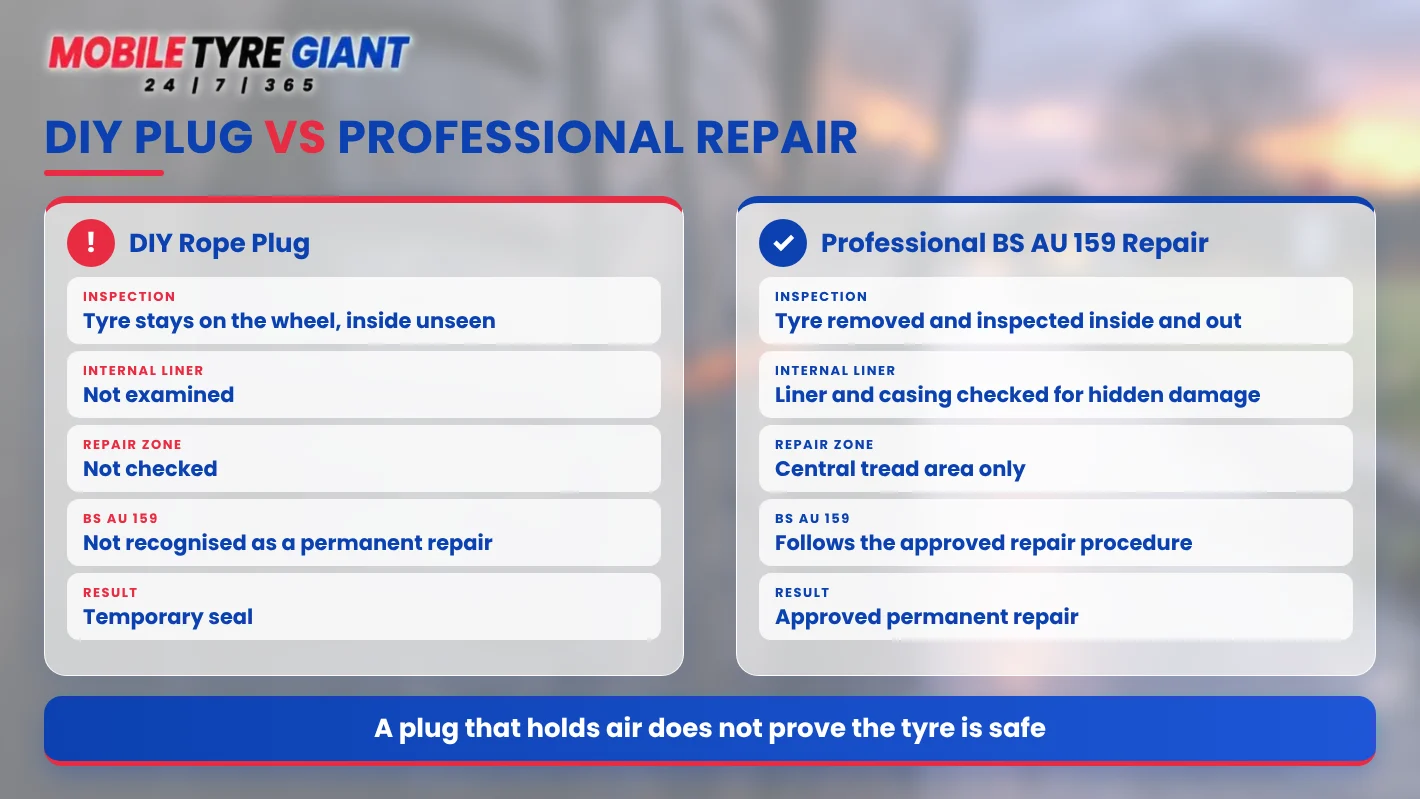
An externally inserted tyre plug is generally treated as a temporary measure rather than a permanent roadgoing repair. This is because the method does not allow the complete internal inspection required by British Standard BS AU 159. The standard specifically excludes temporary externally inserted plugs from its scope for permanent repairs. A tyre may retain air after plugging without meeting the requirements for continued unrestricted service. Drivers should therefore avoid treating an external plug as equivalent to a professionally completed repair.
Carrying or using a DIY plug kit is not specifically prohibited by UK law, but this does not remove the driver’s responsibility to maintain roadworthy tyres. A temporary repair does not automatically make a damaged tyre suitable for motorway driving or prolonged use. Whether limited movement is appropriate depends on the tyre’s condition, the kit manufacturer’s instructions and the circumstances. Professional inspection remains necessary before the tyre can be considered suitable for permanent repair. This is general information rather than legal advice, and specific situations may require further guidance.
What Can an Outside-Only Plug Fail to Reveal?
An outside-only repair does not reveal what has happened to the tyre’s internal liner and reinforcing components. A puncturing object can create damage beneath the tread that is much more extensive than the visible opening. Driving while the tyre is significantly underinflated can also weaken internal materials through excessive flexing and heat. These defects may remain concealed even after the tyre has been reinflated. A successful pressure reading cannot confirm that the casing remains suitable for continued use.
For example, imagine a tyre that loses most of its pressure during a short journey. The driver notices the problem only after reaching a parking area. Although a plug might reduce air loss, the tyre may already have experienced significant internal stress. The resulting damage could make permanent repair unsuitable regardless of the puncture’s original size. Only a proper inspection can establish whether the tyre’s condition allows further use.
How Does a Professional BS AU 159 Repair Differ From a DIY Plug?
A professional permanent puncture repair begins with removing the tyre from the wheel. This allows the technician to inspect the internal liner, tread, sidewalls, bead areas and other relevant components. The puncture must also fall within the permitted repair zone and satisfy the applicable size and condition requirements. Where repair is suitable, the British Standard specifies approved repair materials and procedures. An external plug inserted without tyre removal does not meet those requirements.
For eligible minor punctures, an approved method may involve a combination plug-and-patch unit applied from inside the tyre. Another permitted approach uses an internal patch together with suitable material to fill the penetration channel. These methods address both the injury channel and the inner liner according to the standard. The technician must also check the completed repair and ensure the tyre remains suitable for service. This combination of inspection and controlled repair procedures is what distinguishes professional permanent repair from an emergency external plug.
Which Tyre Punctures Can Be Repaired Safely?
Not every tyre puncture qualifies for repair, regardless of whether a DIY kit can physically seal the opening. For passenger-car tyres, professional minor repairs are generally restricted to the central tread area identified by BS AU 159 as area T. The permitted width depends on the tyre’s nominal section width, so it should not be assumed that the entire tread surface is repairable. The standard also applies limits to the size and nature of the penetration. A tyre must meet all relevant requirements before a technician can approve a repair.
The location of the puncture is only one consideration. The tyre must also have sufficient legal tread depth and remain free from disqualifying structural damage. Previous repairs, damage from underinflation and the tyre’s construction can affect eligibility. Even an apparently small puncture may require replacement if the internal casing has deteriorated. A professional assessment should determine whether repair is appropriate rather than relying on the appearance of the original hole.
Which Punctures in the Central Tread Area May Qualify for Repair?
Small penetrations within the permitted central tread repair zone may qualify for professional repair when the tyre is otherwise sound. British Tyre Manufacturers’ Association guidance identifies a maximum penetration diameter of 6mm for the relevant minor repair category, subject to the standard’s other conditions. The permitted repair area varies according to nominal tyre width. The technician must also consider the tyre’s construction, previous repairs and any additional manufacturer restrictions. A puncture does not qualify simply because its visible opening appears small enough.
Imagine finding a nail in the middle of a tyre’s tread while the vehicle is parked safely. The position may make professional repair possible, but it does not guarantee approval. The puncturing object may have entered at an angle or caused hidden damage beneath the tread. The article about whether a nail puncture needs repair or replacement explains why the position and condition of the damage matter. A technician must remove and inspect the tyre before confirming that a permanent repair is suitable.
Why Should Shoulder and Sidewall Punctures Not Be Plugged?
The shoulder and sidewall perform different structural functions from the central tread area. These sections flex repeatedly as the tyre rotates and carries the vehicle’s weight. Penetration damage in these areas can compromise reinforcing materials and create stresses that ordinary minor repair methods are not intended to address. BS AU 159 does not approve conventional minor penetration repairs outside its defined central repair zone. An external plug does not change those structural limitations.
For example, imagine discovering a screw close to the outer edge of a tyre’s tread. It may appear to be only a short distance from an otherwise repairable central puncture. However, its position could place the injury outside the permitted repair area. Attempting to seal it with a rope plug would not make the tyre eligible for permanent repair. A tyre with shoulder or sidewall penetration damage will generally require replacement rather than a conventional puncture repair.
Why Can a Tyre Remain Unsafe Even When a DIY Plug Holds Air?
A tyre’s ability to retain pressure is important, but it is not proof of structural integrity. The internal casing must withstand repeated loads, movement and heat during normal driving. A temporary plug may close the puncture opening while leaving damaged reinforcing materials untouched. The tyre could therefore appear normal during a short pressure check despite having an underlying problem. This is why professional assessment considers more than whether air continues escaping.
The risks can become particularly important when a tyre is subjected to sustained motorway speeds or heavier vehicle loads. Repeated flexing places demands on the tyre’s internal components, especially when they have already been weakened. A previous period of severe underinflation may increase concern even if the original puncture was small. Certain specialist tyre constructions also have additional repair restrictions. Drivers should not assume that a temporary external seal restores the tyre’s original operating capabilities.
What Internal Damage Can Develop When a Tyre Is Driven Underinflated?
When a tyre operates with insufficient pressure, its sidewalls flex more than intended. This repeated movement can generate excessive heat and damage internal rubber and reinforcing materials. Severe deflation may also cause the internal structure to deteriorate as the wheel continues rotating. Some of this damage may not be visible from outside the tyre. A subsequent external plug cannot reverse deterioration that has already occurred.
Imagine driving several miles before realising that a rear tyre has lost substantial pressure. After stopping, you discover a small puncture that appears suitable for plugging. However, the earlier journey may have caused internal damage unrelated to the visible size of the hole. Even if a temporary plug prevents further air loss, the tyre could remain unsuitable for a permanent repair. A technician needs to examine the inside before deciding whether continued use is safe.
Can a Plug Hide Other Damage or an Incorrect Diagnosis?
A puncture may occur alongside other tyre or wheel problems that a DIY plug cannot identify. A sharp object can damage internal layers, while a separate valve or rim leak may continue releasing air. A tyre may also have pre-existing cracks, abnormal wear or damage from earlier impacts. Plugging one visible opening does not establish that these other problems are absent. A complete inspection helps distinguish an isolated repairable injury from a tyre that should be replaced.
For example, a driver might seal a visible puncture but discover that the tyre continues losing pressure overnight. The original plug may not be sealing correctly, or air could be escaping from another location. A technician may find a second penetration, valve problem or damaged bead seal during inspection. Repeatedly inserting more plugging material would not address those underlying possibilities. The appropriate response is to identify the actual fault and establish whether the tyre remains safe for service.
What Are the Main Safety Risks of Relying on a DIY Tyre Plug?
A DIY tyre plug can appear successful when a punctured tyre stops losing air immediately after treatment. However, the seal may not remain reliable under every driving condition. Tyres experience repeated deformation, changes in temperature and varying forces as the vehicle moves. These conditions can place additional stress on an externally inserted plug and the surrounding puncture area. Relying on a temporary repair without professional assessment can therefore create unnecessary safety risks.
The problem is that drivers may mistake temporary pressure retention for evidence of a completed repair. A tyre can feel normal during a short journey while an unresolved fault remains. Pressure loss may return gradually or develop more quickly if the plug loses its seal. The consequences can become more serious when the vehicle is travelling quickly or carrying additional weight. A temporary external plug should never be treated as a substitute for an approved permanent repair.
Can a DIY Tyre Plug Develop a Slow Leak or Cause Sudden Deflation?
An external plug may initially restrict airflow without creating a durable seal throughout the damaged area. Changes in tyre temperature and movement can affect how the plugging material interacts with the puncture channel. If the seal deteriorates, air may begin escaping again. A slow leak can gradually reduce inflation pressure without producing an obvious change in the tyre’s appearance. More rapid pressure loss is also possible if the temporary seal fails.
Imagine plugging a tyre while the vehicle is parked and finding that it holds pressure during an initial check. The next morning, the same tyre may have lost a noticeable amount of air. This could indicate that the plug has not maintained an effective seal or that another leak is present. Repeated pressure loss increases the risk of driving with inadequate inflation. The tyre should be professionally assessed rather than repeatedly plugged or reinflated.
Can Heat and Vehicle Speed Make an External Plug Less Reliable?
Tyres generate heat as they flex during normal driving. Sustained higher speeds, additional loading and incorrect inflation can increase the demands placed on the tyre. A string or rope plug is not installed using the same controlled internal procedures as a permanent repair. Movement and temperature changes may affect the temporary material’s ability to remain securely positioned. Although a plug does not necessarily fail immediately, its long-term reliability cannot be assumed.
For example, a driver may use a plug after discovering a puncture before a long motorway journey. The tyre might appear stable while travelling slowly near home. However, an extended journey introduces sustained heat, loading and repeated flexing. These conditions make an uncertain repair unsuitable for normal motorway use. The distinction between temporary repairs and safe motorway driving after a tyre repair is important before travelling at higher speeds.
How Far and Fast Can You Drive After Using a Temporary Tyre Plug?
There is no universal speed or distance allowance that makes every externally plugged tyre safe for road use. Different emergency repair products may include particular operating instructions or restrictions. These should be followed, but they do not guarantee that a damaged tyre is roadworthy. The tyre’s condition, previous pressure loss and the nature of the puncture also affect the risks. A manufacturer-stated limit should not be interpreted as permission to continue driving regardless of visible damage or changing handling.
Imagine using an emergency kit after a puncture in a quiet car park. You may be tempted to continue your planned journey because the tyre appears to hold air. However, normal driving should not resume solely on that basis. If limited movement is necessary and permitted by the product instructions, the tyre must remain suitable for that use. When its condition is uncertain, arranging professional assistance or recovery is safer than relying on an unverified temporary seal.
How Do Tyre Type, Vehicle Weight and Driving Conditions Affect Plugging Risks?
The consequences of an unreliable tyre repair can vary depending on the vehicle and the tyre fitted. Passenger cars, commercial vans and electric vehicles may have substantially different load requirements. Some vehicles also use specialist tyre constructions or operate with higher speed ratings. These characteristics influence the demands placed on the tyre during ordinary driving. A DIY plug cannot establish whether the repaired assembly remains suitable for those demands.
A tyre’s load index, speed rating and construction are chosen to satisfy specific operating requirements. A temporary external repair does not provide evidence that those original capabilities have been preserved. Vehicle manufacturers may also place additional restrictions on repairing particular tyre types. These requirements become especially important when a tyre has previously lost significant pressure. The correct approach is to consider the complete vehicle and tyre specification before deciding whether further driving is appropriate.
Why Are Run-Flat Tyres and TPMS Warnings Particularly Important?
Run-flat tyres use reinforced construction to provide limited mobility after certain types of pressure loss. However, that ability does not mean a damaged run-flat tyre can safely be repaired using an external plug. Its reinforced sidewalls can conceal deterioration that develops while the tyre operates with insufficient pressure. Repair policies differ between tyre manufacturers, and some do not permit particular run-flat repairs. The relevant manufacturer instructions must therefore be checked before any repair decision.
A tyre pressure monitoring system, or TPMS, helps alert the driver to changes that may indicate underinflation. However, a warning does not establish whether the puncture is repairable or whether an existing plug remains secure. Imagine a run-flat warning appearing shortly after a temporary plug has been used. The information about driving with a run-flat warning light explains why tyre condition and manufacturer limits matter. Resetting the warning without resolving the underlying pressure problem does not make the tyre safe.
Why Is Motorway Driving Riskier With an Unverified Tyre Plug?
Motorway driving exposes tyres to sustained operating demands over longer distances. At higher speeds, a loss of inflation pressure can affect steering, braking and vehicle stability. An external plug that has not undergone professional inspection introduces uncertainty about whether the tyre can tolerate those conditions. A temporary seal may also conceal a continuing slow leak that becomes more significant during the journey. These risks make motorway driving a particularly unsuitable situation for relying on an unverified puncture repair.
For example, a driver might consider taking a plugged tyre onto the M25 because it has remained inflated while parked. However, a stationary pressure check cannot demonstrate how the temporary seal will behave during sustained driving. If the tyre begins losing pressure, the driver may have limited options for stopping safely. A motorway hard shoulder is also not a suitable place to attempt another tyre repair. Arrange professional inspection or appropriate recovery before undertaking a motorway journey with an uncertain repair.
Do Heavier Vans and Electric Vehicles Face Additional Risks?
Commercial vans often carry substantial loads, while some electric vehicles are heavier than comparable conventional cars. Greater vehicle weight can increase the demands placed on tyres, particularly during braking, cornering and sustained travel. The correct tyre construction and load index are therefore important. A temporary external plug does not establish that the tyre remains suitable for the vehicle’s loading requirements. These concerns apply regardless of how small the visible puncture appears.
Imagine a delivery van carrying equipment throughout the working day. A temporary plug may appear to hold pressure while the van is unloaded and stationary. However, loading the vehicle changes the forces acting on the tyres during normal use. Similar considerations may apply to a heavily loaded electric SUV or family vehicle. The safest decision is to obtain professional assessment rather than assuming that a temporary repair can withstand the vehicle’s intended operating conditions.
Why Can Sealants, Previous Repairs and Wheel Problems Complicate DIY Tyre Plugging?
A visible puncture is not always the only problem affecting a tyre. Emergency sealants, earlier repairs and faults elsewhere in the wheel assembly can complicate the diagnosis. Some tyres may already contain repair materials that affect how the internal surface can be inspected and prepared. Other vehicles may be losing pressure through a damaged valve or wheel rather than through the tread. Applying an external plug without identifying the actual fault can lead to the wrong repair decision.
A professional inspection considers the tyre, valve and wheel as parts of one pressurised assembly. The technician needs to establish where air is escaping and whether earlier work has affected the tyre’s condition. Existing damage or unsuitable repair materials can influence whether a new permanent repair is possible. The presence of a previous plug also needs to be disclosed during assessment. Concealing earlier repairs can make it harder to establish the tyre’s true condition.
Can Emergency Tyre Sealant Affect Later Puncture Repairs?
Liquid tyre sealants are designed to reduce air loss after certain punctures, usually as a temporary mobility measure. However, the material can remain inside the tyre after it has been used. Depending on the product, this may complicate inspection and require additional cleaning before a technician can assess the damage. Some sealants may also affect certain pressure sensors or valve components if the product is incompatible. The effect varies with the sealant formulation and vehicle equipment.
For example, a driver might use liquid sealant after a puncture and later attempt to insert a rope plug into the same tyre. This introduces two temporary repair methods without establishing the tyre’s internal condition. Residual material may also make the puncture area harder to assess. A technician should be told exactly which products have been used before starting an inspection. Using more sealant or additional plugs is not an appropriate substitute for identifying whether permanent repair remains possible.
Can Several Repairs Close Together Make a Tyre Unsafe?
A tyre with previous puncture repairs needs careful assessment before further work is considered. Under BS AU 159, the position and condition of each repair are important. Minor repairs must remain within the permitted repair area, and repair patches must not overlap. Additional tyre manufacturer restrictions may also apply. Several punctures close together can therefore make another repair unsuitable, even when each opening appears relatively small.
Imagine discovering a second puncture close to a previously repaired area. An external plug might appear to seal the new hole, but it would not establish whether the surrounding structure remains suitable. The technician needs to examine the previous repair and the new injury together. Overlapping repair areas or additional casing damage may prevent another permanent repair. The fact that a tyre has previously been repaired does not automatically disqualify it, but every new injury requires proper assessment.
What if the Air Leak Comes From the Valve or Wheel Rim Instead?
Not every tyre that loses pressure has a puncture through its tread. Air can escape from a faulty valve core, damaged valve stem or poor seal between the tyre bead and wheel rim. Corrosion and impact damage may also create leakage around the wheel. In these situations, inserting a plug into an assumed puncture would not address the actual cause. The complete wheel assembly needs to be examined before deciding on a repair.
For example, a driver might notice repeated pressure loss shortly after a tyre has been fitted. They could assume that a small puncture is responsible and consider using a DIY plug. However, the problem may involve a leaking valve or damaged bead seat instead. The explanation of why a tyre keeps losing pressure without a visible puncture shows why other sealing points require attention. Correct diagnosis helps avoid unnecessary tyre damage and ensures that the actual leak receives appropriate treatment.

Is It Legal to Use a DIY Tyre Plug Kit on UK Roads?
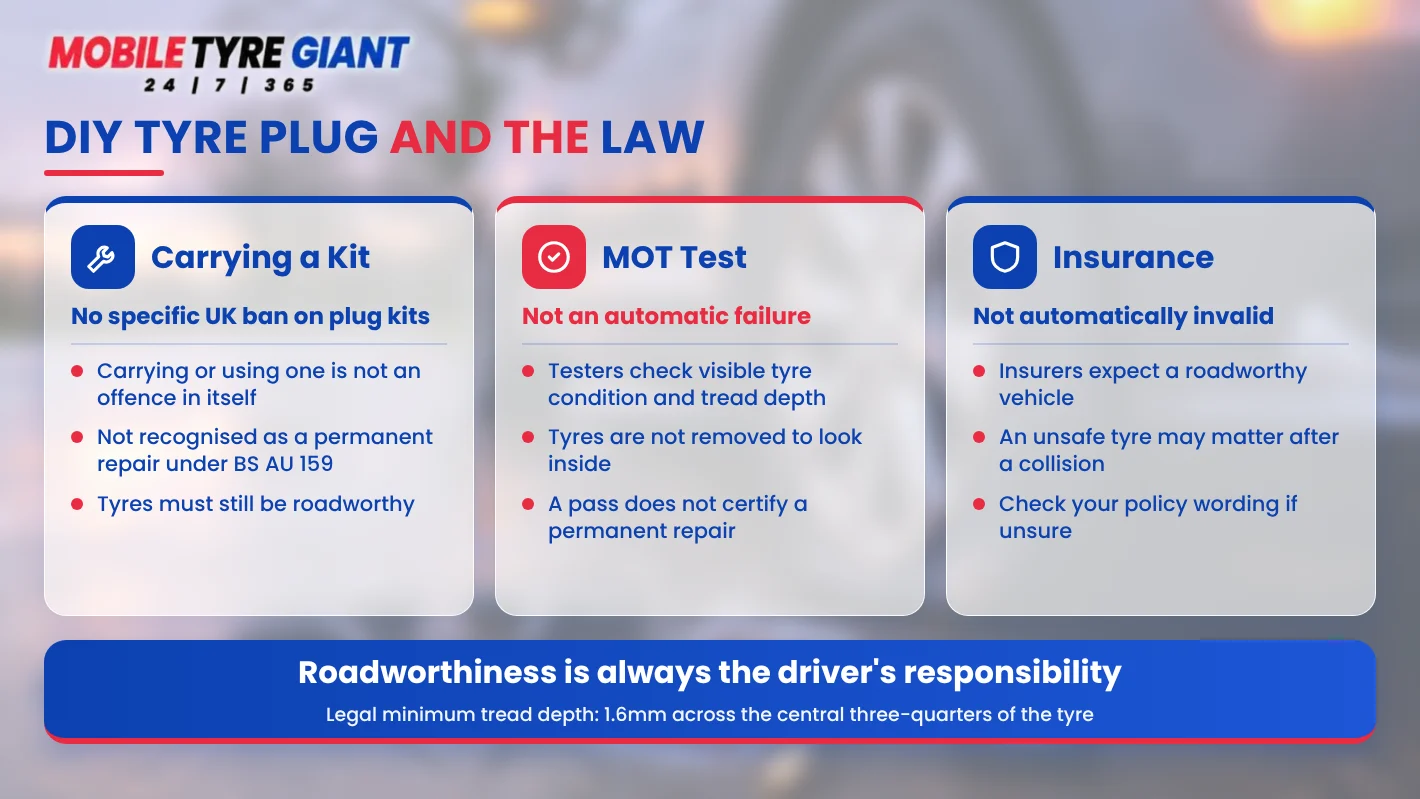
UK law does not specifically prohibit motorists from carrying or using a DIY tyre plug kit. However, using a repair product and having a roadworthy tyre are two different matters. The Road Vehicles (Construction and Use) Regulations 1986 establish requirements concerning tyre suitability, condition and inflation. Drivers remain responsible for ensuring that their vehicle meets these requirements whenever it is used on public roads. An external plug does not remove that responsibility.
A tyre can therefore create a legal problem if its condition makes it unsafe, regardless of how the puncture was treated. The fact that a plug stops visible air loss does not establish compliance with the relevant roadworthiness requirements. Equally, the presence of an external plug does not automatically mean an offence has been committed. The decisive concern is whether the tyre remains suitable and safe for road use. This is general information about UK roadworthiness requirements, not legal advice.
Does UK Law Specifically Ban External Tyre Plug Repairs?
There is no specific UK law that makes possessing or using a string or rope tyre plug kit automatically illegal. However, an externally inserted plug is not recognised as a permanent repair under British Standard BS AU 159. This distinction is important because the British Standard sets out the accepted procedures for professional permanent repairs. Those procedures include removing the tyre from the wheel and examining its internal condition. A temporary roadside measure should not be presented as an equivalent repair.
Imagine a driver discovering a slow puncture while the car is safely parked at home. They may already own a tyre plug kit and assume that using it is automatically permitted for unrestricted driving. However, the absence of a specific ban on the kit does not establish that the resulting tyre is safe. If the tyre has an unresolved dangerous defect, ordinary roadworthiness requirements still apply. Professional assessment is necessary before relying on the tyre for normal service.
Which Tyre Defects Could Make a Vehicle Unroadworthy?
UK tyre regulations prohibit various dangerous conditions, including specified serious cuts, exposed reinforcing cords and structural bulges. A tyre must also be suitable for its intended use and correctly inflated. For most passenger cars and light vans, the legal minimum tread depth is 1.6mm across the central three-quarters of the tread and around the entire circumference. However, a tyre can be unroadworthy even when its tread depth meets that requirement. Damage to its structure or an unsuitable repair can create separate safety concerns.
For example, a driver may plug a small tread puncture and discover that the tyre also has a noticeable sidewall bulge. The external plug would not address the structural defect. The explanation of legal tyre tread depth in the UK helps distinguish minimum tread requirements from wider tyre safety considerations. Police and vehicle enforcement authorities may take action when tyres fail to meet applicable roadworthiness standards. The safest response is to arrange professional assessment rather than continue driving on a tyre with suspected dangerous damage.
Can a DIY Tyre Plug Affect Your MOT Test?
A DIY tyre plug may become relevant during an MOT inspection, particularly if the tyre shows signs of damage or an unsafe repair. However, the presence of a visible external plug is not, by itself, an automatic MOT failure under the published inspection manual. MOT testers assess tyres against specified criteria concerning condition, suitability, tread depth and other visible defects. They do not normally remove tyres from wheels to investigate previous puncture repairs. This limits what the test can establish about damage hidden inside a tyre.
An MOT inspection is also different from a specialist assessment of whether a repair complies with BS AU 159. A tyre may pass the visible MOT checks without having undergone the internal examination required for permanent puncture repair. Conversely, a tyre with dangerous structural damage can fail even if an earlier puncture appears to be sealed. The correct question is whether the tyre meets the applicable test requirements on the day. A valid MOT certificate does not guarantee continued roadworthiness afterwards.
What Do MOT Testers Look for on a Previously Repaired Tyre?
MOT testers examine tyre condition and suitability using the relevant DVSA inspection requirements. They check for defects such as significant cuts, exposed or damaged reinforcing materials, structural bulges and insufficient tread depth. Incorrect fitment or a tyre that is not properly seated on the wheel can also lead to a failure. The condition of the valve and applicable tyre pressure monitoring equipment may also be considered. A previously repaired tyre is assessed against these requirements like any other tyre.
Imagine arriving for an MOT with a tyre that received an external plug several weeks earlier. The tester may not be able to determine whether hidden internal damage exists. However, visible structural deterioration or another listed defect can still result in a failure. The article about whether a puncture repair will pass an MOT explains why repair quality and tyre condition must be considered separately. A test result should never replace proper professional assessment of an external plug.
Does Passing an MOT Prove That a DIY Tyre Plug Is Safe?
Passing an MOT means the vehicle met the relevant test requirements at the time of inspection. It does not certify that an external plug complies with the British Standard for permanent tyre repair. MOT inspections cannot reliably identify every hidden defect inside a mounted tyre. A tyre may therefore pass its MOT despite having an unverified temporary repair. Drivers must still ensure that their tyres remain roadworthy during everyday use.
For example, an externally plugged tyre might show no visible damage when inspected during an MOT. That does not establish whether the puncture affected internal reinforcing materials or whether the repair was completed to BS AU 159. The information about tyre defects that cause MOT failures provides further context about the conditions testers assess. A tyre showing serious damage should be professionally examined even if the vehicle recently passed its MOT. Roadworthiness is an ongoing responsibility rather than something established permanently by one inspection.
Could a DIY Tyre Plug Create Insurance or Liability Problems?
An external tyre plug does not automatically invalidate a motor insurance policy. However, insurers commonly expect vehicles to be maintained in a roadworthy condition. If an accident involves an unsafe tyre or an unsuitable repair, the tyre’s condition may become relevant to an insurance investigation. The insurer may consider the policy wording, circumstances of the incident and available technical evidence. The outcome cannot be predicted solely from whether a DIY plug was used.
Liability concerns can also arise if a driver knowingly continues using a vehicle with a dangerous tyre. An accident investigation may consider whether tyre failure contributed to the incident and whether reasonable precautions were taken. These questions are separate from whether carrying a tyre plug kit is lawful. Anyone concerned about their insurance obligations should check the policy and contact their insurer when necessary. This is general information and not legal or insurance advice.
What Happens if a Plugged Tyre Is Involved in a Collision?
If a plugged tyre is involved in a collision, the tyre’s condition may form part of the investigation. An engineer or other assessor might examine the puncture, repair material and evidence of structural failure. They may also consider whether pressure loss or an unsuitable repair contributed to the accident. The insurer’s response will depend on the policy and the circumstances established by the evidence. It would be misleading to suggest that every accident involving a DIY plug automatically results in a rejected claim.
Imagine a driver losing control after a previously plugged tyre suffers rapid deflation. The investigation may consider whether the temporary repair failed or whether another defect caused the pressure loss. If the condition of the tyre contributed to the incident, questions about maintenance and roadworthiness could arise. However, the presence of a plug alone would not establish the cause of the collision. Accurate maintenance records and professional inspection findings may help clarify what happened.
What Are Your Responsibilities When Carrying Passengers or Lending Your Vehicle?
Carrying passengers does not change the basic requirement to keep a vehicle roadworthy. However, the consequences of a tyre failure can affect everyone travelling inside the vehicle. A driver who knows a tyre has an unresolved temporary repair should not assume that carrying fewer passengers makes the problem acceptable. Vehicle loading must also remain within the applicable limits. Safe tyre condition should be established before the vehicle is used for ordinary journeys.
Imagine lending your car to a family member after using an emergency tyre plug. They may assume the vehicle is fully roadworthy because the tyre appears properly inflated. Failing to explain the temporary repair could leave them unaware of a potential safety concern. The better approach is to arrange professional inspection before allowing the car to return to normal use. Lending the vehicle does not make an unresolved tyre defect less serious.
What Should You Consider Before Selling a Vehicle With a Plugged Tyre?
Selling a vehicle with a known temporary tyre repair raises practical questions about its condition and the information provided to the buyer. The vehicle should not be presented as having a professionally completed permanent repair when only an external plug has been used. Buyers may reasonably expect the vehicle’s tyres to be suitable for road use. If the tyre is unsafe, the issue should be resolved before it returns to normal use. The applicable legal obligations can depend on the circumstances of the sale.
For example, imagine preparing to sell a car that has an externally plugged tyre fitted several months earlier. The tyre may still hold pressure, but its internal condition has never been examined. Rather than describing the puncture as permanently repaired, arrange a professional assessment and disclose the relevant repair history accurately. If the tyre is unsuitable for permanent repair, replacement may be necessary. This helps avoid misleading information and supports safer vehicle ownership.
What Should You Do if You Have Already Used a DIY Tyre Plug?
If you have already inserted a string or rope plug, treat it as a temporary measure rather than proof of a completed repair. Avoid assuming that the tyre is suitable for unrestricted driving simply because the pressure appears stable. Arrange professional inspection as soon as possible to establish whether a permanent repair is permitted. Tell the technician that an external plug has been used and explain the circumstances of the original puncture. The previous repair material and any earlier pressure loss may be relevant to the assessment.
If the tyre is visibly damaged, severely underinflated or otherwise suspected to be unsafe, do not continue driving it. Arrange appropriate assistance from a safe location instead. A professional technician can determine whether the tyre is suitable for repair or requires replacement. Some tyres may also need additional examination because of previous repairs or the vehicle manufacturer’s restrictions. The aim is to restore roadworthiness rather than continue relying on an uncertain temporary seal.
How Soon Should You Arrange Professional Tyre Inspection?
Professional assessment should be arranged as soon as possible after using an external tyre plug. The longer an unverified repair remains in normal service, the longer the driver relies on an uncertain tyre condition. A stable pressure reading is not enough to establish suitability for motorway journeys or other demanding driving. A technician needs to examine the puncture and determine whether the tyre meets the relevant permanent repair requirements. Delaying that assessment offers no safety advantage.
For example, a driver may use a rope plug after discovering a puncture while parked at home. The tyre might remain inflated overnight, making it tempting to continue using the car normally. However, the next step should be professional assessment rather than treating the problem as resolved. Appropriate mobile tyre repair may be available at a safe and accessible location, depending on the tyre’s condition. If the tyre is unsafe to move, arrange suitable assistance or recovery instead of driving it to an appointment.
When Should a Plugged Tyre Be Replaced Rather Than Repaired?
A tyre may require replacement when the puncture falls outside the permitted permanent repair area or the damage exceeds applicable repair limits. Structural deterioration, serious sidewall damage and unsuitable previous repairs can also prevent a permanent repair. Driving with very low pressure may have caused additional internal damage that becomes visible during inspection. The tyre manufacturer may also impose particular repair restrictions based on its construction. A technician must consider all relevant factors before confirming the correct outcome.
Imagine a puncture that appears small from outside but has damaged reinforcing materials beneath the tread. Removing the external plug may reveal that the opening is unsuitable for a standard permanent repair. The tyre may also have been weakened by continued driving after pressure loss. In these circumstances, inserting another plug or applying additional sealant would not restore the required structural condition. Replacement is the appropriate decision when the tyre cannot be confirmed suitable for safe permanent repair.
What Are the Safer Alternatives to Using a DIY Tyre Plug Kit?
When a tyre develops a puncture, the safest response depends on the damage, available equipment and stopping location. A DIY rope plug is not the only option for a driver dealing with sudden pressure loss. Some vehicles carry manufacturer-approved mobility kits, while others have spare wheels or run-flat tyres. Breakdown recovery and professional tyre assistance can also provide alternatives when the vehicle cannot be driven safely. Understanding these options helps drivers avoid relying on an unsuitable temporary repair.
The first consideration should always be whether the vehicle can reach a safe stopping place. An exposed motorway hard shoulder, narrow road or unstable verge may be unsuitable for any tyre work. Even equipment supplied by the vehicle manufacturer should only be used where conditions allow it. Drivers should never continue on a severely damaged tyre simply to reach a preferred repair location. Personal safety and tyre condition must determine the next step.
Is a Manufacturer-Approved Tyre Mobility Kit a Better Option?
A manufacturer-approved tyre mobility kit may provide a suitable temporary solution for certain minor punctures. These kits commonly contain a compressor and liquid sealant intended to reduce air loss until professional assistance becomes available. Unlike an improvised repair, the supplied kit should have instructions relevant to the vehicle and its intended use. However, these products do not provide permanent repairs under BS AU 159. Their purpose is limited mobility rather than restoring the tyre to unrestricted service.
Imagine discovering a small puncture while your vehicle is safely parked in a supermarket car park. The manufacturer’s mobility kit may offer a temporary option if the damage meets its stated conditions. However, sidewall damage, a badly damaged wheel or a tyre that has separated from the rim may make the kit unsuitable. Any specified speed, distance or pressure restrictions must be followed. The tyre still requires professional assessment before returning to normal use.
Should You Use a Spare Wheel or Run-Flat Tyre Instead?
A correctly inflated and compatible spare wheel can provide an alternative to temporarily sealing a punctured tyre. Full-size spares and temporary space-saver wheels have different operating requirements. Space-saver wheels often have specific restrictions involving speed, inflation pressure and vehicle use. The wheel must also be installed using the correct equipment and fastening procedures. Changing a wheel should only be considered when the location is safe for the work.
Run-flat tyres offer another form of limited mobility when the vehicle and tyre are designed for that purpose. However, their permitted operating limits depend on the manufacturer’s instructions and the circumstances of the pressure loss. A run-flat designation does not mean a severely damaged tyre can always be driven. Drivers who discover they have a flat tyre with no spare wheel should check which mobility options their vehicle actually provides. If none is suitable, professional assistance or recovery may be necessary.
When Is Professional Tyre Assistance Safer Than a Roadside Repair?
Professional assistance is often preferable when the tyre’s condition cannot be assessed safely or the vehicle has stopped in a hazardous position. A technician can examine the puncture and determine whether a proper repair is technically possible. Mobile tyre services may attend suitable homes, workplaces and accessible parking locations. However, a technician must have enough safe working space and appropriate equipment. An unsafe roadside position may require vehicle recovery before any tyre work begins.
For example, a driver experiencing a puncture on a busy dual carriageway might be tempted to use a plug kit immediately. Working beside fast-moving vehicles would create risks beyond the original tyre problem. The better response is to follow the applicable breakdown procedure and arrange assistance from a protected location. On motorways, the Highway Code specifically advises against attempting roadside repairs. A safe stopping position matters more than the convenience of any particular repair method.
How Can You Prepare for a Tyre Puncture Before It Happens?
Preparing for a puncture begins with understanding what equipment your vehicle already carries. Some cars have a full-size spare wheel, while others include a temporary spare or mobility kit. Certain vehicles rely on run-flat tyres and pressure monitoring systems instead. Knowing which arrangement applies helps you respond appropriately when a tyre problem occurs. It also prevents confusion when a puncture happens during an unfamiliar journey.
Preparation should include checking the condition of the tyres and the emergency equipment itself. A compressor may no longer work, tyre sealant may have expired or a spare wheel may have lost pressure. A locking wheel nut key can also be misplaced without the driver realising. These problems are easier to resolve before departure than during a breakdown. Regular checks help ensure that the equipment remains appropriate for the vehicle.
What Equipment Should You Keep Ready for a Tyre Emergency?
Useful emergency equipment includes a charged mobile phone, charging cable, torch and high-visibility clothing. If your vehicle carries a spare wheel, make sure the correct wheel-changing equipment and locking wheel nut key are available. Where a manufacturer-approved mobility kit is provided, check its instructions and expiry information. A tyre pressure gauge can also help with routine maintenance when the vehicle is safely parked. These items support preparation but do not make hazardous roadside repairs acceptable.
Imagine preparing for a long journey and discovering that your vehicle’s sealant bottle has expired. Replacing the unsuitable equipment before departure avoids relying on something that may not work when needed. The emergency tyre kit checklist provides a useful reference for reviewing what to carry. Keep equipment secured and accessible without creating loose objects inside the vehicle. Knowing how to contact breakdown assistance is equally important.
Which Routine Tyre Checks Can Reduce Unexpected Puncture Problems?
Regular tyre inspections can help drivers recognise damage before it becomes a more serious problem. Check inflation pressure at least monthly and before long journeys, preferably when the tyres are cold. Look for visible cuts, bulges, embedded objects and uneven tread wear. Check the full tread area rather than concentrating only on the most accessible section. Any repeated pressure loss should be investigated instead of continually corrected through reinflation.
These checks cannot prevent every nail puncture or sudden tyre failure. However, they can reduce the chance of setting off with an existing problem. Avoid driving on tyres that show serious structural damage or are significantly underinflated. If a puncture occurs on a motorway, reach a place of relative safety if possible and follow the Highway Code’s breakdown instructions. Never kneel beside live traffic to use a repair kit, remove a wheel or inspect a puncture.
How Does a Professional Decide Between Repair and Replacement After a Puncture?
A professional repair decision begins with establishing the location and nature of the damage. The technician needs to identify the original penetration and assess the overall condition of the tyre. Previous emergency plugs, sealants and periods of underinflated driving should be disclosed before inspection. These details can affect whether the tyre qualifies for permanent repair. A tyre that holds air is not automatically suitable for continued service.
Under BS AU 159, a permanent repair requires the appropriate inspection and repair procedure. For relevant passenger-car minor punctures, this includes removing the tyre from the wheel and examining it internally and externally. The puncture must fall within the permitted repair area and meet the applicable size and condition requirements. The technician must also consider tyre construction and manufacturer restrictions. The final decision should reflect the actual tyre condition rather than the driver’s preference for a particular outcome.
What Does a Technician Check After a DIY Plug Has Been Used?
The technician first needs to identify where the external plug was inserted and whether the original injury is suitable for assessment. The tyre is removed from the wheel so its internal liner and reinforcing materials can be examined. Any previous plugging material or sealant must be considered during this process. The assessor looks for damage that could have developed before or after the temporary repair. The presence of an external plug does not automatically establish that the tyre can or cannot receive an approved permanent repair.
For example, imagine a driver who used a rope plug after discovering a tread puncture while parked at home. The tyre may still hold pressure when the technician arrives. However, inspection might reveal that the original penetration was larger than it appeared or that the tyre suffered internal damage. In another case, the damage may fall within the permitted repair area and the casing may remain sound. The technician can then decide whether an approved permanent repair is appropriate.
How Do Tread Depth, Tyre Age and Previous Repairs Affect the Decision?
A tyre must be in suitable overall condition before a permanent puncture repair can be considered. Tread depth is relevant because a tyre close to its legal wear limit may have limited remaining usable life. For most passenger cars in the UK, the legal minimum is 1.6mm across the central three-quarters of the tread and around its entire circumference. However, meeting that minimum does not automatically make a damaged tyre repairable. Structural condition and the specific repair requirements remain essential.
Tyre age also deserves attention, particularly when cracking, hardening or other signs of deterioration are present. There is no single age limit that automatically determines the repairability of every passenger-car tyre. The tyre’s physical condition and manufacturer guidance should inform the decision. Previous repairs must also be examined because their location and condition can affect whether another repair is permissible. Repair materials must not overlap in a way that breaches the applicable standard.
When Is Replacing a Punctured Tyre the Safer Decision?
Replacement is generally necessary when a tyre has damage that cannot be repaired to the applicable safety standard. This can include prohibited puncture locations, serious internal damage, exposed reinforcement or structural deterioration. The technician may also identify damage caused by driving while the tyre was severely underinflated. Significant bead damage or an unsuitable previous repair can prevent the tyre from returning to service. In these circumstances, inserting another plug or adding sealant does not resolve the underlying problem.
Imagine a tyre with a small central puncture but extensive internal deterioration caused by continued driving after pressure loss. The original hole might appear repairable, yet the complete tyre is no longer suitable. Understanding how professionals choose between tyre repair and replacement helps explain why internal inspection can change the recommendation. A correctly repaired tyre must meet the relevant requirements, while a tyre that cannot satisfy them should be replaced. The safest decision is based on evidence of roadworthiness rather than whether an emergency plug temporarily stopped the leak.
Final Words: Choose Proper Tyre Repairs Over Temporary Fixes
DIY tyre plug kits may appear convenient when a puncture interrupts a journey, but temporarily stopping air loss is not the same as restoring a tyre’s safety. External plugs do not meet the requirements for permanent repair under BS AU 159, and they cannot establish whether hidden damage remains. Drivers should understand the limitations of their emergency equipment and avoid working in unsafe roadside conditions. UK roadworthiness responsibilities continue to apply regardless of the repair product used.
The safest approach is to prepare before travelling, stop in a suitable location when a puncture occurs and arrange professional assessment. A qualified technician can determine whether the tyre meets the requirements for permanent repair or must be replaced. Tyre condition, puncture position, previous repairs and manufacturer guidance should inform that decision. This is general information rather than legal advice, and safe tyre operation must always take priority over convenience.
Punctured Tyre? Get Safe Professional Help
Share your location and tyre details, and we will confirm the safest professional repair or replacement for your tyre.
Frequently Asked Questions
Find quick answers to the most common questions our customers ask.
There is no specific UK law banning the possession or use of DIY tyre plug kits. However, drivers must ensure their tyres remain roadworthy and comply with applicable regulations.
No. An externally inserted rope plug is not recognised as a permanent repair under BS AU 159. Professional internal inspection and approved repair procedures are required.
A temporary plug does not prove that a tyre is safe for normal driving. Follow applicable product instructions and arrange professional assessment as soon as possible.
An external plug is not automatically an MOT failure. Testers assess tyre condition against the inspection criteria, but a pass does not certify the repair as permanent.
No. Conventional minor puncture repair methods are not approved for sidewall penetrations. Structural sidewall damage generally requires tyre replacement.
Run-flat repair eligibility depends on the tyre manufacturer's instructions and its condition. An external plug should not be assumed suitable or equivalent to an approved permanent repair.
No. Emergency tyre sealant is intended to provide temporary mobility in suitable circumstances. Professional assessment is still needed before normal use resumes.
An external plug does not automatically invalidate insurance. However, an unsafe tyre may become relevant to a claim depending on the circumstances and policy terms.
Possibly, if inspection confirms that the tyre meets the relevant permanent repair requirements. Previous plugging material and any internal damage must be assessed.
A manufacturer-approved mobility kit or suitable spare may provide an appropriate temporary option. Professional tyre assessment, repair or replacement is preferable before returning to normal driving.