

Finding a nail in a tyre can turn an ordinary morning into a stressful one. You may notice it while checking the car, after seeing a tyre pressure warning, or when one corner of the vehicle suddenly looks lower than the others. Your first instinct might be to grab a pair of pliers and pull the nail out, but that can make the situation worse. The object may be partially restricting the escape of air, almost like a finger held over a small hole in a bottle. Removing it without a plan can turn a slow leak into a tyre that deflates within minutes. For now, leave the nail where it is, check the tyre pressure and look for visible damage. This is only a temporary precaution, not permission to ignore the puncture. The tyre still needs to be assessed before you return to normal driving.
A nail in a tyre does not automatically mean you need to buy a replacement. Many small punctures in the central tread area can be repaired when the tyre is otherwise healthy and has not been driven while badly underinflated. However, a puncture near the shoulder or sidewall is a different situation because these areas bend and flex every time the wheel turns. The visible nail head also tells you very little about what has happened inside the tyre. The object may have entered at an angle, damaged the inner liner or affected the casing beneath the rubber. That is why repairability cannot be confirmed from a photograph alone. A professional inspection is needed to decide whether the safe outcome is repair or replacement. The most important thing at this stage is to avoid making a repairable problem more expensive through panic or unnecessary driving.
Found a Nail in Your Tyre? Do These Things First
Start by leaving the vehicle parked in a safe position and switching on the hazard lights if you are beside a road. Do not kneel close to moving traffic simply to get a better photograph of the tyre. Look at the tyre from a safe angle and check whether it appears flat, distorted or separated from the wheel rim. If you have a pressure gauge, compare the reading with the recommended pressure for your vehicle. You can usually find that information inside the driver’s door frame, in the owner’s manual or near the fuel filler flap. A tyre can look reasonably normal while already being seriously underinflated, particularly on vehicles with low-profile or reinforced tyres. Listen for a faint hissing sound, but do not place your face close to the nail. Also check whether the dashboard is showing a tyre pressure monitoring system warning.
Your next action should depend on what you find rather than how close the nearest garage is. A tyre that is completely flat, rapidly losing air or showing a sidewall bulge should not be driven normally. If the pressure appears stable and the nail is in the central tread, repair may be possible, but it still needs prompt assessment. Do not keep topping up the tyre each morning and treating that as a solution. Repeatedly driving with low pressure creates heat inside the tyre and can damage its internal structure. You can review the website’s guide to tyre pressure and safety checks for other warning signs worth checking. The goal is not to diagnose the tyre yourself. It is to recognise whether the vehicle should remain stationary and give a technician accurate information.
What you notice | What to do immediately | Likely next step |
Nail in central tread and pressure appears stable | Leave the nail in and arrange inspection | Repair may be possible |
Tyre is losing pressure slowly | Avoid unnecessary driving | Internal inspection required |
Nail is close to the shoulder | Keep the journey to an absolute minimum | Replacement is more likely |
Nail is in the sidewall | Do not attempt a normal puncture repair | Replacement normally required |
Tyre is completely flat | Stop driving | Mobile assistance or spare wheel |
Bulge, split or exposed cords are visible | Do not move the vehicle normally | Urgent replacement assessment |
Do Not Pull the Nail Out Yet
Pulling the nail out may feel like the obvious solution because the object looks like the cause of the problem. In reality, it can be acting as an imperfect plug and slowing the escape of air. Once removed, the hole may open fully and the remaining pressure can disappear quickly. This is especially inconvenient when the car is parked somewhere safe and could have been inspected without moving it. Do not twist the nail, push it deeper or try to test whether it has reached the inside of the tyre. Even a short screw can move when the wheel rotates and gradually enlarge the damage. Marking the area with chalk or taking a clear photograph is more useful than touching it. A technician can remove the object in controlled conditions and inspect the path it created.
Leaving the nail in does not make the tyre safe to use indefinitely. It simply prevents you from potentially accelerating the leak before help is arranged. Think of it like leaving a splinter in place until you have the right tools and a clean environment to remove it. You would not ignore the injury, but you also would not dig at it carelessly beside the road. The same principle applies here. The tyre may continue losing pressure even with the nail still embedded, so check it rather than assuming it is sealed. If you can hear air escaping or see the tyre dropping, move away from it and arrange assistance. Do not use pliers, a screwdriver or a DIY repair kit unless you are following an emergency procedure approved for your vehicle. A proper repair decision should come after the tyre has been examined internally.
Check the Tyre Pressure and TPMS Warning
Tyre pressure is one of the clearest indicators of how urgent the problem has become. Use a reliable gauge if one is available, because judging pressure by pressing the sidewall with your hand is inaccurate. A modern tyre can feel firm while being several pounds per square inch below its recommended level. If the reading is much lower than the vehicle manufacturer’s figure, the tyre may already have been flexing excessively. Low pressure causes the sidewall to bend more than it should, creating heat and friction inside the casing. That hidden damage can make a small tread puncture unsuitable for repair. Check the pressure again after a short period while the car remains parked. A noticeable drop confirms that the leak is active.
A TPMS warning should not be dismissed simply because the tyre still looks round. The system is designed to alert you when pressure falls significantly, but it does not identify the cause or confirm that the tyre is safe. Temperature changes can affect readings, yet a visible nail gives you a strong reason to investigate rather than reset the warning light. Do not repeatedly inflate the tyre and continue commuting without arranging an inspection. That habit can hide a worsening leak and increase the chance of wheel or sidewall damage. If sealant has already been used, tell the technician before any work begins. Some products can affect the internal inspection process and may need to be cleaned out. Record the pressure reading and the time you checked it, as this helps show how quickly air is escaping.
Can You Drive With a Nail in Your Tyre?
There is no universal yes or no answer because the risk depends on the tyre’s pressure, the location of the nail and whether structural damage is present. A nail in the central tread of a tyre that is holding pressure is different from a screw embedded in the sidewall of a tyre that is already sagging. However, “still inflated” should never be translated as “safe for a normal journey.” The nail can move as the tyre rotates, making the puncture wider or changing the rate of air loss. Driving also loads the sidewall and generates heat, particularly at higher speeds. If the tyre is flat, visibly deformed or affecting steering, do not continue. The guide on driving with a flat tyre explains how quickly wheel and tyre damage can develop.
Motorway driving presents a greater risk because heat, speed and vehicle load are all higher. A tyre that loses pressure gradually around town may deteriorate much faster during sustained high-speed driving. Stop safely if the steering starts pulling, the car begins vibrating or you hear a rhythmic thumping sound. These symptoms can indicate that the tyre is no longer supporting the vehicle correctly. Do not rely on hazard lights as permission to continue for several miles. If you are in a dangerous roadside position, prioritise personal safety and move behind a barrier where possible. The flat tyre emergency guide provides further steps for dealing with a vehicle that cannot be moved safely. When in doubt, arranging mobile assistance is safer than trying to reach a workshop on a damaged tyre.
How Far Can You Drive With a Nail in the Tyre?
No responsible technician can give every driver the same safe mileage. One tyre may hold pressure while parked but begin leaking rapidly as soon as the nail flexes during movement. Another may have already suffered internal damage even though the outside still looks normal. Distance is therefore the wrong measurement to focus on. Pressure stability, puncture position, visible condition and vehicle handling matter far more. A five-mile journey at motorway speed can be more damaging than a very short movement inside a safe car park. Vehicle weight and load also change the level of stress placed on the tyre. This is why online claims that you can safely drive a fixed number of miles should be treated cautiously.
If the tyre is completely flat, do not attempt to drive to a garage. If pressure is falling quickly, arrange help before the vehicle becomes stranded in a less safe location. A tyre holding pressure may still need to remain parked until it can be assessed. The purpose of leaving the nail in is to buy time for inspection, not to extend your normal driving routine. When a vehicle must be moved out of immediate danger, the decision should be based on the surroundings and the manufacturer’s emergency guidance. Never continue simply because the tyre has not yet triggered another warning. A nail in a tyre can remain quiet for a while and then begin leaking without much notice. The safest next step is to identify the damage early, protect the tyre from further harm and arrange a professional repairability check.
When Can a Nail in a Tyre Be Repaired?
A nail in a tyre may be repairable when the puncture is small, sits within the approved central tread area and has not damaged the tyre internally. The central tread is the thick, grooved section that makes direct contact with the road. It is built differently from the shoulder and sidewall, which flex far more as the wheel rotates. However, seeing the nail in the middle of the tread does not guarantee that a repair will be approved. The object may have entered at an angle and travelled towards the shoulder beneath the visible rubber. Its shaft may also be wider than the head suggests, creating a larger puncture channel than expected. A technician therefore needs to remove the tyre from the wheel and inspect both sides of the damage. The tyre’s remaining tread, age, previous repairs and general condition also affect the decision. An otherwise healthy tyre with a clean, minor tread puncture has the strongest chance of being saved.
The tyre must also have remained properly supported after the puncture occurred. Driving while the pressure is very low can make the sidewall fold and rub against itself with every rotation. That repeated movement creates heat inside the casing, similar to bending a piece of wire until it becomes warm and weak. The outside may still look acceptable even when the inner liner has been scuffed or the supporting cords have been damaged. This is why reinflating a tyre does not erase the effects of driving on it while underinflated. A suitable puncture can often receive a professional internal repair once the tyre has passed the complete inspection. Mobile Tyre Giant’s professional mobile tyre repair service can assess suitable punctures at the vehicle’s location. The technician should explain what was found rather than simply saying that the tyre passed or failed. That transparency helps the driver understand whether repair is genuinely safe and worthwhile.
The Nail Must Be Within the Approved Tread Repair Area
The position of the nail is one of the first things a technician checks. A puncture close to the centre of the tread is generally more suitable for assessment than one near the outer edge. This is because the tread crown remains relatively stable as the tyre rolls across the road. The shoulder acts as a transition between the flat tread and the flexible sidewall, so it experiences greater movement and stress. A repair placed too close to this transition may not remain secure as the tyre heats, bends and carries the vehicle’s weight. Drivers often feel frustrated when a tiny nail is rejected because it appears only a short distance from the repairable zone. From the outside, the difference can look no wider than a fingertip. Structurally, however, those few centimetres can completely change how the damaged area behaves. The decision must therefore be based on the approved repair limits, not on how harmless the nail looks.
A photograph can help a technician estimate whether the puncture is central, borderline or clearly within the sidewall. It cannot show the full direction of the object beneath the tread. Imagine pushing a pin diagonally through a thick sponge while looking only at the entry point. The mark on top may be central even though the pin exits much closer to the edge underneath. A nail can create the same misleading impression inside a tyre. The technician must check the internal exit point, the surrounding rubber and any affected cords. If the puncture remains entirely within the permitted area and no secondary damage is present, repair may be possible. If it travels towards the shoulder, replacement may be the responsible recommendation. This is not an arbitrary sales decision when the fitter can clearly show and explain the damage.
The Puncture Must Be Small and Clean Enough to Repair
The size of the puncture also matters, although the visible nail does not always reveal the true diameter of the damage. Many standard car tyre repairs are limited to relatively small penetrations, commonly around 6mm or less. That figure should not be treated as an automatic approval line. A narrow nail can tear the rubber as it moves, while a screw may create an irregular channel through the tread. The object may also have damaged the steel belts or supporting cords beneath the surface. Multiple holes close together can weaken a larger section even when each individual puncture looks small. A technician needs to examine the shape, direction and surrounding material after the object is removed. A clean, straight puncture is generally easier to repair correctly than a jagged or angled injury. The condition of the repair area matters just as much as the measurement itself.
Drivers sometimes assume that pushing an external plug into the hole solves every small puncture. It may stop the hissing sound, but silence does not confirm that the tyre is structurally safe. An external plug cannot reveal damage on the inside, and it does not allow the inner liner to be properly examined. A professional combination repair is completed from inside the tyre after repairability has been confirmed. It seals the inner liner while also filling the puncture channel, rather than covering only the visible opening. The repair must sit securely without interfering with another repair or damaged section. The tyre is then reinflated and checked for continuing pressure loss. Where required, the wheel should also be balanced before being returned to service. This process takes more care than the quick roadside repairs often shown in short social media videos.
When Does a Nail Mean the Tyre Must Be Replaced?
Replacement becomes necessary when the puncture affects an area that cannot support a safe standard repair. A nail in the sidewall is one of the clearest examples because the sidewall bends continuously while supporting the vehicle. The shoulder is also commonly outside the approved repair area because it experiences a mixture of tread pressure and sidewall flex. Large, torn or irregular punctures may damage too much material for a minor repair. Replacement may also be required when the tyre has been driven flat, developed a bulge or exposed its internal cords. Existing cracking, serious uneven wear or bead damage can make repair unreasonable even when the nail itself is small. Previous repairs may also limit where another repair can safely be placed. The technician must evaluate the complete tyre rather than focusing only on the newest puncture. A repair should never be used to extend the life of a tyre that is already structurally questionable.
The financial decision should also consider how much useful life remains in the tyre. Repairing a healthy premium tyre with substantial tread can make excellent sense. Paying for a repair on a tyre that is nearly worn out may simply delay an unavoidable replacement by a short time. The website’s guide to signs that a tyre needs replacing can help drivers understand the wider condition checks. If repair is not safe, mobile tyre replacement allows the damaged tyre to be changed without driving the vehicle to a garage. The replacement must match the vehicle’s required size, load index and speed rating. Tyres on the same axle should also remain compatible in type and condition. A trustworthy technician should explain which defect ruled out repair and show it where possible. That explanation protects the driver from both an unsafe repair and an unnecessary purchase.
Sidewall, Shoulder and Internal Damage Require Extra Caution
A sidewall puncture normally means replacement because this area cannot be treated like the thicker central tread. The sidewall repeatedly compresses and stretches as the tyre enters and leaves the road contact area. A plug placed there would be pulled and flexed thousands of times during even a short journey. Damage can also affect the cords that give the sidewall its shape and strength. Once those cords are cut or weakened, simply sealing the air leak does not restore the original structure. A bulge is a particularly serious sign because it can indicate that the internal reinforcement has separated or failed. The tyre may still hold pressure while the damaged area continues to weaken. Driving on it would be like relying on a cracked chair because it has not collapsed yet. The absence of immediate failure is not evidence of safety.
Internal damage caused by underinflation can be equally serious but harder to see. When the tyre carries the vehicle with too little air, the sidewall bends much further than designed. The inner surfaces can rub, overheat and leave dark rings or loose rubber inside the casing. By the time the driver notices a burning smell, vibration or heavy steering, the damage may already be extensive. Reintroducing air can make the tyre look normal again, which is why outside appearance can be deceptive. A technician may reject the repair after removing the tyre even though the nail sits in an otherwise suitable tread position. That recommendation can feel disappointing, especially when the tyre is relatively new. However, repairing the hole would not reverse damage already caused by running underinflated. Replacement is the safer outcome when the tyre can no longer be trusted to carry its intended load.
How Is a Nail Puncture Professionally Inspected?
A professional inspection begins by removing the wheel and separating the tyre from the rim. This matters because the visible nail head shows only where the object entered, not what happened inside the casing. A nail that appears straight from the outside may have travelled diagonally through the tread and damaged a wider internal area. Once the tyre is removed, the technician can inspect the inner liner for cuts, scuffing, loose rubber and signs of overheating. They will also check whether the tyre has been driven with very low pressure, which can leave a dark wear ring around the inside. The puncture channel is then measured to confirm its size and position within the permitted repair area. Tread depth, existing repairs, cracking and uneven wear are assessed at the same time. This complete inspection prevents a quick external fix from hiding a tyre that is no longer structurally sound. It also gives the driver a clear reason when repair is approved or refused.
A trustworthy technician should be willing to explain what they found in simple language. Drivers often feel suspicious when a small nail leads to a replacement recommendation, particularly when the tyre is new or expensive. One concern repeatedly shared in motoring forums is, “The hole looks tiny, so why can’t it be patched?” The answer is that the visible hole is only one part of the decision. The internal exit point may sit closer to the shoulder, or the tyre may show damage caused by previous low-pressure driving. A good fitter can point out the affected area rather than relying on a vague statement about company policy. If the tyre passes inspection, an approved repair can be completed before it is refitted. If it fails, replacement protects the driver from relying on a weakened structure that merely happens to hold air at that moment.
What Happens During a Proper Puncture Repair?
When the puncture is suitable, the damaged area is prepared from inside the tyre. The technician cleans and carefully shapes the repair surface so the new material can bond correctly. An approved combination repair is often used to seal both the inner liner and the puncture channel. This is different from pushing a strip of rubber into the hole from outside and hoping the air stays in. The internal repair creates a proper seal against pressure while the stem fills the path left by the nail. The surrounding area is checked again to make sure no hidden damage was missed during preparation. The repair must also sit far enough from the shoulder, previous repairs and other damaged areas. Once complete, the tyre is refitted to the wheel and inflated to the correct pressure. A leak test confirms whether the repaired area is holding air properly.
The wheel may then need balancing before it goes back onto the vehicle. Removing and refitting a tyre can change how the wheel and tyre assembly distributes weight as it rotates. Even a small imbalance can produce vibration through the steering wheel or seat, particularly at higher speeds. Mobile Tyre Giant’s mobile wheel balancing service explains how balancing helps the wheel rotate smoothly after tyre work. The wheel nuts should also be tightened correctly, and the pressure should be checked again before the vehicle is returned to use. The driver may be advised to monitor the tyre over the following days for any unexpected pressure loss. A proper repair should not require constant reinflation or repeated visits. If the pressure continues dropping, the tyre, valve and wheel should be checked for another leak rather than assuming the repaired puncture has failed.
Tyre Plug, Patch or Sealant: What Is the Difference?
An external tyre plug is usually inserted through the tread without removing the tyre from the wheel. It can stop or slow a leak, which is why plug kits are popular in roadside videos and online discussions. The process looks quick, clean and satisfying, especially when bubbles disappear during a soapy-water test. However, stopping the visible leak does not prove that the inside of the tyre is undamaged. The plug also does not allow the technician to inspect the casing, inner liner or puncture direction. For this reason, an external plug should not automatically be treated as a complete permanent repair. It may help in a limited emergency when used according to the kit and vehicle instructions. The tyre should still be professionally examined as soon as possible. A convenient temporary fix becomes dangerous when it encourages the driver to ignore hidden damage.
A patch is applied to the inside of the tyre, while a combination plug-patch seals both the internal liner and the puncture channel. This combination approach provides a more complete repair when the damage meets the required criteria. Liquid sealant works differently by spreading inside the tyre and collecting around the leak as the wheel rotates. It is mainly designed to provide temporary mobility, not to restore the tyre permanently. Sealant may also have speed, distance and puncture-size limitations that vary by product. If you have used it, tell the fitter before the tyre is removed because the inside may need additional cleaning. The technician should also check whether the sealant has affected the valve or tyre pressure sensor. Do not combine several temporary methods in an attempt to keep an unsafe tyre on the road. The safest repair is the one chosen after the tyre’s real condition has been examined.
Can Run-Flat Tyres With a Nail Be Repaired?
Run-flat tyres are designed to support the vehicle for a limited period after pressure is lost, but that does not make every punctured run-flat repairable. Their reinforced sidewalls can keep the tyre looking reasonably normal even after it has been driven with little or no air. This creates a difficult inspection problem because the driver may not know exactly when the pressure dropped. The tyre may have travelled far enough to generate damaging heat and stress before the warning was noticed. Manufacturer policies also differ, with some allowing limited repairs after inspection and others placing stricter restrictions on specific tyre models. A fitter therefore needs to check the tyre markings, internal condition and vehicle requirements. The visible nail position alone cannot answer the question. Mobile Tyre Giant’s guide to run-flat tyres and normal tyres explains the key construction and driving differences. That background helps drivers understand why run-flat repair decisions are not identical to those for ordinary tyres.
Drivers sometimes assume that the reinforced sidewall protects the tyre from all damage. In reality, run-flat capability is an emergency feature with defined limits, not permission to continue a normal journey indefinitely. The more distance covered without proper pressure, the harder it becomes to confirm that the tyre remains safe. A technician may recommend replacement even when the puncture sits in the central tread because the history of zero-pressure driving is uncertain. That recommendation can feel wasteful, particularly when the tyre has plenty of tread remaining. However, the repair decision must account for the entire structure, not only the hole created by the nail. The vehicle’s handbook and tyre manufacturer requirements should also be considered. If replacement is needed, the new tyre must match the correct specification for the vehicle and axle. Using the wrong type can affect handling, warning systems and the intended run-flat capability.
What About EV, Acoustic and Self-Sealing Tyres?
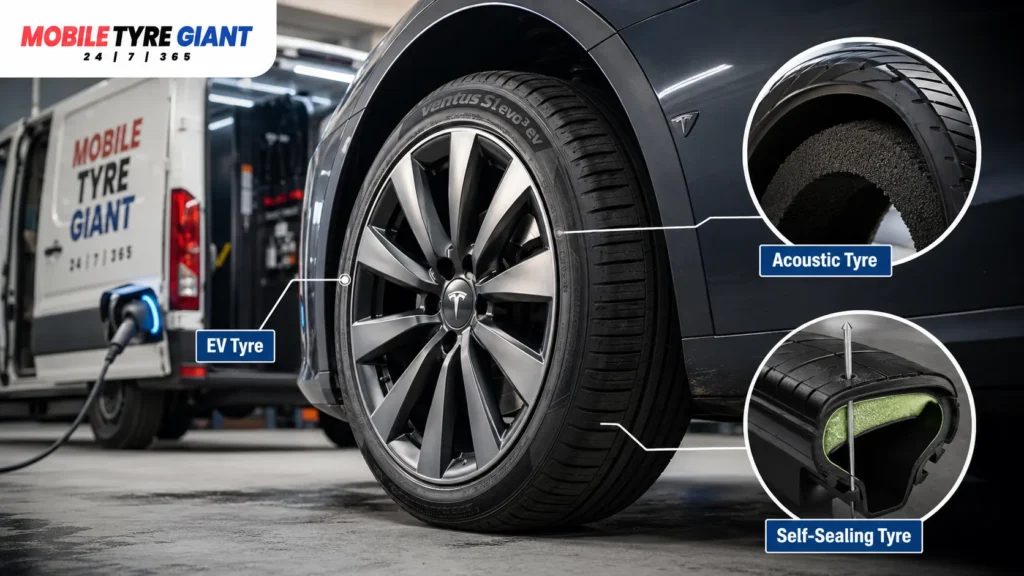
Electric vehicle tyres can often be assessed using the same basic repair principles as other car tyres. The puncture location, size and internal condition still determine whether a nail in a tyre can be repaired safely. However, EVs are often heavier because of their battery packs, which can place greater loads on the tyres. Many use reinforced or extra-load tyres with specific load indexes and construction requirements. Some models also use tyres designed to reduce rolling resistance or handle immediate electric-motor torque. If replacement becomes necessary, fitting the correct specification is essential rather than simply choosing a tyre with matching dimensions. The speed rating, load index and manufacturer approval may all matter. Drivers can use the correct tyre size guide to locate the sidewall markings a fitter needs. Sending a clear picture of those markings helps prevent delays or an unsuitable tyre being brought to the vehicle.
Acoustic tyres contain a layer of sound-absorbing foam attached to the inner surface to reduce road noise inside the cabin. That foam can make puncture inspection and repair more involved because it may cover the area around the damage. A technician may need to move or carefully remove part of the material before examining the inner liner. Self-sealing tyres contain a sealing layer intended to close around certain small punctures automatically. Even when pressure remains stable, the tyre should still be checked because the object may continue moving within the tread. Neither acoustic foam nor self-sealing material guarantees that every nail puncture is harmless. The tyre’s construction and the vehicle manufacturer’s instructions must guide the final decision. A fitter should explain whether the special internal layer can be restored after repair. When replacement is required, matching the original tyre type helps preserve the vehicle’s noise, handling and load-carrying characteristics.
Is It Better Value to Repair or Replace the Tyre?
Repairing a nail puncture usually makes the most financial sense when the tyre is relatively new, has healthy tread and passes a complete internal inspection. A small puncture in the approved central tread area can sometimes be repaired without sacrificing the remaining useful life of the tyre. This is particularly valuable when the damaged tyre is a premium, run-flat or specialist model that would be expensive to replace unnecessarily. However, the cheapest immediate option is not automatically the best long-term choice. A tyre approaching the end of its usable life may technically qualify for repair but provide little value afterwards. Cracking, uneven wear, previous repairs and low remaining tread should all influence the decision. Think of it like repairing an old pair of shoes with a worn-out sole. Fixing one small hole makes little sense if the rest of the structure is already close to replacement. A good technician should therefore assess the complete tyre rather than focusing only on the nail. The goal is to protect both safety and the money you spend.
Replacement becomes better value when the tyre has structural damage, very limited tread life or a puncture outside the approved repair area. Continuing to spend money on temporary fixes can become more expensive than replacing the tyre once and solving the underlying problem properly. This is especially true when the tyre has repeatedly lost pressure or already contains previous repairs. The replacement must also match the vehicle’s required dimensions, load capacity and speed rating rather than simply fitting the wheel. Drivers sometimes focus only on finding the cheapest available tyre after a puncture, but compatibility matters for handling, braking and predictable grip. If the damaged tyre cannot be repaired, a mobile tyre fitting service can replace it at the vehicle’s location without requiring an unnecessary journey on a compromised tyre. Ask what tyre will be supplied before the technician attends so there are no surprises. Confirm the brand, size and specification where possible. A transparent recommendation should always explain why repair is unsuitable and why the proposed replacement fits the vehicle correctly. That approach turns an unexpected puncture into a clear decision rather than a pressured purchase.
Do You Need to Replace One Tyre or Two?
Finding out that one tyre needs replacing often creates another uncomfortable question about the tyre on the opposite side of the axle. You do not automatically need to replace two tyres simply because one has a nail in it. The answer depends on the condition of the remaining tyre, how much tread it has left and whether both tyres will remain compatible after replacement. If the opposite tyre is still relatively new, fitting one correctly matched replacement may be reasonable. A large difference in tread depth can affect how the tyres behave under braking and in wet conditions. The tyre model, construction, load index and speed rating should also be considered. This becomes particularly important on performance vehicles and cars that rely heavily on electronic traction systems. A technician should compare the tyres rather than applying a blanket rule. Replacing two good tyres when only one is required creates unnecessary expense. Equally, replacing only one when the other is heavily worn may create another problem shortly afterwards.
Four-wheel-drive and all-wheel-drive vehicles can require additional care because their drivetrains may be sensitive to differences in tyre rolling circumference. Even tyres marked with the same nominal size can have different effective diameters when one is new and another is substantially worn. The vehicle manufacturer may specify acceptable tread differences between tyres or axles. That guidance should take priority over a generic rule found online. If two tyres do need replacing, tyre manufacturers commonly recommend keeping the pair with the deeper tread where it provides the most stable handling characteristics. The correct arrangement can vary with the vehicle, so the handbook and manufacturer specification matter. Do not assume that buying the same brand automatically solves every compatibility issue. Check the exact tyre model and sidewall markings as well. When booking, tell the fitter if the vehicle uses all-wheel drive or has different tyre sizes on the front and rear. That small detail can prevent the wrong replacement from being selected. The best decision is based on the entire axle and drivetrain, not only the damaged tyre.
What Information Should You Send a Mobile Tyre Fitter?
Providing accurate information before the technician travels can make the difference between a quick solution and a wasted visit. Start with your exact location, including a postcode, road name or recognisable landmark if the vehicle is stranded somewhere unfamiliar. Send the vehicle registration so the fitter can identify the model and likely tyre specification. The tyre size printed on the sidewall is even more useful because vehicles can sometimes be fitted with different wheel options from the factory. A clear photograph of the complete sidewall allows the technician to read the size, load index, speed rating and any run-flat markings. Take another photograph showing the nail in relation to the full tread so its approximate position can be understood. A close-up alone can be misleading because it removes the shoulder and sidewall from view. Tell the fitter whether the tyre is completely flat, slowly losing pressure or still holding pressure normally. Mention any TPMS warning and whether you have already added air. These details help the technician arrive prepared for either inspection, repair or replacement rather than guessing from a single photograph.
Also mention whether emergency sealant or a temporary plug has already been used. This matters because the inside of the tyre may need additional cleaning and inspection before a permanent repair can be considered. If the vehicle has locking wheel nuts, check that the locking wheel nut key is available before the technician arrives. Missing keys can delay otherwise straightforward tyre work, particularly when the wheel needs to be removed for replacement. Tell the fitter about any visible sidewall bulge, split, wheel damage or unusual vibration you noticed before stopping. Do not hide the fact that the tyre was driven while flat because that information can change the repair decision. If you are unsure whether Mobile Tyre Giant covers your location, check the service areas before arranging attendance. Giving the technician accurate information does not guarantee that a puncture can be repaired, but it improves preparation and reduces unnecessary delays. It can also allow a suitable replacement tyre to be sourced in advance if the photographs strongly suggest that repair is unlikely. The more useful information you provide at the start, the easier it is to turn an inconvenient puncture into a straightforward service visit.
What Happens If the Nail Puncture Cannot Be Repaired?
Being told that a tyre cannot be repaired is frustrating, particularly when the nail looks tiny from the outside. The important question is not how large the nail head appears but why the tyre failed the repair assessment. Ask the technician to explain whether the problem is the puncture position, internal damage, excessive size, previous repair, worn tread or structural condition. A genuine replacement recommendation should have a reason that can be described clearly. If the puncture has reached the shoulder or sidewall, a normal minor repair cannot simply recreate the strength of the original structure. The same applies when the tyre has been driven flat and internal abrasion or heat damage has developed. Installing a patch over the visible hole would not reverse damage elsewhere in the casing. This is why professional inspection matters more than a photograph or online opinion. A replacement may cost more than a repair, but an unsafe repair is not genuine savings. The correct objective is to restore the vehicle to a condition you can rely on.
Once replacement is required, the technician should identify the correct tyre specification before removing the damaged one permanently. Matching the size is essential, but load index, speed rating and tyre type can also matter. Run-flat, reinforced, acoustic and vehicle-specific tyres should not be replaced casually with something that merely looks similar. Check the opposite tyre on the axle as well, especially if it is heavily worn or a different model. The wheel itself should be examined if the vehicle was driven while completely flat because the rim may have contacted the road surface. After fitting, the replacement should be inflated correctly and checked for a secure seal around the rim and valve. The wheel should rotate smoothly without vibration once the vehicle returns to normal speed. Keep an eye on the pressure over the following days, particularly if a TPMS warning originally alerted you to the problem. If the warning returns, another leak or sensor issue may need investigation. Replacement should solve the damaged tyre problem, not simply remove the visible nail.
Final Words: Leave the Nail In for Now, Not Forever
A nail in a tyre does not automatically mean an expensive replacement, but it should never be ignored. The safest first move is usually to leave the nail in place, check the pressure and avoid unnecessary driving until the tyre has been assessed. Pulling the object out yourself can transform a slow puncture into rapid air loss. A small nail in the central tread may be repairable when the tyre remains internally sound and has not been damaged by underinflation. Punctures in the shoulder or sidewall are much more likely to require replacement. The same is true when the tyre has been driven flat, developed a bulge or suffered internal casing damage. A photograph can help identify the general location, but it cannot show everything happening beneath the rubber. That is why the final repair or replacement decision should follow an internal professional inspection. Acting early also gives you the best chance of saving a tyre that could otherwise be damaged through continued driving. A simple puncture is much easier to deal with before it becomes a flat tyre at the roadside.
The best approach is neither panic nor complacency. Check what you can safely observe, record the pressure and give the technician clear information about what happened. Do not rely on a fixed online mileage telling you how far a punctured tyre can be driven. Pressure loss, tyre construction, road speed and damage location vary too much for one number to be safe for every driver. If the tyre is flat, rapidly deflating or affecting vehicle control, stop and arrange assistance. If it remains inflated, that is useful information but not proof that the tyre is undamaged. A professional inspection can tell you whether an approved repair will safely preserve the remaining tyre life or whether replacement is the responsible choice. The most important distinction is simple: leave the nail in temporarily, not indefinitely. Deal with the puncture while the vehicle is still somewhere safe. That small decision can prevent additional tyre damage, wheel damage and a far more stressful roadside situation.
Found a Nail in Your Tyre? Get It Checked Today
Share your location, vehicle details and tyre size. We’ll help determine whether your tyre can be repaired or needs replacing.
Frequently Asked Questions
Find quick answers to the most common questions our customers ask.
No. Leave the nail in temporarily because it may be restricting air loss. Check the pressure and arrange professional inspection rather than pulling it out yourself and risking rapid deflation.
Avoid driving if the tyre is flat, rapidly losing pressure, visibly damaged or affecting vehicle control. Even when pressure appears stable, the puncture should still be professionally inspected promptly.
There is no reliable safe waiting period. Leave the nail in only until inspection can be arranged because continued driving may enlarge the puncture or cause damaging underinflation.
The nail may not have fully penetrated the tyre or may temporarily restrict a slow leak. Do not remove it to test the tyre. Check pressure and arrange inspection.
A small central tread puncture may be repairable if the tyre has no internal, shoulder or sidewall damage. Repair can only be confirmed after the tyre is inspected properly.
Sidewall and shoulder punctures are normally unsuitable for standard minor repairs because these areas flex heavily and provide structural support. Replacement is usually the safer and more reliable solution.
Many standard passenger-car puncture repairs are limited to around 6mm, but size alone is not enough. Location, puncture angle, tyre condition and internal damage also determine repairability.
An external plug should not automatically be considered permanent. A proper repair requires internal inspection and an approved method that seals the puncture without ignoring hidden tyre damage.
Possibly. Repair policies vary by tyre manufacturer, and previous zero-pressure driving can cause hidden damage. A run-flat tyre must therefore be internally inspected before repair is considered.
A nail alone does not decide the result. The tyre’s tread, structural condition, cuts, bulges, exposed cords and other safety defects determine whether it meets MOT requirements.
Not automatically. The decision depends on remaining tread, tyre specification, axle compatibility and drivetrain requirements. All-wheel-drive vehicles may require closer matching between tyres than ordinary two-wheel-drive vehicles.
Repair cost varies with damage, tyre type, location and whether mobile attendance is required. Ask for a clear quote covering inspection, repair, balancing and any call-out charge.