

Selecting the correct tyre size for your car directly affects how safely and efficiently your vehicle performs. It influences braking distance, handling, fuel economy, and whether your car stays road legal in the UK. Every vehicle is built with a manufacturer-specified tyre size that matches its suspension, ABS, and speedometer calibration.
When the tyre size is wrong, these systems stop working as intended. Braking can become less predictable, steering can feel unstable, and fuel use can increase. Even small changes in tyre dimensions can create noticeable performance and safety issues.
In 2024, 172 people were killed or seriously injured in tyre-related incidents in 2024, the highest figure in a decade. Tyres were also one of the most common causes of dangerous MOT defects, showing how important correct fitment really is.
So, getting the right tyre for your car is one of the most important tyre decisions you will make as a driver.
How to Read Your Tyre Size?
Your tyre size is printed on the sidewall of every fitted tyre. It looks like this: 205/55 R16 91V
Each part communicates a specific attribute:
- 205: Tyre width in millimetres
- 55: Aspect ratio (profile height as a percentage of width)
- R: Radial construction
- 16: Rim diameter in inches
- 91: Load index (the maximum weight the tyre can carry)
- V: Speed rating (maximum safe speed)
The most common tyre size in the UK is 205/55 R16, though there are hundreds of variations. Always confirm the size against your vehicle handbook. It may have been changed incorrectly by a previous owner.
If you are not sure whether your current tyres match the manufacturer’s specification, Mobile Tyre Giant’s tyre fitting service can help you choose and fit the correct tyres for your vehicle at your home, workplace, or roadside.
In 2026, UK cars predominantly run on 15–19-inch rims. Premium SUVs and electric vehicles increasingly use 20–21-inch rims. Fitting a tyre to the wrong rim diameter is a physical impossibility. The tyre simply will not seat. But fitting the wrong width or profile, while physically possible, carries serious consequences.
What Happens If You Fit the Wrong Tyre Size?
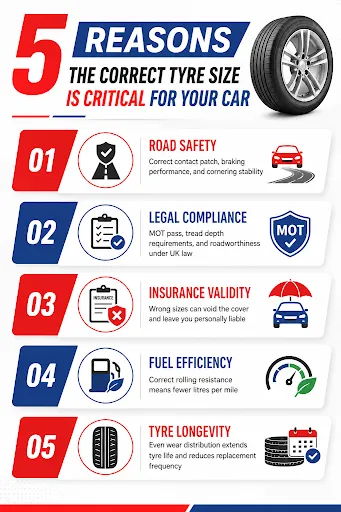
Fitting an incorrect tyre size affects 5 key areas of vehicle performance:
1. Braking Distance
The tyre is the only contact point between your vehicle and the road. An incorrect width changes the contact patch, the area of rubber gripping the tarmac. A narrower tyre reduces grip. A wider tyre on a car not engineered for it can cause instability under hard braking. At 70mph, even a marginal reduction in tyre grip can extend stopping distance by several metres.
2. Speedometer and Odometer Accuracy
Your speedometer is calibrated to the rolling circumference of the manufacturer-specified tyre. Fitting a tyre with a different profile height changes this circumference. A larger rolling diameter causes the speedometer to read lower than your actual speed. This means you could be unknowingly exceeding speed limits. A smaller diameter causes the opposite, overestimating speed. Both outcomes carry legal and insurance risks on UK roads.
3. Fuel Consumption
Under-inflation by just 0.5 bar increases fuel consumption by 2–3%. An incorrectly sized tyre compounds this. When rolling resistance does not match the vehicle’s design parameters, the engine works harder. TyreSafe estimates that £1 billion worth of fuel is wasted annually in the UK due to tyre-related inefficiency. Incorrect sizing contributes directly to this.
4. Handling and Cornering Stability
Manufacturer tyre specifications are set in conjunction with the suspension geometry, wheel arch clearance, and steering system. A tyre that is too wide can foul the wheel arch under full lock. One that is too tall increases the vehicle’s centre of gravity. Both create unpredictable handling, especially at motorway speeds or during emergency manoeuvres.
5. Uneven and Premature Tyre Wear
Mismatched tyre dimensions cause the load to be distributed unevenly across the tread face. This accelerates wear on specific areas, directly affects how long the tyre lasts, and leads to earlier replacement costs.
Table: Tyre Size, Load Index, and Speed Rating
Marking | What It Measures | UK Legal Requirement |
Width (e.g. 205mm) | Contact patch with road surface | Must match the manufacturer’s specification |
Aspect ratio (e.g. 55) | Profile height affects rolling diameter | Deviating changes the speedometer accuracy |
Rim diameter (e.g., R16) | Wheel fitment size | Must match exactly, no tolerance |
Load index (e.g. 91 = 615kg) | Maximum load per tyre | Must meet or exceed vehicle requirements |
Speed rating (e.g. V = 149mph) | Maximum continuous speed | Must meet or exceed the vehicle’s top speed |
The “golden rule” in the UK tyre industry is: you can fit a higher load index or speed rating than specified, but never lower. Fitting a tyre with a lower load rating than the car requires is a legal and safety violation.
Does the Wrong Tyre Size Fail an MOT?
Yes. An incorrectly sized tyre can fail an MOT test. Common reasons for MOT tyre failure include incorrect size, mismatched types on the same axle, insufficient tread depth, sidewall damage, and incorrect pressure.
The DVSA data confirms that tyres are the third most common MOT failure category, accounting for 10.1% of all failures in the 2024/25 period. Over 2 million MOT failures occur in the UK each year due to tyre defects, with one million classified as dangerous.
A tyre that fails on the grounds of a dangerous defect means:
- The vehicle is immediately unroadworthy
- You cannot legally drive it away from the testing centre
- Your insurance policy is voided for any incident occurring under these conditions
Do not assume your vehicle is safe to drive to a garage for repair. It is not legal to do so following a dangerous tyre failure.
Will the Wrong Tyre Size Void Your Insurance?
Yes. Fitting a tyre size that deviates from the manufacturer’s specification is classified as a vehicle modification. Insurers require all vehicles to be roadworthy at the time of any incident. Tyres that do not fit correctly and are not suitable for the car’s weight and design are grounds for an insurer to invalidate a claim.
If your insurer is not informed of a change in tyre size from the vehicle’s Certificate of Conformity, they may refuse any payout following an accident. This has resulted in drivers being personally liable for tens of thousands of pounds in repair and compensation costs.
Always replace tyres with the exact size specified in your vehicle handbook. If you are unsure whether a size variation is acceptable, contact your insurer before fitting.
How Tyre Size Affects Wheel Balancing?
The correct tyre size is closely linked to proper wheel balancing. When a tyre of the wrong dimensions is fitted to a wheel, the weight distribution around the assembly is compromised from the outset. No amount of balancing weight can fully correct a fundamentally wrong tyre-to-wheel ratio.
Unbalanced wheels, whether caused by incorrect sizing, a pothole impact, or simple wear, produce:
- Steering wheel vibration, particularly at speeds of 40–70mph
- Uneven tread wear across the tyre face
- Increased fuel consumption
- Additional stress on wheel bearings and suspension components
After every tyre replacement, professional wheel balancing is essential. It confirms that the tyre and wheel assembly rotates smoothly and that the correct size has been fitted as specified.
Where to Find Your Correct Tyre Size?
Your correct tyre size appears in 3 places:
- The tyre sidewall: printed on every tyre currently fitted to your vehicle
- The vehicle handbook: your manufacturer’s definitive specification
- A sticker inside the driver’s door jamb or fuel filler flap: many UK cars list the approved tyre size here alongside recommended tyre pressures
If in doubt, contact your vehicle manufacturer or a qualified tyre technician. Do not rely on the existing tyres alone. They may not be the correct original specification.
Are Your Wheels Correctly Balanced After Your Last Tyre Fit?
Fitting the right tyre size is only half the job. Every tyre replacement should be followed by professional wheel balancing to eliminate vibration, ensure even wear, and protect your suspension.
Mobile Tyre Giant brings certified mobile wheel balancing directly to your home, office, or roadside, 24 hours a day, 7 days a week.
Our technicians use industrial-grade digital balancing equipment, the same standard found in professional tyre centres, delivered to wherever your vehicle is parked.
Book Your Mobile Wheel Balancing Today
Don’t let an unbalanced wheel undo a perfect tyre fit. Get it done right, at a time and place that suits you.
Frequently Asked Questions
Find quick answers to the most common questions our customers ask.
Changing the width or aspect ratio alters the rolling circumference, affecting your speedometer accuracy, handling, and potentially your insurance. Even a small deviation, such as changing from a 55 to a 45 profile, changes the tyre's overall diameter.
Yes. An incorrectly sized tyre increases rolling resistance, which forces the engine to work harder and burn more fuel. Tyre-related inefficiency wastes £1 billion in fuel annually across UK roads.
It is especially critical on 4WD and AWD vehicles. All four tyres on a 4WD system rotate together through the drivetrain. Even a small difference in rolling circumference between axles, caused by an incorrect tyre size, creates constant tension in the transmission system.
Check your tyre size every time a tyre is replaced and after purchasing a used vehicle. A quick visual check against the size printed on the door jamb or in your handbook takes under a minute.