

A flat tyre can turn an ordinary journey into a stressful roadside problem within seconds. You may hear a sharp bang, feel the steering pull, or see the tyre pressure warning light glow. Panic often makes drivers brake hard or stop in an exposed position. This flat tyre emergency guide explains how to slow down, reach safety, assess the damage, and choose the right solution. Keep both hands on the wheel and ease off the accelerator.
Once the car is secure, identify whether you have a slow puncture, sudden deflation, sidewall damage, or a blowout. Your options also depend on whether the vehicle carries a spare wheel, repair kit, compressor, or run-flat tyres. Think of it like discovering a leak at home: control the immediate risk before choosing the repair. A small tread puncture may be repairable, while a torn sidewall or damaged wheel will usually need replacement.
Flat Tyre? Follow These Seven Emergency Steps First
Hold the steering wheel firmly and let the vehicle slow gradually instead of stamping on the brake. Signal left when safe and move towards a parking space, lay-by, emergency area, or another protected location. Switch on the hazard lights as soon as the vehicle becomes a hazard to others. Passengers should leave from the side furthest from traffic when it is safe. Never inspect, inflate, or change a tyre beside live motorway traffic.
After stopping, check beneath the boot floor for a spare wheel, compressor, sealant, jack, and wheel brace. Locate the locking wheel nut key because the wheel may not come off without it. Inspect the tyre only from a safe position, and never crawl beneath the car or remove a nail. A bulge, shredded sidewall, exposed cord, or damaged rim usually points towards replacement rather than repair. The sequence in this flat tyre emergency guide is simple: stop safely, assess carefully, and then choose repair, replacement, or recovery.
| Situation | Safest immediate response |
|---|---|
| Warning light appears but the car feels stable | Slow down and stop somewhere safe |
| Standard tyre is completely flat | Do not continue driving |
| Vehicle is exposed to fast traffic | Protect passengers and arrange assistance |
| Small tread puncture with an approved kit | Use it only in a safe location |
| Sidewall cut, bulge, or damaged wheel | Arrange inspection and likely replacement |
| No spare or usable repair kit | Contact a mobile tyre service or breakdown provider |
How Do You Know You Have a Flat Tyre?
A useful flat tyre emergency guide should also explain that a flat tyre does not always begin with a dramatic bang. The first clue may be a dashboard warning, a soft thumping sound, or steering that feels heavier on one side. A slow puncture may release air over several days, while sudden deflation can change the vehicle’s handling almost instantly. One tyre may sit lower than the others, although low-profile and reinforced tyres can hide the problem. Use a pressure gauge only after parking somewhere safe.
The speed of pressure loss helps determine how urgently you need assistance. Strong vibration, flapping rubber, a burning smell, or the wheel sitting close to the road can indicate severe damage. Continuing to drive may destroy a tyre that could otherwise have been repaired and may also damage the alloy wheel. A repeated pressure drop can come from a puncture, valve leak, bead leak, or wheel damage. For more detail, read Mobile Tyre Giant’s guide to driving with a flat tyre.
Signs of a Slow Puncture
A slow puncture often feels like a minor inconvenience, so drivers sometimes keep topping up the tyre instead of fixing the cause. The TPMS warning may return after inflation, the car may drift slightly on a straight road, or the steering may feel dull through corners. You might hear a faint ticking sound if a screw touches the road on every wheel rotation. An under-inflated tyre creates extra rolling resistance, which can increase heat and fuel use. These changes may be subtle, but they should not be ignored.
Park safely and compare the pressure with the figure recommended by the vehicle manufacturer. Do not use the maximum pressure printed on the tyre sidewall as the normal target for the car. If pressure falls again, arrange an inspection rather than repeatedly inflating the tyre. A central tread puncture may be repairable, but sidewall damage or driving while under-inflated can change that decision. Mobile Tyre Giant explains these risks further in its guide to the effects of under-inflated tyres.
Signs of Sudden Deflation or a Blowout
This part of the flat tyre emergency guide matters because sudden tyre failure feels sharper and more violent than a slow puncture. You may hear a bang followed by heavy vibration, flapping rubber, or a strong pull towards the damaged side. The steering wheel can feel as though someone has grabbed it, especially when a front tyre fails. Your instinct may be to brake immediately, but harsh braking can make the vehicle harder to control. Keep the wheel steady and ease off the accelerator.
Once stopped, do not assume the tyre can be repaired because the original hole looks small. A tyre that has shredded, separated, or rolled on its sidewall has probably suffered structural damage. The valve, wheel, suspension, or wheel arch may also have been affected. Avoid touching loose rubber or metal because the parts may be hot or sharp. At a safe location, a professional mobile tyre repair assessment can confirm whether repair is possible or replacement is required.
How to Keep Control When a Tyre Goes Flat While Driving
The most important control lesson in any flat tyre emergency guide is that smooth actions are safer than fast reactions. Grip the wheel firmly, keep your eyes on the road, and avoid jerking the steering towards the verge. Lift off the accelerator gradually and allow the vehicle to lose speed while remaining stable. If the car pulls to one side, correct it gently instead of fighting the wheel aggressively. Check the mirrors before moving towards a safer position.
Imagine carrying a full cup of tea across an uneven room: sudden movements spill it, while steady steps keep it controlled. The same principle applies when tyre failure changes the vehicle’s balance. Your goal is not to stop in the shortest possible distance but to reach the safest reasonable place. Once stopped, apply the parking brake, select Park or a gear, switch off the engine, and keep the hazard lights on when needed. Part 2 will cover road-specific stopping rules, passenger safety, and the differences between a spare wheel, sealant kit, run-flat tyre, mobile fitting, and recovery.
Where Should You Stop After a Flat Tyre?
The safest stopping place is not always the closest place, especially when the tyre fails on a busy road. Keep the vehicle moving only as far as necessary to leave the flow of traffic and reduce the risk to passengers. Look for a parking bay, lay-by, service area, emergency area, or another firm and level surface. Avoid stopping immediately after a bend, near a junction, on a steep hill, or anywhere approaching drivers may struggle to see the car. Protecting the people inside the vehicle matters more than protecting a tyre that may already be damaged.
Once stopped, apply the parking brake and switch on the hazard lights so other road users can recognise the obstruction. Select Park in an automatic vehicle, or leave a manual car in first gear or reverse as appropriate. Turn the front wheels away from moving traffic when the road layout allows it. Before opening any door, check mirrors and look carefully for cyclists, motorcycles, and passing vehicles. Do not start inspecting the tyre until you are certain that standing beside the car will not expose you to traffic.
Flat Tyre on a Residential or Local Road
A residential road usually gives you more options than a motorway, but that does not make every stopping place safe. Move into a marked parking space, quiet side road, or wide lay-by whenever one is available. Choose firm and level ground because soft grass, loose gravel, or a sloping surface can make a vehicle jack unstable. Leave enough space around the damaged wheel for safe inspection or professional tyre work. Do not block a driveway, pedestrian crossing, cycle lane, or emergency access point if another safe position is available.
At night, keep the sidelights on when they make the vehicle easier to see. In heavy rain, passengers are often tempted to stand close to the car for shelter, but they should remain away from moving traffic. Check the tyre from a standing position and avoid kneeling in the road. If the wheel is close to a kerb, tell the tyre fitter before they arrive because restricted access may affect how the vehicle can be lifted. A calm description of the location can save time and help the technician arrive with the right expectations.
Flat Tyre on a Dual Carriageway or Fast A-Road
A dual carriageway can be just as dangerous as a motorway because vehicles may pass at high speed. Signal early and try to leave the carriageway through an exit, service area, lay-by, or another protected location. A narrow verge may look convenient from inside the car but provide almost no safe working space once you step outside. Do not stop beside a central reservation or on the outside of a fast bend. If the vehicle remains exposed to traffic, focus on passenger safety and professional recovery rather than trying to save time with a roadside repair.
Exit the vehicle from the side furthest from traffic whenever that can be done safely. Move passengers behind a barrier or well away from the road and do not allow anyone to stand between the vehicle and passing traffic. Keep children and pets under control because noise, headlights, and fast-moving vehicles can cause panic. If there is no safe place to wait outside, contact the appropriate emergency or breakdown service and follow their instructions. A mobile tyre fitter can only work when there is enough safe space to inspect and lift the vehicle.
What to Do With a Flat Tyre on a Motorway
If a tyre fails on a motorway, move into the left lane and aim for a service area, emergency area, or the hard shoulder where one is available. Do not brake sharply or cut across lanes in panic. Switch on the hazard lights and use the left indicator while moving towards safety. When the vehicle stops, turn the wheels towards the verge and leave through the side furthest from traffic if it is safe. Move behind the safety barrier and stand well away from the vehicle.
Do not attempt to change the tyre or use a repair kit beside motorway traffic. Even a quick wheel change exposes you to vehicles travelling at high speed, and a momentary loss of balance can be catastrophic. If the car stops in a live lane, keep seat belts fastened, switch on the hazard lights, and call 999 immediately. Do not cross active lanes or attempt to push the vehicle. Motorway assistance may involve protection, recovery, or moving the car before any tyre repair or replacement can be completed safely.
How to Keep Passengers Safe During a Flat Tyre Emergency
Passengers often become the biggest source of distraction after a tyre failure, especially when children are frightened or several people start giving different advice. The driver should take control of the situation and give simple instructions one at a time. Ask passengers to remain seated until you have checked whether opening the doors is safe. When leaving the vehicle, everyone should use the side furthest from traffic whenever possible. Children, elderly passengers, disabled passengers, and pets may need extra help reaching a protected place.
In cold weather or heavy rain, passengers may want to return to the car, but an exposed roadside vehicle can be struck by another driver. A coat, high-visibility jacket, umbrella, or emergency blanket can make waiting outside more manageable. Keep everyone together and avoid standing directly in front of or behind the vehicle. Use your phone from a safe position and give the exact road name, direction of travel, nearest junction, or postcode. The clearer your information is, the easier it becomes for assistance to locate you without repeated calls.
Should You Use a Warning Triangle?
A warning triangle can help approaching traffic notice a stopped vehicle on an ordinary road, but only when it can be placed without putting you in danger. On a normal road, position it well behind the vehicle where drivers have enough time to react. Do not walk around a blind bend, step into moving traffic, or cross several lanes simply to place it. In darkness or poor weather, a high-visibility jacket may be more useful than a triangle placed in an unsafe position. Never rely on the triangle as permission to work close to traffic.
Do not use a warning triangle on a motorway. Walking behind the vehicle to position one would expose you to fast-moving traffic and create another hazard. Keep the hazard lights on and move behind a safety barrier when possible. If the vehicle is partly blocking a lane or cannot be left safely, contact emergency assistance immediately. Roadside equipment is useful only when its use does not create a greater risk than the flat tyre itself.
Can You Drive With a Completely Flat Tyre?
You should not continue driving on a completely flat standard tyre. The weight of the vehicle can crush the sidewall between the road and the wheel, damaging the tyre’s internal cords within a short distance. The exposed wheel may also strike the road surface, leading to bending, cracking, or expensive alloy damage. A puncture that might have been repairable can quickly become a tyre replacement. You may also lose predictable steering, braking, and stability.
There may be a rare situation where moving a few metres is necessary to escape immediate danger, but that is different from driving to a garage. Once you have reached a safer position, stop and arrange assistance. A slow puncture that still holds pressure is not the same as a completely collapsed tyre, but it also requires careful assessment. Run-flat tyres have different rules, which depend on the vehicle and tyre manufacturer. Mobile Tyre Giant’s guide to run-flat tyres versus normal tyres explains those differences in more detail.
Check What Your Car Has Before Choosing a Solution
Many modern cars do not carry a spare wheel, and some drivers only discover this after opening the boot during an emergency. Lift the boot floor and check for a full-size spare, space-saver wheel, compressor, sealant bottle, jack, and wheel brace. Look for the locking wheel nut key in the glovebox, tool tray, side compartment, or spare-wheel well. Read the vehicle handbook because equipment storage and lifting points vary between models. Do not assume that an unfamiliar bottle or cable can be used safely without instructions.
The equipment you find determines which options are realistic. A usable spare wheel may allow a safe wheel change, while a manufacturer repair kit may temporarily seal a small tread puncture. Run-flat tyres may support limited travel after pressure loss, but only within their approved restrictions. If the vehicle has no usable emergency equipment, do not improvise with household tools or unapproved sealants. Mobile tyre assistance or recovery will be safer than guessing.
Spare Wheel, Repair Kit, Run-Flat Tyre, or Professional Help?
A full-size spare is usually the most familiar solution, but it still requires a safe location, correct tools, and confidence using the vehicle’s lifting points. A space-saver wheel is lighter and easier to store, although it comes with strict speed and distance limits. A repair kit avoids lifting the vehicle, but it cannot fix sidewall damage, a blowout, a damaged rim, or every tread puncture. Run-flat tyres provide temporary mobility, not permission to ignore the warning and finish a long journey. Each option solves a different type of problem.
Professional help becomes the sensible choice when the location is unsafe, the wheel nuts will not move, the locking key is missing, or the tyre has structural damage. A mobile technician may be able to repair or replace the tyre at home, work, in a car park, or at another safe location. Recovery is usually more suitable when the vehicle is exposed to high-speed traffic or has possible wheel or suspension damage. Drivers with no emergency equipment can read the detailed guide about dealing with a flat tyre with no spare. The right choice is not the quickest-looking option but the one that controls the risk without causing further damage.
Can Tyre Sealant Fix a Flat Tyre?
Tyre sealant can temporarily manage some small punctures, but it is not a universal repair. Most manufacturer-supplied kits combine a bottle of sealant with a small air compressor. The sealant enters the tyre, spreads across the inner surface, and may close a small opening in the tread. This can restore enough pressure to move the car to a safe inspection point. It should never be treated as proof that the tyre is permanently safe.
Before using the kit, read the instructions printed on the bottle and in the vehicle handbook. Check the expiry date because old sealant may thicken or fail to spread correctly. Only use the kit when the vehicle is parked away from moving traffic on stable ground. Do not attempt the process on a motorway or beside a fast road. A responsible flat tyre emergency guide must make clear that convenience never overrides roadside safety.
What Damage Can a Tyre Repair Kit Temporarily Handle?
A repair kit may help when a small object has punctured the main tread area and the tyre has not fully collapsed. The tyre should still be sitting correctly on the wheel, with no visible cuts, bulges, or exposed cords. Leave any nail or screw in place because removing it may cause the air to escape faster. Connect the kit exactly as instructed and inflate the tyre to the recommended pressure. Watch the pressure gauge carefully throughout the process.
After inflation, check whether the tyre can maintain pressure before attempting to move the vehicle. Some kits require a short, controlled drive to distribute the sealant, followed by another pressure check. Stop immediately if the tyre begins losing pressure again, vibrates strongly, or looks distorted. Drive only within the speed and distance restrictions supplied with the kit. Professional inspection is still required because an external view cannot reveal internal sidewall damage.
What if the Tyre Repair Kit Does Not Work?
Stop using the vehicle if the compressor cannot raise the pressure or the tyre deflates again within minutes. Repeatedly adding sealant will not repair a torn sidewall, large hole, damaged valve, or cracked wheel. It may also make the later inspection messier without improving safety. Do not continue driving simply because the tyre looks slightly higher than before. A tyre must support the vehicle properly and remain stable under load.
Contact professional assistance and explain that the temporary repair has failed. Tell the technician whether sealant was added, how far the car travelled while deflated, and whether any damage is visible. These details help determine whether repair, replacement, or recovery is more appropriate. A failed kit often indicates that the damage is outside the kit’s intended capability. The next safe step may be an on-site mobile tyre replacement rather than another temporary attempt.
How to Change a Flat Tyre Safely
Changing a wheel can be practical when the car is parked on firm, level ground away from traffic. You will need a suitable spare wheel, working jack, wheel brace, and locking wheel nut key where applicable. Apply the parking brake and place an automatic vehicle in Park. A manual vehicle should be left in first gear or reverse according to the situation. Ask passengers to leave the vehicle and wait somewhere protected before lifting it.
Check the vehicle handbook for the correct jacking point because placing the jack incorrectly can damage the sill or underbody. Loosen the wheel nuts slightly before raising the vehicle, but do not remove them yet. Position a wheel chock diagonally opposite the damaged wheel to reduce unwanted movement. Never place any part of your body beneath a car supported only by its emergency jack. This section of the flat tyre emergency guide applies only when the location and equipment are genuinely safe.
Step-by-Step Wheel Change
Place the jack at the manufacturer-approved lifting point and raise the car until the damaged tyre clears the ground. Remove the loosened wheel nuts and store them somewhere clean where they cannot roll away. Grip the wheel firmly and pull it towards you without placing your feet beneath it. Align the spare wheel with the wheel bolts or hub and push it fully into position. Refit the nuts by hand before using the wheel brace.
Tighten the nuts lightly in an alternating pattern so the wheel sits evenly against the hub. Lower the vehicle until the tyre touches the ground, then tighten the nuts more firmly in the correct sequence. Fully lower the car, remove the jack, and store the damaged wheel and tools securely. Follow all speed and distance limits that apply to a space-saver spare. Arrange a professional torque check and inspection as soon as practical because the spare is an emergency solution, not the end of the repair process.
What if the Locking Wheel Nut Key Is Missing?
A locking wheel nut key is a shaped adapter that allows one locking nut on each wheel to be removed. Drivers often store it in the glovebox, boot tray, centre console, or spare-wheel compartment. Search the vehicle carefully before assuming it has been lost. Check any pouch containing the jack or wheel brace because the key may be clipped inside. Do not use force if an ordinary socket does not fit the locking nut.
Hammering unsuitable tools onto the nut can damage the wheel, locking mechanism, or surrounding components. Tell the tyre technician about the missing key before they travel to your location. This allows them to confirm whether the necessary specialist equipment is available. Mobile Tyre Giant provides locking wheel nut removal for lost, broken, or damaged wheel keys. Mentioning the problem during booking helps prevent delays after the technician arrives.
Can a Flat Tyre Be Repaired?
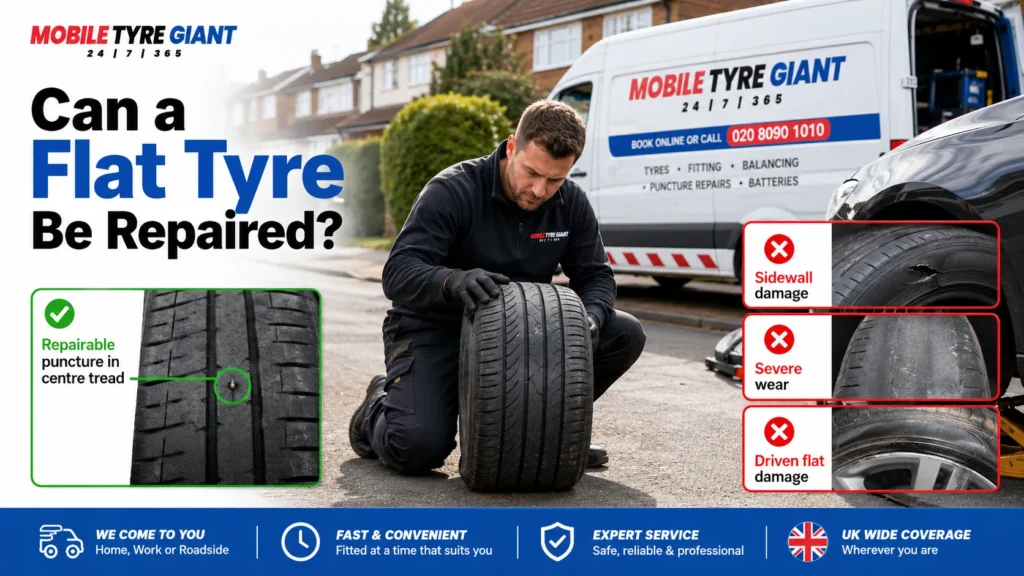
A flat tyre may be repairable when the puncture is small, located within an approved central tread area, and has not caused structural damage. The tyre must normally be removed from the wheel so its inner surface can be inspected. A photograph can reveal a nail, cut, or bulge, but it cannot show damage hidden inside the sidewall. Driving while fully deflated can crush internal cords even when the outside still looks reasonable. This is why a technician should never promise a permanent repair based only on a roadside photograph.
The tyre’s age, tread condition, previous repairs, puncture position, and internal condition all affect the final decision. A proper repair is different from injecting sealant or inserting an emergency roadside plug. It must follow an approved method and restore the airtight inner liner correctly. The technician should also inspect the valve, wheel, and bead area for additional leaks. A trustworthy flat tyre emergency guide should explain both possibilities instead of automatically pushing every driver towards replacement.
| Tyre condition | Likely outcome | Reason |
|---|---|---|
| Small puncture in the central tread | May be repairable | Damage may fall within an approved repair area |
| Nail present but tyre still holds pressure | Inspection required | Internal condition cannot be judged externally |
| Tyre driven while completely flat | Replacement may be required | Internal sidewall cords may be damaged |
| Puncture on the shoulder | Usually replacement | High-flex area is unsuitable for standard repair |
| Sidewall cut or bulge | Replacement | Structural strength may be compromised |
| Shredded tyre or exposed cords | Replacement | Severe structural damage is present |
Signs the Tyre Usually Needs Replacing
Sidewall cuts, punctures near the shoulder, exposed cords, and visible bulges usually make replacement the safer outcome. A blowout that has shredded the rubber has clearly damaged the tyre beyond normal puncture repair. Replacement may also be required when the wheel has rolled on the collapsed sidewall. Heat, crushing, and repeated flexing can weaken the internal structure within a short distance. The tyre may look inflated again while remaining unsafe internally.
A bent or cracked wheel can create continuing air loss even after a new tyre is fitted. Severe pothole impact may also affect alignment, suspension, or steering components. Tell the technician about unusual noises, steering pull, or vibration that began at the same time as the tyre failure. At a suitable location, a mobile tyre fitting service can assess the immediate tyre requirement and explain whether additional mechanical inspection is advisable. The correct decision protects the wheel, vehicle, passengers, and other road users rather than simply getting the car moving again.
Mobile Tyre Fitting or Breakdown Recovery: Which Do You Need?
Mobile tyre fitting is suitable when the vehicle is parked somewhere a technician can work safely. This may include a driveway, workplace, car park, quiet road, or protected roadside location. A technician may inspect the tyre and determine whether repair or replacement is appropriate. This avoids driving a damaged vehicle to a garage and may remove the need for towing. However, mobile fitting is not suitable for every breakdown location.
Recovery is normally safer when the vehicle remains exposed to fast traffic or cannot be lifted securely. It may also be necessary after serious wheel, suspension, steering, or body damage. Think of the difference like calling a plumber or an emergency building team after a leak. One solves a contained problem at its location, while the other moves people away from a wider danger. The condition of the vehicle and its surroundings should determine the choice.
When a Mobile Tyre Fitter Can Help
A mobile tyre fitter may help when the vehicle is on firm, level ground with enough working space around the damaged wheel. Common locations include homes, workplaces, hotel car parks, shopping centres, and quiet residential roads. The technician can inspect visible damage and bring a suitable tyre when the correct details are provided. A small tread puncture may be repairable after the tyre is removed and checked internally. Structural damage, however, usually requires a replacement tyre.
Tell the fitter if the car has run-flat tyres, unusually large wheels, or different tyre sizes on the front and rear axles. You should also mention a missing locking wheel nut key before the technician travels. Clear information helps prevent the frustrating situation where assistance arrives without the required tyre or specialist tool. Drivers can check mobile tyre coverage in their area before requesting help. The final booking should still confirm that the vehicle is in a safe working location.
When Breakdown Recovery Is Safer
Recovery is the better option when the car is stranded in a live lane, on an exposed motorway section, or beside fast-moving traffic. It may also be needed when the ground is soft, steep, uneven, or too narrow for safe lifting. A tyre technician should not be expected to work where passing vehicles could place everyone at risk. Multiple damaged tyres can also make on-site work impractical. Safety must come before the convenience of completing the tyre replacement immediately.
A serious pothole impact may damage more than the tyre itself. Warning signs include a cracked wheel, steering that no longer sits straight, scraping sounds, leaking fluid, or visible suspension damage. Replacing the tyre alone would not make the vehicle safe when another component has failed. Recovery allows the car to be moved to a controlled environment for a wider mechanical inspection. Explain the full incident when requesting assistance rather than describing it only as a puncture.
What Information Should You Give a Mobile Tyre Fitter?
Start with your exact location, postcode, vehicle registration, make, and model. Provide the tyre size from the sidewall when it can be read safely. A marking such as 205/55 R16 contains important information about width, profile, and wheel diameter. Include the full marking because load and speed ratings may also affect tyre selection. Never stand close to moving traffic simply to photograph or read the sidewall.
Describe whether the tyre is slowly losing pressure, completely flat, shredded, or visibly damaged on the sidewall. Mention the number of affected tyres and whether the vehicle uses run-flat tyres. Confirm whether the locking wheel nut key is present and whether the car is parked on firm, level ground. A clear photograph can help the technician prepare, although it cannot confirm internal repairability. Accurate information saves more time than repeatedly asking for the fastest possible arrival.
What Should You Do While Waiting for Tyre Assistance?
Wait somewhere protected from moving traffic and keep your phone available for calls from the technician. Keep the hazard lights on when the vehicle remains an obstruction or needs to be clearly visible. Do not return repeatedly to inspect the tyre if this means standing in a dangerous position. Gather the locking wheel nut key, vehicle handbook, and any tyre details that can be accessed safely. Inform the provider immediately if the vehicle or meeting location changes.
Do not attempt another temporary repair after professional assistance has been arranged unless the provider specifically advises it. Avoid sitting in an exposed vehicle when passengers can wait safely behind a barrier or away from the road. In cold or wet weather, use coats, high-visibility clothing, and emergency blankets where available. Arrival times can change because of traffic, tyre availability, distance, and the complexity of earlier jobs. The guide explaining how long mobile tyre fitting takes covers the factors that can affect an appointment.
What Happens After the Tyre Is Repaired or Replaced?
The technician should confirm the tyre pressure and inspect the wheel before returning the vehicle to use. If a replacement tyre has been fitted, check that its size and specification suit the vehicle. The tyre pressure warning may need time, driving, or a vehicle-specific reset procedure before disappearing. Listen for unusual vibration and check whether the steering feels normal during the next safe journey. Stop and report the issue if the vehicle begins pulling strongly or shaking.
A temporary spare or sealant repair still requires follow-up action. Follow every speed and distance restriction printed in the handbook or supplied with the temporary solution. Replace used sealant so the emergency kit is ready for the next journey. Check the other tyres because similar pressure loss, wear, or age may affect more than one wheel. Mobile Tyre Giant’s tyre safety guide provides further advice on pressure, tread, visible damage, and routine checks.
Common Flat Tyre Mistakes That Make the Situation Worse
The most damaging mistake is continuing to drive because the destination appears close. A few minutes of driving on a collapsed tyre can damage the sidewall and wheel. Another common mistake is braking sharply when the tyre fails at speed. Sudden braking may disturb the balance of the vehicle and make steering more difficult. Smooth deceleration gives the driver a better chance of reaching safety.
Drivers also create risk by stopping on bends, narrow verges, soft ground, or areas with poor visibility. Using sealant on sidewall damage wastes time and may create false confidence. Removing a nail can turn a slow puncture into rapid pressure loss. Using an emergency jack on unstable ground can cause the vehicle to fall. A good flat tyre emergency guide should prevent unsafe improvisation rather than simply explain how tools work.
What Should You Keep in a Flat Tyre Emergency Kit?
Keep a high-visibility jacket, torch, gloves, charged phone, and power bank inside the vehicle. Store the locking wheel nut key where it can be found quickly but will not roll around the boot. Check whether the car carries a compressor, sealant bottle, spare wheel, jack, and wheel brace. Inspect the spare tyre pressure and sealant expiry date before long journeys. Equipment hidden beneath luggage is useless when the driver does not know it exists.
The vehicle handbook should remain in the car because it identifies jacking points and temporary tyre restrictions. A separate pressure gauge can help identify gradual pressure loss before the tyre becomes completely flat. Keep breakdown and mobile tyre contact details accessible even when the phone signal is weak. Before a long trip, practise locating the equipment without lifting or using the jack. Familiarity turns a confusing collection of tools into a clear emergency plan.
Final Words: Stay Safe and Choose the Right Flat Tyre Solution
A flat tyre becomes easier to manage when the driver follows a clear order of actions. Keep control, reduce speed gradually, reach safety, protect passengers, and assess the situation without entering traffic. Check whether the vehicle has a spare wheel, repair kit, compressor, or run-flat tyres. Do not drive on a completely flat standard tyre or assume that every puncture can be repaired. The safest solution may be wheel replacement, temporary inflation, mobile tyre assistance, or recovery.
The location matters as much as the tyre damage. A small puncture on a driveway is a different emergency from the same puncture beside motorway traffic. Give the tyre fitter accurate vehicle, tyre, location, and locking wheel nut information. Follow all aftercare instructions once the immediate problem has been handled. Preparation, calm decisions, and professional inspection can prevent a frustrating puncture from becoming a larger safety or repair problem.
Get Help With Your Flat Tyre
Share your location, vehicle details, and tyre size to arrange professional mobile tyre repair or replacement at a safe and accessible place.
Frequently Asked Questions
Find quick answers to the most common questions our customers ask.
Keep control of the vehicle, reduce speed gradually, move to the safest available location, switch on hazard lights, protect passengers, and avoid driving further on a completely flat standard tyre.
No. Driving on a completely flat standard tyre can damage the sidewall, internal structure, and wheel. Stop safely and arrange professional repair, replacement, or recovery as soon as reasonably possible.
Move left towards an emergency area, service area, or hard shoulder when available. Leave safely, wait behind a barrier, avoid repairs, and call 999 immediately if stranded in active traffic.
Check for a compressor, sealant kit, or run-flat tyres. If none is usable, contact a mobile tyre fitter or breakdown provider rather than attempting to drive the damaged vehicle further.
Tyre sealant may temporarily close certain small tread punctures, but it cannot safely repair sidewall cuts, bulges, blowouts, damaged wheels, or tyres driven while completely flat over any significant distance.
A small puncture within an approved central tread area may be repairable if the tyre has no internal, sidewall, shoulder, or run-flat damage after a complete professional inspection by technicians.
Sidewall punctures, cuts, and bulges normally require replacement because the sidewall flexes constantly and carries structural loads that a standard puncture repair cannot safely restore for continued normal road use.
Do not remove it at the roadside. The object may slow air loss, while removal can cause rapid deflation. Avoid unnecessary driving and arrange professional inspection as soon as possible.
Provide your exact location, registration, vehicle make and model, tyre size, number of damaged tyres, run-flat status, visible damage, locking wheel nut key availability, and parking conditions at the roadside.
Many breakdown policies provide flat tyre assistance, but services and costs vary. A provider may fit a spare or recover the car, while the replacement tyre may remain separately chargeable.