

A tyre problem rarely arrives at a convenient moment. You might notice a pressure warning before leaving home, hear the dull thump of a flat tyre on a quiet road, or find a tyre losing air when the boot is already packed for a long journey. An emergency tyre kit checklist helps you prepare before that moment instead of trying to work out what you need while standing beside the car. The right equipment depends on what your vehicle already uses, because some cars have a full-size spare, others carry a space-saver wheel, and many newer vehicles rely on sealant and a compressor. You may also need a jack, wheel brace, locking wheel nut key, torch, gloves and high-visibility clothing depending on your setup. Simply buying a collection of tools, however, does not automatically mean you are prepared.
A useful tyre emergency kit should be complete, accessible and suitable for the vehicle you actually drive. Sealant may be out of date, a compressor may have gone unused for years, a spare tyre may have lost pressure, or the locking wheel nut key may no longer be where you expect it to be. Think of the kit like a smoke alarm in your home: owning it matters, but it only protects you if it is present, working and understood before an emergency happens. You should also know that no roadside kit can solve every tyre failure. A small puncture and a badly damaged sidewall are completely different problems, even though both may leave the tyre flat. This guide will help UK drivers understand what to carry, what each item is actually for, and when the sensible decision is to stop relying on the kit and arrange professional tyre help.
What Should Be in an Emergency Tyre Kit for UK Drivers?
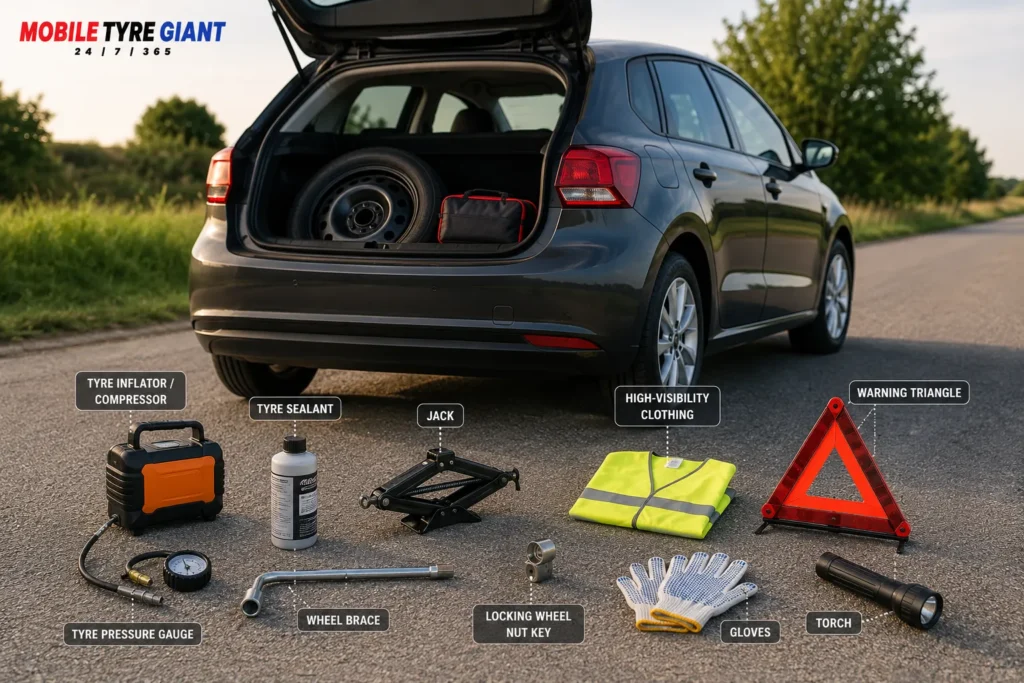
There is no single emergency tyre kit that is correct for every car. The first step is to check what the manufacturer supplied with your vehicle and then make sure the essential components are still present. A car with a spare wheel usually needs the correct jack and wheel brace as well, while a vehicle supplied without a spare may use a tyre sealant bottle and electric compressor instead. Cars fitted with locking wheel nuts also need the matching locking wheel nut key somewhere secure and accessible. Beyond the tyre equipment itself, a torch, gloves and high-visibility clothing can make a roadside problem easier to manage, particularly in darkness or poor weather. The goal is not to fill the boot with every tool you might possibly use, but to carry the equipment that genuinely helps with a tyre-related emergency.
It is also useful to separate repair equipment from safety equipment. A compressor may help restore tyre pressure, while gloves and a torch help you work more safely and see what has happened, but those items serve completely different purposes. This distinction matters because drivers sometimes assume that having an inflator means they have a complete puncture solution. In reality, a tyre may lose pressure because of a puncture, valve problem, wheel sealing issue or more serious damage. If you regularly notice pressure loss, topping the tyre up repeatedly should not become a substitute for finding the cause. Mobile Tyre Giant’s Tyre Pressure Guide explains how to find the correct pressure for your vehicle and check it accurately. Your emergency kit should support sensible decision-making, not encourage you to keep driving on a tyre whose condition you do not understand.
Tyre Inflation and Temporary Repair Equipment
A compact tyre inflator or the compressor supplied with your vehicle can be one of the most useful pieces of equipment in the boot. It allows you to add air when a tyre is below the recommended pressure and is also commonly used as part of manufacturer-supplied puncture repair systems. Some kits combine the compressor with a bottle of tyre sealant designed to provide temporary mobility in specific puncture situations. If your vehicle uses this type of system, check that all hoses, connectors and instructions are still present. Look at the expiry date on the sealant as well, because an old bottle should not simply be assumed to work years after the car was purchased. It is much better to discover an expired kit on your driveway than beside the road with a flat tyre.
The key point is that inflation is not the same as repair. Imagine a bucket with a hole in the bottom: pouring more water into it may raise the level briefly, but it does not remove the hole. A compressor can add pressure to a tyre, but it cannot restore damaged rubber, repair a cut sidewall or straighten a damaged wheel. Even sealant is intended only for the situations described by the particular kit manufacturer and should be treated as a temporary measure rather than a permanent repair. If the tyre refuses to hold pressure after inflation, that is useful information telling you the problem needs investigation. Drivers who keep adding air without checking the cause risk turning a manageable tyre problem into a more serious one. Carry the inflator, but understand exactly what it can and cannot do.
Spare Wheel and Wheel-Change Equipment
If your car carries a full-size spare or a space-saver wheel, the spare is only one part of the emergency setup. You also need the correct jack, a suitable wheel brace and, where locking wheel nuts are fitted, the matching locking wheel nut key. Check these items together rather than looking at the spare wheel alone. A perfectly inflated spare sitting under the boot floor will not help much if the tool needed to remove the damaged wheel is missing. It is worth opening the tool compartment before a long journey and confirming that you know where everything is stored. That simple check can save a great deal of frustration later.
The spare tyre itself also needs attention even though it may spend years out of sight. Pressure can fall while the wheel is stored, and its condition should not be ignored simply because it is not being used every day. A space saver also has different restrictions from a normal road wheel, so the vehicle handbook should be treated as the source of instructions for your particular car. Do not assume that every spare can be driven exactly like the four regular wheels. Drivers whose vehicles have no spare at all should understand what alternative system is provided rather than waiting for a puncture to find out. Mobile Tyre Giant has a separate guide explaining what to do if you have a flat tyre with no spare, which is useful if your vehicle relies entirely on another emergency solution.
Roadside Safety Equipment Worth Keeping Accessible
Tyre tools are important, but the safest emergency tyre kit also considers what happens around the vehicle. A small torch or headlamp can make a major difference if you need to inspect a tyre after dark, especially when the wheel arch and tread are difficult to see. Gloves help keep your hands cleaner and provide some protection when handling a dirty wheel or equipment stored beneath the boot floor. High-visibility clothing is also worth keeping somewhere you can reach without emptying half the luggage onto the roadside. A charged phone and a practical charging option can become equally important if the tyre problem cannot be handled with the equipment you carry. These are simple items, but during a cold, wet or poorly lit breakdown they become much more valuable than they look when sitting unused in the car.
Where you store them matters almost as much as whether you own them. Putting a high-visibility jacket beneath a heavy suitcase, for example, makes little sense if you need it before stepping out of the vehicle. A torch hidden inside the spare-wheel well is equally awkward when the boot is packed at night. Keep the things you may need first in an easy-to-reach location, while heavier tyre tools can remain secured properly in their designated storage areas. You should also resist the temptation to treat every roadside location as a suitable place to start using the equipment. Traffic speed, visibility, road position and available space can make a tyre change or temporary repair unsafe even when you have every tool required. The emergency kit is there to give you options, but your first priority should always be deciding whether the location itself is safe enough to use them.
Part 1 complete. It establishes the awareness stage and core emergency kit items. Part 2 will move into the different vehicle emergency systems, including full-size spares, space savers, sealant and compressor kits, run-flat tyres, and why having a kit does not necessarily mean you are properly prepared.
First Check Which Tyre Emergency System Your Car Actually Has
Before adding new equipment to your boot, find out what system your car was designed to use when a tyre loses pressure. Some vehicles carry a full-size spare wheel, some have a compact space-saver, and others rely on a bottle of sealant connected to a small electric compressor. You may also be driving on run-flat tyres, which are designed to behave differently after pressure loss. The easiest place to start is beneath the boot floor, inside the side storage compartments, or in the area where the manufacturer’s tool kit is stored. The vehicle handbook can then confirm what each item is and how it should be used. This simple inspection is more useful than buying a generic emergency tyre kit and assuming it will suit your car.
Knowing your existing setup also prevents duplicate or incompatible equipment from filling the boot. For example, buying a jack is not especially useful if your vehicle was never supplied with a spare wheel and you have no compatible replacement wheel to fit. Likewise, carrying puncture sealant without understanding whether it is suitable for your tyre system can create false confidence. Think of the emergency setup as a chain: the compressor, sealant, spare wheel, wheel brace and locking key each have a specific role, and one missing link can stop the whole process. Used-car owners should pay particular attention because original equipment may have been removed by a previous owner. A five-minute inspection now can reveal missing tools long before a flat tyre turns them into an urgent problem.
Full-Size Spare Wheel
A full-size spare is generally the closest emergency replacement to the normal wheels already fitted to the vehicle, but that does not mean it can simply be forgotten beneath the boot floor. Check that the wheel is actually present, that the tyre appears in usable condition and that its pressure is correct for the manufacturer’s instructions. A spare that has slowly lost air over several years may be little help when the main tyre suddenly fails. You should also confirm that the jack, wheel brace and any required locking wheel nut key are stored with the spare. If the vehicle has been bought used, do not assume those tools are complete just because the wheel is there.
Drivers should also understand that fitting a full-size spare is only appropriate when the vehicle is positioned somewhere safe enough for a wheel change. Owning the right equipment does not make the edge of a fast road a suitable workshop. If you are unsure about the wheel, the tyre condition or the correct lifting point, use the vehicle handbook rather than guessing. Incorrect jack placement can damage the vehicle or create an unstable lifting situation. If a tyre problem happens in a location where changing the wheel is unsafe, professional assistance is the better option even if the spare itself is ready. Preparation gives you more choices, but it does not remove the need for judgement.
Space-Saver Spare Wheel
A space-saver wheel is smaller and lighter than a normal road wheel, which helps manufacturers reduce weight and preserve boot space. It is designed as a temporary solution rather than a normal long-term replacement, so drivers should check the vehicle handbook for the specific speed and usage restrictions that apply. The tyre pressure required for a space saver may also be different from the pressures used in the vehicle’s regular tyres. Because these wheels spend most of their life hidden away, their pressure is easy to overlook. Checking it occasionally and before a long journey is therefore sensible. A space saver that looks fine but is badly underinflated may not be ready when you finally need it.
The rest of the wheel-change equipment matters just as much as the compact spare itself. You still need the correct jack, wheel brace and locking wheel nut key where applicable. After the space saver is fitted, the damaged normal tyre will also need somewhere to go, which is worth considering if the boot is full of luggage. The temporary wheel should then be replaced with the correct road wheel or tyre as soon as reasonably possible according to the vehicle manufacturer’s instructions. Do not treat a space saver as permission to continue normal driving indefinitely. Its job is to help restore limited mobility, not become a permanent fifth wheel.
Tyre Sealant and Compressor Kits: Convenient but Limited
Many modern vehicles use a tyre mobility kit instead of carrying a spare wheel. These systems typically include a bottle of sealant and a compact compressor that connects to the vehicle’s power supply. Their biggest advantage is convenience because they take up little space and may allow certain punctures to be managed without removing the wheel. They can be particularly useful when the tyre problem is suitable for the particular kit and the vehicle is stopped in a safe location. However, drivers should read the instructions before an emergency rather than trying to understand unfamiliar hoses, valves and switches in the rain or darkness. The sealant should also be checked for an expiry date because it should not be assumed to remain usable forever.
The important limitation is that a repair kit is not a universal cure for a flat tyre. It cannot restore torn rubber, repair a badly damaged sidewall or straighten a damaged wheel. It should also not be treated as a permanent tyre repair. The best way to think about sealant is as a temporary mobility tool for specific situations, not a replacement for proper tyre assessment. If the tyre cannot build or maintain pressure after following the kit instructions, stop repeatedly adding air and investigate the underlying problem. When temporary equipment is not enough, a professional mobile tyre repair service can assess whether the tyre can be repaired or whether another solution is required.
Run-Flat Tyres
Run-flat tyres are designed to retain enough structural support to allow limited movement after significant pressure loss, but they are not ordinary tyres that can simply be driven indefinitely while flat. The exact limits depend on the tyre and vehicle manufacturer, so speed or distance should never be guessed from a general blog. If your vehicle uses run-flat tyres, learn what the dashboard warning looks like and read the instructions provided for your specific car. TPMS is particularly important because a run-flat tyre may not always feel dramatically different the moment pressure falls. A warning should therefore be investigated rather than ignored because the car still feels driveable.
Drivers should also avoid assuming that a run-flat tyre eliminates every need for emergency planning. Severe tyre damage, wheel damage or a problem outside the tyre itself can still leave the vehicle unable to continue safely. Replacement availability can also matter if you use a less common tyre size. This is why it remains useful to know who you would contact if the tyre cannot continue in service. Mobile Tyre Giant’s guide to finding the correct tyre size can help drivers understand the markings on their existing tyres before an emergency occurs. Knowing the tyre size in advance can make communication much easier when a replacement is needed quickly.
Spare Wheel vs Tyre Repair Kit: Which Is Better?
Neither option is automatically better for every driver. A spare wheel can be useful in situations where sealant is unsuitable, but it requires storage space and the correct tools for wheel removal. A tyre repair kit is compact and often easier to carry, but it only works within the limits set by the kit manufacturer and the type of tyre damage. The right choice depends on your vehicle, journey type, boot space, physical ability and the tyre problem you actually encounter. Drivers who travel long distances may value the extra backup of a spare, while someone using a small city car may prefer the factory-supplied mobility kit. The important thing is understanding the trade-off instead of assuming one system covers every possible emergency.
The table below shows the practical differences at a glance. It is not a rule saying one option is superior, because the condition of the tyre and the safety of the roadside location still matter. A spare wheel may not help if the wheel cannot be removed, while sealant may be useless if the sidewall has been badly damaged. Both systems also need maintenance: a spare needs pressure and condition checks, while a repair kit needs a working compressor and in-date sealant. Your emergency plan should therefore include both equipment checks and a backup option for situations the equipment cannot solve. That is the difference between merely carrying tools and actually being prepared.
Factor | Spare or Space-Saver Wheel | Sealant and Compressor Kit |
Storage space | Requires more room | Compact |
Wheel removal | Usually required | Often not required |
Main equipment | Spare, jack, wheel brace, locking key where fitted | Sealant, compressor, hoses and instructions |
Useful for some punctures | Yes, if the spare can be fitted safely | Potentially, depending on damage and kit instructions |
Sidewall or severe tyre damage | May still offer mobility if the wheel itself is undamaged and replacement is suitable | Not a suitable solution |
Maintenance | Check tyre pressure, condition and tools | Check sealant expiry and compressor operation |
Long-term solution | Depends on whether it is a full-size or temporary spare | No, intended as a temporary measure |
Why Having a Kit Does Not Always Mean You Are Prepared
One of the most common weaknesses in an emergency setup is not the choice between a spare wheel and sealant. It is failing to check whether the equipment is still complete and usable. A driver may have carried the same repair kit for six years without noticing that the sealant has expired. Another may have a spare wheel but discover the locking wheel nut key was left at home after the last service. A compressor might look perfectly fine until the first time it is plugged in and fails to run. These are small details when the car is parked safely at home, but they feel much bigger when you are standing beside a flat tyre in cold wind or heavy rain.
Preparation therefore means testing and locating the equipment before you depend on it. Open the boot, find the locking wheel nut key, identify the jack, confirm where the wheel brace is stored and read the repair-kit instructions while there is no pressure to act quickly. If the vehicle has locking wheel nuts and the key is missing or damaged, Mobile Tyre Giant provides locking wheel nut removal when the wheel cannot be removed normally. This kind of preparation also helps you recognise when a tyre problem is beyond what the emergency kit can reasonably handle. Part 3 will focus on exactly that distinction, including punctures, sidewall damage, blowouts, damaged rims and the situations where temporary equipment should no longer be relied upon.
What Can a Tyre Repair Kit Actually Fix?
A tyre repair kit can be useful when the problem falls within the limits set by the kit manufacturer, but it should never be treated as a universal puncture solution. Most sealant-and-compressor systems are intended to provide temporary mobility after certain small punctures in the main tread area. The idea is to introduce sealant into the tyre and then use the compressor to restore enough pressure for the vehicle to move again under the conditions stated in the instructions. That can turn a frustrating roadside problem into something more manageable, particularly when removing a wheel would be difficult. However, the condition and location of the damage still matter. A screw in the tread, a torn sidewall and a cracked wheel may all cause pressure loss, but they are not the same problem and should not be treated in the same way.
This is why visual inspection matters before reaching for the sealant bottle. If you can safely inspect the tyre, look for obvious cuts, bulges, severe deformation or wheel damage rather than assuming every flat tyre is a simple puncture. An embedded nail or screw also deserves care because removing it without understanding the damage can allow the tyre to lose pressure more quickly. Mobile Tyre Giant’s guide on what to do when you find a nail in your tyre explains why repair or replacement depends on more than the object itself. Even when an emergency kit appears to work, the result should be viewed as temporary until the tyre can be assessed properly. A successful inflation gets you moving in some situations, but it does not automatically prove the tyre is safe for normal continued use.
Small Punctures in the Main Tread Area
Small punctures in the main tread area are the type of problem most commonly associated with temporary tyre repair kits. If the particular kit supplied with your vehicle allows it, sealant may be able to reach the puncture while the compressor restores pressure. The important phrase is if the kit allows it, because puncture size limits and operating instructions vary between products and vehicles. Do not assume that advice for another car applies to yours simply because both kits look similar. Read the label and vehicle handbook while the car is safely parked, preferably before you ever need the kit. That way, the instructions will feel familiar rather than like a puzzle being solved beside the road.
Even a small-looking puncture should not be judged from the outside alone. Internal tyre damage can occur if the vehicle has been driven for a significant distance while badly underinflated, and that damage may not be visible from the tread surface. Imagine bending a paperclip repeatedly until the metal weakens inside before it finally snaps. Tyre structures can also suffer damage that is not obvious during a quick roadside look. If the tyre will not maintain pressure after the kit is used as instructed, do not keep repeating the same process and hoping for a different result. At that point, the temporary solution has reached its limit and professional inspection becomes the sensible next step.
Why Tyre Sealant Is Only a Temporary Measure
Tyre sealant is designed to help in an emergency, not to replace a proper inspection or permanent repair. Once used, it may temporarily slow air loss from a suitable puncture and allow limited onward travel according to the kit instructions. The tyre should still be checked because the sealant cannot tell you whether the internal structure has been damaged. It also cannot turn an unsuitable puncture into a safe permanent repair simply because pressure has returned. Drivers sometimes feel reassured when a previously soft tyre becomes firm again, but pressure alone does not tell the whole story. A tyre can hold air and still require further assessment.
After using sealant, follow the specific speed, distance and pressure instructions supplied with the kit rather than relying on a general number found online. Different vehicles and repair systems may specify different limits, and copying someone else’s experience can give false confidence. If the pressure begins falling again, treat that as a warning rather than repeatedly topping it up. The tyre may need a professional puncture repair, or the damage may make replacement necessary. Mobile Tyre Giant provides mobile tyre repair for suitable puncture-related problems at the vehicle’s location. The aim of temporary sealant is to help manage an emergency, not to postpone dealing with the underlying tyre damage indefinitely.
Does Tyre Sealant Expire?
Yes, tyre sealant has an expiry date, and that small printed date can be one of the easiest parts of an emergency kit to forget. The bottle may sit untouched beneath the boot floor for years while the car passes through services, MOTs and several changes of ownership. By the time a puncture happens, a driver may discover that the sealant expired long ago. Check the bottle periodically and especially before long journeys where replacement equipment may be harder to find quickly. If it is out of date, replace it with the correct compatible product rather than leaving it there simply because the bottle is still sealed. A kit should be judged by whether it is usable today, not whether it was complete when the vehicle was new.
The compressor deserves the same attention even though it may not have an expiry date. Plug it into the correct vehicle socket occasionally and confirm that it powers on as expected, following the manufacturer’s instructions. Check that the hose, connectors and cables are still present and have not become damaged beneath luggage or other boot equipment. This is similar to checking a torch before a power cut rather than discovering dead batteries when the room is already dark. A few minutes of preparation at home removes unnecessary uncertainty later. Your emergency tyre kit checklist should therefore include both equipment presence and equipment condition.
What Can an Emergency Tyre Kit Not Fix?
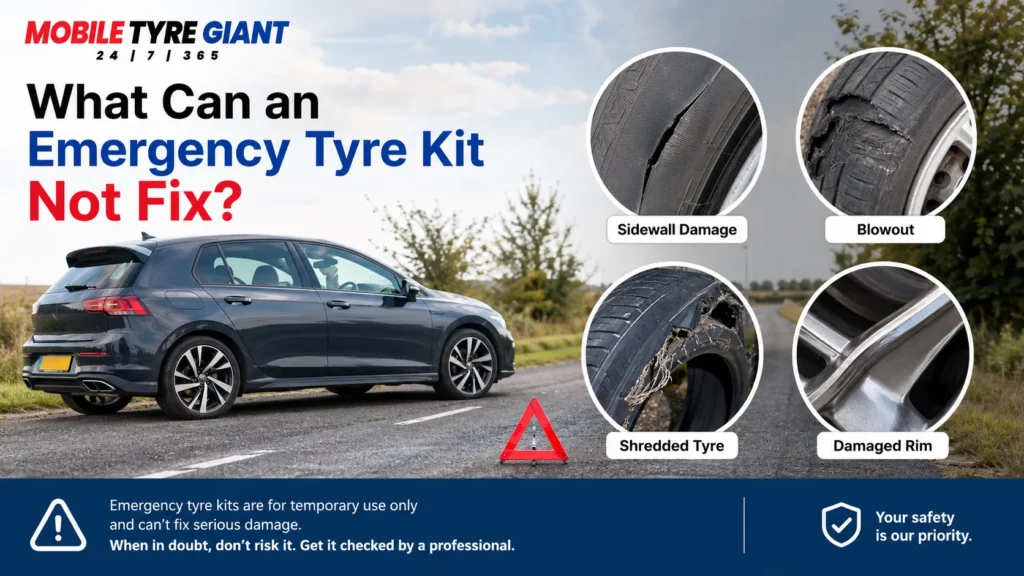
The most valuable skill in a tyre emergency is sometimes recognising when the kit should stay in the boot. Sealant and compressors have clear limitations, and attempting to force a temporary solution onto serious tyre damage can create additional risk. Visible sidewall cuts, large tears, a shredded tyre, significant wheel damage or a tyre that has come away from the rim are completely different from a small tread puncture. These situations need proper assessment rather than another burst of air. A compressor cannot rebuild damaged rubber, and liquid sealant cannot straighten metal. If the tyre looks badly distorted or the wheel itself has taken a heavy impact, treat the problem as more than a simple loss of pressure.
This distinction becomes particularly important after hitting a deep pothole, kerb or road debris. The sudden bang may be followed by a TPMS warning or a rapidly deflating tyre, but adding air without inspecting the wheel can hide the real issue for a few minutes. If the vehicle feels unstable, the tyre will not hold pressure or there is obvious structural damage, stop relying on temporary equipment. Continuing to experiment can waste time while the car remains in an unsafe or inconvenient position. When serious damage makes repair unsuitable, mobile tyre replacement may be the more appropriate solution. The emergency kit is there to help with manageable situations, not to make every damaged tyre repairable.
Sidewall Cuts, Tears and Bulges
Sidewall damage should be treated very differently from a small puncture in the central tread. The sidewall flexes continuously as the tyre rotates and carries load, so visible cuts, tears or bulges can indicate structural damage that an emergency sealant kit is not designed to restore. Pouring sealant into that tyre is a bit like putting tape over a crack in a supporting beam. The surface may look temporarily covered, but the underlying structural problem has not disappeared. If you notice a bulge, split or deep cut in the sidewall, do not assume adding pressure will make normal driving safe. The right response is to have the tyre assessed and replaced if necessary.
Sidewall problems are especially common after sharp pothole impacts or contact with a kerb. Sometimes the tyre loses pressure immediately, while in other cases the damage appears as a bulge that becomes noticeable later. That is why a visual walk-around after a heavy impact can be worthwhile even when the tyre has not gone completely flat. If there is uncertainty, caution is more sensible than trying to prove the tyre can still be driven. Mobile Tyre Giant’s Tyre Safety Guide provides broader guidance on tyre condition and warning signs. A tyre emergency kit gives you useful tools, but knowing when those tools are inappropriate is equally important.
Blowouts, Damaged Wheels and Tyres Driven Flat
A major blowout can leave the tyre torn, shredded or separated in a way that no bottle of sealant can reasonably address. Wheel damage can create a similar problem because air may escape where the tyre should seal against the rim. If the rim is bent or cracked, inflating the tyre again does nothing to restore the shape of the wheel. Tyres that have been driven for a considerable distance while completely or severely underinflated may also have internal damage that cannot be assessed properly at the roadside. The outside may not always show how much heat or stress has built up inside the structure. These are situations where stopping and arranging help is more sensible than repeatedly attempting inflation.
Blowouts also deserve their own response because the immediate priority is controlling the vehicle and reaching a safe stopping place rather than thinking about the repair kit. Once stopped safely, the condition of the tyre can be assessed without rushing. Mobile Tyre Giant has a dedicated guide explaining what to do after a tyre blowout while driving, which covers that emergency in more detail. If the tyre is visibly destroyed or the wheel has been damaged, assume that temporary sealant is not the answer. The practical goal shifts from repairing the tyre yourself to getting the vehicle mobile again through the correct professional solution.
Why a Tyre Inflator and Pressure Gauge Still Matter
A tyre inflator remains valuable even though it cannot repair structural damage. It allows you to correct ordinary pressure loss, check whether a tyre can maintain pressure after a temporary repair and identify when one tyre is behaving differently from the others. A separate pressure gauge can also be useful where the compressor does not provide a clear or trusted reading. Always use the vehicle manufacturer’s recommended tyre pressure rather than copying the number from another car or simply inflating until the tyre looks firm. Tyre pressure can affect handling, tyre wear and fuel efficiency, so accuracy matters outside emergencies too. Keeping an inflator in the car therefore provides everyday value as well as emergency usefulness.
The more important lesson is to watch what happens after air is added. If one tyre repeatedly drops below the correct pressure while the others remain stable, there is probably a reason for it. Possible causes include a puncture, valve issue, wheel-related leak or other sealing problem. Mobile Tyre Giant’s guide to tyre valve failure explains one cause that drivers may overlook when searching only for nails or screws. Treat repeated pressure loss as a diagnostic clue rather than a routine inconvenience. An inflator can buy time in some circumstances, but it should not become a permanent weekly treatment for an unresolved problem.
How Often Should You Check Your Emergency Tyre Kit?
An emergency tyre kit should not disappear beneath the boot floor for years without being checked. A practical time to inspect it is before a long journey, before periods of heavier driving and whenever you notice that something has been removed from the vehicle’s tool compartment. Start with the items most likely to deteriorate or disappear, including tyre sealant, the compressor, spare-wheel pressure and the locking wheel nut key. Check the expiry date printed on any manufacturer-supplied sealant and make sure the correct replacement is arranged if it is out of date. If your car has a spare wheel, check its pressure against the vehicle manufacturer’s instructions rather than waiting until the main tyre is already flat. A spare that has slowly lost air can turn an apparently complete emergency setup into a frustrating surprise.
The compressor should also be checked according to its instructions so you know it still powers on and that the hose and connections are present. Look for the jack, wheel brace and locking wheel nut key at the same time because these small tools are easily misplaced after servicing or previous tyre work. A torch should have usable batteries or enough charge, while high-visibility clothing should be somewhere you can reach without unloading the entire boot. Think of this as checking a fire extinguisher rather than buying one and assuming it will remain ready forever. The inspection does not need to become a major maintenance job, but it should confirm that the kit is complete, suitable and accessible. Those few minutes at home are much easier than discovering a missing tool beside a flat tyre at night.
5-Minute Emergency Tyre Kit Check Before a Long Journey
Begin by identifying whether your car uses a full-size spare, space saver, sealant and compressor kit, run-flat tyres or another manufacturer-approved emergency system. Check that the equipment you expect to find is actually there and that you understand the basic instructions before setting off. Inspect the sealant expiry date, confirm the compressor and cables look serviceable, and check the spare-wheel pressure where a spare is fitted. Locate the jack, wheel brace and locking wheel nut key rather than simply assuming they are beneath the boot floor. Make sure your torch and high-visibility clothing can be reached quickly. Finally, check the pressures of the tyres currently fitted to the vehicle using the correct manufacturer figures.
This short routine is particularly worthwhile before motorway journeys, holidays or journeys where the boot will be packed with luggage. Once bags, pushchairs or suitcases are stacked over the tool compartment, equipment that was technically present can become difficult to reach. If one tyre is already losing pressure before the journey, investigate the reason rather than treating the compressor as a permanent solution. Mobile Tyre Giant’s Tyre Pressure Guide explains how to find and check the correct pressure if you are unsure where to start. It is also worth knowing your tyre size before travelling because that information can be useful if replacement becomes necessary. Preparation should reduce the number of decisions you have to make when something goes wrong.
Is an Emergency Tyre Kit a Legal Requirement in the UK?
UK drivers are not generally required to carry a spare wheel simply because they are driving a private car. Current MOT inspection rules focus on the road wheels and tyres fitted to the vehicle at the time of the test rather than treating the spare as part of the normal tyre inspection. That is one reason many modern cars are supplied with a mobility kit instead of a traditional spare wheel. However, the absence of a legal requirement to carry a spare does not make tyre preparation unimportant. The tyres actually being used on the road still need to be suitable and roadworthy. An emergency kit is therefore best viewed as sensible preparation rather than proof that the vehicle meets every tyre-related requirement.
The more useful question is not simply, “Am I legally required to carry this?” but, “What will I do if one of my tyres becomes unusable?” A driver with no spare should know whether the vehicle relies on sealant and a compressor, run-flat tyres or professional assistance. A driver with a spare should know whether the wheel-change tools are complete and whether the spare is ready to use. If you discover that your vehicle has no spare wheel, Mobile Tyre Giant’s guide on what to do with a flat tyre and no spare explains the available options in more detail. Legal minimums are important, but practical preparation is what prevents a simple puncture from becoming a much longer roadside problem.
Can You Repair or Change a Tyre on a Motorway?
A motorway tyre failure should be treated first as a roadside safety problem, not as an opportunity to test your repair equipment. If the vehicle develops a problem, move left and reach a safer location such as a service area, emergency area or hard shoulder where possible, following the circumstances and current road guidance. Use your hazard lights and focus on getting yourself and passengers away from moving traffic where it is safe to do so. On a motorway, you should not attempt roadside repairs simply because you have a jack, spare wheel or sealant kit available. High-speed traffic can make an otherwise straightforward wheel change extremely dangerous. Your emergency tyre kit does not make an unsafe location safe.
Another important point is the warning triangle. Do not place a warning triangle on a motorway. On other suitable roads, warning equipment may have a role when it can be placed and retrieved safely, but motorway conditions are different. If the tyre fails on a motorway, your priority should be reaching a place of relative safety and getting appropriate assistance rather than walking behind the car to position equipment. Mobile Tyre Giant’s Flat Tyre Emergency Guide covers what to consider when a tyre suddenly becomes unusable. The simplest rule to remember is that roadside safety always comes before saving the tyre or completing the journey.
What Should You Do If the Tyre Repair Kit Does Not Work?
Stop relying on the repair kit if it cannot restore usable pressure, the tyre immediately loses air again or the visible damage falls outside the kit manufacturer’s instructions. Repeatedly running the compressor is not going to rebuild a torn sidewall, repair a shredded tyre or straighten a damaged rim. The same applies if you are unsure what caused the pressure loss in the first place. A tyre may look as though it has a simple puncture while also having damage caused by being driven underinflated. At that point, guessing becomes less useful than having the tyre inspected properly. Temporary equipment has done its job once it helps you understand whether the situation is manageable or needs professional assistance.
Professional help becomes particularly important when there is visible sidewall damage, a blowout, wheel damage, a tyre that refuses to hold pressure or a wheel that cannot be removed because the locking key is missing. A suitable puncture may be eligible for mobile tyre repair, while more serious damage may require mobile tyre replacement. If the problem is a missing or damaged wheel key, locking wheel nut removal may be required before the wheel can come off. The goal is not to turn every tyre problem into a replacement. It is to identify the correct solution without relying on an emergency kit beyond the job it was designed to do.
Final Emergency Tyre Kit Checklist
Before considering your kit complete, confirm that you have the emergency system intended for your vehicle and that every essential part is present. Depending on the car, that may mean a spare or space-saver wheel with a jack, wheel brace and locking wheel nut key, or a sealant-and-compressor mobility kit. Check the spare pressure if one is fitted, the sealant expiry date if your system uses it, and the compressor connections and power supply. Keep a torch, gloves and high-visibility clothing somewhere reasonably accessible rather than buried beneath heavy luggage. Know where the vehicle handbook is or how to access the manufacturer’s instructions for the emergency system. Finally, understand that the kit is designed to give you options rather than guarantee that every tyre failure can be solved at the roadside.
The best emergency tyre kit checklist therefore combines equipment, maintenance and judgement. A compressor is useful only if you understand that adding air is not the same as repairing damage. A spare wheel is useful only when it is serviceable, the correct tools are present and the location is safe enough for it to be fitted. Sealant is useful only within the limits of the particular system, and a locking wheel nut key matters only if you can actually find it when the wheel needs to come off. Check these things before long journeys instead of relying on memory. Good preparation feels uneventful when everything is working, but that is exactly the point.
Final Words: Build an Emergency Tyre Kit You Can Actually Rely On
A good emergency tyre kit is not the biggest collection of tools you can fit in the boot. It is the correct equipment for your vehicle, kept in usable condition and supported by a basic understanding of what each item can and cannot do. Check whether your car has a spare, space saver, mobility kit or run-flat tyres, then make sure the related tools are complete. Keep the locking wheel nut key accessible, check the sealant expiry date, test the compressor and remember to inspect the spare-wheel pressure where applicable. A little preparation at home can remove a surprising amount of uncertainty when a tyre problem happens away from home. Most importantly, do not let having equipment create false confidence about damage it cannot safely resolve.
When a puncture is suitable for temporary treatment, the vehicle’s supplied emergency system may help you regain limited mobility according to its instructions. When there is severe sidewall damage, a blowout, damaged wheel, repeated pressure loss or an unsafe roadside location, the sensible response is different. Knowing when to stop is part of being prepared. Mobile Tyre Giant can provide tyre assistance at your location when an emergency kit cannot solve the problem safely. The purpose of carrying the kit is not to avoid professional help at all costs. It is to give yourself better information, safer options and fewer surprises when a tyre suddenly lets you down.
Is Your Emergency Tyre Kit Not Enough?
If your tyre is badly damaged, will not hold pressure, or your repair kit cannot get you moving, Mobile Tyre Giant can provide professional tyre repair or replacement at your location.
Frequently Asked Questions
Find quick answers to the most common questions our customers ask.
Your kit should match your vehicle and may include a spare or space-saver wheel, jack, wheel brace and locking wheel nut key, or a sealant-and-compressor kit. A torch, gloves, high-visibility clothing and access to the vehicle instructions are also useful.
No, private cars are not generally required simply to carry a spare wheel, and spare wheels are not part of the normal MOT tyre inspection. However, the tyres fitted to the vehicle must still meet the relevant roadworthiness requirements.
Check whether the vehicle has a manufacturer-supplied sealant and compressor kit, run-flat tyres or another emergency system. Learn how it works before a puncture happens and have a plan for getting professional help if the system cannot handle the damage.
It may help with certain suitable punctures, but it cannot be treated as a replacement for every situation a spare wheel might handle. Sidewall damage, severe tyre failure, wheel damage or an unsuitable puncture can still require professional assistance.
No, you should not rely on a standard emergency sealant kit to repair structural sidewall damage. Visible cuts, tears or bulges need proper assessment, and the tyre may need replacement rather than temporary sealing.
Yes, tyre sealant normally has an expiry date that should be checked periodically and before longer journeys. If it has expired, replace it with the correct compatible product rather than assuming the old bottle will still work in an emergency.
A tyre inflator adds air but does not repair damaged rubber by itself. If a tyre repeatedly loses pressure after inflation, the cause could be a puncture, valve problem, sealing issue or wheel damage and should be investigated.
Yes, if your vehicle uses locking wheel nuts, the correct key should be stored securely somewhere accessible in the vehicle. Without it, removing a wheel during tyre replacement or repair can become much more difficult.
You should not attempt vehicle repairs on a motorway hard shoulder simply because you have the necessary tools. Prioritise reaching a place of relative safety, use your hazard lights and arrange appropriate assistance rather than exposing yourself to high-speed traffic.
No, a warning triangle should never be placed on a motorway. Focus instead on moving to a safer location where possible, using hazard lights and following the correct motorway breakdown procedure.
There is no single interval that suits every item, so inspect the kit periodically and before long journeys. Check sealant expiry, compressor condition, spare-wheel pressure, torch power and the presence of the jack, brace and locking wheel nut key.
Stop repeatedly attempting the temporary repair if the tyre will not hold pressure or the damage is outside the kit's instructions. Arrange professional tyre assistance, particularly for sidewall damage, blowouts, wheel damage or tyres that cannot be safely reinflated.