

Tyre tread is one of those things many drivers know they should check, yet the legal wording can still feel confusing when you are actually standing beside the car looking at the rubber. In the UK, the minimum legal tread depth for most cars and light vans is 1.6mm across the primary grooves within the central three-quarters of the tyre, around its entire circumference. That sounds straightforward until questions start appearing about the shoulders, smaller grooves, wear bars, MOT advisories, and whether a tyre measuring 2mm is still legal. This is why understanding UK legal tyre tread depth properly is more useful than simply memorising the number 1.6mm. A tyre may look worn from one angle while still having more tread in another area, which is why a quick glance from several feet away is not enough. Think of tread like the grooves in the sole of a walking shoe: they help maintain contact and move water away, but they do not always wear evenly. On a wet road, the difference becomes much easier to appreciate because those grooves are working to clear water from underneath the tyre. That is also why checking tyre tread should be part of broader tyre safety checks rather than something you only think about just before an MOT. The aim of this guide is to explain the rule in plain English, without turning a simple safety check into a legal textbook. By the end, you should understand exactly what needs measuring, where to measure it, and what the result actually means.
One source of confusion is that the legal minimum and the point at which a driver may choose to replace a tyre are not always the same thing. You might hear 1.6mm mentioned as the legal limit, 2mm discussed as a borderline reading, and 3mm suggested as a sensible point to start planning ahead. Those numbers can sound contradictory when they are presented without context. The law sets the minimum requirement, while replacement decisions can also depend on tyre condition, driving habits, weather, mileage, and how evenly the tread is wearing. A commuter covering hundreds of motorway miles each week may monitor a tyre approaching the limit more closely than someone whose car only does occasional short journeys. The same applies to a driver preparing for winter, when rain, standing water, and cold conditions can make tyre condition feel far more noticeable behind the wheel. This blog will separate legal requirements from practical advice so you are not pushed towards unnecessary replacement or, at the other extreme, encouraged to ignore a tyre that genuinely needs attention. We will also explain the terms used during an MOT so you can understand what an advisory or failure actually refers to. Most importantly, the guidance here is designed to help you make a measured decision based on the condition of the tyre in front of you. That is much more useful than relying on a vague rule of thumb.
What Is the Legal Tyre Tread Depth in the UK?
For most cars and light vans, the minimum tyre tread depth in the UK is 1.6mm in the relevant primary grooves across the central three-quarters of the tread and around the tyre’s full circumference. The phrase “around the full circumference” matters because the tyre must meet the requirement all the way around, not only at the easiest point to reach while the car is parked. Imagine measuring a loaf of bread at one thick slice and assuming every other slice is identical; tyre wear can be just as uneven. A wheel alignment issue, incorrect tyre pressure, suspension wear, or simply the way the vehicle is used can cause one part of the tread to wear faster than another. This is why a proper tread check involves several measurements rather than a single reading. The 1.6mm figure is the legal threshold, not a target that drivers should deliberately try to reach before looking at their tyres again. If your tyres are already close to that point, more frequent checks become sensible because the remaining tread can disappear faster than expected depending on mileage and driving conditions. It is also important to remember that tread depth is only one part of determining whether a tyre is roadworthy. A tyre with plenty of tread can still require attention if it has serious cuts, bulges, exposed cords, or other structural damage. In other words, a healthy-looking number on a tread gauge does not automatically give the entire tyre a clean bill of health.
The legal rule is also more specific than saying “every groove must measure 1.6mm”, which is where many drivers become confused. Tyres contain different types of grooves, channels, and smaller cuts in the tread pattern, and not every one of them starts life at exactly the same depth. The deeper main grooves are the ones that matter most when assessing the legal tread requirement, while smaller secondary grooves or sipes may naturally be shallower. That distinction matters when someone looks at a worn tyre and sees one small groove disappearing before the larger grooves around it. It does not automatically mean the tyre has fallen below the legal tread limit. This is one reason visual checks alone can be misleading, particularly on modern tyres with complex tread patterns. A tread depth gauge gives a clearer picture because it tells you the actual measurement in millimetres instead of forcing you to judge depth by eye. If you are already noticing unusual wear on one side of the tyre, it is also worth understanding the different tyre wear patterns and what may be causing them. Catching that issue early can help prevent a new tyre from developing the same uneven wear pattern later. The legal limit gives you the boundary, but understanding how the tyre is wearing tells you much more about its overall condition.
What Does the Central Three-Quarters of a Tyre Actually Mean?
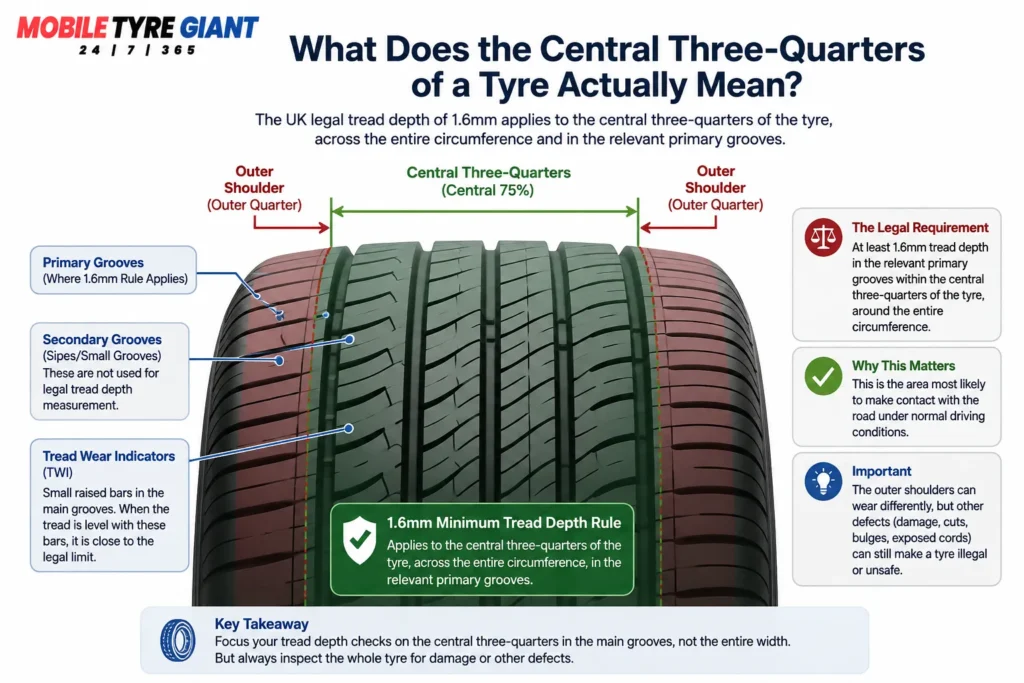
The phrase central three-quarters refers to the middle 75% of the tread width that can normally come into contact with the road. Picture the tread from one shoulder of the tyre to the other, then imagine the outer eighth on each side being separated from the wider middle section. That wider central section is where the main legal tread-depth requirement is assessed. This detail is important because many people assume the entire width of the tyre must have 1.6mm of visible tread everywhere. In reality, the rule focuses on the relevant primary grooves within that central area, although this does not mean damage or severe wear elsewhere can simply be ignored. The tyre shoulders still need inspecting for exposed cords, cuts, cracking, bulges, and unusual wear. If you have ever seen a tyre that looks smooth on one edge but deeper in the middle, you can understand why this part of the rule causes so many questions. The correct answer depends on more than whether the outer edge looks worn. You need to identify where the central tread area lies, check the main grooves there, and inspect the entire tyre for other defects. This is a much more accurate approach than deciding legality from a quick photograph or a single finger rubbed across the tread.
Understanding the central three-quarters also helps explain why drivers sometimes receive different advice about the same tyre. One person may focus entirely on the middle tread reading, while another notices that the inner shoulder is wearing unusually quickly and recommends further inspection. Both observations can be useful, but they are answering slightly different questions. The legal tread-depth test looks at a specific measurement area, while a full tyre inspection looks at the condition of the whole tyre. For example, a tyre could meet the tread-depth requirement in the central section but still show a damaged shoulder that needs immediate attention. The reverse can also happen, where a tyre looks reasonably healthy at first glance but one main groove around part of the circumference has worn below the required depth. This is why checking a tyre properly takes a little more effort than pushing a coin into one convenient groove. When the tread is getting low, rotate your attention around the wheel and look for changes in depth, texture, and wear pattern. The rubber may feel smooth in one place and visibly more defined a few centimetres away, which is often the first clue that the wear is not uniform. Once you understand where the legal measurement is taken, the wording stops sounding technical and starts making practical sense. That knowledge becomes especially useful before an MOT or when deciding whether a tyre really needs replacing.
What Are Primary and Secondary Tyre Grooves?
Primary grooves are essentially the main, deeper grooves in the tyre tread pattern that are used when assessing the legal tread requirement. These are commonly associated with the tread wear indicators built into the tyre, which act as a visual reference as the tread wears down. Secondary grooves and sipes are usually smaller cuts or shallower channels designed for functions such as grip, flexibility, and water movement. Because they may be shallower from the moment the tyre is manufactured, it would make little sense to expect every tiny groove to maintain the same 1.6mm depth. This is why the legal assessment focuses on the main tread pattern rather than treating every line in the rubber equally. To a driver looking at a modern tyre for the first time, the tread can resemble a complicated maze of blocks, channels, and thin cuts. That complexity is exactly why guessing by eye can lead to the wrong conclusion. A small sipe disappearing does not automatically prove that the tyre is illegal, just as a deep-looking groove in one place does not prove the whole tyre is compliant. The useful question is whether the relevant primary grooves meet the minimum depth across the required area and around the circumference. Once you know which grooves matter, checking the tyre becomes much more straightforward.
Tread wear indicators can help you identify these main grooves because they are small raised bars moulded into the tread. As the surrounding tread wears down, the surface gradually gets closer to the height of these bars. They are useful warning references, but drivers should not wait until a tyre looks almost completely smooth before paying attention to it. A proper gauge gives you an actual measurement and removes much of the uncertainty, particularly when the tyre is approaching the legal limit. It is similar to checking fuel by looking into the tank instead of reading the gauge on the dashboard: one method gives a rough impression while the other gives you something you can actually work with. The same principle applies to tyre tread. Visual clues are helpful, but measured information is better when the decision could affect an MOT, road legality, or replacement cost. In later sections, we will compare the common 20p test with a proper tread-depth gauge and explain why the coin test should not be treated as a precision measurement. We will also look at what 2mm and 3mm readings mean in real driving terms, rather than treating them as mysterious numbers. Understanding primary grooves first makes those later checks far easier to interpret. It also helps you avoid replacing a tyre for the wrong reason or continuing to use one because you measured the wrong part of the tread.
Is 2mm Tyre Tread Legal in the UK?
Yes, a tyre measuring 2mm can still be legally compliant in the UK because it remains above the 1.6mm minimum for the relevant primary grooves on most cars and light vans. The important word here is “can”, because one 2mm reading does not automatically prove that the entire tyre meets the legal requirement. You still need adequate tread within the central three-quarters and around the tyre’s complete circumference. Imagine checking the depth of a swimming pool at one corner and assuming every other part is equally deep. Tyres can wear unevenly in much the same way, especially when pressure, alignment, suspension condition, or driving habits are not ideal. A tyre showing 2mm in one groove may have less tread somewhere else, so several measurements give a far more reliable picture. The tyre should also be inspected for cuts, bulges, exposed cords, and other defects because tread depth is only one part of roadworthiness. This is why a 2mm reading should be treated as useful information rather than an automatic pass or fail verdict. If your tyre is already at this level, it makes sense to monitor it more frequently instead of forgetting about it until the next MOT. The closer the tread gets to 1.6mm, the less margin you have before normal wear takes it below the legal threshold.
Whether you should replace a 2mm tyre immediately is a slightly different question from whether it is legally compliant today. A driver covering only modest mileage may reach the replacement point differently from someone travelling hundreds of miles every week on motorways. Weather also matters because wet roads place greater demands on the tread’s ability to move water away from the tyre’s contact area. This is one reason drivers often start thinking seriously about replacement before the exact legal limit is reached. However, that does not mean 2mm suddenly becomes an illegal figure simply because replacement may be sensible to plan. The better approach is to separate legal status, current condition, and replacement timing rather than mixing all three together. If a tyre is wearing evenly, has no visible damage, and remains above the required depth, the decision is different from a tyre showing 2mm in one place and severe shoulder wear elsewhere. Drivers who want to understand how tread relates to overall tyre life can also read our guide on how long tyres last. That wider context helps explain why mileage alone cannot tell you exactly how much useful tread remains. The safest decisions come from measuring the actual tyre rather than trying to estimate its remaining life from age or mileage alone.
Is 3mm the Legal Tyre Tread Limit?
No, 3mm is not the UK legal tyre tread limit for normal car tyres. The legal minimum remains 1.6mm in the relevant primary grooves within the central three-quarters of the tread and around the whole circumference. The confusion happens because 3mm is often discussed as a point where drivers may begin monitoring their tyres more closely or planning future replacement. That is practical advice rather than a separate legal rule. Think of it like a fuel warning light coming on before the tank is completely empty. The warning gives you time to act, but it does not mean the car has already run out of fuel. In the same way, a tyre at 3mm still has significantly more tread than the legal minimum, but it is further through its usable tread life than a newer tyre. This distinction matters because drivers can otherwise feel pressured into believing that a perfectly legal tyre has already broken the law. On the other hand, treating 1.6mm as a target rather than a minimum can also lead to unnecessary risk if the tyre is not checked frequently enough. A sensible driver looks at the measurement as part of a bigger picture that includes condition, usage, weather, and how quickly the tread is wearing.
This is also where online advice becomes confusing because people often speak about their personal replacement preferences as though those preferences were legal requirements. One driver may replace tyres around 3mm because they do high motorway mileage in wet weather, while another may continue monitoring them until closer to the legal threshold. Neither personal habit changes the law itself. What matters is that the tyre remains compliant and roadworthy while it is being used. You should also avoid assuming that tread wears at a perfectly predictable rate, because driving style, tyre pressure, vehicle weight, road surfaces, and alignment can all change how quickly rubber disappears. If your tyre has dropped from 4mm to 3mm much faster than expected, that trend matters more than simply seeing the number 3 on a gauge. Similarly, a tyre can still have 3mm of tread but require replacement because of structural damage or severe deterioration elsewhere. The legal measurement is therefore an important starting point, not the only inspection you should perform. This balanced approach prevents two common mistakes: replacing tyres automatically because someone mentioned 3mm, or waiting until the last fraction of tread without checking anything else. Understanding the difference between a legal minimum and a practical planning point makes the whole decision much easier.
1.6mm vs 2mm vs 3mm Tyre Tread: What Do the Numbers Mean?
The easiest way to understand these figures is to stop treating them as three competing rules. 1.6mm is the legal minimum, while 2mm and 3mm are simply higher tread-depth readings that may influence when you choose to inspect or replace the tyre. A tyre at 3mm has more remaining tread than one at 2mm, but both figures are above the legal tread minimum when the full applicable requirements are satisfied. Once the tyre reaches 1.6mm in the required measurement area, there is effectively no legal margin left for further wear. Below that point, the tyre does not meet the relevant minimum tread-depth requirement. This is why waiting until the tyre reaches exactly 1.6mm before thinking about replacement can create unnecessary pressure, particularly for high-mileage drivers. A tyre that loses several tenths of a millimetre quickly could move from marginally compliant to below the minimum sooner than expected. The better approach is to know the current measurement and keep an eye on how it is changing. That gives you time to plan rather than discovering the problem when the car is due for an MOT or you are preparing for a long journey. The table below makes these different readings easier to compare.
Tread Depth | What It Generally Means | Recommended Approach |
Above 3mm | Comfortably above the legal tread minimum if the tyre has no other defects | Continue routine checks and monitor normal wear |
Around 3mm | Still legally above the minimum, but further through its tread life | Check more regularly and consider future replacement needs |
Around 2mm | Above the 1.6mm minimum if all applicable areas remain compliant | Monitor closely and inspect the whole tyre for uneven wear or damage |
1.6mm | Legal minimum threshold in the relevant primary grooves | Replacement should not be delayed because further wear can make the tyre illegal |
Below 1.6mm | Does not meet the applicable minimum tread-depth requirement | The tyre requires replacement |
The important detail in this comparison is that tread depth alone does not describe the full condition of a tyre. A tyre reading 3mm with a bulge in the sidewall can be a much more serious concern than an evenly worn tyre with slightly less tread but no structural damage. Likewise, two tyres both measuring 2mm can tell completely different stories if one has even wear while the other has a badly worn inner edge. This is where regularly checking the complete tread pattern becomes valuable. You are not simply asking “what number is on the gauge?” but “is this tyre wearing normally and consistently?” Drivers sometimes focus so heavily on the legal number that they miss an obvious wear pattern that could point to another mechanical issue. If one side is wearing noticeably faster, investigating the cause can protect the replacement tyre from developing the same problem. Tyre pressure and wheel alignment are common factors worth checking when unusual wear appears. The table therefore works best as a decision aid rather than a substitute for inspection. Numbers tell you how much tread remains, while the condition of the rubber tells you whether that tread is still part of a healthy tyre. Combining both pieces of information gives you a far more reliable answer.
What Tyre Tread Depth Will Pass an MOT?
For most cars and light vans, an MOT tread-depth inspection uses the same 1.6mm minimum requirement applied to the relevant primary grooves within the central three-quarters of the tread and around the entire circumference. That means a tyre does not fail simply because it measures less than 3mm. A tyre with 2mm of compliant tread can still satisfy the tread-depth requirement at the time of the test. However, the MOT tester is not checking one convenient point and calling the tyre acceptable. The tread pattern needs to meet the requirement across the relevant area and around the wheel, which is why uneven wear can become significant. A tyre might show 2.2mm at one visible point but have a section elsewhere that has already worn more heavily. This is another reason checking your own tyres before an MOT is worth a few minutes of your time. It reduces the chance of being surprised by a failure for something that could have been spotted beforehand. You should also remember that an MOT inspection considers more than tread depth, including certain types of damage and tyre condition. Passing the depth check therefore does not guarantee that every other aspect of the tyre will pass.
An MOT advisory can also cause unnecessary confusion because drivers sometimes assume an advisory means the tyre has already become illegal. That is not necessarily the case. An advisory can flag wear or deterioration that has not yet reached the point required for a failure but may need attention in the future. In practical terms, it is similar to a mechanic saying, “This is not a failure today, but do not forget about it.” That information is particularly useful for tyres because tread continues wearing every time the vehicle is driven. If a tyre passes an MOT with relatively low remaining tread and you then drive thousands of miles, the previous pass does not guarantee that it will remain compliant months later. Drivers are responsible for keeping tyres roadworthy between MOT tests, not simply on the day the certificate is issued. Checking them regularly is therefore far more sensible than treating the annual MOT as the only tyre inspection that matters. If your tyre is approaching replacement and you prefer not to visit a garage, mobile tyre fitting can provide a practical option when replacement is genuinely required. The key is to make the decision from an accurate inspection rather than waiting for an MOT failure to force the issue.
Will 2mm Tyre Tread Pass an MOT?
A tyre with 2mm of tread can pass an MOT if the required primary grooves remain above the 1.6mm minimum across the central three-quarters and around the full circumference, and no separate tyre defect causes a failure. The 2mm figure itself is therefore not an automatic MOT failure. The mistake is assuming that one 2mm measurement guarantees every part of the tyre is also at 2mm. Uneven wear is common enough that several points should be checked before drawing that conclusion. If the inner section of the tread has worn faster than the visible outer section, the most worn area may be easy to miss when the car is parked. This is particularly relevant when alignment has been incorrect for some time. The steering may still feel reasonably normal while the tyre quietly wears on one edge. A quick pre-MOT inspection can uncover this before the vehicle reaches the testing station. You should look at all four tyres rather than checking only the one that appears most worn. One legal tyre tells you nothing about the condition of the other three.
It is also possible for a tyre with more than 2mm of tread to fail because tread depth is only part of the MOT tyre inspection. Serious structural damage, exposed cords, significant bulges, or other defects can matter regardless of how healthy the tread measurement looks. That is why relying entirely on a digital reading can give a false sense of security. Run your eyes around the sidewall, shoulders, and tread surface and look for anything that appears distorted, cracked, cut, or unusually worn. If something looks wrong and you are unsure whether it is safe, professional inspection is more sensible than trying to diagnose structural damage from a photograph. This practical distinction is important because many drivers think MOT tyre checks operate like a simple ruler test. In reality, the tester is judging whether the tyre satisfies several roadworthiness requirements. A 2mm reading can therefore be reassuring, but it should never be the only thing you check. The goal is not merely to pass an MOT on one particular day. It is to keep the tyre legal and roadworthy throughout normal use.
Can the Outer Edge of a Tyre Be Below 1.6mm?
One of the most confusing parts of UK legal tyre tread depth is what happens when the middle of the tyre still has tread but an inner or outer shoulder looks almost smooth. For the tread-depth requirement itself, the 1.6mm minimum applies to the relevant primary grooves within the central three-quarters of the tyre rather than every millimetre across the entire width. This means an outer shoulder having less visible tread does not automatically prove that the tyre has failed the legal tread-depth requirement. However, that should never be interpreted as permission to ignore badly worn shoulders. A tyre can still have other defects that make it unsafe or unroadworthy even when the central tread measurement remains above the minimum. Imagine a pair of shoes where the centre of the sole still has grip but one edge has worn down so far that the material underneath is showing. You would not judge the whole shoe only by the deepest groove in the middle. Tyres deserve the same complete inspection because excessive shoulder wear can reveal a problem developing elsewhere. The important distinction is between where tread depth is legally measured and whether the tyre as a whole remains in acceptable condition. Keeping those two questions separate prevents a lot of the confusion drivers experience before an MOT.
Uneven shoulder wear can also tell you something useful about how the car has been running. If the inner edge is disappearing much faster than the centre, wheel alignment or suspension geometry may deserve attention, while wear on both shoulders can sometimes be linked with incorrect tyre pressure or other operating conditions. You do not need to diagnose the exact mechanical cause from the driveway, but you should recognise when the wear pattern looks abnormal. Run your eyes around as much of the tyre circumference as you can see and compare the inner, middle, and outer sections rather than staring at one patch. The rubber should not reveal cords, severe cuts, bulges, or structural damage anywhere simply because the legal tread area happens to measure above 1.6mm. A smooth-looking shoulder combined with deeper central grooves is therefore a reason to inspect more carefully, not an automatic pass or automatic failure based on appearance alone. This is where practical judgement becomes more useful than repeating a single number. The UK legal tyre tread depth rule gives you a measurable legal boundary, but roadworthiness still depends on the condition of the complete tyre. If the shoulder wear looks severe or you cannot confidently inspect it yourself, getting the tyre checked is a better decision than relying on a photograph or guess. The goal is to understand why the tyre is wearing that way before the same pattern appears on its replacement.
Can a Tyre Be Illegal Even With More Than 1.6mm of Tread?
Yes, a tyre can have more than 1.6mm of tread and still be defective or unsuitable for continued road use. This is an important point because drivers often treat tread depth like a single pass-or-fail health score for the entire tyre. In reality, the tread measurement answers only one part of the inspection. A tyre may still have several millimetres of tread but show a serious sidewall bulge, exposed cords, deep cuts, structural separation, or other significant damage. Think of the tread gauge like checking a person’s temperature: it gives you one useful measurement, but it cannot tell you everything else that may be wrong. The same applies when interpreting UK legal tyre tread depth. A healthy 3mm reading is reassuring only when the rest of the tyre is also in acceptable condition. This is why a visual inspection should always accompany any measurement. Look for areas where the rubber appears distorted, split, unusually cracked, or damaged by an impact. If the tyre has suffered a hard pothole strike or kerb impact, do not assume good tread automatically means no damage occurred.
Another problem is that damage can sometimes develop in areas that are difficult to see while the wheel is fitted to the vehicle. The inner sidewall, for example, is much harder to inspect from a normal standing position than the outer face. If the car develops a vibration, loses pressure repeatedly, or the tyre looks distorted, those symptoms deserve attention even when the visible tread appears healthy. You should also avoid assuming that a recent MOT means the tyre will remain roadworthy for the next twelve months. Tyres continue wearing and can suffer new damage after the test, so condition needs monitoring between MOTs. This is particularly important for cars covering high mileage, carrying heavy loads, or regularly using rough roads. A tread gauge cannot detect internal impact damage, a damaged sidewall, or every possible structural defect. That is why the most reliable routine combines measurement with a careful visual and physical check. The legal number matters, but it should never become tunnel vision. A tyre with generous tread and a serious defect may require faster action than an evenly worn tyre that is simply approaching its replacement point. Good tyre decisions come from assessing the whole component rather than celebrating one acceptable reading.
How to Check Tyre Tread Depth Correctly at Home
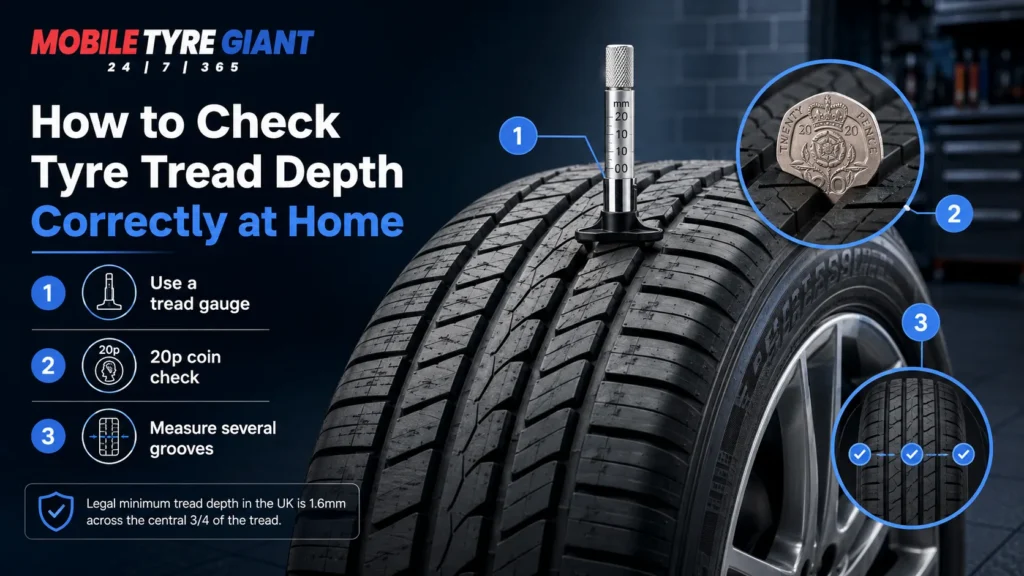
Checking tread at home does not require complicated equipment, but the method matters if you want a useful result. Start by parking the vehicle somewhere safe, level, and well lit so you can clearly see the tread pattern. Identify the main grooves rather than selecting the smallest decorative cuts or sipes in the rubber. Measure several points across the relevant tread area and repeat the process at different locations around the tyre’s circumference. One reading in the easiest groove to reach can miss localised wear elsewhere. If possible, turn the steering on the front wheels to give yourself a clearer view of the tread surface, but keep the vehicle safely stationary while inspecting it. Write down the readings if the tyre is getting close to the limit so you can compare them during future checks. The aim is not to hunt for the highest number but to find the lowest relevant measurement. This is particularly important when checking UK legal tyre tread depth, because the requirement has to be maintained around the relevant circumference. Repeat the same inspection on all four tyres because wear on one wheel does not predict what is happening on another.
While measuring, also use the opportunity to look at the tyre rather than treating the task as purely numerical. Check whether the tread looks even from one side to the other and whether one shoulder has become visibly smoother. Look for stones or debris lodged in the grooves, cuts in the tread blocks, unusual cracking, or anything that appears to have penetrated the rubber. If the pressure has been dropping repeatedly, a tread-depth check alone will not explain the cause. It is also worth checking the tread when the tyre is reasonably clean because mud can make shallow grooves harder to judge accurately. Drivers sometimes rush this inspection just before an MOT, but a monthly habit is much more useful because it lets you notice gradual changes. The closer the measurement gets to the legal threshold, the more frequently it should be monitored. A five-minute check can give you useful warning before the tyre becomes an urgent problem. More importantly, regular measurements help you learn how quickly your own tyres wear instead of relying on generic mileage estimates. Once you know the pattern, deciding when to plan replacement becomes much easier and less stressful.
How Accurate Is the 20p Tyre Tread Test?
The 20p test is popular because almost anyone can perform it without buying a tool. You place the coin into one of the main tread grooves and observe whether the outer band around the coin is hidden by the surrounding tread. If that band disappears into the groove, there is a healthy amount of tread relative to the coin’s rim. If the outer band remains visible, the tyre deserves a more accurate measurement rather than an immediate assumption that it is definitely illegal. This distinction matters because the coin does not act as a precision 1.6mm measuring instrument. Treat it like a smoke alarm rather than a laboratory test: it is useful for alerting you that something deserves closer attention. Repeat the check at several points because one favourable result does not tell you what is happening around the whole tyre. The method is especially useful for drivers who otherwise would not inspect their tread at all. However, when a tyre appears close to the limit, a proper millimetre measurement gives much better information. That is the safest way to relate the result to the actual UK legal tyre tread depth requirement.
The biggest mistake is turning the 20p test into a simple “coin visible equals illegal” rule. That oversimplification can lead one driver to replace a tyre unnecessarily while another driver may assume a single hidden-band reading proves the whole tyre is fine. Neither conclusion is reliable enough on its own. Use the coin as a quick screening method, then move to a tread-depth gauge when the result looks borderline or inconsistent. You should also remember that the coin tells you nothing about bulges, cuts, exposed cords, or damage to the sidewall. A tyre can perform well in the coin test and still need professional attention for a completely different reason. The test is therefore best used as part of a wider inspection rather than as the final verdict. It is quick, familiar, and useful for routine checks, but accuracy matters more when the tread is approaching the legal minimum. Once the margin becomes small, guessing by eye or coin is unnecessary when inexpensive gauges can provide an actual reading. The more precise your measurement, the easier it becomes to make a calm decision instead of reacting to uncertainty.
Is a Tread Depth Gauge Better Than the 20p Test?
A tread-depth gauge is the better choice when you want to know the actual amount of tread remaining in millimetres. The tool is placed into the relevant groove, allowing the probe to reach the bottom while the base rests against the tread surface. The reading then tells you whether you are looking at 4mm, 3mm, 2mm, or something much closer to the legal threshold. That precision becomes especially useful when a tyre looks worn but still has some usable tread remaining. Instead of wondering whether the outer rim of a coin is just visible, you can work with a clear number. A gauge also makes it easier to compare inner, centre, and outer measurements and identify uneven wear. Repeat the readings around the circumference rather than assuming one position represents the whole tyre. If one area consistently measures lower, investigate why that section is wearing faster. For drivers monitoring UK legal tyre tread depth, this method provides far more useful evidence than visual estimation alone. It is simple, inexpensive, and easy to include in a regular tyre-check routine.
Even with a gauge, however, technique still matters. Make sure the probe reaches the base of the appropriate main groove and that dirt or stones are not affecting the reading. Take several measurements instead of repeatedly checking the same easy-to-reach point. If the results vary considerably, use the lowest relevant reading as a reason to inspect the tyre more closely. A digital gauge can make numbers easier to read, but a basic manual gauge can also work perfectly well when used correctly. What matters is consistency and measuring the correct part of the tread. Combine those numbers with a visual inspection of the tread blocks, shoulders, and sidewalls before making a decision. A tyre is not a spreadsheet cell where one acceptable figure means everything else can be ignored. The measurement tells you how much tread remains, while your broader inspection tells you what condition that remaining tread is in. Used together, those two checks provide a much clearer picture of whether the tyre can continue in service or whether replacement should now be planned.
Why Does Low Tyre Tread Matter More in Wet Weather?
Tyre tread does much more than help a tyre look new or worn, because its grooves help move water away from the contact area between the tyre and the road. As tread becomes shallower, there is less space available for that water to escape, which can reduce wet-road grip and increase the chance of aquaplaning in heavy rain or standing water. You may notice this as a slightly lighter feeling through the steering wheel or less confidence when driving through a wet bend. It is similar to walking across a wet tiled floor in shoes with deeply patterned soles compared with shoes that have almost worn smooth. Both may still touch the ground, but one is better equipped to manage the slippery surface underneath. This is why UK legal tyre tread depth should be viewed as a minimum legal requirement rather than a description of how every tyre will perform in every condition. Tyre design, road surface, speed, pressure, vehicle weight, and weather all influence how much grip is available. A tyre with more remaining tread generally has deeper channels available to disperse water than the same tyre when heavily worn. That does not mean every tyre must automatically be replaced at 3mm, but it does explain why wet-weather performance becomes part of the replacement conversation before the legal minimum is reached. Drivers who regularly travel on fast roads in heavy rain may reasonably monitor their tyres more closely as tread decreases.
Wet-weather conditions also highlight why an evenly worn tyre is important. If one section of tread is much shallower than another, the tyre may not clear water consistently across its contact area. This can make a car feel less settled even though one measurement elsewhere on the tread still looks acceptable. The safest approach is therefore to consider the lowest relevant tread measurement along with the general condition of the tyre. Keep tyre pressures correct as well, because under-inflation or over-inflation can change the way the tread contacts the road and may accelerate irregular wear. When rain is hammering against the windscreen and visibility is already reduced, you want the tyres to be one less thing to worry about. Regular checks give you that confidence because you know what condition the rubber is in before the weather turns bad. Tread depth should never be assessed in isolation from the way and conditions in which the vehicle is actually driven. The legal number is important, but practical road safety depends on the complete tyre, not a single measurement.
When Should You Actually Replace Your Tyres?
There is no single replacement figure above 1.6mm that applies to every driver, every tyre, and every journey. The legal threshold provides the boundary, while the sensible replacement point depends on remaining tread, tyre condition, mileage, wear pattern, season, and how the vehicle is used. A tyre sitting around 3mm may have plenty of legal tread remaining, but that is a reasonable point to start monitoring it more closely and thinking ahead. At around 2mm, the tyre can still be legally compliant if the applicable tread area meets the requirement, but the margin before the minimum is obviously smaller. Once the relevant tread reaches 1.6mm, you have reached the legal threshold and should not plan to continue wearing the tyre below it. The practical mistake is waiting until the last possible moment and assuming wear will happen slowly and evenly. A high-mileage driver can remove the remaining fraction of tread much faster than someone who uses the car only at weekends. Likewise, a tyre with irregular wear may reach the limit in one area long before the rest of the tread appears worn. Planning replacement before the situation becomes urgent gives you more control over timing, cost, and tyre choice. It also avoids discovering the problem on the morning of an MOT or before a long journey.
Tread depth is not the only replacement trigger either. A tyre with 4mm remaining but a serious bulge, exposed cord, or significant structural damage can require attention sooner than an evenly worn tyre with less tread. Age, cracking, repeated pressure loss, and impact damage should also be considered when assessing whether a tyre can remain in service. This is where real inspection experience matters because tyre condition is rarely captured by one number alone. If you are unsure whether what you are seeing is ordinary wear or a genuine defect, professional inspection is more sensible than relying on internet photographs that may not show the full tyre. The best rule is simple: measure accurately, inspect the whole tyre, understand how quickly it is wearing, and do not knowingly allow it to fall below the legal requirement. That gives you a far stronger basis for replacement than an arbitrary mileage figure. It also reduces the chance of either wasting useful tyre life or pushing a worn tyre too far.
What Is the Penalty for Illegal Tyre Tread in the UK?
Driving with tyre tread below the legal requirement can lead to serious consequences because each defective tyre can be treated separately. A driver can potentially face a fine of up to £2,500 and three penalty points for each illegal tyre. That means the consequences can multiply if several tyres are defective at the same time. The purpose of mentioning these penalties is not to scare drivers into buying tyres unnecessarily, but to show why regular checks matter. A tyre does not suddenly become worn only on the day of an MOT, and police enforcement is not limited to MOT testing stations. If you know a tyre is already below the required tread depth, continuing normal driving is difficult to justify. Checking tread before a long journey, after noticing unusual wear, or when the tyre starts approaching the limit is far easier than dealing with points, fines, or a roadside problem later. A few minutes with a tread gauge can provide much more certainty than guessing from appearance. The law sets a minimum because tyre condition directly affects the way a vehicle interacts with the road.
You should also remember that a valid MOT certificate does not guarantee the tyres will remain legal until the certificate expires. Tyres can wear significantly between tests, particularly on vehicles covering high annual mileage. A tyre that passed with modest remaining tread can become non-compliant months later if nobody checks it again. The driver remains responsible for keeping the vehicle roadworthy between MOTs. That is why tyre checks work best as a normal maintenance habit rather than an annual panic before the test. If a warning sign appears, such as unusually rapid wear, vibration, repeated pressure loss, or visible damage, investigate it rather than assuming the next MOT will catch it for you. Staying legal is much easier when tyre condition is monitored gradually instead of left until the last moment.
UK Tyre Tread Depth Checklist
A simple routine can prevent most tread-related surprises. Check all four tyres rather than inspecting only the one that looks most worn, and measure the relevant main grooves at several points across the tread and around the circumference. Use a proper tread-depth gauge when the tyre is approaching the legal limit instead of depending entirely on a visual check or coin test. Look for uneven wear between the inner, centre, and outer sections because a single good measurement can hide a more heavily worn area. Inspect the shoulders and sidewalls for cuts, bulges, cracking, exposed cords, or anything that looks distorted. Keep tyre pressures at the correct level because incorrect pressure can contribute to unusual wear. If you receive an MOT advisory for worn tyres, treat it as a reason to monitor them rather than assuming they are guaranteed to remain acceptable until the next test. Pay closer attention before long journeys and during periods of high mileage. If the tread is near the minimum, check it more frequently. The goal is to spot the change early enough that replacement remains a planned decision rather than an emergency.
The most important thing is not to turn tyre tread checking into a complicated ritual. You do not need specialist workshop equipment to notice that a tyre is wearing badly or to take a basic millimetre reading. A small gauge, decent light, and five careful minutes can tell you a great deal. Think of the check in three stages: measure the tread, inspect the condition, then decide what action is needed. If all three look healthy, continue monitoring. If the measurement is getting low, increase the frequency of checks and plan ahead. If the tyre is below the legal requirement or shows serious damage, replacement should not be delayed. This simple routine makes the UK legal tyre tread depth rule much easier to manage in everyday driving.
Final Words: The 1.6mm Rule Is Simple Once You Know Where to Measure
The most important fact to remember is that the UK legal tread requirement is not simply “1.6mm somewhere on the tyre.” For most cars and light vans, the relevant primary grooves need at least 1.6mm within the central three-quarters of the tread and around the tyre’s entire circumference. A 2mm reading can therefore still be legally compliant, while 3mm is not a separate legal limit. The 20p test is useful as a quick screening check, but a tread-depth gauge is better when you need an accurate measurement. You also need to inspect the complete tyre because sufficient tread does not cancel out serious cuts, bulges, exposed cords, or other defects. Understanding these distinctions removes much of the confusion created by conflicting advice online. It also helps you make a decision based on the actual condition of your tyre rather than fear or guesswork. Regular checks become especially important as the tyre gets closer to the minimum. That small habit can prevent MOT surprises, roadside problems, and unnecessary uncertainty.
The aim should not be to squeeze every last fraction of a millimetre from a tyre or replace perfectly usable tyres without reason. The better approach is to know what the law requires, measure correctly, notice how the tyre is wearing, and take action when the evidence says it is necessary. A tyre that is still legal today may need closer monitoring tomorrow if you cover high mileage or encounter heavy wear. Likewise, a tyre with plenty of tread may require immediate attention if there is structural damage. Treat tread depth as one part of a complete tyre inspection and the decision becomes far clearer. When you understand what 1.6mm, 2mm, and 3mm actually mean, you are in a much better position to judge what needs doing next.
Is Your Tyre Tread Close to the Legal Limit?
Share your tyre size and vehicle details. We’ll help arrange mobile tyre fitting if your tyres are worn, damaged, or ready for replacement.
Frequently Asked Questions
Find quick answers to the most common questions our customers ask.
For most UK cars and light vans, the minimum legal tread depth is 1.6mm in the relevant primary grooves across the central three-quarters of the tread and around the entire circumference. The tyre must also be free from other serious defects that could make it unroadworthy.
Yes, 2mm is above the 1.6mm legal minimum when the relevant tread area meets the requirement around the full circumference. However, a tyre approaching 2mm should be checked more frequently because there is less remaining margin before the legal threshold.
A tyre with 2mm of tread can pass the tread-depth part of an MOT if the required primary grooves remain above 1.6mm within the central three-quarters and around the full circumference. Other tyre defects can still result in an MOT failure.
No, 3mm is not the legal minimum for normal car tyres in the UK. The legal threshold is 1.6mm, although some drivers choose to start monitoring or planning replacement more closely around 3mm.
The central three-quarters refers to the middle 75% of the tyre's tread width that can normally contact the road. The relevant primary grooves in this section must meet the minimum tread-depth requirement around the entire circumference.
No, not every small groove or sipe is assessed in the same way. The legal tread-depth requirement focuses on the relevant primary grooves, while secondary grooves may have been shallower from the time the tyre was manufactured.
The 20p test is useful as a quick screening method but should not be treated as a precise 1.6mm measurement. If the tread looks close to the limit, use a proper tread-depth gauge to obtain an accurate reading in millimetres.
You may not always need to remain beside the vehicle during the entire fitting, but the technician must have the Wear outside the central three-quarters does not automatically mean the tyre fails the tread-depth requirement. However, serious shoulder damage, exposed cords, bulges, cuts, or other defects can still make the tyre unsafe or cause an MOT failure.required access to the car, keys, and locking wheel nut key where applicable. Confirm the arrangement when booking because requirements can vary depending on the vehicle, location, and type of work needed.
Yes. Tread depth is only one part of tyre roadworthiness, so a tyre with more than 1.6mm can still be defective if it has serious cuts, exposed cords, structural damage, or significant bulges.
A driver can potentially receive a fine of up to £2,500 and three penalty points for each illegal tyre. Because each defective tyre can be treated separately, regularly checking tread depth and overall tyre condition is important.