

If your tyre keeps losing pressure but no puncture is visible, it can feel like you are dealing with a problem that has no obvious cause. You add air, the tyre looks perfectly normal again, and then a few days later the pressure warning returns or the same wheel feels soft. A nail or screw in the tread is an obvious explanation, but it is far from the only place where air can escape. The leak could be coming from the valve, the area where the tyre seals against the wheel, a damaged rim, or a puncture that is simply too small or awkwardly positioned to see. Think of the tyre and wheel as one sealed container rather than two completely separate parts. If any part of that seal becomes compromised, pressure can gradually fall even though the outer tread still looks fine.
Repeatedly adding air may keep the tyre inflated temporarily, but it does not tell you why the pressure is disappearing. This matters because continuing to drive with an underinflated tyre can affect how the vehicle behaves and may place additional stress on the tyre itself. Our guide to the effects of under-inflated tyres explains why correct pressure matters beyond simply preventing a warning light. The useful clue is usually the pattern of pressure loss, including whether one tyre is affected, how quickly the pressure returns to a low level, and whether the problem began after a pothole, kerb impact or recent tyre fitting. A tyre that keeps losing pressure deserves proper investigation even when nothing obvious can be seen from the outside. The sections below will help you understand which signs point towards a genuine leak and which may have another explanation.
Can a Tyre Lose Pressure Without a Visible Puncture?
Yes, a tyre can lose pressure without a puncture being clearly visible from outside. A very small penetration may sit between tread blocks or remain hidden on a less accessible part of the tyre, while the object causing it may still be embedded in the rubber. Air can also escape without passing through the tread at all. A leaking valve, poor seal between the tyre bead and wheel, corrosion around the rim, or wheel damage can all create gradual pressure loss. This is why simply looking over the outer tread is not enough to rule out a leak. The wheel may look completely normal while a tiny amount of air escapes hour after hour.
This is also why the phrase “no puncture” can sometimes be misleading during early diagnosis. What the driver often really means is that no nail, screw or obvious hole can be seen. The tyre and wheel assembly still contains several other sealing points that need to remain airtight. A valve leak, for example, can produce the same frustrating pattern as a slow puncture, with the tyre repeatedly needing more air. A bead leak may be even harder to notice because the problem occurs around the edge where the tyre sits against the wheel. If the tyre continues losing pressure after being inflated correctly, the absence of visible tread damage should be treated as the start of the investigation rather than proof that nothing is wrong.
Why Does Only One Tyre Keep Losing Pressure?
When only one tyre keeps losing pressure while the other three remain relatively stable, that pattern usually points towards something affecting that particular wheel assembly. The cause could still be a small puncture, but the valve, bead seal and wheel condition also need to be considered. Imagine four sealed bottles sitting in the same room. If the temperature changes, all four are exposed to similar conditions, but if only one repeatedly leaks, you would naturally inspect that bottle more closely. Tyres are similar in that sense. A single wheel behaving differently from the rest gives you more useful diagnostic information than one isolated pressure reading.
Pay attention to how often you need to add air and whether the same tyre is always responsible for the dashboard warning. You may also notice the problem becoming more obvious after the vehicle has been parked overnight or left unused for several days. Do not assume that a slow rate of pressure loss makes the problem harmless, because the tyre may eventually become significantly underinflated. Equally, there is no sensible universal rule saying that losing a particular number of PSI automatically identifies a valve, bead or puncture fault. Different tyres, temperatures and leak sizes behave differently. What matters is that one tyre repeatedly falls below the expected pressure while the others do not.
What you notice | What may need checking |
One tyre repeatedly loses pressure | Tyre, valve, bead or wheel |
Pressure falls again after reinflation | Continuing air leak |
Problem began after a pothole or kerb strike | Tyre or wheel damage |
New tyre still loses pressure | Valve, bead seating or wheel condition |
No visible nail or screw | Hidden puncture, valve, bead or rim |
Tyre eventually becomes visibly flat | More urgent leak assessment |
Why Does My Tyre Lose Pressure Overnight?
A tyre that seems fine in the evening but has noticeably lower pressure the following morning may have a slow leak that becomes easier to detect while the vehicle is stationary. Small punctures, leaking valves and poor tyre-to-wheel seals can all release air gradually rather than causing immediate deflation. The tyre may therefore look normal immediately after inflation but lose enough pressure over several hours for the difference to become obvious the next day. This repeated overnight pattern is more useful than a single low reading because it shows that the pressure is not being maintained. It is especially suspicious when the same wheel behaves this way repeatedly while the remaining tyres stay close to their normal pressures.
Temperature also needs to be considered because tyre pressure naturally changes as the air inside the tyre becomes warmer or colder. That does not mean every lower morning reading is evidence of a leak. What should attract your attention is consistent, repeated loss from one particular tyre or a pressure drop that continues after the tyre has been correctly inflated and monitored. If the tyre becomes very low or completely flat, continuing to drive can create additional problems. The guidance on driving with a flat tyre explains why a tyre that can no longer support the vehicle properly should not simply be treated as another low-pressure warning. Overnight pressure loss is therefore something to monitor carefully rather than repeatedly correcting without finding the cause.
Can Cold Weather Lower Tyre Pressure Without a Leak?
Cold weather can reduce the pressure reading inside a tyre because air contracts as its temperature falls. Drivers often notice this during colder mornings, particularly after a sudden change in weather. The important point is that a temperature-related pressure change normally affects the tyres exposed to the same conditions rather than repeatedly targeting one wheel for no reason. This is why checking all four tyres can provide useful context. If several tyres are slightly lower after a cold night, temperature may be contributing to the readings. If one tyre is substantially lower again while the others remain comparatively stable, a local problem becomes more likely.
You should also compare pressures when the tyres are cold rather than immediately after a long drive, because driving heats the tyres and can temporarily increase the reading. Always work from the pressure recommended for the vehicle rather than guessing based on how firm the tyre looks. Modern tyres can appear visually normal even when their pressure is lower than it should be. Cold weather can therefore explain some pressure movement, but it should not become a convenient explanation for a tyre that repeatedly needs topping up. When the same tyre keeps losing pressure regardless of weather changes, the valve, tyre, bead and wheel all deserve closer attention.
How Do You Tell Cold-Weather Pressure Change From a Real Leak?
Start by looking at the pattern across the entire vehicle rather than focusing only on the warning light. A weather-related change is more likely to affect several tyres in a broadly similar way because they have all experienced the same temperature conditions. A leak is more likely when one tyre consistently drops further than the others or continues falling after you have restored the correct pressure. The timing can also help. If all four tyres read slightly lower on a particularly cold morning but remain stable afterwards, the situation is different from one tyre needing air every few days. That comparison gives you more useful information than trying to diagnose the problem from one PSI reading alone.
Keep in mind that weather and a genuine leak can exist at the same time, so the distinction is not always perfectly clean. A cold morning might lower the reading in every tyre while one already-leaking tyre drops even further. That is why repeated measurements are more useful than assumptions. Check the pressures under similar cold conditions, note which wheel changes the most, and pay attention to any recent events such as a pothole impact or tyre fitting. If one tyre continues falling while the others settle, investigate that wheel rather than endlessly compensating with more air. A tyre that keeps losing pressure but no puncture is visible is usually telling you that the next step should be diagnosis, not another temporary top-up.
What Causes a Tyre to Lose Pressure When No Puncture Is Visible?
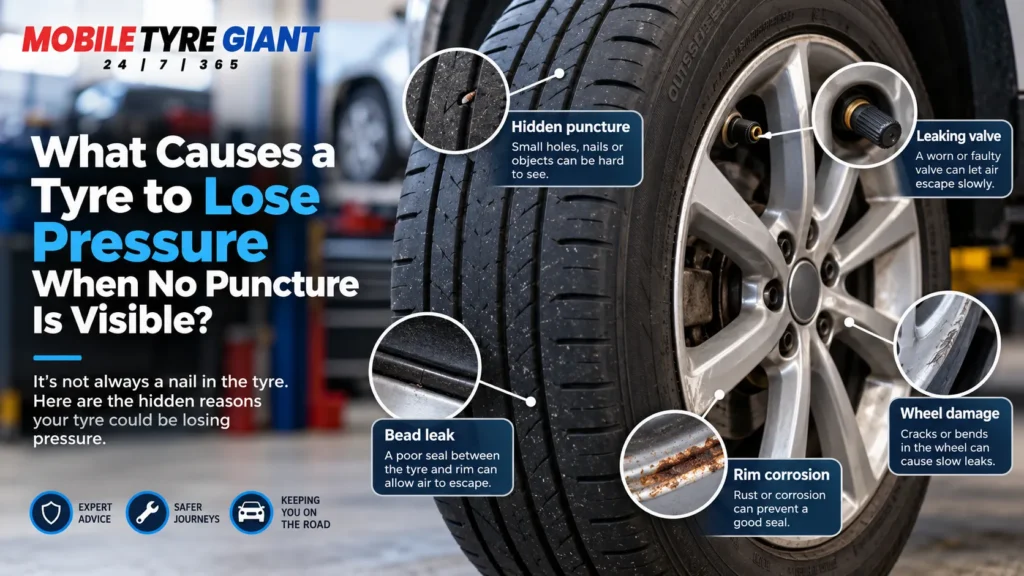
When a tyre keeps losing pressure but no puncture is visible, the leak may be coming from somewhere other than the obvious tread area. The tyre, valve and wheel all work together to keep air sealed inside, so a problem at any of these points can produce the same symptom. A tiny puncture may be hidden between tread blocks, while a valve leak can release air so slowly that the tyre still looks normal for several days. The tyre bead can also lose its seal against the wheel, especially if dirt, corrosion or wheel damage affects the contact surface. In other cases, the wheel itself may be bent or cracked after a pothole or kerb impact.
The easiest way to understand the problem is to stop thinking of it as only a tyre puncture and instead consider the complete wheel assembly. Air can escape through the tread, valve, bead or rim, and each fault may behave slightly differently. Some leaks are constant, while others may become more noticeable when the vehicle is parked, loaded or driven. A tyre may even hold pressure for a while before beginning to drop again, which can make the fault appear unpredictable. The sections below explain the most common hidden leak points and the signs that may help distinguish one from another.
Could There Be a Small or Hidden Tyre Puncture?
A puncture does not always leave a large nail or screw clearly visible in the middle of the tread. Small pieces of metal, sharp road debris or fine penetrations can create a slow air leak while remaining difficult to see during a quick inspection. Sometimes the object stays embedded in the rubber and partially seals the hole it has created. That means the tyre may lose only a small amount of pressure at first rather than becoming flat immediately. The problem can therefore continue for days before the driver realises that the same tyre is repeatedly dropping.
The location of the damage also matters because not every part of the tyre is easy to inspect while the wheel is still fitted to the vehicle. A small puncture may sit closer to the inner tread area, where it is difficult to see without turning or removing the wheel. If you find an embedded object, pulling it out immediately is not always the best move because it may cause the tyre to lose air more quickly. The important step is to have the damage assessed properly so its location, size and repairability can be checked. A slow leak may seem minor, but it still needs diagnosis if the pressure continues to fall.
Could the Tyre Valve Be Leaking?
Yes, the tyre valve can be the source of pressure loss even when the tread and sidewall look completely undamaged. Air passes through the valve every time the tyre is inflated, so the valve stem, valve core and sealing components all need to remain airtight. A loose or damaged valve core may allow air to escape slowly, while an ageing rubber valve can deteriorate over time. On vehicles with tyre pressure monitoring systems, the valve assembly may also include additional seals and components that can develop faults. This can create the frustrating situation where the tyre looks perfect but still needs air every few days.
A valve leak can sometimes be identified because bubbles appear around the valve when leak-detection fluid or soapy water is applied, although not every leak will be obvious during a quick check. If the TPMS warning keeps returning after the tyre has been inflated correctly, the valve area is one of several places worth inspecting. Where a TPMS valve or associated components are responsible, a proper TPMS valve replacement may be more appropriate than replacing an otherwise usable tyre. The key point is that a leaking valve can mimic a slow puncture surprisingly well. That is why the valve should be checked before assuming the tyre itself needs replacing.
Can Air Leak From the Tyre Bead?
The tyre bead is the reinforced edge of the tyre that sits tightly against the wheel and creates an airtight seal. If that seal becomes compromised, air can escape around the edge of the tyre even though there is no hole in the tread. Dirt, corrosion, damage or poor seating can all interfere with the contact between the tyre and wheel. A bead leak is often difficult for a driver to identify because the tyre may look completely normal from the outside. The pressure simply keeps dropping, usually slowly enough to create confusion rather than an obvious flat tyre.
In some cases, bubbles can appear around the tyre-to-wheel edge during a leak test, which helps identify the affected area. However, the exact cause still needs to be established because a leaking bead may be linked to the wheel surface rather than the tyre itself. The sealing area may need to be inspected for corrosion, contamination or physical damage before the tyre can seal correctly again. This is especially relevant when the same wheel repeatedly loses pressure even after the tyre has been changed. Replacing the rubber alone cannot solve a problem that is actually being caused by the surface it is sealing against.
Can Alloy Wheel Corrosion Cause a Slow Air Leak?
Alloy wheels can develop corrosion around the area where the tyre bead sits against the rim. Over time, oxidation and surface pitting can make that sealing surface uneven, allowing very small amounts of air to escape. The leak may be so gradual that the tyre remains usable for several days before the pressure becomes noticeably low. From the outside, the wheel may still look reasonably clean because the affected area can sit underneath the tyre bead. This is one reason repeated pressure loss can continue even when no tread puncture is found.
Corrosion-related leaks are particularly easy to misdiagnose if attention stays focused only on the tyre. The tyre itself may be perfectly capable of holding air, but it cannot do so if the wheel surface does not provide a consistent seal. A technician may need to remove the tyre from the wheel to inspect the bead seat properly and determine whether corrosion is contributing to the leak. Cleaning or repairing the wheel may be possible in some situations, while more serious damage requires a different solution. The important point is not to assume that every slow leak means the tyre is defective.
Did the Pressure Loss Start After a Pothole or Kerb Impact?
If the pressure problem started soon after hitting a pothole or clipping a kerb, the timing is an important clue. A strong impact can damage the tyre, disturb the bead seal or bend part of the wheel even when there is no obvious puncture. The outer face of the alloy may still look normal while the inner rim has taken most of the impact. That kind of hidden wheel damage can create a small gap where air escapes gradually. The driver may therefore notice repeated pressure loss days after the impact rather than an immediate flat tyre.
You should also look for other signs such as vibration, unusual steering behaviour, visible sidewall damage or a wheel that no longer appears perfectly round. Not every pothole strike causes serious damage, but pressure loss beginning directly afterwards should not be dismissed as coincidence. A proper inspection can help determine whether the issue lies in the tyre, bead or wheel. If the impact has created damage that cannot be safely repaired, replacement may eventually be necessary, but that decision should come after diagnosis rather than guesswork. The same symptom can come from several different faults, which is why the sequence of events matters.
Can Hidden Sidewall or Internal Tyre Damage Cause Pressure Loss?
Pressure loss can sometimes come from damage that is not easy to see from the outside of the tyre. The sidewall and internal tyre structure can be affected by impacts, prolonged underinflation or other forms of stress. A tyre may look acceptable at a glance while damage exists on the inner surface or within the casing. This is one reason a simple external inspection cannot confirm that a tyre is completely sound. If pressure continues to fall and the common leak points are not obvious, the tyre may need to be removed and inspected more thoroughly.
Internal or sidewall damage should be treated differently from a straightforward repairable tread puncture. The tyre’s structure plays a major role in supporting the vehicle and maintaining stability, so not every type of damage can be safely repaired. If a proper inspection finds structural damage, a mobile tyre replacement may be required rather than another temporary attempt to stop the leak. The decision depends on the exact location and condition of the damage, not simply how slowly the tyre is losing air. This is why finding the source of pressure loss matters before choosing a repair.
Can a Previous Tyre Repair Start Leaking Again?
A tyre that has been repaired in the past can still develop pressure loss later, although the previous repair should not automatically be blamed. The tyre may have picked up a completely new puncture, or a separate valve, bead or wheel problem may have developed since the original repair. However, if pressure loss appears close to an earlier repair area, that section of the tyre should be included in the inspection. Age, further road impacts and changes in the tyre’s condition can all affect how a previously repaired tyre behaves over time. The important thing is to diagnose the current leak rather than assume the old repair must be responsible.
A professional inspection can establish whether the previous repair remains sound and whether the tyre is still suitable for continued use. This may involve checking the inside of the tyre rather than judging the repair from the outer tread alone. If the repair is still secure, attention can move to the valve, bead and wheel. If a fault is found, the technician can then decide whether another repair is appropriate or whether the tyre has reached the point where replacement is the safer option. That methodical approach prevents unnecessary tyre changes while still treating repeated pressure loss seriously.
Why Is My New Tyre Still Losing Pressure?
A brand-new tyre can still lose pressure if the tyre itself was never the real source of the leak. The new tyre is fitted onto the same wheel, and depending on the work carried out, the same valve or TPMS components may still be involved. If the wheel has corrosion around the bead seat, a slightly damaged rim, or an uneven sealing surface, fitting fresh rubber will not automatically correct that problem. This is why some drivers become understandably frustrated when they replace a tyre and the same wheel starts losing air again a few days later. The pressure loss may look like a faulty new tyre, but the actual cause could be sitting underneath the tyre bead or inside the valve assembly.
The timing of the problem can provide useful clues, especially if the pressure loss began immediately after the tyre was fitted. The tyre may need to be checked for correct seating around the wheel, while the valve, bead and rim should also be inspected for leakage. A new tyre should not simply be accepted as needing repeated top-ups while it somehow “settles in.” If substantial pressure loss continues, there is a fault that deserves proper investigation. Think of fitting a new tyre like replacing the lid on a container: if the edge of the container itself is damaged, a new lid may still struggle to create a perfect seal. The sensible approach is therefore to inspect the complete wheel assembly rather than replacing another tyre without knowing where the air is escaping.
Why Does My TPMS Warning Keep Coming Back After Adding Air?
A TPMS warning that disappears after you inflate the tyre but returns again later may simply be telling you that the pressure has fallen once more. Adding air can restore the correct pressure temporarily, but it does not repair a nail hole, leaking valve, bead problem or damaged wheel. This is why repeatedly resetting the warning without checking the tyre can hide the pattern rather than solve it. If the same wheel triggers the warning again and again, compare its cold pressure with the other tyres and note how quickly it changes. A returning warning is especially useful information when the tyre looks visually normal because modern tyres can lose a meaningful amount of pressure without appearing obviously flat.
There is also another possibility: the tyre pressures may be correct while the monitoring system itself requires attention. Depending on the vehicle, TPMS sensors, valve-mounted components or system calibration can also cause warning problems, so the light should not automatically be treated as proof of a puncture. The important step is to confirm the actual pressure with a reliable gauge before drawing conclusions. If the pressure is genuinely falling, investigate the tyre and wheel for an air leak. If the measured pressures remain correct but the warning persists, the monitoring system may need separate diagnosis. Treat the warning light as information that needs interpreting rather than as a diagnosis by itself.
How Can You Find a Hidden Tyre Air Leak?
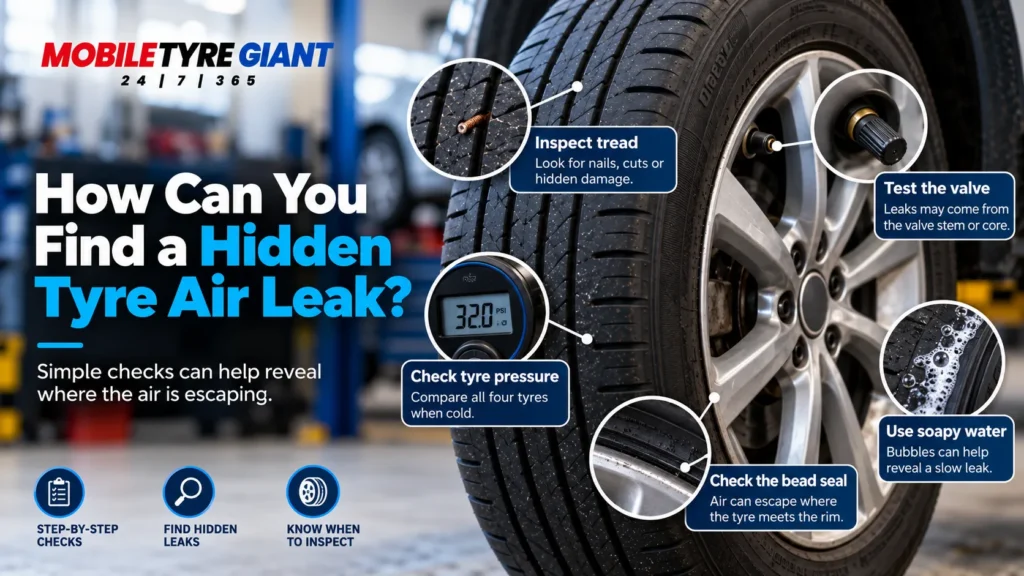
Start by checking the tyre pressures when the tyres are cold and comparing all four wheels under similar conditions. If one tyre is consistently lower, inspect the tread slowly rather than giving it a quick glance from standing height. Look between the tread blocks for small nails, screws, sharp fragments or damaged areas, then inspect as much of the sidewall as you can safely see. Pay attention to the valve as well because a valve leak can be almost invisible without testing. You should also think about when the problem started, because a recent pothole strike, kerb impact or tyre fitting can narrow down the areas worth investigating. Keeping a simple record of pressure readings over several days can also show whether the loss is gradual, rapid or inconsistent.
A basic visual check has limits because several important areas are difficult to inspect properly while the wheel remains on the vehicle. The inner tread, inside face of the wheel, bead seat and internal tyre surface may hide faults that cannot be seen from the driveway. If pressure continues to fall despite no obvious damage, a professional mobile tyre repair assessment can help identify whether the issue is a repairable puncture or another type of leak. The aim should be to locate the exact escape point before deciding what needs replacing. That prevents the common mistake of assuming the tyre must be defective simply because it is the part losing pressure. A good diagnosis checks the entire sealed system, not just the visible rubber.
Can You Use Soapy Water to Find a Slow Tyre Leak?
Soapy water can be a useful basic method for locating some slow air leaks because escaping air may create visible bubbles. The solution can be applied carefully around the tyre valve and the area where the tyre bead meets the wheel, while accessible parts of the tread can also be checked. If bubbles continue forming in one spot, that can point towards the location of an air leak. This technique is especially useful when the leak is too small to hear because a tiny hiss can easily disappear beneath normal background noise. However, treat the test as a screening method rather than a complete diagnosis. A tyre can still have a hidden problem even when you do not see any bubbles.
Very small leaks may only appear under certain conditions, and some areas simply cannot be reached properly while the wheel is fitted. An internal puncture path, damaged inner rim, or leak on the inward-facing side of the wheel may remain completely hidden during a driveway test. Weather, dirt and the thickness of the solution can also make bubbles difficult to interpret. If the tyre repeatedly loses pressure despite an apparently negative test, do not assume the problem has disappeared. The pressure loss itself is evidence that something needs explaining. At that stage, wheel removal and more thorough leak testing can provide information that a basic home check cannot.
Why Can a Garage Find No Puncture Even Though the Tyre Keeps Losing Air?
There are several reasons a quick tyre inspection may not reveal the source of repeated pressure loss. The most obvious is that the leak may not actually be a tread puncture. A valve can leak, the bead can lose its seal, corrosion can affect the wheel, or a crack may exist on a less visible part of the rim. Even a genuine puncture may be extremely small or located on the inner part of the tyre where it is difficult to see with the wheel still fitted. Some leaks can also behave intermittently, which means the tyre may appear to hold pressure during one check and lose it again later. That does not necessarily mean the earlier inspection was careless; some faults genuinely need more detailed testing.
This is why describing the pattern clearly can help when the vehicle is inspected. Tell the technician how often you add air, how much the tyre changes compared with the other wheels, and whether the problem followed a pothole strike, kerb impact or recent tyre work. Those details can direct attention towards the valve, bead or wheel instead of repeating the same tread inspection. If necessary, the tyre may need to be removed from the wheel so the internal surface and sealing areas can be examined. The important thing is not to accept repeated reinflation as the final answer when the tyre continues to lose pressure. A leak that cannot be seen still needs a cause.
What Will a Tyre Technician Check When No Puncture Is Visible?
A proper investigation should begin with the tyre’s actual pressure and condition rather than immediately assuming replacement is required. The technician may inspect the complete tread, shoulders and sidewalls for penetrations or impact damage, then check the valve stem and valve core for leakage. Attention should also move to the bead area where the tyre seals against the wheel, particularly if corrosion or damage is suspected. If the issue began after a pothole or kerb strike, the wheel itself should be checked for distortion or cracking, including areas that are difficult to see while it remains on the vehicle. Where necessary, removing the tyre allows the internal surface, previous repairs and wheel sealing surface to be examined more closely.
The final decision should be based on what is actually found rather than on the assumption that every pressure-loss problem needs a new tyre. A repairable tread puncture, faulty valve and wheel-related leak are different faults and require different solutions. Equally, structural tyre damage or damage in an unsuitable area may mean the tyre cannot safely be repaired. This diagnosis-first approach is important because it can prevent unnecessary replacement while still identifying faults that should not be ignored. If the same tyre keeps losing pressure but no puncture is visible, the goal is simple: find where the air is escaping, assess why it is happening, and then choose the appropriate repair or replacement based on the condition of the tyre and wheel.
Is It Safe to Drive When a Tyre Keeps Losing Pressure?
A tyre that repeatedly loses pressure should not be treated as normal, even if it takes several days before the warning light returns. Correct tyre pressure helps the tyre support the vehicle, maintain its shape and respond predictably during steering and braking. If the pressure falls too far, the tyre can flex more than intended and generate additional heat while driving. You may also notice heavier steering, less precise handling or the vehicle feeling different through bends. The difficulty with a slow leak is that the tyre may look acceptable when you begin a journey but continue losing air while you are driving. This is why there is no sensible universal distance that can be declared safe for every pressure-loss problem.
The condition of the tyre at the time of driving matters more than a simple mileage figure. If the tyre is visibly flat, rapidly losing pressure, showing a bulge, displaying serious sidewall damage or causing unstable handling, continuing to drive could make the problem worse. A tyre that has been driven severely underinflated may also need closer inspection even after it has been reinflated because damage is not always obvious from outside. If the pressure loss is gradual and the tyre remains correctly inflated for the moment, that still does not mean the fault should be ignored indefinitely. The safer approach is to identify why the pressure is falling before the leak becomes more serious or leaves you stranded.
When Should You Stop Driving?
You should stop and reassess the situation if the tyre is visibly collapsing under the weight of the vehicle or the pressure is dropping quickly after inflation. A sudden change in steering, vibration or the vehicle pulling unexpectedly can also indicate that the tyre or wheel needs immediate attention. Visible sidewall cuts, bulges, exposed internal material or serious wheel damage should never be dismissed just because the car can still move. If you hear unusual tyre noise or feel the vehicle becoming unstable, continuing the journey may increase the amount of damage. Pressure loss after a heavy pothole strike or kerb impact also deserves additional caution because both the tyre and wheel may have been affected.
The key is not to turn every slow leak into a roadside emergency, but equally not to normalise a tyre that repeatedly becomes underinflated. Check the actual pressure rather than relying only on how the tyre looks, because modern tyres can sometimes conceal substantial pressure loss visually. If the pressure has fallen well below the vehicle manufacturer’s recommendation, restoring it temporarily does not explain why it happened. Drivers often get into the habit of carrying a small compressor and topping the same tyre up every few days, which can make the fault feel manageable. In reality, repeated inflation is only buying time while the underlying leak remains present.
Why Is Repeatedly Topping Up the Tyre Not a Repair?
Adding air solves the immediate pressure problem but does nothing to repair the place where the air is escaping. It is similar to repeatedly filling a leaking container without finding the crack. The tyre may return to the correct pressure for a few hours or days, but the valve, puncture, bead or wheel fault is still there. This can create false reassurance because the tyre feels normal again immediately after inflation. If the pressure continues dropping, the driver may eventually become so used to topping it up that the recurring problem starts to feel routine.
The pressure-loss pattern can also change over time, particularly if the cause is physical damage that becomes worse. A tiny puncture can open further, a damaged valve can deteriorate, or an already compromised bead seal may begin losing air more quickly. Repeatedly driving while the tyre becomes underinflated can also affect the tyre’s condition and complicate the eventual repair decision. A compressor is useful for restoring pressure when appropriate, but it should not become a permanent substitute for diagnosis. Once the same tyre has required air more than once without an obvious explanation, finding the source of the leak is the more useful next step.
Can a Tyre That Keeps Losing Pressure Be Repaired?
Some pressure-loss problems can be repaired, but the correct solution depends entirely on where the leak is coming from. A small puncture in an appropriate part of the tread may be repairable after the tyre has been properly inspected. A leaking valve may require valve work rather than any repair to the tyre itself. If air is escaping around the bead, the wheel and sealing surface need to be examined to determine why the seal has failed. Corrosion, contamination or wheel damage can all influence what action is appropriate. This is why diagnosing the actual leak before choosing a repair prevents unnecessary work and reduces the risk of fixing the wrong component.
Repairability also depends on the overall condition of the tyre, not just the size of the leak. A tyre may have additional damage from being driven underinflated, an unsuitable puncture location or structural problems that are not visible from outside. Previous repairs and the age and condition of the tyre should also be considered during inspection. The technician may need to examine the inside of the tyre before deciding whether a repair is suitable. The most useful question is therefore not simply “Can slow leaks be repaired?” but “What is leaking, and is that particular fault safe and appropriate to repair?”
When Does the Tyre Need Replacing Instead?
Replacement becomes more likely when inspection identifies structural damage, unsuitable sidewall damage or a puncture that is not considered suitable for repair. The same can apply when the tyre has suffered damage from being driven while severely underinflated. A tyre that appears acceptable externally may still have internal deterioration, which is why removing it for inspection can sometimes be necessary. Age, tread condition and previous damage also contribute to the final decision. Replacing the tyre should therefore be based on its actual condition rather than on the fact that it has simply lost pressure.
It is equally important not to replace an otherwise serviceable tyre when the real problem is somewhere else. If a faulty valve or wheel sealing surface is allowing air to escape, fitting another new tyre without addressing that fault may leave you with exactly the same pressure-loss problem. This is why the tyre, valve, bead and wheel should be considered together. Proper diagnosis allows a repairable fault to be dealt with appropriately while also identifying situations where replacement is genuinely necessary. The objective is not to save or replace the tyre at all costs, but to restore a reliable airtight wheel assembly.
What Should You Do if the Same Tyre Keeps Losing Pressure?
Begin by checking the tyre when it is cold and confirming the recommended pressure for your vehicle. Compare it with the other three tyres so you can see whether the problem is isolated to one wheel or part of a wider temperature-related change. Inspect the tread and visible sidewall carefully for embedded objects, cuts or impact marks. Check the valve area and consider whether the pressure loss began after tyre fitting, a pothole strike or contact with a kerb. If you are comfortable performing a basic leak check, soapy water around accessible valve and bead areas may sometimes reveal bubbles. Keep in mind that failing to find bubbles does not prove there is no leak.
If the same tyre continues losing pressure, arrange a proper inspection rather than continuing the inflate-and-monitor cycle indefinitely. A technician can check areas that are difficult to inspect at home and determine whether the fault involves the tyre, valve, bead or wheel. Where the vehicle cannot reasonably be taken to a workshop because the tyre is too low or unsafe to drive on, mobile tyre fitting can provide a practical route to getting the wheel assessed without relying on a damaged tyre for the journey. The most important step is to move from guessing to diagnosis. Once the exact leak source is known, the correct repair or replacement decision becomes much clearer.
Final Words: No Visible Puncture Does Not Mean There Is No Leak
A tyre that keeps losing pressure is giving you useful information even when there is no nail, screw or obvious hole in sight. Air can escape from a tiny hidden puncture, the valve, the tyre bead or the wheel itself. The pattern of pressure loss often provides the first clue, particularly when one tyre repeatedly drops while the others remain stable. Cold weather can affect pressure readings, but it should not automatically be blamed for an ongoing problem affecting the same wheel. A new tyre can also continue losing air if the original fault lies in the valve, bead seat or wheel rather than the old tyre.
The practical approach is to check the pressure properly, compare the tyres, inspect what you can safely see and arrange further diagnosis when the source remains hidden. Continually adding air may keep you moving temporarily, but it is not a repair. The tyre does not automatically need replacing either, because the real cause may be a repairable puncture, valve problem or wheel-sealing issue. Finding where the air is escaping first helps avoid unnecessary work and makes the repair decision safer and more accurate. When the same tyre keeps going soft, treat the repeated pressure loss as a symptom worth investigating rather than something to keep resetting with a pump.
Tyre Keeps Losing Pressure?
If your tyre keeps losing pressure with no visible puncture, arrange a mobile inspection to find and fix the cause.
Frequently Asked Questions
Find quick answers to the most common questions our customers ask.
Yes, a tyre can lose pressure even when there is no obvious puncture in the tread. Air may escape through a leaking valve, a poor seal between the tyre bead and wheel, corrosion around the rim, wheel damage or a puncture that is too small or hidden to see easily. If the same tyre repeatedly needs air, the complete wheel assembly should be checked rather than assuming there is no leak.
If only one tyre repeatedly loses pressure while the other three remain stable, the problem is more likely to be local to that particular tyre or wheel. A hidden puncture, leaking valve, bead-seal problem or damaged wheel are all possibilities. Comparing all four tyre pressures under similar cold conditions can help confirm whether one wheel is behaving differently.
A slow leak may allow enough air to escape while the car is parked for the pressure difference to become noticeable the following morning. Small punctures, valve leaks and tyre-to-wheel sealing problems can all cause this pattern. Colder temperatures can also reduce pressure readings, but repeated overnight loss from one specific tyre should be investigated rather than automatically blamed on the weather.
Yes, a leaking valve stem, valve core or sealing component can cause a tyre to lose pressure gradually without any puncture in the tread. The tyre may appear completely normal while air escapes slowly through the valve assembly. A valve leak can sometimes be identified during leak testing and may require valve repair or replacement rather than a new tyre.
Yes, corrosion or pitting around the wheel's bead seat can interfere with the airtight seal between the tyre and rim. The affected area can sit underneath the tyre bead, so it may not be visible during a normal external inspection. If the tyre itself appears sound but the same wheel keeps losing pressure, the condition of the rim should be checked.
A new tyre can still lose pressure when the original fault is the valve, bead seal or wheel rather than the old tyre. Fitting fresh rubber does not automatically correct corrosion, a damaged rim or a leaking valve assembly. Persistent pressure loss after fitting should therefore be inspected instead of being accepted as normal settling.
The warning may return because the tyre is genuinely losing pressure again after you inflate it. In other cases, the tyre pressures may remain correct while the TPMS sensor or monitoring system requires diagnosis. Check the actual tyre pressure with a reliable gauge before assuming the warning proves there is another puncture.
Yes, soapy water can help locate some leaks because escaping air may create visible bubbles around the valve, tread or tyre-to-rim edge. It is a useful basic check, but very small, intermittent or hidden leaks may not appear during a simple driveway test. If the tyre continues losing pressure despite no bubbles being visible, further inspection is still necessary.
Repeated pressure loss should not be ignored because the tyre can become underinflated again during a journey. If the tyre is visibly flat, rapidly losing air, seriously damaged or causing unstable handling, you should not continue driving on it. Even a slower leak should be diagnosed rather than managed indefinitely with repeated inflation.
It depends on what is causing the leak and the overall condition of the tyre. Some appropriate tread punctures may be repairable, while valve or bead problems may require work elsewhere in the wheel assembly rather than tyre replacement. Structural, sidewall or other unsuitable damage may mean replacement is necessary, so the tyre should be properly inspected before the decision is made.