

A flat tyre rarely tells you the whole story from the outside. You might spot a small screw sitting neatly in the tread and assume the tyre only needs a quick repair, while another puncture that looks almost identical may have caused damage that makes replacement the safer option. That is why emergency tyre repair vs replacement is a decision based on inspection rather than appearance alone. A technician considers where the damage is located, how the tyre lost pressure, whether it was driven while underinflated, its overall condition and what can be seen inside once it is properly examined. Think of it like finding a leak in a roof: the tiny mark you see from the outside does not always reveal what has happened underneath. A small opening may have caused very little harm, or water may already have damaged the structure behind it. Tyres work in much the same way because the visible puncture is only one piece of evidence. This is particularly important when the vehicle has continued moving after the pressure dropped. The tyre may still look reasonably normal once reinflated, even though its internal structure has been stressed. The correct decision therefore begins with finding out what has actually happened rather than deciding in advance that every flat tyre should be repaired or replaced.
For a driver, the frustrating part is usually uncertainty. You may be standing beside the car thinking, “It is only a tiny nail, so why would I need a whole new tyre?” That reaction is understandable, especially when the tyre still has plenty of tread or was fitted recently. At the same time, replacing every punctured tyre would be wasteful when a proper permanent repair is suitable. Mobile Tyre Giant’s mobile tyre repair service is designed around assessing that situation at the vehicle rather than assuming the answer before inspection. If the tyre meets the appropriate repair criteria and remains structurally sound, repair may be possible. If the technician finds structural damage, serious deterioration or another condition that prevents a safe repair, mobile tyre replacement may be the correct next step instead. This transparency matters because drivers should understand why one option has been recommended. Emergency tyre repair vs replacement should never feel like a coin toss or an automatic sales decision. By understanding the checks behind the verdict, you can make sense of why two apparently similar punctures sometimes receive completely different outcomes.
Emergency Tyre Repair vs Replacement: What Is the Quick Answer?
The quick answer is that a punctured tyre may be repairable when the damage is suitable for a professional repair and the rest of the tyre remains safe for continued use. The location of the penetration matters because damage in the main tread area is treated very differently from structural damage around the shoulder or sidewall. Size and type of damage also matter, but neither one should be considered in isolation. A technician also needs to know whether the tyre was driven after losing pressure because this can create damage that was not caused by the original nail or screw. Imagine two tyres with almost identical screws in their tread. One driver notices the pressure warning quickly, stops and has the tyre assessed without continuing the journey. The other continues driving until the tyre feels soft and the steering starts to feel heavy. The visible punctures may look nearly identical when both cars are parked. Inside, however, the second tyre may have been repeatedly flexing and overheating while underinflated. That is why emergency tyre repair vs replacement cannot reliably be decided from a roadside photograph alone.
Replacement becomes more likely when inspection reveals damage that prevents the tyre from being returned safely to service. Examples can include significant sidewall damage, a bulge, exposed reinforcement, serious cuts, bead damage, internal deterioration or damage caused by running with insufficient pressure. The technician must also consider the condition of the tyre as a whole rather than focusing entirely on the puncture. A perfectly repairable-looking hole does not make cracking, structural deterioration or other serious defects disappear. Equally, the fact that the tyre has plenty of tread left does not automatically mean that every puncture should be repaired. This is where many online discussions become confusing because users understandably compare only what they can see. One driver may say, “Mine looked exactly like that and it was repaired,” without knowing what the other tyre looks like internally. A professional decision has to consider evidence from the actual tyre being examined. The useful question is therefore not simply, “Can this type of puncture be repaired?” It is, “Does this particular tyre still meet the conditions required for a suitable permanent repair?”
How Does a Technician Decide Whether a Tyre Can Be Repaired?
A technician normally starts by diagnosing the problem rather than immediately reaching for repair materials. This distinction matters because pressure loss does not always mean that a nail has pierced the tread. Air may be escaping through a damaged valve, around the seal between the tyre and wheel, through an actual penetration or because of damage caused by an impact. The outside of the tyre is therefore checked for obvious clues, including embedded objects, cuts, cracks, unusual deformation and sidewall damage. The wheel can also matter because a damaged rim may interfere with the tyre’s ability to maintain pressure. Once the source of the leak is identified, the technician can start asking whether the problem is actually suitable for repair. This is the point where emergency tyre repair vs replacement becomes a structured decision rather than a guess. The location and type of damage are assessed alongside the general condition of the tyre. Evidence that the tyre has been run underinflated also raises additional questions about what may have happened internally. A competent inspection therefore builds the decision step by step instead of relying on one visible feature.
The process is useful for drivers because it explains why the cheapest-looking answer is not always the correct one. Suppose a screw has entered the tread and the tyre is still holding most of its pressure. If the damage is in a suitable area and the tyre remains sound internally, the eventual decision may favour repair rather than throwing away a serviceable tyre. Now imagine the same screw but add a deep sidewall scuff, a previous poor repair or signs that the tyre was driven almost flat. Suddenly, fixing the original penetration does not solve the complete problem. This is why a technician should be able to explain what was found rather than simply saying “repairable” or “not repairable.” Good tyre assessment is less like patching a bicycle tube and more like checking whether the entire structure can continue doing its job after the repair. The tyre carries the vehicle, absorbs impacts, changes shape constantly and transfers braking and steering forces to the road. Any permanent repair therefore has to make sense in the context of the tyre as a complete safety component. The next stages of the inspection focus particularly on the source of the pressure loss and the exact position of the damage.
First, the Technician Identifies Why the Tyre Lost Pressure
A tyre that feels soft or triggers a pressure warning can lose air for several reasons, so finding the actual cause comes first. A nail or screw is an obvious suspect when one can be seen in the tread, but visible objects can sometimes be misleading. One real-world situation drivers often describe is finding a large object in the tyre and assuming it must be responsible, only for inspection to reveal that the real leak comes from another small penetration nearby. Slow leaks can also come from valves or from the area where the tyre seals against the wheel. Impact damage from a pothole or kerb can introduce another possibility because the tyre or wheel may have been damaged without leaving a neat puncture hole. This is why simply spraying the visible nail with soapy water or checking whether the tyre feels firm does not give the complete diagnosis. The technician needs to locate the path through which pressure is actually escaping. If an embedded object is still in place, it may even restrict the rate of air loss temporarily. A tyre that appears to be holding air today may therefore still contain a genuine penetration. Correctly identifying the cause prevents the wrong problem from being repaired while the real leak remains untreated.
This first diagnostic step also affects whether the tyre should be moved or driven any farther. If pressure has already dropped significantly, continued driving may turn a straightforward puncture into a more complicated tyre failure. The sidewalls are designed to operate with the support of the correct internal pressure, and when that support disappears they can flex far more than intended. From the driver’s seat, the first clues may be a heavy feeling through the steering, a dull rhythmic noise or the car beginning to pull differently. Those sensations should not be treated as an invitation to squeeze another few miles out of the tyre. The longer a conventional tyre is used in a seriously underinflated condition, the greater the concern about secondary damage. This does not mean there is a universal distance at which every tyre suddenly becomes unrepairable. Vehicle load, tyre construction, remaining pressure, speed and road conditions can all change what happens. What matters for emergency tyre repair vs replacement is that the technician knows the pressure-loss history as well as the original cause. That information helps determine what needs to be inspected more closely before any permanent repair is considered.
Next, the Damage Location and Type Are Checked
Once the source of the pressure loss has been identified, attention turns to exactly where and how the tyre has been damaged. A straightforward penetration through an appropriate part of the main tread presents a very different repair question from damage extending into the shoulder or sidewall. The tyre’s different areas do different jobs and experience different levels of movement while the vehicle is being driven. The sidewall, for example, flexes repeatedly as the tyre rotates and supports the weight of the vehicle, which is why significant structural damage there is treated much more seriously than a suitable minor tread penetration. You can think of the difference like a small hole in the flat centre of a sturdy surface compared with damage at a constantly moving hinge. Both marks may look small, but the stresses acting around them are not the same. The technician therefore checks the entry point, surrounding rubber and visible extent of the damage rather than judging only the object that caused it. A thin screw does not automatically mean minor damage, just as a dramatic-looking nail head does not prove that the tyre must be replaced. The path and position of the penetration matter more than how alarming the object looks from outside. This is where a proper emergency tyre repair vs replacement assessment starts separating appearance from actual repairability.
The condition around the damaged area also matters because punctures rarely exist in isolation from the rest of the tyre. A technician may find cracking, unusual wear, a bulge, cuts, exposed reinforcement or previous repair work close to the new damage. These findings can change the decision even when the fresh puncture itself initially looks straightforward. Sidewall problems deserve particular care because drivers sometimes assume that a small cut should be treated exactly like a small tread puncture. Our detailed guide to tyre sidewall damage explains why cuts, cracks and bulges in this area need a different assessment. The technician also checks whether the object entered cleanly or whether the surrounding material has been torn or distorted. That distinction matters because the visible diameter of a nail is not necessarily the full extent of the injury it created. At this stage, the fitter has gathered enough information to understand the external damage, but one important question can still remain unanswered. What happened on the inside of the tyre while the pressure was falling or after the vehicle continued moving? That internal inspection is where apparently simple punctures can sometimes produce unexpected repair-or-replacement decisions.
The Overall Condition of the Tyre Is Assessed
Finding a repairable-looking puncture does not mean the technician can ignore everything else happening to the tyre. The tread, sidewalls, bead area and visible casing condition all contribute to the final emergency tyre repair vs replacement decision. A tyre may have a small penetration in a favourable position but also show deep cracking, abnormal wear or damage from a previous impact. In that situation, sealing the puncture would solve only one part of a larger problem. Remaining tread depth is also checked because a tyre must still be suitable for continued road use after any repair is completed. For cars and light vans in the UK, the legal minimum tread depth is 1.6 mm across the required central portion of the tread and around its circumference. That legal limit should not be confused with the professional puncture repair area, because the two rules describe different things. The technician may also notice uneven wear that hints at another issue affecting how the tyre has been running. Even when that wear does not directly prevent a puncture repair, it gives useful context about the tyre’s overall condition. A sensible repair decision therefore asks whether the complete tyre still has worthwhile and safe service life ahead of it.
Previous repair work can matter too, especially if a technician finds an old repair close to the new puncture or something that does not appear to have been carried out correctly. Imagine patching the same section of a waterproof jacket several times until the surrounding fabric becomes weaker than the original tear. A tyre is far more safety-critical, but the principle helps explain why repair history cannot simply be ignored. The technician needs to consider where previous damage occurred, how it was repaired and how the new injury relates to it. Ageing rubber can also develop visible cracking or stiffness even when the tread still looks reasonably deep from a distance. Bulges, exposed reinforcement or obvious deformation deserve particular attention because they can indicate structural damage rather than ordinary tread wear. Drivers understandably focus on the object they can see, but the fitter has to look beyond that single nail or screw. This wider inspection protects against the false assumption that fixing the air leak automatically restores the tyre. In a professional emergency tyre repair vs replacement assessment, the tyre has to make sense as a complete component after the repair, not merely hold pressure for the next journey. That distinction is what separates a proper repair decision from a quick attempt to stop air escaping.
Why Is the Location of the Puncture So Important?
Puncture location matters because different parts of a tyre experience different forces as the wheel rotates, corners, brakes and carries the weight of the vehicle. The main tread area is supported differently from the shoulder and sidewall, which constantly flex as the tyre moves through its contact patch. A small penetration through a suitable part of the tread may therefore fall within the conditions considered for a professional minor repair. Move similar-looking damage towards the edge of the tread, however, and the repair decision can change considerably. This is why drivers sometimes receive different answers when two punctures appear almost identical at first glance. The important question is not simply how big the nail head looks but where the actual damage passes through the tyre structure. The shoulder acts as the transition between the tread and sidewall, so it experiences substantial movement during normal driving. The sidewall is even more dependent on controlled flexing and structural integrity. Damage in these areas cannot be judged using the same assumptions applied to an ordinary central tread penetration. For emergency tyre repair vs replacement, location is therefore one of the first major filters in the technician’s decision.
This is also why measuring the distance from a nail to the tyre edge with a ruler or judging a photograph online can give false confidence. A photograph may show roughly where the object entered, but it cannot confirm the complete puncture path or what has happened beneath the rubber. Some online advice reduces the decision to a single universal boundary, but real inspection is more nuanced. Tyre type, size, construction, damage category and the condition of the surrounding structure all matter. A technician follows the applicable professional repair criteria rather than inventing a safe zone by eye. For drivers, the practical takeaway is simple: damage nearer the shoulder or sidewall deserves more caution than a straightforward penetration well within an appropriate tread area. That does not mean every mark near the edge has exactly the same diagnosis, but it does mean the assessment becomes more restrictive. Mobile Tyre Giant’s existing guide to tyre sidewall damage goes deeper into cuts, cracks, bulges and structural concerns in this area. Keeping the location discussion accurate avoids the dangerous idea that every small hole is automatically repairable. It also explains why a fitter may reject a repair even when the visible object itself looks harmless.
What Happens When the Puncture Is in the Main Tread Area?
A minor penetration in an appropriate part of the main tread gives the technician a better starting point for considering repair, but it is still not an automatic yes. The tyre must first be inspected to confirm that the damage is suitable in type and extent and that no other condition rules out continued use. A common example is a screw entering through the tread while the tyre still retains most of its pressure. If the driver notices the problem early, avoids unnecessary driving and the internal structure remains sound, a permanent repair may be possible after proper inspection. This is the situation many drivers imagine when they hear the phrase puncture repair. The mistake is assuming that every tread puncture fits the same pattern. A larger tear, distorted injury or damage combined with serious tyre deterioration may lead to a different conclusion. The technician also needs to understand the actual penetration path rather than relying only on the size of the object left in the tread. Sometimes a screw enters at an angle or causes more damage beneath the surface than its small head suggests. That is why emergency tyre repair vs replacement remains an inspection-based process even when the puncture appears to be in the most favourable location.
The encouraging part for drivers is that replacement is not automatically the default whenever something pierces the tread. If the tyre is otherwise healthy and the injury meets the correct repair criteria, preserving a serviceable tyre can be perfectly sensible. This matters particularly when the tyre is relatively new, because throwing away a sound tyre simply because it picked up a suitable minor puncture would create unnecessary expense. The technician’s role is not to choose the most expensive outcome but to determine whether the tyre can return to service safely after a proper repair. A trustworthy explanation should therefore include what was found, where the damage sits and whether there is any secondary deterioration. If repair is appropriate, Mobile Tyre Giant can provide mobile tyre repair at the vehicle’s location without requiring the driver to move a damaged tyre unnecessarily. If inspection later reveals something more serious, the recommendation can change. That flexibility is important because the final verdict should follow the condition of the tyre rather than the service originally requested. In other words, booking a puncture assessment should not lock the technician into repairing something that inspection shows should be replaced. The aim is to reach the right emergency tyre repair vs replacement decision for the actual tyre in front of them.
Why Do Shoulder and Sidewall Damage Change the Decision?
The shoulder and sidewall deserve a different level of caution because they move and flex much more than the flatter central tread area. Every rotation compresses and releases the tyre as it enters and leaves the road’s contact patch, while cornering and braking add further stress. Damage in these structural zones can therefore behave differently from a straightforward penetration through an appropriate tread area. A cut may appear short while the vehicle is parked but open and close repeatedly as the tyre flexes under load. A bulge is especially concerning because it can indicate that internal reinforcement has been damaged and pressure is pushing the rubber outward. Exposed cords or obvious structural distortion are also signs that the problem goes far beyond a simple air leak. These are the situations where trying to “save” the tyre can become false economy. Stopping the leak does not restore structural strength that has already been lost. For this reason, significant shoulder or sidewall damage commonly pushes the emergency tyre repair vs replacement decision towards replacement rather than a normal minor repair. The physical behaviour of that part of the tyre is what makes the location so important.
Drivers sometimes resist that verdict because the tyre may still look almost new elsewhere. You might have deep tread, no obvious ageing and only one small-looking mark near the edge, yet the location of that damage can outweigh how much usable tread remains. It is similar to finding a crack in the hinge of an otherwise new door: the rest of the door can be pristine, but the failure has occurred where repeated movement matters most. The same principle helps explain why a nearly new tyre is not automatically repairable. A professional fitter should be able to show or explain the damage rather than expecting the customer to accept a vague statement. This is especially useful when replacement is recommended, because clear reasoning reduces the suspicion that a new tyre is being sold unnecessarily. If the tyre is unsuitable for permanent repair, an on-site tyre replacement can resolve the problem without forcing the driver to travel on compromised rubber. The important point is that replacement should follow evidence, not appearance or mileage alone. Shoulder and sidewall condition therefore form one of the clearest dividing lines between straightforward puncture repair and more serious tyre damage. The next stage is even harder for the driver to judge because it involves damage that may be completely invisible from outside.
Why Does the Tyre Need to Be Inspected From the Inside?
The outside of a tyre can only reveal part of what has happened, which is why internal inspection plays such an important role in the emergency tyre repair vs replacement decision. A screw may leave a tiny entry point in the tread, yet the inside of the tyre can show abrasion, torn material or evidence that the casing has been stressed after pressure was lost. The inner liner is designed to help the tyre retain air, and damage to this surface can affect whether a permanent repair remains suitable. A technician may also find rubber debris inside the tyre, which can be a warning that the tyre has been flexing excessively while underinflated. None of these signs can be judged properly from a photograph of the tread. Even a tyre that has been reinflated and looks normal again may carry marks inside that tell a very different story. This is why simply stopping the leak is not the same as proving that the tyre is safe to return to service. The puncture channel itself also needs to be examined because the object may have travelled through the tyre at an angle rather than passing straight through. That difference can affect the extent and position of the internal injury. A proper inspection therefore gives the technician evidence that the driver cannot see while the tyre remains mounted on the wheel.
This is one of the biggest reasons two visually similar punctures can produce different outcomes. Imagine two tyres with screws sitting almost the same distance from the centre of the tread. The first tyre was noticed quickly, remained mostly inflated and shows no secondary damage once removed. The second was driven for several miles with very low pressure, leaving scuffing and structural damage on the inside. From the outside, both tyres could look like simple puncture-repair jobs. Once opened up, however, the second tyre may no longer be suitable for repair. That is why sending a photograph to a fitter can be useful for giving an initial idea but cannot guarantee the final verdict. A photo can show approximate location and obvious external damage, but it cannot reveal the condition of the inner liner, casing or reinforcement. Professional emergency tyre repair vs replacement therefore depends on what is discovered after inspection, not just the appearance of the nail head. This transparency is important because it gives the driver a clear technical reason when the expected repair turns into a replacement.
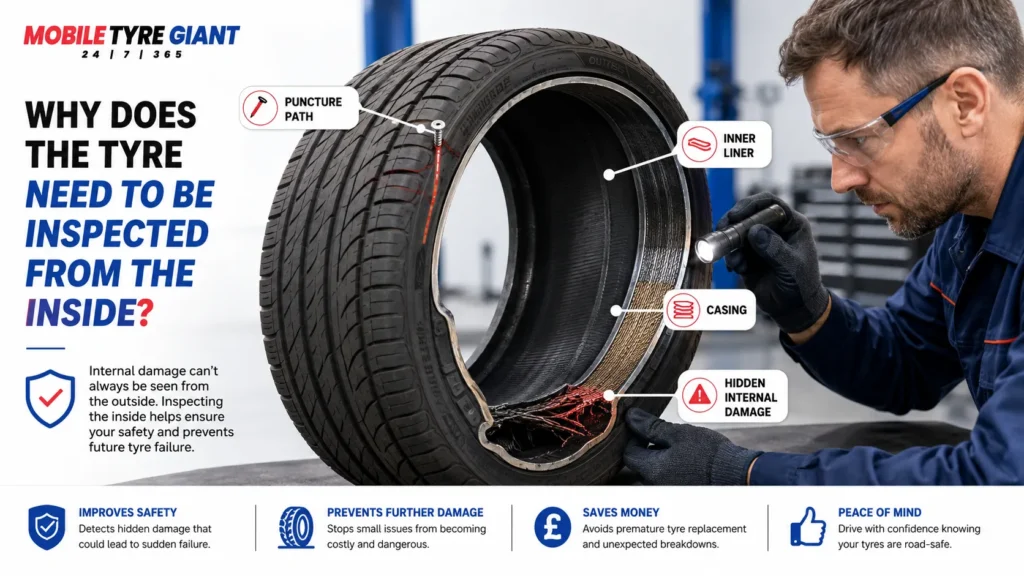
What Can a Technician Find Inside That You Cannot See From Outside?
Internal inspection can reveal damage that develops after the original puncture rather than from the object itself. When a tyre runs with insufficient pressure, the sidewalls and casing can flex much more than intended, generating heat and friction within the structure. A technician may find abrasion around the inner liner, loose rubber particles or signs that the casing has been repeatedly compressed. These clues can show that the tyre was stressed while supporting the vehicle without enough air pressure. The puncture path may also be larger or more irregular on the inside than it appears from the tread surface. In some cases, an old repair or previous damage may only become clear after the tyre has been removed. The bead area can also be examined more closely for damage that could affect how the tyre seals against the wheel. All of these findings matter because a permanent repair should address a tyre that remains structurally suitable, not simply close a hole. If the tyre has already suffered serious internal deterioration, adding a repair to the puncture will not reverse that damage. The technician therefore needs to judge the condition of the complete structure before choosing repair over replacement.
For the driver, this can feel surprising because the outside of the tyre may still look relatively clean. There may be no dramatic split, no bulge and no visible cords, yet the internal surface can show clear evidence that the tyre has been operated in a damaging condition. Think of a shoe with a perfectly normal-looking upper but a cracked sole hidden underneath. The appearance from one angle does not tell you whether the whole structure remains sound. Tyres deserve even more caution because they continuously carry load, absorb impacts and transfer steering and braking forces to the road. This is also why a fitter should be willing to explain what was found rather than giving a vague statement that the tyre “cannot be done.” When replacement is recommended, showing or describing the internal damage makes the reasoning much easier to understand. It also helps separate a legitimate safety decision from the fear many drivers have that they are simply being upsold. Good diagnosis is based on visible evidence, tyre condition and applicable repair criteria. That approach makes the final emergency tyre repair vs replacement decision far more credible.
Can Driving on a Flat Turn a Repairable Puncture Into a Replacement?
Yes, a puncture that might originally have been repairable can become unsuitable if the tyre is driven with very low or zero pressure. Air pressure supports the tyre’s shape and helps it carry the weight of the vehicle correctly. When that pressure drops significantly, the sidewalls flex much more deeply every time the wheel rotates. This repeated compression creates heat and can damage the inner liner, casing or other structural components. The driver may notice the steering becoming heavier, the vehicle pulling, a dull thumping sound or a soft, unstable feeling from one corner of the car. Continuing to drive in that condition can make the original puncture only one part of the problem. A small screw in an appropriate tread area may therefore begin as a potentially repairable injury but end with the tyre requiring replacement because of secondary damage. There is no honest universal distance that guarantees a tyre will remain repairable or become ruined. Vehicle weight, tyre construction, speed, remaining pressure and road conditions all affect the outcome. The safest approach is to avoid unnecessary driving once significant pressure loss becomes apparent and arrange an assessment as soon as practical.
This is why the history of the incident matters during an emergency tyre repair vs replacement inspection. A technician may ask whether the pressure warning appeared before the tyre went visibly flat, how far the vehicle travelled afterwards and whether the tyre was reinflated at any point. Those questions are not small talk because they help identify the risk of hidden damage. A driver who stopped soon after noticing the problem may have preserved a tyre that can still be repaired after inspection. Someone who continued until the tyre was visibly collapsed may have created much greater structural stress. Our guide on driving with a flat tyre explains why continued use can quickly turn a puncture into a more serious problem. The key lesson is not that every flat tyre automatically needs replacing. It is that repairability can change after the original puncture occurs. Once significant secondary damage develops, repairing the hole alone no longer solves the safety issue. That is why early action can sometimes make the difference between preserving the tyre and needing a replacement.
What Tyre Damage Usually Points Towards Replacement?
Replacement becomes the more likely outcome when the technician finds damage that affects the tyre’s structure rather than only a suitable minor penetration. A bulge is one of the clearest warning signs because it can indicate damage to internal reinforcement, allowing pressure to push the rubber outward. Exposed cords or reinforcement are another serious concern because they show that protective rubber has been damaged deeply enough to reveal structural material. Significant cuts, splits, bead damage or obvious casing deterioration can also make a normal puncture repair inappropriate. Serious cracking deserves attention as well, particularly when it is widespread or accompanied by other signs of ageing or deterioration. Internal damage caused by driving with low pressure can be just as important even when the outside still looks fairly normal. A tyre with severe structural damage should not be treated as a simple air-leak problem. Once the structure itself is compromised, stopping the puncture from leaking does not restore the tyre to proper condition. This is why replacement is sometimes recommended even when the visible hole looks small. The final decision is based on the complete condition of the tyre, not the appearance of the puncture alone.
The table below shows how the main findings can influence the emergency tyre repair vs replacement decision, although every tyre still needs to be assessed individually. A suitable tread penetration in an otherwise sound tyre may be repairable, while sidewall or internal structural damage can move the decision towards replacement. Temporary sealant or an external emergency plug does not prove that the tyre qualifies for a permanent repair because the inside still needs to be checked. Run-flat tyres also require careful assessment because manufacturer guidance and the tyre’s condition after pressure loss can affect what is permitted. Replacement can feel frustrating when the tread is still deep, but remaining tread does not cancel out structural damage. In the same way, repair should not be rejected simply because replacement would be easier or more profitable. The correct outcome is whichever option returns a suitable tyre to service without ignoring damage that makes continued use unsafe. If inspection shows that a permanent repair is not appropriate, Mobile Tyre Giant’s mobile tyre replacement service provides an on-site route to getting the vehicle moving again. The value of the assessment is that repair is chosen when the tyre genuinely qualifies and replacement is chosen when the evidence points the other way. That is the practical balance drivers should expect from a professional service.
What the Technician Finds | Likely Outcome | Why |
Suitable minor tread penetration and tyre otherwise sound | Repair may be possible | Damage may meet professional repair criteria |
Significant shoulder or sidewall damage | Replacement likely | Structural area has been affected |
Internal damage after underinflated driving | Replacement likely | Secondary damage goes beyond the original puncture |
Bulge or exposed reinforcement | Replacement | Structural integrity may be compromised |
Serious cracking, casing or bead damage | Replacement | The tyre may no longer be suitable for continued service |
Temporary plug or sealant already used | Further inspection required | Stopping air loss does not prove permanent repairability |
Run-flat tyre with puncture | Case-specific assessment | Manufacturer guidance and tyre condition matter |
What Is the Difference Between an Emergency Fix and a Permanent Tyre Repair?
An emergency tyre fix and a permanent professional repair are not the same thing, even though both may stop air escaping for a period of time. Emergency sealants and externally inserted plugs are mainly intended to restore temporary mobility so the vehicle can be moved to a safer place or assessed professionally. They can be useful when a driver is stranded, but the fact that the tyre begins holding pressure again does not confirm that the structure is suitable for continued long-term use. A permanent repair requires the damage itself and the condition of the tyre to meet the appropriate repair criteria. This is why a technician may still need to remove and inspect a tyre after sealant or an emergency plug has apparently solved the leak. The internal surface may show damage that the temporary repair has hidden from view. Sealant can also make the puncture less obvious from outside, so the fitter needs to identify the original injury carefully. Think of an emergency repair like placing a container under a leaking pipe. It may control the immediate problem, but it does not tell you whether the pipe itself is still sound. In emergency tyre repair vs replacement, restoring pressure is only one part of the assessment.
The distinction becomes particularly important when drivers use a repair kit and then continue driving because the tyre appears normal again. If the tyre has suffered structural damage, temporary pressure retention does not reverse what has already happened inside. A professional technician should therefore treat any previous emergency repair as part of the tyre’s history rather than assuming the problem is finished. The repair material, location of the penetration, tyre condition and any evidence of low-pressure driving still need to be considered. This does not mean that using sealant automatically condemns every tyre to replacement. Some tyres may still qualify for an appropriate permanent repair after the temporary material has been dealt with and the tyre has been properly inspected. Others will not. The important lesson is that “not leaking anymore” and “permanently repaired” are two different conclusions. Drivers who understand this distinction are less likely to keep using a damaged tyre simply because the pressure gauge temporarily looks normal. A proper emergency tyre repair vs replacement decision must still be based on the tyre itself.
Can a Run-Flat Tyre Be Repaired or Does It Need Replacing?
Run-flat tyres create more confusion than almost any other puncture scenario because there is no honest universal answer that applies to every product. Their reinforced construction is designed to help the vehicle remain mobile for a limited period after pressure loss, but that ability does not mean the tyre can always be repaired afterwards. The technician needs to consider the specific tyre, the damage location, the manufacturer’s repair guidance and what happened while the tyre was operating with reduced or zero pressure. Some run-flat manufacturers permit certain repairs under defined conditions, while others impose stricter limitations. The problem is that a run-flat can continue looking relatively normal even after substantial pressure has been lost. That makes visual assessment from outside particularly unreliable. The tyre may have been carrying the vehicle on its reinforced structure while internal heat and flexing were occurring. A technician therefore needs more information than simply knowing that the car reached its destination. In emergency tyre repair vs replacement, run-flat construction changes the assessment but does not eliminate the need for inspection.
Drivers should also avoid assuming that every fitter who recommends replacement is automatically being overcautious, or that every fitter willing to repair the tyre must therefore be correct. Manufacturer instructions and actual tyre condition should guide the decision. This is where a transparent explanation becomes valuable because the technician should be able to identify why the particular run-flat is or is not considered suitable for repair. If you are unsure how these tyres differ from conventional ones, our guide to run-flat tyres vs normal tyres explains the construction and driving differences in more detail. What matters here is that run-flat capability is not a free pass to keep driving indefinitely after pressure loss. The longer the tyre operates in a stressed condition, the greater the concern about damage that may not be visible externally. A nearly new run-flat can therefore still need replacing after a puncture, just as an older one may sometimes remain repairable if the correct conditions are met. The final verdict should always follow the tyre manufacturer’s requirements and the evidence found during inspection.
Can a Mobile Tyre Fitter Assess Repair vs Replacement On-Site?
Yes, a mobile tyre fitter can assess many puncture situations at the vehicle’s location and determine whether repair or replacement is the appropriate next step. This is particularly useful when the tyre is flat, the driver is at home or work, or moving the vehicle could make the damage worse. The technician can begin by identifying the source of the pressure loss, checking the damage location and inspecting the overall condition of the tyre and wheel. If the problem is suitable for an approved repair, the repair can often be completed without the vehicle travelling to a conventional garage. If inspection shows that the tyre cannot safely be repaired, the fitter can move to the replacement option instead. This flexibility matters because drivers do not always know which service they genuinely need when they first call. Someone may book a puncture repair and discover that the tyre has serious internal damage. Another driver may expect replacement only to learn that a proper repair is possible. The purpose of the assessment is to let the condition of the tyre decide the service rather than forcing the original booking to dictate the outcome.
For Mobile Tyre Giant, this means the customer can start with the problem rather than trying to diagnose the tyre before requesting help. A driver can explain whether the tyre is losing pressure, completely flat, damaged after an impact or showing an embedded object, and the technician can investigate from there. If the tyre has suffered a more serious failure, such as becoming badly damaged or separating from the wheel, the situation is different from an ordinary minor puncture. Our guide on what to do when a tyre has come off the rim explains those more severe cases separately. For a typical puncture, however, the best outcome is not automatically “repair” or “replacement.” It is the option supported by the inspection. That is what makes on-site assessment useful for emergency tyre repair vs replacement, especially when the driver cannot safely move the vehicle. Clear communication about what has been found should remain part of the service so the customer understands why the recommendation changed if replacement becomes necessary.
What Should You Do While Waiting for the Tyre to Be Assessed?
The first priority is to avoid turning a manageable tyre problem into a more serious one. If the tyre is visibly flat or pressure has dropped significantly, avoid driving on it unless moving the vehicle is essential for immediate safety. If a nail or screw is still embedded, do not pull it out simply to see how deep it is because the object may currently be slowing the air loss. Keep the vehicle somewhere safe and away from moving traffic where possible. If you know the tyre size, vehicle registration and approximate location of the damage, having that information ready can make the mobile assessment easier. You can usually find tyre-size markings on the sidewall, although there is no reason to put yourself in danger trying to read them beside fast-moving traffic. Avoid experimenting with repeated inflation if the tyre is badly damaged, bulging or visibly separating from the wheel. A pressure reading can be useful information, but it does not replace inspection. The goal while waiting is to preserve the tyre’s current condition rather than testing how far it can still travel. This gives the technician the best chance of making an accurate emergency tyre repair vs replacement decision.
It is also worth remembering that a roadside situation can change priorities. If you are stopped in a dangerous position, personal safety comes before trying to inspect the tyre yourself. Do not crouch beside a wheel close to live traffic simply to photograph a screw or check the tread. A good description of what happened, including when the pressure warning appeared and whether the vehicle was driven afterwards, may be more useful than a risky close-up photograph. If you used sealant or another emergency repair product, tell the technician because that information forms part of the assessment. The same applies if the tyre has been repaired previously or has recently suffered an impact. These details help build a clearer picture before the tyre is examined. Most importantly, do not assume that because the tyre is still holding some pressure the problem has stopped developing. Early professional assessment can prevent unnecessary extra damage and may preserve a tyre that would otherwise become unsuitable for repair.
Final Words: Repair the Tyre When It Is Suitable, Replace It When It Is Not
The most important point in emergency tyre repair vs replacement is that neither option should be chosen automatically. A puncture that looks small may still require replacement if it affects the wrong part of the tyre or if hidden structural damage has developed. At the same time, a serviceable tyre should not be discarded simply because a nail or screw has entered an area that can be properly repaired. The technician needs to consider the cause of pressure loss, location of the damage, condition of the tyre, previous repair history and evidence of underinflated driving. Internal inspection can then reveal the part of the story that cannot be seen from outside. This is why photographs, mileage and visible tread depth can help but cannot make the final decision alone. A good repair is about returning a suitable tyre to service, while a good replacement decision is about recognising when that is no longer possible. The evidence should decide, not assumptions about cost or appearance. That approach protects both safety and unnecessary spending.
For drivers, the practical takeaway is simple: treat a puncture as something that needs assessment rather than something you must diagnose yourself. Avoid unnecessary driving, leave embedded objects in place and explain clearly what happened before the pressure loss was noticed. If a professional repair is suitable, it can preserve a tyre that still has useful life remaining. If structural damage or another serious condition makes repair inappropriate, replacement is the correct outcome even when the puncture itself looks minor. Mobile Tyre Giant can assess the tyre where the vehicle is located and provide the appropriate repair or replacement route according to what is found. The customer should also expect a clear explanation when the final recommendation differs from what they initially expected. That transparency is especially important when the tyre is relatively new or the damage looks deceptively small. Ultimately, the right emergency tyre repair vs replacement decision is the one supported by the condition of the complete tyre.
Not Sure Whether Your Tyre Needs Repair or Replacement?
Mobile Tyre Giant can inspect the damage at your location and determine whether a safe repair is possible or a replacement is needed.
Frequently Asked Questions
Find quick answers to the most common questions our customers ask.
No. Some punctures can be repaired when the damage falls within an appropriate repair area and the tyre remains structurally sound, but sidewall damage, internal deterioration, serious cuts, bead problems or damage caused by underinflated driving can make replacement necessary.
There is no reliable universal distance that a driver should measure from a photograph. Professional repairability depends on the permitted repair area for the tyre and the actual damage, while significant shoulder or sidewall damage generally requires a different assessment.
A normal minor car-tyre repair is generally not suitable for significant structural sidewall damage. Because the sidewall flexes constantly while driving, punctures, cuts, bulges or structural damage in this area commonly lead to replacement.
Usually, leave the object in place until the tyre has been assessed. Pulling it out may allow air to escape faster, and removing it does not tell you whether the tyre is suitable for a permanent professional repair.
Holding air does not prove the tyre is safe to continue using normally. The object may be partly sealing the penetration, and pressure can fall later, while driving underinflated can create additional internal damage that changes the repair decision.
Yes. A puncture that may initially have been suitable for repair can become unrepairable if continued driving with very low or zero pressure damages the inner liner, casing or sidewall structure.
An externally inserted emergency plug should not automatically be treated as a permanent professional repair. It may restore temporary mobility, but the tyre still needs assessment to determine whether it meets the conditions for an appropriate permanent repair.
Sometimes. Run-flat repairability depends on the tyre manufacturer, the position and type of damage, the overall condition of the tyre and whether it has been driven after losing pressure.
Potentially, yes. Using sealant does not automatically mean the tyre must be replaced, but the temporary material must not be treated as proof that the tyre is permanently repairable, and professional inspection is still required.
Because visible puncture size is only one part of the assessment. A small hole may be in an unsuitable location or accompanied by internal, casing, bead or underinflation damage that cannot be seen while looking at the tyre from outside.