

Finding a mark on the side of a tyre can be confusing because tyre sidewall damage does not always look dramatic. You might notice a shallow cut after brushing a kerb, fine cracks while checking the tyres at home, or a rounded bulge that seems to have appeared after hitting a pothole. The first reaction is often the same: is this simply cosmetic, or is the tyre no longer safe to use? That question matters because the sidewall is not just a decorative outer layer of rubber. It forms part of the tyre’s load-bearing structure and flexes continuously as the wheel turns. A harmless-looking surface mark and damage affecting the internal reinforcement can therefore require very different responses.
The difficult part for a driver is that the tyre may still look inflated and the car may still feel completely normal. A tyre holding pressure does not automatically tell you whether every part of its internal structure is undamaged. Equally, replacing a tyre because of every tiny scuff would be unnecessary and expensive. The sensible approach is to identify what type of damage you are looking at and then consider its depth, location and appearance. This guide explains cuts, cracks, bulges and other common sidewall marks in practical terms, without treating every imperfection as an emergency. If you want a broader overview of regular inspection points, our Tyre Safety Guide explains the main tyre checks UK drivers should carry out.
What Is Tyre Sidewall Damage?
The sidewall is the area of the tyre between the tread and the wheel rim, and it has to perform several jobs at the same time. It helps support the vehicle’s weight, contains inflation pressure and flexes whenever the tyre passes over bumps and uneven road surfaces. Beneath the visible outer rubber are reinforcing components such as the tyre carcass and cords, which contribute to the tyre’s strength. Tyre sidewall damage can therefore range from a mark affecting only the outer rubber to a defect involving those deeper structural layers. Think of it like a thick protective jacket over a reinforced frame. Scuffing the jacket is different from damaging the frame underneath, even if both marks initially appear on the surface.
That distinction is why photographs and quick roadside glances do not always provide a definite answer. A light abrasion caused by rubbing against a kerb may only disturb the outer rubber, while a sharp impact can damage reinforcing material beneath a surface that still holds air. Incorrect inflation can also make the sidewall flex differently and increase stress during normal driving, so pressure remains an important part of overall tyre care. Our Tyre Pressure Guide explains how to find and check the manufacturer’s recommended pressures correctly. When examining the sidewall itself, look at the shape of the damage as well as its size. Cuts, cracks and bulges each tell a different story, which is why identifying the type of damage is the first useful step.
What Does Tyre Sidewall Damage Look Like?
There is no single appearance that represents all tyre sidewall damage. A cut normally appears as a localised slice, split or gouge, while cracking tends to form multiple fine lines across areas of ageing rubber. A bulge is different again because the shape of the sidewall itself changes and protrudes outward. Drivers may also see scuffs, scratches, missing pieces of surface rubber or a loose rubber flap after contact with a kerb. Some of these marks may be superficial, whereas others can indicate that the tyre needs professional assessment. This is why describing damage simply as “a mark on the tyre” does not provide enough information.
A useful first check is to look at whether the sidewall remains its normal shape and whether anything beneath the outer rubber is visible. Never assume that a tyre is safe simply because the damage is small or because the pressure has not fallen. At the same time, avoid assuming that every surface scratch means immediate structural failure. The table below gives a simple visual guide to the most common forms of damage before we examine each one in more detail. It is intended to help identify what you may be looking at, not to certify an uncertain tyre as safe for continued driving.
What you notice | Typical appearance | What it may indicate |
Sidewall cut or gouge | Localised slice, split or missing rubber | Surface damage or deeper impact damage |
Fine cracking | Multiple small lines in the rubber | Ageing or rubber deterioration |
Deep or widespread cracking | Larger splits or clearly deteriorated rubber | More advanced deterioration |
Outward bulge | Rounded area projecting from the sidewall | Possible internal structural damage |
Light scuff | Surface abrasion without obvious deformation | Often cosmetic, but depth still matters |
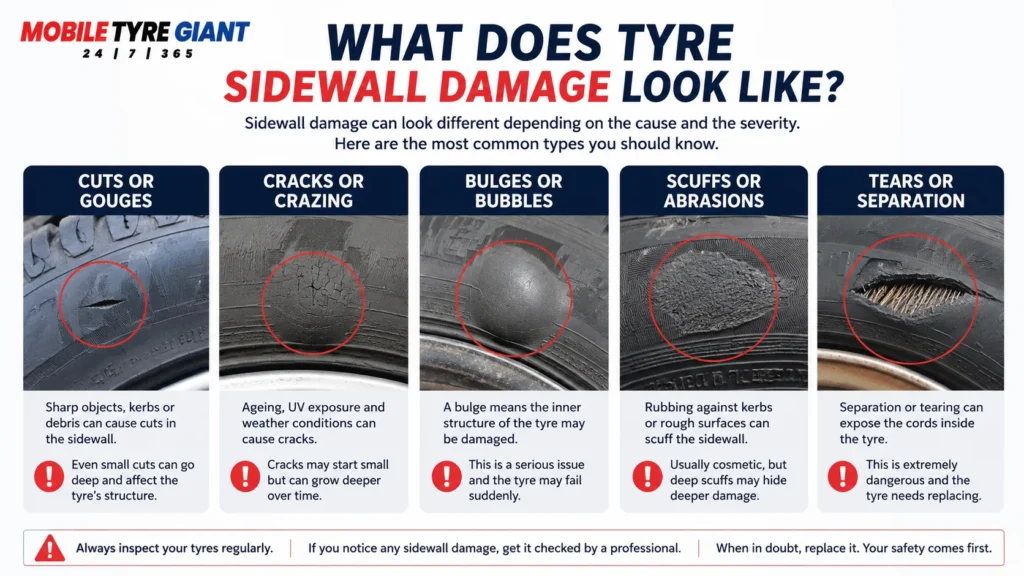
Tyre Sidewall Cuts and Gouges
A tyre sidewall cut often appears after the tyre contacts a kerb, sharp debris or another hard object. Some cuts remove only a thin layer of surface rubber, leaving what looks like a small flap or shallow gouge. Others penetrate deeper and may reach the reinforcing layers beneath the surface. The visible length of the cut alone does not tell you how serious it is because a short but deep cut can matter more than a longer superficial scrape. You should also pay attention to whether the damaged area changes shape when the tyre is loaded. A cut accompanied by exposed cords, a growing bulge or another obvious structural change is very different from a light surface nick.
Drivers often become concerned after finding a small chunk missing from the sidewall even though the tyre is still holding normal pressure. That reaction is understandable because the remaining pressure can make the damage seem less serious than it looks. However, air retention tells you that the tyre has not developed an obvious leak at that moment; it does not provide a complete assessment of the carcass underneath. Conversely, missing surface rubber does not automatically mean that the internal structure has been reached. If the depth cannot be judged confidently, professional inspection is more reliable than pulling at the rubber or trying to open the cut yourself. The goal is to determine whether the damage is limited to the protective outer layer or has affected something deeper.
Tyre Sidewall Cracks and Crazing
Tyre sidewall cracks usually develop differently from sudden impact cuts. Instead of one localised slice, you may see networks of fine lines forming across the rubber, sometimes described as crazing or perishing. Rubber naturally changes as tyres age and are exposed to heat, sunlight, weather and environmental conditions. Fine surface lines can therefore look very different from deep cracks opening through deteriorated rubber. A tyre can also have plenty of tread remaining while the sidewall shows signs of ageing. This is an important reminder that tread depth is only one part of tyre condition.
When checking cracked rubber, look at how widespread the cracking is and whether individual cracks appear shallow or deep. Small surface lines should not be described in exactly the same way as large splits that expose material beneath the rubber. Tyre age, storage history and overall condition also provide useful context when deterioration is suspected. Cracking that becomes deeper, spreads significantly or appears alongside other defects deserves closer assessment rather than being ignored because the tyre has not gone flat. Regular visual inspections make these changes easier to notice before they become severe. The purpose is not to panic at the first fine line, but to recognise when normal-looking ageing may be progressing into more significant deterioration.
Tyre Sidewall Bulges and Bubbles
A tyre sidewall bulge or bubble is usually easier to recognise because the contour of the tyre changes. Instead of a flat or gently curved sidewall, one area pushes outward like a small swelling beneath the rubber. This can happen after a hard pothole or kerb impact damages internal reinforcing cords while the outer rubber remains largely intact. The tyre may continue holding air because the pressure-containing layers have not necessarily opened into an obvious leak. That is why a bulge should not be judged by pressure loss alone. A genuine outward bulge can indicate that the structure supporting that area has been weakened.
It is also important not to confuse an outward bulge with every small irregularity visible on a radial tyre. Some tyres show slight inward indentations where internal materials overlap during manufacture, and those can be normal features rather than signs of failure. Direction therefore matters: an area protruding outward is not the same as a shallow inward line or depression. If an outward bubble appears after a noticeable impact, especially after hitting a pothole, it should be taken seriously even if the vehicle still drives normally. The next part of this guide will explain how to separate cosmetic marks from structural warning signs and what common causes can tell you about the level of concern. Understanding that difference is far more useful than applying the same verdict to every mark on a tyre.
What Causes Tyre Sidewall Damage?
Tyre sidewalls are designed to flex repeatedly, but they can still be damaged by sudden impacts, poor road conditions, sharp objects and gradual deterioration. One of the most common situations is hitting a pothole hard enough for the tyre to become compressed between the road surface and the wheel. Kerbs can cause a similar problem, particularly when the tyre catches the edge at an awkward angle while parking or turning. Sharp road debris may create a more obvious cut or gouge, while long-term ageing tends to produce cracking rather than one sudden defect. Incorrect tyre pressure can also change how much the sidewall flexes and how effectively the tyre absorbs impacts. The cause therefore provides useful context, although it cannot tell you on its own whether the damage is cosmetic or structural.
The timing of the damage is not always obvious either. A driver may remember a heavy pothole impact but notice the bulge only later when checking the car at home, while another person may find a cut without recalling any particular incident. This is one reason visual tyre checks after a strong impact are useful even when the vehicle continues to drive normally. You should look at the visible outer sidewall, but remember that the inner sidewall can also be affected and is much harder to inspect during a quick walk around the car. New vibration, unusual pressure loss or an obvious change in the tyre’s shape after an impact should not simply be ignored. Understanding the likely cause helps you decide what deserves closer attention, but the appearance and depth of the actual damage remain more important than guessing when it happened.
Potholes and Kerb Impacts
A hard pothole impact can place a large amount of force through a relatively small section of the tyre. Imagine squeezing a flexible cushion sharply between two hard surfaces: the sidewall has to deform quickly as the wheel drops into the pothole and then climbs back out. In more severe impacts, the internal reinforcement can be overstressed even if the outer rubber does not split open. This is one reason a tyre sidewall bulge may appear after a pothole without an obvious puncture. The same type of compression can occur when a tyre strikes a kerb with enough force. Low-profile tyres can make drivers particularly aware of these impacts because there is less visible sidewall between the road and wheel, although any tyre can suffer impact damage under the wrong conditions.
Kerb contact can also create a different type of damage when the sidewall rubs rather than strikes directly. You may see scraped rubber, a shallow gouge or a small flap where the outer layer has been caught by the kerb. A light scrape and a deep impact cut are not the same defect, so the fact that both happened while parking does not mean they should receive the same verdict. After a significant pothole or kerb strike, check for a new outward bulge, cuts, pressure changes and obvious wheel damage once you are somewhere safe. If the vehicle develops vibration afterwards, that also deserves attention because an impact can affect more than the visible tyre surface. Our guide on what to do if a tyre blows out while driving explains the emergency response if tyre damage progresses to a sudden failure while the vehicle is moving.
Ageing, Weather and Rubber Deterioration
Cracking usually develops more gradually than impact damage because tyre rubber changes as it gets older. Heat, sunlight, oxygen and environmental exposure can all contribute to deterioration over time, particularly when a vehicle spends long periods parked outside. The rubber may begin to look dry and develop fine lines that become easier to see when the sidewall flexes. These early surface cracks can be quite different from large splits opening deeply into deteriorated rubber. That is why describing every visible crack as equally dangerous would be misleading. The overall condition of the tyre, depth of the cracking and age of the rubber all help provide context.
Drivers sometimes focus almost entirely on tread because tread depth is easy to measure and widely discussed. A tyre can still have useful tread remaining while its sidewalls show signs of ageing, especially on vehicles that cover relatively low annual mileage. Caravans, second cars and vehicles stored for long periods can be good examples because the tyres may age without wearing their tread quickly. Regular checks should therefore include the whole visible tyre rather than only the grooves touching the road. If cracking becomes deeper, widespread or accompanied by other defects, it deserves more attention than a few faint surface lines. Ageing cannot be reversed by adding air or applying cosmetic tyre products, so significant deterioration needs to be judged by the actual condition of the tyre.
Incorrect Tyre Pressure and Excessive Flexing
Tyre pressure affects how the sidewall behaves every time the vehicle moves. When pressure is too low, the tyre can deform more than intended as it rolls, which increases sidewall flex and can make the tyre more vulnerable to heat and impact-related stress. It is similar to repeatedly bending a piece of flexible material farther than necessary: the extra movement changes the loads passing through it. This does not mean every underinflated tyre will suddenly develop a bulge or crack, but incorrect pressure can contribute to conditions that are harder on the sidewall. Overloading the vehicle can create additional stress for similar reasons because the tyre has to support more weight. Maintaining the manufacturer’s recommended pressure is therefore part of protecting both the tread and sidewall.
Another problem is that drivers sometimes reduce pressure intentionally because they believe a softer tyre will absorb potholes more comfortably. That is not a sensible way to protect the tyre because lower pressure changes its operating shape and can leave less protection between the wheel and a hard road impact. Pressure should be set according to the vehicle manufacturer’s recommendations, including any different figures specified for heavier loads. If one tyre repeatedly loses pressure, simply topping it up without investigating the cause is also a poor long-term solution. A valve problem, puncture, bead issue or tyre damage may be responsible. Sidewall care works best when correct pressure is treated as routine maintenance rather than something checked only after a warning light appears.
How Serious Is Tyre Sidewall Damage?
The seriousness of tyre sidewall damage depends much more on what has actually been affected than on how dramatic the mark looks from a distance. A broad black scuff can look alarming but remain limited to the outer rubber, while a small outward bubble may indicate a more important structural problem beneath an otherwise clean surface. The most useful distinction is therefore between superficial damage and signs that the tyre’s reinforcing structure may have been compromised. Visible cords or ply, a genuine outward bulge, a significant tear or deep damage are much more concerning than a light surface abrasion. Unknown-depth cuts sit between those two categories because it may not be possible to judge them confidently without inspection. This is why sidewall assessment should not become a simple size contest where the smallest mark is assumed safe and the largest mark is assumed dangerous.
Drivers should also resist testing a cut aggressively by pulling at loose rubber or pushing objects into it. Doing that can make the damage worse and still may not tell you what is happening inside the carcass. Instead, note whether the tyre has changed shape, whether reinforcing material is visible and whether the defect appeared after a significant impact. Look for other warning signs such as a new bulge or pressure change, while remembering that the absence of those signs does not provide a complete guarantee. When the depth or structure cannot be judged confidently, professional assessment is more useful than repeatedly comparing photographs online. The goal is not to label every imperfect tyre unsafe, but to avoid overlooking the signs that separate surface damage from a genuine structural concern.
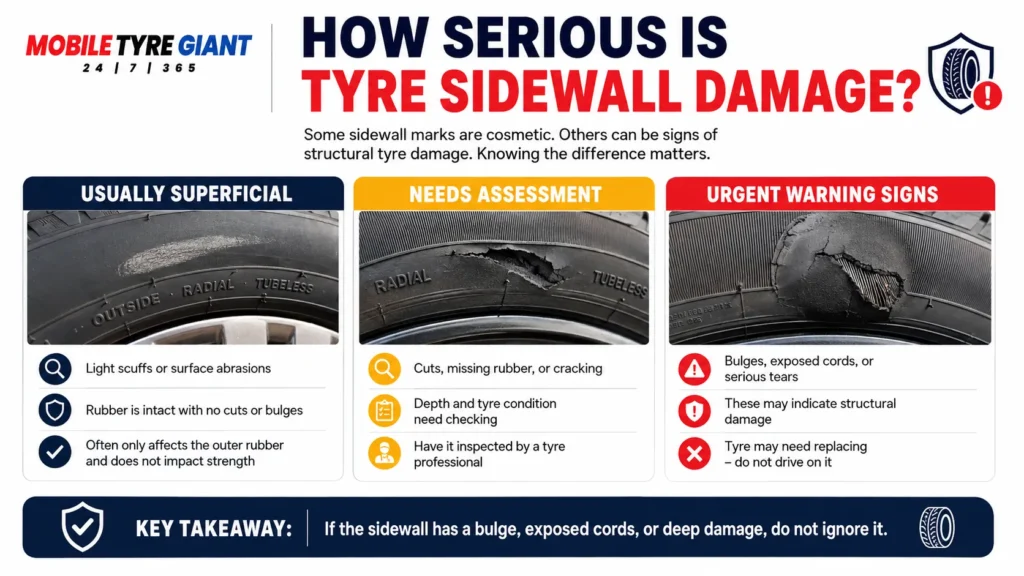
Cosmetic Sidewall Scuffs vs Structural Damage
Cosmetic sidewall damage usually affects the external rubber without altering the normal shape of the tyre or exposing its reinforcing structure. Typical examples include light abrasions from brushing a kerb, superficial scratches and shallow marks around raised lettering or protective rubber features. These can look unpleasant, particularly on a new tyre, but appearance alone does not prove that the tyre has lost structural strength. Structural damage is different because the problem extends beyond the outer surface and may involve cords, plies or separation within the tyre. An outward bulge is one of the clearest visual clues that something beneath the surface may no longer be supporting pressure normally. A deep cut that exposes reinforcing material is another much more serious warning sign.
The difficult cases are those sitting between the two extremes, such as a chunk of rubber missing with no obvious cords visible. Drivers often look for one simple rule that will give an immediate yes or no answer, but tyres do not always cooperate with that approach. A photograph can show the general appearance but may hide depth, inner-sidewall damage or changes that become clearer when the tyre is inspected properly. If you have just clipped a kerb and found a loose flap, avoid assuming that gluing the rubber back down repairs whatever caused it. Adhesive may change how the surface looks, but it cannot rebuild damaged internal reinforcement. Where the condition is uncertain, having the tyre assessed gives you a much firmer basis for deciding whether it can remain in service.
Tyre Bulge vs Normal Sidewall Indentation
A genuine tyre bulge usually projects outward from the normal sidewall contour and can look like a rounded bubble trapped beneath the rubber. That outward shape matters because it may indicate that internal reinforcement has been weakened and pressure is pushing the affected area farther outward than the surrounding sidewall. A normal radial tyre indentation looks different because it generally pulls slightly inward rather than swelling outward. These shallow inward lines can appear where internal tyre materials overlap during construction. They may become more noticeable under certain lighting or when the tyre is viewed from an angle. Seeing an irregular shape therefore does not automatically mean that the tyre has developed structural damage.
The direction and behaviour of the deformation are more informative than simply calling every uneven area a bulge. If the area clearly protrudes outward, appeared after a pothole or kerb impact, or seems to be increasing, it deserves prompt attention. A shallow inward indentation that has remained consistent can be part of normal radial tyre construction rather than a developing failure. Drivers who are unsure should avoid making the decision based only on a dark photograph taken from one angle because shadows can make subtle shapes difficult to interpret. Looking across the sidewall from several angles in good light can help you understand whether the surface is pushing outward or dipping inward. Where doubt remains, professional inspection is the safer way to distinguish a harmless construction feature from genuine tyre sidewall damage.
Can You Drive With Tyre Sidewall Damage?
Whether you can continue driving depends on the type and seriousness of the damage rather than simply on the fact that a mark exists. A light surface scuff is very different from an outward bulge, deep tear or exposed reinforcing material. If the sidewall has clearly changed shape or there are signs that the tyre structure may have been compromised, it should not be treated like a harmless cosmetic mark. The difficulty is that some damaged tyres can still feel completely normal from the driver’s seat. There may be no steering change, no warning light and no immediate loss of pressure. That normal feeling can create false reassurance when the real issue is hidden beneath the outer rubber.
The safest approach is to base the decision on the condition of the tyre rather than on how urgently you need to reach your destination. If you are uncertain about a cut, newly developed bulge or impact-related damage, professional assessment is more useful than trying to prove that the tyre can survive another journey. This becomes especially important before motorway driving, where speeds are higher and there are fewer safe opportunities to stop if the condition worsens. A clearly superficial mark may not require the same response as structural damage, but unknown damage should not be dismissed simply because the car remains driveable. If a tyre does fail while the vehicle is moving, our guide to what to do during a tyre blowout explains the safest immediate response. The key question is therefore not “can the car still move?” but “is there enough evidence to trust the tyre’s condition?”
Is Sidewall Damage Safe If the Tyre Is Still Holding Air?
A tyre that continues to hold its normal pressure can certainly seem reassuring. Many drivers discover a cut or bulge, check the pressure and conclude that the tyre must be structurally sound because no air is escaping. The problem with that assumption is that inflation pressure only tells you whether there is an obvious leak at that moment. It does not confirm that every reinforcing cord, ply or internal layer remains undamaged. A pothole impact, for example, may weaken the internal structure without immediately opening a path for air to escape. The tyre can therefore remain inflated while still showing another warning sign such as an outward bulge.
Pressure should still be checked because a sudden or continuing drop is useful evidence that something is wrong. However, it should be considered alongside the appearance of the sidewall, the circumstances that caused the damage and any change in the tyre’s shape. Think of an inflated tyre like a sealed container with a supporting frame around it. The container can still hold pressure even if part of that supporting frame has been weakened. This is why repeatedly checking that the PSI has stayed the same is not a substitute for inspecting visible sidewall damage properly. If you are unsure what pressure the tyre should have in the first place, our Tyre Pressure Guide explains how to use the vehicle manufacturer’s recommended figures. Normal pressure is useful information, but it should never become the only reason for declaring damaged sidewall rubber safe.
What If the Sidewall Cut Has No Cords Showing?
Not seeing any cords or reinforcing material is generally better than finding them exposed, but it does not automatically give every sidewall cut a clean bill of health. The outer rubber exists partly to protect the reinforcing structure underneath, so a shallow mark that remains within that rubber can be very different from a deeper cut. The challenge is determining the actual depth without causing additional damage. A loose rubber flap can make a cut look dramatic from one angle while hiding the bottom of the affected area from another. Drivers sometimes pull at the flap or push into the cut in an attempt to see whether cords are present. That is not a sensible way to inspect a tyre because it can disturb the damaged rubber and still provide an incomplete view.
Visible cords are an important warning sign because they show that the defect has reached the reinforcing material. Their absence, however, should be treated as one piece of evidence rather than a universal DIY test. Internal impact damage can also exist without reinforcement being obviously visible through the outer sidewall. If the cut followed a strong kerb or pothole strike, the history of the impact matters alongside what can be seen on the surface. The same applies if the tyre has developed a new bulge near the damaged area or if the depth of the cut cannot be judged confidently. Small cuts that appear completely superficial may ultimately prove to involve only the outer rubber, but uncertain cases are better inspected than guessed at. This distinction prevents two opposite mistakes: replacing every tyre with a tiny surface nick and continuing to use a tyre whose deeper damage has simply been overlooked.
Can Tyre Sidewall Damage Be Repaired?
Structural tyre sidewall damage should not be treated in the same way as a straightforward puncture in a suitable part of the tread. The sidewall flexes continuously as the tyre rotates, supports load and changes shape over road imperfections, which makes it a very different repair environment from the central tread area. A conventional puncture repair may be possible when the damage is located in an approved repair area and the tyre remains otherwise suitable, but that does not mean a plug or patch can safely rebuild damaged sidewall reinforcement. Cuts, punctures and bulges affecting the sidewall therefore require a different decision. If internal cords have been compromised or the tyre has developed structural separation, simply sealing the surface does not restore the original strength.
This is also why products intended as temporary puncture measures should not be confused with structural repairs. Adding sealant, applying adhesive to a rubber flap or inserting an external plug cannot reverse damage to the carcass underneath. A tyre technician needs to consider where the damage is located and whether the tyre remains suitable for repair before any permanent repair is attempted. Our mobile tyre repair service is relevant when a tyre has a puncture that can be properly assessed for repairability. If the problem is genuine structural sidewall damage, the practical solution is more likely to involve replacement than repair. Understanding that difference can save a driver from wasting time trying temporary fixes on a tyre that needs a fundamentally different solution.
Sidewall Puncture vs Repairable Tread Puncture
A nail entering the central tread and a sharp object piercing the sidewall may both create a loss of air, but they are not equivalent repair situations. The tread is thicker and contains a defined central area where certain minor punctures can sometimes be repaired after proper inspection. The sidewall, by contrast, bends significantly during every wheel rotation. That continuous movement places different stresses on any damaged area and is one reason sidewall punctures are not handled like ordinary repairable tread punctures. The location of the injury therefore matters just as much as its apparent size. A tiny hole in the wrong area can present a different repair decision from a similar-sized hole in the approved central tread region.
Drivers should also remember that the object causing the puncture may have damaged more than the visible entry point. Before repairing a suitable tread puncture, the tyre still needs assessment for secondary damage, run-flat damage or other conditions that could make a repair inappropriate. This is particularly important if the tyre was driven for some distance while badly underinflated. If you find a nail or screw, avoid assuming that every puncture automatically requires replacement or that every puncture can automatically be repaired. Location, condition and damage history all matter. The key comparison is simple: a repairable tread puncture involves restoring a suitable localised injury, while structural sidewall damage may involve a part of the tyre that cannot be safely restored in the same way. That is why identifying the damaged area correctly comes before deciding whether repair or replacement makes sense.
Repair or Replace a Damaged Sidewall?
Replacement becomes the more realistic option when sidewall damage has affected the tyre’s structural integrity. Examples include a genuine outward bulge, exposed reinforcing cords, a significant structural cut or another defect that cannot be restored through an approved tyre repair. This can be frustrating when the tyre is relatively new and still has plenty of tread, but tread remaining on the tyre does not repair damage elsewhere. The decision should be based on whether the tyre can continue performing its structural job safely, not simply on how much rubber is left in the tread grooves. It is similar to a shoe with a nearly new sole but a torn supporting side section: the unused sole does not remove the separate structural problem. The condition of the entire tyre matters.
Where replacement is necessary, there is also no benefit in driving farther than needed simply to reach a conventional tyre shop. If the tyre is questionable to drive on, arranging mobile tyre replacement allows the problem to be dealt with at the vehicle’s location where service availability and circumstances permit. A technician can also confirm the tyre size and assess the visible damage before replacement, which helps avoid relying on guesses made from an online photograph. Drivers should provide accurate vehicle and tyre information when arranging assistance because dimensions, load ratings and other specifications matter when selecting the replacement. The purpose of replacement is not merely to remove an ugly mark from the sidewall. It is to restore a tyre that can safely perform the load-bearing, pressure-containing and road-contact functions expected of it.
Will Tyre Sidewall Damage Fail an MOT?
Tyre sidewall damage can cause an MOT failure, but not every visible mark automatically means the tyre will fail. The assessment depends on the type, depth and structural significance of the defect. Visible ply or cords are a serious concern because they show that the damage has reached the tyre’s reinforcing structure. Cuts can also become an MOT issue when they are sufficiently large and deep enough to affect the cords beneath the rubber. A genuine lump, bulge or tear caused by structural separation or partial failure is treated much more seriously than a shallow cosmetic scuff. This distinction matters because drivers sometimes assume that any scratch on the sidewall automatically makes the vehicle unroadworthy.
MOT assessment also recognises that radial tyres can show normal sidewall irregularities that are not caused by structural failure. A slight inward indentation, for example, should not automatically be confused with an outward structural bulge. This is another reason why judging a tyre from one photograph can be unreliable. If your MOT is approaching and you have noticed a cut, crack, bulge or exposed material, getting the tyre checked beforehand can prevent uncertainty on the day of the test. Passing an MOT also should not be used as a permanent guarantee that a tyre will remain suitable indefinitely, because tyre condition can change after the inspection. Regular inspection between MOT tests remains an important part of keeping the vehicle roadworthy.
What Should You Do After Hitting a Kerb or Pothole?
After a significant kerb or pothole impact, first continue only until you can stop somewhere safe to inspect the vehicle. Look at the tyre for a new cut, missing rubber, outward bulge or obvious pressure loss, and check the wheel for visible damage as well. If the impact felt particularly harsh, remember that the inner sidewall may also have been affected even though it is difficult to see during a normal roadside check. Listen and feel for new vibration, steering changes or unusual noises once the vehicle is moving again. A tyre pressure warning can provide useful information, but the absence of a warning does not prove that no damage occurred. Impact damage can sometimes affect internal reinforcement without creating an immediate puncture.
If you find a genuine bulge, exposed reinforcement, major tear or another defect that makes you question the tyre’s structure, continuing a normal journey simply to see whether it survives is not a sensible test. The same caution applies before a long motorway journey, where sustained speed increases the consequences of tyre failure. If the mark appears minor but its depth cannot be judged confidently, a professional tyre inspection can provide a much clearer answer than comparing photographs online. Avoid pulling aggressively at rubber flaps, inserting objects into cuts or trying to reshape a damaged area yourself. Those methods can make inspection harder and may worsen the defect. The aim after an impact is simple: identify obvious warning signs early and avoid turning uncertain damage into a bigger problem.
How Can You Reduce the Risk of Tyre Sidewall Damage?
Not every pothole or piece of road debris can be avoided, but good tyre maintenance can reduce unnecessary stress on the sidewall. Start with correct tyre pressure because an underinflated tyre flexes more heavily and can be more vulnerable when it hits a sharp edge or pothole. Pressure should be checked when the tyres are cold and adjusted according to the vehicle manufacturer’s recommended figures rather than a generic PSI found online. Drivers should also avoid repeatedly mounting kerbs, especially at speed or at a sharp angle. A kerb may look smooth from the driver’s seat, but its edge can scrape or pinch the sidewall against the wheel. Regular visual checks make it easier to notice small changes before they are forgotten.
It is also useful to inspect tyres before long journeys and after any unusually strong impact. Look beyond tread depth and check the visible sidewalls for cracking, cuts, unusual deformation or areas where rubber has been removed. Tyres on vehicles that cover low mileage still deserve attention because rubber can deteriorate with age even when tread wear is limited. If you are unsure what should be included in a routine inspection, our Tyre Safety Guide covers pressure, tread, visible damage and other practical checks in more detail. Prevention does not mean trying to keep tyres looking cosmetically perfect. It means maintaining the conditions that allow them to flex, carry load and absorb normal road impacts as intended.
When Does Tyre Sidewall Damage Need Replacement?
Replacement becomes the sensible option when sidewall damage has affected, or is strongly suspected of affecting, the structural integrity of the tyre. A genuine outward bulge is an important example because it can indicate damaged internal reinforcement. Exposed ply or cords, significant tears, deep structural cuts and sidewall punctures that fall outside the normal repairable tread area also point towards replacement rather than a conventional puncture repair. Severe deterioration and deep widespread cracking can lead to the same conclusion. The fact that a tyre has plenty of tread remaining does not cancel out a serious defect elsewhere. Tread life and structural condition are two separate parts of deciding whether a tyre remains suitable for service.
There are also cases where the correct decision cannot be made confidently from appearance alone. A shallow kerb scuff may prove to be cosmetic, while a similar-looking area can hide deeper impact damage. When the damage cannot be judged with confidence, professional assessment helps avoid both unnecessary replacement and unsafe continued use. If the tyre has genuine structural sidewall damage and should not be driven normally, our mobile tyre replacement service provides an option for dealing with the tyre at the vehicle’s location. The important point is not to replace tyres automatically because they look imperfect. Replacement should follow evidence that the tyre cannot safely continue performing its structural job or cannot be repaired appropriately.
Final Words: Know When Tyre Sidewall Damage Needs Attention
Tyre sidewall damage is easier to understand once you stop treating every mark as the same problem. A shallow scuff, fine cracking, deep cut and outward bulge can all appear on the same part of the tyre while meaning very different things. The most important distinction is whether the problem appears limited to the outer rubber or shows signs that the reinforcing structure beneath it may have been affected. Pressure retention, remaining tread and the fact that the car still feels normal can all provide useful information, but none of them should be used alone to declare uncertain sidewall damage safe. Bulges, exposed cords and significant structural damage deserve a very different response from ordinary cosmetic marks.
If you notice damage after clipping a kerb, hitting a pothole or carrying out a routine tyre check, inspect what you can safely see and consider how the damage occurred. Avoid experimenting with glue, makeshift plugs or aggressive probing where the depth is unclear. A professional assessment is the better option when you cannot confidently distinguish superficial damage from a structural problem. Where replacement is necessary, the goal is not simply to make the tyre look better but to restore a roadworthy tyre capable of supporting the vehicle and maintaining pressure correctly. Taking sidewall damage seriously does not mean panicking over every scratch. It means recognising the warning signs that genuinely matter and responding appropriately.
Worried About Tyre Sidewall Damage? Get It Sorted Safely
If your tyre has a cut, crack, bulge or other sidewall damage, Mobile Tyre Giant can assess the problem and provide mobile tyre assistance where needed.
Frequently Asked Questions
Find quick answers to the most common questions our customers ask.
A small sidewall cut can sometimes be limited to the outer rubber, but size alone does not determine whether it is safe. The depth of the cut and whether any reinforcing material has been affected are more important. If cords or ply are visible, the damage is clearly more serious. Where the depth cannot be judged confidently, professional inspection is preferable to assuming that a short cut is harmless.
Not necessarily. A damaged tyre can continue holding normal pressure even when an impact has affected part of its internal reinforcement. Pressure retention tells you that there is no obvious air leak at that moment, but it does not prove that the entire tyre structure remains undamaged. A bulge, deep cut or other structural warning sign should therefore not be ignored simply because the PSI remains stable.
Not seeing cords is better than finding reinforcing material exposed, but it is not a complete safety test. The damage may still be difficult to assess if the cut is deep, followed a strong impact or sits beneath a loose rubber flap. Avoid pulling the damage apart to investigate it yourself. If you cannot confidently determine whether the cut is superficial, have the tyre inspected.
Structural sidewall damage is generally not handled like a normal repairable puncture in the central tread. The sidewall flexes constantly while the tyre is moving, and a patch or plug cannot rebuild damaged internal reinforcement. If you are unsure whether the problem is a tread puncture or sidewall damage, our mobile tyre repair service explains how puncture repairability is assessed.
It can, depending on the defect. Exposed ply or cords, qualifying deep cuts and structural lumps, bulges or tears can result in an MOT failure, while a superficial cosmetic mark is not automatically treated in the same way. The important issue is whether the damage affects the tyre's structure and meets the relevant MOT defect criteria.
A genuine outward bulge is a serious warning because it can indicate that internal reinforcement has been damaged. That type of structural problem is not something that can be restored with a normal puncture repair. However, drivers should first distinguish an outward bulge from a normal slight inward indentation found on some radial tyres.
A bulge normally pushes outward from the tyre's usual contour and can indicate structural weakness beneath the rubber. A normal radial tyre indentation generally dips slightly inward and can result from overlapping internal materials used during construction. If the shape is difficult to identify, especially after a recent impact, professional assessment is more reliable than judging it from one viewing angle.
Serious structural sidewall damage can increase the risk of tyre failure and sudden pressure loss. The concern is greater where the tyre has a genuine bulge, exposed reinforcement or significant structural damage. A superficial scuff should not be described as carrying the same risk, which is why correctly identifying the type of damage matters.
Yes. A hard pothole impact can damage internal tyre reinforcement without immediately causing an obvious puncture. The tyre may continue holding pressure while a bulge or other deformation becomes noticeable afterwards. This is why checking the tyre after a significant impact is useful even when the pressure warning system remains quiet.
Yes. Cuts, bulges and impact damage can occur on the inner sidewall as well as the outer side that is easy to inspect. Inner-sidewall problems may not be visible during a quick walk around the vehicle, particularly when the car is parked close to the ground. If a strong impact occurred or symptoms such as vibration develop without obvious outer damage, a more complete tyre inspection may be needed.