
Getting a flat tyre on the North Circular A406 can be particularly stressful because of the road’s heavy traffic and complicated junctions. This major London route carries cars, delivery vans, lorries and commuters travelling between different parts of the capital. Some sections have several lanes in each direction, while others include traffic lights, roundabouts and busy connecting roads. Unlike a motorway, the A406 does not have a continuous hard shoulder where drivers can pull over during a breakdown. Knowing how to respond when a tyre suddenly loses pressure can help prevent an already difficult situation from becoming more dangerous. The priority is to maintain control and find the safest available stopping place.
Imagine travelling westbound towards Hanger Lane when a tyre pressure warning appears and the steering begins to feel unusually heavy. Traffic is moving around you, a junction is approaching and there is nowhere obvious to stop. Braking sharply or pulling into the nearest gap without checking the surroundings could create another hazard. However, continuing for too long on a severely damaged tyre can also affect steering and damage the wheel. The safest response depends on how controllable the vehicle remains and which stopping options are immediately available. Understanding the particular challenges of the A406 helps you make a more informed decision.
Why Is a Flat Tyre on the A406 Different From a Motorway or Quiet Road?
The North Circular is an important London road, but it is not a motorway. Its layout changes between sections, with dual carriageways, junctions, traffic signals and local access arrangements. Some stretches carry fast-moving traffic, while others experience frequent congestion and complicated lane changes. Unlike a quiet residential street, there may be very few suitable places to pull over without obstructing traffic. These differences make choosing a stopping position especially important.
A driver cannot assume that motorway breakdown arrangements apply automatically to the A406. There is no continuous motorway-style hard shoulder, and stopping restrictions vary along the route. Some sections are managed by Transport for London and have restrictions identified by signs and road markings. The general advice for a flat tyre on an A-road remains relevant, but the North Circular’s junctions and heavy traffic create additional challenges. The best response must take account of the exact section you are travelling along.
How Do Busy Junctions and Gyratories Make an A406 Breakdown More Dangerous?
The North Circular includes major junctions such as Hanger Lane, Brent Cross, Henlys Corner and Bounds Green. These locations can involve turning traffic, merging vehicles, traffic signals and several possible routes. Drivers may need to select a particular lane well before reaching a junction. A sudden tyre failure can make these movements more difficult because steering response may change unexpectedly. Stopping in the wrong position could also expose the vehicle to traffic arriving from several directions.
Imagine approaching the Hanger Lane Gyratory when you hear a repeated thumping noise from a tyre. Other vehicles may be moving towards different exits while traffic enters from connecting roads. Attempting an abrupt lane change to reach a particular exit could increase the risk of a collision. If the vehicle remains controllable, maintain a predictable course and look for a safer route away from the busiest traffic. Do not force your way across several lanes simply because a side road or forecourt appears nearby.
Why Do Traffic Volume and Stopping Restrictions Matter on the A406?
The A406 carries a mixture of private vehicles, buses, delivery vans and larger commercial traffic. These vehicles have different braking distances, turning characteristics and visibility limitations. A stationary car can therefore create a significant hazard, particularly where the road narrows or traffic approaches at speed. Large vehicles may have limited space to move around an obstruction. Remaining visible and avoiding sudden manoeuvres can help reduce the risk of another incident.
Stopping restrictions also matter because some sections of the North Circular form part of London’s controlled road network. Red route markings may prohibit stopping except where permitted by signs or applicable exemptions. Other sections can have different restrictions, including bus lanes, clearways or controlled parking arrangements. A genuine breakdown may leave you unable to reach a normally permitted parking place, but that does not make every roadside position safe. Protecting people from traffic must come first, while the applicable signs and restrictions should be respected whenever a safe choice is available.
What Should You Do in the First 30 Seconds After a Tyre Goes Flat on the A406?
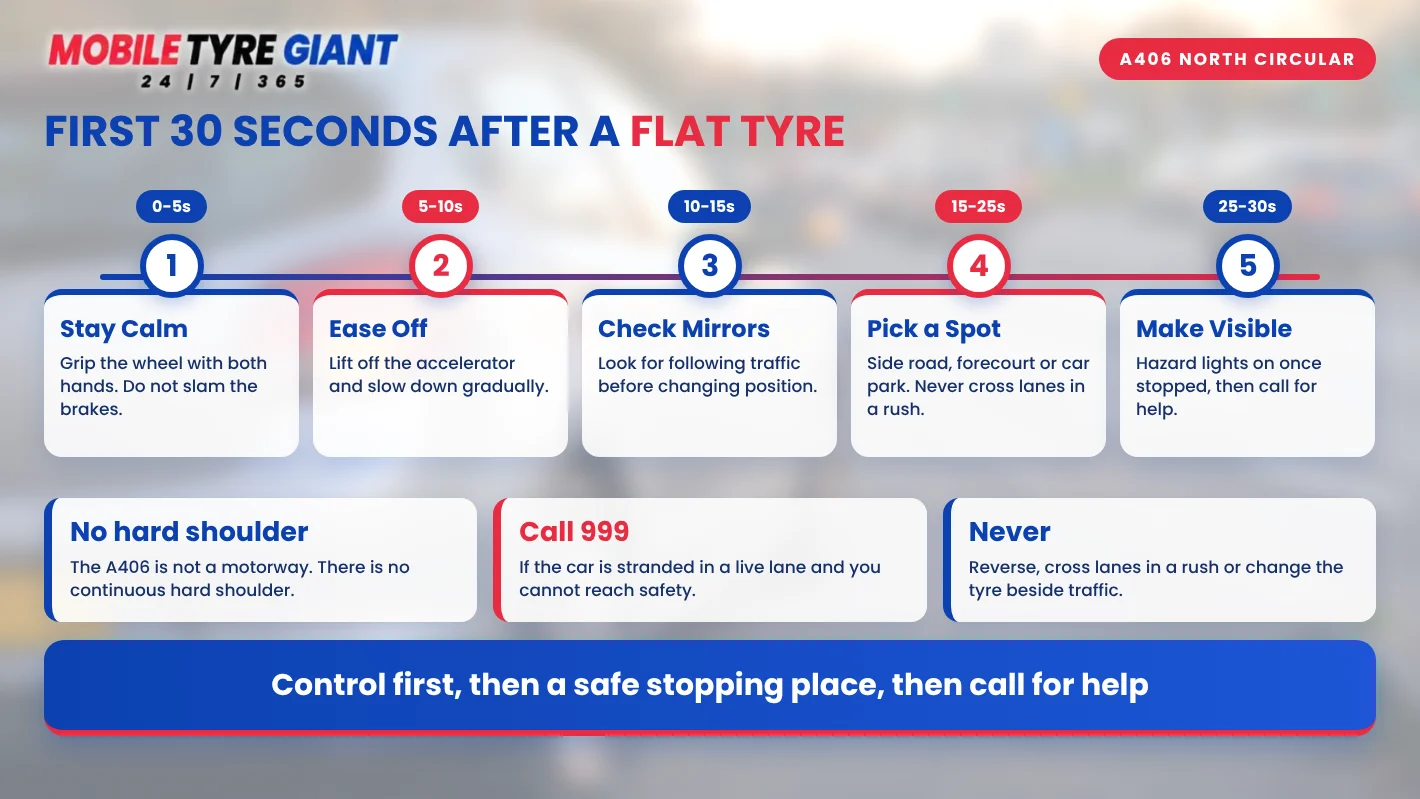
The first moments after a tyre failure should be spent maintaining control rather than inspecting the damage. Hold the steering wheel firmly and ease off the accelerator without making sudden movements. Avoid harsh braking because the damaged tyre may affect the vehicle’s stability. Check your mirrors and surrounding traffic before changing position. The objective is to slow down predictably while identifying a place where the vehicle can stop more safely.
A slow puncture may leave the car reasonably controllable for a short period, while a blowout can produce an immediate change in handling. The severity of the problem determines how far the vehicle can safely move. There is no fixed distance that every driver should cover after a tyre failure. If the tyre is badly damaged or the vehicle becomes unstable, further driving may be unsafe. Your immediate decisions should reflect the condition of the car and the traffic around you.
How Should You Control the Vehicle After Sudden Tyre Pressure Loss?
A sudden loss of pressure can cause the car to pull towards the damaged wheel or feel less responsive to steering. Keep both hands firmly on the steering wheel and resist the temptation to make abrupt corrections. Reduce speed gradually where possible and avoid unnecessary acceleration. Check whether the vehicle remains stable enough to move towards a safer stopping position. Do not attempt to maintain your normal speed simply because surrounding traffic is moving quickly.
For example, a driver travelling near Brent Cross might notice the steering pulling to one side after striking road debris. The immediate priority is to maintain the vehicle’s direction while reducing speed carefully. Braking suddenly in heavy traffic could create an additional risk, especially if other vehicles are following closely. A controlled reduction in speed gives nearby drivers more opportunity to respond. Once the vehicle has slowed, assess whether an accessible side road or safer stopping location is available.
When Should You Use Hazard Warning Lights During an A406 Tyre Emergency?
Hazard warning lights can help alert other drivers when your stationary vehicle temporarily obstructs traffic. Once stopped in a position that presents a hazard, switch them on to improve the warning to approaching vehicles. However, hazard lights are not permission to stop wherever you choose. The Highway Code places restrictions on their use while driving, including specific provisions for motorways and unrestricted dual carriageways. Do not assume those provisions apply identically to every section of the North Circular.
Imagine stopping because the damaged tyre makes further movement unsafe and part of the vehicle remains close to a running lane. Hazard lights can warn approaching drivers that the vehicle is stationary. However, they cannot guarantee that passing traffic will recognise the danger in time. Avoid standing beside the damaged wheel or moving between the vehicle and approaching traffic. If the position creates an immediate danger that cannot be managed safely, contact the emergency services rather than attempting a roadside repair.
Where Can You Stop Safely on the A406 Without a Hard Shoulder?
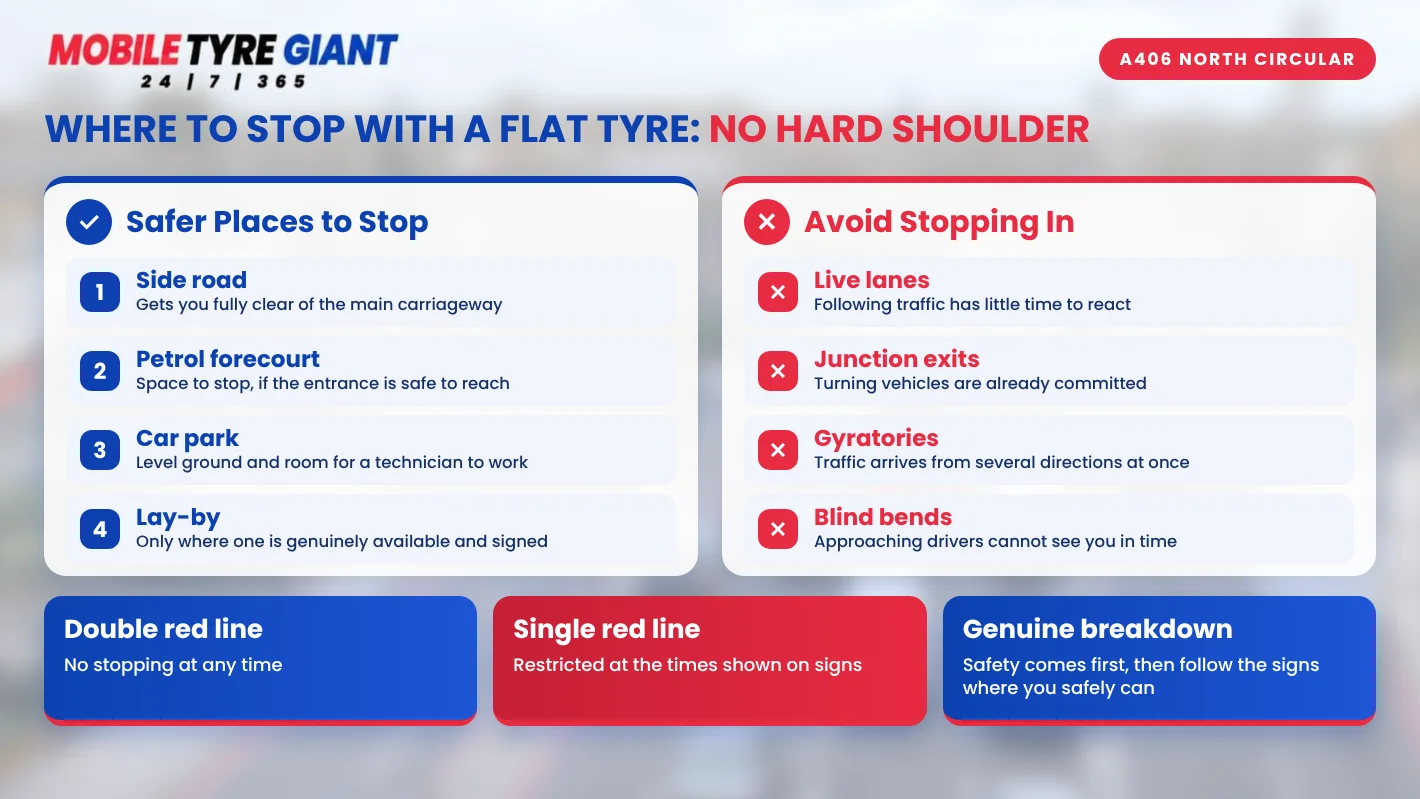
The best stopping place is generally somewhere the vehicle can get completely clear of moving traffic. Depending on the section of the A406, this might be an accessible side road, a suitable lay-by, a petrol station forecourt or a car park. However, none of these locations should be reached through an unsafe manoeuvre. Their entrances, available space and stopping restrictions must also be considered. A location that looks convenient from a distance may not provide safe access for a damaged vehicle.
The aim is not to find the closest possible place at any risk. Instead, identify a suitable position that the vehicle can reach without losing control or crossing traffic dangerously. A slow puncture may allow more flexibility than a completely deflated tyre or sudden blowout. Never continue for a long distance on a destroyed tyre simply to reach a preferred destination. If the vehicle cannot safely move farther, stop as safely as possible and arrange appropriate assistance.
Are Side Roads, Petrol Stations and Car Parks Safer Than Stopping on the A406?
A suitable side road or car park can provide greater separation from passing traffic than the main carriageway. Petrol station forecourts may also offer accessible parking space and better visibility for arranging assistance. However, the entrance must be reached safely and without forcing an abrupt turn. Some forecourts are too small, busy or restricted to provide suitable working space. The exact location should be assessed rather than assuming that every commercial parking area is appropriate.
Imagine travelling near Bounds Green when a tyre begins losing pressure. A nearby side road may offer a safer place to stop if the vehicle remains controllable and the turn can be made normally. Once clear of the North Circular, you may have more room to assess the problem and contact assistance. The information about where to park in London with a flat tyre explains why choosing a suitable stopping position matters. The vehicle should not obstruct junctions, access points or pedestrian routes while waiting for help.
What Should You Check Before Stopping on a Red Route or Restricted Road?
Some sections of the North Circular are subject to red route restrictions that limit where vehicles may stop. Double red lines normally indicate no stopping at any time, while single red lines operate during the times displayed on signs. Other restrictions may apply to bus lanes, clearways and designated parking bays. Drivers should check the actual markings and signs instead of assuming the entire A406 follows one set of parking rules. Stopping restrictions are especially important when selecting somewhere to wait for assistance.
However, an unexpected tyre failure can create circumstances where reaching a permitted parking place is impossible. In that situation, the priority remains avoiding an immediate danger to yourself and other road users. Do not continue driving on a severely damaged tyre merely to avoid a stopping restriction. Once stationary, make the vehicle visible and explain the breakdown location when requesting assistance. If the stopping position is exposed or obstructs traffic, appropriate recovery may be necessary before tyre work can begin.
What Should You Never Do After a Flat Tyre on the North Circular?
A tyre emergency can become much more dangerous when a driver reacts suddenly or tries to solve the problem in an exposed location. Avoid unnecessary lane changes, sharp braking and attempts to reach an exit across several lanes. Do not stop voluntarily where following traffic has little opportunity to react. Never reverse along the carriageway or make an unsafe turn to reach a missed stopping place. These actions can create risks greater than the original puncture.
Once stationary, avoid leaving the vehicle without checking the surrounding traffic and available escape routes. A narrow roadside position may leave very little protection from passing vehicles. Do not kneel beside a traffic-facing wheel or begin changing the tyre where vehicles are passing close by. A repair kit or spare wheel does not make a dangerous location suitable for mechanical work. Arranging recovery may be safer than trying to complete a repair beside the North Circular.
Why Should You Avoid Stopping in Live Lanes, Junction Exits and Gyratories?
Live traffic lanes are not safe places to stop voluntarily because approaching vehicles may have limited time to react. Junction exits can be particularly dangerous when drivers are turning or changing lanes. Gyratories introduce additional risks because vehicles may approach from different directions while navigating unfamiliar lane arrangements. Stopping on a blind bend can also reduce the distance from which approaching drivers can see your vehicle. These locations should be avoided whenever the car can safely reach a more protected position.
Imagine a tyre failure while approaching a busy exit near Henlys Corner. Stopping directly on the exit could obstruct vehicles already committed to turning. Trying to reverse or cross another lane to reach a nearby side road would be equally dangerous. If the car remains controllable, follow a predictable route towards a safer place. If it cannot be moved safely, make the situation known to the emergency services when the obstruction presents an immediate danger.
Should You Stay Inside the Vehicle or Move Away From Traffic?
The safest waiting position depends on exactly where the vehicle has stopped. If the car is safely parked away from moving traffic, occupants may be able to leave and wait in a protected location. However, stepping out beside a busy A406 lane could expose passengers to immediate danger. Check for approaching vehicles, pedestrians, cyclists and other hazards before opening a door. Never assume that a nearby pavement is safe if reaching it requires walking through moving traffic.
If you cannot leave the vehicle safely, remaining inside with seat belts fastened may be the safer immediate option. Keep the hazard warning lights operating where appropriate and request assistance. If the vehicle is stranded dangerously in a live lane or there is an immediate risk of collision, call 999 and ask for the police. Explain that you are on the A406 North Circular and describe your direction of travel, nearest junction or landmark. Do not attempt to push the vehicle, change the wheel or inspect the tyre while exposed to moving traffic.

How Can You Describe Your Exact Location on the A406 North Circular?
Describing your exact location is one of the most important steps when requesting assistance on the North Circular. The A406 passes through several parts of London, so simply saying that you have broken down on the North Circular may not be enough. Recovery drivers and mobile tyre technicians need to know which carriageway or road section they should approach. An incorrect location can send assistance towards the opposite side of a busy junction. Clear details about your direction of travel and nearby landmarks can make the vehicle easier to find.
The A406 includes major junctions, flyovers, roundabouts and sections where local roads run close to the main carriageway. These arrangements can make access more complicated than an ordinary residential street. A technician may need to approach through a particular slip road or local junction to reach your stopping place. Your location should therefore describe where the vehicle is actually parked, not merely the nearest point shown on a map. Accurate information also helps the provider assess whether the position is suitable for tyre fitting.
Which Junctions, Directions and Landmarks Should You Mention?
Begin by stating that you are on the A406 North Circular Road and explaining your direction of travel. Where the signs identify the route as eastbound or westbound, use that direction when describing your location. Mention the last major junction you passed and the next junction ahead if you know them. Nearby landmarks, petrol stations, retail parks and road signs can also help identify the correct section. Providing several accurate details is more useful than relying on one vague location.
Imagine travelling westbound after passing Brent Cross when your tyre develops a problem. If you reach a suitable stopping place, tell the assistance provider that you were travelling westbound on the A406 and describe the nearest junction or landmark. This helps distinguish your location from vehicles travelling in the opposite direction. If you have entered a side road or car park, explain that the car is no longer on the main carriageway. The exact parking entrance may be particularly helpful when the surrounding roads have complicated access arrangements.
What if You Are Unsure Which Section of the A406 You Are On?
It is not unusual to become uncertain about your location after an unexpected breakdown. The North Circular changes direction and passes through junctions that can be confusing for unfamiliar drivers. If your mobile phone has a mapping application, check your position while remaining somewhere safe. A location-sharing feature may allow you to send a pin directly to the recovery or tyre assistance provider. However, a location pin should be supported by a description of where the vehicle has stopped.
For example, you might recognise that you are near Bounds Green but be unsure which junction you passed most recently. Tell the operator what you know rather than guessing at a road number or direction. Look for visible road names, nearby businesses or junction signs without moving into traffic. If your phone shows that you are on a service road beside the A406, explain that distinction. Never leave a protected waiting position simply to obtain a more precise location.
Who Should You Contact After a Flat Tyre on the North Circular?
The appropriate contact depends on whether your vehicle is creating an immediate danger or is parked in a reasonably safe location. A flat tyre on the A406 does not automatically require an emergency services response. Many breakdowns can be handled through an existing recovery provider or a suitable mobile tyre assistance service. However, a vehicle stranded in moving traffic may require urgent protection before any repair arrangements can begin. The immediate circumstances should determine which service you contact first.
Unlike a motorway, the North Circular has ordinary road junctions, local access points and varying stopping restrictions. This means breakdown arrangements may differ depending on exactly where the car has stopped. A suitable car park could allow direct tyre assistance, while an exposed carriageway position may require recovery. If you cannot establish a safe waiting position, explain the danger when contacting the appropriate service. Do not arrange ordinary roadside fitting as a substitute for emergency help where there is an immediate risk of collision.
When Should You Call 999 Instead of a Tyre Assistance Provider?
Call 999 when the breakdown creates an immediate danger requiring an emergency response. This may include a vehicle stranded in a live A406 traffic lane where approaching vehicles could collide with it. If you cannot safely move the car or get clear of traffic, remain inside with your seat belt fastened and ask for the police. Explain the road name, direction of travel, nearest junction and the nature of the obstruction. Emergency services can assess the situation and arrange appropriate assistance.
Imagine your vehicle becoming immobilised on a busy section of the North Circular near a junction. Traffic continues moving around the car, and there is no safe way to reach a pavement or protected area. Attempting to push the car or step into the carriageway could increase the danger. Contacting the emergency services takes priority over finding someone to replace the tyre. Once the immediate traffic hazard has been addressed, recovery or tyre assistance can be arranged.
Should You Contact Breakdown Recovery or a Mobile Tyre Service First?
If the vehicle is parked safely, the next decision is whether it needs recovery or direct tyre assistance. A mobile technician may be able to inspect and repair a puncture at a suitable roadside or parking location. However, a tyre cannot always be repaired, and some stopping positions do not provide enough space for fitting equipment. Recovery may be necessary when the vehicle remains too exposed or has additional mechanical damage. Explain the circumstances before making a booking so the provider can assess what is practical.
For example, a car parked in an accessible retail park near the A406 may be suitable for a mobile tyre visit. A vehicle stopped beside a narrow, fast-moving section presents a different situation. The information about same-day versus emergency mobile tyre fitting explains how urgency and working conditions can affect the service required. Emergency attendance depends on technician availability, vehicle access and the tyre specification needed. Do not assume that requesting an urgent call-out guarantees an immediate arrival or a repair at the original stopping position.
When Is It Safer to Wait Inside the Car Rather Than Outside?
Your waiting position should depend on how exposed the vehicle is to passing traffic. If the car has reached a suitable car park or side road, passengers may be able to wait in a protected location away from moving vehicles. However, leaving a vehicle beside a busy A406 lane may be dangerous if doors open directly into traffic. The presence of a pavement does not automatically make it safe to reach. Consider whether everyone can get clear without crossing a traffic lane or stepping into another hazard.
Imagine stopping in a restricted space near a busy junction where vehicles are passing close to the driver’s door. If there is no safe way to exit and reach protection, remaining inside with seat belts fastened may be the safer immediate action. If the vehicle is in an immediately dangerous position, contact 999 and ask for the police. Conversely, where occupants can safely reach a protected position away from traffic, waiting there may reduce their exposure to a collision involving the stopped vehicle. Follow the instructions provided by emergency responders or recovery personnel when the situation requires their involvement.
What Should You Expect When Mobile Tyre Assistance Arrives on the A406?
A mobile tyre visit begins with confirming that the technician can safely access the vehicle and work around the damaged wheel. The North Circular’s traffic conditions can make this assessment particularly important. Even when a puncture is technically repairable, the vehicle’s position may prevent immediate work. A car parked on a suitable level surface provides different conditions from one stopped near a slip road or busy carriageway. The technician must consider working space, vehicle stability and passing traffic before using equipment.
Once the location is suitable, the technician can assess the tyre and identify the cause of pressure loss. A nail or screw may have caused a small puncture, but air can also escape from a damaged valve or wheel seal. The condition of the sidewall and wheel must also be considered. If the tyre is not suitable for professional repair, replacement may be required instead. The final decision should be based on the tyre’s actual condition rather than an assumption made during the initial booking.
What Vehicle and Tyre Details Should You Provide Before the Technician Travels?
Start with the vehicle registration, make and model so the provider can identify the likely fitment requirements. Explain which wheel is affected and whether the tyre is partially deflated, completely flat or visibly damaged. If you know the tyre size, provide the complete markings from the sidewall, including load index and speed rating. Mention whether the vehicle carries a spare wheel and whether the locking wheel nut key is available. The technician should still verify the approved specification before fitting a replacement.
For example, a driver with a family SUV may know that the vehicle has large alloy wheels but not remember the exact tyre size. Guessing could lead to an unsuitable replacement being selected for the call-out. Explain what you know and allow the provider to confirm the required specification. Also report whether the vehicle can still move safely and whether the affected wheel is accessible. Never crouch beside an exposed A406 traffic lane merely to read the sidewall markings.
Can a Mobile Tyre Fitter Repair a Puncture at an A406 Stopping Point?
Professional mobile puncture repair may be possible when the vehicle is parked somewhere with adequate working space and safe access. A suitable car park, private driveway or accessible side road may provide appropriate conditions. However, the exact location must be assessed rather than assuming every roadside position is suitable. The technician also needs to establish that the damage meets the requirements for permanent tyre repair. A puncture close to the shoulder or sidewall may make replacement necessary.
Imagine a driver who reaches a petrol station forecourt after noticing a slow puncture near Henlys Corner. If the vehicle is safely parked and the site permits the work, the technician may be able to inspect the tyre there. Professional mobile tyre repair involves identifying the damage and deciding whether it is suitable for an approved repair. If the tyre has been driven while severely underinflated, internal damage may prevent repair. A suitable stopping location makes inspection possible, but it does not guarantee that the tyre can be repaired.
Why Might an A406 Tyre Call-Out Take Longer Than Expected?
The total duration of a tyre call-out depends on more than the puncture itself. The provider must first locate the vehicle, travel through the surrounding road network and establish safe access. Congestion around Brent Cross, Hanger Lane or other major junctions can affect the journey, particularly when temporary restrictions are in place. Once on site, the technician must identify the fault and determine whether repair is permitted. These stages make an exact completion time difficult to guarantee.
For example, a tyre may have a small visible puncture but also show signs of damage from driving with insufficient pressure. Further inspection may be needed before the technician can decide whether it can return to service. The explanation of how long mobile puncture repair can take distinguishes technician travel from diagnosis and repair work. Restricted working space or a missing locking wheel nut key can create additional complications. A safe and properly completed repair should take priority over meeting an unrealistic arrival or completion expectation.
What Commonly Causes Flat Tyres on the A406 North Circular?
Flat tyres on the North Circular can result from several types of road hazards and existing tyre problems. The A406 carries a mixture of commuter traffic, delivery vehicles and heavy commercial traffic across different parts of London. Its busy junctions, connecting roads and changing carriageway layouts expose tyres to varied driving conditions. Nails, screws, pothole impacts and damaged road edges can all contribute to tyre problems. However, the presence of a hazard does not mean every puncture or tyre failure can be attributed to the condition of the road.
The circumstances surrounding a tyre failure can provide useful clues about its cause. A sudden impact near a junction may suggest wheel or tyre damage, while gradual pressure loss could indicate a puncture or existing fault. Tyres that are already worn, damaged or incorrectly inflated may be more vulnerable to problems during a journey. Roadworks can also introduce unfamiliar lane arrangements and surfaces that require additional attention. Understanding these possibilities helps drivers explain the incident accurately when requesting professional inspection.
Can Road Debris and Roadworks Cause Punctures on the North Circular?
Sharp objects such as screws, nails and metal fragments can penetrate a tyre’s tread and allow air to escape. These objects may be difficult to notice from the driver’s seat, particularly in heavy traffic. A small penetration can initially produce slow pressure loss rather than immediate deflation. Roadworks and temporary traffic arrangements may also introduce unfamiliar surfaces, loose material or altered driving lines. However, a puncture discovered near roadworks does not prove that the works caused the damage.
Imagine travelling along the A406 near Staples Corner and noticing a tyre pressure warning shortly after passing through a temporary lane arrangement. The warning could indicate a small tread puncture, but it might also result from an unrelated valve or wheel problem. Once the vehicle has reached a safe location, a technician can inspect the tyre to identify the source of air loss. If a nail or screw remains embedded in the tread, its position and the surrounding damage will affect repairability. Avoid removing the object yourself when the tyre has not been professionally assessed.
How Can Potholes, Worn Road Edges and Kerb Strikes Damage Tyres?
Potholes and uneven road surfaces can place sudden stress on tyres and wheels. When a tyre strikes a sharp road edge, its sidewall may become compressed between the obstacle and the wheel rim. This can damage internal reinforcing materials even when the outer rubber shows only limited marks. Kerb contact during turning can also cause cuts, abrasions or wheel distortion. The consequences depend on the severity of the impact, tyre condition and vehicle speed.
For example, a driver navigating a connecting road near Hanger Lane might strike a raised kerb while completing a turn. The tyre could remain inflated initially but develop a visible bulge or slow pressure loss afterwards. A similar problem may follow a pothole impact near a busy junction. Professional inspection should include the affected tyre and wheel rather than assuming the damage is limited to the tread. Serious structural damage may make further driving unsafe even when the tyre continues holding air.
What Happens if You Continue Driving With a Flat Tyre on the A406?
Continuing to drive on a severely underinflated tyre can cause damage beyond the original puncture. Tyres rely on correct inflation pressure to support the vehicle and maintain their intended shape. When pressure falls significantly, the sidewalls flex excessively and may become trapped between the wheel and road surface. This can damage internal reinforcing materials and affect vehicle stability. The problem may become more serious during braking, turning or travelling over uneven surfaces.
The North Circular presents particular challenges because drivers may encounter lengthy junction approaches, congested lanes and limited stopping opportunities. A driver may be tempted to continue towards a distant petrol station or car park despite a worsening tyre problem. However, there is no fixed distance that every vehicle can safely travel on a flat standard tyre. The condition of the tyre and the surrounding traffic must determine the safest response. Reaching a protected location is important, but continuing on a destroyed tyre can create additional danger.
Can Driving Slowly on a Flat Tyre Damage the Wheel and Sidewall?
Driving slowly does not prevent damage when a tyre has lost the pressure needed to support the vehicle. The sidewall can fold repeatedly as the wheel rotates, placing stress on its internal construction. If the tyre collapses sufficiently, the wheel rim may contact the road and suffer distortion or other damage. These problems can occur before the driver notices significant changes in steering. A tyre that is later reinflated may still contain hidden deterioration that makes it unsuitable for repair.
Imagine a driver experiencing a puncture near Brent Cross and deciding to continue towards a familiar parking area. The vehicle may remain controllable initially, but the tyre could deteriorate as pressure continues falling. Understanding whether you can drive with a flat tyre helps explain why even a short journey can cause further damage. If the tyre begins making loud flapping noises or the vehicle becomes unstable, continued movement may be unsafe. A damaged wheel may also require separate inspection after the tyre problem is resolved.
What Do TPMS Warnings and Handling Changes Tell You After a Puncture?
A tyre pressure monitoring system can alert the driver when inflation pressure falls below an expected level. Some vehicles use sensors inside the wheels, while others detect changes through wheel-speed information. However, a TPMS warning does not establish whether the tyre has suffered a puncture, valve problem or another fault. A sudden loss of pressure may also cause steering pull, unusual vibration or changes in braking behaviour. These symptoms should be treated as reasons to assess the vehicle’s condition promptly.
For example, an A406 commuter might notice a pressure warning while travelling towards Bounds Green. If the vehicle remains stable, the driver should assess the available safe stopping options without making abrupt manoeuvres. If steering becomes difficult or the tyre begins collapsing, continuing towards a distant destination may not be appropriate. Resetting the TPMS warning does not repair a puncture or confirm that inflation pressure is correct. A professional inspection should establish why the warning occurred and whether the tyre remains roadworthy.
How Do Professionals Decide Whether an A406 Puncture Can Be Repaired?
A professional tyre repair decision depends on the puncture’s location, size and the tyre’s overall condition. Minor penetrations within the permitted central tread repair area may qualify for permanent repair. However, damage near the shoulder or sidewall requires a different assessment because these areas perform important structural functions. The technician must remove the tyre from its wheel and inspect its internal and external condition. A tyre that has suffered serious damage while underinflated may be unsuitable even when the original puncture appears small.
The relevant British Standard for permanent tyre repairs is BS AU 159. It specifies approved repair procedures and limits relating to the damaged area. Previous repairs, tyre construction and manufacturer restrictions can also affect eligibility. A successful inflation or temporary sealant application does not establish that the tyre can be permanently repaired. The final decision should follow a complete assessment rather than an assumption based on the visible hole.
Which Central Tread Punctures May Qualify for Professional Repair?
Small punctures within the approved central tread area may qualify for repair when the tyre remains structurally sound. British Tyre Manufacturers’ Association guidance generally limits relevant minor penetration damage to a maximum diameter of 6mm. The permitted repair zone varies according to the tyre’s nominal section width, so it should not be assumed that every tread puncture is eligible. Previous repairs and any damage caused by underinflation must also be considered. The technician should confirm that the complete tyre meets the applicable requirements before proceeding.
Imagine a driver discovering a small screw in the centre of a tyre after reaching a safe car park near the North Circular. The position may make professional repair possible, but it does not guarantee approval. The puncturing object could have damaged internal materials or created a larger injury than the visible opening suggests. Understanding the difference between tyre repair and replacement can help explain why internal inspection matters. A permanent repair should only be completed when the tyre satisfies the relevant safety requirements.
Why Do Sidewall Damage and Tyre Age Affect Repair Decisions?
The tyre sidewall flexes continuously as the vehicle moves and forms an important part of its load-bearing structure. Significant sidewall cuts, bulges and damaged reinforcing materials can compromise that structure. Conventional minor puncture repairs are not approved for penetration damage outside the permitted central tread repair area. A tyre may therefore require replacement despite having substantial tread remaining. The explanation of tyre sidewall damage provides additional information about cuts, bulges and other visible defects.
Tyre age is another consideration, particularly when cracking, hardening or other deterioration affects the rubber. However, there is no single age limit that automatically determines the repairability of every passenger-car tyre. A technician should consider the tyre’s physical condition, service history and manufacturer guidance. Run-flat tyres also require particular attention because their repair eligibility depends on the manufacturer’s restrictions and any damage sustained while deflated. A tyre should be replaced when a suitable permanent repair cannot be confirmed.
What Extra Challenges Do Vans, Electric Vehicles and Cars Without Spare Wheels Face on the A406?
Different vehicle types can experience additional complications after a puncture on the North Circular. Commercial vans may carry substantial loads, while some electric vehicles have relatively high vehicle weights and specific tyre requirements. These factors influence the tyre’s load capacity and approved inflation pressure. A tyre that is unsuitable for the vehicle can create additional safety concerns. Correct fitment remains essential whether the vehicle is used for deliveries, commuting or family journeys.
The lack of a spare wheel can also complicate a breakdown when the vehicle cannot safely continue. Some modern cars rely on temporary mobility kits or run-flat technology instead of carrying a conventional spare. These arrangements have limitations and cannot resolve every type of tyre damage. On a busy A406 section, the vehicle may need recovery before anyone can examine the wheel safely. Understanding the equipment and specifications fitted to your vehicle helps determine which options are realistic.
Why Do Loaded Delivery Vans Need Particular Attention After a Puncture?
Delivery vans place different demands on their tyres depending on the vehicle’s permitted weight and how the load is distributed. Incorrect inflation or tyres with insufficient load capacity can increase the risk of overheating and abnormal wear. A puncture may become more serious if the vehicle continues moving while heavily loaded. This is particularly relevant during routes involving repeated stopping, turning and braking. The tyre’s approved specification must remain suitable for the vehicle’s actual operating requirements.
Imagine a delivery van travelling between stops around Wembley and the North Circular. A tyre begins losing pressure while the van is carrying equipment and parcels. The driver may notice that the vehicle feels less stable during braking or turning. The information about delivery van tyre wear and prevention explains how inflation, loading and driving conditions affect commercial tyres. Professional assessment should consider the damaged tyre’s load rating and whether the vehicle needs recovery before replacement.
What Should Electric Vehicle Drivers Consider After an A406 Tyre Failure?
Electric vehicles may require tyres with particular load capacities, dimensions or other manufacturer-approved characteristics. Their weight and power delivery can influence the demands placed on the tyres during acceleration and braking. However, not every electric vehicle needs a tyre specifically marketed as an EV product. The essential requirement is that the replacement meets the vehicle manufacturer’s approved specifications. A tyre that physically fits the wheel may still be unsuitable if its ratings or construction are incorrect.
For example, an electric SUV could suffer a puncture while travelling along the A406 towards Henlys Corner. If the tyre becomes severely deflated, the driver should not assume that the vehicle’s technology makes continued driving safe. Some electric vehicles are supplied without spare wheels, making recovery or suitable mobile assistance necessary. The technician will need to confirm the tyre’s load index, dimensions and other relevant requirements before fitting a replacement. Vehicle weight should also be considered when choosing suitable lifting and recovery equipment.
What if Your Car Has No Spare Wheel or Uses Run-Flat Tyres?
A vehicle without a spare wheel may have a sealant kit, compressor or another manufacturer-approved temporary mobility system. These products are intended for limited use under specified conditions rather than permanent repairs. Severe sidewall damage, large punctures and damaged wheels may make a sealant kit unsuitable. Run-flat tyres can provide restricted mobility after certain pressure losses, but their permitted speed and distance depend on manufacturer guidance. Neither arrangement guarantees that a badly damaged tyre can safely complete the journey.
Imagine stopping in an accessible car park near Hanger Lane after a tyre warning appears. Your vehicle has no spare wheel, and the supplied sealant kit cannot address the visible damage. Continuing along the North Circular simply to reach a conventional garage may create unnecessary risk. A professional technician may be able to fit a suitable replacement if the location is safe and accessible. If the vehicle cannot be worked on safely or the wheel has suffered additional damage, recovery to an appropriate location may be necessary.
How Can You Prepare for a Flat Tyre Before Driving on the A406?
Preparing for a journey on the North Circular means checking more than the route on your navigation system. The A406 includes busy dual carriageways, signal-controlled junctions and sections where stopping safely can be difficult. A little preparation can help you recognise a tyre problem before entering one of these stretches. Regular tyre checks, suitable emergency equipment and access to breakdown assistance all play a useful role. These precautions cannot prevent every puncture, but they can make an unexpected breakdown easier to manage.
The condition of your vehicle is particularly important if you regularly use the A406 for commuting or deliveries. Heavy traffic around Hanger Lane, Brent Cross and other major junctions may leave limited opportunities to deal with a developing problem. Knowing where suitable exits and accessible parking locations exist along your usual journey can help with preparation. However, road layouts and restrictions can change, so follow the actual signs and markings. Your plan should always allow for the possibility that reaching a particular stopping place will not be safe.
Which Tyre and Vehicle Checks Should You Make Before Setting Off?
Check your tyre pressures when the tyres are cold, using the settings recommended by the vehicle manufacturer. Different pressures may apply when the vehicle is carrying additional passengers or luggage. Inspect the visible tread and sidewalls for unusual wear, cuts, bulges and embedded objects. Make sure the tyres meet the vehicle’s approved size and load requirements. These checks are especially useful before joining a busy section of the North Circular where stopping options may be limited.
Imagine preparing to drive from Enfield towards Wembley with several passengers and luggage. A tyre that is noticeably underinflated may be placed under additional stress during the journey. Correcting the pressure before departure is safer than discovering the problem near a congested junction. Avoid exceeding the vehicle’s permitted loading limits, and remember that luggage should be distributed securely. Good preparation helps reduce avoidable tyre problems, although it cannot eliminate the risk of sudden road damage.
What Emergency Equipment Should You Keep in Your Vehicle?
Start by finding out whether your car has a full-size spare wheel, a space-saver spare, a mobility kit or run-flat tyres. Check that any supplied equipment is complete, suitable for your vehicle and in usable condition. If a spare wheel is fitted, confirm that its inflation pressure is correct. Keep the locking wheel nut key accessible where applicable, along with a charged phone, charging cable, torch and high-visibility clothing. These items can support an emergency response without requiring you to attempt an unsafe roadside repair.
For example, a driver may discover that their vehicle has no spare wheel only after experiencing a puncture near Brent Cross. Finding this out beforehand makes it easier to understand which assistance options will be available. The emergency tyre kit checklist can help you review the equipment worth carrying. Save your breakdown provider’s contact details somewhere accessible without relying entirely on mobile internet. Having the right equipment is useful, but never attempt wheel-changing work beside live A406 traffic.
How Can You Reduce Pothole and Kerb Damage During an A406 Journey?
Watch the road surface ahead and leave enough space from the vehicle in front to identify hazards where visibility allows. Avoid sudden steering movements around potholes that could send your car into another lane or towards a kerb. Reduce speed appropriately when approaching visibly damaged road surfaces or unfamiliar temporary layouts. At junctions and slip roads, take care when turning close to raised kerbs and narrow traffic islands. Correct tyre pressure can help the tyre perform as intended, although it cannot prevent every impact injury.
Imagine approaching a connecting road near Henlys Corner and noticing a damaged patch of tarmac close to the kerb. A controlled approach is preferable to swerving sharply across another vehicle’s path. If you do strike a pothole, pay attention to any new vibration, steering change or pressure warning afterwards. The information about pothole tyre damage in London explains why some impact damage is not immediately visible. Do not assume that a tyre escaped damage solely because it remained inflated after a heavy impact.
What Should You Check After a Tyre Has Been Repaired or Replaced on the A406?
Once tyre work has been completed, the next priority is confirming that the vehicle is ready to return to normal driving. Ask the technician what fault was found and whether the tyre was repaired or replaced. Confirm that the fitted tyre meets the vehicle manufacturer’s specification. The wheel should be securely fitted, and the tyre should be inflated to the appropriate pressure. Any remaining concerns about the wheel, valve or surrounding components should be explained before you leave.
A successful repair or replacement does not mean every possible issue has automatically been resolved. The original puncture may have occurred alongside other tyre or wheel problems. If the vehicle previously struck a kerb or pothole, the technician may recommend further checks. Keep the details of the completed work so you know what was inspected and whether anything remains outstanding. Returning to the A406 should only happen when the vehicle is considered suitable for road use.
Why Should You Check Tyre Pressure, TPMS and the Other Wheels?
Ask the technician to confirm the inflation pressure of the repaired or replacement tyre. Once the tyres are cold, compare their pressures with the vehicle manufacturer’s recommended settings. If a tyre pressure monitoring system warning appeared during the breakdown, confirm that the underlying fault has been addressed. Some vehicles require a TPMS reset or recalibration after tyre work, while others update automatically. A warning that remains illuminated or returns should be investigated rather than repeatedly dismissed.
Imagine having a punctured front tyre replaced in a suitable car park near the North Circular. The new tyre may be ready for use, but another tyre could also have low pressure or unusual wear. Checking the remaining tyres helps establish whether the problem was isolated. It is also sensible to ask whether the damaged wheel shows signs of an impact that might affect vehicle handling. Never simply reinflate a tyre that suffered severe damage and assume that pressure retention proves it is safe.
Should Wheel Nuts or Bolts Be Rechecked After a Tyre Replacement?
Wheel security is an important part of tyre replacement because the wheel must remain correctly attached to the vehicle. Ask the technician to confirm that the wheel fixings have been tightened to the vehicle manufacturer’s specified torque. A suitable calibrated torque tool should be used rather than relying on guesswork. Some manufacturers or service procedures recommend checking wheel-fixing torque again after a specified driving distance. The correct interval depends on the vehicle and applicable instructions.
For example, a driver may have a replacement tyre fitted before resuming their usual A406 commute. Before leaving, they should ask whether a follow-up wheel torque check is required and when it should happen. Do not assume that every vehicle uses the same distance or tightening procedure. Avoid attempting to tighten the fixings by feel, as incorrect torque can create its own problems. If you notice unusual wheel movement, knocking or vibration after fitting, stop safely and arrange inspection rather than continuing the journey.
Should You Choose Mobile Tyre Assistance, Recovery or a Garage After an A406 Breakdown?
Choosing the right service depends on the vehicle’s condition and where it has stopped. Mobile tyre assistance can be practical when a car is parked in a suitable location with adequate access and working space. Recovery may be necessary if the vehicle cannot be worked on safely or has damage beyond the tyre itself. A conventional garage may be appropriate when the vehicle can be transported there safely or requires additional mechanical work. The decision should be based on safety and the work needed rather than convenience alone.
The North Circular’s changing road layout makes this choice particularly important. A vehicle in an accessible parking area near Wembley presents different conditions from one immobilised beside a busy carriageway near Staples Corner. Some sections have restricted stopping areas, while others connect to local roads with different arrangements. A tyre technician cannot safely work wherever a vehicle happens to stop. Describe the location accurately and allow the provider to assess whether direct attendance is appropriate.
When Is Mobile Tyre Assistance the Right Choice on the North Circular?
Mobile tyre assistance is most suitable when the vehicle has reached a safe, accessible place where the technician can work. This may include an appropriate car park, driveway or side road with sufficient space. The provider must be able to reach the vehicle with the necessary equipment and suitable tyre specification. There should also be a safe position for the occupants while work is carried out. The fact that the vehicle is close to the A406 does not automatically make the location suitable.
Imagine a driver who reaches an accessible car park near Hanger Lane after noticing a puncture. The vehicle is no longer obstructing the main road, and there may be sufficient room for professional tyre work. However, permission, access restrictions and the condition of the parking surface still matter. Giving the provider clear location details helps establish whether mobile assistance is feasible. Any repair or replacement must be completed properly before the vehicle returns to normal use.
When Is Recovery Safer Than Trying to Reach a Garage?
Recovery is often the safer option when the car cannot be moved without risking further damage or loss of control. A vehicle stranded in an exposed position may need to be relocated before tyre work can begin. Recovery may also be necessary if the wheel, suspension or another component has suffered serious damage. In these circumstances, driving slowly to a garage is not necessarily a safe alternative. The correct approach depends on the condition of the vehicle and the hazards around it.
For example, a severe impact near Brent Cross might damage both a tyre and its wheel rim. Even after the tyre has been replaced, the vehicle may still require inspection for wheel or suspension problems. Recovery to a suitable garage can allow that assessment without unnecessary road use. If the immobilised vehicle is creating an immediate danger in a live lane, emergency assistance takes priority. Never attempt to push a damaged car across moving A406 traffic to reach a more convenient location.
How Can You Check Mobile Tyre Coverage Around the A406?
Before requesting mobile tyre assistance, confirm that the provider serves the specific part of the North Circular where your vehicle is located. Coverage may include nearby areas such as Wembley, Brent Cross, Enfield or other North London neighbourhoods. However, service availability can depend on technician location, road access, the tyre specification and the safety of the stopping place. A provider covering North London may still be unable to work at a particular roadside position. Confirm the practical details before assuming that a mobile visit can proceed.
For example, you might be parked on a side road near Bounds Green but unsure whether your exact location is covered. Checking the provider’s mobile tyre fitting service areas can help identify whether assistance is offered nearby. Share your precise location and explain whether the vehicle has safe access for a service van. Avoid relying on a promised arrival time until availability and the circumstances have been assessed. If direct tyre fitting is unsuitable, recovery to a safer location may be the appropriate next step.
Final Words: Stay Prepared and Make Safer Decisions on the A406
A flat tyre on the North Circular can be challenging because of heavy traffic, busy junctions and limited safe stopping opportunities. Preparing your vehicle, checking your tyres and understanding your emergency equipment can make an unexpected problem easier to handle. If a tyre fails, the immediate priority is finding a safe position rather than continuing towards a preferred destination. Stopping restrictions vary along the route, but personal safety should always guide your decisions during a genuine emergency.
Once the vehicle is secure, choose assistance based on its condition and the safety of the location. Mobile tyre fitting may be suitable where access is safe, while exposed positions or more extensive damage may require recovery. After a repair or replacement, confirm tyre pressure, wheel security and any recommended follow-up checks before resuming your journey. Careful preparation and a sensible response can help you manage an A406 tyre emergency without creating further risks.
Flat Tyre on the A406? Get Safe Professional Help
Share your location and tyre details, and we will confirm the safest professional repair or replacement for your vehicle.
Frequently Asked Questions
Find quick answers to the most common questions our customers ask.
Keep control of the vehicle, reduce speed carefully and look for a safe stopping place. Avoid sudden braking or steering, and arrange assistance once you are safely stopped.
No. The A406 is a major London road with different carriageway and junction layouts. It does not have a continuous motorway-style hard shoulder.
Look for a suitable side road, car park, petrol station or other protected stopping area. Follow the applicable signs and restrictions whenever you can do so safely.
Red route restrictions apply where indicated by the relevant signs and markings. An unavoidable breakdown should be handled with safety as the priority rather than continued driving on a dangerous tyre.
There is no universally safe driving distance for a flat tyre. A severely deflated or damaged tyre may make further driving unsafe, even at low speed.
Mobile tyre assistance may be available in nearby North London areas. The provider must confirm local coverage, access and a suitable working location.
Give the road name, direction of travel, nearest junctions and visible landmarks. Share a phone location pin if possible and explain whether you are on the main road or a nearby side road.
Check whether the manufacturer supplied a temporary mobility kit or fitted run-flat tyres. If those options are unsuitable, arrange professional assistance or recovery.
Yes. Look for pressure loss, sidewall damage, wheel distortion and changes in steering or vibration. Arrange an inspection if the impact was severe or symptoms develop afterwards.
Yes. Confirm the correct pressure, monitor any TPMS warnings and follow the manufacturer's wheel-fixing recheck instructions. Report unusual vibration or continued pressure loss promptly.