

That sudden bang as a wheel drops into a pothole can make even an experienced London driver tense up. One moment the road looks ordinary, and the next you feel a sharp thud through the steering wheel and wonder whether the tyre or alloy has survived it. London potholes can appear throughout the year, but damaged road surfaces often become particularly noticeable during and after colder, wetter periods when water, traffic and repeated surface deterioration take their toll. The difficult part is that pothole damage is not always as obvious as an instant flat tyre. A tyre may continue holding pressure while a sidewall, wheel or alignment-related problem has already started developing.
Protecting your tyres and wheels therefore begins before the impact and continues after it. Correct tyre pressure, sensible observation of the road ahead and regular tyre inspections can all reduce the chance of a small road defect becoming an expensive problem. You also need to know what changes to look for after a hard impact, including a new sidewall bulge, repeated pressure loss, steering vibration or a car that suddenly feels different on a straight road. London drivers dealing with an unexpected tyre problem can use mobile tyre fitting in London when the vehicle needs professional tyre support at home, work or a suitable roadside location. The aim of this guide is to help you reduce pothole risk, recognise damage early and make a sensible decision about what to do next.
Why Pothole Damage Becomes a Bigger Risk on London Roads
London road surfaces deal with a demanding combination of traffic, buses, delivery vehicles, repeated braking, utility works, rainfall and seasonal temperature changes. Water can enter weaknesses in a road surface and repeated vehicle loads can make damaged areas progressively worse. Colder periods can add another problem when trapped water freezes and expands, although freeze and thaw is not the only reason potholes form. By late winter and spring, drivers may therefore encounter road defects that have become deeper, wider or harder to spot in poor weather. A pothole partly filled with rainwater can be especially deceptive because the surface may look like an ordinary puddle from several car lengths away. Busy London traffic can also leave very little space to change course safely once you notice the hole.
Calling this “pothole season” should not suggest there is a fixed date when the problem begins and ends. Potholes can appear on London roads in any month, and road-condition records show that reporting continues through summer and autumn as well as winter. The practical point is that drivers should increase their awareness when road surfaces have been exposed to prolonged wet or cold conditions and after periods when defects become more visible. Residential streets, heavily used urban routes and roads with repeated repairs can all create unexpected impacts at relatively modest speeds. Even a pothole encountered during a short school run or commute can hit hard enough to make you stop and inspect the wheel. Treat the season as a reminder to prepare your tyres rather than as permission to relax during the rest of the year.
What Actually Happens When a Tyre Hits a Pothole?
A tyre normally acts as part of the cushioning between the road and the wheel, but a deep or sharp-edged pothole can compress that cushion very quickly. Imagine stepping unexpectedly off a kerb when you thought the pavement was level. Your leg absorbs a sudden load because there was no time to prepare, and a tyre experiences a similar rapid change when it drops into a hole and then strikes the far edge. The sidewall can be squeezed between the wheel rim and the road surface in a fraction of a second. Depending on the severity and angle of the impact, that force can affect the tyre casing, the rim or other wheel and suspension components. A dramatic impact may produce an immediate flat, but a less obvious impact can leave the tyre inflated while still deserving inspection.
This is why judging pothole damage only by whether the tyre went flat is a poor test. Internal tyre damage can sometimes lead to a sidewall bulge later, while a damaged wheel may create a slow pressure leak rather than an instant failure. The steering may also begin to vibrate or the car may feel different after the impact. Some drivers walk around the vehicle, see no obvious split in the rubber and assume they have escaped completely. A visual check is useful, but it cannot reveal every problem on the inner sidewall or inside the tyre and wheel assembly. After a genuinely hard pothole strike, continue paying attention to pressure, vibration, steering behaviour and any change in the shape of the tyre.
Why Correct Tyre Pressure Matters Before You Hit a Pothole
Correct tyre pressure gives the tyre the support it was designed to have when carrying the vehicle’s weight. An under-inflated tyre flexes more, which can leave the sidewall with less support when the wheel suddenly drops into a pothole. That does not mean the correct pressure can make a tyre immune to a severe impact, because a large enough pothole can still cause damage. It does mean there is little sense making the tyre more vulnerable by routinely driving below the vehicle manufacturer’s recommended pressure. Check the pressure when the tyres are cold and use the figures specified for your vehicle rather than copying a number from another car. Remember that the recommended settings may also change when the vehicle is heavily loaded.
Pressure also gives you a valuable reference after an impact. If one tyre begins losing air while the other three remain stable, the change may point towards a puncture, valve problem, wheel damage or a sealing issue that needs investigation. Simply adding air every morning can hide the symptom without addressing the reason it started after the pothole strike. Our guide to the effects of under-inflated tyres explains why correct pressure matters for tyre condition and vehicle behaviour beyond pothole protection alone. Keep a pressure gauge or portable inflator somewhere accessible so checking does not depend on finding a working petrol-station machine. A two-minute check before a busy week of London driving is far easier than discovering a damaged tyre when you are already late for somewhere.
Which Parts of the Tyre and Wheel Can a Pothole Damage?
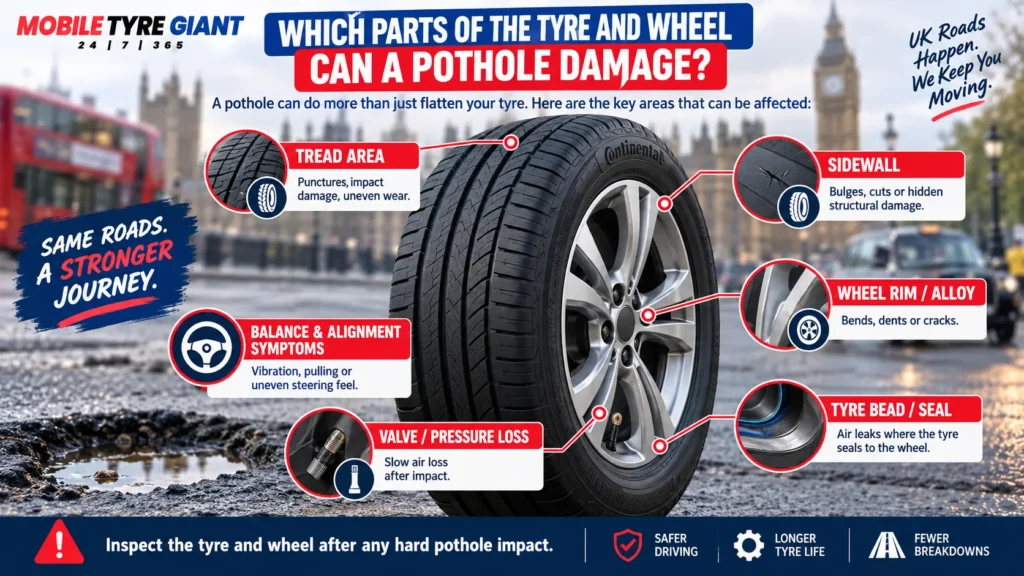
The tyre normally takes the first contact, but the impact does not necessarily stop at the rubber. A severe pothole strike can affect the tyre sidewall, tread area, wheel rim, balance, alignment or parts of the suspension depending on how the wheel enters and leaves the hole. The visible damage may be a cut or bulge, while other symptoms can appear as pressure loss, vibration or a change in steering. Large alloy wheels with shorter tyre sidewalls can provide less cushioning between the road and rim than a setup with more sidewall height. That does not mean larger wheels or low-profile tyres are automatically unsuitable, but drivers should understand that less rubber separates the alloy from the road impact. The correct tyre size and pressure therefore become particularly important on vehicles with these setups.
Pothole damage can also create more than one problem at the same time. A hard strike may damage the tyre and bend the rim, meaning replacing only the rubber would not necessarily solve the pressure loss or vibration. Conversely, a scratched alloy does not automatically mean the wheel has suffered structural damage. The sensible approach is to inspect the complete wheel and tyre assembly rather than guessing based on the loudness of the impact. If your car uses larger wheels, performance tyres or a less common setup, knowing the correct tyre size for your vehicle can also help when a damaged tyre eventually needs replacement. Pothole protection is partly about avoiding impacts, but it is equally about recognising which component may have absorbed the force.
Sidewall Bulges, Cuts and Hidden Tyre Damage
A sidewall bulge after a pothole impact is one warning sign that should never be dismissed as cosmetic. The bulge can appear when the internal structure supporting the tyre has been damaged and air pressure begins pushing the weakened area outward. It may look like a small egg-shaped swelling rather than a dramatic split, which is why drivers sometimes underestimate it. A tyre can still hold air while showing this type of structural warning. Deep cuts, exposed internal material or major deformation also require prompt attention. If you spot serious sidewall damage, do not keep driving simply because the tread still has plenty of life left.
The inner sidewall deserves consideration too because it is much harder to see during a quick roadside walk-around. A pothole may affect the side facing the suspension, leaving the outside of the tyre looking normal. New vibration or unexplained pressure loss after an impact can therefore matter even when you cannot see obvious damage. Avoid crawling beneath a vehicle at the roadside or putting yourself close to moving traffic just to inspect the inner surface. If the impact felt severe and something about the vehicle has changed, arrange a safer and more complete inspection. The cost of checking a suspicious tyre is easier to justify than gambling on damage you cannot properly see.
Bent Wheels, Cracks and Changes in Steering
The wheel itself can absorb a significant amount of force when there is not enough tyre movement to cushion the pothole edge. Depending on the wheel material, design and impact, the rim may bend, crack, dent or suffer damage around the area where the tyre seals against it. A bent section can sometimes contribute to vibration or pressure loss, while a crack needs proper assessment because structural wheel damage cannot be judged safely from a casual glance. Do not confuse ordinary cosmetic kerb marks with proof of structural failure, but do not assume a wheel is fine simply because the face still looks attractive. The inside edge may have taken the stronger hit. A close professional inspection becomes more useful when the impact was severe or symptoms continue afterwards.
Pay attention to how the vehicle behaves on the next safe stretch of smooth road. A steering wheel that begins vibrating, a car that pulls noticeably to one side or a wheel that suddenly feels different can point towards a problem that needs investigating. Potholes can affect balance, alignment or wheel condition, but those symptoms should not be diagnosed from the driver’s seat alone because several faults can feel similar. Note when the vibration appears and whether it changes with speed, because those details can help during inspection. Avoid testing a questionable wheel by deliberately driving faster to see whether the vibration gets worse. If the car feels substantially different after the impact, the useful response is to have the tyre and wheel checked rather than learning to live with the new sensation.
How Can You Reduce Pothole Damage Before It Happens?
You cannot control the condition of every London road, but you can reduce some of the risk by giving yourself more time to see damaged surfaces ahead. Leave enough space behind the vehicle in front so you are not driving blindly into whatever appears beneath it. On wet roads, treat deep-looking puddles carefully because water can hide the depth and edges of a pothole. Keep your attention further up the road rather than staring only at the bumper directly ahead. If you spot a pothole early and it is safe to do so, reduce speed smoothly before reaching it. Sudden panic braking or a sharp last-second steering movement can create a different hazard, particularly in busy London traffic.
The aim is not to weave around every mark in the road. A small surface defect may be less dangerous than swerving into a cyclist, another vehicle, a kerb or oncoming traffic. Use the available space and make gradual decisions rather than treating every pothole as an emergency obstacle course. At night, poor weather and reflections from wet roads can make defects harder to judge, so a little more following distance can be especially valuable. Keep the windscreen clear and headlights working properly because visibility is part of pothole protection too. Good preparation will not prevent every impact, but it can reduce how often a pothole catches you completely by surprise.
Avoid Sudden Swerving When a Pothole Appears
The natural reaction when a deep pothole suddenly appears is to pull the steering wheel away from it. In an empty road that may sometimes be possible, but London streets often have vehicles, cyclists, pedestrians, parked cars and kerbs close to your path. A violent steering input can turn a tyre-protection decision into a collision risk. Before changing direction, you need to know that the space beside you is actually clear. If there is no safe escape route, controlled slowing and maintaining vehicle stability can be safer than an aggressive swerve. The pothole may damage a tyre or wheel, but moving blindly into another road user can create a far more serious situation.
Looking ahead gives you more options because you can make a gentle adjustment rather than an abrupt one. This matters especially on narrow residential streets where parked vehicles restrict the usable road width. If another car is approaching, do not assume that crossing the centre line is safe simply to avoid a hole. The same applies near cycle lanes, bus lanes and junctions where other road users may appear alongside you quickly. A calm response starts several seconds before the pothole, not when the wheel is already about to enter it. London driving already demands constant observation, and road-surface awareness should become part of that same routine.
Slow Down Before the Impact, Not During a Panic Reaction
Speed changes the amount of force involved when the tyre and wheel strike the edge of a pothole. If you can see the defect early enough, easing off the accelerator and reducing speed progressively gives the tyre and suspension a less severe impact to manage. This does not mean slamming on the brakes when another vehicle is close behind you. Check what is happening around the car and slow in a controlled way whenever conditions allow. A pothole approached at a sensible speed can still cause damage, but high speed leaves less time to react and can make the strike much harsher. Smooth preparation is more useful than a dramatic reaction at the last second.
Once an impact is unavoidable, concentrate on keeping the vehicle stable and under control. Do not make a habit of accelerating into a pothole or deliberately testing whether the tyre can take the hit. Equally, avoid staring at the pothole for so long that you lose awareness of traffic, crossings or other hazards ahead. Your first responsibility remains safe control of the vehicle. After the impact, the important question becomes whether the tyre, wheel or steering behaviour has changed. That is where a proper post-impact inspection becomes more valuable than replaying the moment and wondering whether you should have reacted differently.
What Should You Do Immediately After Hitting a Pothole?
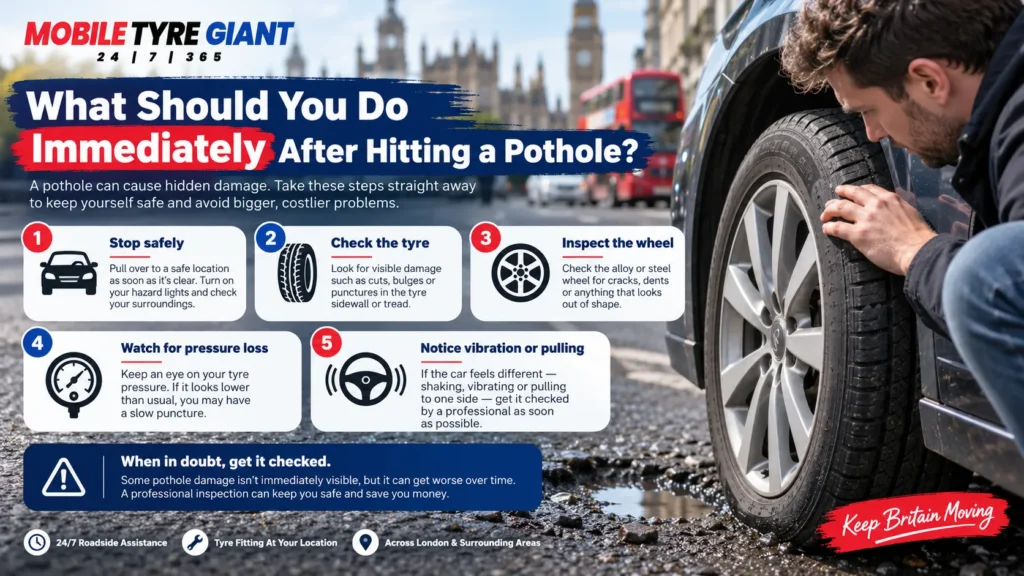
A hard pothole impact can make you want to stop immediately, but the first available piece of road is not always a safe place to inspect the vehicle. Keep control of the steering, reduce speed if the car feels different and look for somewhere suitable to stop away from moving traffic. Once parked safely, switch on the hazard lights if the location or situation requires them and walk around the vehicle from a safe position. Look at the tyre that took the impact and compare it with the tyre on the opposite side. Check whether it appears low, distorted or visibly damaged. Then look at the wheel for fresh dents, cracks or obvious changes around the rim.
The first inspection should help you decide whether the vehicle looks suitable to continue or whether professional help is needed. A tyre that is completely flat, badly bulged, deeply cut or visibly separated should not be treated like a minor cosmetic issue. If everything looks normal, that does not automatically prove there is no damage, so continue monitoring pressure and vehicle behaviour. Some symptoms become clearer only after the car moves again or after pressure begins leaking slowly. Use the quick guide below as a practical first response rather than a substitute for professional assessment.
What You Notice After the Impact | What It Could Mean | Sensible Next Step |
Tyre immediately flat | Puncture, sidewall damage or wheel damage | Stop driving and arrange assistance |
New sidewall bulge | Possible structural tyre damage | Do not ignore it, arrange inspection |
Pressure dropping slowly | Tyre, valve, bead or wheel sealing issue | Monitor once, then investigate the cause |
Steering vibration | Wheel balance, tyre or wheel damage may be involved | Arrange inspection if it continues |
Car pulling to one side | Alignment, tyre or suspension issue may be involved | Have the vehicle checked |
Fresh wheel dent or crack | Possible structural wheel damage | Avoid unnecessary driving until assessed |
No visible damage | Hidden damage may still be possible after a heavy strike | Monitor pressure, steering and vibration |
Check the Tyre and Wheel Before Continuing
Start with the tyre sidewall because impact damage can sometimes show there as a swelling, split, cut or unusual deformation. Move your view around the tread as far as it is safely accessible and check for anything lodged in the rubber. Do not place yourself underneath the car or stand in moving traffic to see the inner sidewall. Look next at the wheel rim for a fresh dent, crack or area that no longer looks circular. A cosmetic scrape alone does not prove the wheel is structurally damaged, but a visible bend or crack deserves proper attention. Compare the affected wheel with the opposite side if you are unsure whether its shape looks normal.
If the tyre is visibly flat, avoid driving on it simply to reach a more convenient garage. Driving with the tyre collapsed can add further damage to the tyre, rim and surrounding components. If the tyre remains inflated but the impact felt severe, check the pressure as soon as practical and compare it with the correct cold setting later. A small leak may not be obvious during the first few minutes after the impact. Make a mental note of what you saw immediately after the strike because that information can be useful if symptoms develop later. The important thing is not to confuse “still inflated” with “definitely undamaged.”
Watch the TPMS and Tyre Pressure Over the Next Few Hours
A TPMS warning shortly after a pothole impact deserves attention because it may indicate that one tyre has started losing pressure. Stop somewhere safe and check the tyre rather than simply resetting the warning and continuing as normal. If you have a pressure gauge, compare the affected tyre with the manufacturer’s recommended setting and with the other tyres. A tyre that continues losing pressure after reinflation needs investigation. The source may be the tyre itself, the valve, the point where the tyre seals against the wheel or damage to the wheel. The dashboard warning can tell you that something has changed, but it cannot identify the exact cause.
Even without an immediate TPMS warning, it is worth rechecking the tyre later after a significant pothole strike. Some leaks develop gradually enough that the first reading may appear close to normal. If the same tyre loses pressure again the following day, do not keep adding air indefinitely and assume the pothole had no lasting effect. Record the pressure if necessary so you can see whether there is a consistent pattern. A single small change across all tyres may be less concerning than one wheel repeatedly falling behind the others. Monitoring is useful only when it leads to action if the same problem keeps returning.
Pay Attention to New Vibration, Pulling or Unusual Road Noise
Once you resume driving, notice how the steering wheel and car feel without deliberately increasing speed to test them. A new vibration that was not present before the pothole may indicate that the tyre and wheel assembly needs checking. Lost balance weights, wheel damage, tyre deformation or other issues can sometimes produce vibration, while pulling may raise questions about alignment or another problem. Do not assume the cause from one symptom alone because different faults can feel similar from behind the steering wheel. What matters is the timing. If the behaviour began immediately after a heavy pothole strike, that connection is worth mentioning during an inspection.
Where vibration is related to wheel imbalance, professional mobile wheel balancing can help restore smooth rotation without requiring you to guess where the problem lies. Balancing, however, will not repair a cracked or badly bent wheel, so a proper assessment should come before assuming that balance is the only issue. Listen for new humming, knocking or rubbing sounds as well, particularly if they appeared at the same time as the steering change. If the vehicle feels substantially different or unstable, reduce unnecessary driving until it can be checked. Pothole protection is not finished when you successfully drive away from the hole. The next few miles can tell you whether the impact left a problem that needs attention.
Can Pothole Tyre Damage Be Repaired or Does the Tyre Need Replacing?
Not every tyre that hits a pothole needs replacing, but the decision depends on the type and location of the damage rather than how expensive or new the tyre is. A small puncture in an appropriate part of the tread may sometimes be repairable after the tyre has been removed and inspected properly. Impact damage is different because the force can affect the sidewall, internal structure or bead where the tyre seals against the wheel. A tyre that still holds air can therefore be damaged in a way that makes repair unsuitable. This is why a visual roadside inspection is useful for spotting warning signs but cannot make the final repair decision.
The technician also needs to consider what happened after the pothole strike. If the tyre lost pressure and the vehicle continued driving on it, additional internal damage may have occurred even if the original problem looked minor. Sidewall deformation, exposed cords, severe cuts and structural bulges are very different from a straightforward tread puncture. The condition of the wheel matters too because a bent or cracked rim can create continued pressure loss even after the tyre itself has been changed. Avoid deciding that a tyre is repairable simply because the tread has plenty of depth remaining. The safest repair decision comes from inspecting the whole tyre and wheel assembly rather than focusing on a single visible mark.
When Might a Tyre Still Be Repairable After a Pothole?
A tyre may still be suitable for repair when the damage is limited to a repairable part of the tread and there is no evidence of sidewall or internal structural damage. For example, the pothole itself may not puncture the tyre, but the impact could push an existing nail further into the tread and make a slow leak more noticeable. In that situation, the puncture location, size and tyre condition need to be assessed before any repair is attempted. The tyre should normally be removed from the wheel so the inside can be examined rather than repaired from the outside based on guesswork. This inspection can reveal damage that is invisible when the tyre remains mounted.
Repair should not be treated as the automatic cheaper option. A technically repairable puncture can become unsuitable if the tyre has been driven for too long while badly under-inflated or flat. Heat and sidewall flexing can damage the internal construction even when the external hole itself appears small. If you are unsure how much additional damage can occur after pressure is lost, the guide explaining whether you can drive with a flat tyre covers what happens when the tyre continues carrying the vehicle without proper air support. Stopping early can therefore preserve repair options that might disappear after several more miles of driving. The real question is not whether the hole can be plugged, but whether the complete tyre remains structurally suitable for safe use.
When Is Replacement the Safer Option?
Replacement becomes the sensible route when the pothole has caused damage that cannot be safely restored through an approved tyre repair. A sidewall bulge is one of the clearest examples because it can indicate that the internal structure has been weakened by the impact. Deep sidewall cuts, exposed cords, severe deformation or damage caused by driving on a fully deflated tyre can also rule out repair. The same principle applies where the tyre has suffered extensive internal damage that only becomes visible after removal from the wheel. Good tread depth does not cancel out structural damage elsewhere on the tyre.
If replacement is needed, the new tyre should match the vehicle’s required size and specification rather than simply being the closest option available. Load index, speed rating and other manufacturer requirements still matter even when the replacement is being fitted because of an emergency pothole impact. A professional mobile tyre replacement service can be useful when the damaged tyre should not be driven to a garage. The remaining tyres should also be looked at so that the replacement decision considers the wider condition of the vehicle rather than one damaged corner in isolation. Replacing an unsafe tyre promptly is far better than trying to extend its life because the damage happened unexpectedly.
How Can You Protect Your Tyres Through the Rest of Pothole Season?
Protecting tyres during London pothole season is less about buying special equipment and more about maintaining the tyre’s normal operating condition. Correct pressure, healthy tread, suitable tyre specification and regular visual inspections give the tyre the best chance of dealing with everyday road impacts. None of these measures can guarantee that a deep pothole will cause no damage. They simply remove avoidable weaknesses that can make an impact harder on the tyre and wheel. A poorly maintained tyre already operating below the correct pressure begins the encounter at a disadvantage.
The other part of protection is learning from smaller impacts before a larger one causes a breakdown. If the same route regularly contains damaged road surfaces, allow more following distance so you can see what the vehicle ahead is avoiding. Pay particular attention after prolonged rain, utility works or periods when new surface defects become noticeable. Inspect the tyres more often if your normal commute repeatedly includes rough roads. A quick pressure and sidewall check at the weekend can reveal a slow leak or fresh mark before Monday morning traffic. Preventative tyre care is not dramatic, but that is exactly why it works.
Keep Tyre Pressure and Condition Consistent
Pressure should not be something you check only after a pothole impact. Checking it regularly when the tyres are cold gives you a normal baseline and makes sudden changes easier to recognise. If one tyre normally sits at the correct pressure and then begins losing several PSI after a hard impact, that pattern provides useful information. Check all four tyres rather than adjusting only the one that looks low because visual appearance can be misleading. Use the vehicle manufacturer’s recommended figures for the specific load rather than the maximum pressure printed on the tyre sidewall.
Condition matters just as much as pressure because an already damaged tyre may tolerate another impact less effectively. Look for existing cuts, cracking, uneven tread wear and small sidewall distortions during routine checks. The broader tyre safety guide explains how pressure, tread and wear patterns work together when assessing tyre condition. If you regularly drive through rough London streets, consider keeping a simple note of pressures or checking them on the same day each week. Consistency helps you spot gradual changes that are difficult to remember from one month to the next. The goal is to know what normal looks like before a pothole gives you a reason to question it.
Do Low-Profile Tyres Need Extra Care Around Potholes?
Low-profile tyres have a shorter sidewall between the road and the wheel rim, which means there is less tyre height available to absorb a sharp road impact. That does not make every low-profile tyre weak, and many vehicles are designed to use them safely. The important difference is that a severe pothole can transfer force to the wheel more directly than it might with a taller sidewall. This is one reason drivers of cars with large alloy wheels often become especially aware of deep potholes and broken road edges. Correct pressure becomes particularly important because an under-inflated low-profile tyre provides even less effective cushioning.
After a hard impact, check both the tyre and wheel rather than looking only for a puncture. A low-profile tyre may remain inflated while the rim develops a bend, or the sidewall may show a small impact bulge later. Do not deliberately overinflate the tyre in an attempt to protect the alloy because pressure should remain at the vehicle manufacturer’s specified setting. Overinflation changes how the tyre contacts the road and is not a legitimate pothole-protection strategy. If the vehicle uses different tyre sizes front and rear, make sure any emergency replacement also follows the correct specification. The safest approach is proper pressure, appropriate tyres and early inspection after any impact that felt unusually severe.
Should You Have the Wheels and Alignment Checked After a Pothole?
You do not need a full alignment check after every minor bump in the road. The stronger reason to arrange one is a noticeable change in how the car behaves after a significant pothole strike. If the vehicle begins pulling to one side, the steering wheel no longer sits as it did before, or the tyres start developing uneven wear, the impact may have altered something that needs assessment. Alignment describes the angles at which the wheels sit relative to the vehicle and road, and a hard impact can sometimes disturb those settings. The resulting change may be subtle at first rather than producing an obvious failure.
Continue monitoring the affected tyres during the weeks after the impact because uneven wear can develop gradually. Look across the complete tread rather than only at the outside shoulder that is easiest to see while the car is parked. Remember that pulling or abnormal wear does not prove alignment is the only possible cause, so avoid treating a symptom as a diagnosis. Tyre pressure, tyre condition, suspension components and wheel damage may also influence what you feel through the steering. Tell the technician when the symptoms began and whether they followed a particular pothole strike. That context can make the inspection much more useful than simply asking for an adjustment without explaining what changed.
When Should You Stop Driving After Hitting a Pothole?
Not every pothole impact means the car must stop immediately, but certain warning signs should change your decision. A tyre that has gone flat, developed a visible bulge, suffered a deep sidewall cut, or started losing pressure rapidly should not be treated as something to monitor while you continue driving across London. The same applies if the wheel is visibly bent or cracked, or if the vehicle suddenly feels unstable through the steering. Pull over somewhere safe rather than stopping in a live traffic lane simply to inspect the damage. Once safely parked, look at the affected tyre and wheel from a safe position and decide whether continuing the journey is sensible.
If the car still feels normal and there is no visible damage, you can continue monitoring the tyre closely, but a severe impact still deserves attention. Check the pressure again later and pay attention to new vibration, pulling or unusual road noise. Hidden damage may not become obvious during the first few minutes after the impact. If you are not confident that the tyre is safe to drive on, arranging mobile tyre fitting at your location can remove the need to keep driving on a tyre you are concerned about. The best decision is based on the tyre’s condition and the vehicle’s behaviour, not on how inconvenient it would be to stop.
Can You Drive if the Tyre Still Holds Air?
A tyre holding air is a positive sign, but it does not prove that the tyre escaped the pothole without damage. Internal sidewall damage can sometimes exist even when the pressure appears normal immediately after the impact. Look for a new bulge, deep cut, distorted sidewall or fresh damage around the rim before deciding whether to continue. If the tyre looks normal, drive cautiously and pay attention to how the car feels. A vibration that begins after the impact, repeated pressure loss or a change in steering should prompt a professional inspection.
Pressure should also be checked again after the tyre has had time to reveal a slow leak. A damaged bead, bent rim or small puncture may allow air to escape gradually rather than producing an instant flat. Comparing the affected tyre with the others can make that pattern easier to recognise. If it needs topping up repeatedly after the pothole strike, stop treating the pressure loss as normal maintenance. The fact that the tyre still contains some air does not explain why it has begun losing it.
Is a Sidewall Bulge Safe to Drive On?
A sidewall bulge is a serious warning sign because it can indicate that the internal tyre structure has been weakened. The outer rubber may still look intact, and the tyre may remain fully inflated, but the shape has changed because the supporting structure beneath it is no longer behaving normally. This type of damage can appear after the tyre is sharply compressed between the pothole edge and the wheel rim. Do not try to push the bulge back into shape, cover it or continue using the tyre simply because the tread is still deep.
If you discover a bulge after a pothole impact, avoid unnecessary driving and arrange an assessment or replacement. The safest option is to treat structural tyre damage differently from a small tread puncture. A repair that may be suitable for a minor puncture in the correct part of the tread does not make a structurally damaged sidewall safe again. The visible swelling is the tyre telling you that something underneath the surface has changed. That is not a warning worth postponing until your next service or MOT.
Can You Report a London Pothole or Claim for Vehicle Damage?
Yes, potholes can be reported to the organisation responsible for the road, and drivers whose vehicles have been damaged may also be able to submit a compensation claim. The organisation depends on the road involved. In London, Transport for London manages red routes, local borough councils manage many other roads, and some major roads may fall under a different highway authority. If you want to report a pothole or pursue a claim, record the exact location, date and approximate time while the details are still fresh. Photographs of the road defect and vehicle damage can also be useful where it is safe and legal to take them.
Compensation is not automatic simply because a pothole damaged your tyre or wheel. The responsible authority may consider how the road was inspected, whether the defect had previously been reported and what maintenance procedures were followed. Keep repair invoices, inspection findings and photographs of the damage in case they are required later. Never put yourself at risk by standing in a live carriageway or returning to an unsafe road position simply to take a photograph. Evidence can support a claim, but personal safety should always come first.
What Evidence Should You Keep After Pothole Damage?
Start with the exact road location because a vague description such as “somewhere in London” is unlikely to be very useful later. Note the street name, nearby junction, landmark or other identifying feature, then record the date and approximate time of the impact. Photograph the pothole if you can do so safely from a legal position and take clear images of the tyre, wheel and any other visible damage. If your dashboard showed a tyre pressure warning after the impact, it can also be helpful to record when it appeared.
Keep any professional inspection notes, tyre replacement receipts, wheel repair invoices or alignment reports connected with the incident. These records can help show what damage was found rather than relying only on your own description of how the car felt. Avoid exaggerating or guessing about faults that have not been diagnosed. A factual record of the impact, visible damage and repair costs is more useful than a dramatic account. If you decide to submit a claim, accurate evidence gives the responsible authority something concrete to assess.
Final Words: Protect Your Tyres Before and After the Pothole
London potholes cannot always be avoided, but tyre and wheel damage does not have to catch you completely unprepared. Correct tyre pressure, healthy tyre condition, sensible following distance and good observation all help reduce unnecessary risk before an impact happens. If you do hit a pothole, check the tyre, sidewall and wheel as soon as you can stop safely. Watch for pressure loss, new vibration, pulling, visible bulges and changes in how the car behaves. The most useful habit is noticing when something feels different rather than waiting for a dramatic failure.
Pothole season is also a reminder that tyre maintenance and road awareness work together. A well-maintained tyre can still be damaged by a severe impact, but starting with the correct pressure and good condition removes avoidable weaknesses. After a hard strike, do not assume everything is fine simply because the tyre remains inflated. Monitor it, investigate new symptoms and avoid unnecessary driving if visible structural damage appears. A few minutes of careful checking after that familiar London pothole thud can prevent a small road impact from becoming a much bigger tyre or wheel problem.
Hit a Pothole and Worried About Your Tyre?
If your tyre, wheel or steering feels different after a pothole impact, arrange professional mobile tyre help before driving further.
Frequently Asked Questions
Find quick answers to the most common questions our customers ask.
Look for a new sidewall bulge, cut, split, pressure loss, TPMS warning or visible deformation after the impact. Also check whether the car has developed vibration, pulling or unusual road noise. Some tyre damage may not be obvious immediately, so continue monitoring pressure and vehicle behaviour after a hard pothole strike even when the tyre still looks inflated.
Yes. A pothole can damage the internal structure of a tyre without creating an obvious hole or immediate loss of air. The tyre may continue holding pressure while a sidewall bulge, internal damage or wheel problem develops. This is why visible condition, pressure and driving behaviour should all be checked after a severe impact rather than using a flat tyre as the only sign of damage.
A sidewall bulge can indicate internal structural damage and should not be treated as a cosmetic defect. Avoid unnecessary driving and arrange professional assessment or tyre replacement rather than waiting to see whether the bulge becomes larger. A tyre may continue holding air even when its internal structure has been weakened.
Yes, a severe pothole strike can sometimes affect wheel alignment, although not every impact causes a problem. Warning signs can include the car pulling to one side, an off-centre steering wheel or uneven tyre wear developing afterwards. Because several faults can create similar symptoms, an alignment check is more useful than assuming the pothole definitely changed the wheel angles.
New vibration after a pothole impact can be associated with wheel imbalance, tyre damage, a bent wheel or another steering or suspension issue. The speed at which the vibration appears may provide useful information, but it does not confirm the cause by itself. If the vibration continues on different road surfaces, have the tyre and wheel assembly inspected rather than simply becoming used to the shaking.
Yes. A sufficiently hard pothole impact can bend, dent or crack an alloy wheel, particularly where the tyre sidewall provides less cushioning between the road and rim. Signs can include pressure loss, vibration or visible damage to the wheel. Remember that the inner edge of the wheel may take the impact even when the outer face looks normal.
Pressure loss after a pothole strike can come from several possible sources, including tyre damage, a puncture, a leaking valve, damage around the tyre bead or a bent wheel affecting the seal. If the same tyre repeatedly loses air after being correctly inflated, arrange an inspection rather than continuing to top it up indefinitely.
Low-profile tyres have a shorter sidewall, so there is less tyre height between the road and the wheel rim to absorb a sharp impact. That can make the wheel more exposed during a severe pothole strike, although low-profile tyres are not automatically unsafe. Correct pressure, suitable tyre specification and careful driving on damaged roads become particularly important with this type of setup.
No. A minor pothole impact does not automatically mean the alignment has changed. An alignment check becomes more important after a severe strike or when the car begins pulling, the steering wheel sits differently, or the tyres start wearing unevenly. Use the vehicle's behaviour and tyre condition to decide whether further inspection is needed.
You may be able to submit a claim to the organisation responsible for the road, but compensation is not guaranteed. Record the location, date, time and damage, keep repair invoices and take photographs where it is safe to do so. In London, responsibility can differ between Transport for London red routes and roads managed by individual borough councils, so identify the correct road authority before submitting the claim.