

A damaged tyre has a habit of appearing at the worst possible moment. You may step outside before work, notice the car leaning slightly, and hear the dull slap of soft rubber when you move closer. At that point, the first question is not simply how quickly someone can change the tyre. You need to know whether the vehicle is safe, whether it can remain where it is, and whether the problem prevents you from continuing your journey. Same-day mobile tyre fitting is normally a scheduled visit completed later that day, while emergency mobile tyre fitting prioritises a stranded, unsafe, or immobilised vehicle.
For most drivers, the difference becomes clearer once safety is separated from inconvenience. A flat tyre on a quiet driveway can feel urgent because the car is needed for work, but the vehicle may still be in a secure position. A shredded tyre beside a busy road creates a very different level of risk. Mobile Tyre Giant offers a professional mobile tyre fitting service for homes, workplaces, and suitable roadside locations, but the correct booking still depends on the situation. This guide explains how to choose between same-day vs emergency mobile tyre fitting without panic, guesswork, or unnecessary expense.
Same-Day vs Emergency Mobile Tyre Fitting: The Quick Difference
Both services can result in a tyre being dealt with today, but they do not operate in the same way. Same-day fitting is usually arranged around an available appointment window and suits a car that can remain safely parked. Emergency fitting is designed for a vehicle that cannot continue safely or has become stranded during a journey. The key difference is therefore risk and mobility, not simply how quickly the driver wants the job completed. One UK forum user summed up a common same-day situation by saying, “I’ve got a flat tyre and I’m working Wednesday at 8am.”
That driver clearly needed a quick solution, but the vehicle being safely parked could make a scheduled visit more appropriate than an emergency callout. Think of it like choosing between a same-day appointment and an urgent response. One deals with a problem that needs attention soon, while the other deals with a situation that cannot safely wait. Emergency does not mean a technician can appear instantly, and same-day does not mean a slot is automatically guaranteed. Tyre availability, traffic, location, technician capacity, and safe working space affect both services.
| Factor | Same-Day Mobile Tyre Fitting | Emergency Mobile Tyre Fitting |
|---|---|---|
| Main purpose | Complete the job later that day | Prioritise an immobilised or unsafe vehicle |
| Typical situation | Vehicle safely parked at home or work | Vehicle stranded or unable to continue safely |
| Booking type | Scheduled appointment | Priority callout |
| Common locations | Driveway, workplace, depot, or safe car park | Roadside, home, work, or another breakdown location |
| Availability | Depends on booking time and tyre stock | Depends on technician location, demand, and tyre stock |
| Cost factors | Tyre, fitting, travel, and appointment needs | Urgency, distance, attendance time, and tyre specification |
| Best choice when | The vehicle can wait safely | The vehicle cannot reasonably wait safely |
What Is Same-Day Mobile Tyre Fitting?
Same-day mobile tyre fitting is a scheduled service intended to complete a tyre repair or replacement before the end of the day. It is commonly used when a vehicle is parked on a driveway, in a workplace car park, or at a fleet depot. The driver may have discovered a flat tyre in the morning, noticed a slow loss of pressure, or found that the tread is too worn for an upcoming journey. The problem still needs attention, but the vehicle is not exposing the driver or other road users to an immediate danger. This gives the fitter time to confirm the correct tyre and arrange a realistic appointment.
The biggest advantage is convenience without unnecessary emergency pressure. You do not need to drive a damaged tyre to a garage, sit in a waiting area smelling hot rubber, or lose several hours from your working day. A mobile technician brings the required equipment to the vehicle and completes the work where safe access is available. However, same-day availability depends on the booking time, travel distance, technician schedule, and whether the exact tyre is physically in stock. Sending your registration, tyre sidewall photograph, location, and preferred completion time early can prevent avoidable delays.
What Is Emergency Mobile Tyre Fitting?
Emergency mobile tyre fitting is a priority service for a vehicle that is stranded, immobilised, or unsafe to continue driving. Typical examples include a blowout, a shredded tyre, rapid pressure loss, severe sidewall damage, or a fully deflated tyre discovered during a journey. In these situations, waiting for a normal appointment may leave the driver exposed beside a road or unable to reach a safe destination. The technician must consider both the tyre damage and the environment surrounding the vehicle. This makes an emergency callout more complex than a straightforward fitting on a driveway.
Priority assistance still has practical limits. Traffic, distance, current workload, weather, tyre availability, and safe working space can all affect the arrival time. A responsible fitter should provide a realistic estimate rather than making an impossible promise to arrive within minutes. The driver should describe the location honestly, particularly when the car is near fast-moving traffic, standing on soft ground, or obstructing a road. In some situations, recovery to a safer position may be required before the tyre can be changed. Emergency mobile tyre fitting is about restoring mobility safely, not asking a technician to work in a dangerous location.
Is Your Tyre Problem an Emergency or an Inconvenience?
The answer depends more on the vehicle’s condition and location than on your personal schedule. Missing work, a school run, an appointment, or a delivery slot is frustrating, but inconvenience alone does not always require emergency dispatch. A car sitting securely on a level driveway can normally wait for an organised same-day visit. A car resting on a collapsed tyre beside moving traffic cannot be treated in the same way. The first situation needs prompt assistance, while the second may require immediate safety action.
Before booking, ask whether the vehicle is safely parked, whether it can remain there for several hours, and whether the tyre is losing air rapidly. These three questions usually make the choice between same-day vs emergency mobile tyre fitting much clearer. Some drivers panic and request the most urgent option even though their car is safely parked. Others take the opposite risk and try to drive a completely flat tyre to a garage to save money. The sensible approach is to judge the safety risk first and your timetable second.
Signs You Should Not Continue Driving
Do not continue driving when a conventional tyre is fully deflated, visibly shredded, separated from the rim, or damaged through the sidewall. You should also stop if you can see exposed cords, a large bulge, a deep cut, or damage caused by striking a kerb or pothole. Strong vibration, repeated thumping, or the steering pulling sharply after an impact may indicate more than a simple pressure loss. Driving in that condition can destroy a tyre that might otherwise have been repairable. It can also damage the wheel and make the final repair considerably more expensive.
The rubber of a flat tyre can fold beneath the wheel like a crushed shoe, heating and tearing as the vehicle moves. Even a short, slow journey can leave the rim scraping against the road surface. A tyre pressure warning light requires a calmer assessment because it does not always mean the tyre is already flat. Check the vehicle from a safe position and avoid standing close to moving traffic. Mobile Tyre Giant’s guide to driving with a flat tyre explains why cautious action is normally cheaper than turning a repairable puncture into a damaged wheel and full tyre replacement.
When Same-Day Mobile Tyre Fitting Is the Better Choice
Same-day mobile tyre fitting is usually the right choice when the vehicle is parked safely but still needs attention before the day ends. The problem may disrupt your plans, but it is not placing you beside moving traffic or leaving the car in a dangerous position. Common examples include a flat tyre on a driveway, a slow puncture discovered at work, or worn tread noticed before a planned journey. In these situations, requesting priority emergency dispatch may add unnecessary pressure without improving safety. A scheduled technician can still bring the correct tyre, inspect the damage, and complete the work at your location.
The practical benefit is that the service can be organised around your day rather than turning the tyre problem into a full garage visit. You can continue working, remain at home, or handle other responsibilities while waiting for the fitter. However, same-day does not mean that every tyre is immediately available or that every requested time can be guaranteed. Large wheels, run-flat tyres, unusual load ratings, and specific brands may require additional sourcing. Providing complete information early gives the fitter the best chance of completing the repair or replacement within your required timeframe.
You Find a Flat Tyre on Your Driveway
Finding a flat tyre on the driveway is frustrating, especially when your keys are already in your hand and you are ready to leave. The car may look as though one corner has sunk into the ground, with the tyre sidewall folded beneath the weight of the vehicle. Although the situation feels urgent, the car is already in a relatively controlled and secure environment. You should not attempt to drive a fully deflated conventional tyre to a nearby garage. Instead, a same-day appointment can bring the workshop equipment directly to the vehicle.
Before booking, photograph the complete tyre sidewall and any visible nail, cut, or damaged area. Send the vehicle registration, postcode, full tyre size, and the time by which the car must be usable. Clear photographs help the fitter judge whether the problem appears suitable for inspection and whether a replacement tyre may be required. You should also locate the locking wheel nut key before the technician travels. A missing key can turn a simple fitting into a delayed or incomplete appointment, even when the correct tyre is already available.
You Notice Worn Tyres Before an Important Journey
A tyre does not need to be completely flat before it requires same-day attention. You may notice that the tread looks smooth, the shoulder appears heavily worn, or small cracks have developed around the rubber. Perhaps you are planning a motorway journey, collecting family from the airport, or driving several hundred miles the following morning. Continuing with a visibly worn tyre simply because it still holds air is not a sensible gamble. Same-day fitting allows the tyre to be checked and replaced before the journey begins.
The same approach works when a problem is discovered in a workplace car park. The vehicle can remain stationary while you continue with your working day, provided the parking area offers enough safe space for the technician. Businesses can also use this option when a van or fleet vehicle needs to be ready for its next shift. The cost of a scheduled fitting may be far lower than losing an entire day of work or waiting until the tyre fails on the road. Confirming the correct size, axle position, and number of tyres beforehand helps the appointment run smoothly.
When Emergency Mobile Tyre Fitting Is Necessary
Emergency mobile tyre fitting becomes appropriate when the vehicle cannot continue safely or cannot remain in its current position for several hours. The issue may involve a sudden blowout, severe sidewall damage, a shredded tyre, or pressure disappearing faster than the tyre can be reinflated. Unlike a safe driveway appointment, the driver may be exposed to darkness, cold weather, passing traffic, or an unfamiliar location. The first priority is therefore personal safety rather than inspecting the tyre closely. Once the vehicle and occupants are as safe as possible, emergency assistance can be arranged.
A genuine emergency does not always mean the technician will arrive instantly. The response still depends on traffic, distance, tyre stock, current demand, and whether the location is suitable for roadside work. Giving an accurate location is particularly important when the driver is on an unfamiliar road or inside a large car park. A shared live location, nearby road sign, junction number, or recognisable landmark can prevent wasted time. The correct service is the one that restores the vehicle safely, not the one making the most dramatic arrival promise.
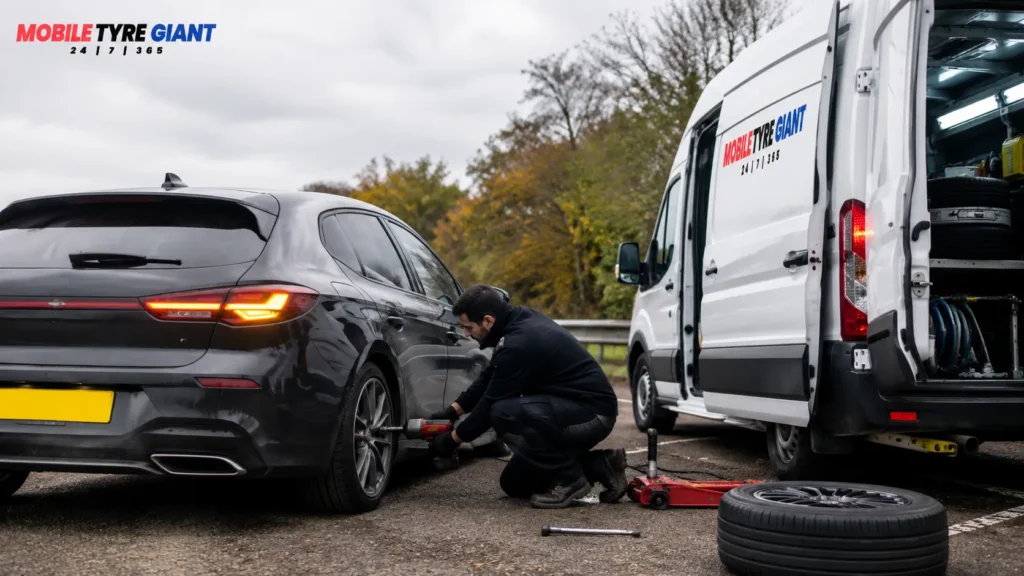
The Tyre Has Blown Out or Shredded During a Journey
A blowout can sound like a heavy bang beneath the vehicle, followed by a harsh flapping noise and sudden vibration through the steering wheel. The driver should avoid sharp braking or aggressive steering and instead reduce speed gradually while keeping control of the vehicle. Once stopped safely, do not attempt to continue driving on the damaged tyre. The rubber may already be torn away from the casing, leaving the wheel exposed to the road. This type of damage normally requires mobile tyre replacement rather than a simple puncture repair.
A shredded tyre can also damage the wheel arch, valve, wheel, or nearby vehicle components. The technician therefore needs more than a photograph of the original puncture point. Send wide images showing the complete wheel, surrounding bodywork, and available working space. Mention any warning lights, unusual steering behaviour, or impact with a kerb or pothole before the failure. This information helps the fitter arrive with realistic expectations and suitable equipment. It also prevents the customer from assuming that replacing the tyre alone will automatically solve every problem caused by the incident.
Pressure Is Falling Rapidly or the Problem Happens Out of Hours
A slow puncture and rapid pressure loss are not the same problem. A tyre that loses a small amount of pressure over several days may be suitable for a planned same-day inspection when the vehicle is safely parked. A tyre that becomes visibly soft within minutes can leave the driver stranded before reaching the next safe destination. Repeatedly adding air is not a reliable solution when pressure disappears almost immediately. Rapid loss may indicate a larger puncture, damaged valve, bead leak, cracked wheel, or serious sidewall damage.
Problems occurring late at night, on Sundays, or during bank holidays can also require emergency assistance when the vehicle cannot be secured or left where it is. The darkness and quiet surroundings can make a simple tyre problem feel much more intimidating. Stay inside a safe building or behind a protective barrier where possible rather than standing beside the damaged wheel. Share your location with someone you trust and keep your phone charged while waiting. When speaking to the fitter, confirm the complete price, estimated arrival window, tyre specification, and payment method before dispatch.
What Should You Do After a Tyre Problem on a Motorway?
A motorway tyre failure requires a different response from a flat tyre found at home. Fast-moving traffic, limited space, poor visibility, and heavy vehicles create risks that are more serious than the damaged tyre itself. When possible, move left and reach a service area, emergency area, exit, or another place of relative safety. Switch on the hazard lights and avoid stopping in a live traffic lane unless the vehicle physically cannot move. Do not focus on photographing the tyre until you and your passengers are away from immediate danger.
When it is safe to exit, leave through the side furthest from traffic and move behind a barrier where one is available. Children, older passengers, and pets should also be kept away from the carriageway. Do not attempt to change the tyre yourself beside fast-moving traffic simply because a spare wheel is available. The wind and vibration created by passing lorries can make the roadside feel unstable even when the vehicle appears well positioned. Emergency tyre support should only begin once the location is suitable for a technician to work without unacceptable exposure.
Move to Relative Safety and Know When Recovery Comes First
A mobile fitter cannot safely work in every place where a vehicle breaks down. A narrow shoulder, blind bend, live lane, unstable verge, or location directly beside fast traffic may require the vehicle to be recovered first. This does not mean the mobile service has failed or refused to help. It means the environment presents a greater danger than the tyre problem itself. Moving the car to a service station, recovery compound, car park, or wider emergency area can make the eventual fitting safer and more efficient.
Once the vehicle is in a suitable location, the technician can inspect whether the tyre might qualify for mobile puncture repair or whether replacement is necessary. Do not assume that every nail can be repaired, especially if the tyre was driven while deflated. Sidewall damage, exposed cords, large punctures, and internal structural damage normally rule out a safe permanent repair. A professional inspection protects you from paying for a temporary solution that cannot safely support the vehicle. The correct outcome may take slightly longer, but it is better than returning to the road with a compromised tyre.
How Quickly Can a Mobile Tyre Fitter Arrive?
Arrival time is one of the first things drivers ask about, especially when the car is stranded or needed later that day. A responsible answer should be realistic rather than dramatic. Mobile Tyre Giant typically aims to reach customers within 30 to 60 minutes, but this should never be treated as an unconditional guarantee. Traffic, distance, current bookings, technician location, and tyre availability can all change the estimate. An accurate arrival window is more useful than hearing an impressive promise that cannot be kept.
The difference between same-day and emergency mobile tyre fitting also affects how the visit is scheduled. Emergency jobs are prioritised because the vehicle may be immobilised or positioned somewhere unsuitable. Same-day appointments are usually fitted into an available daytime route. Both services still require the correct tyre and equipment to be confirmed before the van leaves. A technician arriving quickly with the wrong tyre does not solve the customer’s problem.
What Affects an Emergency Arrival Time?
Location has the biggest influence on emergency response. A technician may be nearby, but heavy traffic, road closures, accidents, or restricted access can extend the journey. A clear postcode is helpful, although a shared live location is often better when the vehicle is beside a long road or inside a large car park. Junction numbers, nearby businesses, petrol stations, and visible landmarks can also guide the fitter. Vague instructions such as “near the roundabout” often cause unnecessary delays.
Tyre stock can affect the response just as much as distance. Common tyre sizes may already be carried in the van, while unusual run-flat, SUV, van, or performance tyres may need to be collected first. The number of damaged tyres and any locking wheel nut problem should also be mentioned before dispatch. Weather and safe access can further influence the arrival and fitting time. A realistic estimate should therefore be confirmed after the fitter receives the complete vehicle, tyre, and location information.
What Affects a Same-Day Appointment?
Same-day fitting depends heavily on how early the booking is made. A driver who contacts the service in the morning has a better chance of securing a suitable slot than someone calling shortly before the end of the working day. Technician availability must also match the customer’s location and required tyre. A heavily booked route may have space later in the afternoon even when an immediate visit is impossible. This is why same-day means completion within the day, not automatic attendance within minutes.
Customers should explain any fixed deadline before confirming the booking. Saying that the vehicle is required before 5 p.m. is more useful than simply asking for the earliest available appointment. The fitter can then judge whether the route, traffic, and stock make that deadline realistic. Drivers should avoid arranging another important commitment immediately after the expected arrival window. Leaving some flexibility protects against delays caused by earlier emergency jobs or unexpected road conditions.
Is Emergency Mobile Tyre Fitting More Expensive?
Emergency mobile tyre fitting can cost more than a scheduled same-day appointment, although urgency is only one part of the price. Immediate dispatch may require a technician to change an existing route, travel farther, or attend outside normal hours. Night, weekend, and bank holiday work can also affect availability and operating costs. The tyre itself may be the largest part of the total, particularly when the vehicle needs a large, reinforced, run-flat, or premium model. Two drivers with similar punctures can therefore receive different quotes because their vehicles require completely different tyres.
Price should never be judged only by the callout charge. A lower quote may exclude balancing, valve work, disposal, VAT, or specialist removal of a damaged locking wheel nut. Another quote may look higher because those items are already included. The customer needs to compare the complete service, not just the first number mentioned on the phone. Requesting the total price in writing makes the comparison much easier and reduces confusion when payment is due.
What Can Increase the Final Price?
Tyre size, brand, load rating, speed rating, and construction all affect the replacement cost. A small common tyre is usually easier to source than a specialist tyre fitted to a high-performance car, electric vehicle, large SUV, or commercial van. The condition of the wheel can also matter if the tyre has been driven while completely flat. A damaged valve, cracked wheel, seized nut, or missing locking wheel nut key may require additional work. These complications are not always visible until the technician begins the inspection.
Travel distance and attendance time may also influence the service charge. An emergency job in the middle of the night can involve different costs from a scheduled driveway appointment during normal hours. The number of tyres being changed and whether matching tyres are required on the same axle should be confirmed beforehand. Customers should not hide details in the hope of receiving a lower quote. Accurate information produces a more reliable price and reduces the chance of the job being delayed once the fitter arrives.
What Should Be Included in the Quote?
A complete quote should clearly state whether it includes the tyre, attendance, fitting, balancing, valve work, old tyre disposal, and VAT. It should also identify the tyre brand, size, load index, speed rating, and run-flat status where applicable. Customers should ask whether the tyre is new and whether the quoted product is physically available. The payment method and any deposit requirement should be explained before dispatch. An invoice should be provided after the work has been completed.
Extra services should be listed separately rather than appearing as a surprise at the end. This includes TPMS work, specialist valve replacement, damaged wheel issues, and locking wheel nut removal. A professional provider should be willing to explain why any additional work is needed. The customer should also ask what warranty applies to the supplied tyre and the fitting work. Clear pricing protects both the driver and the technician from avoidable disputes.
What Information Does a Mobile Tyre Fitter Need Before Dispatch?
The quality of the information sent during booking can determine whether the first visit succeeds. At minimum, provide the exact location, vehicle registration, make and model, full tyre size, and number of affected tyres. The fitter should also know whether the car is safely parked or stranded beside a road. Mention any visible damage, warning lights, recent impact, or rapid pressure loss. Clear details allow the technician to choose suitable stock, equipment, and a realistic route.
Photographs are often more useful than a long description. Send one image showing the full sidewall, one close-up of the visible damage, and one wider photograph showing the vehicle and surrounding working space. Do not photograph the tyre while standing close to moving traffic. If the wheel has a locking nut, locate the key before the van is dispatched. Tell the fitter immediately when the key is missing, damaged, or difficult to use.
| Information to send | Why it matters |
|---|---|
| Exact location or live pin | Prevents wasted time finding the vehicle |
| Vehicle registration | Helps identify the correct vehicle specification |
| Full tyre size | Confirms the tyre that must be supplied |
| Sidewall photograph | Shows size, rating, and tyre markings |
| Damage photograph | Helps assess likely repair or replacement needs |
| Run-flat status | Ensures the correct tyre construction is supplied |
| Locking wheel nut status | Prevents delays during wheel removal |
| Safe access details | Confirms whether fitting can be completed on site |
How to Read the Full Tyre Size
A common tyre marking may look like 205/55 R16 91V. The number 205 shows the tyre width in millimetres, while 55 describes the sidewall height as a percentage of that width. The letter R means the tyre uses radial construction, and 16 identifies the wheel diameter in inches. The number 91 is the load index, which shows how much weight the tyre is designed to carry. The final letter V is the speed rating.
Stopping at “205/55 R16” can result in the wrong tyre being supplied because the load and speed ratings still matter. Run-flat, reinforced, or XL markings can also change which tyre is suitable. Some vehicles require tyres with specific manufacturer approval markings or higher load ratings. The safest approach is to send a clear sidewall photograph rather than typing the size from memory. That small step can prevent a failed dispatch and several extra hours of waiting.
What Happens During Mobile Tyre Fitting?
Once the technician arrives, the first step is not immediately removing the wheel. The vehicle, tyre, and surrounding area should be inspected to confirm that the work can be completed safely. The fitter will check the tyre size, visible damage, wheel condition, valve, and any warning lights reported during booking. They may also ask how the damage occurred and whether the tyre was driven while losing pressure. These details help determine whether the tyre might be repairable or requires replacement.
The vehicle must be parked on firm, level ground with enough room around the affected wheel. The technician will use the correct lifting point, loosen the wheel nuts, and raise the vehicle using professional mobile equipment. A missing or damaged locking wheel nut key can delay this stage, which is why it should be discussed before dispatch. Once the wheel is removed, the tyre can be inspected more closely. This internal inspection often reveals damage that cannot be seen while the tyre remains fitted to the vehicle.
Repair, Replacement and Wheel Balancing
If the puncture is within a repairable section of the tread and the tyre has no structural damage, a permanent professional repair may be possible. If the sidewall is cut, the tyre is shredded, the cords are visible, or the tyre has been badly damaged while flat, replacement is normally the safer outcome. The technician should explain the reason rather than simply stating that a new tyre is needed. A clear explanation helps the customer understand what they are paying for and why the cheaper option may not be suitable.
After a replacement tyre is fitted to the wheel, balancing is an important part of the process. Small balancing weights are used to correct uneven weight distribution around the wheel and tyre assembly. Without proper mobile wheel balancing, the driver may feel vibration through the steering wheel or seat at higher speeds. The tyre is then inflated to the correct pressure, and the wheel is refitted to the vehicle. The nuts should be tightened using the correct torque rather than simply being forced as tightly as possible.
Final Safety Checks Before You Drive Away
A professional visit should end with more than a quick visual glance. The fitter should confirm the tyre pressure, check the wheel installation, and make sure the valve is not leaking. Where the vehicle uses a tyre pressure monitoring system, the warning light may need time to reset after the pressure has been corrected. If the light remains on, the sensor, valve, or another tyre may require further attention. Mobile Tyre Giant also offers TPMS valve replacement when the problem is related to a damaged or leaking valve component.
Before the technician leaves, inspect the supplied tyre and check that the size and specification match what was agreed. Ask for an invoice showing the work completed, tyre supplied, and final amount paid. Confirm what warranty applies to the tyre and fitting service. If anything feels unusual during the first drive, such as vibration, pulling, knocking, or continued pressure loss, stop safely and contact the provider. A few minutes spent checking the work can prevent confusion later.
How to Avoid a Delayed or Failed Mobile Tyre Appointment
Most failed appointments begin with incomplete information rather than a problem with the fitting equipment. The customer may send only the wheel diameter, forget to mention that the tyre is run-flat, or assume the locking wheel nut key is inside the car. The technician then arrives with a tyre that looks similar but does not match the required load or speed rating. This wastes time for everyone and can leave the vehicle stranded for even longer. A clear booking process is therefore part of a successful tyre fitting.
Send a full sidewall photograph rather than relying on a tyre size copied from an old invoice. Explain whether the vehicle is on a driveway, roadside, underground car park, or soft ground. Mention height restrictions if the fitter must enter a covered car park. Confirm how many tyres are affected and whether the wheel appears damaged. These details may seem minor, but they help the technician prepare for the actual situation rather than an incomplete description.
Confirm the Exact Tyre Before Dispatch
Ask the provider to confirm the full tyre size, load index, speed rating, and construction before the van leaves. If you require a particular tyre brand or matching tyre on the same axle, say so clearly. Do not accept vague wording such as “a suitable tyre” when the actual specification has not been confirmed. The fitter should also explain when the requested brand is unavailable and offer a clearly identified alternative. This gives you the chance to compare the option before the technician is already standing beside the vehicle.
Physical stock confirmation is especially important for unusual sizes, run-flat tyres, commercial vans, electric vehicles, and performance cars. Online listings do not always mean the tyre is already loaded in the van or available locally. Ask whether the tyre is physically available and ready for dispatch. A slightly longer wait for the correct tyre is better than a quick arrival with the wrong product. Correct preparation is what turns a promised appointment into a completed job.
Get the Price and Arrival Window in Writing
A verbal quote can easily become unclear when the situation changes or several people handle the booking. Request a text or WhatsApp message confirming the total amount, tyre specification, and what the price includes. The message should identify fitting, balancing, disposal, VAT, and any callout or out-of-hours charge. If specialist work may be required, ask how it will be priced. Written confirmation gives both the customer and provider a shared record of the agreement.
The same principle applies to arrival times. Ask for a realistic window rather than demanding an impossible exact minute. Traffic, earlier emergency jobs, and tyre collection can affect the route. A reliable provider should update you when a significant delay occurs. Keep your phone nearby and make sure the vehicle remains accessible during the appointment window. Missed calls and locked car parks can delay a properly prepared technician just as easily as traffic.
Same-Day or Emergency? Four Realistic Driver Scenarios
Consider a driver who walks outside at 7 a.m. and finds a completely flat tyre on the driveway. The car is needed for work in the afternoon, but it is safely parked and not blocking traffic. This situation is urgent to the driver, but it usually suits same-day mobile tyre fitting rather than emergency priority dispatch. The driver should avoid moving the vehicle, send the tyre details early, and provide the required completion deadline. A planned visit can solve the problem without the pressure of a roadside emergency.
Now imagine a driver who hears a loud bang while travelling and feels the vehicle pulling sharply. They manage to stop in a safe area and discover that the tyre has shredded. The car cannot continue, and leaving it there for several hours may not be practical. This is a genuine emergency mobile tyre fitting situation, provided the location is safe enough for the technician. If the vehicle is still exposed to fast-moving traffic, recovery to a safer position should happen before fitting.
A Slow Puncture at Work and a Flat Tyre at Night
A slow puncture discovered in an office car park may suit a same-day inspection. The vehicle is already parked, the driver can remain at work, and the fitter has time to confirm whether the tyre can be repaired. However, the driver should not assume that adding air automatically makes the journey home safe. If the pressure drops rapidly or the tyre is nearly flat, the car should remain stationary. Same-day service allows the problem to be handled before the driver returns to the vehicle.
A flat tyre late at night with no spare presents a different challenge. If the vehicle is stranded away from home and cannot be secured safely, emergency assistance may be the sensible option. The driver should share the exact location, stay somewhere protected from traffic, and confirm the complete price before dispatch. Darkness, rain, and unfamiliar surroundings can make the wait feel longer than it really is. Clear communication and realistic updates become especially important in this situation.
Same-Day or Emergency Mobile Tyre Fitting: Final Decision
Choose same-day mobile tyre fitting when the vehicle is parked safely and can wait for an available appointment later that day. This option works well for driveway flats, slow punctures, worn tyres, workplace fitting, and fleet vehicles needed for a later shift. It offers convenience without treating every tyre problem as a crisis. The earlier you provide the correct information, the more likely the fitter can source the tyre and complete the work within your deadline. Same-day fitting is planned urgency.
Choose emergency mobile tyre fitting when the vehicle is stranded, fully immobilised, unsafe to continue driving, or unable to remain in its current position. Blowouts, shredded tyres, rapid pressure loss, and severe sidewall damage usually fall into this category. The fastest advertised arrival should not be your only deciding factor. Confirm the correct tyre, realistic arrival window, safe fitting location, and complete price before dispatch. Emergency fitting is priority assistance, but it still depends on careful preparation and safe working conditions.
Final Words: Choose the Service Based on Safety, Not Panic
The difference between same-day and emergency mobile tyre fitting is easier to understand once you stop measuring urgency only by the clock. A vehicle parked safely on a driveway may need attention today, but it can normally wait for an organised same-day appointment. A vehicle stranded beside a road, unable to move, or sitting on a badly damaged tyre needs a faster and more safety-focused response. In both cases, the correct tyre specification and accurate location information are essential. Speed without preparation often creates a second delay.
Before booking, take a clear sidewall photograph, find the locking wheel nut key, share your exact location, and ask for the full price in writing. Do not continue driving on a fully deflated conventional tyre simply to avoid a callout. That short journey can turn a repairable puncture into a ruined tyre and damaged wheel. Choose same-day fitting when the vehicle can wait safely and emergency fitting when it cannot. That simple rule will help you make a calmer, safer, and more cost-effective decision.
Need Same-Day or Emergency Tyre Help?
Share your location, vehicle details, and tyre size to arrange the right mobile tyre fitting service for your situation.
Frequently Asked Questions
Find quick answers to the most common questions our customers ask.
Same-day fitting is a scheduled visit completed later that day. Emergency fitting prioritises a vehicle that is stranded, unsafe, or unable to continue its journey.
Call for emergency help when the tyre is blown, shredded, fully flat, or losing pressure rapidly and the vehicle cannot be driven or left safely.
Same-day fitting suits a vehicle parked safely at home, work, or another accessible location that needs repair or replacement before an upcoming journey or deadline.
It can cost more because of priority dispatch, distance, out-of-hours attendance, or specialist tyre requirements. Request the complete written price before confirming the callout.
Arrival depends on location, traffic, demand, technician distance, and tyre stock. Mobile Tyre Giant typically aims for 30 to 60 minutes, but this is not guaranteed.
A puncture may be repairable when it is within the permitted tread area and the tyre has no structural damage. The tyre must be professionally inspected first.
No. Driving a fully deflated conventional tyre can damage the tyre, wheel, and vehicle control. Stop safely and arrange professional repair or replacement.
No. A mobile fitter can bring a suitable replacement when the correct size, load rating, speed rating, and tyre type are confirmed before dispatch.
Professional replacement should normally include wheel balancing, but confirm this when booking. The quote should clearly list fitting, balancing, disposal, valves, and VAT.
Only when the vehicle is in a safe location with enough working space. A live-lane or exposed breakdown may require recovery before tyre fitting can begin.