

A puncture never seems to happen at a convenient moment, so the first question most drivers ask is simple: how long does mobile puncture repair take? For most Mobile Tyre Giant puncture repairs, the actual on-site repair takes around 20 to 40 minutes once the technician arrives. The exact time depends on what is causing the air loss, where the tyre is damaged, and whether the tyre can be safely repaired. A straightforward nail or screw in a suitable part of the tread may be relatively quick to diagnose, while a slow leak with no obvious cause can require more investigation. Think of it like finding a small water leak at home: fixing the visible problem may be simple, but finding exactly where the leak starts can take longer than expected.
There is also an important difference between mobile puncture repair time and the total time from requesting help to driving away. The technician first has to travel to your location, assess the tyre, identify the source of pressure loss, confirm whether repair is appropriate, and then complete the work. Mobile Tyre Giant currently provides mobile tyre repair for punctures, slow leaks and other tyre pressure problems at suitable home, workplace and roadside locations. That means a driver with a flat tyre outside the office does not necessarily have to arrange recovery simply to have the tyre inspected. Understanding each stage separately gives you a much more realistic idea of how long you may actually be waiting before the car is ready to move again.
How Long Does a Mobile Puncture Repair Usually Take?
Most professional mobile puncture repairs can be completed within the 20 to 40 minute repair window after the technician arrives, provided the tyre is suitable for repair. That period is not simply spent pushing a plug into a visible hole and sending the vehicle away. The technician needs to identify the problem, examine the damaged area and determine whether the tyre meets the conditions for a proper repair. If a screw is sitting clearly in the tread and the tyre has remained properly inflated, diagnosis may be fairly straightforward. When the tyre is quietly hissing air overnight but there is no obvious object in the tread, identifying the real cause can take more time.
The condition of the tyre also matters because two punctures that look almost identical from outside may have very different outcomes once inspected. One tyre may have a small repairable penetration, while another may have been driven underinflated long enough to suffer additional internal damage. This is why a responsible technician should not promise that every puncture will take exactly the same number of minutes. The useful figure is a normal working range, not a stopwatch guarantee. For the driver, the more practical expectation is that a straightforward repair is often relatively quick, but the technician must prioritise whether the tyre is safe to return to service rather than simply completing the job as fast as possible.
Does the 20 to 40 Minute Repair Time Include Technician Travel?
No, the 20 to 40 minute mobile puncture repair time normally starts when the technician reaches the vehicle and begins assessing the problem. Technician arrival is a separate part of the callout, and Mobile Tyre Giant currently publishes a typical response window of 30 to 60 minutes, although actual arrival can depend on location, traffic and technician availability. A driver in a busy town centre during light traffic may have a different experience from someone waiting farther away during rush hour. This distinction matters because saying that a repair takes 30 minutes can sound as though you will be driving again 30 minutes after making the call. In reality, the total journey includes dispatch, technician travel, diagnosis, repair and the final checks before the vehicle can return to the road.
A useful way to picture it is like ordering a meal for delivery: preparation time and delivery time are both part of your overall wait, but they are not the same thing. The tyre itself may only require a relatively short period of hands-on work once the mobile fitter is beside the vehicle. If the technician then discovers that the air loss is coming from a valve, bead seal or another less obvious source, diagnosis can alter the expected completion time. The goal should therefore be to understand total downtime, rather than concentrating on one headline number. That gives a stranded driver a more honest expectation and avoids the frustration of assuming that technician travel is included within the advertised repair window.
Stage | What Happens | What Affects the Time |
Booking and dispatch | Your location, vehicle details and tyre problem are confirmed | Accuracy of the information provided |
Technician travel | The mobile fitter travels to your vehicle | Location, traffic and technician availability |
Diagnosis and inspection | The source of air loss and tyre condition are checked | Visible puncture, slow leak, valve or bead problems |
Puncture repair | A professional repair is completed when the tyre is suitable | Damage location and tyre condition |
Final checks | Pressure and repair are checked before driving | Whether any additional issue is found |
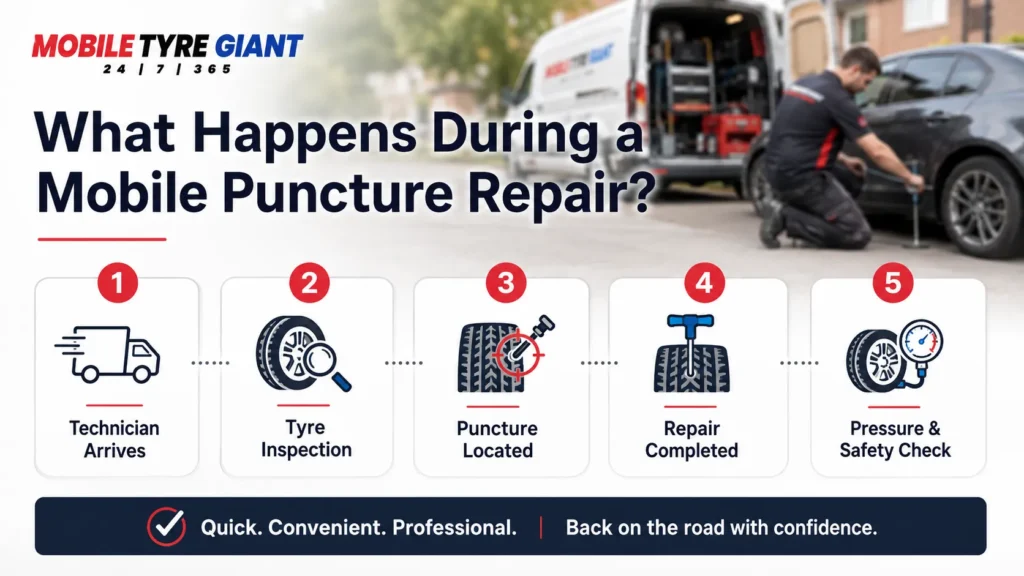
What Happens During a Mobile Puncture Repair?
The first part of a professional mobile puncture repair is diagnosis because a tyre losing pressure does not automatically mean there is one obvious hole in the tread. A nail or screw may be clearly visible, but pressure loss can also come from a leaking valve, a problem around the bead where the tyre meets the wheel, or a very small puncture that is difficult to see. Mobile Tyre Giant states that its technicians assess the damage on arrival and identify whether the problem involves the puncture, valve, bead or sidewall before deciding what work is appropriate. That inspection matters because simply fixing the first visible object could leave another source of air loss untouched. A driver may only notice a soft tyre in the morning, but the technician’s job is to find out what actually caused it rather than guessing from the first symptom.
Once the cause has been identified, the technician checks whether the tyre is suitable for repair and examines the condition of the affected area. Where the puncture can be professionally repaired, the work is completed and the tyre is returned to the correct pressure before the vehicle is released. Mobile Tyre Giant’s current repair process also includes checking that the completed repair is holding before the customer drives away. This explains why a proper mobile tyre puncture repair may take longer than a five-minute roadside fix that only deals with the visible hole. The extra time is not wasted time because diagnosis, inspection and final checking are what turn a quick response into a service designed to get the vehicle moving again with greater confidence.
What Can Make a Mobile Puncture Repair Take Longer?
A straightforward puncture may fit comfortably within the normal repair window, but some jobs naturally require more time because the cause is not obvious or the tyre has suffered additional damage. One of the biggest variables is diagnosis. A screw sitting in the centre of the tread gives the technician an obvious place to start, while a tyre that loses a few PSI every night may have no visible sign of damage at all. The technician may need to check the tread, valve, bead area and overall tyre condition before finding the real source of pressure loss. Tyre type can also affect the process, particularly when a run-flat tyre or another construction requires additional checks before repairability can be confirmed. Wheel access matters too because seized components, restricted working space or a missing locking wheel nut key can slow down removal. None of these situations automatically means something is seriously wrong, but they can turn what looks like a simple puncture into a longer inspection. The important point is that repair time depends on what the technician finds, not simply on the size of the object visible from outside. A careful mobile fitter should spend the time needed to understand the problem rather than rushing to meet an unrealistic minute-by-minute promise.
The condition of the tyre before the technician arrives can make an even bigger difference. A tyre that has remained inflated after picking up a small nail is very different from one that has been driven several miles while soft or completely flat. When a tyre runs with insufficient pressure, its sidewalls flex far more than they are designed to, creating heat and potentially damaging the internal structure. That damage may not be obvious while the wheel is still fitted to the car, which is why proper inspection matters. Drivers sometimes focus only on the original puncture and assume that removing the nail will solve everything, but the journey taken after the puncture can change the final outcome. If you are unsure whether it is safe to continue, Mobile Tyre Giant’s guide to driving with a flat tyre explains why continuing on a deflated tyre can cause further damage. Weather and safe working conditions can also influence how quickly the job can be completed, particularly if the vehicle is stopped in an exposed or unsuitable position. In practice, the fastest repair is usually the one where the vehicle has been stopped early, the tyre remains accessible and the technician can diagnose the problem without additional complications.
Does a Slow Puncture Take Longer to Repair?
A slow puncture can take longer to deal with because the challenge is often finding the source rather than carrying out the repair itself. Imagine coming out to the car each morning and noticing that one tyre looks slightly softer, yet there is no nail, screw or obvious cut anywhere on the tread. That kind of pressure loss may come from a tiny penetration that only leaks when the tyre flexes, but it can also be caused by a valve or a poor seal where the tyre meets the wheel. The air may escape so gradually that the tyre still looks normal to the eye, which makes visual diagnosis unreliable. A technician therefore needs to check the tyre methodically rather than assuming that every slow leak is caused by a hidden nail. If the leak is found quickly and the tyre is suitable for repair, the job may still be relatively straightforward. If several areas need checking, the diagnosis stage can take longer than it would for an obvious puncture. This is why two drivers with what both describe as a “slow puncture” can experience different repair times. One may have a clearly repairable tread penetration, while the other may have a valve or bead-related issue that requires a different solution.
Slow punctures are also easy for drivers to underestimate because the tyre may continue holding enough air to appear usable for days. Repeatedly adding air can temporarily restore pressure, but it does not identify why the tyre is losing it. The tyre pressure monitoring system may warn the driver again, or the steering may begin to feel slightly different as pressure drops, but neither symptom tells you exactly where the leak is. A proper diagnosis becomes especially important when a tyre has already been inflated several times because the original rate of pressure loss can become harder to judge. The technician may also find more than one issue, such as a small tread puncture combined with a leaking valve. In that situation, repairing only the most obvious problem could leave the customer with the same pressure warning a few days later. Taking a little longer to inspect the tyre thoroughly can therefore save a second callout and another period of downtime. For the driver, the useful expectation is that a slow puncture is not necessarily harder to repair, but it can take longer to diagnose because the source of air loss may be less obvious.
Can Every Tyre Puncture Be Repaired?
No, not every tyre puncture can be repaired, and this is one of the main reasons a mobile puncture callout can take a different path from what the driver originally expected. The technician has to consider where the damage is located, how large or severe it is, the general condition of the tyre and whether the tyre has suffered additional internal damage. Small penetrations within an appropriate part of the tread may be candidates for professional repair, but damage around the shoulder or sidewall is a different situation because these areas experience significant flexing while the vehicle is moving. The age and condition of the tyre also matter. A tyre with cracking, very low tread or previous damage may not be a sensible candidate for repair even if the latest puncture itself looks small. Similarly, a tyre that has been driven while badly underinflated may have internal damage that cannot be judged from the outside. This is why repairability should be confirmed after inspection rather than promised over the phone based only on a driver’s description. A professional technician needs to decide whether returning the tyre to service is appropriate, not simply whether the visible hole can physically be filled.
This distinction is also important when thinking about time. A customer may book expecting a 20 to 40 minute repair, but the technician could inspect the tyre and determine that replacement is the correct outcome instead. That does not mean the inspection has failed or that time has been wasted. It means the original problem has been properly assessed before a decision is made. The alternative would be to repair a tyre simply because the puncture looks small, without considering whether the surrounding structure is suitable for continued use. Drivers understandably want to avoid paying for a replacement when a repair is possible, but they should also avoid the opposite mistake of insisting on a repair when the tyre is no longer suitable. The best outcome is the one supported by the tyre’s actual condition. In practical terms, mobile puncture repair should always begin with the expectation of inspection first and repair second. That approach gives the driver a more realistic understanding of both timing and possible outcomes.
Can a Nail or Screw in a Tyre Be Repaired?
A nail or screw in the tyre does not automatically mean the tyre needs replacing. If the object has created a small penetration in a suitable part of the tread and the tyre is otherwise in good condition, repair may be possible after inspection. This is one reason drivers should avoid judging the tyre only from how dramatic the puncture looks from outside. A large screw head can look alarming while the actual penetration is relatively small, whereas a tiny object positioned close to the shoulder may create a problem that is less suitable for repair. The angle of entry can matter as well because damage inside the tyre may not follow the same path suggested by the visible head of the nail or screw. The technician therefore needs to inspect more than the surface appearance before confirming the solution. If the tyre has retained most of its pressure and has not been driven while flat, there may be fewer complications than with a tyre that has been heavily underinflated. That can help keep diagnosis and repair within the normal working window. The safest assumption is not “nail equals repair” or “nail equals replacement”, but rather “nail equals inspection first.”
Drivers are sometimes tempted to pull the object out before help arrives because it seems like the obvious thing to do. In many cases, leaving it alone until the tyre can be assessed is more sensible because removing it can allow air to escape much faster and make the vehicle harder to move safely. The technician can then identify the exact penetration and determine whether the tyre is suitable for professional repair. This is especially useful when the vehicle is parked at home, work or another safe location and there is no immediate need to disturb the tyre. If inspection shows that the damage falls outside the repairable area, or the tyre has suffered additional structural damage, replacement may be required instead. That decision should come from the condition of the tyre rather than from assumptions based on the object itself. For most drivers, the practical takeaway is simple: a visible nail or screw can often lead to a relatively straightforward repair, but only after the tyre has been properly checked. That inspection is part of the repair time, not an unnecessary delay.
Can Run-Flat Tyres Be Repaired?
Run-flat tyres need more careful assessment because they are designed to support the vehicle for a limited distance after losing pressure, and that can make internal damage harder to judge from the outside. A driver may arrive home thinking the tyre is still in reasonable condition because it never looked completely collapsed, but the reinforced sidewall may have been working much harder than normal during the journey. Whether a run-flat tyre can be repaired depends on the tyre manufacturer’s guidance, the position of the puncture, the condition of the tyre and how far it was driven after pressure was lost. Some run-flat tyres may be considered for repair when the damage is minor and the tyre has not been compromised, while others should be replaced once they have been driven significantly underinflated. The important point is that “run-flat” does not mean “automatically repairable” or “automatically replaceable.” Inspection is what determines the outcome. That extra assessment can make the visit take slightly longer than a simple conventional tyre puncture because the technician has more factors to consider. For the driver, the safest expectation is that the fitter will examine the tyre first and follow the relevant manufacturer guidance rather than making a decision based only on the fact that the tyre is labelled run-flat.
Run-flat tyres also highlight why total puncture repair time cannot always be predicted accurately over the phone. Two drivers may both report a nail in the tread, yet one tyre may have maintained enough pressure while the other has been driven for several miles after the warning appeared. From outside, those tyres can look similar, but their internal condition may be completely different. A technician therefore needs to consider pressure history, visible damage and the condition of the sidewall before deciding whether repair is appropriate. If replacement is required, the original 20 to 40 minute repair expectation naturally changes because the job has moved from repair into replacement. This is not a delay caused by poor planning but a change in the correct technical solution. Drivers can help by telling the fitter in advance if the vehicle uses run-flat tyres and whether the car was driven after the low-pressure warning appeared. That information gives the technician a clearer picture before arriving. It also reduces the risk of treating a run-flat puncture as if it were identical to a standard tyre puncture.
What Happens If the Tyre Cannot Be Repaired?
If inspection shows that the tyre is not suitable for repair, the next step is normally replacement rather than attempting to patch damage that should not be returned to service. Common reasons include sidewall or shoulder damage, significant internal deterioration, severe damage from driving while deflated, or overall tyre condition that makes repair inappropriate. This can be disappointing for a driver who expected a quick puncture fix, especially when the visible hole looks small. However, the decision has to be based on the entire tyre rather than the size of the object that caused the original problem. A small puncture combined with hidden sidewall damage can be more serious than a larger-looking tread puncture in an otherwise healthy tyre. The technician should explain what has been found and why repair is or is not suitable. That transparency matters because real drivers often worry that replacement is being recommended simply because it costs more. A proper inspection gives the decision a mechanical reason rather than turning it into guesswork. When replacement is required, Mobile Tyre Giant can provide mobile tyre replacement at a suitable location when the correct tyre is available.
The timing naturally changes once the job becomes a replacement because the technician may need to confirm tyre size, specification and stock before fitting can begin. If the replacement tyre is already available on the service vehicle, the transition from inspection to fitting may be relatively smooth. If the required size or specification is less common, additional coordination may be needed. This is another reason it helps to provide accurate vehicle registration and tyre details when making the booking. Imagine turning up to buy a pair of shoes without knowing the size: someone can still help, but the process is faster when the correct specification is known from the start. Tyres work in the same practical way, except the fitment requirements are much more important for vehicle safety. The useful lesson is that a failed repair inspection does not mean the callout has been wasted. It means the technician has identified that repair is not the correct solution and can move toward the safer alternative. For the driver, that is ultimately more valuable than completing a fast repair on a tyre that should have been replaced.
Is Mobile Puncture Repair Faster Than Going to a Garage?
Mobile puncture repair can reduce overall disruption because the technician travels to the vehicle rather than requiring the vehicle to reach a tyre depot first. That difference becomes especially important when the tyre is too flat to drive safely, the car has no spare wheel, or the driver is at home or work and does not want to arrange recovery. A garage may complete the physical repair just as quickly once the vehicle is inside the workshop, so it would be inaccurate to claim that mobile repair is always faster in every situation. The real advantage is often the removal of extra steps. There is no separate drive to the garage, no need to organise another vehicle, and in many cases no waiting room. If the vehicle is already parked somewhere safe, the technician can work where it stands while the driver continues with other tasks nearby. That can make the whole experience feel significantly shorter even when technician travel is included. For someone stranded with a completely flat tyre, avoiding recovery alone can make a major difference to total downtime.
There are situations where a garage may still be convenient, particularly if the tyre is holding pressure correctly, the vehicle can be driven safely and a trusted tyre depot is only a short distance away. The important comparison is therefore not simply “mobile equals fast” and “garage equals slow.” It is better to compare the full journey from discovering the puncture to getting the car back into normal use. Mobile service tends to be particularly valuable when moving the vehicle creates additional risk or inconvenience. The driver also gains the benefit of seeing the assessment happen at the vehicle rather than handing the car over and waiting elsewhere. For urgent cases, Mobile Tyre Giant also explains the difference between same-day and emergency mobile tyre fitting, which can help drivers understand whether their situation requires immediate assistance or can be handled as a scheduled visit. The fastest option is ultimately the one that resolves the tyre problem safely with the fewest unnecessary steps. That is why total downtime is a more useful measure than workshop repair time alone.
Can Mobile Puncture Repair Be Done at Home or Work?
Yes, mobile puncture repair can often be carried out at home or work when the vehicle is parked in a location that gives the technician enough safe access to the affected wheel. A driveway, workplace car park or other private parking area can be ideal because the vehicle is stationary and there is usually more working space than on a busy roadside. This can make the entire experience less stressful for the driver. Instead of sitting in a waiting area listening for their name to be called, they can remain at home or continue working while the technician deals with the tyre outside. The car does not need to be driven while pressure is low, which can also reduce the chance of turning a repairable puncture into more serious damage. Access still matters, however. A car parked tightly against a wall, squeezed between other vehicles or positioned on unsuitable ground may need to be moved slightly before work can begin. Giving the technician a clear description of where the vehicle is parked can therefore help avoid unnecessary delays.
Home and workplace repair also suits slow punctures particularly well because these problems are often discovered before the tyre becomes completely flat. A driver may notice a tyre pressure warning on the way home, add air temporarily, and then find the same tyre low again the following morning. Rather than repeatedly topping it up and hoping the problem disappears, arranging an inspection at the vehicle allows the cause to be identified without unnecessary travel. The technician can then determine whether the issue is a repairable tread puncture, valve-related leak or another problem. This is where mobile service becomes more than simply emergency roadside assistance. It can be used as a practical scheduled solution when the car is already parked somewhere safe. For the customer, the main benefit is control over the situation rather than waiting until the tyre becomes completely unusable. Dealing with a slow leak early can also reduce the risk of driving on insufficient pressure and causing additional damage before the tyre is inspected.
Can a Mobile Tyre Fitter Repair a Puncture at the Roadside?
A mobile tyre fitter may be able to repair a puncture at the roadside, but the location must be safe enough for the technician to work. A quiet residential street, suitable lay-by or secure car park is very different from a live motorway lane or a narrow road with fast-moving traffic passing close to the vehicle. Even when the tyre itself is perfectly repairable, unsafe working conditions can prevent immediate repair at the exact place where the vehicle stopped. In those situations, safety takes priority over speed. The vehicle may need to be moved to a safer location or recovered before the technician can begin. Drivers sometimes focus so heavily on getting the tyre fixed quickly that they overlook how much space is needed around the wheel for tools, lifting equipment and safe movement. A technician working inches away from live traffic cannot carry out the same controlled inspection as someone working on a driveway. That is why roadside repair should always be described as possible where conditions allow, not guaranteed everywhere.
If the vehicle is already stopped in a safe roadside position, the process can be very similar to a home or workplace callout. The fitter identifies the source of the pressure loss, checks whether the tyre is repairable and completes the work if the damage is suitable. The biggest difference is the environment around the vehicle. Rain, darkness, restricted access or heavy traffic can all make the job slower or change what can be done safely. Drivers can help by providing an accurate location and explaining the surroundings when they request assistance. Saying “I am on a road near Guildford” is far less useful than giving the road name, direction of travel and a clear landmark or safe stopping point. Accurate location details can reduce time spent trying to find the vehicle and allow the technician to judge whether the roadside position sounds workable before arrival. In an urgent puncture situation, that simple information can make a noticeable difference to the overall callout time.
What Should You Do While Waiting for a Mobile Tyre Fitter?
Once help has been arranged, the best thing you can do is avoid turning a manageable puncture into more serious tyre damage. If the tyre is visibly flat or significantly underinflated, continuing to drive can place additional stress on the sidewall and internal structure. Even a short journey can change the condition of a tyre that might otherwise have been repairable. If the vehicle is already in a safe place, leaving it parked until the technician arrives is normally more sensible than repeatedly moving it. A nail or screw that is still embedded in the tread should also generally be left alone until the tyre can be assessed because pulling it out can allow pressure to escape more quickly. You should not rely only on how the tyre looks, since a tyre can lose substantial pressure before appearing completely flat. If you are unsure what damage further driving may cause, Mobile Tyre Giant’s guide to driving with a flat tyre explains the risks in more detail. The aim while waiting is simple: protect the tyre from additional damage and keep the vehicle somewhere that can be accessed safely.
Your surroundings matter as much as the tyre itself. A car sitting securely on a driveway presents a very different situation from one stopped beside fast-moving traffic, so personal safety should always come before saving a few minutes. If you are on a public road, remain aware of traffic and follow any appropriate safety procedures for the location rather than standing beside the damaged wheel. Make sure the technician has an accurate location, especially if you are in a large car park, industrial estate or unfamiliar road where several entrances may exist. A short description such as the building name, car park level or nearby landmark can make the vehicle easier to find. It is also useful to keep your phone available in case the fitter needs clarification when approaching the location. These small preparations do not change the physical repair time, but they can reduce avoidable delays before work begins. For a driver who is already late or stranded, removing even a few unnecessary minutes from the overall callout can make the experience noticeably easier.
How Can You Help the Mobile Fitter Complete the Repair More Quickly?
Providing accurate information when arranging the callout is one of the easiest ways to reduce unnecessary delays. The technician should know the vehicle registration, exact location and what you have noticed about the tyre. Mention whether the tyre is completely flat, slowly losing pressure or has a visible nail or screw in the tread. If the vehicle was driven after the pressure warning appeared, say so because that may affect the inspection. Drivers who know they have run-flat tyres should also mention this rather than assuming every tyre is handled in exactly the same way. If sealant or an emergency inflation kit has already been used, that information is useful too. You do not need to become a tyre expert before calling, but clear observations help the technician understand what type of problem may be waiting. Think of it like describing a fault to a mechanic over the phone: “the tyre keeps losing pressure overnight” is far more useful than simply saying “something is wrong with my wheel.” Better information helps the callout begin with fewer unknowns.
Access to the wheel can also affect how smoothly the job progresses. If your vehicle uses locking wheel nuts, have the locking wheel nut key ready if you know where it is. Searching through the boot, glovebox and storage compartments after the technician arrives wastes time that could otherwise be spent diagnosing the tyre. The same applies to vehicles parked tightly beside walls, kerbs or other cars. Where it is safe and possible to do so before the tyre becomes fully deflated, leaving enough working space around the affected wheel can make access easier. Do not move an unsafe or badly deflated vehicle simply to create space, however, because protecting the tyre and vehicle remains more important than saving a few minutes. Clear communication, accessible equipment and a safe working area are the practical details most likely to keep the visit efficient. They cannot guarantee an exact completion time, but they remove delays that have nothing to do with the puncture itself.
How Long Before You Can Drive After a Professional Puncture Repair?
In most cases, there is no long waiting period after a professional puncture repair has been completed successfully. Once the repair is finished, the tyre has been inflated correctly and the technician has confirmed that it is holding pressure, the vehicle can normally return to use. You should not need to leave the car parked for several hours simply to allow a standard professional repair to “set.” The important point is that the technician has finished all necessary checks before handing the vehicle back. If another issue is discovered during the inspection, such as damage that makes repair unsuitable, you should follow the technician’s recommendation rather than assuming the original repair timeline still applies. The same applies if pressure loss continues after inspection or another component is found to be causing the problem. A completed repair should therefore be treated as the end of the process only once the tyre has passed the final checks. That final confirmation is what separates “the hole has been dealt with” from “the vehicle is ready to drive again.”
It is still sensible to remain aware of the tyre afterwards, particularly if the original problem was a slow leak that had been developing for some time. If a tyre pressure warning returns or the tyre begins losing pressure again, the problem should be investigated rather than repeatedly topping it up. Continued air loss could indicate another issue that was not related to the original puncture. For most straightforward repairs, however, the driver can continue the journey once the technician has completed the work and confirmed the tyre is suitable for use. This is why the most useful measure of mobile puncture repair time is not simply the number of minutes spent with tools in hand. The real endpoint is the moment when the vehicle has a tyre that has been assessed, repaired where appropriate and checked before returning to the road. For a stranded driver, that is the result that actually matters.
Final Words: How Quickly Can You Get Back on the Road?
So, how long does mobile puncture repair take? For most Mobile Tyre Giant puncture repairs, the actual on-site repair takes around 20 to 40 minutes once the technician arrives, but that figure should not be confused with the entire callout. Technician travel, diagnosis, tyre condition, puncture location and unexpected damage can all influence total downtime. A visible nail in a repairable part of the tread may be relatively straightforward, while a slow leak, run-flat tyre or tyre that has been driven while deflated can require more careful assessment. The fastest outcome is not always the best outcome if important checks are skipped. A proper mobile repair should begin with identifying the real cause of pressure loss and confirming that the tyre can safely be returned to service. If repair is suitable, the work can often be completed at the vehicle without a trip to a tyre depot. If it is not suitable, replacement becomes the safer next step.
The practical takeaway is to think in terms of arrival time, diagnosis time and repair time, rather than relying on one headline number. Stopping early when you notice pressure loss, providing accurate vehicle details and having your locking wheel nut key available can all help reduce avoidable delays. Mobile puncture repair is particularly useful when the vehicle is already parked at home, work or another suitable location and driving it could cause further damage. When professional help is needed, Mobile Tyre Giant’s mobile tyre repair service provides on-site diagnosis and repair where the tyre is suitable. The goal is not simply to finish as quickly as possible, but to get the vehicle moving again with the correct solution for the condition of the tyre.
Got a Puncture and Need It Fixed at Your Location?
Mobile Tyre Giant can inspect the tyre, identify the cause of the pressure loss, and complete a professional puncture repair at your home, workplace, or another suitable location.
Frequently Asked Questions
Find quick answers to the most common questions our customers ask.
Most Mobile Tyre Giant puncture repairs take around 20 to 40 minutes once the technician arrives. The exact duration depends on how easily the leak can be found, where the tyre is damaged, its overall condition and whether additional problems are discovered during inspection.
No. Technician travel time is separate from the actual repair. Location, traffic and technician availability can affect how long it takes the fitter to reach you, while the 20 to 40 minute repair window generally refers to the work carried out after arrival.
No. Repairability depends on the location and severity of the damage, the tyre's overall condition and whether it has suffered internal damage. Sidewall, shoulder or significant structural damage can make replacement more appropriate than repair.
It can because the technician may first need to identify whether the pressure loss is coming from a small tread puncture, valve, bead seal or another less obvious problem. Once the cause has been found, the correct repair or alternative solution can be determined.
Often, but not automatically. A small nail or screw in a suitable part of the tread may be repairable if the tyre is otherwise in good condition, but the technician still needs to inspect the damage before confirming that repair is appropriate.
Standard puncture repair is generally not suitable for sidewall or shoulder damage because these areas flex considerably while the vehicle is moving. If the tyre has structural damage outside the suitable repair area, replacement will normally be the safer solution.
Some run-flat tyres may be repairable, but the decision depends on manufacturer guidance, the location of the puncture and whether the tyre was driven while deflated. An inspection is necessary because internal damage may not be obvious from outside.
Yes, mobile puncture repair can normally be carried out at home when the vehicle is parked somewhere with safe and suitable access to the affected wheel. Workplaces and private car parks may also be suitable locations for an on-site repair.
A puncture may be repaired at the roadside when the tyre is suitable for repair and the vehicle is stopped somewhere safe enough for the technician to work. Busy, exposed or otherwise dangerous roadside locations may require the vehicle to be moved first.
If inspection shows that the tyre cannot safely be repaired, replacement will normally be recommended. This may happen because of sidewall damage, severe internal damage, poor tyre condition or damage caused by driving while deflated, and mobile tyre replacement may then be the appropriate next step.