
Getting a flat tyre at night can be particularly unsettling, especially on an unfamiliar road with limited lighting. You might hear a sudden bang, notice the steering pulling to one side or see a tyre pressure warning on your dashboard. Darkness makes it harder to assess the road, recognise passing traffic and identify a suitable stopping place. The temptation to pull over immediately or inspect the damaged tyre can create additional danger. Knowing how to respond helps protect everyone in the vehicle.
Whether you are travelling through a residential street, along a rural road or on a motorway, the first priority is reaching a place of relative safety. The appropriate response depends on traffic speed, visibility, road conditions and how severely the tyre is damaged. A slow puncture and a sudden blowout can affect vehicle control in different ways. However, neither situation should encourage unnecessary driving on a damaged tyre. Following a clear safety procedure is more important than attempting a quick roadside repair.
What Should You Do First When a Tyre Goes Flat at Night?
If a tyre suddenly loses pressure while driving, hold the steering wheel firmly and avoid abrupt movements. Ease off the accelerator and allow the vehicle to slow down gradually while maintaining control. Do not stamp on the brakes or make a sharp turn towards the roadside. Check your mirrors, assess surrounding traffic and signal before moving towards a safer stopping place. The objective is to stop without creating a second emergency.
Imagine travelling along a poorly lit road when the steering begins to feel unusually heavy. Stopping immediately beside a blind bend could expose you to approaching vehicles. If the car remains controllable, look for a suitable parking area, lay-by or safe exit. However, severe tyre damage may make continued driving unsafe. The advice in the flat tyre emergency guide explains how the severity of tyre damage affects the available options.
How Can You Recognise a Flat Tyre in the Dark?
A flat tyre may produce unusual noises, vibration or changes in steering behaviour before you notice anything visually. Sudden deflation can cause a loud bang or repeated thumping as the damaged rubber contacts the road. A slow puncture may first appear as a tyre pressure warning on the dashboard. You might also notice the vehicle pulling towards one side. These warning signs should be taken seriously, even when the tyre cannot be seen clearly.
A pressure warning does not always mean the tyre has completely deflated. However, continuing to drive without investigating the problem can cause additional damage. Reduce speed carefully and identify a suitable stopping location before inspecting anything. Do not open a door or step into the road to look at the wheel. Visibility and traffic conditions must be assessed before approaching the tyre.
Should You Keep Driving to a Brighter Location?
A well-lit parking area can be safer than a dark roadside, but reaching it must not require driving on a severely damaged tyre. If the vehicle remains stable and the problem appears to involve gradual pressure loss, moving carefully towards a nearby suitable stopping location may be possible. However, a completely flat standard tyre can quickly suffer serious sidewall and wheel damage. Strong vibration, unstable steering or a shredded tyre makes continuing particularly dangerous.
For example, a driver may spot a petrol station entrance shortly after a pressure warning appears. Reaching it could provide better visibility and safer access for assistance if the vehicle remains suitable to move. A sudden blowout is different because the tyre may no longer support the vehicle correctly. Never travel an arbitrary distance simply to find better lighting. The vehicle’s condition and immediate traffic hazards must determine when to stop.
Where Is the Safest Place to Stop With a Flat Tyre at Night?
The safest stopping location is one where the vehicle and its occupants are less exposed to moving traffic. On an ordinary road, this may be a suitable car park, wide lay-by or another safe area away from the carriageway. Avoid stopping near blind bends, narrow verges or places where approaching drivers have limited visibility. Check that the ground is reasonably firm and that the vehicle does not obstruct essential access. A convenient location is not necessarily a safe one.
When the vehicle has stopped, apply the parking brake and secure it according to the manufacturer’s instructions. Switch on hazard warning lights if the vehicle is causing an obstruction or needs to warn approaching traffic. Keep appropriate vehicle lights on in darkness, following the Highway Code’s lighting requirements. Do not stand between the vehicle and approaching traffic. Before anyone leaves the car, assess whether the doors can be opened safely.
What Should You Do on a Residential or Rural Road?
Residential roads often provide more stopping options than motorways, but darkness can conceal hazards. Look for a safe parking space or quiet area where passing vehicles can clearly see the stopped car. Watch for cyclists, pedestrians and motorcycles before opening the doors. On rural roads, narrow verges, ditches and uneven surfaces may make stopping or walking beside the vehicle dangerous. Avoid moving into an unfamiliar unlit area without checking for hazards.
The Highway Code advises using reflective clothing at night or in poor visibility. It also recommends placing a warning triangle at least 45 metres behind a broken-down vehicle on an ordinary road, but only when this can be done safely. Never walk into traffic or around a blind bend simply to position one. A warning triangle must never be placed on a motorway. Personal safety always takes priority over roadside equipment.
Should You Leave Your Sidelights or Hazard Lights On?
Hazard warning lights help other road users recognise a stationary vehicle that presents a hazard. They are particularly useful when a breakdown leaves the car obstructing the road or stopped somewhere unexpected. The Highway Code also advises keeping sidelights on if possible when it is dark or visibility is poor. For vehicles parked on roads or lay-bys where the speed limit exceeds 30 mph, parking lights are legally required. The precise lighting requirements depend on the situation and road.
Do not assume that hazard warning lights make it safe to stand beside the car. Approaching drivers may still have limited time to react, particularly on bends or roads without street lighting. Keep passengers away from passing traffic and avoid blocking the vehicle’s lights with your body. If the vehicle cannot be made adequately safe where it has stopped, request suitable assistance. Remaining visible should support a safe waiting position rather than replace one.
What if You Get a Flat Tyre on a Motorway at Night?
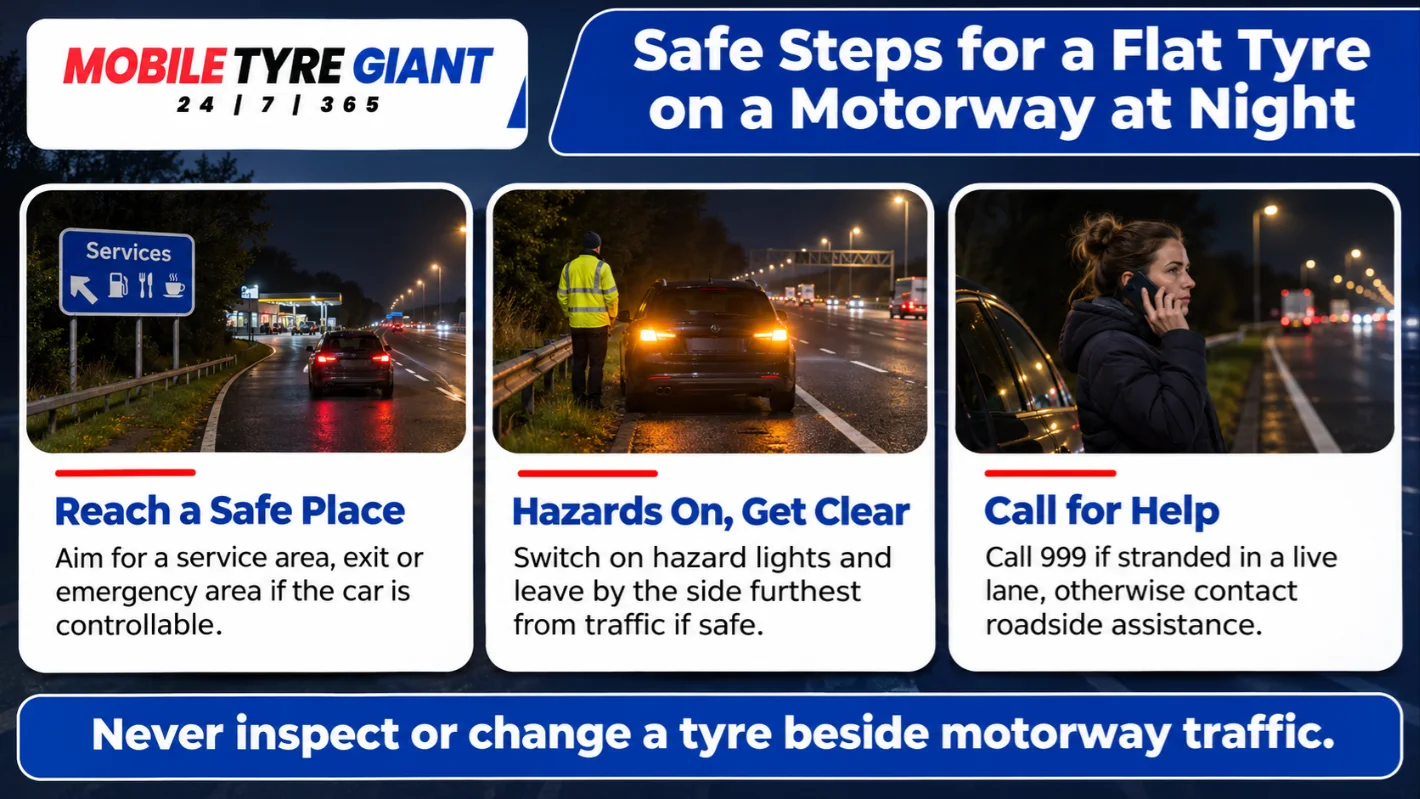
A motorway breakdown at night requires particular caution because traffic may continue travelling at high speed. If the vehicle remains controllable, the preferred option is to reach a motorway service area or leave at a suitable exit. If that is impossible, move towards an available emergency area or hard shoulder where one exists. Avoid stopping in a live lane unless absolutely necessary. Switch on hazard warning lights and use sidelights in darkness.
Once stopped in a suitable location, leave the vehicle by the side furthest from traffic if it is safe and possible. Move behind a safety barrier where available, while checking for uneven ground or other hidden hazards. Keep passengers together and well away from moving vehicles. Do not attempt to inspect or change the tyre beside motorway traffic. The information about a flat tyre on a motorway explains these stopping procedures in more detail.
What Changes on a Smart Motorway at Night?
Some smart motorway sections do not have a continuous hard shoulder, making emergency areas particularly important. These areas are marked by signs displaying an orange SOS symbol. If the vehicle remains controllable, aim for a suitable emergency area, service area or exit. However, never attempt to reach a distant stopping point when the damaged tyre makes further driving unsafe. Follow overhead traffic signals and never use a lane displaying a red X.
Darkness can make it harder to judge the distance to a refuge area or identify hazards beyond the carriageway. Once safely stopped, switch on the hazard lights and follow National Highways’ breakdown instructions. Emergency areas are not ordinary parking spaces, and drivers must contact the motorway operator before rejoining traffic. Do not attempt repairs while exposed to motorway traffic. Recovery to a safer location may be necessary before tyre work can begin.
What if Your Car Stops in a Live Motorway Lane?
A stationary vehicle in a live motorway lane presents an immediate collision risk. If you cannot reach a place of relative safety or safely exit and get clear of traffic, stay inside the vehicle. Keep your seat belt fastened, switch on the hazard warning lights and call 999 immediately, asking for the police. Provide the motorway name, direction of travel and any location information available. The emergency services can alert motorway operators to arrange appropriate protection.
Do not attempt to push the vehicle, cross active lanes or inspect the damaged tyre. Other drivers may not recognise the stationary vehicle in time, particularly in darkness or poor weather. If an emergency SOS system is available in the car, it may provide another way to contact the emergency services. Follow the operator’s instructions and avoid unnecessary movements. The immediate traffic danger must be addressed before arranging tyre repair or replacement.
How Can You Keep Yourself and Passengers Safe While Waiting?
After stopping, assess whether passengers can safely leave the vehicle and move away from traffic. On motorways, follow the specific breakdown instructions about leaving through the side furthest from moving vehicles and waiting behind a safety barrier. On ordinary roads, select a protected waiting position appropriate to the surroundings. Do not assume that remaining directly beside the vehicle is safe simply because it is dark or cold. An approaching vehicle could strike the broken-down car.
Keep children supervised and ensure passengers understand where they should wait. If reflective clothing is available within easy reach, put it on before moving to a safe position. A torch can help identify hazards underfoot, but avoid shining it directly towards approaching drivers. Use your phone to contact suitable assistance once everyone is protected. Do not return to an exposed vehicle unnecessarily to collect luggage or inspect the tyre.
When Should You Call Emergency Services or Breakdown Assistance?
Call 999 when there is an immediate danger that requires an emergency response, particularly if you are stranded in a live motorway lane and cannot safely get clear. A collision, injury or other serious threat may also require emergency services. For a non-emergency breakdown in a safe location, contact your breakdown provider or an appropriate tyre assistance service. If stopped in a motorway emergency area or hard shoulder, use the free emergency telephone where available or contact National Highways for advice.
Explain your location clearly, including the road name, direction of travel, nearest junction or postcode. Mention whether the car is obstructing traffic and whether passengers need additional assistance. Tell the provider if the tyre is completely flat, shredded or visibly damaged. Never leave a safe waiting position just to photograph the tyre. Accurate information helps responders assess the situation without creating further roadside risks.
How Do You Arrange Emergency Tyre Assistance at Night?
Once you have stopped safely and protected yourself and your passengers, the next step is arranging appropriate assistance. A flat tyre at night may require mobile tyre fitting, professional puncture repair or vehicle recovery. The right solution depends on the tyre damage, your location and whether a technician can work safely. A well-lit car park provides different conditions from an exposed roadside or motorway hard shoulder. Before contacting a provider, establish whether there is an immediate danger requiring emergency assistance.
For an ordinary breakdown in a safe location, contact your breakdown provider or an available tyre assistance service. If you are on a motorway hard shoulder or in an emergency area, follow National Highways instructions before arranging tyre work. Use an available emergency telephone or contact National Highways on 0300 123 5000 for advice. If you are stranded dangerously in a live lane and cannot get clear of traffic, call 999 and ask for the police. Roadside tyre assistance should never replace an emergency response when people are in immediate danger.
Can You Get Mobile Tyre Fitting During the Night?
Mobile tyre fitting can be available outside ordinary garage opening hours, including late evenings and early mornings. This can be useful when a tyre fails after work, during a long journey or while the vehicle is parked overnight. However, availability depends on the location, technician coverage and required tyre specification. A provider must also confirm that the stopping position is suitable for carrying out the work. Operating overnight does not mean every roadside location is safe for tyre fitting.
Imagine discovering a completely flat tyre in a supermarket car park shortly before midnight. Rather than attempting to drive to a closed garage, you may be able to arrange professional assistance at the parked vehicle. The provider will need to confirm access, tyre availability and suitable working space. Checking the relevant mobile tyre service areas can help establish whether assistance is offered near your location. Always confirm actual attendance and working conditions before assuming a call-out can proceed.
When Should You Choose Vehicle Recovery Instead?
Vehicle recovery may be necessary when a tyre cannot be repaired or replaced safely where the car has stopped. A narrow roadside, exposed motorway location or unstable verge may leave insufficient space for fitting equipment. Recovery can also be appropriate when a blowout has damaged the wheel or another vehicle component. In these circumstances, fitting a replacement tyre alone may not make the vehicle roadworthy. The vehicle may need to be moved to a suitable workshop or safer parking location.
For example, a car that stops on an unlit road with fast-moving traffic may be too exposed for a technician to work beside the damaged wheel. A recovery vehicle could move it to a safer location before inspection. A badly damaged wheel may also prevent an ordinary roadside tyre replacement. Explain these circumstances when requesting assistance so the provider can assess the situation. The objective is to resolve the breakdown without creating additional risks for drivers, passengers or technicians.
Should You Wait Inside or Outside the Vehicle at Night?
The correct waiting position depends on the road and the immediate hazards. On a motorway, if you can safely leave the vehicle and move clear of traffic, follow the Highway Code’s instructions to wait well away from the carriageway. Use a safety barrier where one is available and safe to reach. Do not return to the vehicle simply because the weather is cold or the surroundings are dark. If you cannot safely get clear, remain belted inside and seek emergency assistance as directed by the Highway Code.
On an ordinary road or in a car park, assess the surroundings before deciding where to wait. A safe indoor area or protected position away from moving vehicles may be preferable to standing beside the car. Keep children supervised and avoid walking across poorly lit traffic routes unnecessarily. If the location feels unsafe, explain the circumstances to the assistance provider. Your waiting arrangements should protect people rather than merely place them close to the vehicle.
What Information Should You Give During a Night-Time Tyre Call-Out?
Clear information helps an assistance provider understand the problem and assess what equipment may be required. Start with your location, vehicle registration and the nature of the tyre failure. Explain whether the tyre is slowly losing pressure, completely flat or visibly damaged. Mention if the car is parked in a safe bay, on a narrow road or near fast-moving traffic. These details are especially important at night when the technician may have difficulty finding the vehicle.
You should also explain whether anyone requires additional assistance, particularly if you are travelling with children or someone with limited mobility. State whether the vehicle can be reached safely without entering moving traffic. Do not leave a protected waiting position to gather information that is difficult to obtain. If you are unsure about the tyre size or damage, say so rather than guessing. Accurate information is more useful than a complete description obtained at unnecessary personal risk.
How Can You Share Your Exact Location in the Dark?
A postcode or clear street address is useful when the vehicle is parked in a residential area or car park. You can also provide a nearby landmark, car park entrance or navigation location. On rural roads, the road name, direction of travel and nearest junction may help identify your position. If your phone has a mapping application, you may be able to share a location pin. Make sure you remain in a safe position while using it.
Motorway breakdowns require additional location details because the two carriageways may be reached from different directions. Tell the operator which motorway you are on and whether you are travelling northbound, southbound, eastbound or westbound. Driver location signs and marker posts can provide useful reference information when visible from safety. Emergency telephones can also help motorway operators identify where you have stopped. Never walk along an exposed carriageway simply to obtain a more precise location.
What Vehicle and Tyre Details Does the Technician Need?
The vehicle registration, make and model help a technician identify the likely wheel and tyre requirements. The complete tyre size, load index and speed rating are also useful when arranging a replacement. If the vehicle has different front and rear tyre specifications, the affected wheel position matters. Mention whether the car uses run-flat tyres or has any known manufacturer-specific requirements. The technician should still verify the approved specification before fitting anything.
For example, two cars with similar wheel diameters may require different tyre widths or load ratings. Supplying only the wheel size may therefore be insufficient. If you know the tyre markings, provide them exactly as displayed rather than estimating. You can also mention any previous tyre pressure warnings or recent impacts. These details help the provider assess whether the problem is likely to involve a straightforward puncture or more extensive damage.
What if You Cannot Safely Inspect the Damaged Tyre?
At night, reading tyre markings may require standing close to the road or crouching beside a damaged wheel. Do not attempt this when passing vehicles, poor lighting or the stopping position make it dangerous. The same applies to photographing a puncture or checking the inside of the wheel. A technician can verify the details once the vehicle is in a safe working location. Your safety takes priority over obtaining a tyre photograph.
If you cannot identify the tyre size, explain the limitation when arranging assistance. Your vehicle handbook, manufacturer information or previous tyre paperwork may contain useful specifications. However, these sources do not replace confirmation of the correct fitment. Do not assume that every wheel on the vehicle uses the same tyre size. The provider should confirm the required tyre before completing a replacement.
What Happens When a Mobile Tyre Technician Arrives at Night?
When the technician arrives, the first consideration should be whether the vehicle can be worked on safely. Adequate space, suitable ground and safe access to the damaged wheel are essential. A technician may use portable lighting and specialist fitting equipment, but these cannot remove every roadside danger. If the vehicle is exposed to fast-moving traffic or positioned on unstable ground, recovery may be the safer option. The decision must reflect actual conditions rather than the urgency of the breakdown.
Once the location is suitable, the technician can inspect the tyre and wheel to identify the problem. A small puncture may qualify for professional repair, while severe sidewall damage or a blowout may require replacement. The wheel should also be checked for obvious impact damage. Any necessary work must follow the manufacturer’s specifications and appropriate fitting procedures. A safe repair is more important than completing the job quickly.
Can a Technician Replace a Tyre in a Dark Car Park?
A suitable car park can provide space for professional tyre fitting, even when the surrounding area is poorly lit. However, the surface must be stable enough for the vehicle to be lifted safely. The technician also needs sufficient clearance to access the wheel and use equipment without obstructing other vehicles. Portable work lights may improve visibility, but they must be positioned safely. Access restrictions or unsuitable ground can still prevent fitting.
Where the conditions permit, professional mobile tyre replacement can be carried out without driving the damaged vehicle to a garage. The replacement must match the vehicle’s approved tyre specification. The technician should check the valve, wheel condition, inflation pressure and secure installation. Wheel balancing may also be required after fitting. If the location is unsuitable, moving the vehicle elsewhere may be necessary.
What if Your Locking Wheel Nut Key Is Missing?
Many vehicles have locking wheel nuts designed to discourage wheel theft. Removing these usually requires a matching key or adaptor. If the key is missing, damaged or inaccessible, the technician may be unable to remove the wheel using ordinary tools. This can delay a tyre replacement, particularly during an overnight call-out. Checking whether the key is present before requesting assistance helps the provider prepare.
If the key is missing, tell the technician before arrival rather than waiting until the wheel is being removed. Specialist locking wheel nut removal may be possible with suitable extraction equipment. However, not every locking nut can be removed without difficulty or potential damage. Attempting removal with improvised tools can damage the wheel or fastening components. After extraction, the correct replacement fastening must be fitted and tightened to the manufacturer’s specification.
What Should You Check Before Driving Away After a Night Call-Out?
Before continuing your journey, confirm that the tyre has been repaired or replaced correctly and that the wheel is securely fitted. Check whether the work involved a permanent repair or a temporary mobility solution with restrictions. The tyre should be inflated to the vehicle manufacturer’s recommended pressure. Any tyre pressure monitoring system warning should be assessed and reset where appropriate. If wheel damage or another fault remains unresolved, further inspection may be necessary.
Take a moment to assess the vehicle’s lights, surrounding traffic and route before leaving the stopping location. Ensure everyone is seated with their seat belts fastened and that any equipment has been secured. If you are leaving a motorway emergency area, use the emergency telephone and follow the operator’s instructions before rejoining. Do not continue if the vehicle still vibrates severely, handles abnormally or shows signs of further tyre failure. A successful call-out should leave the vehicle suitable for the intended journey, not simply capable of moving.

What Should You Do if You Have a Flat Tyre at Night With No Spare?
Discovering that your car has no spare wheel can make a night-time breakdown more difficult. Many modern vehicles are supplied with a temporary tyre repair kit or run-flat tyres instead of a conventional spare. Some vehicles depend entirely on professional assistance when a tyre becomes damaged. Before searching for equipment, make sure the car is stationary in a safe location and everyone is protected from moving traffic. Your first priority remains personal safety rather than finding the quickest way to inflate the tyre.
Imagine discovering a completely flat tyre while parked at an unfamiliar motorway service area after midnight. You open the boot expecting to find a spare wheel but discover only a small compressor and sealant bottle. These items may be useful for certain minor punctures, but they cannot repair every type of damage. The options described in what to do with a flat tyre and no spare explain why the tyre’s condition matters. Never assume that having an emergency repair kit means the vehicle can safely continue its journey.
How Can You Tell Whether Your Car Has a Spare or Repair Kit?
Check the vehicle handbook to identify the emergency tyre equipment originally supplied with your car. A conventional spare may be stored beneath the boot floor or carried in another designated location. Other vehicles have a temporary space-saver wheel, compressor or tyre sealant kit. Some cars use run-flat tyres and may not contain any wheel-changing equipment. Understanding your vehicle’s arrangement before a breakdown makes an unexpected night-time stop easier to manage.
If you are already stranded beside a busy road, do not open the boot or search beneath luggage when doing so would expose you to traffic. Tell the assistance provider that you are unsure whether a spare is available. The vehicle registration and model may help identify its original equipment, although previous owners could have changed it. Any spare wheel must be compatible with the vehicle and maintained at the correct pressure. A damaged, unsuitable or severely underinflated spare is not a reliable solution.
Can a Tyre Sealant Kit Fix a Puncture at Night?
A tyre sealant kit may provide temporary mobility after certain small punctures in the main tread area. These kits generally use a compressor and liquid sealant to reduce air loss and restore inflation pressure. However, their effectiveness depends on the puncture, tyre condition and product instructions. A successful temporary seal does not restore the tyre to its original condition. Professional inspection or replacement is still required according to the relevant instructions.
Consider a minor puncture discovered in a safely parked car. If the damage falls within the kit manufacturer’s permitted limits, the driver may be able to use the equipment as instructed. However, working beside motorway traffic or on an exposed roadside remains unsafe, regardless of the kit’s capabilities. A temporary repair may also involve strict speed, distance and pressure-checking requirements. If the tyre continues losing air or the system reports low pressure, stop using it and arrange assistance.
When Should You Avoid Using Emergency Tyre Sealant?
Do not use tyre sealant when the damage falls outside the kit manufacturer’s permitted conditions. Significant sidewall cuts, large tears, damaged wheels and tyres that have been driven while completely flat may be unsuitable. Sealant cannot restore damaged reinforcing materials or repair a cracked alloy wheel. A tyre that has separated from its rim also requires professional assessment. Attempting repeated inflation can conceal the seriousness of the original problem.
A driver might discover a shredded tyre after striking debris on a poorly lit rural road. Although a compressor is available, the tyre may have extensive damage that cannot be sealed. Trying to inflate it repeatedly would not make the wheel safe for normal driving. The correct response is to remain in a protected location and arrange suitable recovery or replacement. Temporary mobility equipment should only be used when both the damage and the stopping location make its use appropriate.
Can Run-Flat Tyres Help After a Puncture at Night?
Run-flat tyres are designed to support a vehicle for a limited period after certain types of pressure loss. Their reinforced sidewalls can help the tyre retain its shape when inflation pressure drops. This may allow a compatible vehicle to reach a safer location without an immediate roadside wheel change. However, run-flat capability is limited and depends on the tyre and vehicle manufacturer’s specifications. It does not guarantee that every damaged tyre remains safe to drive.
Imagine a driver receiving a low-pressure warning on an unlit road. If the vehicle is equipped with suitable run-flat tyres and remains stable, limited continued driving may be permitted under the manufacturer’s instructions. However, a severe impact, visible tyre damage or abnormal handling may make further driving unsafe. Run-flat tyres should also be used with an operational tyre pressure monitoring system. The correct response depends on the actual condition of the vehicle rather than the run-flat designation alone.
How Far Can You Drive on a Punctured Run-Flat Tyre?
Some run-flat tyres permit restricted driving after pressure loss, commonly with limits around 50 miles and 50 mph. However, these figures should never be treated as universal permissions. The tyre’s construction, vehicle loading and manufacturer instructions determine the actual limits. Severe damage may make continued driving unsuitable even before those limits are reached. Always consult the relevant tyre and vehicle guidance.
At night, the most sensible destination is a nearby safe location where the tyre can be assessed. A driver should not attempt to complete a long journey merely because the tyre has run-flat technology. Road conditions, traffic and vehicle stability remain important. Continued movement can also damage the internal tyre structure. Once safely stopped, arrange professional inspection rather than assuming the tyre can return to normal service.
Can a Run-Flat Tyre Be Repaired After Losing Pressure?
Repairing a run-flat tyre requires particular caution because damage may develop while it supports the vehicle without normal inflation pressure. The reinforced sidewalls can conceal internal deterioration that would be more obvious on an ordinary tyre. Repair policies also differ between manufacturers and tyre constructions. Some damaged run-flat tyres must be replaced rather than repaired. A visible nail or small puncture is not enough to confirm repairability.
If your vehicle has been driven after a run-flat warning appeared, tell the technician approximately how far you travelled and under what conditions. Mention any vibration, unusual noises or impact damage. These details help the technician assess whether the tyre may have experienced excessive stress. Do not assume that reinflating it restores its original strength. The final decision should follow the relevant manufacturer guidance and professional assessment.
Should a Punctured Tyre Be Repaired or Replaced After a Night-Time Breakdown?
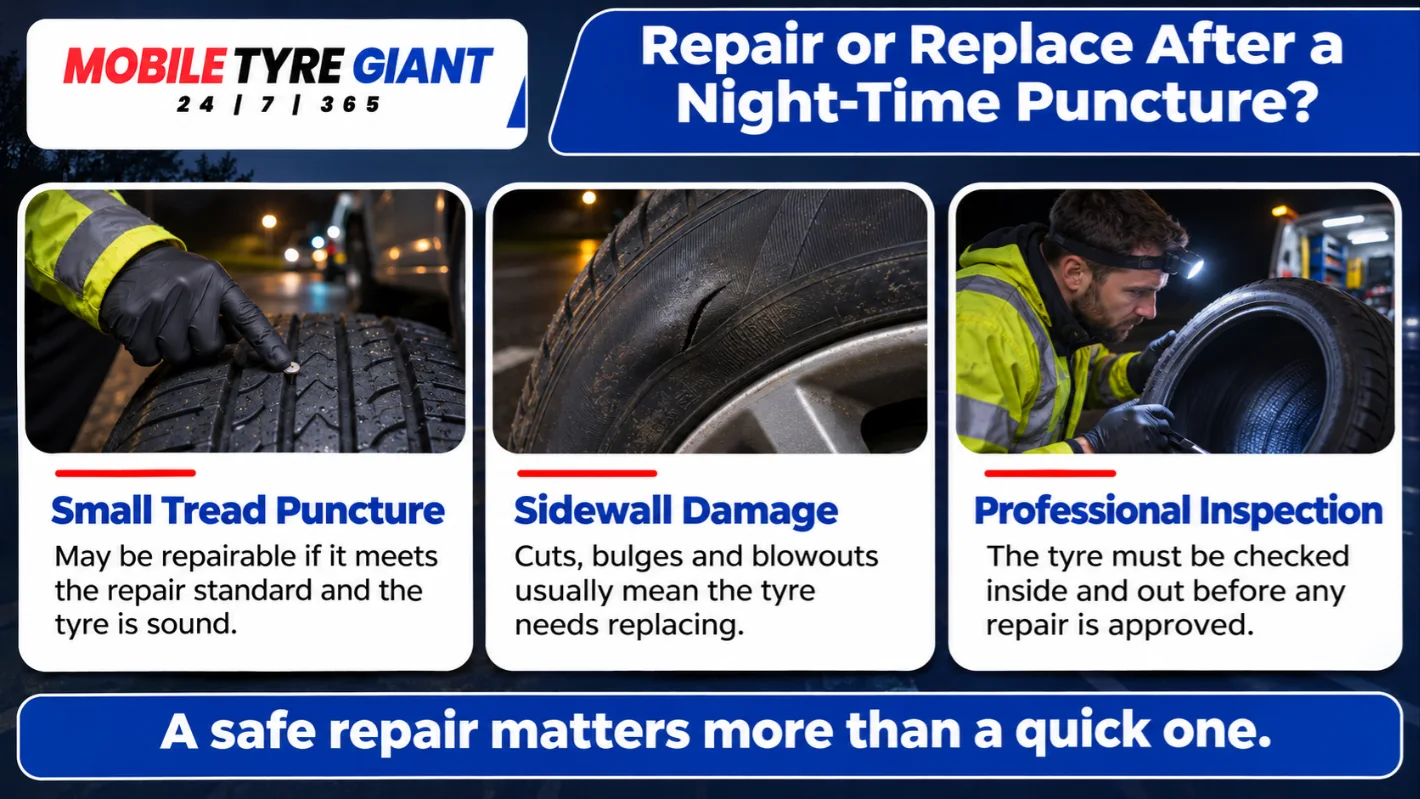
A flat tyre does not always need replacing, but the cause and extent of damage determine the available options. Small punctures in the approved central tread area may qualify for permanent professional repair. However, sidewall damage, structural defects or internal deterioration can make replacement necessary. The tyre must be examined properly before a repair decision is confirmed. Darkness should never encourage a rushed assessment based only on the visible puncture.
Imagine a tyre losing air slowly while the vehicle remains parked in a well-lit car park. A technician may discover a small central tread puncture that meets the relevant repair requirements. Another tyre with a similar visible hole might have internal damage from being driven while flat. The explanation of tyre repair versus replacement highlights why professional inspection matters. The correct outcome depends on the complete tyre condition rather than how small the original puncture appears.
Can a Nail or Screw Puncture Be Repaired Safely?
A nail or screw in the main tread area does not automatically mean the tyre needs replacing. A minor puncture may be repairable if it meets the relevant British Standard and the tyre remains structurally sound. However, the position, size and direction of the penetration all matter. Previous repairs and damage caused by underinflation can also affect eligibility. A technician must inspect the tyre internally before approving a permanent repair.
If you notice a nail while checking a safely parked car, avoid pulling it out yourself. The object may be restricting the escape of air, and removing it could cause faster deflation. The information about whether a nail in a tyre needs repair or replacement explains how puncture location affects the decision. Never crouch beside fast-moving traffic to inspect or photograph the object. Tell the technician what you noticed and allow the tyre to be assessed in suitable working conditions.
Why Do Sidewall Damage and Blowouts Usually Require Replacement?
The tyre sidewall supports the vehicle and flexes continuously during driving. Cuts, bulges and structural damage in this area can compromise tyre strength. A blowout may also damage the internal casing, bead or wheel rim. These defects cannot generally be corrected using ordinary minor puncture repair methods. Replacing the damaged tyre may therefore be necessary before the vehicle returns to road use.
Imagine hearing a loud bang followed by strong vibration on a dark dual carriageway. After stopping safely, the driver discovers that part of the tyre sidewall has torn away. Applying sealant or inserting a temporary plug would not restore the damaged structure. The wheel may also need checking for cracks or distortion. Professional recovery or replacement should be arranged from a location where the work can be completed safely.
What Emergency Tyre Equipment Should You Keep in Your Car at Night?
Keeping essential equipment in the vehicle can make an unexpected night-time breakdown easier to manage. Useful items include a charged phone, charging cable, torch, high-visibility clothing and the vehicle’s approved tyre mobility equipment. A tyre pressure gauge can help with routine checks when the car is parked safely. If the vehicle has locking wheel nuts, keep the correct key in an accessible location. These items help with preparation but do not eliminate the hazards of roadside breakdowns.
Check the equipment periodically rather than assuming everything in the boot is ready to use. A spare wheel may need inflation, a sealant bottle may have expired and a torch may have flat batteries. The emergency tyre kit checklist provides a practical reminder of items worth checking before a journey. Keep essential equipment secured so it cannot move dangerously inside the vehicle. Preparation is particularly helpful when travelling through unfamiliar or poorly lit areas.
How Can a Torch and High-Visibility Clothing Improve Safety?
A torch can help you identify uneven ground, obstacles and safer walking routes when visibility is poor. High-visibility clothing may also make you easier for approaching drivers to notice. However, neither item provides protection from a moving vehicle. Avoid standing close to passing traffic or positioning yourself behind a broken-down car. Your location remains more important than the equipment you are wearing.
On motorways, follow the Highway Code’s advice about reaching a place of relative safety and staying well away from traffic. Do not attempt repairs on a hard shoulder or exposed emergency area. On ordinary roads, only inspect the tyre when there is enough space and the surroundings are safe. Keep a charged phone available for requesting assistance and sharing your location. Equipment should support a safe response, never encourage unnecessary roadside risks.
What Should You Check Before Driving Away After a Night-Time Tyre Call-Out?
After a flat tyre has been repaired or replaced, it is important to confirm that your vehicle is safe before continuing the journey. Darkness can make it difficult to notice wheel damage, remaining debris or other problems around the vehicle. A completed tyre fitting does not automatically mean every fault has been resolved. The technician should confirm that the tyre is suitable for the vehicle and correctly installed. Any unresolved steering, wheel or suspension damage may require further assessment.
Imagine experiencing a blowout on a poorly lit road before receiving assistance in a nearby car park. Once the replacement tyre has been fitted, you may be tempted to leave immediately. However, checking the work and understanding any remaining concerns can prevent another unexpected stop. Ask whether the wheel has been inspected and whether the replacement meets the manufacturer’s approved specifications. Taking a few additional precautions can help you resume your journey with greater confidence.
How Do You Know a Tyre Repair Is Safe for Normal Driving?
A permanent tyre repair must meet the relevant British Standard and be suitable for the tyre’s construction and damage. For eligible passenger-car punctures, this involves removing the tyre from the wheel and inspecting its internal condition. A small hole in the central tread area may qualify for repair, but structural damage and serious underinflation can make replacement necessary. Temporary sealant kits do not provide the same assurance as an approved permanent repair. Always establish what type of repair has been completed.
Before leaving, ask whether any restrictions apply to the repaired tyre. Professional mobile tyre repair may resolve suitable punctures at a safe and accessible location. However, a tyre with damaged reinforcing material, significant sidewall defects or severe internal deterioration should not return to normal use. If a temporary mobility solution was used, follow the manufacturer’s limits. Do not assume that a tyre is safe simply because it holds air.
Why Should You Check Tyre Pressure and Dashboard Warnings?
Correct tyre inflation is essential for safe handling, braking and tyre durability. After a repair or replacement, the tyre should be inflated according to the vehicle manufacturer’s recommendations. Some vehicles require different pressures for the front and rear tyres or when carrying additional passengers and luggage. A tyre pressure monitoring system may also need checking or resetting after the work. However, resetting a warning must never replace investigating genuine pressure loss.
The tyre pressure guide explains how to identify the manufacturer’s recommended inflation settings. For routine checks, measure pressure when the tyres are cold using a suitable gauge. If a TPMS warning returns shortly after a repair, stop somewhere safe and check the tyre pressures again. Repeated warnings may indicate a continuing leak or monitoring system problem. Arrange further assessment rather than repeatedly clearing the warning.
How Can You Safely Continue Your Journey After a Night-Time Breakdown?
Returning to the road requires careful attention to your surroundings, particularly when visibility is poor. Before moving, make sure passengers are seated, seat belts are fastened and any tools or damaged tyre components are secured. Check that the vehicle’s lights are working and that the route ahead is clear. If you were stopped in a car park or lay-by, watch for pedestrians and approaching vehicles before pulling away. Never rush back into traffic simply because your journey has been delayed.
Your departure procedure also depends on where the breakdown occurred. Leaving a residential parking space is different from rejoining a motorway after an emergency stop. Follow any instructions provided by the emergency services, traffic officers or motorway operators. If the vehicle still has a serious mechanical problem, it should not return to normal driving. Recovery may be necessary when tyre replacement alone has not restored roadworthiness.
What Should You Do When Leaving a Motorway Hard Shoulder or Emergency Area?
Rejoining a motorway from a hard shoulder requires particular care because traffic may be travelling at high speed. Once the vehicle is roadworthy, build up speed appropriately, indicate and look for a safe gap before joining the carriageway. Remain alert to debris, obstacles or other stationary vehicles on the hard shoulder. Darkness and poor weather can make judging approaching traffic more difficult. Never pull directly into a live lane without ensuring that it is safe.
An emergency area has a different procedure under the Highway Code. Before leaving, you must use the emergency telephone provided and follow the operator’s instructions. Motorway operators may need to arrange traffic protection before you can rejoin. Do not assume that completing a tyre repair gives you permission to leave the emergency area immediately. Follow the instructions given and wait until it is safe to proceed.
What if Your Vehicle Still Vibrates or Feels Unstable?
Unusual vibration, pulling to one side or abnormal steering after a tyre failure can indicate an unresolved problem. The original incident may have damaged the wheel, affected alignment or caused problems with another component. Incorrect wheel balancing can also contribute to vibration, although it is not the only possible cause. A replacement tyre will not automatically correct damage elsewhere on the vehicle. Continuing to drive without investigating serious symptoms may increase the risk of another breakdown.
For example, a driver might notice that the steering wheel continues to shake after a tyre damaged by a pothole has been replaced. The wheel itself may be distorted, or the vehicle may require further mechanical inspection. If the handling feels unsafe, stop in a suitable location and seek professional assistance. Do not try to diagnose the problem while driving. The vehicle should only continue when its condition is suitable for road use.
How Can You Reduce the Risk of Another Flat Tyre at Night?
Not every puncture can be prevented, but regular tyre maintenance can reduce avoidable risks. Correct inflation, suitable tread depth and timely inspection help identify developing problems before a journey. Damage from potholes, kerbs and road debris may also become more noticeable through regular visual checks. A tyre that repeatedly loses pressure should be investigated rather than continually inflated. Preparation is particularly useful before driving long distances or travelling through unfamiliar areas after dark.
Keeping essential breakdown equipment accessible can also make an unexpected stop easier to manage. A charged phone, torch, reflective clothing and the vehicle’s approved tyre mobility equipment may all be useful. Check that any spare wheel is correctly inflated and that a sealant kit has not passed its expiry date. These items cannot guarantee that a breakdown will be avoided or resolved without assistance. Their purpose is to support a safer response when difficulties arise.
Which Tyre Checks Matter Before a Night-Time Journey?
Start by inspecting the tyres for visible cuts, bulges, embedded objects and uneven tread wear. Confirm that inflation pressures match the manufacturer’s recommendations for the vehicle’s expected load. For most UK passenger cars and light vans, the legal minimum tread depth is 1.6mm across the central three-quarters and around the entire circumference. However, a tyre with legal tread depth may still be unsafe because of structural defects. Any suspicious damage should be assessed before departure.
The tyre safety guide explains how to recognise important tyre condition and wear problems. Check the spare wheel or mobility equipment where fitted, and make sure the locking wheel nut key is available. If a tyre appears significantly underinflated, identify the cause before starting a long journey. Repeated pressure loss may indicate a puncture, valve fault or problem with the wheel rim. Identifying these faults while parked safely is preferable to discovering them on a dark roadside.
What Should Your Night-Time Flat Tyre Safety Checklist Include?
A useful response starts with controlling the vehicle and reaching the safest available stopping place. Hold the steering wheel firmly, reduce speed carefully and avoid sudden braking or steering. Once stopped, use hazard warning lights where appropriate and keep sidelights on in darkness if possible. Assess whether passengers can safely leave the vehicle and move away from traffic. Never stand between the vehicle and approaching vehicles or attempt repairs in an exposed motorway location.
Next, identify the road, direction of travel and nearest useful location reference before requesting assistance. Call 999 when an immediate danger requires an emergency response, particularly if you are stranded in a live motorway lane and cannot get clear safely. Otherwise, arrange appropriate breakdown or tyre assistance from a safe position. Explain whether the tyre is punctured, completely flat or visibly damaged. Before continuing, confirm that the vehicle is roadworthy and any temporary-use restrictions are understood.
Final Words: Staying Safe During a Night-Time Flat Tyre Emergency
A flat tyre at night requires a calm response and careful decisions about where to stop. Poor visibility and moving traffic can make an otherwise straightforward tyre problem dangerous. Your priority should be controlling the vehicle, reaching a place of relative safety and protecting everyone involved. Tyre repair or replacement should only begin when the working conditions are suitable.
Regular tyre checks, reliable emergency equipment and knowing when to request assistance can help you handle unexpected problems more effectively. If a tyre cannot be repaired safely or the vehicle remains unstable, arrange recovery rather than taking unnecessary risks. Always follow motorway safety procedures and respect any restrictions on temporary tyre repairs. Making safety the first priority is the best way to manage a flat tyre after dark.
Flat Tyre at Night? Get Safe Help Fast
Share your location and tyre details, and we will confirm the safest way to repair or replace your tyre.
Frequently Asked Questions
Find quick answers to the most common questions our customers ask.
Hold the steering wheel firmly, reduce speed gradually and find a safe stopping place. Avoid sudden braking and assess the traffic before leaving the vehicle.
Only consider changing a tyre where conditions and equipment make it safe. Never attempt a wheel change beside motorway traffic or in an exposed location.
Use hazard warning lights to warn traffic when your stationary vehicle presents a hazard. Keep sidelights on in darkness where appropriate under the Highway Code.
Yes, some mobile tyre services operate overnight. Attendance depends on location, technician availability, tyre specifications and whether the vehicle can be accessed safely.
Move to a safe location and check whether the vehicle has a suitable mobility kit or run-flat tyres. Arrange professional assistance if the damage cannot be managed safely.
A suitable sealant kit may temporarily address certain minor tread punctures. Follow the manufacturer's restrictions and never use it beside dangerous traffic.
Call 999 and ask for the police if you are stranded dangerously and cannot reach a safe position or get clear of traffic. Ordinary breakdowns do not automatically require 999.
A TPMS warning may indicate low tyre pressure or a monitoring fault. Stop safely, check the pressures and investigate the cause before continuing.
Yes, if the damage meets the applicable repair requirements and the tyre remains structurally sound. A professional internal inspection is needed before permanent repair.
Useful items include a charged phone, charging cable, torch, reflective clothing and approved tyre mobility equipment. Check their condition before travelling.