
A tyre that keeps losing air without an obvious puncture can be frustrating, particularly when it looks completely normal from the outside. You might inflate it correctly, drive for a few days and then discover that the pressure has dropped again. Sometimes the problem is not a nail, screw or damaged valve. Instead, air may be escaping from the narrow area where the tyre meets the wheel rim. This is known as a tyre bead leak, and it can affect both steel and alloy wheels.
A bead leak often develops gradually, making it easy to mistake for ordinary tyre pressure changes. However, repeatedly inflating the tyre does not repair the underlying fault. Corrosion, wheel damage, contaminated sealing surfaces or a damaged tyre bead can all prevent the assembly from holding air correctly. Understanding how the seal works helps explain why these problems occur and what a technician needs to inspect. Identifying the actual cause is essential before deciding whether the tyre can be reseated, repaired or must be replaced.
What Is a Tyre Bead Leak and How Does It Happen?
A tyre bead leak occurs when pressurised air escapes between the tyre’s reinforced edge and the wheel rim. On a correctly fitted tubeless tyre, these surfaces form part of the airtight system that keeps the tyre inflated. If the contact area becomes damaged, distorted or contaminated, small gaps can develop. Air may then escape slowly even though the tread contains no obvious puncture. The leak can become more noticeable as the tyre ages or the wheel experiences further damage.
Most modern passenger cars use tubeless tyres rather than separate inner tubes. Their airtight construction depends on the inner liner, valve and properly seated tyre beads working together. The explanation of how tubeless tyres work provides useful background on this arrangement. A fault at any sealing point can lead to pressure loss. That is why a proper inspection must consider the entire wheel and tyre assembly instead of focusing only on the tread.
Where Are the Tyre Bead and Bead Seat Located?
The tyre bead is the strong, reinforced edge running around each side of the tyre. It contains bead wires and surrounding materials designed to secure the tyre against a compatible wheel. The bead seat is the shaped surface of the wheel where this reinforced edge rests. When the tyre is fitted and inflated correctly, the bead sits firmly against that surface. The contact between them forms an important part of the airtight seal.
Think of the tyre and wheel as two components designed to fit together precisely. Even when both appear undamaged, their sealing surfaces must remain suitable for proper contact. Dirt, corrosion or deformation can interfere with that fit and create a route for air to escape. The leak may occur on the inner or outer side of the wheel, making it difficult to identify through an ordinary visual check. A technician may need to remove the tyre to examine the complete bead-seat area.
Why Does a Bead Leak Often Cause Slow Pressure Loss?
Many bead leaks develop through small gaps rather than a large opening. Pressurised air gradually escapes, causing the tyre to lose pressure over several days or weeks. The rate can vary depending on the size of the gap, the condition of the wheel and changes in temperature. A tyre might therefore appear properly inflated immediately after topping up but become noticeably soft later. This repeated pattern is a reason to investigate rather than continue adding air indefinitely.
For example, a driver may notice that one tyre requires inflation every weekend while the other three remain relatively stable. This suggests a possible leak, although it does not identify the source. A puncture, faulty valve or bead-seat problem could produce similar symptoms. The article on tyres losing pressure without a visible puncture explains why these problems can be difficult to distinguish. Finding the actual leak location is more useful than assuming every slow pressure loss comes from the tread.
What Causes Air to Escape Around a Wheel Rim?
A tyre bead leak can develop for several reasons, including wheel corrosion, impact damage and problems during tyre fitting. Each cause affects the sealing surfaces differently, but the result can be similar. Small gaps form where the tyre should sit securely against the wheel, allowing air to escape. Some problems develop slowly through exposure to moisture and road contaminants. Others appear after a pothole strike, kerb impact or incorrect installation.
The age of the tyre alone does not establish why the seal has failed. A relatively new tyre can leak when fitted to a damaged or heavily corroded wheel. Equally, an older tyre may develop damage around its bead while the wheel remains in acceptable condition. Both components therefore require examination before any repair decision. Replacing the tyre without identifying a faulty rim may leave the original pressure-loss problem unresolved.
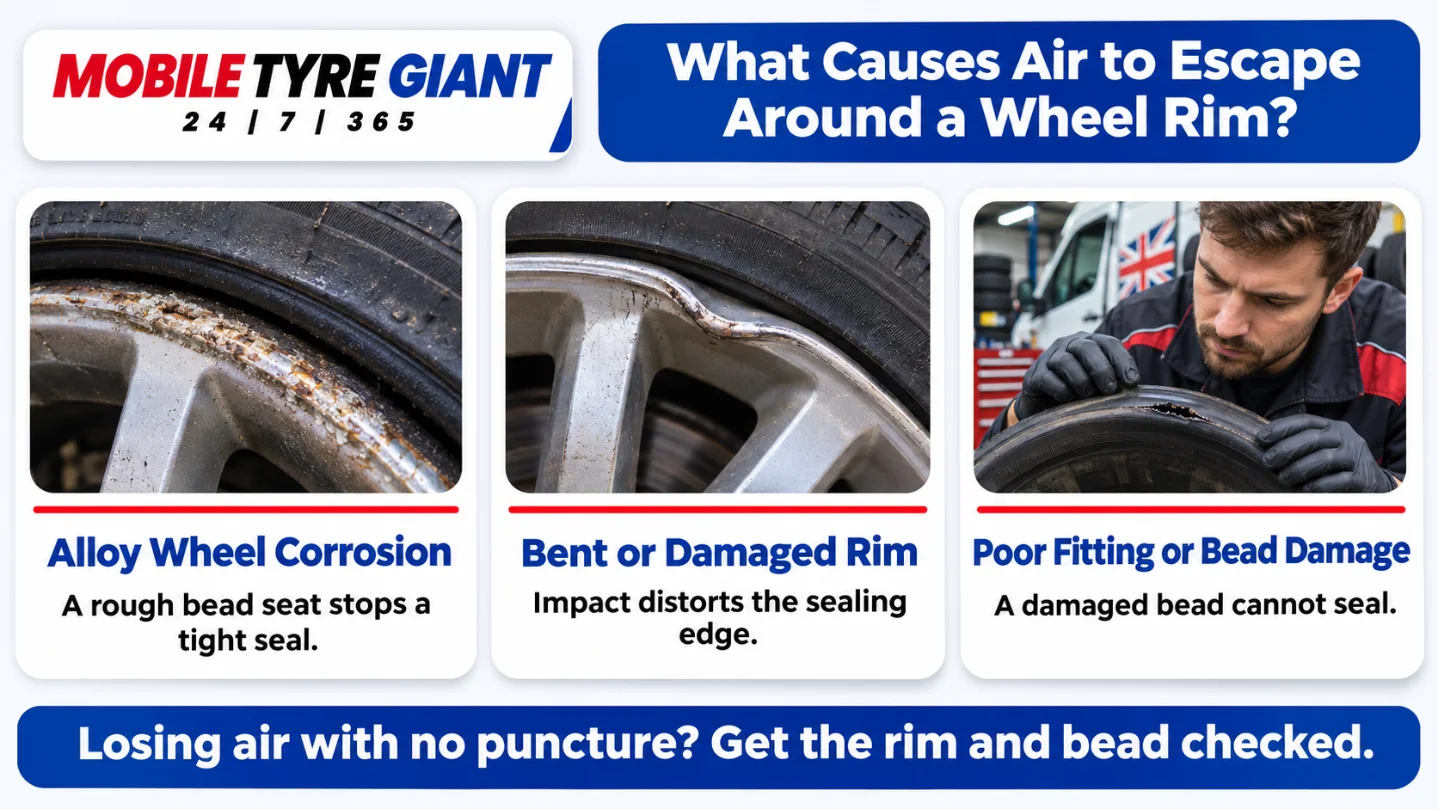
Can Corrosion on an Alloy Wheel Cause a Bead Leak?
Yes, corrosion around the bead seat is a recognised cause of air loss. Over time, moisture, road salt and damage to the wheel’s protective finish can contribute to deterioration of the sealing surface. Corrosion deposits or rough patches may interfere with the tyre bead’s contact against the rim. Even relatively small irregularities can create pathways for pressurised air. The problem may remain hidden until the tyre is removed from the wheel.
Imagine an older car whose alloy wheels have been exposed to several British winters. The visible wheel faces may still look reasonably clean, while corrosion has developed around the inner bead seat. The driver might repeatedly replace air without finding a puncture. During professional inspection, the technician may discover that the sealing surface needs attention. Whether the wheel can be restored depends on the location and severity of the corrosion, not simply its appearance.
Can a Bent or Damaged Rim Break the Tyre Seal?
A bent or distorted wheel rim can prevent the tyre bead from sitting correctly against its sealing surface. This may happen after striking a pothole, clipping a kerb or hitting road debris. Even when the tyre remains inflated immediately after the impact, the distorted area may begin losing air later. The same impact can also damage the tyre bead or sidewall. Consequently, both the wheel and tyre need assessment when pressure loss begins after a noticeable impact.
Consider a driver who strikes a deep pothole and notices a tyre pressure warning the following morning. The tyre may have no visible nail or screw, but the wheel edge could be slightly deformed. A cracked alloy may also cause air loss, depending on the fracture’s location. Structural wheel damage should not be treated as an ordinary sealing problem. If a wheel is bent, cracked or suspected to be structurally unsafe, professional assessment is necessary before normal driving continues.
Can Incorrect Tyre Fitting or Bead Damage Cause Air Leaks?
Tyres must be fitted using suitable equipment and procedures to protect their reinforced bead areas. Incorrect mounting techniques can damage the rubber or internal bead components. A damaged bead may no longer form an effective seal against the wheel, even if the tyre appears to sit correctly. Contamination left on the bead seat can also interfere with proper seating. These issues sometimes become apparent shortly after a tyre replacement.
If pressure loss starts soon after new tyres are installed, it is sensible to have the fitting checked. However, the timing alone does not prove that the technician damaged the tyre. A pre-existing rim defect or faulty valve could also be responsible. A qualified fitter can inspect the relevant sealing surfaces and investigate the air loss. Simply adding more pressure or repeatedly reseating a damaged tyre is not an acceptable substitute for identifying the fault.
How Can You Recognise a Possible Tyre Bead Leak?
The most common symptom is repeated pressure loss without an obvious puncture. One tyre may consistently require more frequent inflation than the others. A tyre pressure monitoring system may display warnings, or the vehicle may begin to feel different as inflation pressure falls. However, these symptoms do not specifically confirm a bead leak. They indicate that the tyre and wheel assembly requires further investigation.
A bead leak may be suspected when air appears to escape around the circumference where the tyre meets the wheel. Technicians can use a suitable leak-detection solution to identify escaping air through bubble formation. This can help distinguish bead-seat leakage from other faults. However, some leaks are intermittent or difficult to locate while the wheel remains fitted. A complete inspection may involve removing the wheel and tyre to examine hidden surfaces.
How Is a Bead Leak Different From a Tyre Valve Leak?
A bead leak occurs at the tyre-to-wheel sealing surface, while a valve leak develops around the inflation valve or its components. Both can cause gradual pressure loss without damaging the tyre tread. A valve may leak because of a defective valve core, damaged stem or deteriorated seal. Some tyre pressure monitoring systems also use valve assemblies with replaceable sealing components. These faults can produce symptoms almost identical to a bead leak.
For example, a driver might assume corrosion is responsible because an alloy wheel is several years old. However, a leak test could reveal that air is escaping from the valve instead. The explanation of tyre valve failure and pressure loss outlines the symptoms associated with these faults. Correct diagnosis helps avoid unnecessary tyre or wheel replacement. The leaking component should be identified before deciding on the repair.
When Should You Stop Driving and Arrange an Inspection?
A tyre that repeatedly loses pressure should be inspected promptly because underinflation can affect handling, braking and tyre condition. If the tyre becomes severely deflated, develops a visible bulge or shows signs of structural damage, do not continue normal driving. Operating a tyre with insufficient pressure can generate excessive heat and damage its internal construction. Repeated inflation does not establish that the tyre remains safe. The longer an unresolved leak continues, the greater the risk of additional damage.
If the vehicle is already parked safely, check the tyre’s visible condition without attempting to remove or reseat it yourself. Avoid using flammable sprays, excessive inflation pressure or improvised tools to force a bead into position. Tyre mounting and inflation require appropriate equipment and safety procedures. A professional assessment should establish whether the air loss comes from the bead, wheel, valve or another source. Only then can a suitable repair or replacement decision be made.
How Do Professionals Diagnose a Tyre Bead Leak?
Diagnosing a tyre bead leak starts with identifying exactly where pressurised air is escaping. A tyre that repeatedly loses pressure may have a puncture, faulty valve, damaged wheel or problem around the bead seat. These faults can produce similar symptoms, so visual inspection alone is not always reliable. A technician normally begins by checking the tyre’s condition, inflation pressure and visible wheel surfaces. The aim is to locate the leak before deciding whether any component needs repair or replacement.
Imagine a driver who inflates the same tyre every few days but cannot find a nail or screw. The problem might appear to be a simple slow puncture, even though air is escaping around the rim. Replacing the tyre immediately could be unnecessary if the existing tyre is sound and the wheel has a correctable sealing defect. Equally, cleaning the rim would not solve pressure loss caused by a damaged valve. A systematic inspection helps prevent unnecessary work and reduces the risk of overlooking a more serious fault.
Why Should Tyre Pressure Be Checked Before Leak Testing?
An accurate pressure reading helps establish how much air the tyre has lost and whether the problem requires immediate attention. The technician should compare the reading with the vehicle manufacturer’s recommended inflation pressure. A tyre that is severely underinflated may also need examination for internal damage caused by driving without enough air. The pressure reading alone cannot reveal whether the leak comes from the bead, tread or valve. However, it provides a useful starting point for further testing.
Drivers can record pressure readings before an appointment if the vehicle is parked safely and the tyre shows no obvious dangerous damage. Checking pressures when the tyres are cold produces more consistent results. The explanation of how to check tyre pressure correctly covers the equipment and procedure involved. If one tyre repeatedly loses pressure while the others remain stable, report that pattern to the technician. Do not exceed the manufacturer’s recommended inflation settings to compensate for an unresolved leak.
How Does a Soap-Bubble Test Identify a Bead Leak?
A soap-bubble test is a practical method technicians use to locate escaping air. A suitable leak-detection solution is applied around suspected areas of the inflated tyre and wheel assembly. If pressurised air escapes through a gap, bubbles may appear at the leaking point. The technician can examine both bead-seat areas, the valve and other possible sources of leakage. This helps distinguish a rim-related problem from a puncture elsewhere on the tyre.
For example, bubbles forming along the line where the tyre meets the alloy wheel may indicate bead-seat leakage. Bubbles around the valve could suggest a different fault requiring separate attention. Some workshops also use controlled water-immersion testing to locate difficult leaks. However, visible bubbles identify an air path rather than proving the tyre is safe to reuse. The condition of the wheel and tyre must still be assessed before a repair decision is made.
Can a TPMS Warning Confirm That the Rim Is Leaking?
A tyre pressure monitoring system can alert the driver when tyre pressure becomes too low or changes unexpectedly. Depending on the system, it may use pressure sensors inside the wheels or calculate changes from wheel-speed information. However, the warning does not identify a bead leak specifically. A puncture, valve problem or temperature-related pressure change may produce a similar alert. The warning should therefore be treated as a reason to investigate rather than a final diagnosis.
Imagine topping up a tyre after the dashboard displays a low-pressure warning. The warning disappears, but the same alert returns several days later. This suggests that the underlying pressure-loss problem may still be present. Resetting the system without finding the cause does not repair the tyre or wheel. A technician should establish whether air is leaking before considering any sensor or system fault.
Why Must the Tyre Sometimes Be Removed From the Wheel?
A leak may be visible around the rim while the tyre is fitted, but the underlying damage can remain hidden. The bead-seat surfaces sit beneath the reinforced edges of the tyre, making them difficult to inspect fully from outside. Corrosion, trapped debris and damaged rubber may only become apparent after professional removal. Deflating and removing the tyre using suitable equipment allows the technician to inspect these contact areas directly. This is often necessary when external leak testing points towards a problem with the bead seal.
Removing the tyre also allows examination of its internal condition. A tyre driven with inadequate pressure may have hidden damage even when the outer sidewall appears normal. The wheel can be checked for distortion, cracking and surface deterioration around the bead seat. These findings help determine whether reseating is appropriate or whether replacement is necessary. A proper inspection is particularly important after a pothole strike or repeated pressure loss.
What Does Hidden Corrosion on an Alloy Wheel Look Like?
Corrosion around the bead seat may appear as rough patches, blistered coating, flaking finish or deposits on the wheel surface. These irregularities can prevent the tyre bead from maintaining consistent contact with the rim. Moisture and winter road salt can contribute to deterioration over time, particularly where the protective wheel finish has been damaged. Corrosion may affect either the inner or outer bead-seat area. It is therefore possible for the visible face of an alloy wheel to look clean while the hidden sealing surface is deteriorating.
Consider a vehicle whose alloy wheels have been used through several winters. The driver may notice slow pressure loss but see no obvious damage when checking the tyres. Once the tyre is removed, a rough section of the bead seat might become visible beneath its reinforced edge. This could explain why the tyre has struggled to maintain pressure. The technician must assess how severe the corrosion is before deciding whether the surface can be restored safely.
How Can a Technician Tell Whether the Wheel Is Damaged?
A technician examines the wheel for visible cracks, distortion, impact marks and defects around the sealing surfaces. A bent rim can prevent the tyre bead from sitting evenly, while a fracture may create a separate route for air loss. Damage to the inner barrel can be especially difficult for drivers to identify while the wheel remains on the vehicle. The technician may also check whether the wheel runs true if an impact or vibration suggests distortion. A wheel should not be considered structurally sound simply because it still holds air.
A pothole impact may damage both the wheel and tyre during the same incident. This makes it important to inspect the bead, sidewall and relevant wheel surfaces together. The information about driving with a cracked alloy wheel explains why suspected structural fractures require professional assessment. Cleaning or reseating a tyre cannot restore the strength of a cracked wheel. If the damage makes the wheel unsuitable for continued use, replacement may be necessary.
Can a Corroded Wheel Be Cleaned and Resealed?
Some bead leaks caused by limited surface corrosion can be corrected by professionally preparing the affected sealing surface. However, this depends on the wheel manufacturer’s requirements and the extent of the damage. The technician must determine whether the corrosion is superficial or has affected the wheel more seriously. Any permitted cleaning should preserve the shape and integrity of the bead seat. Removing excessive wheel material or concealing serious damage would not provide a safe repair.
In suitable cases, the technician may clean the sealing surface and use approved fitting materials according to the relevant procedures. Certain manufacturer-approved methods also permit specific bead-sealing products after appropriate preparation. Such products are not universal solutions for cracked, heavily corroded or distorted rims. If the wheel is unsuitable for restoration, the correct decision may be replacement. The objective is to restore a sound sealing surface rather than temporarily hide the air leak.
When Is Cleaning the Bead Seat an Appropriate Solution?
Cleaning may be suitable when the wheel remains structurally sound and the problem is limited to removable contamination or corrosion. The technician should inspect the entire sealing area and assess whether the required surface can be restored within the manufacturer’s limits. Loose deposits, damaged coating and rough patches may need appropriate treatment. Once the surface has been prepared, the tyre bead must still be examined before refitting. A clean rim does not compensate for a damaged or incompatible tyre.
Imagine a wheel with a small area of surface corrosion but no visible cracking or distortion. Following inspection, the technician may determine that controlled surface preparation is permitted. If the wheel remains suitable, the tyre can be fitted using the correct equipment and procedure. The assembly must then be tested to confirm that air is no longer escaping. If leakage continues, the underlying cause requires further investigation instead of repeated attempts to conceal it.
Why Should a Damaged Tyre Bead Never Be Simply Reseated?
The reinforced tyre bead is essential for keeping the tyre correctly positioned against the wheel. Cuts, tears, exposed reinforcing material or serious deformation can compromise its condition. These defects may arise from impact damage, previous incorrect fitting or other mechanical stress. A tyre with significant bead damage should not be treated as safe merely because it can be inflated. Its suitability must be established through professional inspection.
A technician might discover bead damage while removing a tyre to investigate pressure loss. Even if the rim corrosion is minor, the tyre itself could be unsuitable for refitting. Applying bead sealant cannot restore damaged reinforcement or correct a structurally defective tyre. In such cases, replacement may be necessary before the wheel-and-tyre assembly can return to service. The decision must consider the condition of both components rather than focusing only on stopping the leak.
What Checks Are Needed After a Tyre Has Been Reseated?
After a tyre has been refitted, the technician should confirm that its beads are seated correctly and the assembly holds the appropriate inflation pressure. The valve and both bead-seat areas should be checked for continuing air loss. The wheel must also be fitted securely using the vehicle manufacturer’s fastening requirements. If the tyre has been removed and refitted, wheel balancing should normally be checked before the vehicle returns to regular use. These steps help confirm that the original work has not left an unresolved problem.
Properly equipped mobile tyre fitters may be able to complete balancing at a suitable location, depending on the equipment available. The explanation of whether mobile tyre fitters can balance wheels on-site outlines how this process works. However, balancing cannot correct a cracked wheel, damaged tyre bead or continuing pressure leak. If the tyre still loses air after refitting, further diagnosis is needed. A completed fitting should address both correct installation and the original cause of pressure loss.

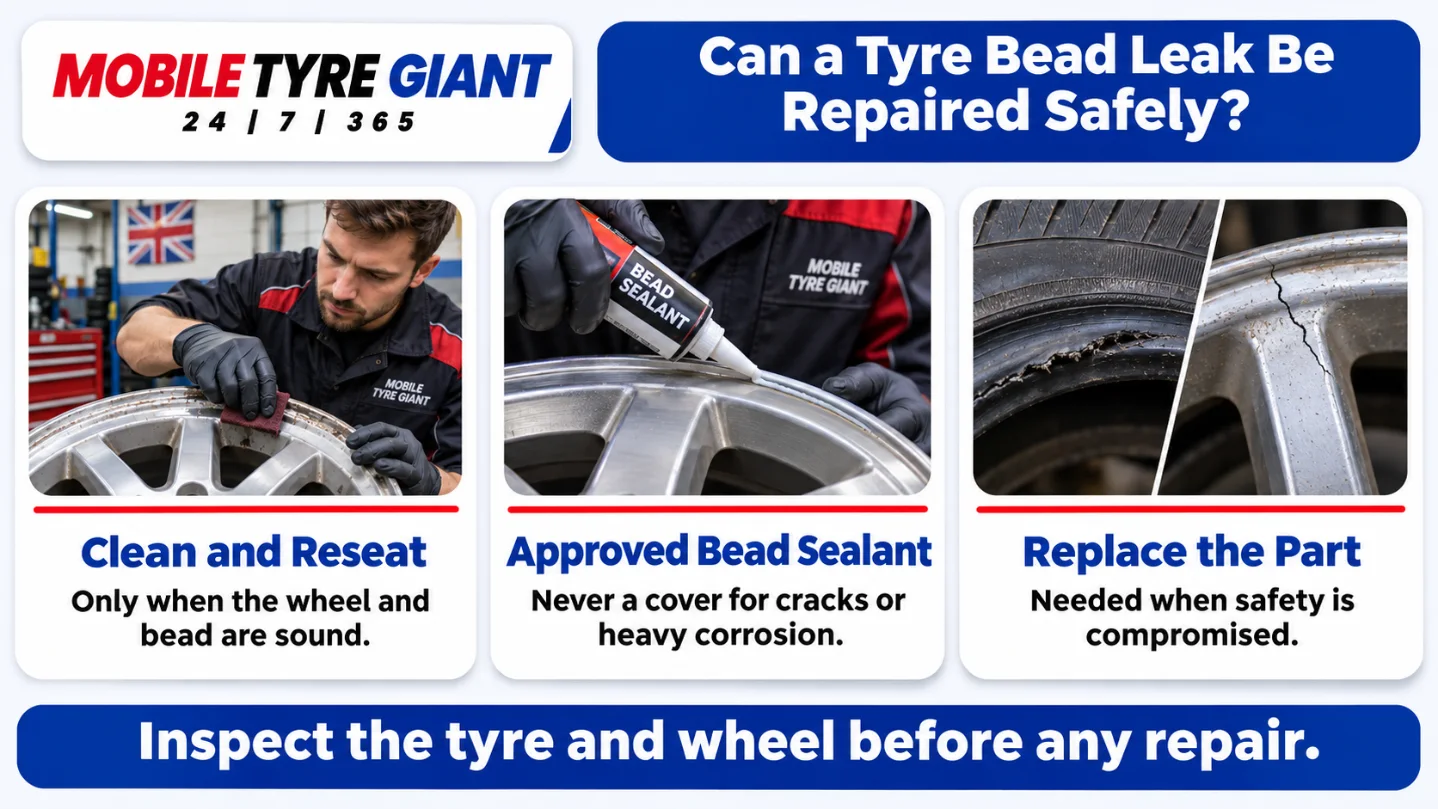
Can a Tyre Bead Leak Be Repaired Safely?
A tyre bead leak can sometimes be corrected without replacing the tyre, but the underlying cause must be identified first. If the wheel is structurally sound and the problem involves removable corrosion or contamination, professional cleaning and reseating may restore the seal. However, a damaged tyre bead, distorted wheel or serious structural defect requires a different approach. The technician must inspect both components before deciding whether they are suitable for continued use. Simply stopping the visible air leak does not automatically make the assembly safe.
Consider a driver whose tyre loses pressure every few days because corrosion has developed around the alloy wheel’s bead seat. If the damage is limited and the wheel manufacturer permits appropriate surface preparation, the sealing area may be restored. A tyre with torn bead reinforcement would not qualify for the same treatment. Understanding the difference between tyre repair and replacement helps explain why some defects can be corrected while others require new components. The correct decision depends on structural condition, not just the size of the air leak.
When Can a Tyre Be Cleaned and Reseated on the Rim?
Professional reseating may be appropriate when the tyre bead remains undamaged and the wheel’s sealing surface can be restored safely. A technician first removes the tyre to inspect the bead and rim. If permitted by the wheel manufacturer’s instructions, suitable cleaning can remove contamination or minor corrosion. The tyre can then be refitted using the correct equipment and mounting procedures. The completed assembly must hold pressure without continuing leakage.
Imagine a wheel with a small rough patch along the bead seat but no cracks or deformation. After examining the wheel and tyre, the technician may determine that controlled cleaning is sufficient. However, the work must not remove excessive material or change the wheel’s intended shape. If the tyre still leaks after proper preparation, further diagnosis is needed. Repeatedly reseating a tyre without addressing the original defect is not an appropriate solution.
Does Tyre Bead Sealant Permanently Stop Air Leaks?
Tyre bead sealant is a specialist fitting product that may be used in certain circumstances to help address minor sealing irregularities. It is not the same as emergency puncture sealant placed inside a tyre. Some tyre and wheel manufacturers permit particular bead-sealing materials when their specified fitting procedures are followed. However, these products are not suitable for every wheel or tyre. Their use depends on the condition of the components and the manufacturer’s instructions.
For example, a technician may consider an approved sealing product after confirming that the wheel and tyre are structurally sound. The product should not be used to conceal deep corrosion, a cracked rim or damaged bead reinforcement. A temporary reduction in air loss does not prove the underlying defect has been corrected. Using excessive sealant or an unsuitable product can also complicate later inspection and fitting. Proper diagnosis and surface condition remain more important than applying additional sealing material.
Can a Damaged Tyre Bead Itself Be Repaired?
A tyre bead is a reinforced structural component designed to secure the tyre against the wheel rim. Damage to its reinforcing material can compromise both tyre retention and the airtight seal. British tyre repair guidance identifies bead damage, including a broken bead core, as a reason not to undertake a conventional tyre repair. This is different from cleaning contamination from an otherwise sound bead-seat surface. A damaged structural bead must not simply be patched or covered with sealing compound.
Imagine a tyre that was damaged during mounting and now has torn rubber around its reinforced edge. Even if the tyre inflates successfully, its condition may no longer be suitable for normal road use. The technician must examine the extent of the damage rather than assuming the tyre can be rescued. A defective bead may require replacing the tyre entirely. Safety takes priority over attempting to reuse a component that can no longer perform its intended function.
When Does a Tyre Bead Leak Require Replacement?
Replacement becomes necessary when the tyre or wheel cannot be restored to a safe, serviceable condition. This may involve severe bead damage, internal tyre deterioration, substantial wheel corrosion or structural rim damage. A tyre that has been driven while significantly underinflated may also have hidden damage. The visible location of the leak is only one factor in the decision. Both the tyre and wheel must meet the relevant requirements before the vehicle returns to normal use.
A common mistake is assuming that replacing the tyre will solve every bead leak. If the original problem is a cracked or distorted wheel, another tyre may experience the same sealing difficulty. Similarly, repairing the wheel’s sealing surface will not restore a tyre with serious internal damage. The technician must establish which component is responsible and whether additional faults are present. This prevents unnecessary replacement and reduces the risk of repeated pressure loss.
Can Driving With a Flat Tyre Make a Bead Leak Worse?
Driving on a severely underinflated tyre can cause extensive damage beyond the original air leak. Without sufficient pressure, the sidewall flexes excessively and may become trapped between the wheel and the road. This can generate heat and damage the tyre’s internal structure. The wheel rim may also make contact with the road surface, creating further sealing problems. Even a short distance can cause damage that is not immediately visible.
Consider a driver who notices a soft tyre but continues towards a nearby garage. What began as a minor rim leak may develop into serious sidewall damage as the tyre collapses under the vehicle’s weight. In this situation, professional mobile tyre replacement may be more appropriate than attempting to reseat the original tyre. The vehicle must first be at a location where fitting can be carried out safely. Continuing to drive on a collapsed tyre is not a sensible way to reach assistance.
What Happens if a Tyre Comes Off the Rim Completely?
A tyre can become partly or fully unseated when it loses substantial pressure or experiences severe mechanical stress. Once the bead moves away from its intended position, the tyre may lose its remaining air rapidly. Steering and braking behaviour can become unpredictable, particularly if the failure happens while moving. The wheel may also suffer damage as the tyre stops supporting the vehicle correctly. This is a more serious situation than an ordinary slow bead leak.
If the tyre separates from the wheel, stop in a safe location and avoid further driving. Do not attempt to force the bead back into position or inflate it using improvised methods. The explanation of what to do when a tyre comes off the rim covers the immediate precautions and inspection requirements. A technician must check the tyre bead, sidewalls, internal structure and wheel before deciding whether anything can be reused. A tyre that appears to fit back onto the rim is not automatically safe.
Should a Cracked or Bent Wheel Be Replaced?
A cracked or bent wheel can prevent the tyre from seating correctly and maintaining pressure. A crack may also compromise the wheel’s structural integrity, even when it appears relatively small. Distortion around the rim flange or bead seat can create gaps that allow air to escape. These problems cannot be solved simply by applying bead sealant. The wheel requires professional assessment to establish whether any approved repair is possible.
Imagine striking a pothole and later discovering that the tyre loses pressure overnight. Inspection may reveal a distorted rim edge rather than damage to the tyre itself. A new tyre fitted to the same damaged wheel might still struggle to maintain an airtight seal. Severe corrosion or structural cracking may make wheel replacement necessary. The wheel must be suitable for use before a replacement tyre is fitted.
How Does Professional Mobile Tyre Assistance Work for Bead Leaks?
Mobile tyre assistance may provide a practical solution when a vehicle repeatedly loses pressure and cannot safely be driven to a workshop. A technician can assess the symptoms, inspect the wheel and identify possible causes of leakage. The work that can be completed depends on the equipment available, the condition of the tyre and wheel, and the safety of the location. Some bead-seat problems can be addressed with appropriate fitting equipment. Others require specialist wheel assessment or replacement.
The first step is explaining the pressure-loss problem accurately when requesting assistance. Professional mobile tyre repair may be suitable where the tyre and wheel are sound and the defect is repairable. However, a structural wheel fault or damaged tyre bead may require replacement rather than repair. A mobile service cannot make an unsafe component suitable for use simply because the vehicle is difficult to move. The repair decision must remain based on the condition of the assembly.
What Information Should You Give the Tyre Technician?
Provide your vehicle registration, make and model, the affected wheel position and your exact location. Explain how frequently the tyre loses pressure and whether the problem began after a pothole impact or recent tyre fitting. Mention any visible wheel corrosion, sidewall damage or unusual vibration. If you know the tyre size and service ratings, these details can also be useful. Accurate information helps the technician assess the likely work and required equipment.
For example, saying that a rear tyre loses pressure overnight after striking a kerb is more informative than simply reporting a flat tyre. The technician can consider possible rim distortion as well as a puncture or valve problem. If the vehicle cannot be moved safely, make this clear before arranging attendance. Do not crouch beside traffic or attempt to remove the tyre just to provide additional information. A professional assessment should take place when suitable working conditions are available.
How Do You Know Whether the Bead Leak Has Been Fixed?
After an appropriate repair, the tyre and wheel assembly should be tested to confirm that it holds air. The technician should check the bead-seat areas and other potential leakage points, including the valve. Correct inflation must be established using the vehicle manufacturer’s approved settings. If the tyre has been removed and refitted, the wheel may also require balancing. These checks help confirm that the original pressure-loss problem has been addressed.
A successful initial leak test is encouraging, but drivers should continue monitoring tyre pressure afterwards. If the same tyre begins losing pressure again, the problem requires further investigation. Repeated warnings, visible damage or unexplained vibration should not be ignored. Do not continue driving on a tyre that becomes significantly underinflated. The purpose of a proper repair is to restore a safe, reliable wheel and tyre assembly, not merely delay the next pressure warning.
How Can You Prevent Tyre Bead Leaks From Happening Again?
Preventing repeat tyre bead leaks starts with maintaining the condition of both the tyre and wheel. The bead must remain properly seated against a clean, undamaged rim to maintain an airtight seal. Corrosion, pothole impacts and incorrect fitting can interfere with this contact over time. Regular tyre inspections help identify pressure loss before it causes more serious damage. However, even well-maintained wheels can develop leaks, so prevention also depends on recognising problems early.
Imagine having a corroded bead seat professionally cleaned and the tyre correctly reseated. The repair may restore the seal, but future damage to the wheel could create another leak. Protecting the wheel from avoidable impacts and checking tyre pressures regularly can help identify changes. If the tyre begins losing air again, arrange further inspection rather than assuming the original repair has failed. A lasting solution depends on addressing the actual condition of the tyre and rim.
Why Is Correct Tyre Pressure Important for Bead Sealing?
Correct tyre pressure helps the tyre maintain its intended shape and supports appropriate contact between the bead and rim. However, pressure alone cannot repair a damaged sealing surface. An underinflated tyre flexes excessively, potentially generating heat and causing internal damage. Severe pressure loss can also increase the risk of the bead becoming unseated during demanding driving conditions. Maintaining the correct pressure is therefore important for tyre safety and durability.
Check tyre pressures at least once a month and before long journeys, preferably when the tyres are cold. Use the vehicle manufacturer’s recommended figures rather than the maximum pressure printed on the tyre sidewall. The tyre pressure guide explains how to find the correct settings for different vehicles and loads. If one tyre repeatedly needs additional air, investigate the cause instead of continually topping it up. Repeated inflation is not a substitute for repairing an active leak.
Can Regular Wheel Cleaning Help Prevent Rim Corrosion?
Keeping wheels clean can help reduce the build-up of road salt and contaminants that contribute to corrosion. This is particularly relevant during British winters when road surfaces are frequently treated with salt. However, cleaning the visible face of an alloy wheel does not guarantee that its hidden bead seat remains corrosion-free. The sealing surface sits beneath the tyre and cannot be inspected fully without removing it. A wheel may therefore look clean while a bead leak is developing underneath.
Use suitable wheel-cleaning products and avoid aggressive methods that could damage the protective finish. If corrosion, flaking coating or impact damage becomes visible, arrange professional assessment. Never attempt to scrape or grind the bead seat while the tyre is fitted. Restoring a damaged sealing surface requires appropriate equipment and an understanding of the wheel manufacturer’s limits. Preventing further deterioration is preferable to repeatedly treating the same leak.
What Warning Signs Suggest a Tyre Bead Leak Has Returned?
A tyre bead leak may return gradually without producing any obvious external damage. One of the clearest warning signs is repeated pressure loss in the same wheel after inflation or repair. The tyre may appear normal when parked but trigger a dashboard warning several days later. Changes in steering behaviour or unusual vibration can also indicate a developing tyre problem. However, these symptoms do not establish that the bead is responsible.
A driver might discover that the front-left tyre loses pressure overnight while the other tyres remain stable. Although previous rim corrosion could make another bead leak possible, the cause may be different this time. A new tread puncture, valve problem or damaged wheel could produce similar symptoms. Professional leak testing helps distinguish these possibilities. Accurate diagnosis prevents unnecessary repairs and helps ensure that structural damage is not overlooked.
Can a TPMS Warning Light Detect a Tyre Bead Leak?
A tyre pressure monitoring system, or TPMS, can alert a driver when tyre pressure falls below an expected level. Direct systems measure pressure using sensors inside the wheels, while indirect systems infer pressure changes from wheel behaviour. Neither system can identify a bead-seat leak specifically. A warning might result from a puncture, valve fault, pressure change or another problem. The light indicates that the tyre pressures or monitoring system need checking.
If the warning appears, stop somewhere safe and inspect the tyres before continuing. Use an accurate gauge to compare their pressures with the manufacturer’s recommendations. A warning that repeatedly returns after correct inflation may indicate an unresolved leak. Do not reset the system simply to hide the warning. If all tyre pressures are correct but a system fault remains, the TPMS itself may require professional diagnosis.
How Can You Tell a Bead Leak From a Nail Puncture?
A bead leak occurs where the tyre meets the wheel, while a nail puncture generally creates an opening through the tread or another part of the tyre. Both faults may produce slow pressure loss, sometimes over several days. A nail may be visible in the tread, but some punctures are difficult to spot without proper inspection. Likewise, rim corrosion can remain hidden beneath the tyre bead. The position of escaping air is more useful than symptoms alone.
If a nail is visible, do not remove it simply to test whether the tyre leaks. The explanation of whether a nail puncture needs repair or replacement covers the importance of puncture position and internal condition. A minor tread puncture may qualify for repair, while damage around a structural tyre bead requires a different assessment. Technicians can use controlled leak testing to identify the escape point. Neither fault should be diagnosed solely from how quickly the tyre loses pressure.
What Should You Do if a Tyre Keeps Losing Air After Repair?
A tyre that continues losing pressure after bead-seat work requires another inspection. The original leak may not have been completely resolved, or a separate defect may be responsible. Possible causes include remaining corrosion, a faulty valve, tyre bead damage or a distorted wheel. Some problems only become apparent when the assembly is examined again. Continuing to inflate the tyre without finding the fault can lead to further tyre damage.
Before arranging assistance, record how quickly the pressure drops and whether the warning appears after driving or while the vehicle is parked. Mention any recent wheel impacts, tyre replacements or previous bead repairs. These details can help the technician decide which areas require attention. Do not assume a repeat leak can be solved by adding more bead sealant. The appropriate repair depends on the results of a fresh inspection.
When Is a Leaking Tyre Unsafe to Drive?
A tyre may be unsafe when pressure falls significantly, its shape becomes distorted or visible structural damage appears. Sidewall bulges, exposed reinforcing material and serious cuts require urgent professional attention. A cracked or badly distorted wheel can also make the assembly unsafe, regardless of the remaining tyre pressure. If the tyre is completely flat or the vehicle becomes difficult to control, do not continue normal driving. Arrange suitable assistance from a safe location.
UK tyre regulations also require the correct inflation pressure and freedom from certain dangerous defects. For most passenger cars and light vans, the minimum legal tread depth is 1.6mm across the central three-quarters and around the entire circumference. However, a tyre with legal tread depth may still be unroadworthy because of structural damage or an unresolved serious leak. If the wheel or tyre is suspected to be unsafe, the vehicle should not return to normal road use until properly assessed. Safety depends on the complete condition of the assembly, not tread depth alone.
When Should You Arrange a Professional Tyre Inspection?
Arrange an inspection promptly whenever a tyre repeatedly loses air without an obvious explanation. A technician can check the bead seats, valves, tyre casing and wheel condition to locate the fault. Depending on the findings, the solution may involve approved cleaning and reseating, valve servicing or replacing an unsuitable component. If the wheel is cracked or badly distorted, specialist assessment may be necessary. Not every bead leak can be corrected safely at the vehicle’s location.
If the tyre cannot be driven safely, mobile assistance may provide an alternative to travelling to a workshop. Check the relevant mobile tyre service areas to establish whether attendance is available near your location. Explain the previous repair history and any signs of wheel damage before arranging a visit. A technician should confirm that suitable access, equipment and working conditions are available. The objective is to restore a safe and reliable tyre seal rather than simply stop the immediate pressure loss.
Final Words: Keep Your Tyre and Rim Sealing Safely
A tyre bead leak may appear to be a minor inconvenience, but repeated pressure loss can indicate problems with the wheel, tyre or sealing surfaces. Corrosion, impact damage and incorrect fitting are among the possible causes. Identifying the exact fault is more important than repeatedly inflating the tyre or applying temporary sealing products. Professional inspection helps determine whether the existing components can be restored safely.
Regular pressure checks and sensible wheel maintenance can help reduce avoidable problems, but they cannot guarantee that a bead leak will never develop. If air continues escaping around the rim, investigate the problem before it causes additional tyre damage. The right solution may involve approved cleaning and reseating or replacing a defective component. A secure, correctly inflated tyre is essential for safe and dependable everyday driving.
Leaking Tyre or Losing Air Around the Rim?
Share your location and tyre details, and we will confirm the safest repair or replacement option for you.
Frequently Asked Questions
Find quick answers to the most common questions our customers ask.
A tyre bead leak occurs when air escapes between the tyre's reinforced edge and the wheel rim. Corrosion, damage or poor seating can disrupt the airtight seal.
Driving with significant or continuing pressure loss can be dangerous. If the tyre is badly underinflated or damaged, stop driving and arrange professional assistance.
Common causes include bead-seat corrosion, wheel distortion, damaged tyre beads and fitting problems. Professional testing is needed to identify the actual fault.
Sometimes. Minor sealing problems may be corrected by approved cleaning and reseating, provided the tyre and wheel remain structurally sound.
Approved bead sealants may help with certain minor sealing irregularities. They cannot safely repair cracked wheels, damaged bead reinforcement or serious corrosion.
Yes. Air escaping around the rim can lower tyre pressure enough to trigger a TPMS warning. However, the warning cannot identify the leak's location.
Yes. Corrosion can create uneven surfaces that prevent the tyre bead from sealing correctly. The affected area may be hidden beneath the fitted tyre.
No. Inflation temporarily restores pressure but does not correct a damaged sealing surface. A tyre that repeatedly loses air needs professional inspection.
Not necessarily. A sound tyre may be reseated on a suitable wheel, but structural bead damage or internal deterioration can make replacement necessary.
Maintain correct tyre pressure, inspect wheels for damage and address repeated air loss promptly. Proper tyre fitting and attention to rim corrosion also help.