

Tyre rotation sounds simple: move the tyres to different positions on the car so they wear more evenly. The confusing part begins when you look at the different diagrams. One guide shows the rear tyres crossing to the front, another crosses the front tyres to the rear, and directional tyres appear to follow a completely different rule. None of these patterns is automatically correct for every car. The right tyre rotation pattern depends on the drivetrain, tyre construction, wheel sizes and the instructions provided by the vehicle and tyre manufacturers.
Understanding the pattern matters because the four tyres do not normally work under identical conditions. Steering, braking, vehicle weight and driven wheels place different demands on each position, so one axle may wear faster than the other. Rotation is intended to distribute that workload more evenly before a large tread-depth difference develops. It cannot repair an alignment problem, damaged suspension or an already badly worn tyre, but when used correctly it can form a useful part of routine tyre maintenance. Before deciding where each tyre should move, you need to understand what the tyres are doing in their current positions.
What Is Tyre Rotation?
Tyre rotation means moving tyres or complete wheel-and-tyre assemblies from one position on the vehicle to another according to an appropriate pattern. A front-left tyre might move to the rear-left position, for example, while another pattern could move a rear tyre diagonally to the opposite front corner. The purpose is not simply to swap tyres randomly. Each move is chosen to help distribute wear caused by the different loads experienced at the front, rear, left and right sides of the vehicle.
A proper rotation also creates a useful opportunity to inspect all four tyres closely. Tread depth can be compared across the vehicle, pressures can be corrected for their new axle positions and the tread can be checked for cuts, cracking, feathering or irregular wear. If you want to assess those differences accurately before rotating, our guide on how to check tyre tread explains how to measure across the tread rather than judging the tyre from one easy-to-see spot.
Why Do Front and Rear Tyres Wear at Different Rates?
Front tyres usually deal with steering forces and a large share of the braking load. On many cars they also carry additional weight from an engine positioned towards the front of the vehicle. If the car is front-wheel drive, those same tyres also have to transmit engine torque to the road. Combining steering, braking and acceleration work can make the front axle wear its tyres more quickly than the rear under many normal driving conditions.
Rear-wheel-drive vehicles distribute the workload differently because engine torque is delivered through the rear tyres. Four-wheel-drive and all-wheel-drive systems can distribute power across both axles, but that still does not guarantee perfectly identical wear at all four corners. Driving style, suspension geometry, tyre pressure, road camber and repeated turning can all influence the final wear pattern. Rotation is therefore about managing normal differences, not assuming that every car wears tyres in exactly the same way.
Why Does the Tyre Rotation Pattern Matter?
Moving a tyre to the wrong position can create problems rather than preventing them. A directional tyre that is moved to the opposite side without being correctly remounted may rotate against its intended direction. A car with wider rear tyres may not allow those wheels to be moved to the front at all. Even where all four tyres have the same dimensions, the recommended crossing pattern can differ according to whether the vehicle is front-wheel drive, rear-wheel drive or all-wheel drive.
The safest approach is to treat a rotation diagram as a guide rather than an instruction that overrides the vehicle handbook. Manufacturer recommendations should be checked first because some vehicles have specific tyre positions, axle pressures or drivetrain requirements. Rotation is most useful when the tyres are suitable for movement and are still in good enough condition to continue service. It should never be used to hide a worn tyre or move an unsafe tyre to a less noticeable position.
Does Tyre Rotation Fix Uneven Tyre Wear?
Rotation can help prevent normal differences in tyre wear from becoming excessive, but it does not correct the mechanical cause of abnormal wear. If one front tyre is rapidly wearing on its inner edge because the wheel alignment is incorrect, moving that tyre to the rear does not correct the alignment. It simply moves the damaged wear pattern to another corner. The same applies to wear caused by worn suspension, incorrect pressure or another vehicle fault.
This distinction is important because some drivers rotate tyres only after seeing obvious uneven wear. By that stage, the first job should be identifying why the wear developed. Compare the inner, centre and outer tread areas on each tyre and look for a consistent pattern. Our broader tyre safety guide can help you identify tread, pressure and condition issues that should be addressed before deciding whether rotation is appropriate.
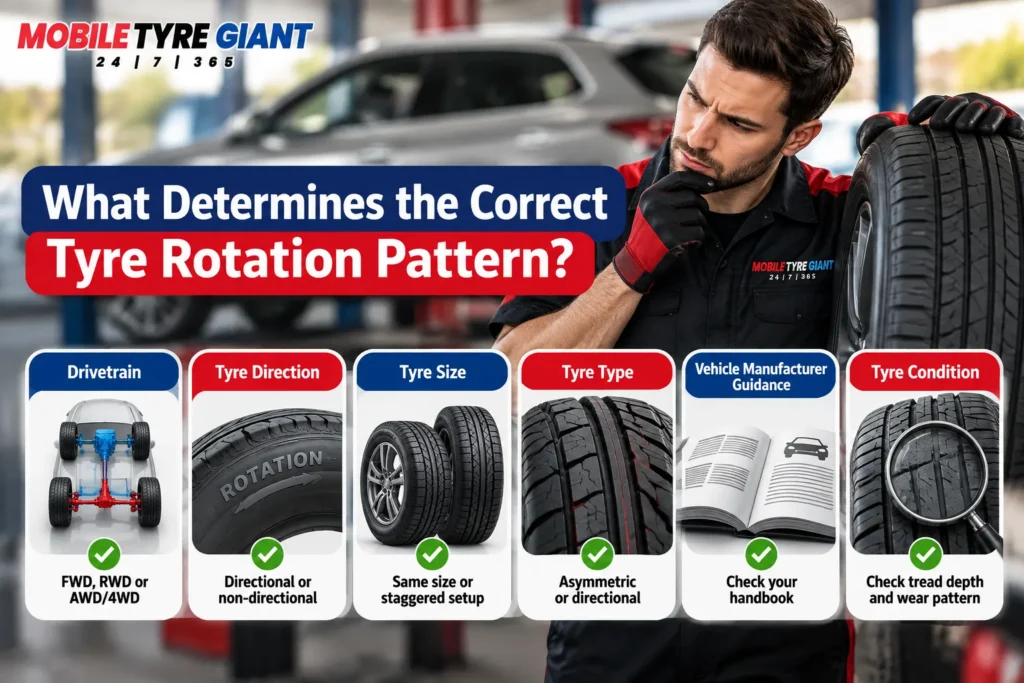
What Determines the Correct Tyre Rotation Pattern?
Four things should be checked before choosing a pattern: drivetrain, tyre direction, tyre size and manufacturer instructions. Drivetrain determines which axle is responsible for transmitting power. Tyre direction determines whether the tyre can move from the left side of the car to the right without being removed from the wheel. Tyre size determines whether front and rear assemblies are interchangeable. Manufacturer guidance brings those factors together for the specific vehicle.
You should also look for markings on the tyre sidewall before any wheels are moved. An arrow marked Rotation identifies a directional tyre and shows the direction in which it should turn while the vehicle moves forward. An asymmetric tyre normally has an Inside and Outside marking instead. These are different concepts, and confusing them can lead to the wrong rotation decision.
Directional, Asymmetric and Non-Directional Tyres Explained
A directional tyre has a tread pattern designed to operate in a specific rotational direction. When it remains mounted on the same wheel, it is normally moved from front to rear on the same side of the vehicle. Simply moving the complete wheel diagonally to the other side would reverse its direction of rotation. To use it on the opposite side, the tyre may need to be removed from the wheel and correctly remounted so that its rotation arrow still points forward.
An asymmetric tyre is different. Its inner and outer tread zones perform different jobs, so the sidewall marked Outside must remain facing away from the vehicle. An asymmetric tyre is not automatically directional. Some tyres are both asymmetric and directional, while many asymmetric tyres can rotate in either direction once correctly mounted. Non-directional tyres of equal size generally provide the greatest flexibility for conventional cross-rotation patterns.
What Is the Forward Cross Tyre Rotation Pattern?
The forward cross is one of the most common patterns for front-wheel-drive vehicles using four equal-size, non-directional tyres. In this arrangement, the two front tyres move directly backwards to the rear on the same side. The rear tyres then move forwards while crossing sides. The left-rear therefore moves to the right-front, and the right-rear moves to the left-front.
The logic reflects the heavier workload often experienced by the front tyres of a front-wheel-drive car. Moving those tyres straight backwards gives them a different working position, while crossing the rear tyres as they move towards the front helps distribute position-specific wear over time. The pattern should still be confirmed against the vehicle manufacturer’s recommendations, especially on cars with specialised drivetrains, tyre setups or different front and rear pressures.
Can Every Front-Wheel-Drive Car Use a Forward Cross Pattern?
No. A front-wheel-drive layout alone is not enough to choose the pattern. If the car has directional tyres, the complete wheel-and-tyre assemblies will normally stay on their original sides and move only from front to rear. If the front and rear tyres are different sizes, a standard forward cross may not be possible because the rear tyres cannot simply be installed on the front axle. Specific vehicle recommendations can also override the generic rotation pattern.
Tyre condition can change the decision as well. A tyre with severe irregular wear, sidewall damage or insufficient tread should be inspected rather than automatically rotated. Vibration should also be investigated before assuming that changing tyre positions will solve it. Rotation and balancing perform different jobs: rotation changes tyre positions, while mobile wheel balancing corrects weight imbalance within the rotating wheel-and-tyre assembly. Knowing that difference prevents one maintenance procedure from being used to mask another problem.
What Should You Check Before Rotating Your Tyres?
Start by confirming all four tyre sizes and comparing their tread patterns and sidewall markings. Check whether any tyre is directional, whether front and rear sizes differ and whether the vehicle handbook specifies a particular rotation method. Measure tread depth across each tyre rather than only in the centre, and note any significant difference between the front and rear axles. This creates a clear picture of the tyre set before anything is moved.
Then inspect pressure, visible damage and wear patterns. A tyre with a bulge, exposed cords, serious cracking or another structural concern should not simply be rotated and returned to service. If one tyre shows much heavier wear than the others, investigate the reason first. The correct rotation pattern works best as preventive maintenance on a healthy set of compatible tyres, not as a shortcut for repairing a tyre or vehicle fault.
What Is the Rearward Cross Tyre Rotation Pattern?
The rearward cross pattern is commonly associated with rear-wheel-drive vehicles and can also be suitable for some four-wheel-drive or all-wheel-drive vehicles using four equal-size, non-directional tyres. In this pattern, the rear tyres move directly forward to the front axle on the same side. The front tyres move backwards while crossing sides, so the front-left moves to the rear-right and the front-right moves to the rear-left. This gives each tyre a different working position while keeping the driven rear tyres moving forward without crossing.
The pattern can help distribute wear where the rear axle is responsible for transmitting engine torque to the road. Rear tyres on a rear-wheel-drive vehicle may experience additional acceleration forces, while the front tyres continue to handle steering and a significant part of braking. Moving the tyres between these positions can help balance those different workloads over time. As with any rotation pattern, the vehicle handbook should take priority if the manufacturer specifies a different method.
Is Rearward Cross Suitable for Every Rear-Wheel-Drive Car?
No. Drivetrain is only one part of the decision. A rear-wheel-drive car fitted with directional tyres will usually need a same-side front-to-rear rotation rather than a cross pattern unless the tyres are removed from the wheels and correctly remounted. A vehicle with wider rear tyres than front tyres may not allow front-to-rear rotation at all. Sports cars and performance models commonly use these staggered setups, so checking tyre sizes is essential before moving anything.
Wheel dimensions also matter because two tyres with similar-looking sidewalls may still be fitted to wheels with different widths or offsets. Never assume that a wheel can move between axles simply because the overall appearance is similar. If you are unsure whether the front and rear tyre dimensions match, the markings can be checked using our correct tyre size guide before choosing a rotation pattern.
What Is the X-Pattern Tyre Rotation?
The X-pattern, sometimes called a cross pattern, moves every tyre diagonally to the opposite corner. The front-left moves to the rear-right, the front-right moves to the rear-left, the rear-left moves to the front-right and the rear-right moves to the front-left. This pattern may be suitable for vehicles using four identical, non-directional tyres where the vehicle or tyre manufacturer permits cross rotation.
Its main advantage is that every tyre changes both axle and side. That can help spread position-specific wear across the full set over several rotation intervals. However, because every tyre crosses sides, the X-pattern is not suitable for directional tyres while they remain mounted on their existing wheels. It may also be unsuitable for vehicles with staggered wheel sizes, axle-specific tyre specifications or manufacturer restrictions.
Is an X-Pattern Better Than Forward or Rearward Cross?
Not necessarily. There is no single rotation pattern that is automatically better for every vehicle. Forward cross, rearward cross and X-pattern each move tyres differently to suit certain layouts. The correct choice depends on drivetrain, tyre construction and the vehicle manufacturer’s recommendations rather than which diagram appears most symmetrical.
Consistency is often more important than choosing the most complicated pattern. A suitable rotation performed at sensible intervals can help prevent a large wear difference from developing between positions. Changing randomly between patterns without understanding why can make maintenance harder to track. If the manufacturer specifies one method, following that method consistently is generally the simplest approach.
How Should AWD and 4WD Tyres Be Rotated?
All-wheel-drive and four-wheel-drive vehicles deserve particular attention because many of their drivetrains are sensitive to differences in tyre circumference. If one tyre has substantially more tread than another, its rolling circumference can differ slightly. On some AWD systems, excessive differences between tyres can place additional stress on drivetrain components because the system continually tries to manage different wheel speeds. Rotation can help keep tread wear more even across the set.
Where four equal-size, non-directional tyres are fitted, manufacturers may recommend an X-pattern or another cross-rotation method. The exact recommendation varies by vehicle, so the handbook should be checked rather than applying one universal AWD diagram. Regular tread-depth comparison is also important because rotation works best before large differences develop. Once one or two tyres are significantly more worn, simply changing their positions may not restore a properly matched set.

Why Is Matching Tread Depth Important on AWD Vehicles?
AWD systems transfer power between multiple wheels, so a consistent rolling circumference across the tyres can be more important than on some two-wheel-drive vehicles. A tyre with much deeper tread has a slightly larger effective rolling diameter than a heavily worn tyre of the same nominal size. That difference may be small, but certain drivetrain systems are designed around relatively closely matched tyres.
This does not mean every minor tread difference will damage an AWD vehicle, and acceptable limits vary by manufacturer. It does mean that tyre replacement and rotation decisions should be made more carefully. If one tyre becomes damaged beyond repair while the others are already significantly worn, replacing only that tyre may not always be the correct solution. The vehicle manufacturer’s allowable tread or circumference difference should be checked before deciding how many tyres need replacement.
How Do You Rotate Directional Tyres?
Directional tyres are usually rotated from front to rear while staying on the same side of the vehicle. The front-left moves to the rear-left and the rear-left moves to the front-left, with the same process on the right-hand side. This preserves the direction indicated by the rotation arrow moulded into the tyre sidewall. Moving the complete wheel diagonally would reverse that direction, which is why normal cross patterns are not used in the same way.
The rotation arrow should point in the direction the tyre turns when the vehicle travels forward. If a directional tyre has accidentally been fitted on the wrong side, simply moving the wheel may not solve the issue. The tyre may need to be removed from the wheel and remounted correctly. Directional tread designs are intended to manage water and road contact in a particular direction, so correct orientation should be treated as a fitting requirement rather than a cosmetic preference.
Can Directional Tyres Ever Be Crossed From One Side to the Other?
Yes, but normally only if the tyre is removed from its wheel and correctly remounted so that its rotation direction remains correct. This is more involved than a standard wheel rotation because the tyre bead must be broken, the tyre turned on the wheel and the assembly refitted and balanced where necessary. For routine maintenance, keeping directional wheel-and-tyre assemblies on the same side is usually much simpler.
Crossing directional tyres is therefore not normally something a driver should do at home simply by swapping complete wheels. If a specific wear-management reason makes left-to-right movement desirable, professional fitting can determine whether remounting is appropriate. Any tyre removal also creates an opportunity to inspect the inside of the tyre, valve and wheel for damage that is difficult to see while the tyre is installed.
What Is Side-to-Side Tyre Rotation?
Side-to-side rotation means moving tyres between the left and right sides while keeping them on the same axle. The left-front swaps with the right-front and the left-rear swaps with the right-rear. This pattern may be considered on certain vehicles with different front and rear tyre sizes where front-to-rear movement is impossible but the tyres themselves are non-directional and suitable for side-to-side movement.
This is particularly relevant to some staggered performance setups. For example, the rear tyres may be wider than the front tyres, preventing them from changing axles. If the tyre design and manufacturer instructions allow it, moving them between left and right positions may still help manage side-specific wear. It is not automatically suitable, however, because directional tyres cannot simply be swapped across the vehicle while mounted on the same wheels.
Can Staggered Tyres Be Rotated Front to Rear?
Usually not when the front and rear tyre or wheel sizes are different. A staggered setup may use wider tyres at the rear or different wheel widths between the axles. Moving those assemblies forward could create clearance, handling or fitment problems. The tyre sidewall sizes and wheel specifications therefore need to be checked before attempting any rotation.
Some staggered vehicles offer very limited rotation options, particularly if the tyres are directional as well as different sizes front and rear. In that case, there may be no conventional rotation pattern available without demounting tyres. Regular pressure checks, alignment inspection and suspension maintenance become even more important because the tyres may remain in the same positions throughout much of their service life.
When Should a Tyre Not Be Crossed to the Opposite Side?
A tyre should not be crossed to the opposite side while still mounted if doing so would make a directional tread rotate backwards. It should also not be moved if the opposite position requires a different tyre size, load specification or wheel dimension. Any vehicle-specific restriction in the handbook should be followed. Rotation diagrams should never override actual tyre markings or fitment requirements.
The tyre’s condition may also make rotation inappropriate. Severe inner-edge wear, exposed cords, a sidewall bulge or damage caused by rubbing should be investigated rather than moved to another corner. Abnormal wear may point to an alignment or suspension problem, and rotating the tyre can make the symptoms less obvious without correcting the cause. Our guide on how suspension problems damage tyres explains several wear patterns that should be investigated before rotation.
Should You Rotate a Tyre That Is Already Badly Worn?
Not as a substitute for replacement. Rotation can help manage normal wear while a tyre is still serviceable, but it cannot restore tread that has already been lost. If a tyre is close to the legal limit, damaged or worn unevenly enough to affect safety, moving it to another axle does not solve the underlying problem. It should first be assessed to determine whether it can remain in service.
This becomes especially important when one tyre is much worse than the other three. The cause could be low pressure, wheel alignment, suspension wear or another mechanical issue. Fixing that cause before fitting or rotating tyres helps prevent the same pattern from returning. Where a tyre has reached the end of its usable life, the guidance in our when to replace tyres article can help distinguish normal wear from signs that replacement should no longer be delayed.
How Often Should You Rotate Your Tyres?
There is no single rotation interval that applies perfectly to every vehicle, but many manufacturers recommend checking rotation somewhere around every 5,000 to 8,000 miles or at scheduled servicing intervals. The correct figure for your car should come from the vehicle handbook because tyre construction, drivetrain and manufacturer maintenance schedules can change the recommendation. Cars that cover a lot of motorway mileage may wear differently from vehicles used mainly for short urban journeys, and aggressive acceleration, hard cornering or frequent heavy loads can accelerate position-specific wear. Rotation should therefore be based on both mileage and actual tyre condition rather than waiting for one exact number.
A useful habit is to compare all four tyres whenever pressures are checked or the vehicle is serviced. If the front axle is clearly wearing faster than the rear while the tyres remain otherwise healthy, rotation may be appropriate before a large tread-depth difference develops. Waiting until one axle is heavily worn reduces the benefit because rotation is primarily preventive maintenance. The most successful rotation schedules begin while all four tyres still have plenty of usable tread and no serious abnormal wear.
Should Tyres Be Rotated at Every Service?
It can be convenient to inspect rotation requirements during each service because the car is already being checked and mileage can be recorded easily. That does not mean the wheels must automatically be moved every time. If the vehicle has covered only a small distance since the previous rotation and all four tyres are wearing evenly, another immediate rotation may provide little benefit. The handbook recommendation and measured tread depths should guide the decision.
Keeping a simple record can help. Note the mileage when the tyres are fitted and each time they are rotated, then compare tread depth across the axles during later checks. This creates a clearer picture of how quickly the vehicle wears its front and rear tyres. It also prevents rotation from becoming a random maintenance task carried out too frequently or forgotten entirely.
Should Tyre Pressure Be Checked After Rotation?
Yes. Tyre pressures should be checked after rotation because some vehicles specify different pressures for the front and rear axles. A tyre that was correctly inflated for the rear position may need a different pressure after it is moved to the front. Using the old pressure simply because the tyre itself has not changed can leave the newly positioned tyre over-inflated or under-inflated relative to the manufacturer’s specification.
Pressure should ideally be checked when the tyres are cold and adjusted using the vehicle’s pressure label or handbook. Do not use the maximum pressure moulded into the tyre sidewall as the normal operating pressure for the vehicle. If you need a refresher on the correct procedure, our guide on how to check tyre pressure explains where to find the recommended values and how to take a reliable reading.
Do Front and Rear Tyres Always Use the Same Pressure?
No. Many vehicles specify different front and rear pressures because the axles carry different loads. The recommended figures may also change when the vehicle is heavily loaded, carrying several passengers or travelling with luggage. Rotating tyres without changing their pressure to suit the new position can therefore undo part of the maintenance benefit you were trying to achieve.
The units shown on pressure labels can also differ between cars and inflators. Some use PSI, others bar or kPa. If you are comparing a vehicle label with an inflator using a different unit, use the correct conversion rather than estimating. Our tyre pressure conversion guide covers PSI, bar and kPa so the tyre can be set accurately after it changes axle.
Does Tyre Rotation Affect TPMS?
It can, especially on vehicles that display the pressure for each individual wheel position. After rotation, the physical sensor that was previously recognised as the front-left wheel may now be at the rear. Some vehicles detect the new locations automatically after driving, while others require a TPMS relearn or reset procedure. If the system is not updated correctly, the dashboard may show a pressure reading against the wrong corner.
Vehicles with simpler TPMS warning systems may not require position-specific relearning, but pressure still needs to be corrected after the tyres move. The exact procedure depends on the car, so the handbook should be checked after rotation. If one sensor stops communicating immediately after wheel work, do not assume the rotation itself has damaged the system. The sensor, valve and relearn process should be checked separately.
Should TPMS Sensors Be Relearned After Every Tyre Rotation?
Not on every vehicle. Some systems automatically identify sensor positions after a short drive, while others require a manual relearn procedure or diagnostic equipment. Vehicles that display individual tyre positions are more likely to need some method of updating where each sensor is located. The correct procedure can vary significantly between manufacturers.
This is one reason tyre rotation should be treated as more than simply swapping four wheels with a jack. Pressure settings, sensor locations and wheel torque all need to be correct when the job is finished. If a TPMS warning remains after rotation despite correct pressures, the relearn process should be checked before assuming a sensor has failed.
Do Tyres Need Balancing After Rotation?
Tyre rotation and wheel balancing are different maintenance procedures. Rotation moves tyres between positions on the vehicle, while balancing corrects uneven weight distribution in the wheel-and-tyre assembly. If a wheel was properly balanced before rotation and there are no vibration symptoms, rotating it does not automatically mean it needs to be balanced again. The balance weights remain attached to that wheel regardless of which corner it moves to.
Balancing should be investigated if you notice steering-wheel vibration, seat vibration or a speed-related shake after the wheels have been moved. A balance problem may have existed before the rotation but become more noticeable when the affected wheel is moved to a different axle. Missing balance weights, tyre damage or wheel distortion can also create vibration, so the cause should be diagnosed rather than assuming rotation itself created the problem.
Does Tyre Rotation Fix Wheel Alignment Problems?
No. Wheel alignment controls the angles at which the wheels sit relative to the road and each other. Rotation only changes which tyre occupies each position. If incorrect toe, camber or another geometry problem is causing rapid inner-edge wear, outer-edge wear or feathering, moving that tyre elsewhere will not correct the underlying geometry.
Rotation can sometimes make an alignment-related wear pattern appear less obvious for a while because the affected tyre has moved, but the vehicle will continue creating abnormal wear until the alignment or mechanical cause is corrected. If you notice a saw-tooth or feathered tread pattern, our guide to tyre feathering causes explains how alignment and suspension issues can create that type of wear.
Should the Best Tyres Go on the Front or Rear?
When there is a meaningful difference in tread depth between two tyres, many tyre manufacturers recommend fitting the tyres with the greater tread depth to the rear axle, regardless of whether the vehicle is front-wheel drive or rear-wheel drive. The reason is vehicle stability. Rear tyres with significantly less grip, particularly in wet conditions, can increase the risk of the rear of the vehicle losing traction unexpectedly.
This point can seem counter-intuitive on a front-wheel-drive car because the front tyres steer, accelerate and carry much of the braking load. However, maintaining rear-axle stability is important when replacing only two tyres. Rotation schedules should ideally prevent a very large tread difference developing in the first place, but when two new tyres are required, tyre placement should follow the vehicle and tyre manufacturer’s guidance rather than simply putting the newest pair on the driven axle.
Can You Rotate Newer Rear Tyres to the Front?
Sometimes, but tyre condition and tread balance across both axles need to be considered first. If moving substantially deeper-tread rear tyres to the front would leave much more worn tyres on the rear axle, the resulting setup may reduce rear stability. Rotation is not about forcing every tyre through every possible position regardless of how worn the set has become.
This is why rotation is most effective when started early and repeated before large tread differences develop. If two tyres are already considerably more worn than the others, it may be time to reassess the set rather than follow a rotation diagram mechanically. Where worn or damaged tyres need changing, mobile tyre replacement can address the unsafe tyres while the remaining pair is assessed for condition and suitable axle placement.
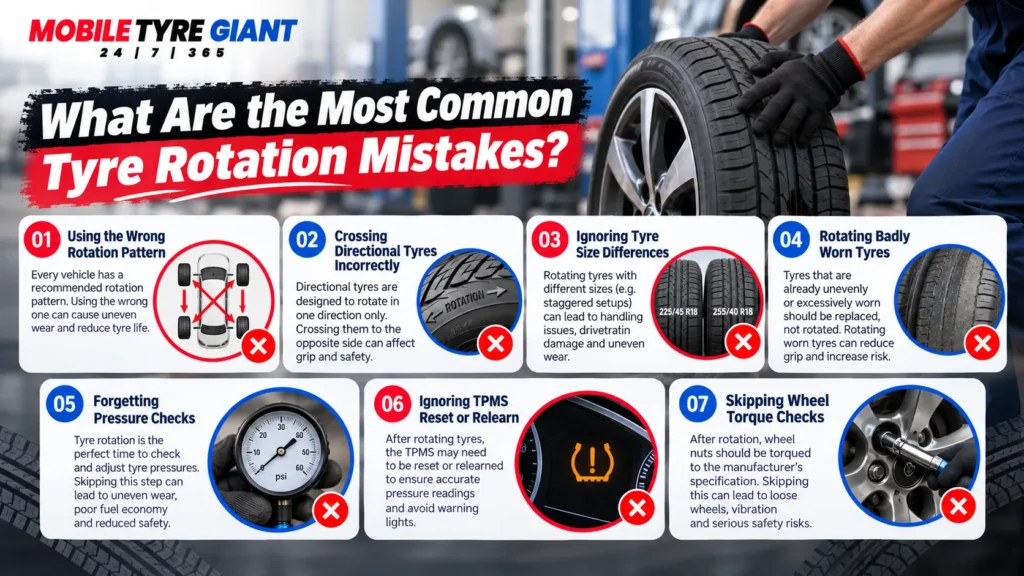
What Are the Most Common Tyre Rotation Mistakes?
One of the most common mistakes is using a generic rotation diagram without first checking whether the tyres are directional or whether the car has different front and rear sizes. Another is rotating tyres that already show severe abnormal wear without investigating the cause. Drivers may also forget to adjust axle-specific pressure settings, update TPMS positions or tighten wheel fixings correctly after moving the wheels. Each of these mistakes can turn a simple maintenance procedure into a new problem.
Another mistake is assuming rotation can make tyres last indefinitely. Rotation can help distribute normal wear, but every tyre still ages and loses tread over time. Cuts, bulges, exposed cords, severe cracking and excessive tread wear are not corrected by changing positions. A proper rotation should finish with a complete tyre-condition check rather than treating the diagram itself as the entire job.
Is Randomly Swapping Tyres Better Than Not Rotating Them?
No. Random swapping can put directional tyres on the wrong side, move incompatible wheel sizes between axles or make a carefully monitored wear pattern harder to understand. Rotation should follow a defined pattern that suits the vehicle and tyre configuration. Recording that pattern also helps ensure the next rotation continues logically rather than sending tyres back and forth without purpose.
If the correct pattern is unclear, check the vehicle handbook, tyre sidewall markings and front and rear sizes before moving anything. A few minutes spent confirming those details is more useful than following a diagram designed for a different drivetrain or tyre type. The aim is controlled, predictable wear across a safe and compatible tyre set, not simply changing wheel positions because a particular mileage has been reached.
How Should Tyres Be Rotated Safely?
A safe tyre rotation should begin before any wheel is removed. Confirm the tyre sizes on all four corners, identify any directional arrows or Inside and Outside markings, and check the vehicle handbook for a recommended rotation pattern. Measure the tread depth at several points across each tyre and note the current wheel position so you know exactly where every tyre started. This prevents confusion once several wheels are off the vehicle and makes it easier to identify whether one axle or corner has been wearing faster than the others.
The vehicle should then be lifted using the correct jacking points and supported safely before the wheels are moved according to the chosen pattern. Wheel mounting surfaces should be clean, the wheels should sit correctly against the hubs, and the fixings should be tightened using the appropriate sequence and manufacturer-specified torque. Tyre rotation is often easiest to combine with professional mobile tyre fitting when tyres already need attention, because their condition, pressure and fitment can all be checked during the same visit.
Should You Mark Tyres Before Removing Them?
Yes. Marking each tyre or wheel position can make the rotation process much easier, especially if all four wheels look similar. Simple labels such as FL for front-left, FR for front-right, RL for rear-left and RR for rear-right allow you to compare the starting positions with the intended rotation pattern. This is particularly useful when following a cross pattern because two or more wheels may be moving diagonally across the vehicle.
Recording the original positions also helps with future maintenance. If one tyre later develops unusual wear, you can trace where it has previously been fitted and determine whether the wear followed the tyre or remained with one corner of the vehicle. That information can help distinguish a tyre-related issue from a wheel alignment, suspension or pressure problem.
What Should Be Checked Immediately After Tyre Rotation?
Tyre pressure should be one of the first checks after rotation, particularly if the vehicle specifies different front and rear pressures. Once the tyres have moved to their new positions, set each one according to the pressure required for that axle. Check the valve caps, inspect the sidewalls again and confirm that no directional tyre has accidentally been fitted to rotate backwards. If the vehicle uses position-specific TPMS readings, complete any reset or relearn procedure required by the manufacturer.
The wheels should also be checked for correct seating and fixing torque. After the vehicle is lowered, make sure the steering moves freely through its normal range and listen for rubbing, knocking or other unfamiliar noises during the first journey. A tyre that fitted correctly on one axle may have different clearance around suspension or body components in another position, especially if wheel or tyre specifications are unusual. Any unexpected vibration or handling change should be investigated rather than accepted as a normal result of rotation.
Is It Normal for the Car to Feel Different After Tyre Rotation?
A slight difference in steering feel can sometimes be noticed because tyres with different wear characteristics have moved to new positions. However, strong vibration, pulling, rubbing or sudden instability should not be considered normal. These symptoms may indicate incorrect pressure, wheel balance problems, incompatible wheel positions or an underlying alignment issue that became more noticeable after the rotation.
Tyres can also develop wear patterns that match the position where they spent thousands of miles. Moving a tyre with noticeable feathering or cupping may change how road noise or vibration is transmitted through the vehicle. This is another reason tyres should be inspected before rotation rather than moved automatically. If the new symptoms are significant, stop and have the wheels and tyres checked.
When Should You Avoid Rotating Tyres?
Rotation should be avoided when the tyre or vehicle configuration does not allow the intended movement. Different front and rear tyre sizes, directional tyres that would rotate backwards, damaged tyres and incompatible wheels can all restrict the available options. Rotation may also be unnecessary where the vehicle manufacturer specifically advises against it or uses a specialised tyre setup designed to remain in fixed positions.
You should also avoid treating rotation as a solution for serious wear. If one tyre has a bulge, exposed reinforcement, deep cuts, severe cracking or very low tread, it needs assessment rather than relocation. A tyre that has become unsafe does not become acceptable simply because it moves from the front axle to the rear. Safety and tyre condition always take priority over completing a planned rotation schedule.
Should Tyres With Uneven Wear Be Rotated?
Mild differences caused by normal front-to-rear wear may be exactly what a rotation schedule is intended to manage. Severe uneven wear is different. If one shoulder is rapidly disappearing, the tread has developed pronounced feathering or one tyre is significantly more worn than the others, investigate why before moving it. Alignment, suspension, pressure or wheel damage may be involved.
Once the mechanical cause has been corrected, a technician can decide whether the affected tyre still has enough safe and even tread to remain in service. In some cases, rotation may still be useful. In others, the damage or wear pattern may already be too advanced. Moving the tyre without dealing with the cause simply spreads the problem across another position.
How Should You Keep Track of Tyre Rotations?
Keeping a simple rotation record is one of the easiest ways to make the maintenance useful over the full life of the tyre set. Record the mileage, date, tread depth and position of each tyre before and after rotation. You do not need a complicated spreadsheet. A note in the vehicle service record or phone can be enough to remind you when the next inspection is due and which pattern was used previously.
This is particularly useful for high-mileage vehicles because tyre wear can change gradually and become difficult to remember over several months. Fleet operators can benefit even more because consistent records make unusual wear patterns easier to identify before they affect multiple tyres. Our fleet tyre check service is designed around systematic tyre-condition monitoring where multiple vehicles or frequent mileage make regular checks especially important.
Should You Use the Same Rotation Pattern Every Time?
Usually, yes, provided the vehicle, tyre setup and manufacturer recommendations have not changed. Using a consistent pattern makes it easier to understand how each tyre moves through the available positions over its service life. It also prevents tyres from being randomly moved backwards and forwards without achieving a useful distribution of wear.
The pattern may need to change if new tyre types, different wheel sizes or a staggered setup are introduced. For example, fitting directional tyres may remove the option of conventional cross rotation. Whenever the tyre configuration changes, reassess the rotation method instead of automatically following the pattern used with the previous set.
Quick Tyre Rotation Pattern Guide
The following table summarises the most common rotation approaches. It should be used as a general reference rather than a replacement for the vehicle manufacturer’s instructions.
Vehicle or Tyre Setup | Common Rotation Approach | Main Point to Check |
Front-wheel drive, equal-size non-directional tyres | Forward cross | Rear tyres cross to front |
Rear-wheel drive, equal-size non-directional tyres | Rearward cross | Front tyres cross to rear |
Suitable equal-size non-directional setup | X-pattern | Every tyre moves diagonally |
Directional tyres | Front to rear on same side | Keep rotation arrow facing correctly |
Staggered, non-directional tyres | Side to side where permitted | Front and rear sizes cannot swap |
Directional staggered setup | Rotation may be very limited | May require tyre demounting |
AWD or 4WD | Manufacturer-specified pattern | Keep tread depths closely matched |
The table also shows why choosing a rotation pattern based only on whether a vehicle is front-wheel drive or rear-wheel drive can be misleading. Tyre design and wheel size may remove certain movements completely. Before rotating, always compare the actual tyres on the vehicle with the assumptions behind the pattern.
Final Words: Choose the Rotation Pattern That Fits Your Vehicle
Tyre rotation can help distribute normal wear, but there is no single pattern that works for every vehicle. Forward cross, rearward cross, X-pattern, front-to-rear and side-to-side rotation each have specific uses. The correct choice depends on drivetrain, tyre direction, front and rear sizes, TPMS requirements and the vehicle manufacturer’s recommendations. Checking those details before moving the wheels is far more important than following a generic diagram.
Rotation also works best as preventive maintenance rather than a repair for tyres that are already badly worn. Measure tread depth, check pressure, inspect for damage and investigate abnormal wear before changing positions. After rotation, reset the correct axle pressures, confirm TPMS operation where necessary and watch for vibration, rubbing or unusual handling. Done consistently, tyre rotation can help maintain a more balanced tyre set and make developing problems easier to spot.
Tyres Wearing Unevenly or Due for Rotation?
If your tyres are wearing at different rates or you are unsure which rotation pattern suits your vehicle, get expert tyre help before uneven wear gets worse.
Frequently Asked Questions
Find quick answers to the most common questions our customers ask.
There is no single best rotation pattern for every vehicle. Front-wheel-drive cars with equal-size non-directional tyres may use a forward cross, while rear-wheel-drive vehicles may use a rearward cross. Directional and staggered tyre setups require different methods, so the vehicle handbook and tyre markings should always be checked first.
Many vehicles have rotation recommendations somewhere around every 5,000 to 8,000 miles, but the correct interval depends on the manufacturer, tyre type, drivetrain and driving conditions. Checking tread depth regularly is more useful than relying on mileage alone because abnormal wear may require attention earlier.
A common pattern for a front-wheel-drive vehicle with equal-size, non-directional tyres is the forward cross. The front tyres move straight backwards to the rear, while the rear tyres move diagonally forward to the opposite sides. Manufacturer guidance should still be checked before using this pattern.
A rearward cross is commonly used where appropriate. The rear tyres move straight forward on the same side, while the front tyres cross diagonally to the rear. This pattern is generally intended for equal-size, non-directional tyres and may not work with directional or staggered setups.
Yes. Directional tyres are normally rotated from front to rear while remaining on the same side so their rotation arrows continue pointing correctly. Moving a complete directional wheel to the opposite side would reverse its running direction unless the tyre is removed and correctly remounted.
Yes, many AWD vehicles can have their tyres rotated, and regular rotation can be particularly useful for keeping tread depths more closely matched. The exact pattern and acceptable tread difference vary by manufacturer, so the vehicle handbook should be followed rather than assuming every AWD vehicle uses the same rotation method.
Rotation options are limited when the front and rear tyres or wheels are different sizes. Front-to-rear movement usually is not possible in that situation, although non-directional tyres may sometimes be moved side to side if the manufacturer permits it. Directional staggered setups may offer very little conventional rotation.
No. Rotation does not automatically change the balance of a wheel-and-tyre assembly. Balancing should be considered if vibration is present, a balance weight has been lost or tyre work has otherwise disturbed the assembly. Rotation and balancing are separate maintenance procedures.
It can. Vehicles that display pressure for individual wheel positions may need a TPMS reset or relearn after the wheels are moved. Some systems recognise the new positions automatically after driving, while others require a specific procedure or diagnostic equipment.
When two tyres have significantly more tread than the other pair, tyre manufacturers commonly recommend placing the deeper-tread pair on the rear axle to support rear stability, particularly on wet roads. The vehicle manufacturer's guidance should still be followed, especially on vehicles with unusual drivetrain or tyre requirements.