

Tyre feathering is one of those wear problems that drivers often feel before they clearly see it. Run your hand gently across the tread and the surface may feel fairly smooth in one direction, then noticeably sharper or rougher when you move your hand back the other way. That sawtooth texture develops because the edges of the tread blocks are not wearing at the same rate. One side becomes rounded while the opposite edge stays higher and sharper. At first, the tyre may still have plenty of tread depth, which makes the problem easy to dismiss. The car may also continue driving normally enough that nothing feels urgent. However, feathered wear usually means the tyre is being scrubbed across the road rather than rolling as cleanly as it should.
That is why tyre feathering should be treated as a clue rather than just an unusual tread pattern. The tyre is showing you that something about wheel alignment, steering geometry, suspension condition, pressure, or another part of the setup may need attention. Some drivers first notice a humming or droning sound, while others find the problem during a routine tread check. A UK driver recently described a feathered front tyre as feeling “smooth one way” but noticeably sharp when rubbing the tread in the opposite direction. That description is useful because the condition can be easier to identify by touch than by sight. The sooner you recognise the pattern, the better chance you have of addressing the underlying cause before more tread is unnecessarily worn away.
What Is Tyre Feathering?
Tyre feathering is a form of uneven tread wear where each tread block or rib develops a different height across its edge. Instead of the tread wearing flat and evenly, one side of the block becomes smoother and lower while the opposite side remains sharper. When you move your hand across the tread, this difference can create a stepped or sawtooth sensation. The tyre may look fairly normal when viewed from a standing position, especially during the early stages. That is one reason drivers can miss it during a quick visual inspection. It is also different from a tyre that is simply worn more heavily on one entire shoulder. Feathering happens across individual tread edges because the tyre is experiencing sideways scrubbing as it rolls.
The most common mechanical link is incorrect toe alignment, which describes whether the wheels point slightly inward or outward relative to the vehicle’s direction of travel. Even a small incorrect angle can cause the tread to drag sideways against the road during thousands of rotations. That repeated movement gradually creates the feathered edge. Our broader tyre safety guide includes feathered wear among the patterns that can point towards alignment issues. It is important not to treat the tread pattern as a complete diagnosis on its own, though. Worn steering or suspension components can allow alignment angles to change while driving, and other tyre problems can produce wear that looks similar from a distance. A proper inspection should therefore focus on the cause as well as the tyre itself.
What Does a Feathered Tyre Feel Like?
The easiest way to recognise a feathered tyre is often through touch. With the vehicle safely parked and the tyre accessible, move your hand lightly across the tread from one side towards the other. In one direction the tread blocks may feel relatively smooth, while in the opposite direction the edges can feel noticeably rough, sharp, or stepped. The effect can be similar to brushing your hand over very small ramps or the teeth of a fine saw. You do not need to press hard to detect it, and there is no benefit in forcing your fingers into deep tread grooves. If the tread contains stones, sharp debris, exposed material, or obvious damage, avoid running your bare hand across it.
Feathering can also create a different sensation from behind the steering wheel. Some drivers notice increased tyre roar or a humming sound that changes with road speed. Others describe the car as feeling less smooth than it used to, although noise alone does not prove that the tyres are feathered. Road surfaces, wheel bearings, tyre design, and balance problems can produce similar sounds or sensations. The useful clue is when the unusual noise appears together with the directional roughness across the tread. If you can physically feel the stepped pattern, the tyre is giving you stronger evidence than sound alone. Regularly checking tyre tread condition can help you spot this kind of uneven wear before it becomes severe.
What Does Tyre Feathering Look Like?
Visually, tyre feathering can appear as a series of tread blocks that are slightly higher on one edge and more rounded on the other. From directly above, the differences may look subtle, especially if the wear has only just started. Looking across the tread from a lower angle can make the stepped pattern easier to notice because light catches the raised edges differently. The wear may appear across several ribs rather than being limited to one completely bald shoulder. You may also notice that one part of the tread feels much more pronounced than it looks. This is why checking by both sight and touch is more useful than relying on one method alone.
Do not confuse feathering with every other form of uneven tyre wear. A tyre worn heavily across the centre may point towards a pressure-related issue, while wear on both outer shoulders can be associated with running under-inflated. A single inner or outer edge wearing faster can be linked with alignment or camber problems. Cupping usually looks more like irregular dips or scalloped patches around the tread rather than a consistent sharp-to-smooth edge across each block. Those differences matter because replacing the tyre without understanding the actual wear pattern can leave the original cause untouched. The new tyre can then begin developing the same problem again.
Is Tyre Feathering Normal Wear?
No, feathered tread should not be treated as the same thing as normal, even tyre wear. All tyres gradually lose tread as they cover miles, but healthy wear should generally develop consistently across the surface unless the vehicle design or operating conditions create a known pattern. With tyre feathering, the shape of the tread block itself tells you the tyre has been rubbing against the road unevenly. That does not necessarily mean the tyre is immediately dangerous or below the legal tread limit. A mildly feathered tyre can still have substantial usable tread remaining. However, ignoring the underlying issue allows the uneven wear to continue and can shorten the useful life of the tyre.
UK drivers are responsible for keeping tyres roadworthy, including maintaining legal tread depth and ensuring they are free from relevant defects. Feathering is not a separate legal tread-depth measurement, so you should still check tread properly across the required area of the tyre. More importantly, do not assume that a tyre is healthy simply because the deepest groove still measures well above the minimum. Uneven wear can eventually leave one part of the tread far more worn than another. Regular measurements across several points make this easier to spot. The sensible approach is to investigate why the feathering developed while there is still useful tread left to protect.
Is Feathering the Same as Cupping or One-Sided Wear?
No. Feathering, cupping, and one-sided wear are different patterns, although drivers often group them together because all three look like uneven tyre wear. Feathering produces a directional sharp and smooth edge across the tread blocks. Cupping usually creates repeated dips, scallops, or patches around the circumference of the tyre, often making the surface look as though small sections have been scooped out. One-sided wear is more straightforward, with either the inner or outer shoulder becoming significantly more worn than the rest of the tread. These patterns can overlap when a vehicle has more than one mechanical problem, which is why appearance alone should not be used to make a final diagnosis.
The likely causes also differ. Feathering is strongly associated with incorrect toe alignment, while cupping can be linked with wheel imbalance, worn suspension components, or other issues that allow the tyre to move irregularly as it rotates. One-sided wear may involve alignment angles such as camber or toe, depending on the vehicle and wear pattern. If vibration accompanies patchy or cupped wear, mobile wheel balancing may form part of the investigation, but balancing should not automatically be prescribed for every feathered tyre. The first job is to identify the actual wear pattern and then inspect the steering, suspension, pressures, and alignment accordingly. Correct diagnosis protects the replacement tyre from repeating the same wear.
What Causes Tyre Feathering?
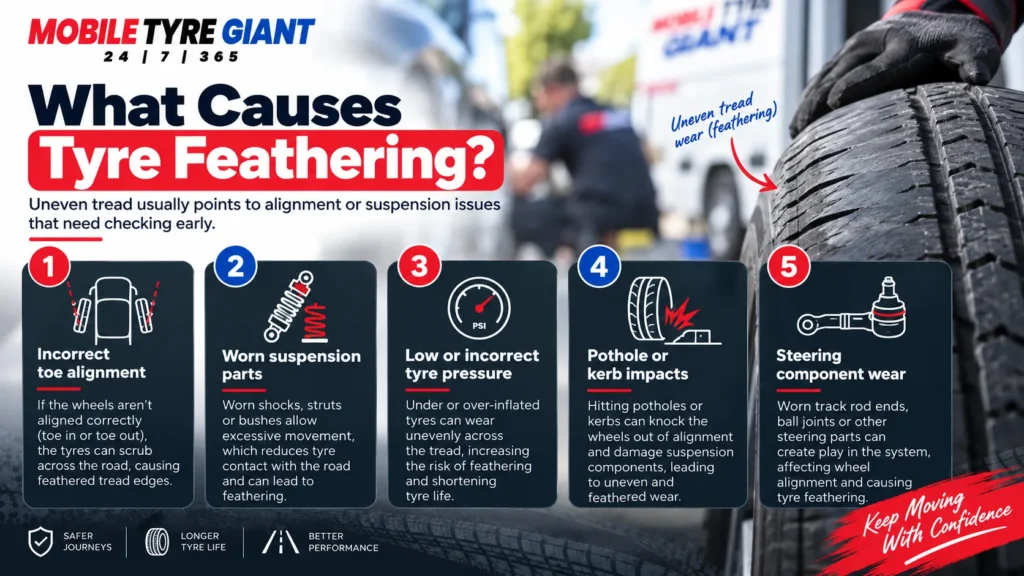
The most common reason for tyre feathering is incorrect wheel alignment, particularly an incorrect toe setting. Toe describes whether the wheels point slightly towards each other or away from each other when viewed from above. When that angle is outside the correct specification, the tyre does not roll perfectly straight along the road. Instead, the tread is dragged sideways a tiny amount with every rotation. One journey may not make the problem obvious, but thousands of rotations can gradually wear one edge of each tread block more than the other. That repeated sideways scrub creates the sharp and smooth pattern that makes feathering distinctive.
Alignment is not the only thing worth checking, though. Steering components, suspension wear, incorrect pressure and impact damage can all influence how the tyre meets the road. A vehicle may also have more than one issue at the same time, which can make the tread pattern harder to interpret. For example, poor toe alignment may produce feathering while low pressure creates additional shoulder wear. That is why looking at one tyre and immediately ordering an alignment can sometimes miss part of the problem. The better approach is to examine the tread pattern, pressures, steering behaviour and suspension condition together.
Why Is Incorrect Toe Alignment the Main Cause of Feathering?
Toe alignment has such a strong connection with feathering because even a small sideways angle creates continuous friction across the tread. Imagine pushing a rubber eraser forwards while holding it slightly sideways. Instead of gliding cleanly, one edge drags harder across the surface and begins wearing differently from the other. A tyre with incorrect toe experiences a similar effect every time the wheel turns. Over hundreds or thousands of miles, the tread blocks develop a directional edge. The driver may not notice anything dramatic because the alignment can be only slightly outside specification while still creating enough scrub to damage the tyre gradually.
Incorrect toe can develop for several reasons. Alignment may simply drift over time, or a pothole, kerb impact or worn steering component may change the wheel position. Replacement suspension parts can also require alignment afterwards because changing a component may alter the geometry. A steering wheel that is no longer centred, a car that pulls consistently or fresh feathering across the tread can all provide reasons to have the alignment checked. However, not every alignment issue causes obvious pulling, so a car that seems to drive straight can still have enough toe error to wear the tyres unevenly.
Can Worn Steering or Suspension Parts Cause Feathered Tyres?
Yes. Worn steering or suspension components can contribute to feathering because they affect how accurately the wheel remains positioned while the car is moving. Bushes, ball joints, track rod ends and other components are designed to control wheel movement within specific limits. If wear allows too much movement, the alignment measured while the car is stationary may not remain exactly the same when braking, accelerating or travelling over uneven roads. The tyre can then scrub across the surface in a way that gradually develops uneven tread edges. This is why repeated feathering after an alignment deserves further investigation rather than simply adjusting the wheels again.
Suspension wear may also produce other symptoms alongside the tyre pattern. The steering can feel vague, the vehicle may wander more than it used to, or knocks may appear over bumps. None of those symptoms identifies one component by itself, but they give useful context when feathering is present. If worn parts are responsible, aligning the wheels before repairing them may provide only a temporary improvement because the geometry can move again under load. A proper inspection should therefore check whether the steering and suspension are capable of holding the alignment correctly before assuming the tyres themselves are the only problem.
Can Incorrect Tyre Pressure Cause Feathering?
Incorrect tyre pressure is better known for causing other wear patterns, but it can contribute to uneven wear and make an existing feathering problem worse. Under-inflation allows the tyre to flex more and can increase wear towards the shoulders, while excessive pressure can place more load through the centre area of the tread. Neither pattern is exactly the same as classic feathering caused by incorrect toe. However, when pressure is wrong at the same time as the alignment, the resulting tread can show a mixture of wear patterns. That can make the tyre look much more irregular than a simple alignment problem would on its own.
Check pressure before diagnosing tread wear because it is one of the easiest variables to confirm. Use the vehicle manufacturer’s recommended cold pressures rather than guessing from appearance or copying another vehicle. A tyre can look reasonably normal while still being several PSI below the correct setting. Our guide to the effects of under-inflated tyres explains how low pressure changes tyre behaviour and wear. Correcting the pressure will not reverse tread that has already feathered, but it prevents another avoidable factor from continuing to distort the wear pattern.
Can Wheel Imbalance Cause Tyre Feathering?
Wheel imbalance is not usually the primary cause of classic feathering. An unbalanced wheel tends to create vibration and can contribute to irregular or cupped wear rather than the consistent sharp-to-smooth tread edges associated with incorrect toe. Drivers often confuse the two because both conditions can produce tyre noise and uneven wear. If the steering wheel vibrates at certain speeds and the tread shows patchy dips rather than directional edges, balance may deserve more attention. If the tyre feels smooth in one direction and sharp in the other, alignment becomes a stronger suspect.
That distinction matters because balancing and alignment correct different problems. Balancing adjusts the distribution of weight around the tyre and wheel assembly so it rotates smoothly. Alignment adjusts the direction and angles at which the wheels sit relative to the vehicle and road. Balancing a wheel will not correct an incorrect toe angle, just as adjusting alignment will not remove a significant wheel imbalance. A tyre can also suffer from both problems at once, which is why vibration and feathering should be assessed together rather than assuming one service will automatically solve everything.
Can Potholes or Kerb Impacts Lead to Tyre Feathering?
A pothole or kerb impact can contribute indirectly to tyre feathering by disturbing wheel alignment or damaging steering and suspension components. The impact itself usually does not carve a feathered pattern into the tyre immediately. Instead, it may shift the geometry slightly, after which the tyre begins scrubbing across the road during normal driving. The driver might remember the impact but see no obvious tyre damage at the time. Several weeks later, the tread begins feeling rough in one direction and the connection between the two events becomes easier to recognise.
Pay attention to changes that begin after a hard impact. A steering wheel that sits slightly off-centre, a car that starts drifting, new vibration or uneven tread developing on one tyre all provide useful clues. Even if the tyre remained fully inflated after the impact, the alignment may still deserve checking. Do not assume a wheel needs alignment after every small pothole, but a noticeable change in steering or developing feathered wear gives you a practical reason to investigate. The sooner the geometry is corrected, the less additional tread is likely to be scrubbed away.
Why Does Feathering Sometimes Return After an Alignment?
If feathering returns after the wheels have already been aligned, the first question should be whether the underlying cause was actually corrected. Worn suspension or steering components can allow the alignment to move again, while repeated pothole or kerb impacts can knock the settings out after the adjustment. Tyre pressure problems can also continue creating abnormal wear even when the alignment itself is now correct. Another possibility is that the existing feathered tyre continues feeling rough because alignment cannot restore rubber that has already worn into a stepped shape. Correcting the geometry stops further abnormal wear, but it does not rebuild the missing tread.
This is why the tyre needs to be monitored after corrective work. Check whether the wear pattern stops becoming more pronounced and whether the vehicle feels more stable on the road. If feathering continues to develop quickly, return for further inspection rather than waiting until the tyre becomes badly worn. A technician may need to look beyond basic alignment settings and inspect the components that hold the wheel in position. Solving the mechanical cause protects both the current tyre and any replacement fitted later.
Is Tyre Feathering Dangerous?
Mild tyre feathering does not automatically mean the tyre is about to fail, but it should never be treated as harmless normal wear. The pattern shows that the tread has been rubbing against the road unevenly, which means something in the vehicle setup is not working as intended. At first, the tyre may still have plenty of legal tread and the car may feel almost normal. The problem is that continued scrubbing can remove usable rubber faster than expected and make the wear increasingly uneven. Noise can also become more noticeable as the raised tread edges repeatedly contact the road. If the underlying alignment or suspension issue remains, the tyre can continue deteriorating even though it looked acceptable only a few weeks earlier.
The safest approach is to treat feathering as an early warning rather than waiting for the tyre to become obviously worn out. Check tread depth across several areas and compare the feathered tyre with the tyre on the opposite side of the same axle. Look for other symptoms such as pulling, steering vibration, an off-centre steering wheel or new suspension noises. A tyre can still be road legal while showing a pattern that deserves mechanical attention. Fixing the cause early may help preserve the tread that remains and prevent the same problem appearing on another tyre. Ignoring the pattern until the MOT or next service simply gives the abnormal wear more time to develop.
Can Feathered Tyres Affect Grip, Noise or Handling?
Feathered tread can make the tyre noisier because the uneven edges strike the road differently from a smooth, evenly worn tread surface. The sound is often described as a humming, droning or rough road noise that becomes more noticeable as speed increases. On some surfaces, the noise can be subtle, while on smooth tarmac it may stand out much more clearly. The steering may also feel slightly less refined if the feathering has become severe or if the alignment problem causing it is affecting how the wheels track. None of those symptoms proves that feathering is the only issue, but the combination of directional tread roughness and changing road noise makes the wear pattern easier to identify.
Grip can also become less consistent when tread wear is badly uneven, particularly if one part of the tyre is approaching the legal minimum while other areas still look healthy. Wet conditions are where tread condition matters most because the grooves need enough depth to move water away from the contact area. This is why checking only the deepest-looking section of a feathered tyre can give a false sense of security. Measure several points across and around the tyre rather than relying on one reading. If the tread has become significantly uneven, the question is no longer only whether the tyre feels rough. You also need to decide whether enough safe and legal tread remains across the required area.
Can Tyre Feathering Be Fixed?
The mechanical cause of tyre feathering can often be corrected, but the tread that has already worn into a stepped shape cannot be rebuilt. If incorrect toe alignment caused the problem, correcting the alignment can stop the same abnormal scrubbing from continuing. If worn suspension or steering parts are allowing the wheel geometry to move, those components need attention before the alignment can remain stable. Correct tyre pressure should also be restored if inflation has contributed to the overall wear pattern. The important distinction is between fixing the cause and fixing the tyre. Mechanical adjustment can protect the remaining tread, but it cannot put rubber back onto the edges that have already worn away.
After the cause is corrected, the tyre may continue to feel rough for a while because the existing tread pattern remains physically uneven. In some cases, normal driving may gradually reduce how noticeable mild feathering feels, but that should never be treated as a guaranteed repair method. Continue measuring the tread and monitor whether the stepped pattern is getting worse. If the tyre is still legal, structurally sound and wearing more normally after the correction, replacement may not be immediately necessary. If the feathering is severe, noisy or has left parts of the tread excessively worn, replacing the tyre may make more sense. The decision should be based on remaining tread, condition and the severity of the wear rather than appearance alone.

Will Wheel Alignment Make Feathered Tyres Smooth Again?
Wheel alignment can correct the geometry that is causing new feathering, but it will not instantly make an already feathered tread surface smooth. Think of the tyre like the sole of a shoe that has worn down more heavily on one edge. Changing the way you walk may stop the uneven wear from continuing, but the missing material does not suddenly return. The same applies to the tread blocks on a feathered tyre. Once one edge has worn lower than the other, the physical difference remains until normal wear gradually changes the surface or the tyre is replaced.
This is why drivers sometimes believe an alignment “did not work” because the tyre still sounds noisy the next day. The better test is whether the vehicle now tracks correctly and whether the tread stops developing additional feathering over the following weeks. Check the steering wheel position, tyre pressures and tread pattern again after some normal driving. If the wear continues to become more pronounced, the alignment may not be the whole problem. Worn bushes, joints or repeated impacts may need further investigation. Alignment should be viewed as a correction to wheel geometry, not a cosmetic treatment for tread that has already been damaged.
Can Tyre Rotation Help With Feathered Wear?
Tyre rotation may help equalise normal wear on some vehicles, but it should not be used as a shortcut for fixing the cause of feathering. Moving a feathered tyre to another position while the toe or suspension problem remains can simply shift the symptom around the vehicle. Before considering rotation, identify why the tread developed its sharp and smooth edges. Check the vehicle manufacturer’s guidance too, because not every tyre setup can be rotated in the same pattern. Directional tyres, staggered wheel sizes and some drivetrain configurations can limit which positions are suitable.
If rotation is permitted and the mechanical cause has already been corrected, it may form part of a broader tyre maintenance strategy depending on the remaining tread and overall condition. That decision should consider the tyre on the opposite side of the axle as well. Moving one badly feathered tyre next to a much smoother tyre can affect how evenly the pair behaves. Do not rotate a tyre simply because you want to hide the worn edge where it is harder to see. Rotation should manage suitable tyres that remain in good condition, not postpone replacement of one that has become excessively or illegally worn.
When Should a Feathered Tyre Be Replaced?
A feathered tyre should be replaced when the uneven wear has reduced tread below the legal requirement, when structural damage is present, or when the overall condition makes continued use unsuitable. For most cars and light vans in the UK, the legal tread minimum is 1.6mm across the central three-quarters of the tyre and around its entire circumference. Feathering can make measurement more complicated because one tread edge may be much lower than another nearby section. Use a proper tread gauge at several points rather than measuring only where the groove looks deepest. If any required area has become excessively worn, a healthy-looking section elsewhere does not cancel the problem.
Replacement can also make sense before the tyre becomes illegal if severe feathering has created excessive noise, poor ride quality or a tread pattern that is no longer wearing normally. The underlying cause should be corrected before fitting the new tyre, otherwise the replacement can begin developing the same pattern. Our guide on when to replace tyres covers the wider signs that can make replacement necessary, including tread depth, age and structural condition. Do not judge a feathered tyre purely by mileage or how recently it was fitted. A nearly new tyre can still be damaged by incorrect alignment if the geometry is far enough out.
Should You Replace Both Tyres on the Same Axle?
You do not automatically need to replace both tyres on an axle simply because one has developed feathering. Start by checking the opposite tyre’s tread depth, wear pattern, age, specification and general condition. If the other tyre still has suitable tread and matches the required size and specification, replacing one may be possible depending on the vehicle. However, a large difference in tread depth or condition across the axle may affect how evenly the tyres perform. Some vehicles, particularly certain four-wheel-drive systems, may also have manufacturer requirements about tread differences that need to be followed.
The important point is not to turn a one-tyre problem into an automatic four-tyre sale or, at the other extreme, ignore a badly mismatched pair to save money. Inspect the complete axle and follow the vehicle manufacturer’s guidance. If one tyre has feathered because of an alignment issue, check whether the opposite tyre is beginning to show a similar pattern before deciding what needs replacement. Correct the mechanical cause first wherever possible, then fit suitable tyres based on their actual condition. That approach protects both safety and the life of the new tyre.
What Should You Do When You Notice Tyre Feathering?
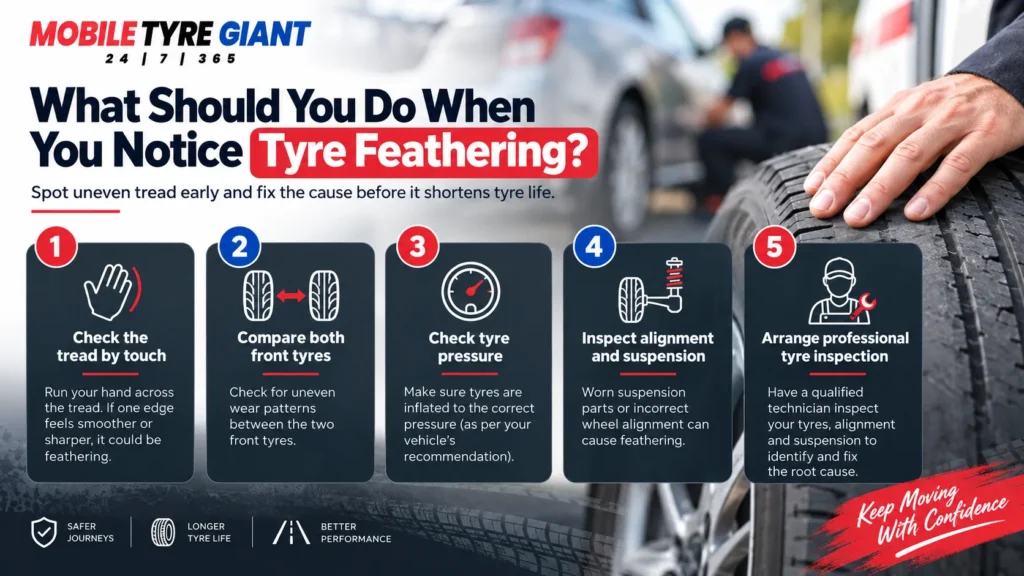
If you discover a sharp-to-smooth tread pattern, do not start by replacing the tyre immediately. First check the pressure and compare the feathered tyre with the tyre on the opposite side of the same axle. Look for uneven shoulder wear, cuts, bulges, exposed material or any other damage that could change the urgency of the situation. Pay attention to how the car drives too, including whether the steering wheel sits straight, the vehicle pulls to one side or road noise has recently increased. Those observations give useful clues about what may be causing the wear. The tread pattern tells you that something needs investigating, but it does not identify the exact mechanical fault by itself.
The next step is usually to have wheel alignment and the relevant steering and suspension components checked. If the alignment is corrected while worn components are still allowing the wheel to move, the problem may return quickly. Likewise, fitting a fresh tyre before correcting the cause can result in the new tread developing the same feathered edges. Treat the tyre and the vehicle as one system rather than two separate problems. Correct the reason for the abnormal wear, then decide whether the existing tyre has enough legal and usable tread to remain in service. This order gives the replacement tyre, if one is needed, the best chance of wearing normally.
What You Notice | What It May Suggest | Sensible Next Step |
Tread feels smooth one way and sharp the other | Possible feathering from incorrect toe | Check alignment and tyre condition |
Steering wheel sits off-centre | Alignment may be out | Arrange geometry inspection |
Car pulls to one side | Alignment, tyre or suspension issue may be involved | Have the vehicle checked |
Humming or droning increases with speed | Uneven tyre wear may be contributing | Inspect tread and rule out other causes |
Feathering returns after alignment | Worn parts or recurring impact may be involved | Inspect steering and suspension |
Feathered tread is close to 1.6mm | Replacement may be required | Measure properly and replace if necessary |
Can You Keep Driving on a Feathered Tyre?
A lightly feathered tyre with sufficient tread, correct pressure and no structural damage may not require the car to be stopped immediately, but the cause should still be investigated. Continuing to drive for months without checking alignment can allow the uneven wear to become much more pronounced. What began as a slightly sharp tread edge can eventually turn into substantial tread loss across part of the tyre. That can shorten tyre life and make road noise increasingly noticeable. The longer the cause remains active, the more usable rubber is being scrubbed away unnecessarily. Early inspection is therefore more about preventing deterioration than reacting to an emergency.
Stop treating feathering as a minor maintenance issue if the tyre also shows serious damage, very low tread or rapid pressure loss. The same applies if the vehicle feels unstable, pulls strongly or has developed significant vibration. Those symptoms may indicate that the problem extends beyond ordinary tread wear. If the feathered tyre has reached the point where replacement is necessary, mobile tyre fitting can provide replacement at your home, workplace or another suitable location without requiring unnecessary driving on a tyre you are concerned about. The decision should be based on tread depth, condition and the underlying cause rather than the feathered appearance alone.
What Should Be Checked Before Replacing a Feathered Tyre?
Before fitting a replacement, make sure the reason for the feathering has been addressed. Wheel alignment is the obvious starting point, particularly the toe setting, but steering and suspension components may also need inspection if there is play or wear. Check tyre pressure history as well because incorrect inflation can add another wear pattern on top of the feathering. If the vehicle recently hit a pothole or kerb, mention that during the inspection because the timing can help explain when the problem began. A replacement tyre should not become an expensive diagnostic tool that confirms the old problem still exists.
The tyre on the opposite side of the axle should also be inspected before deciding what to replace. Compare tread depth, specification, age and wear pattern rather than assuming that only the visibly feathered tyre matters. If both tyres show similar directional wear, the problem may have been affecting the axle for some time. If only one tyre is affected, localised component wear or another issue may deserve closer attention. Replacing the correct number of tyres is important, but preventing the abnormal wear from returning is even more important. A new tyre fitted to unresolved geometry can begin feathering surprisingly quickly.
How Can You Prevent Tyre Feathering?
The best way to prevent feathering is to keep the wheels correctly aligned and respond early when steering behaviour changes. You do not need to arrange alignment every few weeks simply as a precaution. Instead, pay attention after pothole or kerb impacts, suspension repairs or any event that changes how the car tracks. A steering wheel that suddenly sits at an angle or a vehicle that starts pulling deserves investigation before the tread has thousands of miles to scrub unevenly. Regular tyre inspections also help because early feathering can be subtle. Feeling the tread during a routine check may reveal the problem before it becomes visually obvious.
Pressure and general tyre maintenance still matter even though toe alignment is the strongest link with classic feathering. Keep the tyres at the manufacturer’s recommended cold pressure and inspect tread across several points instead of checking only the easiest outer edge. Look for patterns rather than isolated marks. If the same tyre repeatedly develops uneven wear, do not keep treating each replacement as an unrelated event. The vehicle is giving you repeat evidence that something needs attention. Prevention works best when tyre condition, alignment and steering or suspension health are considered together.
How Often Should Wheel Alignment Be Checked?
There is no single alignment interval that every UK car needs to follow. Alignment is better checked when symptoms, tyre wear or vehicle events give you a reason. Feathering, one-sided wear, an off-centre steering wheel or consistent pulling are all practical triggers. A hard pothole or kerb strike can also justify inspection if the car feels different afterwards. Alignment should normally be considered after certain steering or suspension components are replaced too, because the work can affect wheel geometry. A calendar alone cannot tell you whether the wheels remain correctly positioned.
Routine tyre inspections can effectively act as your early-warning system between alignment checks. Run your eyes across the tread monthly and look for changes in shape, depth and wear from one side to the other. If the tread begins developing a directional roughness, act while there is still useful rubber remaining. Waiting until the tyre is badly feathered means the geometry may have been incorrect for thousands of miles. A quick alignment check prompted by early wear can cost far less than repeatedly replacing tyres that never reach their expected life.
Final Words: Treat Tyre Feathering as a Warning, Not Just Worn Tread
Tyre feathering is distinctive because it often feels different before it looks seriously worn. Tread blocks that feel smooth in one direction and sharp in the other usually indicate that the tyre has been scrubbing sideways against the road. Incorrect toe alignment is one of the most common causes, but steering or suspension wear, impacts and incorrect pressure can complicate the pattern. That is why the right response is investigation rather than simply fitting another tyre. Find the mechanical reason, correct it and then decide whether the remaining tread is still suitable for continued use.
Checking tyres regularly makes this much easier because you learn what normal tread feels and looks like before a problem develops. If feathering appears, measure the tread at several points, check pressure and pay attention to steering, noise and vibration. Severe wear, structural damage or tread approaching the legal minimum can make replacement necessary, but mild feathering may still leave usable life once the cause has been corrected. The important thing is not to let a small tread pattern become an expensive recurring problem. Treat the tyre as an early warning from the vehicle and deal with the cause while there is still something worth protecting.
Noticed Feathered or Uneven Tyre Wear?
If your tyre feels rough, wears unevenly or points to an alignment issue, get it professionally checked before the damage gets worse.
Frequently Asked Questions
Find quick answers to the most common questions our customers ask.
A feathered tyre usually feels smoother when you run your hand across the tread in one direction and rougher, sharper or more stepped when you move it back the opposite way. This happens because one edge of each tread block has worn more than the other, creating a sawtooth-like surface that can sometimes be easier to detect by touch than by sight.
Incorrect toe alignment is one of the most common causes of tyre feathering because the wheels scrub slightly sideways across the road instead of rolling perfectly straight. Worn steering or suspension components can also allow the geometry to move, while pressure problems or impacts may contribute additional uneven wear.
Yes. Incorrect wheel alignment, particularly the toe angle, is strongly associated with feathered tread. Even a small alignment error can repeatedly drag the tread sideways as the tyre rotates, gradually wearing one edge of the tread blocks lower than the other and creating the characteristic sharp-to-smooth pattern.
Incorrect pressure can contribute to uneven tyre wear, but classic feathering is more closely linked with alignment, especially toe. Under-inflation often increases shoulder wear, while excessive pressure can contribute to greater centre wear. When pressure and alignment are both incorrect, several wear patterns can appear on the same tyre.
Mild feathering does not automatically mean a tyre is about to fail, but it is abnormal wear that should be investigated. Continued driving with the underlying cause unresolved can remove tread prematurely, increase tyre noise and eventually leave part of the tyre much more worn than the rest. Serious damage or tread below the legal limit requires more urgent action.
Wheel alignment can correct an alignment problem that is causing further feathering, but it cannot restore tread that has already worn away. The existing sharp and smooth edges may remain after the geometry is corrected, although the important goal is to stop the pattern becoming worse. Severe existing wear may still make tyre replacement necessary.
No. Feathering normally creates sharp and smooth edges across individual tread blocks, while cupping tends to create irregular dips or scalloped areas around the tyre. The causes can also differ, with feathering commonly associated with incorrect toe alignment and cupping more often linked with imbalance, suspension problems or irregular wheel movement.
A pothole does not usually create the feathered tread pattern instantly, but a hard impact can disturb wheel alignment or damage steering and suspension components. The tyre may then begin wearing unevenly over the following weeks or months. New feathering after a significant impact is a good reason to have the alignment and related components checked.
Not always. If the feathering is mild, the tread remains legal and sufficient, and the tyre has no structural damage, correcting the underlying cause may allow the tyre to continue in service. Replacement becomes more likely when wear is severe, tread depth is too low, damage is present or the tyre has become excessively noisy or uneven.
Maintain the correct tyre pressures, inspect tread regularly and arrange alignment checks when the car develops pulling, an off-centre steering wheel or uneven wear. Alignment may also deserve attention after hard pothole or kerb impacts and relevant suspension work. Correcting worn steering or suspension components early can help stop the feathering from returning.