

You pull up at an air pump, look at your vehicle’s pressure label and suddenly realise the numbers do not match. The sticker might show 230 kPa, the pump might be set to bar, while the pressure gauge in your glovebox displays PSI. Nothing is necessarily wrong. PSI, bar and kPa are simply different units used to describe the same thing: tyre pressure. The confusing part is knowing how one reading translates into another without accidentally adding too much or too little air. For example, 32 PSI is approximately 2.21 bar or 221 kPa, even though those numbers look completely different at first glance.
This PSI, bar and kPa tyre pressure conversion guide explains how the three units relate, how to read common pressure values and how to avoid treating a conversion chart as a recommendation for your vehicle. That last point matters because converting 35 PSI into bar does not mean your car actually requires 35 PSI. The correct pressure depends on the vehicle manufacturer’s specification, tyre setup and, in some cases, vehicle load. You should normally find that information on the driver’s door area, fuel filler flap or in the vehicle handbook. If you are unsure how to take the reading itself, our guide on how to check tyre pressure explains the checking process in more detail.
Why Are Tyre Pressures Shown in PSI, Bar and kPa?
Tyre pressure can appear in different units because vehicles, pressure gauges and inflation equipment are produced for different markets. UK drivers commonly encounter PSI and bar, while kPa may appear on certain vehicle placards, imported cars, digital equipment or technical information. You might therefore have a perfectly correct pressure label showing one unit and a pump displaying another. The three values are not competing recommendations. They are simply different numerical ways of expressing the same pressure. Once you understand that relationship, the apparently different numbers become much easier to work with.
Think of it like measuring a journey in miles or kilometres. The number changes, but the actual distance does not. Tyre pressure behaves in the same way. A tyre at 2.2 bar is not carrying less pressure simply because another gauge displays roughly 32 PSI. The unit has changed, not the air pressure inside the tyre. Problems begin when a driver sees two different-looking numbers and assumes one of them must be wrong. Knowing the basic conversion relationship removes that uncertainty and makes forecourt pressure checks much easier.
What Does PSI Mean on a Tyre Pressure Gauge?
PSI stands for pounds per square inch. It describes pressure as the amount of force applied over one square inch of area. PSI remains familiar to many UK drivers and is widely displayed on handheld tyre gauges, inflators and vehicle information. If your car recommends 32 PSI, for example, that value is approximately equal to 2.21 bar and 221 kPa. The number itself only has meaning when you keep the unit attached to it. Saying that a tyre should be set to “32” without saying PSI could create confusion if the inflation equipment is displaying another measurement.
PSI is particularly easy to recognise because normal passenger-car tyre readings are often shown as two-digit numbers, although there is no universal correct PSI for every vehicle. One car might require different pressures at the front and rear, while another may specify higher pressures when carrying several passengers and luggage. Do not copy a pressure simply because another vehicle uses it or because it appears in a general conversion chart. The chart helps translate your manufacturer’s figure into another unit. It does not replace the manufacturer’s figure.
What Does Bar Mean for Tyre Pressure?
Bar is another pressure unit commonly encountered on European vehicles, digital pumps and tyre-pressure equipment. One bar equals exactly 100 kPa and approximately 14.5 PSI. That means a reading of 2.0 bar is roughly 29 PSI, while 2.5 bar is approximately 36.3 PSI. Because bar uses smaller decimal numbers, the display can look very different from PSI even when the tyre contains exactly the same pressure. This is why a pump showing 2.3 should not be compared directly with a handbook figure of 33 without first checking which unit each number represents.
Bar readings are often shown with one or two decimal places, such as 2.2, 2.3 or 2.5 bar. A difference of only a few tenths of a bar can represent several PSI, so it is worth reading the display carefully rather than treating the decimal as insignificant. If your vehicle label gives the recommended pressure in PSI but the pump only displays bar, convert the manufacturer’s figure rather than estimating. Once the equivalent bar value is known, use that value on the pump and check the pressure while following the vehicle manufacturer’s normal instructions.
What Does kPa Mean for Tyre Pressure?
kPa stands for kilopascal, another unit used to measure pressure. The relationship between kPa and bar is particularly simple because 100 kPa equals exactly 1 bar. That means 200 kPa equals 2.0 bar, 220 kPa equals 2.2 bar and 250 kPa equals 2.5 bar. For drivers who are comfortable with bar, converting between these two units is therefore mostly a matter of moving the decimal point. PSI requires a different conversion factor, which is why 220 kPa is approximately 31.9 PSI rather than 22 or 220 PSI.
You may encounter kPa on a vehicle information label even if your usual tyre gauge is set to PSI. This can initially make the manufacturer’s recommendation look unusually high because kPa values are normally written as three-digit numbers. A figure such as 230 kPa does not mean the tyre requires an extreme pressure. It is simply about 2.3 bar or 33.4 PSI. Recognising the unit before adjusting the tyre is one of the simplest ways to prevent a major inflation mistake.
Are PSI, Bar and kPa Measuring the Same Tyre Pressure?
Yes. PSI, bar and kPa can all describe exactly the same tyre pressure. Only the scale changes. One bar equals exactly 100 kPa and approximately 14.504 PSI. One PSI equals approximately 6.895 kPa or 0.0689 bar. These relationships allow any recommended pressure to be converted from one unit into another without changing the actual target pressure. If the vehicle manufacturer specifies 35 PSI, for example, the equivalent is approximately 2.41 bar or 241 kPa.
This distinction is important because conversion and pressure selection are two different tasks. A converter tells you what 35 PSI looks like in bar or kPa. It cannot tell you whether 35 PSI is correct for your particular car. Always start with the manufacturer-approved figure and convert that value only when your gauge or inflator uses a different unit. This avoids one of the most common pressure-checking mistakes: finding a generic number online and treating it as suitable for every tyre and every vehicle.
H3: Quick PSI, Bar and kPa Tyre Pressure Conversion Chart
The table below gives common pressure values in all three units. The bar and kPa figures are rounded to practical values, so you may occasionally see a slightly different final decimal on another accurate converter or vehicle label. That small difference is normally the result of rounding, not a different conversion formula. Use the chart to translate a pressure that you already know is correct for your vehicle.
PSI | Bar | kPa |
26 PSI | 1.79 bar | 179 kPa |
28 PSI | 1.93 bar | 193 kPa |
30 PSI | 2.07 bar | 207 kPa |
32 PSI | 2.21 bar | 221 kPa |
34 PSI | 2.34 bar | 234 kPa |
35 PSI | 2.41 bar | 241 kPa |
36 PSI | 2.48 bar | 248 kPa |
38 PSI | 2.62 bar | 262 kPa |
40 PSI | 2.76 bar | 276 kPa |
42 PSI | 2.90 bar | 290 kPa |
44 PSI | 3.03 bar | 303 kPa |
For example, imagine your vehicle placard says 240 kPa but the petrol station inflator is set to PSI. A pressure of 240 kPa is 2.4 bar and approximately 34.8 PSI, so a display close to 35 PSI represents the same pressure. Alternatively, if your handbook says 32 PSI but your inflator uses bar, the equivalent is approximately 2.21 bar. The important habit is to read the unit first and the number second. That simple check prevents a three-digit kPa figure, a decimal bar figure and a two-digit PSI figure from looking like three different pressure recommendations.
How Do You Convert PSI to Bar?
Converting PSI to bar is straightforward once you know the basic relationship between the two units. 1 PSI equals approximately 0.06895 bar, so the calculation is to multiply the PSI figure by 0.06895. For example, if your vehicle recommends 32 PSI, multiplying 32 by 0.06895 gives approximately 2.21 bar. A recommendation of 35 PSI converts to roughly 2.41 bar, while 40 PSI is approximately 2.76 bar. You do not normally need to calculate several decimal places when setting normal road-vehicle tyre pressures because most pumps display bar to one or two decimal places. The important thing is to stay reasonably close to the manufacturer’s specified value rather than rounding carelessly by several PSI.
An easier way to think about the conversion is that about 14.5 PSI equals 1 bar. This mental shortcut can help you recognise whether a converted figure makes sense. For example, 29 PSI should be around 2 bar, while a value near 43.5 PSI should be close to 3 bar. If your calculator gives 32 PSI as 3.2 bar, you immediately know something has gone wrong. Simple sense-checking is useful because one misplaced decimal can turn a normal pressure into a seriously incorrect target.
PSI to Bar Formula and Examples
The practical formula is PSI × 0.06895 = bar. Using this formula, 30 PSI becomes approximately 2.07 bar, 32 PSI becomes 2.21 bar, 34 PSI becomes 2.34 bar and 36 PSI becomes about 2.48 bar. These figures are useful because passenger-car pressures often sit somewhere around this general numerical range, although the correct figure for your own vehicle must still come from its pressure label or handbook. The conversion formula only changes the unit. It does not decide what pressure the tyre needs.
When using a petrol-station inflator, you may find that the display allows only one decimal place. If your converted target is 2.21 bar, for example, the machine may allow 2.2 bar rather than 2.21. That difference is small and comes from the level of precision the equipment provides. The bigger mistake would be rounding 2.21 bar up to 2.5 because the numbers appear close. A difference of 0.3 bar represents more than 4 PSI, which can meaningfully change tyre pressure. Keep rounding sensible and as close to the vehicle manufacturer’s specification as the equipment allows.
How Do You Convert Bar to PSI?
To convert bar into PSI, multiply the bar value by approximately 14.504. A tyre pressure of 2.0 bar is therefore about 29.0 PSI, while 2.2 bar converts to approximately 31.9 PSI. A setting of 2.4 bar is roughly 34.8 PSI, and 2.5 bar is about 36.3 PSI. These conversions explain why a European-style vehicle label showing 2.3 bar may correspond to a gauge reading in the low 30s when switched to PSI. The pressure is the same even though the displayed number changes significantly.
This conversion is particularly useful if your vehicle information sticker lists bar while your portable compressor is permanently set to PSI. Instead of guessing, convert the exact manufacturer’s figure once and remember the equivalent. For example, if the placard says 2.3 bar for the front tyres and 2.5 bar for the rear under a particular load condition, those values equal about 33.4 PSI and 36.3 PSI. Keeping the correct front and rear values separate is important because some vehicles intentionally specify different pressures between axles.
Bar to PSI Formula and Examples
The formula is bar × 14.504 = PSI. If the recommended value is 2.1 bar, the equivalent is approximately 30.5 PSI. At 2.2 bar, the figure becomes about 31.9 PSI, while 2.6 bar converts to roughly 37.7 PSI. A reading of 3.0 bar is approximately 43.5 PSI. You can use a calculator for an exact conversion or refer to a pressure table when dealing with common values. Either approach is preferable to estimating based on how firm the tyre looks.
Tyres cannot be accurately judged by appearance alone because modern radial tyres may look slightly compressed even at the correct pressure. A tyre can also be several PSI below its recommended level without appearing obviously flat. That is one reason routine gauge checks matter. If pressure remains too low for an extended period, the tyre can generate more heat, increase rolling resistance and develop abnormal wear. Our guide on how under-inflated tyres affect your vehicle explains those effects in more detail.
How Do You Convert PSI to kPa?
PSI can be converted to kilopascals by multiplying the PSI value by approximately 6.895. This means 30 PSI is about 207 kPa, 32 PSI is approximately 221 kPa and 35 PSI is around 241 kPa. A tyre set to 40 PSI contains approximately 276 kPa of pressure. The larger kPa numbers can initially look strange to drivers accustomed to PSI, but the conversion is completely normal. The three-digit number does not mean the tyre is being inflated to an unusually high pressure.
The easiest check is to remember that roughly 14.5 PSI equals 100 kPa because 100 kPa also equals 1 bar. Therefore, a tyre around 29 PSI should show approximately 200 kPa. A tyre near 36 PSI should be around 250 kPa. These rough relationships are useful for spotting an obvious unit mistake before you start inflating. If you expect about 32 PSI but the pump displays 320 kPa, for example, the pressure would actually be more than 46 PSI rather than an equivalent reading.
PSI to kPa Formula and Examples
The exact practical formula is PSI × 6.89476 = kPa. A recommendation of 28 PSI converts to approximately 193 kPa, while 33 PSI converts to about 228 kPa. At 36 PSI, the equivalent is roughly 248 kPa, and 42 PSI becomes about 290 kPa. Most drivers do not need to remember the full five-decimal conversion factor. Using 6.895 provides sufficient accuracy for understanding and converting normal tyre-pressure readings.
You may also see vehicle labels where kPa appears first and PSI or bar is printed alongside it in smaller text. If all three units are shown, use the value that matches your pressure gauge and there is no need to convert manually. When only one unit is available, conversion becomes useful. Always double-check which loading condition the figures refer to because a manufacturer’s placard may show one pressure for normal use and another for a heavily loaded vehicle. Converting the wrong row accurately still gives you the wrong pressure for the situation.
How Do You Convert kPa to PSI and Bar?
Converting kPa into bar is particularly simple because 100 kPa equals exactly 1 bar. Divide the kPa figure by 100 to get bar. A pressure of 220 kPa becomes 2.2 bar, 240 kPa becomes 2.4 bar and 300 kPa becomes 3.0 bar. Converting kPa into PSI requires multiplying the kPa figure by approximately 0.14504. Therefore, 220 kPa is approximately 31.9 PSI, while 240 kPa is about 34.8 PSI.
Because kPa and bar have such a simple relationship, it is often easiest to convert kPa into bar mentally first. For example, if your sticker says 250 kPa, you can immediately recognise that as 2.5 bar. From there, you may remember that 2.5 bar is approximately 36.3 PSI. This two-step approach is useful when you do not have a calculator, although an accurate gauge or conversion chart is preferable when setting the final pressure. The aim is not to memorise every possible value, but to understand the scale well enough to avoid large errors.
Quick Conversion Formulas to Remember
For everyday use, there are four main relationships worth keeping in mind: PSI × 0.06895 = bar, bar × 14.504 = PSI, PSI × 6.895 = kPa, and kPa × 0.14504 = PSI. You can also remember that bar × 100 = kPa and kPa ÷ 100 = bar. These formulas all describe the same pressure in different units. If you use an online calculator, digital inflator or conversion chart, the same relationships are being applied automatically behind the scenes.
Conversion | Formula | Example |
PSI to bar | PSI × 0.06895 | 32 PSI ≈ 2.21 bar |
Bar to PSI | Bar × 14.504 | 2.2 bar ≈ 31.9 PSI |
PSI to kPa | PSI × 6.895 | 35 PSI ≈ 241 kPa |
kPa to PSI | kPa × 0.14504 | 240 kPa ≈ 34.8 PSI |
Bar to kPa | Bar × 100 | 2.5 bar = 250 kPa |
kPa to bar | kPa ÷ 100 | 230 kPa = 2.3 bar |
These calculations are most useful when the vehicle and inflation equipment use different units. They should not encourage drivers to chase excessive decimal precision while overlooking the basics. A correctly identified manufacturer’s pressure, checked with a reliable gauge and adjusted under the recommended conditions, matters more than whether your conversion ends in 2.21 or 2.20 bar. The conversion is simply the bridge between the number on the vehicle and the number on your gauge.
What Are the Most Common Tyre Pressure Conversion Mistakes?
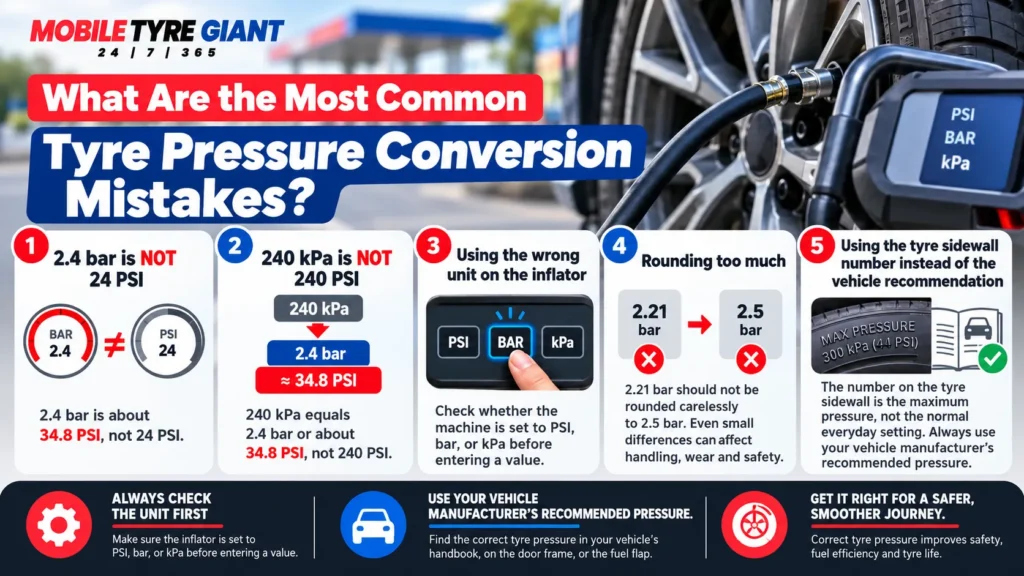
One of the most common mistakes is assuming that similar-looking numbers represent similar pressures. For example, 2.4 bar is not 24 PSI. It is approximately 34.8 PSI. Likewise, 240 kPa is not 24 PSI or 240 PSI. Another mistake is confusing bar with kPa and forgetting the factor of 100 between them. Drivers may also use a conversion correctly but start with a pressure copied from another vehicle, which defeats the purpose entirely. Conversion only works safely when the original pressure recommendation is already correct for the vehicle and load.
Rounding too aggressively can also create unnecessary errors. Turning 2.21 bar into 2.5 bar because both begin with a two changes the pressure by more than 4 PSI. Another mistake is changing pressure based on the maximum figure moulded into the tyre sidewall rather than the vehicle manufacturer’s normal recommended setting. The tyre sidewall contains important technical information, but it is not a substitute for the car manufacturer’s pressure placard. Always identify the correct recommended pressure first, then convert only if your gauge uses a different measurement.
Why Should You Check the Unit Before Inflating?
Checking the unit takes only a second but can prevent one of the largest possible pressure mistakes. Digital pumps often allow drivers to switch between PSI, bar and kPa using a button on the control panel. If the previous user left the machine in a different unit, entering your usual number without checking the display could produce a completely incorrect target. A driver expecting 35 PSI should never simply type “35” into a machine that is currently displaying another unit. Always look for the PSI, bar or kPa symbol before entering the value.
The same habit applies when using a portable compressor, TPMS display or handheld gauge. Know which unit the device is showing before comparing the reading with your handbook. Once the unit is confirmed, conversion becomes simple and predictable. A quick pause before inflating is far easier than correcting a large pressure error afterwards. In tyre-pressure checks, understanding the unit is just as important as understanding the number.
Where Can You Find the Correct Tyre Pressure for Your Car?
The correct tyre pressure should come from the vehicle manufacturer’s information rather than a generic online chart or the number printed on another driver’s tyre. On many cars, the pressure label can be found inside the driver’s door area, on the door pillar, inside the fuel filler flap or in the vehicle handbook. The label may show pressure in PSI, bar, kPa or more than one unit at the same time. It may also list separate figures for the front and rear tyres and different settings for normal and heavily loaded driving. Always identify which row applies to your vehicle and current load before converting anything.
This distinction matters because a conversion chart tells you only what one unit equals in another unit. It cannot tell you what pressure your specific vehicle requires. Two cars fitted with tyres of similar size can still have different recommended pressures because vehicle weight, suspension setup, axle loads and manufacturer calibration differ. Start with the manufacturer’s figure, then convert it into the unit used by your gauge or inflator. That order keeps the process simple and prevents a convenient conversion chart from being mistaken for a pressure recommendation.
Is the Pressure Printed on the Tyre Sidewall the Correct Setting?
Not usually. The information moulded into a tyre sidewall contains important technical details, but drivers should not automatically use a sidewall pressure figure as the everyday inflation target for the vehicle. The recommended operating pressure normally comes from the vehicle manufacturer because it is chosen for the specific vehicle setup. Inflating every tyre to a sidewall figure without checking the vehicle placard can leave the tyres at a pressure that is unsuitable for normal driving. Always treat the vehicle’s pressure label or handbook as the primary reference.
This is an important point because drivers sometimes see a pressure number on the tyre itself and assume it must be the correct setting. The tyre can be designed for use across many different vehicles, each with its own recommended pressure. The car manufacturer determines how that tyre should normally be inflated when fitted to that particular vehicle. If the sidewall and vehicle label appear confusing, use the vehicle information first and have the specification checked professionally if you are still unsure.
Should Front and Rear Tyres Have the Same Pressure?
Not always. Some vehicles specify the same pressure at all four wheels, while others recommend different front and rear pressures. The difference often reflects the way weight is distributed between the axles and how the vehicle has been designed to handle. For example, one vehicle might recommend 33 PSI at the front and 30 PSI at the rear under normal loading. Another may use equal pressures around the car. Neither approach is universally better because the correct setting depends on the vehicle manufacturer’s specification.
This is why each figure on the pressure label should be read carefully rather than assuming one number applies everywhere. If the front tyres require 230 kPa and the rear tyres require 210 kPa, converting them gives approximately 33.4 PSI and 30.5 PSI respectively. Setting all four tyres to 33 PSI because it is easier would ignore the manufacturer’s rear specification. Treat the front and rear values independently when the placard gives different numbers.

Why Can Rear Tyre Pressure Increase With a Full Load?
Vehicle manufacturers may specify higher rear pressures when the car is carrying several passengers, luggage or a heavier load. Extra weight changes the load supported by the tyres, particularly at the rear of many vehicles. Increasing pressure to the manufacturer’s loaded setting helps the tyre carry that additional load in the way the vehicle was designed for. A placard might therefore show one row for everyday driving and another for a fully loaded vehicle. The loaded figures can look noticeably higher, but they should not be applied unless they match the actual driving condition described.
The opposite mistake is also common. A driver may set the tyres to the fully loaded pressure once and then continue using that figure during light everyday driving without checking whether the manufacturer recommends a lower normal setting. Always read the symbols or wording beside each row on the pressure label. If the vehicle returns to normal loading, return to the normal recommended pressure when appropriate. Conversion does not change this logic. It simply lets you express the correct loaded or unloaded figure in PSI, bar or kPa.
Should Tyre Pressure Be Checked When Tyres Are Cold?
Tyre pressures are normally intended to be checked when the tyres are cold unless the vehicle manufacturer specifically gives different instructions. As a tyre rolls along the road, the rubber flexes and heat builds inside the tyre. Warmer air expands, which causes the pressure reading to rise. That means a tyre showing a higher pressure after a motorway journey has not necessarily been over-inflated when cold. It may simply be showing the normal effect of temperature during driving.
For the most consistent reading, check pressure before a long journey or after the vehicle has been parked long enough for the tyres to cool. If you measure immediately after driving and release air simply because the reading has increased, the tyre may become under-inflated once it cools again. This is another reason pressure figures should be interpreted in context rather than treated as fixed numbers under every condition. Cold readings provide the most useful comparison with the manufacturer’s normal recommended figures.
Why Does Tyre Pressure Change With Temperature?
Air pressure inside a tyre changes as temperature changes. When the air becomes warmer, pressure rises, and when the air becomes colder, pressure falls. UK drivers may therefore notice lower readings during colder winter weather even when there is no obvious puncture. A tyre that was correctly inflated during mild conditions can later show a slightly lower reading after a significant temperature drop. Regular checks help identify whether the change is simply seasonal or whether one tyre is losing pressure faster than the others.
Temperature changes also explain why comparing a cold morning reading with a reading taken after an hour of driving can be misleading. Use similar checking conditions whenever possible, particularly if you are monitoring a tyre that appears to be losing pressure. If one tyre repeatedly drops faster than the others under similar conditions, investigate the cause rather than continually topping it up. Persistent pressure loss may indicate a puncture, valve issue, bead problem or another fault that needs attention.
How Does TPMS Relate to PSI, Bar and kPa?
A tyre pressure monitoring system, or TPMS, is designed to warn the driver when tyre pressure may be significantly low, but it should not replace regular manual checks. Some vehicles display individual tyre pressures on the dashboard, while others provide only a warning light when a pressure difference is detected. Depending on the vehicle settings, the display may show PSI, bar or kPa. If the dashboard unit differs from the pressure figure in your handbook, simply convert the manufacturer’s recommended value before comparing the readings.
Drivers should also remember that not every TPMS works in exactly the same way. Direct systems use pressure sensors at the wheels, while indirect systems infer changes using wheel-speed information rather than measuring pressure directly at each tyre. The dashboard therefore may not always behave like a handheld pressure gauge. Use TPMS as an important warning system, but still confirm actual pressures with a suitable gauge when carrying out routine checks. If a direct system develops a sensor or valve fault, TPMS valve replacement may be needed depending on the exact problem.

Why Is the TPMS Light Still On After Inflating the Tyres?
A TPMS warning may remain illuminated for several reasons even after the tyres have been adjusted. Some vehicles require a reset or relearn procedure, while others need to be driven for a short period before the system recognises the corrected pressure. A tyre may also still be below the required figure, especially if the wrong unit was used during inflation. For example, setting a tyre to 2.2 when the machine is showing PSI instead of bar would clearly not provide the intended pressure. Always confirm both the number and unit before assuming the warning system is faulty.
If the pressures are correct but the warning continues, check the vehicle handbook for the appropriate TPMS reset procedure. Persistent warnings can also indicate a sensor, valve or system problem rather than low pressure alone. Do not simply ignore the light because the tyres appear visually normal. Tyres can look reasonably inflated while still being below their recommended pressure. A manual reading provides a useful second check before deciding whether the issue is pressure-related or requires further diagnosis.
Is There One Correct PSI for Every Car?
No. There is no single PSI, bar or kPa figure that is correct for every car. You may often see values such as 30, 32, 35 or 36 PSI used in examples, but those are examples rather than universal recommendations. The correct pressure varies between vehicle models, tyre setups, axle positions and loading conditions. Even two versions of the same model can sometimes have different recommendations depending on wheel or tyre specification. This is why searching for “normal tyre pressure” without identifying the vehicle can produce misleading answers.
A better question is: what pressure does the manufacturer specify for this vehicle under these conditions? Once you have that number, unit conversion becomes simple. If the label says 230 kPa, you know that equals 2.3 bar or approximately 33.4 PSI. If another car requires 260 kPa, that becomes 2.6 bar or approximately 37.7 PSI. Both vehicles can be correctly inflated even though their pressure figures are different.
Does Tyre Size Change the Recommended Pressure?
Tyre size can be one factor in the manufacturer’s pressure specification, but drivers should not try to calculate a new pressure simply from the tyre size printed on the sidewall. Vehicle weight, wheel size, tyre construction, axle load and manufacturer testing all influence the final recommended setting. If the vehicle is using an approved alternative wheel and tyre size, check whether the manufacturer provides a corresponding pressure specification. Do not assume that a larger wheel automatically needs more pressure or that a smaller tyre always needs less.
If the tyre size has been changed from the vehicle’s standard specification, pressure advice should come from reliable vehicle-specific information rather than a generic formula. The same principle applies to replacement tyres. Matching the correct size and load specification matters, but the everyday inflation target still comes from the vehicle requirements. A conversion guide helps you translate that target between PSI, bar and kPa once the correct figure has been established.
How Often Should You Check Tyre Pressure?
A practical routine is to check tyre pressures at least once a month and before longer journeys, particularly when the car will be carrying additional passengers or luggage. Pressure can gradually fall over time even when there is no obvious puncture, and seasonal temperature changes can also affect the reading. Check all four tyres rather than only the one that looks slightly low because visual appearance is not a reliable pressure gauge. If your vehicle has a spare tyre that requires inflation, include that in routine checks as well. Always compare the reading with the vehicle manufacturer’s recommended figure rather than a generic PSI, bar or kPa value found elsewhere.
Try to check the tyres when they are cold so the reading can be compared properly with the manufacturer’s specification. If you regularly use a digital inflator, confirm which unit it is displaying before entering the target pressure. Drivers who switch between a petrol-station pump and a portable compressor can easily encounter different default units. Keeping the manufacturer’s pressure figures saved on your phone in both PSI and bar can make future checks quicker. Regular pressure checks are also a useful opportunity to inspect tread and sidewalls for damage, which is why broader tyre safety checks should form part of the same routine.
What Happens if Tyre Pressure Is Too Low?
When tyre pressure is too low, the tyre flexes more than intended as it rolls. That additional movement can generate extra heat, increase rolling resistance and place more stress on parts of the tread and sidewall. The vehicle may also feel less responsive, particularly during steering or braking. Under-inflation can contribute to excessive wear towards the shoulders of the tread and may reduce fuel efficiency because the tyre requires more energy to roll. The exact effect depends on how low the pressure is and how long the vehicle continues to be driven.
A tyre that repeatedly loses pressure should not simply be topped up every few days without investigating the cause. A puncture, leaking valve, damaged wheel rim or poor bead seal may allow air to escape gradually. Temperature changes can cause small fluctuations across all tyres, but one tyre dropping much faster than the others deserves attention. Check the reading under similar cold conditions before assuming there is a leak. If the pressure continues falling, have the tyre inspected rather than relying on repeated inflation.
What Happens if Tyre Pressure Is Too High?
Over-inflation can also change the way a tyre meets the road. Excessive pressure can make the tyre less compliant over rough surfaces and may concentrate more of the load towards the central area of the tread. The car can feel firmer over bumps, and an excessively inflated tyre may be more vulnerable to impact damage when it encounters potholes or sharp road irregularities. This does not mean that every slightly higher warm reading represents over-inflation because pressure naturally rises as the tyre heats during driving.
The correct comparison should normally be made with the tyre cold and using the manufacturer’s recommended setting for the current load. Do not deliberately add extra pressure because you believe a harder tyre will always improve fuel economy or tyre life. Likewise, do not use a high number seen on the tyre sidewall as your everyday setting. Correct inflation is about matching the vehicle specification, not simply putting as much air into the tyre as possible. If pressure is adjusted correctly, the tread has a better chance of contacting the road as intended.
What Should You Do if Your Gauge Uses a Different Pressure Unit?
If your vehicle label and pressure gauge use different units, do not guess. First identify the exact recommended pressure on the vehicle placard, including whether it applies to the front, rear, normal load or full load condition. Then convert that figure using the formulas covered earlier in this guide. For example, 230 kPa equals 2.3 bar and approximately 33.4 PSI. Once converted, use the equivalent figure on your gauge or inflator. The actual target pressure has not changed, only the way it is displayed.
It can be useful to write the converted values down if you regularly use the same equipment. For example, if your normal front setting is 2.3 bar and rear setting is 2.1 bar, you could note their PSI equivalents beside them for quick reference. This reduces the chance of recalculating incorrectly each time. However, check the vehicle label again whenever the loading condition changes or when you are unsure which value applies. A remembered conversion is useful only if the original figure is still the correct recommendation for the journey.
Should You Round Tyre Pressure Conversions?
Small rounding differences are normal when converting PSI, bar and kPa. A figure of 32 PSI converts to approximately 2.206 bar, which will usually be written as 2.21 bar or sometimes 2.2 bar depending on the equipment. Similarly, 35 PSI is about 241.3 kPa, which may appear as 241 kPa or 240 kPa on a simplified chart. These small differences are caused by rounding and do not mean one conversion method is fundamentally wrong. The important thing is to avoid large approximations that shift the pressure several PSI away from the intended target.
Use the precision available on your pump or gauge without becoming distracted by unnecessary decimal places. If a machine works in increments of 0.1 bar, set the closest practical value to the manufacturer’s converted recommendation. Do not turn 2.21 bar into 2.5 bar simply because 2.5 is easier to remember. A few hundredths of a bar and several tenths of a bar are very different things. Sensible rounding keeps the pressure close to the original specification.
What Should You Do if Tyre Pressure Keeps Dropping?
A pressure reading that repeatedly falls below the recommended level can indicate more than a simple conversion issue. Start by confirming that you are checking the tyre under similar conditions each time and that the gauge itself is reliable. If one tyre loses noticeably more pressure than the others, inspect it for nails, screws, cuts or valve problems. Slow leaks can be difficult to see, particularly when a small object remains embedded in the tread and temporarily restricts the escape of air. A damaged wheel or bead area can also create gradual pressure loss.
Do not assume that resetting the TPMS warning or repeatedly adding air has solved the problem. Inflation restores the pressure temporarily, but it does not repair the leak. If the tyre continues losing air, arrange an inspection before the tread, sidewall or internal structure suffers from repeated under-inflation. If the tyre is damaged beyond safe repair or no longer has sufficient usable tread, the guide on when to replace tyres explains the wider replacement signs to consider. The correct pressure should remain reasonably stable when the tyre, valve and wheel are in good condition.
A Simple Tyre Pressure Routine to Remember
The easiest routine is find, check, convert and adjust. Find the manufacturer’s recommended pressure first. Check the tyre when cold with a reliable gauge. Convert the figure only if your gauge uses a different measurement unit. Then adjust the pressure and recheck it before replacing the valve cap. This sequence keeps the process focused on the correct vehicle specification rather than on memorising generic pressure numbers.
Repeat the process for each tyre because front and rear pressures may differ. If the vehicle is heavily loaded, check whether the manufacturer gives a separate loaded setting. Pay attention to any tyre that requires frequent topping up because repeated pressure loss deserves investigation. Once you understand how PSI, bar and kPa relate to one another, the numbers become much less confusing. The most important habit is simply to start with the correct manufacturer figure every time.
Final Words: Convert the Unit, Not the Recommended Pressure
PSI, bar and kPa are three different ways of expressing the same tyre pressure. Approximately 14.5 PSI equals 1 bar, while 1 bar equals exactly 100 kPa. Understanding those relationships makes it much easier to use a pump or pressure gauge that displays a different unit from the vehicle placard. The conversion itself is simple, but the starting figure must always be the correct manufacturer recommendation for the vehicle, axle and loading condition. A conversion chart should translate that recommendation, not replace it.
For everyday tyre care, check pressures regularly when the tyres are cold, confirm the unit before inflating and investigate any tyre that repeatedly loses air. Avoid copying a pressure from another vehicle or relying on a generic “normal PSI” figure because there is no single pressure suitable for every car. Once you have the right manufacturer value, converting between PSI, bar and kPa is simply a matter of changing the scale. That small amount of attention can help support more even tyre wear, predictable handling and better overall tyre condition.
Confused About PSI, Bar or kPa?
Use the correct tyre pressure for your vehicle and avoid conversion mistakes that can lead to under-inflation, over-inflation or uneven tyre wear.
Frequently Asked Questions
Find quick answers to the most common questions our customers ask.
32 PSI is approximately 2.21 bar. Some tyre inflators display only one decimal place, in which case you may see a setting close to 2.2 bar. Always make sure 32 PSI is actually the recommended pressure for your vehicle before using the converted value.
35 PSI converts to approximately 2.41 bar. On equipment that displays pressure to one decimal place, this may be shown close to 2.4 bar. The conversion tells you the equivalent pressure only and does not mean every car should be inflated to 35 PSI.
2.2 bar is approximately 31.9 PSI, which is commonly rounded to about 32 PSI for easy reference. If your vehicle manufacturer specifies 2.2 bar, use that value or its accurate PSI equivalent depending on which unit your gauge displays.
2.5 bar equals approximately 36.3 PSI. It also equals exactly 250 kPa. If a pressure label shows 2.5 bar and your inflator works in PSI, a figure close to 36 PSI represents the same pressure.
230 kPa converts to approximately 33.4 PSI and exactly 2.3 bar. This is a good example of how a three-digit kPa figure can represent an ordinary passenger-car tyre pressure rather than an unusually high setting.
240 kPa equals exactly 2.4 bar and approximately 34.8 PSI. If your vehicle placard gives 240 kPa but your pump displays PSI, a setting close to 35 PSI represents the same pressure.
Neither unit is inherently better because PSI and bar measure the same pressure using different scales. The easiest option is usually to use whichever unit matches your vehicle placard or pressure gauge so you do not need to convert the figure manually.
There is no universal correct PSI for every car. The required pressure depends on the vehicle, tyre setup, axle and loading condition. Check the manufacturer's pressure label, usually found around the driver's door area, fuel filler flap or vehicle handbook, and use the figures listed there.
Tyre pressure should normally be checked when the tyres are cold unless the vehicle manufacturer provides different instructions. Pressure rises as tyres warm during driving, so releasing air from a warm tyre simply because the reading is higher can leave it under-inflated once it cools.
kPa and bar measure the same pressure but use different numerical scales. 100 kPa equals exactly 1 bar, so converting between them is simple. For example, 220 kPa is 2.2 bar, 250 kPa is 2.5 bar and 300 kPa is 3.0 bar.