
Many drivers expect the front tyres to wear out first. After all, the front wheels usually handle steering, carry a large share of the braking load and, on most UK cars, also transmit engine power to the road. So when you check the tread and discover that the rear tyres are noticeably more worn than the fronts, it can look like something is wrong. Sometimes there is a perfectly reasonable explanation, particularly on a rear-wheel-drive vehicle. In other cases, the difference can point towards tyre pressure, wheel alignment, suspension or driving conditions that need attention.
The important question is not simply whether the rear tyres have less tread. You need to look at how they are wearing. Two rear tyres that are evenly worn across the tread tell a different story from tyres that are worn heavily on their inner edges. One rear tyre wearing faster than the other suggests a different problem again. Measuring tread depth properly and identifying the wear pattern gives you much more useful information than comparing the tyres from a distance.
Is It Normal for Rear Tyres to Wear Faster Than Front Tyres?
It can be normal on certain vehicles. Tyre wear is influenced by where engine or motor torque is delivered, how the vehicle’s weight is distributed and what each axle is required to do. On a rear-wheel-drive car, the rear tyres transmit acceleration forces to the road every time the vehicle pulls away or accelerates. A powerful engine, frequent hard acceleration or high torque can increase that workload further, allowing the rear tyres to wear faster even when there is no mechanical fault.
That does not mean every rear-wheel-drive vehicle should rapidly destroy its rear tyres. Wear rate still depends on tyre compound, pressure, alignment, suspension condition, mileage and driving style. If the difference has suddenly become much larger than it used to be, or the rear tread is wearing in an unusual pattern, it deserves investigation. Regularly measuring all four tyres with the methods in our tyre tread checking guide makes it much easier to recognise whether the difference is gradual or abnormal.
Why Do Rear-Wheel-Drive Cars Wear Rear Tyres Faster?
On a rear-wheel-drive vehicle, engine power travels through the drivetrain to the rear wheels. Every time you accelerate, the rear tyres must transmit that torque through a relatively small contact patch. The harder the vehicle accelerates, the greater the forces placed through those tyres. Over thousands of miles, that additional propulsion workload can make the rear tread disappear faster than the front.
The effect can be more noticeable on performance cars because they often combine high torque with wider or softer-compound rear tyres. Those tyres may deliver excellent grip but can sacrifice some tread life in return. Driving style also matters considerably. Smooth acceleration distributes the load progressively, while repeated hard launches and strong acceleration create greater tread stress and can shorten the useful life of the rear pair.
What if a Front-Wheel-Drive Car Is Wearing the Rear Tyres Faster?
This is less typical and deserves a closer look. On most front-wheel-drive cars, the front tyres perform the steering, transmit engine torque and take a large proportion of the braking load. As a result, you would generally expect them to wear at least as quickly as the rears under normal conditions. If the rear pair is disappearing much sooner, the pattern of wear becomes particularly important.
Rear alignment settings, incorrect pressure, suspension wear or an unusual difference in tyre age or specification can all change the expected wear rate. It is also possible that the rear tyres were already older or had less tread when the current front tyres were installed. Before assuming there is a mechanical fault, compare manufacturing history, mileage and actual tread depths on all four corners.
Could the Rear Tyres Simply Be Older Than the Front Tyres?
Yes. This is one of the easiest explanations to overlook. If the front tyres were replaced more recently, they may have significantly deeper tread even though the car itself is not wearing its rear tyres unusually quickly. A driver comparing only current tread depth might conclude that the rear axle is creating excessive wear when the tyres simply started with different amounts of usable rubber.
Look at service or fitting records where available and check whether the front and rear tyres are the same make, model and approximate age. Different tyre compounds can also wear at different rates. A high-mileage rear tyre should not be compared directly with a recently fitted front tyre without considering how many miles each has already covered.
Does Tyre Pressure Make Rear Tyres Wear Faster?
Yes. Incorrect pressure can significantly affect both the speed and shape of tyre wear. An under-inflated rear tyre flexes more through the shoulders and generates additional heat as it rolls. This can accelerate shoulder wear and increase rolling resistance. If both rear tyres have been consistently under-inflated, they may wear faster than correctly inflated front tyres even on a vehicle where the fronts would normally carry more workload.
Over-inflation creates a different pattern because the centre of the tread can carry more of the load. If both rear tyres are worn more heavily through the middle, pressure history should be checked rather than immediately blaming alignment. The correct front and rear pressures may also be different, so copying the front pressure onto the rear tyres is not always correct. Our tyre pressure guide explains how to find the vehicle manufacturer’s recommended cold pressures and check each axle correctly.
Why Might Front and Rear Tyre Pressures Be Different?
Vehicle manufacturers specify pressures according to axle loads, tyre size, suspension setup and expected operating conditions. The rear tyres may require a different pressure from the fronts, especially when the vehicle carries passengers, luggage or heavy loads. Some cars also list separate settings for normal and fully loaded driving.
Using the same pressure in all four tyres simply because the tyre size looks similar can therefore produce incorrect inflation on one axle. Always use the pressure label or vehicle handbook rather than the maximum figure printed on the tyre sidewall. If rear wear is developing faster than expected, checking whether the rear pressure has been maintained correctly is one of the simplest diagnostic steps.
Can Rear Wheel Alignment Cause Faster Tyre Wear?
Yes. Rear wheel alignment can have a major effect on tyre life even though the rear wheels do not normally steer in the same way as the fronts. Alignment describes several wheel angles, including toe and camber, that determine how the tyre sits and travels relative to the road. If those angles move outside specification, the tread can be dragged or loaded unevenly throughout every journey.
Rear alignment problems can be particularly easy to miss because the vehicle may not always pull strongly to one side. The driver may only discover the issue when the rear tyres are inspected and significant tread has already disappeared. If both rear tyres are wearing quickly but in a specific area rather than uniformly, alignment becomes much more relevant.
Why Do Rear Tyres Wear on the Inside Edge?
Inner-edge wear is commonly associated with the relationship between rear camber and toe. Many vehicles use some negative camber, meaning the top of the wheel leans slightly inward. A small amount may be part of the normal suspension design, but excessive negative camber places more load towards the inner shoulder. If toe is also incorrect, the tyre can scrub across the road as it rotates and accelerate inner-edge wear further.
This pattern can be difficult to spot because the outer side of the tyre may still look healthy when viewed beside the car. A driver can therefore believe there is plenty of tread left while the hidden inner shoulder is already significantly worn. Always check across the complete tread width rather than judging rear tyres from their visible outer edges.
Can Wheel Imbalance Make Rear Tyres Wear Faster?
Wheel imbalance can contribute to irregular or accelerated wear because the wheel-and-tyre assembly does not rotate as smoothly as intended. At road speed, the uneven distribution of mass can create vibration and repeated changes in how the tyre contacts the road. Over time, this may contribute to patchy, scalloped or cupped wear rather than a smooth reduction in tread depth.
The symptoms can be less obvious when the imbalance is on the rear axle because steering-wheel vibration is often associated more strongly with front-wheel problems. Rear imbalance may instead be felt through the seat, floor or body of the vehicle. If faster rear wear is accompanied by speed-related vibration, mobile wheel balancing can help determine whether imbalance is contributing to the problem.
Does Rear Tyre Cupping Mean the Wheel Is Out of Balance?
Not necessarily. Imbalance is one possible cause of cupped or scalloped wear, but weak dampers, suspension movement, wheel or tyre runout and other mechanical faults can produce similar tread patterns. The appearance of cups around a rear tyre should therefore start a diagnosis rather than end it.
Check whether the pattern affects one tyre or both rear tyres and whether there are other symptoms such as humming, bouncing or vibration. A tyre that is evenly worn across the rear axle points towards a different cause from one showing repeated high and low sections. Identifying the exact wear pattern prevents unnecessary parts from being replaced based on one symptom.
Can Heavy Loads Make Rear Tyres Wear Out Faster?
Yes. The rear axle often carries a much larger share of added vehicle load when passengers, luggage, tools or equipment are placed towards the back of the vehicle. Extra weight increases the forces the rear tyres must support and can accelerate wear, particularly if the pressures have not been adjusted to the manufacturer’s fully loaded specification.
This is especially relevant to vehicles that regularly carry equipment or heavy luggage rather than only doing so occasionally. A driver may become accustomed to the load and overlook the effect it has on tyre pressure requirements and rear tread life. If both rear tyres show relatively even but faster wear, vehicle loading history should form part of the diagnosis.
Does Towing Increase Rear Tyre Wear?
It can. Towing increases the load placed through the vehicle, and the trailer’s nose weight adds load around the rear axle. That does not automatically make rear tyre wear abnormal, but frequent towing increases the importance of correct tyre pressure, vehicle loading and tyre condition.
The vehicle and trailer manufacturer’s limits should always be followed rather than compensating for a heavy load simply by adding arbitrary extra pressure. If a car frequently tows and the rear tyres are wearing much faster than before, compare the tread pattern and pressure history before assuming the wear is solely caused by the drivetrain.
How Do Rear Toe and Camber Affect Tyre Wear?
Rear toe and camber can change tyre wear even when the car appears to drive normally. Toe describes whether the wheels point slightly inward or outward when viewed from above, while camber describes how much the wheel leans inward or outward when viewed from the front or rear. Manufacturers deliberately use small amounts of both to achieve the handling and stability characteristics they want. Problems begin when those angles move outside the intended specification because the tyre can start scrubbing or carrying too much load on one part of the tread.
Incorrect rear toe can wear rubber surprisingly quickly because the tyre is effectively being dragged slightly sideways on every journey. Excessive negative camber can place more load on the inner shoulder, while the visible outer tread may remain relatively healthy. When both toe and camber are incorrect, inner-edge wear can accelerate substantially. Measuring alignment is therefore more useful than simply looking at how straight the wheels appear while the vehicle is parked.
Can Rear Alignment Be Wrong Without the Car Pulling to One Side?
Yes. A vehicle can have significant rear alignment issues without producing the obvious steering pull many drivers associate with alignment problems. Both rear wheels may be out of specification in a relatively symmetrical way, or the vehicle’s steering and suspension may compensate enough that the driver does not notice a strong directional problem. The tyres can still be scrubbing against the road throughout every journey.
This is why rear tyre wear is often the first clue. If both rear tyres are wearing their inner edges much faster than the fronts, rear geometry should be checked even if the steering wheel sits straight. The wear pattern provides evidence of what the tyres have been experiencing over thousands of miles, sometimes long before the driver notices a handling symptom.
Can Worn Rear Suspension Cause Tyres to Wear Faster?
Yes. Suspension components are responsible for controlling the position and movement of each wheel. Worn bushes, ball joints, links or dampers can allow the rear wheels to move in ways they should not under acceleration, braking and cornering. This can alter wheel alignment dynamically, meaning the geometry may change while the vehicle is moving even if a static inspection appears close to normal.
Weak dampers can also allow the wheel to bounce excessively after bumps, creating repeated changes in tyre loading. Bush wear may allow toe or camber to shift under load. Both situations can produce uneven or accelerated rear tyre wear. Our guide on how suspension problems damage tyres explains how dampers, bushes and other components can create several different tread patterns.
Can Worn Rear Bushes Cause Inner-Edge Tyre Wear?
They can. Suspension bushes locate components while still allowing controlled movement. As the rubber deteriorates or separates, the suspension arm can move farther than intended. That movement may allow rear toe or camber to change while the car accelerates, brakes or travels over uneven roads.
The result can be heavy inner-edge wear even after a basic alignment adjustment. If the suspension component cannot hold the wheel securely in the correct position, alignment settings may not remain stable. This is why worn bushes should be repaired before repeatedly paying to realign a vehicle that keeps wearing its rear tyres.
Why Is One Rear Tyre Wearing Faster Than the Other?
When only one rear tyre is wearing unusually quickly, a problem local to that corner becomes more likely. Possible causes include alignment differences, suspension wear, a weak damper, wheel damage, incorrect pressure or a dragging brake. The tyre itself may also have started with less tread or may be a different make, model or age from the tyre on the opposite side.
Look closely at the shape of the wear. Uniform wear across one tyre can suggest something different from severe inner-edge wear or scalloping. Compare pressures and tread depths on both sides and inspect the affected corner for signs of previous impact damage. A history of hitting a pothole or kerb can be particularly useful because it may explain why one side changed while the other remained normal.
Does One Rear Tyre Wearing on the Inside Mean Alignment Is Wrong?
Alignment is one of the strongest possibilities, but it should not be assumed without inspection. Excessive negative camber or incorrect toe can heavily wear one rear inner shoulder, but worn suspension parts may be responsible for allowing those alignment angles to change. A bent suspension arm or wheel after an impact can create a similar pattern.
The correct diagnosis therefore involves checking the complete corner rather than simply adjusting alignment and sending the vehicle away. If the tyre is already heavily worn, the cause should ideally be repaired before a replacement tyre is fitted. Otherwise the new tyre can begin developing the same inner-edge wear.
Do Staggered Tyres Make Rear Tyres Wear Faster?
They can. A staggered setup normally means the rear tyres or wheels are wider than the fronts. This is common on many performance and rear-wheel-drive cars because wider rear tyres can help manage engine torque and provide the handling characteristics intended by the manufacturer. The downside is that front-to-rear tyre rotation is often impossible because the sizes are different.
Without rotation, the rear tyres remain exposed to the same driven-axle forces throughout their entire service life. If they also use a softer performance compound, faster rear wear can become normal even when alignment and pressure are correct. The difference can look dramatic compared with the fronts because the front tyres may have a completely different size, workload and compound.
Can Staggered Rear Tyres Be Rotated to the Front?
Usually not if the front and rear sizes are different. A wider rear tyre may not fit safely on the front axle because wheel width, offset, clearance and vehicle handling requirements are different. The tyre sidewall markings and vehicle specifications should be checked before any attempt is made to swap positions.
Where front-to-rear rotation is impossible, careful pressure maintenance and alignment become even more important because you cannot use rotation to distribute axle wear. If the rear tyres are wearing rapidly but evenly, compare their actual mileage with the expected life of that tyre type before assuming there is a mechanical fault.
Can AWD or Four-Wheel Drive Wear Rear Tyres Faster?
Yes, depending on how the drivetrain distributes torque. AWD does not necessarily send exactly the same amount of power to all four wheels at all times. Some systems are rear-biased, while others normally operate primarily through one axle and transfer torque elsewhere only when needed. A rear-biased system can therefore place greater propulsion loads through the rear tyres.
Tyre matching is particularly important on many AWD vehicles because significant differences in tread depth or rolling circumference can affect drivetrain operation. If the rear tyres are wearing much faster, check whether the pattern is normal for that vehicle and whether tread differences are approaching the manufacturer’s allowable limits. Replacing tyres on AWD cars can require more consideration than simply changing whichever one first reaches the minimum tread.
Can Different Tread Depths Damage an AWD System?
On some AWD systems, large differences in rolling circumference can place additional stress on drivetrain components because tyres with different effective diameters rotate at slightly different speeds. The acceptable difference varies between manufacturers, so there is no universal tread-depth figure that applies to every AWD vehicle.
This is why rear tyre wear should be monitored before the difference becomes extreme. If the rear pair is already substantially more worn than the fronts, check the vehicle manufacturer’s tyre-matching requirements when replacement becomes necessary. The goal is not only tyre safety but also maintaining the conditions the AWD system was designed to operate with.
Do Electric and High-Torque Cars Wear Rear Tyres Faster?
They can, particularly where the vehicle sends a large proportion of motor torque to the rear axle. Electric motors can deliver strong torque immediately, which places significant acceleration forces through the tyres. EVs can also be heavier than comparable combustion-engine vehicles because of their battery packs, adding further load to the tyres.
A rear-wheel-drive EV driven smoothly may still provide reasonable tyre life, but repeated strong acceleration can consume rear tread considerably faster. Tyres designed for electric vehicles may use construction and compounds intended to cope with the vehicle’s weight and torque, but they are still subject to wear. Rapid rear tyre wear on an EV should therefore be judged against driving style, tyre specification and alignment rather than blamed on one factor alone.
Does Regenerative Braking Affect Rear Tyre Wear?
It can influence tyre loading depending on how the vehicle distributes regenerative braking. Some systems recover energy through particular driven wheels, while others combine regenerative and conventional braking in more complex ways. The effect varies widely between vehicles and should not be assumed to be the primary reason rear tyres are wearing quickly.
Acceleration torque is often a more obvious contributor on powerful rear-driven vehicles. If the rear wear is evenly distributed across the tread, drivetrain load and driving style become more plausible explanations. If the tyres instead show concentrated inner-edge or patchy wear, pressure, alignment or suspension deserves more attention.
Can Driving Style Make Rear Tyres Wear Much Faster?
Yes. Frequent hard acceleration places substantially more stress through driven tyres, particularly on rear-wheel-drive vehicles. Rapid throttle inputs can cause small amounts of slip even when the driver does not notice obvious wheelspin. Over thousands of miles, this repeated stress can shorten rear tyre life.
Fast cornering can also wear the rear shoulders more quickly, while repeated heavy braking and aggressive driving increase overall tyre workload. The effect is especially noticeable on performance tyres designed to prioritise grip. If rear tyres consistently wear evenly but much sooner than expected and the vehicle is mechanically healthy, driving style may be a significant part of the explanation.
Can Frequent Wheelspin Destroy Rear Tyres Quickly?
Yes. Wheelspin means the tyre is rotating faster than the vehicle is travelling, causing the tread to slide across the road rather than roll normally. This creates significant friction and can remove rubber very quickly. Even brief repeated wheelspin can shorten tyre life dramatically compared with smooth acceleration.
Electronic traction control can reduce excessive slip, but it cannot prevent all tyre wear created by aggressive use. If the rear tyres show unusually rapid but relatively uniform wear on a powerful vehicle, consider how the car is being driven before searching for a mechanical defect that may not exist.
Can a Binding Rear Brake Cause One Tyre to Wear Faster?
A binding brake can contribute indirectly to unusual tyre wear because one wheel may experience continuous resistance and additional heat. A sticking caliper, seized slider or parking-brake problem can prevent the wheel from rotating as freely as the opposite side. The vehicle may feel sluggish, pull slightly or develop a hot smell after driving.
The tyre wear pattern may not be as predictable as classic alignment wear, so brake binding should be considered alongside pressure, suspension and geometry when one rear tyre behaves differently from the other. Excessive heat around one wheel after normal driving can be a useful warning sign, although hot brakes should not be touched directly.
How Can You Tell if a Rear Brake Is Binding?
Possible signs include one rear wheel becoming noticeably hotter than the other, increased fuel consumption, a burning smell, the vehicle feeling reluctant to roll freely or one wheel producing more brake dust. In more severe cases, the car may pull or the affected brake may overheat during a relatively short journey.
A brake fault should be inspected promptly because it affects more than tyre wear. Continuing to drive with a severely binding brake can damage braking components and create excessive heat around the wheel. If one rear tyre is wearing unusually quickly and the same corner shows brake symptoms, both issues should be investigated together.
What Does the Rear Tyre Wear Pattern Tell You?
The shape of the wear is often more useful than simply knowing that the rear tyres have less tread than the fronts. If both rear tyres have worn evenly across their full width, drivetrain load, tyre compound, mileage, vehicle weight and driving style become stronger possibilities. If the wear is concentrated on the inner edges, alignment or suspension geometry moves higher on the diagnostic list. Centre wear, shoulder wear and scalloped patches each point towards a different set of checks.
This is why rear tyre wear should be inspected across the complete tread rather than judged from one visible section. Compare the inner shoulder, centre and outer shoulder on both rear tyres, then compare those findings with the fronts. Our wider tyre safety guide explains how tread wear, pressure, sidewall condition and other tyre defects should be assessed together rather than in isolation.
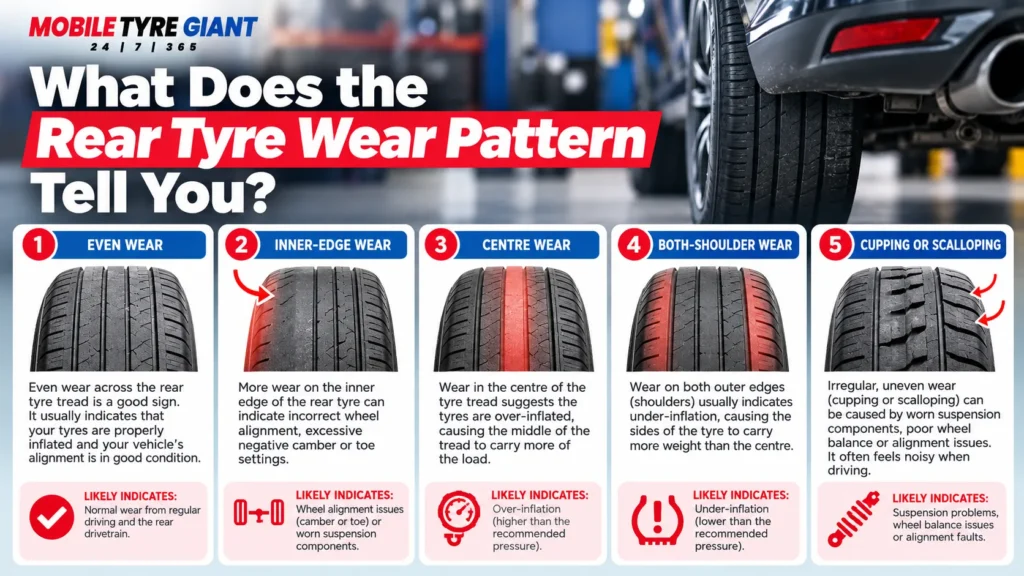
What Does Even Wear Across Both Rear Tyres Mean?
If both rear tyres are wearing relatively evenly from inner shoulder to outer shoulder, the wear may be related to normal use rather than a geometry fault. This is particularly plausible on rear-wheel-drive or rear-biased AWD vehicles because both tyres share propulsion duties. Wider performance tyres, softer compounds and frequent hard acceleration can also shorten rear tyre life while still leaving a fairly uniform tread pattern.
The important question is how quickly that even wear is occurring. Rear tyres that last a reasonable mileage and wear symmetrically may simply be doing the job expected of them. If they suddenly begin wearing much faster than previous sets, compare tyre specification, pressure history, vehicle loading and driving conditions before deciding that the pattern is normal.
What Does Inner-Edge Wear on Rear Tyres Mean?
Heavy rear inner-edge wear deserves closer attention because it often points towards wheel geometry rather than ordinary drivetrain wear. Excessive negative camber can place more load on the inner shoulder, while incorrect toe can make the tyre scrub slightly sideways as it travels. A tyre may therefore appear healthy from the outside while its hidden inner edge is approaching the end of its usable tread.
This can become particularly expensive because drivers often discover the wear late. The visible centre and outer shoulder may still have several millimetres of tread while the inner edge has become severely worn. If both rear tyres show a similar inner-edge pattern, rear alignment and suspension condition should be inspected before simply fitting another pair.
Is Inner-Edge Rear Wear the Same as Tyre Feathering?
Not necessarily. Continuous inner-edge wear means one side of the tyre is consistently wearing faster, while feathering produces a saw-tooth feel across individual tread blocks or ribs. Feathering is often linked strongly with toe because the tread is being scrubbed as the tyre rolls. The two patterns can occur together when alignment is sufficiently incorrect.
Run your hand carefully across the tread in both directions. If the tread feels smooth one way but sharp or raised when your hand moves back, feathering may be present. Our guide to tyre feathering causes explains how toe, suspension and alignment problems create this distinctive pattern.
What Does Centre Wear on the Rear Tyres Mean?
If the centre of both rear tyres is wearing faster than the shoulders, inflation history deserves attention. Excessive pressure can change how the tyre carries load and may concentrate wear through the central part of the tread. The pattern can become more noticeable over thousands of miles if the tyres are consistently inflated above the vehicle manufacturer’s recommendation.
Do not automatically reduce the pressure without checking the official vehicle specification. Rear pressure may legitimately be higher than front pressure, especially when the vehicle is heavily loaded. Compare the current cold readings with the pressure label and consider whether the vehicle has regularly been driven using a fully loaded setting even when it was carrying little weight.
What Does Wear on Both Rear Tyre Shoulders Mean?
Wear concentrated on both shoulders can suggest persistent under-inflation because the outer parts of the tread may carry more load while the centre contacts the road less effectively. Heavy vehicle loading can make the pattern worse if tyre pressures have not been adjusted appropriately for the extra weight.
This pattern should not be confused with one-sided shoulder wear caused by alignment. If both the inner and outer shoulders are wearing faster than the centre on both rear tyres, pressure history becomes particularly relevant. Check for slow leaks as well because a tyre that repeatedly loses air may spend much of its mileage below the intended pressure even if it is occasionally topped up.
What Does Cupping or Scalloping on Rear Tyres Mean?
Cupping creates alternating high and low areas around the circumference instead of one continuous band of wear. The tread may feel wavy when you run your hand around it, and the tyre can produce humming, droning or vibration at road speed. This type of wear can point towards weak damping, wheel imbalance, wheel or tyre runout, suspension movement or several contributing faults.
The location matters too. One scalloped rear tyre may suggest a problem on that individual corner, while similar wear on both rear tyres can point towards a condition affecting the rear axle more generally. Cupping should not be treated as ordinary rear-drive tyre wear because normal propulsion load does not usually create a repeating scooped pattern on its own.
Can Rear Tyre Cupping Make the Car Feel Unstable?
It can. As the wheel rotates, alternating high and low tread sections contact the road differently, which can create vibration and make the tyre feel less smooth. The severity depends on how deep the cups have become and whether the mechanical fault that caused them is still present.
Instability may also come from the suspension or wheel problem behind the cupping, not only from the tyre itself. Strong rear vibration, bouncing after bumps or a noticeable change in handling deserves inspection rather than assuming the tyre has simply become noisy with age.

Can Different Tyre Brands or Compounds Explain Faster Rear Wear?
Yes. Two tyres of the same nominal size can have very different compounds, tread designs and wear characteristics. A softer performance tyre may provide strong dry or wet grip but wear faster than a harder touring tyre. If the rear axle uses one model and the front uses another, comparing tread loss directly can therefore be misleading.
Different tyre ages matter as well. Rear tyres fitted several thousand miles before the fronts naturally have less remaining tread even if their wear rate is completely normal. When analysing front-to-rear differences, compare tyre make, model, age and starting tread depth rather than assuming all four tyres began their service life under identical conditions.
Does Tyre Size Affect Rear Tyre Wear?
It can, particularly on staggered vehicles where the rear tyres are wider or have a different profile from the fronts. Wider tyres may use different construction or compounds and often cannot be rotated front to rear. Their service life should therefore be judged based on the specification and workload of the rear axle rather than by comparing them with different front tyres.
Before deciding whether replacement tyres should match an existing setup, check all sidewall markings carefully. Our correct tyre size guide explains width, profile, wheel diameter and other specifications that need to remain suitable for the vehicle.
Does Motorway or Urban Driving Change Rear Tyre Wear?
Driving environment can influence how quickly rear tyres wear. Long motorway journeys usually involve fewer acceleration and cornering events, so tread wear can be relatively steady even though mileage accumulates quickly. Urban driving involves repeated acceleration, braking, roundabouts, junctions and tighter turns, which can increase tread stress even when the annual mileage is lower.
Powerful rear-wheel-drive vehicles can be particularly affected by stop-start driving if strong acceleration is frequently used when leaving junctions or traffic lights. Short journeys also make pressure maintenance easy to overlook. Understanding where the vehicle spends most of its time helps explain why two cars with similar mileage can have very different rear tyre life.
Can Fast Cornering Wear Rear Tyres More Quickly?
Yes. Cornering creates lateral forces through the tread, and faster cornering increases those forces. On rear-driven performance vehicles, the rear tyres may simultaneously manage cornering and acceleration loads, which can accelerate shoulder wear and overall tread loss.
Occasional enthusiastic driving will not necessarily destroy a healthy tyre, but repeated high-load cornering can noticeably shorten tyre life. If shoulder wear is severe or clearly different on one side, however, alignment and pressure should still be checked rather than blaming driving style alone.
Are Worn Rear Tyres More Dangerous Than Worn Front Tyres?
Heavily worn tyres are a safety concern on either axle, but rear grip has an important role in vehicle stability. If the rear tyres lose grip before the fronts, particularly on wet roads, the back of the vehicle can become unstable and begin to move sideways. This can be harder for an average driver to control than the more progressive understeer associated with front grip loss.
That is why tyre manufacturers commonly recommend fitting the tyres with greater tread depth to the rear when only two tyres are being replaced, subject to the vehicle manufacturer’s requirements. The objective is to maintain stronger rear-axle stability, especially during wet cornering and emergency manoeuvres.
Should the Best Tyres Always Go on the Rear?
When there is a meaningful tread-depth difference between two pairs, placing the deeper-tread pair on the rear is widely recommended for stability. However, vehicle-specific requirements can affect the decision, particularly on AWD cars, staggered setups or vehicles with manufacturer restrictions.
The best outcome is to avoid allowing one axle to become dramatically more worn in the first place. Regular tread checks make it easier to plan replacement before the difference becomes extreme. Where rear tyres have already reached the end of their usable life, our guide on when to replace tyres explains the wider signs that replacement should no longer be delayed.
When Should Faster-Wearing Rear Tyres Be Replaced?
Rear tyres should be replaced when tread depth reaches the legal or practical replacement point, when abnormal wear leaves part of the tread significantly lower than the rest, or when structural damage makes continued use unsafe. Do not judge the tyre from the deepest remaining groove if the inner shoulder or another section is already badly worn.
Replacement should ideally happen after the cause of abnormal wear has been identified. If rear alignment, suspension or pressure problems remain unresolved, a new pair can begin wearing in the same pattern almost immediately. Where the rear tyres are no longer suitable for continued use, mobile tyre replacement can deal with the worn tyres while the underlying cause is considered.
Should Both Rear Tyres Be Replaced Together?
Replacing both rear tyres together is often sensible when they are similarly worn because it keeps tread depth and grip more closely matched across the axle. If only one tyre is damaged while the other remains relatively new and healthy, a single replacement may sometimes be appropriate, provided the tyre specification and tread difference remain suitable for the vehicle.
AWD systems and performance vehicles may require more careful matching, so manufacturer guidance should be checked before replacing only one tyre. The goal is not simply to fit a legal tyre but to maintain a compatible, balanced set that supports predictable handling.
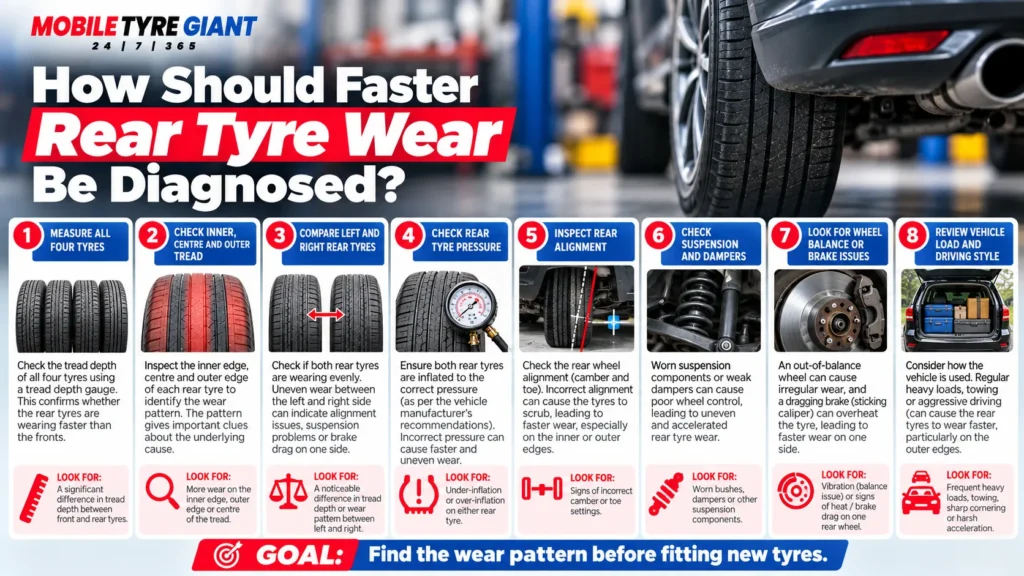
How Should Faster Rear Tyre Wear Be Diagnosed?
Start by measuring all four tyres rather than looking only at the rear pair. Record tread depth across the inner shoulder, centre and outer shoulder of each tyre, then compare the patterns between the left and right sides. Check the cold tyre pressures and note whether the rear tyres are the same make, model, age and specification as the fronts. This helps separate normal differences in tyre age or compound from genuinely abnormal rear wear.
The next step depends on what the tread is showing. Even wear may point more towards drivetrain load, mileage, tyre compound or driving style, while inner-edge wear brings alignment and suspension geometry into focus. Shoulder wear suggests pressure or loading should be investigated, and scalloping deserves checks for damping, balance and wheel movement. The wear pattern should guide the diagnosis rather than replacing parts based only on the fact that the rear tyres have worn first.
Should Rear Alignment Be Checked Before New Tyres Are Fitted?
If the old tyres show strong inner-edge wear, feathering or a significant difference between the left and right sides, checking rear alignment before or alongside replacement is sensible. New tyres can begin wearing abnormally very quickly if the geometry remains outside specification. Correcting the problem after several thousand miles may already mean losing a noticeable amount of new tread.
Alignment should also be considered together with suspension condition. Adjusting geometry on a vehicle with worn bushes or damaged components may not provide a lasting result because those parts can allow the wheel angles to change again under load. Repairing any mechanical looseness first gives the final alignment a better chance of remaining correct.
Can Tyre Rotation Help if the Rear Tyres Wear Faster?
Sometimes. If all four tyres are the same size, non-directional and the vehicle manufacturer permits rotation, moving tyres between positions can help distribute normal axle-related wear. This can be useful on vehicles where one axle consistently wears tyres faster because of drivetrain or weight distribution. Rotation works best before a large tread-depth difference develops.
It is not suitable for every setup. Staggered wheels may prevent front-to-rear movement, while directional tyres have restrictions on changing sides. AWD vehicles may also have specific recommendations. Our guide to tyre rotation patterns explains forward cross, rearward cross, directional and staggered rotation methods in more detail.
Should You Rotate Tyres After the Rear Pair Is Already Heavily Worn?
Usually not simply to postpone replacement. Moving heavily worn rear tyres to the front does not restore the tread that has already disappeared and may place the poorer tyres on the steering axle. When there is a significant difference in remaining tread, tyre placement needs to consider stability rather than following a rotation schedule mechanically.
Rotation is most effective as preventive maintenance while all four tyres remain healthy and reasonably close in condition. Once one axle has become substantially more worn, assess whether replacement is now the more appropriate option and restart a suitable rotation schedule afterwards if the vehicle allows it.
How Can You Prevent Rear Tyres From Wearing Out Too Quickly?
The first step is maintaining the correct cold pressures for the rear axle and vehicle load. Check them regularly rather than only when a warning light appears. If the car regularly carries passengers, tools, luggage or a trailer, make sure you understand whether the manufacturer specifies a different loaded pressure. Incorrect pressure can shorten tyre life even when no other vehicle fault exists.
Mechanical maintenance matters just as much. Investigate changes in handling, unusual rear vibration, bouncing after bumps or uneven tread before the wear becomes severe. Rear alignment and suspension are easy to overlook because many drivers associate tyre wear problems mainly with the steering axle. Keeping the rear of the vehicle mechanically healthy gives the tyres a much better chance of wearing evenly.
Does Smooth Driving Really Make Rear Tyres Last Longer?
Yes, particularly on rear-wheel-drive, rear-biased AWD and high-torque electric vehicles. Strong acceleration transfers substantial torque through the rear tread and increases tyre slip and heat. Using the throttle progressively reduces those repeated high-load events and can help preserve tyre life.
Driving style will not compensate for incorrect alignment or worn suspension, but it can significantly influence the wear rate of an otherwise healthy set. Two identical cars using identical tyres can produce very different rear tyre mileage depending on how strongly they are accelerated, cornered and loaded.
What Should Be Checked After Replacing Worn Rear Tyres?
After new rear tyres are fitted, confirm that they are the correct specification and set to the correct cold pressure. If the old pair showed abnormal wear, make sure the underlying alignment, suspension or wheel problem has been addressed rather than assuming replacement completed the repair. It is worth recording the tread depth and mileage of the new tyres so future wear can be compared accurately.
Recheck the tyres after the first few weeks and during normal pressure inspections. New tyres make developing abnormal wear easier to identify because the tread begins with an even profile. If one shoulder starts disappearing quickly or one rear tyre begins wearing differently from the other, investigate early instead of waiting until the pattern becomes severe.
What if the New Rear Tyres Start Wearing Quickly Again?
Rapid recurrence strongly suggests that the original cause remains or that another contributing issue was missed. Recheck alignment, suspension bushes, dampers, pressure, vehicle loading and wheel condition. If one side is affected much more strongly, focus particularly on that rear corner.
Do not assume the new tyres are defective simply because the wear has returned. Tyre defects are possible, but a repeated pattern on the same vehicle and axle often points towards the conditions in which the tyre is operating. Finding the cause before another pair is consumed can save considerably more money than repeatedly replacing tyres.
Rear Tyre Wear Diagnosis Checklist
Use this checklist when the rear tyres appear to be wearing more quickly than the fronts.
Check | What to Look For |
Overall tread depth | Compare all four tyres |
Inner rear shoulders | Excessive camber or toe-related wear |
Centre tread | Possible over-inflation |
Both shoulders | Possible under-inflation |
Cupped or scalloped areas | Damping, balance or suspension issue |
Left vs right rear tyre | Corner-specific mechanical problem |
Tyre age | Rear tyres may simply be older |
Tyre make and model | Different compounds can wear differently |
Rear pressure | Correct setting for normal and loaded use |
Suspension | Bushes, dampers and wheel movement |
Alignment | Rear toe and camber |
Vehicle loading | Frequent passengers, tools, luggage or towing |
Driving style | Hard acceleration and high cornering loads |
Drivetrain | RWD, AWD, EV or staggered setup |
This checklist helps narrow down the likely cause, but several factors can exist together. A rear-wheel-drive car may naturally use its rear tyres more quickly while also having slightly incorrect alignment, for example. Diagnosis is most accurate when tread pattern, vehicle design, pressure history and mechanical condition are considered together.
When Should You Arrange Professional Tyre Help?
Professional inspection is worthwhile when rear wear is rapid, strongly uneven or difficult to explain. Inner-edge wear that cannot be seen easily from outside, repeated pressure loss, severe scalloping or a large left-to-right difference should not simply be monitored for months. The earlier the cause is identified, the more tread you may be able to save.
If the rear tyres are already worn beyond useful service, fitting replacements can be combined with an inspection of the likely cause. Professional mobile tyre fitting can provide a convenient way to replace worn tyres, but alignment, suspension or braking problems still need to be addressed where they are responsible for the wear.
Final Words: Faster Rear Tyre Wear Is Not Always a Fault
Rear tyres wearing faster than the fronts can be completely normal on some vehicles, especially rear-wheel-drive, rear-biased AWD and high-torque cars. Tyre compound, staggered sizes, vehicle load and driving style can also make the rear pair disappear first without indicating a mechanical defect. The key is whether the wear is even, predictable and consistent with the way the vehicle is designed and used.
Abnormal patterns tell a different story. Inner-edge wear, scalloping, one rear tyre wearing much faster or repeated rapid wear after replacement should prompt checks of pressure, alignment, suspension, wheel condition and brakes. Measure the tyres regularly, investigate unusual patterns early and repair the underlying cause before another set is damaged. That approach protects both tyre life and the stability of the vehicle.
Rear Tyres Wearing Faster Than the Front?
If your rear tyres are wearing quickly, unevenly or showing inner-edge damage, get the cause checked before fitting another set.
Frequently Asked Questions
Find quick answers to the most common questions our customers ask.
Rear tyres can wear faster because of rear-wheel drive, rear-biased AWD, high engine or motor torque, staggered tyre sizes, heavy loading or driving style. If the wear is uneven, alignment, pressure, suspension or another mechanical problem may also be involved.
Yes. Rear-wheel-drive cars transmit acceleration forces through the rear tyres, so those tyres often experience greater propulsion load than the fronts. Powerful engines, softer performance tyres and frequent hard acceleration can make the difference even more noticeable.
Rear inner-edge wear is commonly associated with excessive negative camber, incorrect toe or worn suspension components that allow wheel geometry to change. Because the inner shoulder is difficult to see from outside the car, the problem can become severe before the driver notices it.
One rear tyre wearing faster than the other can point towards a problem specific to that corner, such as incorrect alignment, suspension wear, wheel damage, incorrect pressure or a binding brake. Different tyre age or specification can also explain the difference.
Yes. Under-inflation can accelerate shoulder wear and increase heat, while excessive pressure can concentrate wear through the centre. Rear pressures may also differ from front pressures, so always use the vehicle manufacturer's recommended figures.
Rear-wheel-drive electric cars can wear rear tyres faster because electric motors can deliver high torque immediately and EVs can be relatively heavy. The actual wear rate still depends on tyre specification, alignment, pressure and driving style.
Yes. Incorrect rear toe or camber can cause rapid wear even when the vehicle does not obviously pull to one side. Inner-edge wear is particularly common when geometry is outside specification, especially if worn suspension components are also present.
When two tyres have noticeably more tread than the other pair, tyre manufacturers commonly recommend placing the deeper-tread tyres on the rear axle to support rear stability, particularly in wet conditions. Vehicle-specific requirements should still be followed.
Replacing both rear tyres together is often sensible when they are similarly worn because it keeps grip and tread depth more closely matched across the axle. If only one tyre is damaged and the other remains relatively new, a single replacement may sometimes be suitable depending on the vehicle.
Rotation can help distribute normal axle-related wear when the vehicle uses compatible tyre sizes and the manufacturer permits it. It cannot fix wear caused by incorrect alignment, suspension problems or inappropriate pressure, so those faults should be corrected first.