

Snow can turn an ordinary UK journey into a completely different driving experience within minutes. A road that felt predictable on the way to work can become slippery, compacted or partially frozen on the way home, leaving the tyres with far less grip for accelerating, steering and braking. That is why preparing the tyres before snow arrives matters just as much as changing the way you drive once you are on the road. If the tyres are already worn, incorrectly inflated or damaged, careful driving can only compensate so much.
UK snowfall is often patchy rather than continuous, which creates another problem. You might leave home on a wet road, reach untreated snow a few miles later and then encounter ice beneath a shaded bridge or country lane. Your tyres must therefore cope with changing surfaces, not just deep snow. Checking tread depth, inflation pressure, overall condition and the type of tyres fitted gives you a much better starting point before deciding whether the journey should be made at all.
Why Does Tyre Preparation Matter So Much in Snow?
Your tyres provide the only physical contact between the vehicle and the road. In dry conditions, there is normally enough friction for the car to respond predictably to steering, braking and acceleration. Snow and ice reduce that grip dramatically, so the amount of traction available becomes much easier to exceed. A sharp steering input, hard acceleration or sudden braking that would feel normal on a dry road can cause wheelspin or a loss of grip in winter conditions.
Good tyres cannot make snow or ice behave like dry tarmac, but their condition influences how effectively the vehicle uses the limited grip that is available. Adequate tread helps the tyre interact with snow, water and slush, while correct pressure allows the tread and casing to work as designed. Cuts, bulges, serious cracking or badly worn tread reduce the margin further. A complete tyre safety check before winter weather arrives can identify these problems before you need the tyres most.
Why Do Snow and Ice Reduce Tyre Grip So Quickly?
Snow can create several different surfaces within the same journey. Fresh loose snow behaves differently from compacted snow, slush or polished ice. As vehicles pass over snow, it can become compressed and increasingly slippery, particularly around junctions, hills and areas where traffic repeatedly brakes. Temperatures around freezing can also create a mixture of water and ice that changes grip over very short distances.
This unpredictability is why tyre preparation should happen before the journey rather than after the vehicle begins sliding. A driver cannot create extra tread depth or repair a damaged tyre once already on an icy road. Preparation gives you a chance to identify weak tyres, correct pressure and decide whether your existing tyre type is appropriate for the conditions you expect to encounter.
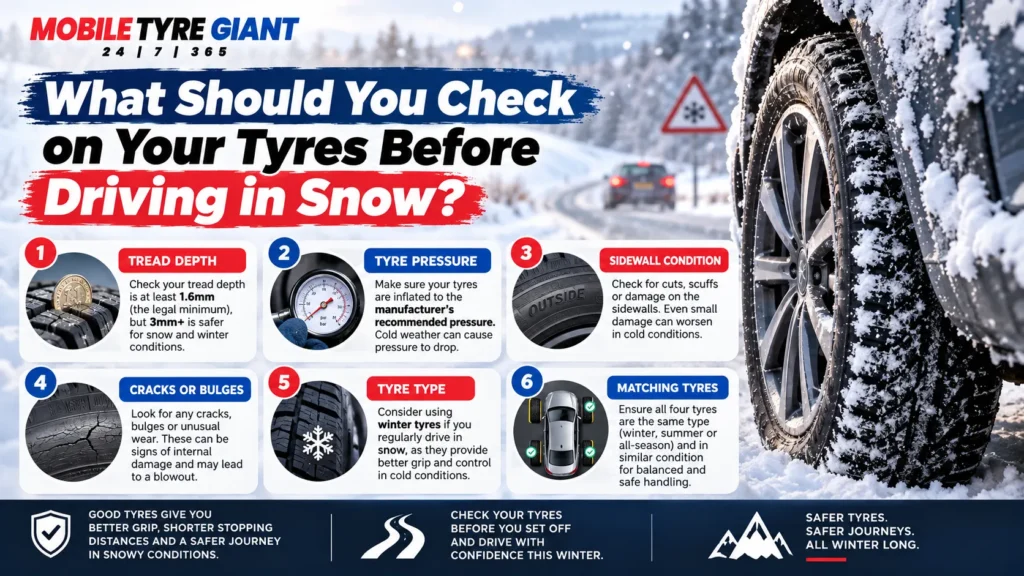
What Should You Check on Your Tyres Before Driving in Snow?
Start with all four tyres rather than checking only the driven wheels. Look at the tread across the full width and around as much of the circumference as possible. Inspect both shoulders and the visible sidewalls for cuts, cracks, bulges, embedded objects or unusual wear. If one tyre looks significantly more worn than the others, do not assume it is acceptable simply because the remaining three look healthy.
You should also check whether the tyres are all the correct size and suitable type for the vehicle. Confirm that directional tyres are rotating the correct way and that there is no obvious mismatch between tyres that could affect handling. Snow places a greater emphasis on balanced, predictable grip, so existing differences between the four tyres may become much more noticeable when the road surface becomes slippery.
How Much Tread Do You Need for Driving in Snow?
For most UK cars, the legal minimum tread depth is 1.6mm across the central three-quarters of the tread around the tyre’s continuous circumference. However, the legal minimum should not automatically be treated as the ideal target for snow. As tread becomes shallower, the tyre has less ability to work through water, slush and loose snow. Winter driving therefore gives you a strong reason to assess tyres before they become completely worn down to the legal limit.
Measure tread in several places rather than checking only the most visible centre groove. Inner-edge or shoulder wear can leave part of the tyre much more worn than the section you first inspect. Our guide on how to check tyre tread explains the 20p test, tread wear indicators and accurate gauge measurements. If the tyres are already close to replacement before snow is forecast, waiting until winter conditions arrive reduces your safety margin.
What Tyre Pressure Should You Use When Driving in Snow?
Use the tyre pressures recommended by the vehicle manufacturer for the load and tyre size fitted to your car. These figures are normally found in the owner’s handbook, inside the driver’s door area or around the fuel filler flap. Pressure should ideally be checked when the tyres are cold because driving generates heat and raises the reading. Checking them before a winter journey gives you a more reliable starting point.
Cold weather can reduce tyre pressure as the temperature falls, so a tyre that was correctly inflated during milder weather may need checking again after a significant temperature change. Do not rely entirely on the tyre pressure monitoring system because TPMS is primarily a warning system rather than a substitute for regular manual checks. Our guide on how to check tyre pressure explains how to find the correct specification and take an accurate cold reading.
Should You Lower Tyre Pressure to Get More Grip in Snow?
For normal UK road driving, you should not deliberately reduce tyre pressure below the vehicle manufacturer’s recommendation simply because it is snowing. The idea often comes from off-road situations where lowering pressure can sometimes increase a tyre’s footprint on soft surfaces, but normal road tyres and vehicle handling systems are designed around specified operating pressures. Deliberate under-inflation can increase sidewall flex, heat generation and unpredictable handling.
Snow already reduces the amount of grip available, so introducing incorrect pressure adds another variable when you need the tyre to behave predictably. Use the pressure recommended for your vehicle and its current load unless the vehicle or tyre manufacturer provides a specific alternative instruction. If pressure has fallen because of cold weather, restore it rather than assuming the lower figure will improve snow traction.
Are Summer Tyres Suitable for Driving in UK Snow?
Summer tyres are commonly fitted to UK cars and can legally be used throughout the year, provided they meet the necessary condition and tread requirements. However, they are designed primarily for milder and warmer road conditions. Their tread patterns and compounds are not specifically optimised for prolonged snow, ice and low-temperature use, which means their available traction can be more limited when winter conditions become severe.
This does not mean every UK driver automatically needs a second set of tyres. The right choice depends on where you live, when you drive and how often your local roads experience snow or sustained cold conditions. Someone driving mainly on regularly treated urban roads in southern England may have different needs from a driver regularly travelling through rural, elevated or northern areas where winter conditions are more frequent.
Are All-Season Tyres Better for Occasional UK Snow?
All-season tyres are designed to provide a compromise between summer and winter performance. For many UK drivers, that makes them attractive because the climate often includes wet, cold and occasionally snowy conditions rather than months of continuous deep snow. Their tread patterns generally provide more features for dealing with colder, wetter or lightly snowy surfaces than a typical summer tyre while remaining suitable for year-round use.
They are still a compromise. A dedicated winter tyre is designed specifically for colder and more demanding winter conditions, while a summer tyre is optimised for warmer use. All-season tyres can therefore make practical sense where snow is occasional but cold and wet conditions are common. When choosing them, make sure the tyre specifications remain suitable for your vehicle rather than selecting a tyre solely because it carries an all-season label.
When Are Winter Tyres Worth Considering in the UK?
Winter tyres become more relevant if you regularly drive in prolonged cold conditions, frequent snow, rural areas, steep roads or locations where untreated surfaces are common. Their rubber compounds and tread designs are specifically developed to provide useful grip in colder winter conditions. The benefit is not limited to deep snow because cold, damp roads can also reduce the performance margin available from tyres designed primarily for warmer temperatures.
Whether the extra seasonal tyre change makes sense is therefore a personal use-case decision rather than a universal UK requirement. Consider your normal routes, local weather, journey necessity and whether you can avoid driving during severe snowfall. Drivers who must remain mobile during repeated winter weather may value dedicated winter tyres more than someone who can simply postpone a journey when snow arrives.
Are Winter Tyres a Legal Requirement in the UK?
No. Winter tyres are not generally a legal requirement for ordinary driving in the UK. You can use suitable summer or all-season tyres throughout winter provided they remain legal, correctly fitted and in safe condition. The absence of a legal requirement does not mean all tyre types perform identically in snow, however. Legality and optimum winter grip are two different questions.
The situation also changes if you drive abroad. Several European countries and regions have their own winter tyre, snow-chain or seasonal equipment rules. If a UK journey continues into Europe during winter, check the requirements for every country and region on the route before travelling. A tyre setup that is legal in Britain may not satisfy winter equipment rules elsewhere.
Should Winter or All-Season Tyres Be Fitted to All Four Wheels?
Where you change from summer tyres to winter or all-season tyres, fitting the same tyre type across all four wheels provides more predictable grip and handling. Fitting winter tyres only to the driven axle may improve traction when pulling away, but it can create a significant difference in available grip between the front and rear of the vehicle. In slippery conditions, predictable balance matters just as much as the ability to start moving.
The same principle applies to mixing winter, summer and all-season tyres. Even if the tyre sizes are identical, their compounds and tread behaviour can differ when temperatures fall. A balanced four-tyre setup helps the vehicle respond more consistently during braking, steering and cornering. Before snow arrives, think of the tyres as a complete set rather than four independent pieces of rubber.
What Do Winter Tyre Markings Mean?
Tyre sidewall markings can help you understand whether a tyre has been designed and tested for winter conditions. One of the most useful symbols to look for is the 3PMSF marking, which stands for Three-Peak Mountain Snowflake. It appears as a snowflake inside a three-peaked mountain outline. A tyre carrying this symbol has met a defined snow-performance testing standard rather than relying only on a manufacturer’s description of the tyre.
You may also see M+S, meaning Mud and Snow, printed on winter or all-season tyres. M+S indicates that the tyre is intended to perform better in muddy or snowy conditions than a conventional tyre of the same general category, but the marking alone does not mean it has passed the same standardised snow test as a 3PMSF tyre. For UK drivers choosing tyres specifically with snow performance in mind, understanding that difference is more useful than relying on the words “winter” or “all-season” alone.
Is 3PMSF Better Than M+S for Snow?
The 3PMSF symbol gives you stronger evidence of tested snow performance because the tyre has had to meet a specified performance threshold. M+S on its own is a manufacturer-applied designation and does not represent the same objective snow certification. This makes 3PMSF particularly useful when comparing different all-season or winter tyres that may otherwise appear similar.
That does not mean a 3PMSF symbol makes a tyre suitable for every winter situation. Tread depth, pressure, tyre age and road conditions still matter, and severe ice can overwhelm even a good winter tyre. The symbol should therefore be seen as one part of tyre selection rather than a guarantee that a vehicle cannot lose grip.
Are All-Season Tyres Enough for UK Snow?
For many UK drivers, all-season tyres can provide a practical compromise because British winters often involve cold rain, slush and occasional snow rather than months of continuous severe winter conditions. A good all-season tyre designed for winter use can offer better cold-weather and light-snow capability than a typical summer tyre while remaining suitable for year-round use. This can remove the need to change between separate summer and winter sets twice a year.
Whether they are enough depends on where and when you drive. Someone living in an urban area where roads are usually gritted and snow clears quickly may have very different requirements from someone regularly travelling through rural hills, untreated roads or higher parts of the UK. Dedicated winter tyres remain more relevant where snow, ice and prolonged low temperatures are common rather than occasional.
Should You Look for 3PMSF on All-Season Tyres?
If snow performance is one of your main reasons for choosing all-season tyres, looking for the 3PMSF symbol makes sense. Not every tyre sold as all-season necessarily offers the same winter capability, so the certification gives you another way to compare them. It confirms that the tyre has met a recognised snow-traction performance requirement rather than simply carrying a seasonal marketing description.
Tyre suitability still has to match the vehicle. Check the correct size, load rating and speed rating before changing tyre type. If you are unsure how to interpret the numbers and letters on the sidewall, our correct tyre size guide explains the main tyre markings and why matching the vehicle specification matters.
Can Old or Cracked Tyres Become More of a Problem in Snow?
Yes. Snow preparation should include checking the age and condition of the rubber, not only tread depth. An older tyre may still have several millimetres of tread while its sidewall or tread grooves show cracking, hardening or perishing. Cold conditions can make aged rubber feel stiffer, and a tyre that has already deteriorated has less margin when it needs to provide grip on a slippery surface.
Inspect the shoulders, sidewalls and tread grooves before winter driving. Fine surface ageing is different from deeper cracking, visible reinforcement, bulges or deformation, but any deterioration deserves attention when difficult weather is forecast. Our guide to tyre cracking and perishing explains how to distinguish early surface crazing from signs that a tyre may need replacing.
Are Low-Mileage Tyres Automatically Better for Winter?
No. Low mileage does not necessarily mean the tyre rubber is young or in good condition. A car that is driven occasionally may retain deep tread for many years while the tyre continues ageing through sunlight, oxygen, temperature changes and environmental exposure. This can create a tyre that looks impressive when tread depth is measured but is no longer in the condition you would ideally want before snow or ice.
Check the manufacturing date and inspect the complete tyre rather than judging it by tread alone. This is particularly relevant to second cars, older vehicles and cars that spend long periods parked outside. Winter preparation should identify ageing tyres before they are asked to perform in some of the year’s lowest-grip conditions.
Why Can the TPMS Warning Light Appear in Cold Weather?
Air pressure inside a tyre can fall as temperatures drop. This means a tyre that was correctly inflated during milder weather may show a lower pressure reading after a cold night. On vehicles with a tyre pressure monitoring system, the reduction may be enough to trigger a dashboard warning. The warning should not simply be dismissed as a winter nuisance because it may also indicate genuine under-inflation or a separate air leak.
Check all four tyre pressures manually when they are cold and compare them with the manufacturer’s recommended figures. If one tyre is significantly lower than the others or loses pressure again after inflation, investigate for a puncture, leaking valve or another problem. Cold weather can explain a modest pressure change, but it should not be used to explain away repeated pressure loss.
What if the TPMS Warning Stays On After Correcting the Pressure?
Some vehicles require a reset, relearn procedure or a short drive before the TPMS recognises that the pressures have been corrected. The process varies between vehicles, so the handbook should be checked. If the warning continues despite correct pressures and the required reset procedure, there may be a sensor, valve or system fault.
Sensor age can also matter because direct TPMS sensors use internal batteries that eventually reach the end of their service life. If the pressures are correct but an individual reading disappears or the system begins behaving intermittently, our guide to TPMS sensor battery life and replacement explains how sensor batteries, programming and replacement work.
Are Snow Socks or Snow Chains Useful in the UK?
Snow socks are fabric traction devices that fit over the driven tyres and can provide additional grip in certain snowy conditions. They are lightweight and easier to store than metal chains, which makes them attractive as emergency equipment for occasional UK snow. They are intended for use on snow-covered surfaces rather than normal clear roads and should be removed once conditions no longer require them.
Snow chains provide a more aggressive form of traction and may be useful in deeper or more severe snow where the vehicle has enough wheel-arch clearance for them. They must be the correct size and fitted according to the manufacturer’s instructions. Neither snow socks nor chains should be viewed as a substitute for healthy tyres because damaged, under-inflated or badly worn tyres still need attention before the journey.

Can You Drive Normally With Snow Socks or Chains Fitted?
No. These devices are temporary traction aids rather than equipment for normal-speed driving. Follow the manufacturer’s speed limits and fitting instructions, drive smoothly and remove them when you return to clear road surfaces. Driving too quickly can damage the traction device, tyre, wheel arch or surrounding vehicle components.
It is also worth practising fitting them before winter if you plan to carry them. Learning for the first time on a dark roadside while snow is falling is much more difficult than checking the process at home. Make sure the equipment actually fits your tyre size and that there is enough clearance around the wheel before relying on it for an emergency journey.
Does Four-Wheel Drive Mean You Do Not Need to Prepare Your Tyres?
No. Four-wheel drive and all-wheel drive can improve the vehicle’s ability to distribute engine power when accelerating, but they cannot create unlimited tyre grip. All four tyres still determine how effectively the vehicle can steer, brake and respond to changing road conditions. A four-wheel-drive vehicle on badly worn or unsuitable tyres can therefore struggle despite having power delivered to more wheels.
The misconception becomes particularly risky when drivers feel confident because the vehicle pulls away easily in snow. Acceleration may feel secure, but braking is still limited by available tyre grip. Every vehicle uses its tyres to slow down, regardless of how many wheels receive engine power. AWD or 4WD should therefore complement good tyre preparation rather than replace it.
Are Winter Tyres Useful on an AWD or 4×4 Vehicle?
They can be very useful where winter conditions justify them. AWD helps manage traction through the drivetrain, while winter tyres are designed to improve the tyre’s interaction with cold, snowy and icy surfaces. These technologies address different parts of the problem, so using one does not eliminate the potential benefit of the other.
Matching tyres across all four wheels is particularly important on many AWD systems. Large differences in tread depth, tyre type or rolling circumference may affect the way the drivetrain operates. If one tyre is badly worn or damaged before snow arrives, do not assume the vehicle’s AWD system can compensate for it.
What Should You Check Immediately Before Setting Off in Snow?
Begin with the tyres while the vehicle is still parked. Check cold pressures, tread depth and visible tyre condition, then make sure there are no bulges, deep cracks or obviously damaged sidewalls. Confirm that the tyres have not lost pressure overnight and that any TPMS warning has been investigated. If snow is already falling heavily, also consider whether the journey is necessary rather than treating tyre preparation as permission to drive regardless of conditions.
Clear the vehicle properly before setting off and check that your planned route remains usable. Snow and ice can vary significantly between main roads, residential streets, bridges and rural sections, so allow much more time than usual. Good tyre preparation improves your starting position, but the final safety decision still depends on the weather, route and whether conditions allow the journey to be made sensibly.
How Should You Drive to Protect Tyre Grip in Snow?
Once you are moving in snow, the aim is to avoid asking the tyres for more grip than the road can provide. Accelerate gently, build speed gradually and leave significantly more space between your vehicle and the traffic ahead. Every sharp input asks the tyre to change what it is doing quickly, and slippery surfaces make those changes harder to manage. Smooth driving gives the tread more opportunity to maintain contact without suddenly breaking traction.
Your speed should also match the conditions rather than the posted limit. A road may legally allow 30, 50 or 70 mph while the safe speed in snow is considerably lower. Look well ahead so you can react early instead of relying on sudden braking or steering. Even well-prepared tyres cannot overcome the basic lack of friction created by compacted snow or ice, so tyre preparation and driving technique have to work together.
Why Are Smooth Steering Inputs So Important?
A tyre has a limited amount of grip available at any moment. When you turn sharply, brake hard or accelerate aggressively, you demand a large amount of that grip very quickly. On dry roads there may be enough traction to cope, but snow reduces the available margin. Smooth steering allows the tyre to build cornering force progressively rather than being asked to change direction suddenly.
Plan bends before reaching them. Reduce speed while the vehicle is travelling relatively straight, then steer gradually through the corner. Avoid braking heavily halfway through a slippery bend unless necessary because the tyres are already being asked to provide cornering grip. A calm, progressive input is much easier for the tyre to manage than a sudden correction.
How Should You Accelerate and Brake in Snow?
Accelerate gently enough that the driven tyres do not spin. Too much throttle can cause them to rotate faster than the vehicle is actually travelling, reducing useful traction and potentially allowing the car to slide sideways. On a manual vehicle, selecting an appropriate higher gear where suitable can sometimes help reduce excessive wheel torque, but vehicle-specific guidance should always take priority.
Braking should also begin earlier than usual. Build braking force gradually rather than stamping on the pedal at the last moment. Modern ABS can help maintain steering control during emergency braking, but it cannot create grip where the tyres have almost none. The most effective strategy is to anticipate junctions, queues and bends early enough that emergency braking is less likely to be required.
What Does Wheelspin Tell You About Available Grip?
Wheelspin is a clear sign that the driven tyres are being asked to transmit more acceleration force than the surface can support. Continuing to press the accelerator harder usually does not solve the problem. Instead, ease off gently and allow the tyres to regain traction before applying power more progressively.
Repeated wheelspin can also polish or disturb the snow beneath the tyre, making it harder to move away. If the car repeatedly struggles from the same position, avoid aggressive throttle inputs that simply spin the wheels faster. Check that traction control is being used according to the vehicle manufacturer’s guidance and consider whether the road conditions are suitable for continuing the journey at all.
How Should You Drive Up and Down Hills in Snow?
Approach a snowy uphill section with enough controlled momentum to avoid unnecessary acceleration halfway up the slope. Sudden throttle inputs on the climb can cause wheelspin, especially if the snow has already been compacted by other vehicles. Maintain a smooth, steady speed where conditions allow and leave plenty of space so you are less likely to have to stop partway up the hill.
Descending requires even more anticipation because gravity is already encouraging the vehicle to gain speed. Begin slowing before the steepest section and use gentle braking rather than allowing speed to build and then trying to remove it suddenly. On vehicles where it is appropriate, lower gears can help control speed, but abrupt downshifts should be avoided because they can disturb tyre grip.
What if the Car Cannot Climb a Snowy Hill?
If the driven tyres repeatedly spin and the vehicle is making little or no progress, continuing to apply more throttle may make the situation worse. Ease off, maintain control and consider whether a safer alternative route is available. Trying several increasingly aggressive attempts can leave the vehicle sideways, stuck or positioned where other road users cannot pass safely.
Tyre tread and tyre type make a noticeable difference in these situations, but they do not guarantee that every slope can be climbed. Deep snow, polished ice and untreated gradients may overwhelm even winter-focused tyres. If the route clearly exceeds the traction available, turning back or postponing the journey can be more sensible than forcing the vehicle onward.
What Should You Do if the Car Starts to Skid?
If the vehicle begins to lose grip, avoid panicked steering or sudden braking. Ease off the accelerator and concentrate on looking where you want the vehicle to go. Steering inputs should remain smooth because aggressive corrections can cause the tyres to lose even more traction. The correct response can vary depending on whether the front or rear tyres are sliding and on the vehicle’s stability-control systems.
Modern electronic stability systems can help correct certain skids, but they still rely on the tyres having some grip available. Tyre condition therefore remains fundamental. Worn, badly inflated or inappropriate tyres reduce the amount of traction the vehicle’s safety systems have to work with. If a skid or loss of control occurs repeatedly at very low speeds, conditions may simply be too poor to continue safely.
What Is Understeer and Oversteer in Snow?
Understeer happens when the front tyres lose enough grip that the vehicle does not turn as much as you intended. You may turn the steering wheel but feel the car continue pushing towards the outside of the bend. Adding more steering angle usually does not create more grip. Reducing speed and allowing the front tyres to regain traction is more useful than continuing to turn the wheel harder.
Oversteer occurs when the rear of the vehicle begins moving sideways relative to the front. Snow and ice can make this happen quickly if rear grip is significantly reduced. Smooth corrections are essential because sudden steering movements can create a second slide in the opposite direction. Balanced tyre condition across both axles helps reduce large differences in available grip.
Why Is Compacted Snow Often More Difficult Than Fresh Snow?
Fresh snow can be slippery, but repeated traffic can compress it into a much harder surface. Compacted snow may offer less predictable grip, especially around junctions, bends, roundabouts and hills where vehicles repeatedly accelerate or brake. The surface can become polished and may hide areas of ice underneath, making one section feel noticeably different from the next.
Do not assume a road is safe simply because other vehicles have already driven over it. Their tyres may actually have made parts of the surface more slippery. Watch the behaviour of traffic ahead, increase following distance and be prepared for sudden changes in traction. Shaded areas and places where temperatures remain lower deserve particular caution.
How Can You Recognise Possible Black Ice?
Black ice can be extremely difficult to see because it may appear as ordinary wet or dark road surface. It is more likely in freezing conditions, particularly around shaded areas, bridges, exposed roads and places where water has collected and frozen. A sudden reduction in tyre noise or unusually light steering can sometimes indicate a loss of available grip, but you should not rely on these signs alone.
If freezing conditions are likely, assume apparently clear sections may still contain ice. Reduce speed before reaching shaded bends or bridges rather than waiting for the tyres to slip. Once the vehicle is already on ice, sudden braking or steering makes maintaining control more difficult.
What Should You Do if a Tyre Hits a Hidden Pothole in Snow?
Snow, slush and standing water can hide potholes that would normally be easy to avoid. A strong impact can damage the tyre sidewall, wheel, alignment or suspension even if the tyre does not immediately lose air. Once it is safe to stop, inspect for bulges, cuts, rapid pressure loss or obvious wheel damage. Pay attention to any vibration, steering pull or new warning light when you begin moving again.
A pothole impact should not be dismissed because the tyre still looks inflated. Some damage may be internal or may become more noticeable as you continue driving. Our guide to pothole tyre damage explains what to inspect after a hard impact and why tyres, wheels and alignment can all be affected.
Can Snow Hide Kerbs and Damage the Tyre Sidewall?
Yes. Deep or piled snow can make the edge of the carriageway difficult to judge, particularly in car parks, residential streets and roads where ploughed snow has accumulated near the kerb. Striking a kerb can pinch the tyre, cut the sidewall, damage the wheel or create a bulge that may not have been present before.
If you feel a significant impact, inspect the tyre instead of assuming the snow absorbed it. Sidewall bulges and deep cuts are particularly important because they can indicate structural damage. Where the tyre is no longer suitable for continued use, mobile tyre replacement can avoid driving further on a tyre that may have been weakened.
Why Might the Steering Wheel Vibrate After Driving Through Snow?
Snow and ice can occasionally build up inside a wheel or around the rim, creating an uneven rotating mass. This may cause temporary vibration at certain speeds even though the tyre itself is not damaged. If it is safe to do so, inspect for packed snow or ice and allow it to clear before assuming the wheel has suddenly lost its balance.
Persistent vibration after the snow and ice have cleared needs further investigation. A hidden pothole impact may have damaged the wheel, a balance weight could have been lost or the tyre may have developed a problem. Our mobile wheel balancing service can help diagnose vibration when the issue continues after the obvious winter buildup has been removed.
Should You Keep Driving if the Vibration Is Severe?
No severe or suddenly developing vibration should simply be ignored. Reduce speed safely and inspect the tyres and wheels when you can stop in a suitable location. Look for visible damage, low pressure or packed snow and ice, but avoid putting yourself at risk beside a dangerous road simply to examine the wheel.
If the vibration remains strong after obvious snow buildup has been ruled out, arrange professional inspection before continuing a long or high-speed journey. A wheel or tyre damaged by a hidden pothole can create symptoms that become more noticeable as speed rises. Snowy conditions already reduce safety margins, so adding an unresolved vibration makes continued driving less predictable.
What Should You Check After Driving in Snow?
Once the journey is over, do not assume the tyres need no further attention simply because the car arrived safely. Snow, slush and road salt can hide cuts, trapped debris or damage caused by potholes and kerbs. When the vehicle is parked somewhere safe, inspect the tread and visible sidewalls for new marks, bulges, cracking or objects lodged in the grooves. Check whether any tyre appears noticeably lower than the others and pay attention to any warning lights that appeared during the journey.
Tyre pressure is worth checking again once the tyres have cooled, especially if one wheel took a hard impact or the TPMS warning appeared. Snow and ice can also collect around the wheel and temporarily affect how the vehicle feels, so remove obvious buildup where it is safe to do so. If a tyre has developed visible damage or is losing pressure after winter driving, arranging mobile tyre fitting can be safer than continuing to drive on a tyre whose condition is uncertain.
Should You Remove Snow and Ice From Around the Wheels?
Yes. Packed snow can build up around the wheel arch, suspension area and inside the wheel, particularly after driving through deeper or slushy snow. In some cases, the buildup may create rubbing noises or temporary vibration. Clearing it helps you inspect the tyre properly and makes it easier to distinguish harmless snow buildup from actual tyre or wheel damage.
Do not use sharp metal tools against the tyre sidewall or wheel because you could create damage while trying to remove the ice. Allow stubborn buildup to thaw naturally where practical. Once the wheel area is clear, inspect again for cuts, bulges, missing balance weights or other problems that may have been hidden by snow.
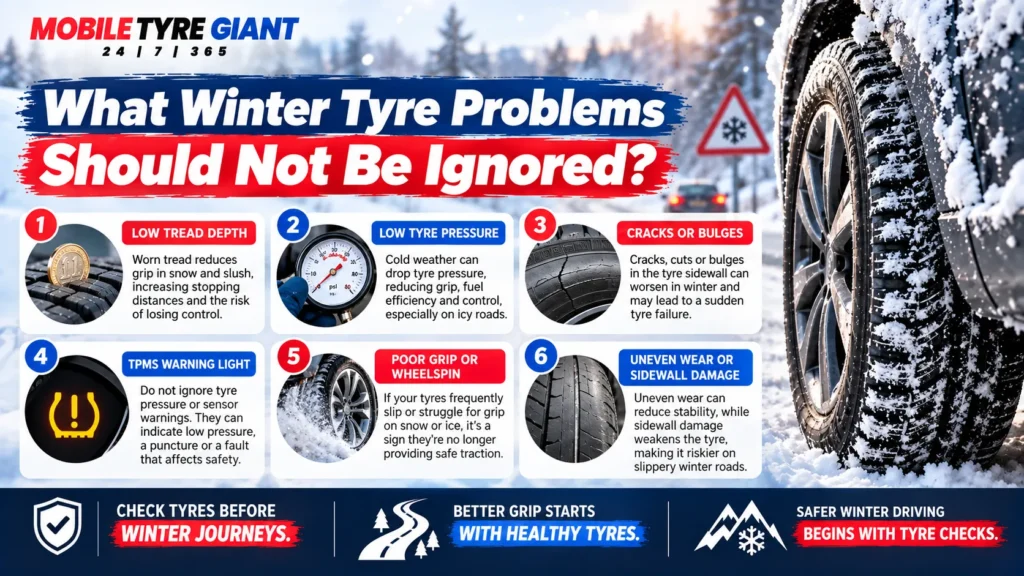
What Winter Tyre Problems Should Not Be Ignored?
Several signs deserve immediate attention after driving in snow. These include a tyre that repeatedly loses pressure, a new sidewall bulge, a deep cut, visible reinforcement, severe vibration or a wheel that appears damaged after an impact. A tyre that suddenly feels different after hitting a hidden pothole should also be checked even if it still looks inflated.
A persistent TPMS warning should not be dismissed as a normal winter issue either. Cold temperatures can lower pressure, but a warning that returns after correct inflation can point to a puncture, leaking valve or sensor problem. The safest winter preparation is not only about getting ready before snowfall. It is also about identifying problems quickly after difficult journeys.
When Should You Stop Driving Instead of Continuing?
Stop and reassess the situation if a tyre is visibly damaged, rapidly losing pressure or causing severe vibration. Continuing in snow with a compromised tyre removes even more of the limited grip already available. If you are unsure whether the tyre is safe, avoid attempting to reach home simply because the remaining distance seems short.
The same applies when the weather itself becomes too severe. If visibility, snow depth or road conditions deteriorate beyond what the tyres and vehicle can safely manage, stopping somewhere appropriate or postponing the journey may be the better option. Tyre preparation improves your ability to cope with winter roads, but it cannot make every journey safe.
What Should You Keep in the Car for Snowy Conditions?
A small winter kit can make a significant difference if traffic stops or the car becomes stranded. Useful items include warm clothing, gloves, a torch, phone charging equipment, an ice scraper, screenwash suitable for winter temperatures and a small amount of food and water for longer journeys. A compact shovel can also be useful if snow builds around the driven wheels.
If you regularly travel through areas where snow becomes more severe, suitable snow socks or chains may also be worth carrying if they are compatible with your vehicle and tyre size. They should be tested for fit before an emergency and used only according to the manufacturer’s instructions. Carrying equipment is useful, but it should support good tyre preparation rather than compensate for worn or damaged tyres.
Should You Carry a Tyre Inflator in Winter?
A portable tyre inflator can be useful because cold temperatures can reduce pressure and winter journeys may take you far from a convenient filling station. It allows you to correct a modest pressure drop if the tyre is otherwise healthy. A separate pressure gauge can also provide a useful comparison if you are unsure whether the inflator’s built-in reading is accurate.
An inflator should not be used to repeatedly hide a leak. If one tyre loses pressure every few days, adding air only treats the symptom. The tyre, valve and wheel need inspection to identify why the pressure keeps falling.
How Should You Prepare Tyres if Snow Is Forecast Overnight?
If snow is expected, tyre preparation is easier the evening before than during a freezing morning. Check tread depth, tyre pressure and visible condition while there is still good light. Make sure any tyre that already had a slow leak has been dealt with rather than simply topped up. Confirm that your tyre type and condition are suitable for the route you expect to use.
It is also useful to check the weather and road conditions before leaving. Main roads may be treated while smaller residential or rural roads remain covered. A journey that begins on a clear road can still lead onto untreated snow several miles later. Preparing the tyres and planning the route together gives you a better chance of avoiding difficult sections.
Should You Inflate Tyres the Night Before Snow?
Yes, provided you set them to the vehicle manufacturer’s recommended cold pressure. The important point is not that the tyres need a special snow pressure, but that they should be correctly inflated before the temperature drops further. If the car has been driven recently, allow the tyres time to cool before taking the final reading where possible.
Check again after a major temperature change if necessary. A pressure that was correct during mild weather may fall enough in colder conditions to need adjustment. Keeping the tyres at the correct pressure supports predictable handling when grip is already limited.
Do You Need Different Tyres for a Short Period of Snow?
Not every short UK snowfall means the vehicle needs a dedicated winter tyre set. The decision depends on how often snow occurs where you live, whether your journeys are essential and the type and condition of tyres already fitted. Drivers using good-quality all-season tyres with healthy tread may feel adequately prepared for occasional winter conditions, while someone regularly travelling through higher or rural areas may benefit more from dedicated winter tyres.
The most important mistake to avoid is assuming that any tyre is fine simply because snow is expected to last only a day or two. Worn summer tyres remain worn summer tyres regardless of how long the weather lasts. If the current tyres are already near replacement, winter weather can provide a strong reason to deal with them before grip becomes even more limited.
Should You Change Tyres Just Because the Forecast Shows Snow?
Not automatically. Start with the condition and type of tyres currently fitted, then consider the likely road conditions and how essential your journeys are. A well-maintained tyre set that is appropriate for normal UK use may be adequate for light or occasional snow if the journey can be made carefully.
If your tyres are already worn, cracked, mismatched or unsuitable for your normal winter routes, the forecast may reveal a problem that already existed rather than create a new one. Replacement decisions should therefore be based on overall condition and expected use rather than one weather forecast alone.
UK Snow Tyre Preparation Checklist
Use this checklist before driving when snow or freezing conditions are expected.
Check | What to Confirm |
Tread depth | Adequate tread across the full tyre width |
Tyre pressure | Set to the vehicle manufacturer’s cold specification |
Sidewalls | No bulges, deep cuts or serious cracking |
Tyre type | Suitable summer, all-season or winter setup for your use |
Directional tyres | Rotation arrows fitted correctly |
Tyre age | No serious age-related deterioration |
TPMS | No unexplained warning or missing sensor reading |
Matching tyres | No unsuitable combination creating large grip differences |
Snow equipment | Correct-size socks or chains if you plan to carry them |
Journey conditions | Route and weather suitable enough to travel |
This checklist cannot guarantee grip on snow or ice, but it removes several avoidable tyre problems before the journey begins. If a tyre fails one of the important condition checks, dealing with it before travelling is much easier than trying to solve the problem on a snowy roadside.
Final Words: Prepare the Tyres Before the Snow Arrives
Driving safely in snow begins before the wheels start turning. Adequate tread, correct pressure, healthy sidewalls and an appropriate tyre type all affect how much usable grip the vehicle has when the road becomes slippery. Winter tyres or all-season tyres can provide additional cold-weather capability in the right circumstances, but no tyre removes the need for smooth driving, longer stopping distances and careful route decisions.
UK snow can be unpredictable, with clear main roads leading quickly into untreated residential streets, compacted snow or hidden ice. That is why preparation should cover both the tyres and the journey itself. Check the tyres before bad weather arrives, inspect them again after difficult journeys and deal with damage or pressure loss promptly. If you need help while travelling within the coverage area, the service areas page can help you check where mobile tyre assistance is available.
Driving in Snow or Worried About Your Tyres?
If your tyres have low tread, pressure issues, winter damage or poor grip in snow, get expert tyre help before setting off.
Frequently Asked Questions
Find quick answers to the most common questions our customers ask.
The UK legal minimum for most car tyres is 1.6mm across the central three-quarters of the tread around its continuous circumference, but tyres close to that minimum have less tread available to deal with snow, water and slush. For winter preparation, condition and usable tread should be assessed well before the tyres become completely worn to the legal threshold.
For normal UK road driving, use the vehicle manufacturer's recommended tyre pressure rather than deliberately lowering it for snow. Under-inflation can increase sidewall flex, heat and handling problems, so any pressure lost during cold weather should normally be restored to the correct specification.
No. Winter tyres are not generally compulsory for ordinary UK road use. Drivers can legally use suitable summer or all-season tyres through winter as long as they meet legal and safety requirements, although winter tyres can provide additional cold-weather and snow performance where conditions justify them.
All-season tyres can be a practical option for many UK drivers who experience cold, wet weather and occasional snow. Their suitability depends on the tyre itself, local conditions and the routes you regularly drive. If snow performance is important, a 3PMSF-marked all-season tyre provides evidence that it has met a recognised snow-performance test.
The Three-Peak Mountain Snowflake symbol indicates that the tyre has met a recognised snow-traction performance requirement. It provides more meaningful evidence of tested snow capability than an M+S marking alone, although tyre condition, pressure and tread depth still remain important.
It is generally better to maintain similar grip characteristics across all four wheels rather than fitting winter tyres only to the driven axle. A large difference in front and rear grip can make the vehicle behave less predictably during braking or cornering on slippery roads.
No. Four-wheel drive can help distribute power when accelerating, but braking and steering still depend on tyre grip. AWD or 4WD does not compensate for worn, damaged or unsuitable tyres, and winter-focused tyres can still provide additional grip where conditions justify them.
Yes. Lower temperatures can reduce tyre pressure enough to trigger the TPMS warning. Check all four tyres manually and inflate them to the manufacturer's recommended cold pressures. If the warning persists or one tyre continues losing pressure, investigate for a leak or system fault.
Snow socks can be used as temporary traction aids in suitable snowy conditions, provided they fit correctly and are used according to the manufacturer's instructions. They should not be treated as normal-road equipment and should be removed when driving returns to clear surfaces.
Ease off the accelerator rather than applying more throttle. Wheelspin means the driven tyres are being asked for more grip than the surface can provide. Allow them to regain traction, apply power more gently and reconsider the route if the vehicle repeatedly cannot make progress.