

A TPMS warning can be confusing because the first thing most drivers suspect is low tyre pressure. Sometimes that is exactly what the system is telling you, but there is another possibility that becomes increasingly common as a vehicle gets older: the battery inside a direct TPMS sensor is reaching the end of its life. These small sensors sit inside the wheel and monitor tyre pressure before transmitting information to the vehicle. They are designed to work for years without regular battery changes, which is convenient until the internal power source eventually becomes too weak to communicate properly. When that happens, correcting the tyre pressure alone may not clear the warning.
Most factory-fitted direct TPMS sensors use a sealed battery and typically remain in service for several years before replacement becomes necessary. A commonly quoted working range is around five to ten years, although the actual life varies between vehicles and sensor designs. When the battery eventually fails, the normal repair is usually to replace the complete sensor rather than opening it and changing the battery like a key fob. The important first step, however, is proper diagnosis. A warning light can also be caused by genuinely low pressure, a leaking valve, tyre damage, programming problems or another TPMS fault, so the battery should not be blamed without checking the basics first.
What Is a TPMS Sensor and What Does Its Battery Do?
TPMS stands for Tyre Pressure Monitoring System. On a direct TPMS setup, each monitored wheel contains a small electronic sensor, commonly mounted as part of or close to the tyre valve. The sensor measures pressure and transmits information wirelessly to the vehicle so the driver can be warned when the system detects a problem. Some vehicles display individual tyre pressures, while others provide only a warning lamp. The sensor needs its own internal power source to measure and transmit this information because there is no normal wired electrical connection running from the rotating wheel to the vehicle.
The battery inside the sensor is designed for very low power consumption. The sensor does not necessarily transmit at maximum frequency every second of its life, and different manufacturers use different strategies to preserve battery power. Some sensors change transmission behaviour when the vehicle is parked or moving, while others communicate more frequently when pressure changes are detected. This allows a small battery to last for years rather than months. If your TPMS warning appears, it is still worth starting with a manual tyre pressure check because a working sensor may simply be warning you about a real pressure problem.
Do All TPMS Systems Have Batteries Inside the Wheels?
No. The difference between direct and indirect TPMS is important when discussing battery life. Direct TPMS uses pressure sensors fitted to the wheels, and these sensors generally contain their own internal batteries. Indirect TPMS does not normally use pressure sensors inside each tyre. Instead, it uses data from the vehicle’s ABS or wheel-speed system to identify changes that may indicate a tyre has lost pressure. Because there is no dedicated pressure sensor inside each wheel, there is no TPMS sensor battery to replace in an indirect system.
This distinction prevents a lot of unnecessary confusion. If your vehicle uses indirect TPMS, a persistent warning may require tyre pressure correction, recalibration or diagnosis of another vehicle system rather than replacement of four battery-powered wheel sensors. If it uses direct TPMS, sensor age and battery condition become much more relevant. Vehicle handbooks often explain which system is fitted, and a tyre specialist can also identify the system using the vehicle information and diagnostic equipment. Knowing which type you have should come before buying replacement sensors.
How Long Do TPMS Sensor Batteries Usually Last?
A typical direct TPMS sensor battery often lasts somewhere in the region of five to ten years. This should be treated as a general service-life range rather than a countdown date printed on every sensor. Some sensors may fail earlier, while others continue transmitting beyond that range. Vehicle use, sensor design, temperature exposure and the way the sensor communicates can all affect how quickly its stored energy is consumed. This is why two cars of the same age do not necessarily develop TPMS battery faults at exactly the same time.
Sensor age becomes particularly relevant on cars that are reaching the later years of that typical battery-life window. If the original sensors are eight or nine years old and one suddenly stops communicating, battery depletion becomes a realistic possibility. That still does not mean the sensor should be replaced without diagnosis because valve corrosion, physical damage or a communication problem can produce similar symptoms. The age of the sensor is one piece of evidence rather than the diagnosis by itself.
What Can Affect TPMS Sensor Battery Life?
Driving patterns can influence battery life because many sensors adjust their activity depending on whether the vehicle is moving. The exact behaviour varies by manufacturer, but sensors that transmit frequently or experience more operating cycles can consume their available power differently from sensors on a lightly used vehicle. Temperature also matters because batteries and electronics spend their lives inside a wheel exposed to summer heat, winter cold and repeated heating and cooling during journeys. Over many years, those conditions form part of the normal ageing process.
Battery depletion is not the only reason an older sensor can fail. Moisture, road salt and corrosion can affect valve components, while pothole or wheel damage can affect the sensor assembly. Tyre fitting also needs care because the sensor sits inside the wheel close to an area where fitting equipment is working. A damaged valve or sensor can therefore fail long before its battery reaches the end of its expected life. This is why the sensor and valve assembly should be considered whenever tyres are removed or replaced.
What Happens When a TPMS Sensor Battery Starts to Fail?
A weakening battery can eventually prevent the sensor from transmitting reliably to the vehicle. Depending on the system, the driver may see a TPMS malfunction warning, an individual wheel may stop displaying a pressure reading or the warning may return even after the tyre pressures have been confirmed as correct. The exact dashboard behaviour differs between manufacturers, so one specific warning pattern should not be treated as universal. Some systems distinguish between low pressure and a TPMS fault more clearly than others.
A diagnostic TPMS tool can help identify which sensor is communicating and whether one wheel is no longer responding. On supported sensors, the tool may also provide information that helps assess battery condition or sensor status. This is much more useful than replacing sensors by guesswork. If one tyre is actually losing air, for example, replacing its electronic sensor will not repair a leaking tyre or valve. Proper diagnosis separates a battery problem from a pressure problem before parts are changed.
Does a TPMS Warning Light Always Mean the Sensor Battery Is Dead?
No. A TPMS warning should first be treated as a reason to check the tyres, not as proof that the sensor has failed. Low pressure caused by temperature changes, a puncture, a leaking valve or gradual air loss can correctly trigger the system. Check all tyres using a reliable gauge and inflate them to the vehicle manufacturer’s recommended cold pressures. If the warning clears after correcting the pressure and following the vehicle’s reset or relearn procedure, the sensor battery may have been working normally all along.
If the pressures are correct but the system continues indicating a malfunction, sensor diagnosis becomes more appropriate. A damaged sensor, exhausted battery, valve issue or programming problem may then be involved. Our TPMS valve replacement service covers problems involving TPMS-compatible valve stems and related pressure-loss faults, which can sometimes be mistaken for an electronic sensor failure. The key is to identify whether the warning comes from lost tyre pressure or from the monitoring system itself.
Can You Replace Only the Battery Inside a TPMS Sensor?
On most factory-style direct TPMS sensors, the practical answer is no. The battery is normally sealed into the electronic sensor assembly and is not designed as a routine service item. Unlike a car key battery, there is usually no simple cover that the driver opens to install a replacement cell. When the internal battery is exhausted, the standard repair is to replace the complete TPMS sensor with a compatible unit. The new sensor may then need programming, cloning or a vehicle-specific relearn procedure.
There are aftermarket or specialist TPMS designs where a battery can be changed, particularly some external monitoring systems, but these should not be confused with the sealed internal sensors commonly fitted by vehicle manufacturers. Trying to cut open or modify a sealed sensor simply to save the original casing is not a normal tyre-service procedure. The sensor has to survive moisture, vibration, wheel rotation and the environment inside the tyre, so maintaining its sealed construction matters. For most drivers, full sensor replacement is the sensible solution when a sealed battery reaches the end of its life.
Why Is the TPMS Battery Usually Sealed Into the Sensor?
The TPMS sensor lives in a demanding location. It rotates with the wheel, experiences repeated vibration and temperature changes and sits inside an environment where reliability matters for years at a time. A sealed design protects the electronics and battery from contamination and reduces the number of joints or covers that could loosen during long-term use. It also allows the sensor to be manufactured as a compact unit that can operate with minimal maintenance.
The disadvantage is that battery replacement is no longer a simple maintenance job once the battery eventually wears out. Instead, the complete electronic sensor becomes a service-life component. This can feel wasteful compared with changing a normal coin-cell battery, but it avoids relying on a manually opened and resealed sensor inside the wheel. Once a new sensor is fitted correctly and recognised by the vehicle, it begins a new service life rather than carrying forward the ageing electronics and seals from the original unit.
Should TPMS Sensors Be Checked When New Tyres Are Fitted?
Yes. Tyre replacement is one of the most practical times to inspect a direct TPMS sensor because the tyre is already being removed from the wheel. The fitter can check the visible condition of the valve and sensor assembly and consider the age of the components before everything is refitted. If the sensors are already approaching the end of their typical battery life, this can be a useful time to discuss whether replacement makes sense rather than waiting for one to fail shortly after a new tyre has been installed.
This does not mean every TPMS sensor should automatically be replaced whenever tyres are changed. A relatively young sensor that communicates normally and has no obvious damage may have years of useful life remaining. The decision should consider sensor age, diagnostic results, valve condition and the cost of accessing the sensor again if it fails later. Regular tyre and pressure checks still remain important even when the TPMS is working correctly, which is why broader tyre safety checks should continue alongside electronic monitoring.
What Are the Signs of a Failing TPMS Sensor Battery?
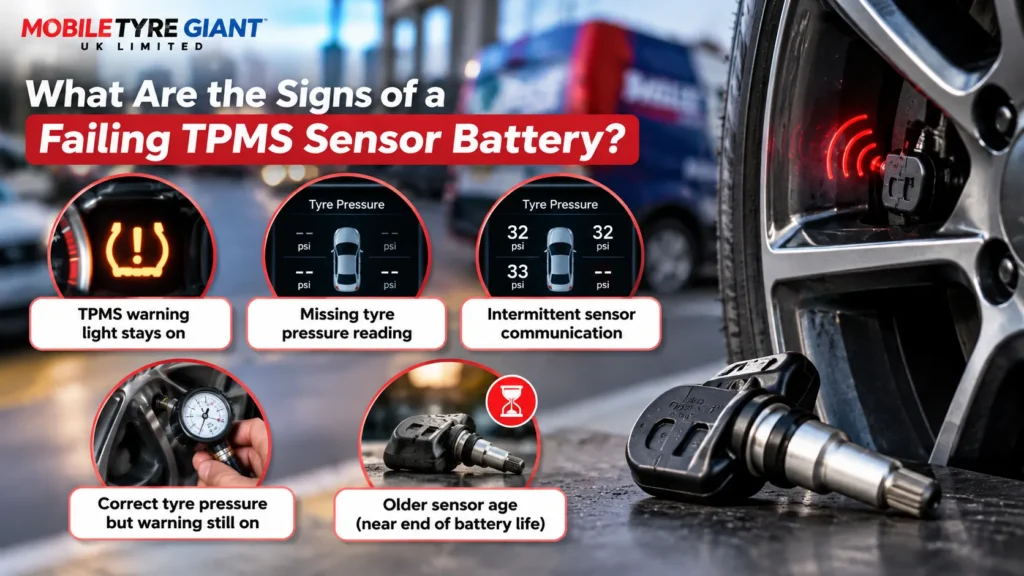
A failing TPMS sensor battery does not always produce one obvious symptom. On some vehicles, an individual tyre pressure reading may disappear from the dashboard, while other systems may show a general TPMS malfunction warning. You may also notice that the warning returns even after all four tyres have been checked and adjusted correctly. Intermittent behaviour can happen as an ageing sensor begins transmitting less reliably, although communication problems can also come from damage, programming faults or interference. This is why a battery problem should be diagnosed rather than assumed from the dashboard light alone.
Sensor age is another useful clue. If the vehicle still has its original sensors and is approaching the typical five-to-ten-year battery-life range, a failed battery becomes more likely than it would be on a relatively new car. The warning may also become more frequent during colder weather because ageing batteries can perform differently as temperatures drop. However, cold weather can also lower actual tyre pressure, which means the first step should still be confirming the pressure manually. A reliable gauge helps separate a real low-pressure event from a monitoring-system fault.
Can a TPMS Sensor Work Intermittently Before the Battery Dies?
Yes. An ageing TPMS sensor may sometimes communicate successfully and then fail to send a reading on another journey. The dashboard may temporarily regain the pressure display after the car has been driven, only for the fault to return later. Intermittent behaviour does not automatically prove that the internal battery is weak, but it is one possible explanation when the sensor is old and no physical damage is obvious. The vehicle’s receiver and TPMS electronics also need to be considered during diagnosis.
This intermittent stage is useful because it can give you warning before the sensor stops communicating completely. If the same wheel repeatedly loses its dashboard reading while the actual tyre pressure remains stable, have that sensor tested rather than waiting for the system to fail permanently. A diagnostic tool can usually determine whether the sensor is transmitting and help identify which corner of the vehicle is causing the problem. Replacing the correct failed sensor is much more sensible than fitting several new sensors based only on a warning light.
What Does a Flashing TPMS Light Mean?
On many vehicles, a TPMS light that flashes for a period after the ignition is switched on and then remains illuminated can indicate a system malfunction rather than simply low tyre pressure. The exact warning behaviour varies between manufacturers, so the vehicle handbook should be checked before interpreting the pattern as a universal rule. A malfunction can involve a failed sensor, depleted sensor battery, communication problem, programming issue or another fault within the TPMS. A steady warning, by contrast, is more commonly associated with low tyre pressure on many systems.
The practical response is the same at the beginning: check the actual tyre pressures first. If one tyre is low, correct it to the manufacturer’s specified cold pressure and inspect for the reason it lost air. If all pressures are correct but the warning behaves like a malfunction signal, the TPMS itself needs investigation. Do not keep resetting the warning without understanding the cause because a system fault may leave you without the pressure monitoring you expect during future driving.
Why Is the TPMS Light Still On After Correcting Tyre Pressure?
Some vehicles need to be driven for a short period before the system recognises that the pressures have been corrected. Others require a manual reset or relearn procedure through the dashboard, infotainment system or another vehicle-specific process. If the correct procedure has been followed and the warning remains, there may be a sensor or system fault rather than a pressure problem. This is especially worth investigating when one wheel no longer reports a reading while the others continue working normally.
Repeatedly adding more air because the warning remains can create a different problem. If the tyre is already at the correct pressure, adding extra PSI will not repair a dead sensor battery and may leave the tyre over-inflated. Use the manufacturer’s pressure specification rather than the warning light itself to decide how much air belongs in the tyre. If the pressure is correct, move the diagnosis towards the TPMS system instead of continuing to change the tyre pressure.
How Is a Failing TPMS Sensor Diagnosed?
Professional diagnosis normally begins by confirming tyre pressures and then checking whether each direct TPMS sensor is communicating. A TPMS diagnostic tool can be held close to each wheel to activate or read the sensor. Depending on the system and equipment, the tool may identify the sensor ID, measured pressure, temperature and battery or sensor status. If three sensors respond normally and one does not, the faulty corner becomes much easier to identify. Vehicle diagnostics can then confirm whether the car is receiving the expected sensor information.
Diagnosis should also include the physical condition of the valve and sensor where appropriate. A sensor that has been damaged during tyre fitting may stop communicating even though its battery still has useful life. Likewise, a valve leak can cause genuine low pressure while the sensor electronics continue working correctly. These faults require different repairs, which is why replacing a sensor simply because the TPMS light is on can waste money. If a tyre needs to be removed to access the sensor, mobile tyre fitting can also provide an opportunity to inspect the wheel and tyre condition at the same time.
Can a TPMS Sensor Battery Be Tested Directly?
The battery inside a sealed TPMS sensor is not normally tested by opening the sensor and putting a meter across the battery terminals. Instead, battery condition is usually assessed through TPMS diagnostic equipment if the sensor supports reporting that information. Some tools may show a battery status such as normal or low, while others simply reveal that the sensor no longer responds. Sensor age and communication behaviour then become part of the diagnosis.
A sensor that fails to respond is not automatically confirmed as having a dead battery because physical damage or electronic failure can produce the same result. That is why technicians consider several pieces of information together. If the sensor is old, has stopped transmitting and there is no sign of external damage, battery depletion becomes a strong possibility. The practical repair is still usually complete sensor replacement because the original sealed battery is not designed to be serviced separately.
Can TPMS Valve Corrosion Be Mistaken for a Dead Sensor Battery?
Yes. TPMS valves spend their lives exposed to water, road salt, brake dust and changing temperatures, so corrosion can become a problem even when the electronic sensor still works. A corroded valve stem or valve core may allow slow pressure loss, which can repeatedly trigger the warning system. The driver may assume the sensor battery has failed because the TPMS light keeps returning, when the real problem is that the tyre is genuinely losing air through the valve.
Corrosion can also make valve servicing more difficult because old components may seize or become fragile. The sensor and valve are often part of the same assembly, but that does not mean every valve problem requires replacing the entire electronic sensor. Depending on the design, service parts such as valve cores, seals or stems may be replaceable separately. The condition should be inspected before deciding whether the problem is mechanical, electronic or both.
Can a Leaking TPMS Valve Drain the Sensor Battery Faster?
A leaking valve does not normally drain the TPMS battery in the same direct way that leaving a light switched on drains a normal battery. However, some sensor systems may transmit differently when pressure changes are detected, and repeated pressure changes can influence communication behaviour depending on the design. The more important issue is that the leaking valve creates a genuine tyre-pressure problem that needs to be repaired independently of battery condition.
If the tyre repeatedly drops several PSI, topping it up every week is not a long-term solution. The valve, tyre bead, puncture area and wheel should be inspected to find where the air is escaping. A slow leak can damage the tyre if it is repeatedly driven under-inflated. Correct diagnosis protects both the tyre and the TPMS system rather than treating every warning as an electronic problem.
Should You Replace One TPMS Sensor or All Four?
You do not automatically need to replace all four TPMS sensors when one fails. If the other sensors are relatively young, communicate normally and show no signs of battery problems, replacing only the failed sensor is often reasonable. This keeps the repair focused on the actual fault rather than replacing working components unnecessarily. The new sensor must still be compatible with the vehicle and correctly programmed or relearned so the car recognises it.
The decision becomes more complicated when all four sensors are the same age and are approaching the end of their expected service life. If one original eight- or nine-year-old sensor has already failed because of battery depletion, the remaining sensors may also be nearing the same stage. Replacing all of them during the same tyre service can reduce the chance of paying repeatedly to remove tyres as each sensor fails separately. Whether that makes financial sense depends on sensor age, labour costs and how long you intend to keep the vehicle.

Is It Worth Replacing TPMS Sensors When Changing All Four Tyres?
Sometimes. If the sensors are already old and the tyres are being removed anyway, replacing ageing sensors can be more efficient than waiting until one fails shortly after the new tyres have been fitted. The wheel is already accessible, so part of the labour involved in reaching the sensor is already being carried out. This does not mean new sensors should automatically be fitted every time four tyres are changed. Sensor age and diagnostic condition should guide the decision.
For newer sensors, replacing four healthy units provides little benefit simply because the tyres are new. A better approach is to inspect them, check communication and consider whether the valve service components need attention. If the vehicle is seven, eight or nine years old and still uses its original sensors, discussing replacement during a full tyre change becomes more reasonable. Planning the work can help avoid another tyre removal shortly afterwards.
What Happens When a TPMS Sensor Stops Communicating Completely?
When a direct TPMS sensor stops transmitting, the vehicle can no longer receive pressure information from that wheel. Depending on the car, the dashboard may show a missing pressure value, a TPMS malfunction warning or a general warning lamp. The tyre itself may still be at the correct pressure, but the driver has lost electronic monitoring for that wheel. This is why the fault should not be ignored simply because the tyre looks normal.
Until the system is repaired, pressure should be checked manually with a reliable gauge more frequently because you cannot depend fully on TPMS monitoring. The underlying tyre and valve should also be inspected to make sure there is no separate pressure-loss problem. Once the failed sensor is replaced, it may need to be programmed or relearned before the warning clears. The system should then be checked again to confirm that all monitored wheels are communicating correctly.
How Is a TPMS Sensor Replaced?
Replacing a direct TPMS sensor normally requires the tyre to be partially or fully removed from the wheel so the sensor can be accessed safely. The vehicle is lifted, the wheel is removed, the tyre bead is carefully released from the rim and the old sensor or valve assembly is removed. The technician then fits a compatible replacement sensor and any required valve components before the tyre is reseated and inflated. This is why TPMS sensor replacement is more involved than replacing an external valve cap or changing a key-fob battery.
Care is important because the sensor sits inside the wheel close to the area where tyre fitting equipment works. Incorrect tool positioning can damage the new or existing sensor during bead removal or refitting. Once the sensor is installed, the tyre should be inflated to the correct vehicle specification and the wheel refitted securely. If the vehicle requires sensor programming or relearning, that step must also be completed before the job is considered finished.
Does the Tyre Need to Come Off to Replace a TPMS Sensor?
In most direct TPMS systems, yes, because the sensor is mounted inside the wheel. The tyre usually needs to be moved away from the valve area so the technician can reach the sensor without damaging the bead or internal components. On some wheel and tyre combinations, the complete tyre may not need to be removed from the rim, but the bead still needs to be broken and moved enough to access the sensor safely.
This access requirement is one reason sensor replacement is often convenient during tyre fitting. If the tyre is already being removed, the sensor can be inspected or replaced without repeating the same access work later. It is also why replacing one ageing sensor shortly after fitting new tyres can feel frustrating. Planning sensor replacement around tyre changes can sometimes save duplicated labour when the sensors are already near the end of their expected battery life.
Does a New TPMS Sensor Need Programming?
Often, yes. A replacement sensor normally has its own identification code, and the vehicle needs to recognise that code before it can use the sensor correctly. Some replacement sensors are programmed to match the vehicle specification before installation, while others may be cloned from the old sensor ID. The exact procedure depends on the sensor type and vehicle. A compatible sensor that has not been programmed correctly may physically fit the wheel but still fail to communicate with the car.
Programming and relearning are related but not always the same step. Programming prepares the sensor with the correct protocol or identification information, while relearning allows the vehicle to register which sensors are fitted and where they are located. Some vehicles handle relearning automatically after driving, while others require a diagnostic procedure. This is why fitting the sensor is only part of the job.
What Is TPMS Relearning?
TPMS relearning is the process that allows the vehicle to recognise the sensor IDs fitted to the wheels. Depending on the car, the process may happen automatically after a drive, may require a dashboard sequence or may need diagnostic equipment. Some vehicles also need the sensors assigned to specific wheel positions so the dashboard can display the correct front-left, front-right, rear-left or rear-right pressure.
The vehicle handbook usually explains any driver-accessible reset or relearn procedure, but not every replacement can be completed without specialist equipment. If a new sensor has been installed and the TPMS warning remains, do not assume the replacement part is defective immediately. The vehicle may simply not have completed its relearn process. Confirm the correct procedure before replacing more components.
How Much Does TPMS Sensor Replacement Usually Cost?
The total cost varies because there are several parts to the job. The replacement sensor itself has a cost, and there may also be labour for tyre removal, sensor installation, wheel refitting and programming or relearning. Sensor prices vary between original equipment, direct replacement and programmable aftermarket options. The type of valve and whether any additional service parts are needed can also affect the total.
Replacing a sensor during an existing tyre change may sometimes reduce duplicated labour because the wheel and tyre are already being worked on. Replacing a failed sensor on its own may involve more labour because the tyre has to be accessed specifically for the sensor. The cheapest sensor is not automatically the best value if it is incompatible with the vehicle or cannot be programmed correctly. Compatibility and reliable communication matter more than simply choosing the lowest-priced part.
Is It Cheaper to Replace TPMS Sensors During a Tyre Change?
It can be. When a tyre is already being removed, the fitter already has access to the sensor area, so replacing an old sensor at the same time can avoid another bead break and refit later. This can be especially useful when all four sensors are nearing the end of their typical battery life and all four tyres are being replaced. The exact saving depends on the workshop or mobile service pricing.
However, replacing young and healthy sensors simply because the tyres are off does not necessarily save money in the long term. The decision should be based on sensor age, diagnostic results and expected remaining life. If the sensors are only a few years old and working normally, inspection may be enough. If they are approaching ten years old and one has already failed, preventive replacement becomes easier to justify.
Can You Drive With a Failed TPMS Sensor?
A failed TPMS sensor does not automatically mean the tyre itself is unsafe, but it does mean you have lost part of the monitoring system. If the tyre pressures have been manually checked and the tyres are otherwise in good condition, the vehicle may still be physically capable of driving normally. The problem is that the failed sensor can no longer warn you if that tyre later loses pressure. You therefore need to rely more heavily on manual pressure checks until the system is repaired.
For vehicles covered by the relevant UK MOT requirements, an obviously malfunctioning TPMS can also create an MOT issue. That makes repair important even when the tyre pressure is currently correct. Do not ignore a persistent TPMS fault for months simply because the car feels normal. The system exists to alert you to pressure loss before the problem becomes obvious through handling or appearance.
Will a Failed TPMS Sensor Fail an MOT?
On applicable vehicles, yes, a TPMS that is malfunctioning or obviously not working can be recorded as a major MOT defect. The exact MOT requirement depends on vehicle category and first-use date, so not every older car is treated the same way. For many M1 passenger vehicles first used on or after 1 January 2012, TPMS operation is part of the inspection.
This is another reason a warning light should not simply be reset repeatedly without diagnosis. If the sensor battery is dead, the fault will normally return because the underlying problem has not changed. Replacing the failed sensor and completing the required programming or relearn process restores the monitoring function and addresses the actual fault rather than hiding the warning temporarily.
Can TPMS Sensors Be Damaged During Tyre Fitting?
Yes. A direct TPMS sensor is mounted inside the wheel close to the tyre bead, which means tyre fitting equipment must be positioned carefully around it. If the fitter does not know where the sensor is located, a tyre lever or fitting head can strike the sensor and crack the housing or damage the valve. This is one reason experienced tyre fitting becomes particularly important on vehicles with direct TPMS.
The risk does not mean TPMS-equipped tyres are difficult to fit when the correct procedure is followed. The sensor position is identified before the bead is moved, and the fitting sequence is chosen to keep tools away from the sensor. If a TPMS warning appears immediately after tyre work when there was no warning beforehand, physical sensor damage or an installation issue should be considered during diagnosis.
Should TPMS Valves Be Serviced During Tyre Replacement?
Where serviceable valve components are fitted, inspecting or replacing appropriate seals, cores or valve parts during tyre replacement can be sensible. These small components are exposed to road dirt, moisture and repeated pressure cycles, and their condition can affect air retention. The exact service kit depends on the sensor and valve design, so parts should not be mixed between incompatible systems.
A healthy electronic sensor can still be paired with a leaking or corroded valve. Servicing the valve components during a tyre change can therefore help prevent a future slow leak that might otherwise be mistaken for a failing sensor. If the complete valve assembly is damaged, our TPMS valve replacement service can address the mechanical side of the system without assuming the electronics themselves are necessarily at fault.
Can Changing Wheels or Tyres Affect TPMS Operation?
Changing tyres alone should not normally stop a healthy TPMS sensor from working, provided the sensor is not damaged during fitting and the tyre remains compatible with the wheel. Problems are more likely when complete wheels are changed, such as switching to a second set of seasonal wheels without compatible sensors. The vehicle may then fail to recognise the new sensor IDs until the system is programmed or relearned.
Wheel position can also matter on systems that display individual corner pressures. Rotating wheels may cause the dashboard position to become incorrect until the vehicle completes a relearn process. If the car shows the wrong wheel location or a sensor disappears after a wheel change, check the relearn requirements rather than assuming the battery has suddenly failed.
Can Aftermarket Wheels Use the Original TPMS Sensors?
Often they can, but compatibility needs to be confirmed. The new wheel must physically accommodate the sensor and valve design, and the sensor must remain compatible with the vehicle’s TPMS protocol. Valve hole size, wheel profile and clearance inside the rim can all matter. Simply transferring the old sensor without checking fitment can cause leaks or physical interference.
Sensor age should also be considered before transferring older TPMS units into new wheels. Moving an eight- or nine-year-old sensor into a freshly fitted wheel may save money initially but can result in another tyre removal if the battery fails soon afterwards. If the sensors are already close to the end of their expected life, replacement during the wheel change may be the more practical option.
When Should TPMS Sensors Be Replaced Preventively?
TPMS sensors do not have to be replaced simply because they have reached a particular birthday, but age becomes increasingly relevant as the original batteries approach the later part of their expected service life. A sensor that is seven, eight or nine years old and still working normally may continue operating for some time, while another of the same age may fail sooner. The decision should therefore combine age with diagnostic results, communication quality, valve condition and whether the tyres are already being removed. Preventive replacement makes the most sense when access to the sensor is already available and the remaining battery life is uncertain.
This is particularly worth considering when all four original sensors are the same age. If one has already failed because its battery is exhausted, the others may not be far behind, although they do not have to fail at exactly the same time. Replacing all four can sometimes avoid repeated tyre removal over the following months or years. On the other hand, replacing four healthy sensors that are still relatively young may add unnecessary cost. There is no universal rule that every TPMS sensor must be replaced after a fixed number of years.
Should TPMS Sensors Be Replaced at Seven or Ten Years Old?
There is no automatic rule that a sensor must be replaced at seven, eight or ten years. The commonly quoted battery-life range of around five to ten years describes typical service life rather than a guaranteed expiry date. A sensor that is still communicating correctly and has a healthy valve assembly may continue working beyond that range. Another may fail sooner because of battery depletion, physical damage or environmental exposure.
Sensor age becomes more useful when combined with the timing of tyre replacement. If a vehicle is approaching ten years old, still has its original TPMS sensors and all four tyres are already coming off, replacing ageing sensors may be more convenient than waiting for them to fail individually. If the vehicle is much newer and diagnostic checks show healthy sensors, there is little reason to replace them only because the tyres are being changed.
Can You Extend the Life of a TPMS Sensor Battery?
There is very little a driver can do to directly recharge or extend a sealed TPMS battery because its operating behaviour is controlled by the sensor electronics. You cannot switch the sensor off manually between journeys or replace the battery as part of routine maintenance. The most useful approach is therefore to protect the overall sensor assembly from avoidable damage rather than trying to preserve the battery itself. Careful tyre fitting, correct valve servicing and avoiding unnecessary impact damage can help the sensor reach its normal service life.
Using the correct tyre pressure also protects the wider wheel and tyre system. A TPMS sensor is designed to monitor pressure, but it should not become the only reason you check the tyres. Monthly manual checks can identify a slow leak before repeated low-pressure warnings become normal. If you are unsure how PSI, bar and kPa relate when comparing dashboard readings with a gauge, our tyre pressure conversion guide can help you match the units correctly.
Does Frequent Driving Drain TPMS Batteries Faster?
Driving can influence how often some direct TPMS sensors wake up and transmit, but the exact behaviour depends on the sensor and vehicle design. Many sensors use motion detection and different transmission modes to conserve battery power while the vehicle is parked. A car that is used heavily may therefore accumulate more active sensor time than one that spends long periods stationary. However, this does not provide a useful reason to change normal driving habits simply to save the TPMS battery.
The battery is designed to support years of normal vehicle use. It makes more sense to treat TPMS battery depletion as a long-term service-life issue rather than something the driver needs to manage day by day. When the sensor eventually reaches the end of its life, replacement is the normal solution. Trying to reduce vehicle use purely to preserve a TPMS battery would provide little practical benefit.
What Should Be Checked After a New TPMS Sensor Is Fitted?
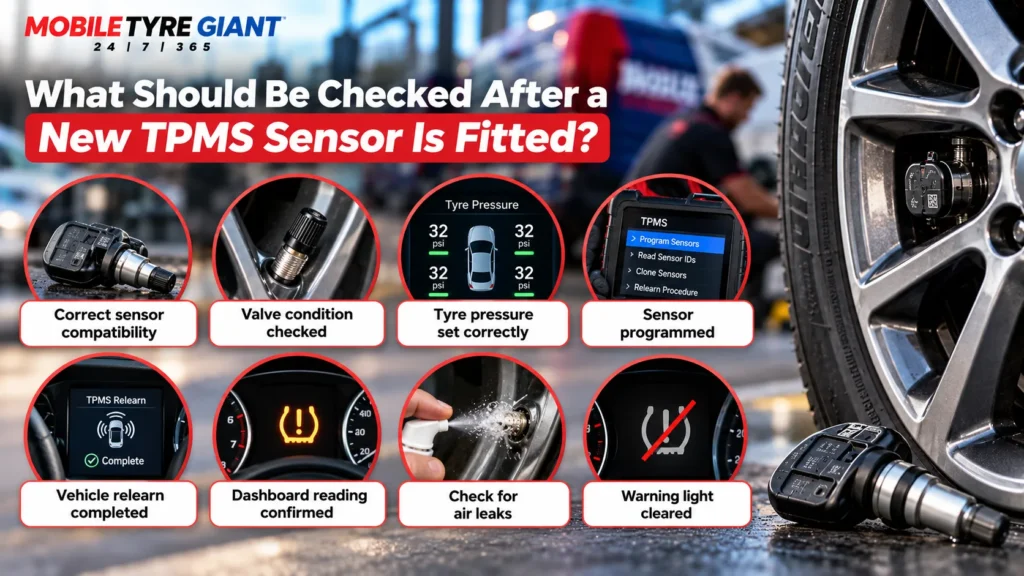
After replacement, the first check is whether the new sensor is communicating correctly with the vehicle. The tyre should be inflated to the manufacturer’s recommended cold pressure, the sensor should be programmed or relearned where required, and the dashboard should recognise the monitored wheel. If the vehicle displays individual tyre pressures, make sure the correct pressure appears in the correct wheel position after the relearn procedure has completed. A successful installation means more than simply fitting the sensor inside the rim.
The valve should also be checked for air leakage, especially after the tyre has been reinflated. The tyre itself should be inspected for any puncture or bead issue that may have contributed to the original warning. If a TPMS fault was investigated because one tyre repeatedly lost pressure, replacing the sensor will not repair an unrelated puncture. A genuine leak may instead need professional mobile tyre repair where the damage is suitable for repair.
TPMS Sensor Replacement Checklist
The table below provides a simple sequence of checks after sensor replacement. Not every vehicle follows exactly the same programming method, but the general principles remain useful.
Check | What to Confirm |
Sensor compatibility | Correct frequency and vehicle protocol |
Valve condition | Secure installation with no visible damage |
Tyre pressure | Set to the manufacturer’s cold specification |
Sensor programming | Replacement sensor configured correctly |
Vehicle relearn | Car recognises the new sensor ID |
Dashboard reading | Correct wheel reports pressure where supported |
Air leakage | Valve and bead hold pressure normally |
TPMS warning | Warning clears after the required procedure |
Follow-up | Pressure remains stable after normal driving |
A checklist is useful because more than one problem can exist at the same time. For example, a new sensor can communicate perfectly while the tyre continues losing air through a puncture. Likewise, a sensor may be installed correctly but still not appear on the dashboard because the relearn process has not been completed. Checking the complete system prevents one fault from being mistaken for another.
What if the TPMS Warning Returns After Sensor Replacement?
A warning that returns after replacement does not automatically mean the new sensor has failed. The vehicle may not have completed its relearn process, the sensor may have been programmed incorrectly or another wheel may have a separate TPMS problem. Actual tyre pressure should be checked again as well because a genuine leak can trigger the system even when the replacement sensor is functioning correctly. Diagnosis should therefore start with the same basics rather than immediately removing the new sensor.
If the warning behaves like a system malfunction, diagnostic equipment can confirm whether all sensor IDs are being received. If the dashboard instead shows one tyre gradually losing pressure, inspect the tyre, valve and wheel for a leak. Replacing electronics will not solve physical air loss. A methodical approach is especially useful on older vehicles where more than one original sensor may be approaching the end of its battery life.
Can Another TPMS Sensor Fail Soon After One Is Replaced?
Yes, particularly when all four original sensors were fitted at the same time and are now of a similar age. If one battery reaches the end of its life, the other sensors may also be approaching the same stage. This does not mean another failure is guaranteed within days or weeks, but it becomes more plausible on an older set of sensors. That is why age should be discussed when deciding whether to replace only one sensor or several.
If you choose to replace just the failed sensor, monitor the system normally rather than assuming the others must immediately be changed. If another sensor later stops communicating, diagnosis can confirm whether it has also reached the end of its life. Preventive replacement is mainly a convenience and cost-planning decision, not a requirement to throw away functioning sensors.
Final Words: TPMS Batteries Last Years, but They Do Not Last Forever
Direct TPMS sensors are designed to operate for years with almost no attention from the driver, but their sealed batteries eventually reach the end of their service life. A typical lifespan is often around five to ten years, although actual life varies by sensor design, vehicle use and operating conditions. When a sealed battery fails, the normal repair is to replace the complete sensor rather than trying to open it and install a new battery. Proper diagnosis should always come first because low tyre pressure, valve leaks and sensor damage can create similar warnings.
The best approach is to treat TPMS as part of normal tyre maintenance rather than waiting until the warning system stops working completely. Check pressures manually, investigate persistent warnings, inspect sensors and valves during tyre changes and consider sensor age when several original units are approaching the end of their expected life. After replacement, make sure the new sensor is compatible, programmed correctly and recognised by the vehicle. A working TPMS supports tyre safety, but it works best alongside regular manual pressure and tyre-condition checks.
TPMS Warning Light or Sensor Battery Problem?
If your TPMS warning stays on, a tyre pressure reading disappears or an ageing sensor stops communicating, get the system checked before the fault gets worse.
Frequently Asked Questions
Find quick answers to the most common questions our customers ask.
A direct TPMS sensor battery commonly lasts around five to ten years, although there is no guaranteed lifespan for every vehicle. Sensor design, driving patterns, environmental conditions and age can all affect how long the battery continues transmitting reliably before the complete sensor needs replacement.
Most factory-style direct TPMS sensors use a sealed battery that is not designed for routine replacement. When the battery is exhausted, the usual repair is to replace the complete sensor assembly and then program or relearn the new sensor to the vehicle where required.
Possible signs include an individual pressure reading disappearing, intermittent sensor communication or a persistent TPMS malfunction warning even when the tyre pressures are correct. Sensor age can strengthen the suspicion, but diagnostic testing is the best way to distinguish a weak battery from physical damage, programming problems or another TPMS fault.
Not necessarily. On many vehicles, a flashing TPMS warning followed by a steady light indicates a system malfunction, but the fault could involve a sensor battery, damaged sensor, communication problem or programming issue. Check the vehicle handbook and actual tyre pressures before assuming the battery is responsible.
No. One failed TPMS sensor can normally be replaced on its own if the others are working correctly. Replacing all four may make sense when they are the same age and approaching the end of their typical battery life, particularly if the tyres are already being removed.
Many replacement TPMS sensors need to be programmed with the correct vehicle protocol or sensor information, and the vehicle may also require a relearn procedure. The exact process varies between manufacturers, so fitting a compatible sensor physically into the wheel is not always enough for the system to begin working.
The tyre may still be physically safe if its pressure and condition are checked manually, but the failed sensor means you no longer have full electronic pressure monitoring. The fault should be repaired, particularly on vehicles where a malfunctioning TPMS is included in the applicable MOT inspection requirements.
For applicable UK vehicles, an obviously malfunctioning TPMS can be recorded as a major MOT defect. Requirements depend on vehicle category and first-use date, so older vehicles may not be treated in exactly the same way. A persistent TPMS fault should therefore be diagnosed rather than ignored.
Yes. Direct TPMS sensors sit inside the wheel close to the tyre bead, so incorrect use of tyre fitting equipment can damage the sensor or valve. A competent fitter identifies the sensor position and uses the correct fitting sequence to reduce the risk of striking it.
It can be worthwhile when the sensors are already old and approaching the end of their expected battery life because the tyres are already being removed. Younger sensors that communicate normally usually do not need replacing simply because new tyres are being fitted. Age, diagnostic condition and future labour should guide the decision.