

Wheel spacers can look like a simple modification. They sit between the wheel and hub and move the wheel slightly further outward, often to improve clearance, accommodate a different wheel setup or change how the wheels sit within the arches. The spacer itself may only be a few millimetres thick, but that small change affects how the wheel locates on the hub, how the fixings engage and how much clearance exists around the tyre. That is why a tyre change on a vehicle fitted with spacers deserves more attention than simply removing the old tyre and fitting a new one. The tyre may be perfectly suitable, but the complete wheel assembly still has to fit and secure correctly.
A safe tyre fitting therefore involves checking the spacer as part of the wheel system rather than treating it as an unrelated accessory. The fitter needs to know whether the spacer is the correct type for the hub, whether it sits completely flat, whether the wheel bolts or studs provide suitable engagement and whether the tyre clears the bodywork and suspension throughout normal wheel movement. Existing vibration, unusual tyre wear or signs of rubbing should also be investigated before the vehicle goes back on the road. If a tyre needs replacing on a modified wheel setup, professional mobile tyre fitting should include careful wheel security and fitment checks rather than assuming the spacer can simply be ignored.
What Are Wheel Spacers and Why Do They Matter During Tyre Fitting?
A wheel spacer is fitted between the vehicle hub and wheel mounting face, increasing the distance between the wheel and the hub. In practical terms, it pushes the wheel outward. Depending on the vehicle and spacer thickness, this can create more clearance between the inside of the wheel and suspension components or produce a wider visual stance. Some drivers use spacers when fitting aftermarket wheels, while others use them to address a particular clearance issue. Whatever the reason, the spacer becomes part of the connection between the wheel and the vehicle once it is installed.
That connection matters enormously during tyre fitting because the tyre is only as secure as the wheel assembly carrying it. The fitter is not simply checking whether the new tyre fits the rim. They also need to consider whether the wheel sits correctly against the spacer, whether the spacer sits correctly against the hub and whether the fixing system remains appropriate for the new mounting position. Rust, dirt, paint build-up or an incorrectly shaped spacer can prevent the components from sitting completely flush. Even a small amount of unwanted movement or poor seating can create vibration, affect wheel security or make the vehicle feel different after the tyre change.
How Do Wheel Spacers Change Wheel Position and Offset?
Wheel offset describes where the wheel mounting face sits relative to the centreline of the wheel. Adding a spacer effectively moves the wheel outward and reduces the effective positive offset by approximately the thickness of the spacer. For example, fitting a 10mm spacer moves the wheel roughly 10mm further away from the hub mounting surface. That change may sound minor, but it affects the position of both the wheel and tyre relative to the wheel arch, suspension and steering components.
The important issue is clearance. Moving the wheel outward may solve an inner clearance problem, but it can create a new problem on the outside of the wheel arch. The tyre may sit closer to the arch liner, wing or bodywork when the suspension compresses or the steering reaches full lock. A setup that appears perfectly clear while the car is parked can behave differently over a bump or during a tight turn. That is why fitment should be assessed dynamically as well as visually. Tyre width, wheel width, offset, spacer thickness and suspension setup all work together, so changing one measurement can affect several others.
What Is the Difference Between Hub-Centric and Simple Slip-On Spacers?
A hub-centric spacer is designed to locate closely around the vehicle’s hub centre and usually provides a matching centre lip for the wheel. This helps the wheel remain centred in the same way it would on the original hub. A simple slip-on or shim-style spacer may be thinner and may rely more heavily on the existing hub spigot extending far enough through the spacer to continue locating the wheel. The exact suitability depends on the vehicle, spacer thickness, hub design and wheel centre bore.
The important point during tyre fitting is not that one label automatically makes a spacer safe. The fitter needs to confirm that the specific spacer and wheel combination locates properly and sits flat without rocking or gaps. A spacer with the wrong centre bore, PCD or profile can interfere with proper seating even if the wheel bolts can physically be installed. Likewise, a thick spacer may reduce the available hub-centre engagement if the design does not provide an appropriate replacement locating lip. Correct fit is more important than simply being able to tighten the wheel onto the car.
Why Should You Tell the Tyre Fitter That Wheel Spacers Are Installed?
Always tell the tyre fitter that spacers are fitted, particularly if they are not immediately obvious from outside the vehicle. The fitter may need to manage non-standard bolts, extended studs, locking wheel fixings or bolt-on spacers differently from the factory wheel setup. If a spacer remains attached to the hub when the wheel comes off, it should not simply be treated as part of the hub without inspection. Its mounting surface, condition and seating all matter before the wheel is refitted.
This becomes particularly important if the car has been purchased used and you do not know exactly which parts are standard. Extended bolts can look similar to original bolts until they are placed side by side, while some bolt-on spacer designs use a separate set of fixings beneath the wheel. Mixing the wrong bolts with the spacer setup can compromise wheel security. If a locking wheel bolt is damaged, seized or cannot be removed using the supplied key, the locking wheel nut removal service may be needed before the tyre can be safely removed and replaced.
Do Wheel Spacers Need Longer Wheel Bolts or Studs?
Many slip-on spacer installations require longer wheel bolts or suitable extended studs because the spacer increases the distance between the wheel and the original mounting surface. Reusing a standard bolt after adding a spacer can reduce the amount of thread engagement available to secure the wheel. A bolt may appear tight even though it is engaging fewer threads than the original setup. That is why bolt length, thread type, seat profile and compatibility must all be checked rather than judged simply by whether the bolt turns into the hub.
At the other extreme, a bolt that is too long can also create problems. Depending on the vehicle, an excessively long bolt may contact components behind the hub or bottom out before the wheel is properly clamped. The correct fixing therefore needs to suit the spacer thickness, wheel design and vehicle hub. Bolt-on spacers use a different arrangement again because the spacer may first be secured to the hub and the wheel then secured separately to the spacer. In every design, the correct hardware and manufacturer-specified tightening procedure are fundamental to safe wheel fitment.
Why Must the Spacer and Wheel Sit Completely Flush?
The hub face, spacer and wheel mounting face should create a flat, stable stack with no dirt, corrosion or foreign material holding one surface away from another. Imagine placing two sheets of glass together with a small stone trapped between them. The surfaces may touch around most of the area, but they cannot sit properly flat. The same principle applies to a wheel assembly. Rust scale or debris trapped behind a spacer can prevent full contact even when the wheel bolts initially feel tight.
Once the vehicle is driven, the components can settle or move slightly as loads pass through the wheel. If the mounting faces were not properly seated, that movement can reduce clamping force and contribute to vibration or looseness. This is why the hub and mounting surfaces should be inspected and cleaned when the wheel is removed. The spacer should not rock or leave a visible gap, and the wheel should then sit properly against the spacer. Wheel security deserves the same attention as tyre condition because a perfectly healthy tyre is of little use if the wheel carrying it is not mounted correctly.
Can Tyres Be Fitted Safely on a Car With Wheel Spacers?
Yes, tyres can be fitted to vehicles using wheel spacers, but the spacer setup needs to be compatible and in safe condition. The presence of a spacer does not automatically make tyre fitting unsafe, and it does not automatically mean a vehicle will fail an MOT. What matters is the finished wheel assembly. The wheel must remain secure, its fixings must be compatible, and the tyre must not foul the vehicle. These are practical safety issues rather than questions of whether the car has been modified at all.
A fitter should therefore look beyond the tyre bead and tread. The spacer should fit correctly, the wheel should locate properly, the fixings should provide suitable engagement and the wheel should rotate without catching surrounding components. Once the vehicle is lowered, clearance also needs to make sense under steering and suspension movement. Regular tyre inspections remain important because rubbing, unusual shoulder wear or new vibration can be early signs that something in the wheel setup needs attention. The tyre safety guide provides a useful wider checklist for inspecting tread, pressure and tyre condition alongside these spacer-specific checks.
What Should Be Checked Before Refitting a Wheel With Spacers?
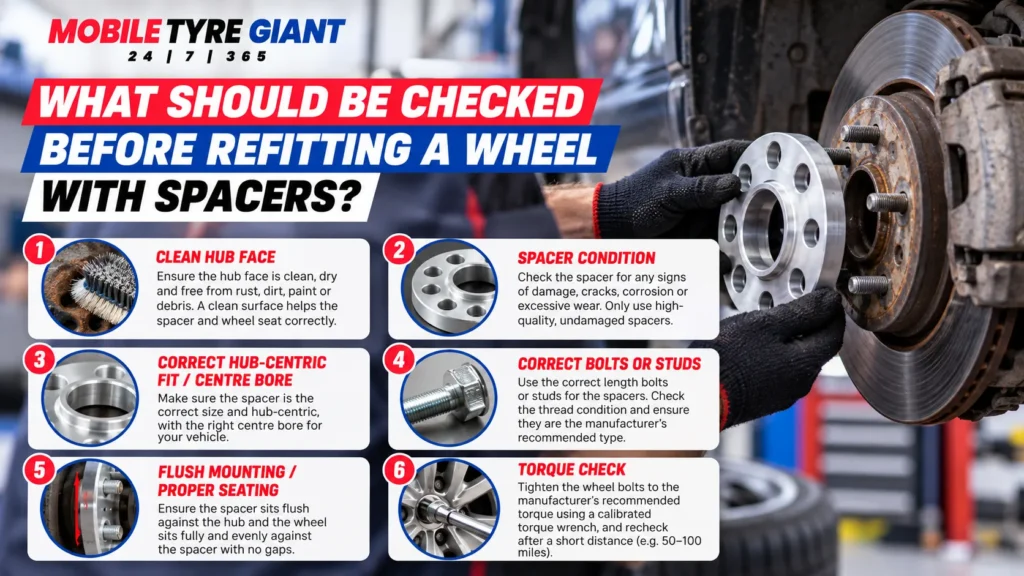
Before a wheel is refitted, the spacer and hub should be inspected rather than simply putting everything back in the same position. Check the spacer for cracks, distortion, damaged mounting holes, corrosion or signs that it has been moving against the hub. The mating surfaces should be clean and flat so the spacer can sit squarely against the hub. Heavy rust, dirt or trapped debris can prevent full contact and create a small gap that becomes more important once the wheel is carrying road loads. The wheel mounting face should also be checked for damage or contamination before it is placed over the spacer.
The fitter should then confirm that the spacer matches the vehicle and wheel setup correctly. That includes the bolt pattern, centre bore, spacer thickness and the way the wheel is located on the hub. If a spacer uses its own fixing hardware, those fixings should be inspected separately from the wheel bolts or nuts. The goal is to create a secure stack from hub to spacer to wheel with no rocking, gaps or mismatched components. A tyre change is therefore a useful opportunity to identify spacer problems that may otherwise remain hidden behind the wheel.
Why Is Hub-Centric Fitment Important?
Hub-centric fitment helps position the wheel concentrically around the vehicle hub rather than relying only on the wheel bolts or studs to centre it. When a spacer includes a correctly sized centre bore and suitable locating lip, it can help maintain that relationship after the wheel has been moved outward. This does not mean every hub-centric spacer is automatically safe, but correct centring reduces the chance of the wheel sitting slightly off-centre. Even a small centring error can contribute to vibration once the wheel begins rotating at road speed.
If the spacer does not locate properly on the hub, or the wheel cannot locate correctly on the spacer, the fitment should be investigated before tightening everything together. Forcing a wheel onto an incompatible centre lip or using a spacer with the wrong bore is not a sensible solution. The wheel should slide into its intended position without being held crooked by the fixings. When unexplained vibration appears after wheel or spacer work, centring should be one of the items checked alongside tyre condition and balance.
How Much Wheel Bolt or Stud Engagement Is Needed With Spacers?
The fixing system must provide enough thread engagement to secure the wheel properly after the spacer has been added. A slip-on spacer increases the distance between the wheel and hub, which means the original bolt may no longer reach far enough into the hub. The exact amount of engagement required depends on the vehicle, thread size and fixing design, so there is no universal number of turns that applies to every car. This is why extended bolts or studs should be selected according to the spacer and vehicle specifications rather than guessed from appearance.
Correct thread engagement is only one part of compatibility. The bolt or nut also needs the correct thread pitch, diameter and seat shape for the wheel. A tapered seat, radius seat and flat seat are not interchangeable simply because the bolt threads into the hub. Using the wrong seat can prevent the wheel from being clamped correctly against the spacer. If a wheel fixing looks different from the others, is difficult to tighten or does not seat normally, it should be checked before the vehicle is driven.
Can Standard Wheel Bolts Be Used With Wheel Spacers?
Sometimes, but only when the spacer design and remaining thread engagement allow it. Very thin spacers may still leave enough usable thread with the original bolts on certain vehicles, while thicker slip-on spacers commonly require longer fixings. The important question is not whether the standard bolt can physically reach the hub. It is whether the bolt provides the correct safe engagement and seat after the spacer has changed the wheel position.
Using longer bolts simply because a spacer is fitted is not automatically correct either. A bolt that is excessively long can bottom out or interfere with components behind the hub before the wheel is properly clamped. The correct bolt length should therefore be matched to the original fixing specification plus the spacer design. If there is any uncertainty, the wheel should not be refitted on the assumption that “tight enough” means secure enough.
How Important Is Correct Wheel Bolt Torque With Spacers?
Correct wheel bolt or wheel nut torque is critical because it creates the clamping force that holds the wheel assembly securely together. Too little torque can allow movement between the wheel, spacer and hub, while excessive torque can overstress threads or distort components. A spacer does not remove the need to follow the vehicle, wheel or spacer manufacturer’s specified tightening procedure. The fixings should be tightened evenly rather than fully tightening one side while the wheel is still sitting unevenly.
A calibrated torque wrench is the appropriate tool for the final tightening stage. Impact tools may be useful during removal or initial fitting when used correctly, but they should not replace controlled final torque. The wheel should normally be tightened in the correct sequence so clamping force is distributed evenly around the hub. This is particularly important with spacers because there are additional mating surfaces in the assembly. Good torque practice helps the wheel remain seated properly against those surfaces.
Should Wheel Bolts Be Rechecked After Fitting Spacers?
Some spacer and wheel manufacturers recommend rechecking torque after a specified period or distance, particularly after new components have been installed. The reason is that newly fitted surfaces can settle slightly during early use. If the particular spacer manufacturer provides a re-torque instruction, follow that guidance rather than inventing a universal mileage figure. The same principle applies after spacer removal and refitting during tyre work.
If a wheel develops clicking, knocking or vibration after refitting, do not simply continue driving until the next planned torque check. Stop and have the wheel assembly inspected. A loose wheel fixing is a serious safety concern, and a spacer can make diagnosis more complicated because there may be more than one set of fixings involved. Early inspection is much safer than assuming that new vibration is only a balancing issue.

Can Wheel Spacers Cause Tyres to Rub?
Yes, wheel spacers can contribute to tyre rubbing because they move the entire wheel and tyre assembly further outward. A tyre that previously cleared the arch may begin touching the inner liner, wing edge or another body component after the spacer is added. The amount of clearance lost depends on spacer thickness, tyre width, wheel offset, suspension height and steering geometry. A wider replacement tyre can make the issue more noticeable even when the spacer itself has not changed.
Rubbing is not always obvious while the car is parked with the wheels pointing straight ahead. The tyre moves relative to the body as the steering turns and the suspension compresses over bumps. This means clearance should be considered at full steering lock and through realistic suspension movement. If the vehicle has aftermarket wheels or non-standard tyre dimensions, confirming the correct tyre specification becomes even more important. Our correct tyre size guide explains the markings and fitment factors that should be checked when tyre size is in question.
Where Should You Check for Tyre Rubbing?
Start around the outer wheel arch and inner arch liner, looking for polished areas, scuff marks or exposed material that suggest repeated contact. Then inspect the inside of the tyre for marks near suspension struts, springs, control arms or other components. The inner sidewall is easy to overlook because it is less visible when the vehicle is on the ground. A tyre can therefore appear completely normal from outside while rubbing is taking place on the hidden side.
The steering should also be checked through both directions where practical and safe. A front tyre may clear everything while pointing straight ahead but come much closer to the liner or bodywork at full lock. Suspension compression can reduce clearance further when driving over bumps. If fresh rubbing marks are visible after a tyre change, do not assume the new tyre simply needs time to “settle in.” Tyre contact with another part of the vehicle needs to be corrected.
Can Wheel Spacers Cause Vibration After Tyre Fitting?
They can contribute to vibration if the wheel is not centred properly, the spacer is not seated flat or the fixing system has been disturbed during refitting. A small amount of dirt trapped behind the spacer can create runout, while an incorrect centre bore can leave the wheel slightly off-centre. The driver may then notice vibration through the steering wheel or body at certain speeds. Because the vibration appears after a tyre change, it is easy to assume that wheel balancing is always the cause.
Balance should certainly be checked, but it is only one possibility. The spacer, hub mating faces, wheel centring and fixings should also be inspected before repeatedly adding balance weights. If the tyre and wheel assembly itself is out of balance, professional mobile wheel balancing may resolve that problem. If the spacer is sitting incorrectly, however, balancing the wheel will not repair the underlying fitment issue.
How Can You Tell if Vibration Is From the Spacer or Wheel Balance?
Wheel imbalance often becomes noticeable within a particular speed range and may produce steering wheel shake or vibration through the vehicle. Spacer-related fitment problems can feel similar, especially when poor centring creates rotational movement. This overlap means symptoms alone cannot always identify the cause. The timing of the problem can provide a clue. If vibration begins immediately after spacers or wheels have been removed and refitted, the mounting arrangement deserves careful inspection before assuming a new tyre is defective.
A useful diagnostic process is to confirm correct wheel and tyre balance, then inspect the hub and spacer surfaces, centring and fixing hardware. The wheel should be removed if necessary so the mating faces can actually be seen rather than judged from outside. Repeatedly balancing a wheel that is not sitting concentrically on the hub may improve nothing. Accurate diagnosis saves time and avoids treating the tyre as the problem when the issue is actually how the wheel has been mounted.
What Are the Warning Signs of an Unsafe Wheel Spacer Setup?
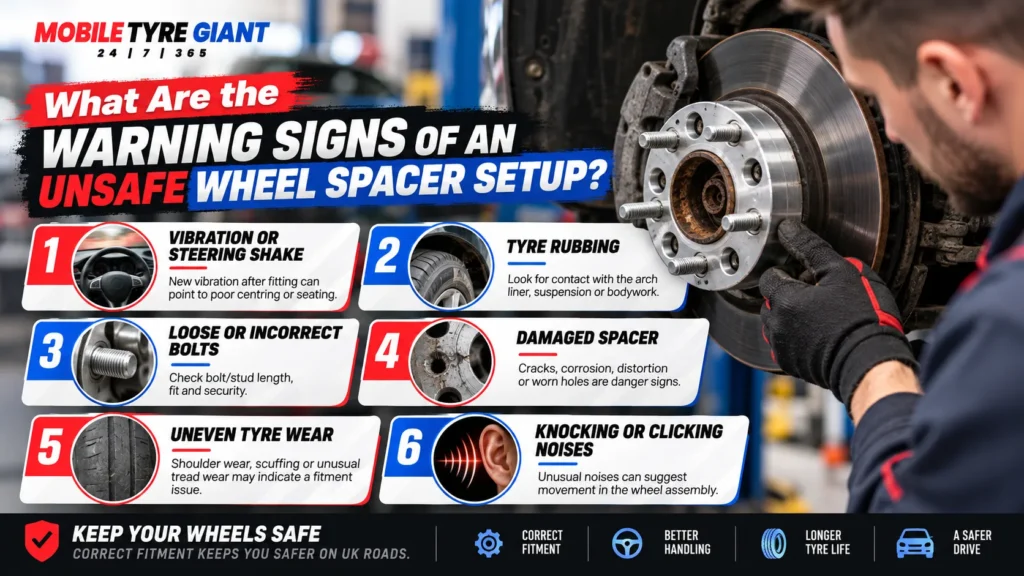
New vibration, repeated wheel bolt loosening, unusual knocking, visible spacer damage and tyre rubbing should all be treated as warning signs. Uneven tyre wear can also develop if the modified wheel position affects alignment or suspension behaviour. A wheel that suddenly looks as though it sits differently from the opposite side deserves investigation, particularly if the vehicle has recently hit a pothole or kerb. Do not assume that a spacer is safe indefinitely simply because it has been fitted for months without an obvious problem.
You should also pay attention after any tyre or wheel work because removing and refitting the assembly can reveal existing problems or introduce a fitment issue if the components are not reinstalled correctly. A safe spacer setup should remain secure, properly centred and free from interference with the tyre or surrounding components. If any part of the assembly looks damaged, incompatible or poorly seated, the safest approach is to correct the fitment before normal driving continues.
Should You Keep Driving if a Wheel With Spacers Starts Vibrating?
Persistent new vibration should be investigated rather than accepted as a normal side effect of using spacers. If the vibration is severe, accompanied by knocking or begins immediately after wheel work, reduce unnecessary driving and have the wheel assembly checked. The cause may be relatively simple, such as balance or centring, but wheel fixing problems also need to be ruled out. Continuing to drive makes little sense when the symptom involves the parts securing the wheel to the vehicle.
If the vibration is mild and existed before the tyre fitting, mention that history to the fitter because it can help separate an old issue from a newly introduced one. The important thing is not to keep adding balance weights or changing tyre pressures without confirming the mechanical fitment. Wheel spacers introduce extra components into an area where accurate mounting matters. When something feels different after refitting, checking those components systematically is the safest response.
Are Wheel Spacers Legal and MOT-Safe in the UK?
Wheel spacers are not automatically an MOT failure simply because they are fitted to a car. The important question is whether the modification leaves the wheel, tyre and surrounding components safe and secure. Current UK MOT inspection requirements include wheel security, compatible wheel fixings, wheel and hub condition, tyre condition and whether a tyre is fouling another part of the vehicle. This means a properly fitted spacer setup may present no MOT issue, while an insecure wheel, incompatible fixing or rubbing tyre can result in a defect. The spacer therefore needs to be judged as part of the complete wheel installation rather than as an isolated accessory.
This distinction is important because drivers sometimes assume that passing an MOT proves a spacer setup is permanently safe. An MOT is an inspection of the vehicle’s condition at the time of the test. Components can loosen, wear or become damaged afterwards, and changes such as different tyres or wheels can alter existing clearances. A setup that passed previously should still be inspected whenever wheels are removed, new tyres are fitted or vibration develops. Safe wheel fitment remains the driver’s responsibility between MOT tests.
Can Wheel Spacers Cause an MOT Failure?
Spacers themselves are not listed as an automatic reason for rejection, but problems associated with them can lead to an MOT failure. A loose or missing wheel nut, bolt or stud is considered a significant defect, and wheel fixings that are incompatible with the wheel can also be rejected. Tyres are checked for fouling against other parts of the vehicle, so a spacer that pushes a tyre into contact with the bodywork or another component can create a problem. Wheel and hub security are therefore particularly important on a modified setup.
A tyre may also fail for reasons that developed indirectly after the wheel position changed. Persistent rubbing can damage the sidewall or tread, while an unsuitable wheel position may contribute to abnormal wear. This is why an MOT should not be viewed as the first time spacer clearance is checked. If there are visible rubbing marks, damaged fixings or unexplained wheel movement, address them when they appear rather than waiting for the next test.
Should You Tell Your Insurer About Wheel Spacers?
Wheel spacers alter the original wheel position, so they may be considered a vehicle modification by an insurer. Whether they affect your policy depends on the insurer and the terms of your cover. The safest approach is to tell your insurer about the modification and allow them to confirm whether any policy information or premium needs to change. Do not assume that a relatively small spacer thickness is automatically too minor to mention.
Keeping records of the spacer specification and professional fitting can also be useful. If the wheels, tyres or spacers are changed again, update the information where required rather than relying on details from the previous setup. Insurance questions are separate from whether the vehicle passes an MOT. A spacer installation can be mechanically sound while still being something your insurer expects you to declare.
Can Wheel Spacers Affect Suspension and Wheel Bearings?
Moving the wheel further outward changes the position at which road forces act relative to the hub and suspension. Depending on spacer thickness, wheel offset and the original vehicle geometry, this can alter leverage on wheel bearings and other components. A small, correctly engineered change does not mean a bearing will suddenly fail, but increasingly aggressive changes can place the wheel further from the position the suspension was originally designed around. That is one reason spacer thickness should be selected for a genuine fitment requirement rather than simply choosing the widest option available.
The overall wheel setup matters more than spacer thickness alone. Wheel width, offset, tyre size, vehicle weight, suspension design and driving conditions all influence the loads passing through the hub. A modified vehicle that regularly encounters potholes or carries heavy loads may experience different stresses from a lightly used car on smoother roads. If new bearing noise, play or suspension symptoms appear after changing wheel fitment, the modification should be considered during diagnosis rather than automatically blaming the tyre.
Can Wheel Spacers Affect Wheel Alignment?
A spacer does not directly change toe or camber simply by sitting between the hub and wheel, but changing the effective wheel position can alter how the vehicle responds to existing suspension geometry. A wider track can change steering feel, and an aggressive wheel-and-spacer combination may make existing alignment or suspension problems more noticeable. If other suspension modifications are fitted at the same time, the relationship becomes even more important. Tyres should therefore be monitored after significant fitment changes rather than assuming their wear pattern will remain identical.
If the vehicle begins pulling, the steering wheel becomes off-centre or one tyre develops abnormal shoulder wear, alignment and suspension condition should be checked. Do not try to correct these symptoms by changing tyre pressure or balancing the wheel without confirming the actual cause. Alignment, wheel balance and spacer fitment solve different problems even though they can sometimes create similar symptoms. A systematic inspection is more useful than changing several settings at random.
Can Wheel Spacers Cause Uneven Tyre Wear?
Wheel spacers do not automatically cause uneven tyre wear. A correctly fitted spacer on a suitable wheel and suspension setup can operate without creating an unusual tread pattern. Problems are more likely when the spacer is combined with incorrect alignment, tyre rubbing, excessive wheel offset or worn suspension components. For example, moving a wide tyre further outward may cause the shoulder to touch the arch under compression, while an existing alignment problem may continue removing tread from one edge regardless of the spacer.
This is why tread should be checked after modifying wheel fitment. Inspect the inner shoulder, centre and outer shoulder rather than looking only at the visible outside edge. Compare the tyres on the same axle and note whether one is wearing noticeably faster than the other. Our guide on how to check tyre tread explains how to inspect the full tread area rather than relying on a quick visual check from beside the car.
What Tyre Wear Patterns Should You Watch for With Spacers?
Outer shoulder damage deserves attention because spacers move the tyre closer to the wheel arch. Fresh scuffing, small cuts or polished areas can indicate that the tyre is touching the liner or bodywork during steering or suspension movement. Inner-edge wear should also be checked because it can point to alignment or suspension problems that may be unrelated to the spacer itself. Feathered tread, patchy wear or cupping can provide further clues that wheel geometry, suspension control or balance needs investigation.
The important thing is not to diagnose the spacer from the tread pattern alone. A tyre can develop uneven wear from incorrect pressure, alignment, worn components or several issues acting together. Use the wear pattern as evidence that something needs checking. If part of the tread has already become heavily worn or the sidewall has been damaged by rubbing, correcting the spacer clearance will stop the cause but will not restore the missing rubber.
Can a Wider Track Cause Tyres to Protrude or Catch the Wheel Arch?
Because spacers move the wheel outward, they reduce the amount of clearance between the outer tyre and the wheel arch. Whether that creates a problem depends on the original wheel offset, tyre width, spacer thickness and body shape. A 5mm change on one car may leave plenty of room, while the same change on another vehicle may place the tyre extremely close to the arch liner. After fitting, the tyre should have adequate clearance rather than simply looking flush with the body when the vehicle is stationary.
Clearance needs to be considered with the steering turned and the suspension moving. When the vehicle corners, brakes or hits a bump, the tyre does not remain in exactly the same position relative to the body. Rear tyres can also move closer to the arch as the suspension compresses with passengers or luggage. If a tyre begins touching another part of the vehicle, the setup needs correcting rather than waiting for the rubbing to remove enough material to create its own clearance.
Can a Different Tyre Size Create Problems With Existing Wheel Spacers?
Yes. A spacer setup that works with one tyre size may not provide the same clearance after a wider or taller tyre is fitted. Even when two tyres are approved for the same wheel diameter, differences in section width, sidewall profile and actual manufactured dimensions can change how close the tyre sits to surrounding components. This is particularly important when aftermarket wheels and spacers have already reduced the original clearance margins.
Before changing tyre size, consider the complete wheel package rather than checking only whether the tyre will mount onto the rim. Steering clearance, suspension clearance, arch clearance, load requirements and overall rolling diameter may all matter. If the existing tyres have already been rubbing, fitting a wider replacement is unlikely to solve the issue. Confirm the correct specification first and make sure the spacer arrangement remains compatible with the new tyre dimensions.
What Should You Check After Hitting a Pothole With Wheel Spacers Fitted?
A significant pothole impact deserves attention on any vehicle, but spacer-equipped wheels introduce additional mounting surfaces and hardware that should be considered during inspection. Start with the tyre and wheel. Look for sidewall bulges, cuts, pressure loss, wheel damage and new vibration. Then consider whether the spacer or wheel position may have been disturbed. A hard impact can also affect alignment or suspension components even when the tyre remains inflated.
If the steering feels different after the impact, avoid assuming that the tyre simply needs balancing. Check the wheel fixing, spacer seating, wheel condition and alignment-related symptoms as appropriate. Our guide to pothole tyre damage explains the wider warning signs to look for after a hard road impact. Early inspection is particularly useful when a modified wheel setup suddenly begins vibrating or rubbing after previously working without problems.
When Should a Tyre Be Replaced After Spacer-Related Rubbing or Damage?
A tyre does not automatically need replacing because you found a light cosmetic mark, but damage to the tread or sidewall should be assessed carefully. Deep cuts, exposed cords, bulges or serious structural damage should never be ignored. Persistent rubbing can gradually remove rubber from an area that is not designed to act as a contact surface, particularly the sidewall. Correcting the spacer or clearance problem is essential, but the tyre still needs to be judged on the damage already present.
Replacement may also be required if rubbing or abnormal geometry has reduced tread to an unsafe level. Measure the tyre at several points rather than judging it by the deepest-looking section. The guide on when to replace tyres covers tread, structural damage and other replacement warning signs in more detail. If there is uncertainty about a damaged sidewall or hidden inner-edge wear, have the tyre inspected before continuing normal driving.
What Should Be Checked After Tyres Are Fitted With Wheel Spacers?
After a tyre has been fitted and the wheel refitted, the final checks should cover much more than tyre pressure. The spacer should still be seated flat against the hub, the wheel should locate correctly, and all wheel bolts or nuts should be tightened using the correct procedure and torque specification. The fitter should also confirm that the tyre is not touching the suspension, wheel arch liner or bodywork while the vehicle is stationary. If the wheel or spacer has been removed during the job, any dirt or corrosion between the mounting faces should have been dealt with before refitting.
Once the vehicle is back on the ground, pay attention during the first drive. New vibration, knocking, steering shake or rubbing noises should not be treated as normal simply because spacers are fitted. The steering should feel consistent with how the car behaved before the tyre change, and the wheel should not suddenly feel unbalanced at particular speeds. If something has changed immediately after the work, the wheel assembly should be inspected before additional mileage is added. Early investigation is much easier than allowing a small mounting or clearance issue to develop into tyre or wheel damage.
Should You Check Clearance Again After the Car Is Lowered?
Yes. Clearance that looks adequate while the vehicle is lifted may change once the tyres are carrying the full weight of the car. Suspension compression moves the wheel relative to the body, so the tyre can sit closer to the arch liner, wing or suspension components once the car returns to normal ride height. Front wheels should also be considered through their steering range because full lock can bring the tyre much closer to parts that were well clear when the wheel pointed straight ahead.
Extra attention is useful if the vehicle has lowered suspension, wider tyres, aftermarket wheels or thicker spacers. These modifications can reduce the original clearance margins considerably. A tyre does not need to be visibly jammed against the body to have a problem. Repeated light contact over bumps can gradually mark or damage a sidewall. If fresh scuffing appears after fitting, the cause should be corrected rather than waiting to see whether the tyre continues to clear itself.
Should Wheel Fixings Be Rechecked After Driving?
Some wheel or spacer manufacturers specify that wheel fixings should be rechecked after an initial bedding-in distance. If the manufacturer of the spacer or wheel gives this instruction, follow its recommended procedure and interval rather than relying on a universal mileage figure. Newly disturbed mounting surfaces can settle slightly during use, particularly where the spacer, wheel and hub have all been removed and refitted. A controlled torque check can confirm that the assembly remains properly secured.
Do not wait for a planned recheck if the vehicle develops knocking, clicking or vibration in the meantime. Those symptoms deserve immediate inspection because wheel security is not something to monitor casually. If bolt-on spacers use a separate set of hidden fixings, both the spacer-to-hub connection and the wheel-to-spacer connection may need consideration. The exact procedure depends on the specific spacer design, which is why manufacturer instructions matter.
When Should Wheel Spacers Be Removed or Replaced?
Wheel spacers should be removed from service if they are cracked, distorted, badly corroded or no longer fit securely against the hub. Damaged bolt holes, worn threads on bolt-on spacer systems or visible movement marks can also indicate that the component should not simply be refitted. A spacer that no longer sits completely flat can compromise the way the wheel is clamped, even if the wheel bolts still appear to tighten normally. Cosmetic marks are different from structural damage, so the overall condition needs to be judged carefully.
Removal may also be necessary when the spacer creates a fitment problem even though the component itself is undamaged. If the tyre rubs, the wheel protrudes excessively, the correct fixing engagement cannot be achieved or the wheel cannot remain properly centred, the setup needs to be reconsidered. Increasing tyre pressure, trimming random bodywork or continuing to drive until the rubbing stops are not proper solutions. The wheel, tyre and spacer need to work as one compatible assembly.
Should You Remove Spacers if Tyres Keep Rubbing?
If tyre rubbing continues despite confirming the correct tyre size, wheel fitment and suspension condition, the spacer thickness or overall setup may need to change. Spacers move the tyre outward, so removing or reducing them can sometimes restore clearance at the wheel arch. However, that decision should not be made without considering why the spacer was installed in the first place. Removing it may solve outer clearance while recreating an inner clearance problem between the wheel and suspension.
The correct solution is therefore to assess the full geometry rather than changing one component at random. Wheel offset, tyre width, spacer thickness, suspension height and body clearance should all be considered together. If the tyre has already been damaged by repeated rubbing, correcting the clearance does not automatically make the existing tyre safe. If replacement is required, professional mobile tyre replacement can help avoid unnecessary driving on a tyre with questionable sidewall or tread damage.
Can You Reuse Wheel Spacers After Changing Tyres?
In many cases, an undamaged and correctly specified spacer can continue to be used after a tyre change. The important point is that it should be inspected before being refitted rather than automatically transferred back into place. Check the mounting surfaces, centre location, bolt holes, threads where applicable and overall condition. The new tyre should also be compatible with the existing wheel and spacer clearance because changing tyre width or profile can alter the available space.
Reuse becomes questionable when the spacer is damaged, incompatible with the new wheel setup or responsible for inadequate fixing engagement. The same applies if the tyre change reveals previous rubbing or uneven contact that was hidden before the wheel was removed. A tyre replacement is a good opportunity to review the complete setup rather than assuming every old component must remain. If the spacer no longer suits the wheel and tyre combination, it should be changed or removed as part of correcting the fitment.
Wheel Spacer and Tyre Fitting Safety Checklist
A useful safety check should cover the hub, spacer, wheel, fixings and tyre rather than looking at one component in isolation. Before driving, confirm that the spacer sits flat, the wheel centres correctly, the correct bolts or studs are being used and the tyre has adequate clearance. After fitting, check for vibration, rubbing and unusual steering behaviour. If a problem appears, investigate the cause before continuing normal use.
Safety Check | What to Confirm |
Spacer condition | No cracks, distortion or damaged fixing holes |
Hub mounting face | Clean, flat and free from heavy corrosion or debris |
Centre fit | Spacer and wheel locate correctly on the hub |
Wheel bolts or studs | Correct length, thread and seat type |
Tightening | Correct sequence and specified torque |
Tyre clearance | No contact with arch, liner or suspension |
Full steering lock | Front tyres remain clear in both directions |
Suspension compression | Tyre remains clear when vehicle is loaded or over bumps |
First drive | No new vibration, knocking or rubbing |
Follow-up | Recheck fixings where manufacturer guidance requires it |
The checklist is deliberately broader than a standard tyre installation because spacers introduce another component between the wheel and hub. A tyre can be correctly mounted and balanced yet still be part of an unsafe wheel assembly if the spacer does not fit properly. Equally, spacers should not automatically be blamed for every vibration or wear problem. Systematic checking helps identify whether the cause is the tyre, balance, spacer, fixing hardware, alignment or suspension.
Final Words: Treat the Spacer as Part of the Wheel Assembly
Wheel spacers can be used alongside correctly fitted tyres, but they should never be treated as an invisible accessory once the wheel is removed. They change wheel position and can affect fixing engagement, centring and tyre clearance. A safe fitting therefore means checking the hub face, spacer condition, wheel location, bolt or stud compatibility, torque and clearance around the tyre. New vibration, rubbing or repeated loosening should always be investigated rather than accepted as a normal consequence of running spacers.
The safest approach is to look at the wheel, tyre and spacer as one connected system. Make sure the tyre specification is correct, confirm that the wheel remains properly secured and check that the modified position does not create contact with the body or suspension. Inspect the setup again after pothole impacts, tyre changes or any noticeable change in handling. Correctly fitted components should work together without rubbing, movement or unexplained vibration. When they do not, fix the cause before continuing normal driving.
Wheel Spacers Causing Tyre or Fitment Problems?
If you notice tyre rubbing, vibration, uneven wear or concerns with wheel bolts or spacer fitment, get the setup checked before driving further.
Frequently Asked Questions
Find quick answers to the most common questions our customers ask.
Wheel spacers can be used safely when they are correctly specified, properly fitted and combined with suitable wheels, tyres and fixing hardware. Problems are more likely when spacers are poorly centred, damaged, too thick for the setup or used with incorrect bolts or studs. Regular checks for security, clearance and vibration remain important.
Yes. New tyres can be fitted to a vehicle using wheel spacers, but the spacer setup should be inspected when the wheel is removed. The fitter should check spacer condition, mounting surfaces, wheel centring, fixing compatibility and tyre clearance before the wheel is returned to service.
Many slip-on spacers require longer wheel bolts or extended studs because the spacer moves the wheel further away from the hub. The exact fixing length depends on spacer thickness, vehicle thread specification and wheel design. Bolts that are too short or excessively long can both create safety problems, so suitable hardware should be used.
They can because spacers move the wheel and tyre outward towards the wheel arch. Whether rubbing occurs depends on spacer thickness, wheel offset, tyre width, suspension height and available clearance. The tyre should be checked at normal ride height, through steering movement and where possible under suspension compression.
Yes, particularly if the spacer is not sitting flat, the wheel is not correctly centred or the fixing hardware is unsuitable. Wheel imbalance can create similar symptoms, so vibration should be diagnosed systematically rather than assuming the spacer or tyre is automatically responsible.
A spacer does not directly adjust toe or camber, but moving the wheel outward changes the effective wheel position and can alter steering feel or make existing suspension and alignment problems more noticeable. Uneven tyre wear, pulling or an off-centre steering wheel should still be investigated through proper alignment and suspension checks.
Wheel spacers are not automatically an MOT failure simply because they are fitted. However, insecure wheels, incompatible fixings, damaged components or tyres that foul another part of the vehicle can result in MOT defects. The complete wheel and tyre installation must remain safe and secure.
Some spacer and wheel manufacturers recommend checking torque again after an initial period of use. Follow the instructions supplied for the specific components rather than relying on one universal distance. If knocking, vibration or looseness appears before that point, have the wheel assembly inspected immediately.
Spacers do not automatically cause uneven wear, but an unsuitable setup can contribute indirectly through rubbing, altered effective wheel position or interaction with existing alignment and suspension problems. Regular tread inspection helps identify abnormal wear before it becomes severe.
Yes. Tell the fitter before work begins because spacers may involve longer bolts, extended studs, locking fixings or separate bolt-on hardware. Knowing the vehicle is modified allows the fitter to check the complete mounting arrangement and tyre clearance rather than treating it as a standard factory wheel setup.