

A flat tyre rarely happens when you have time to deal with it calmly, so the last thing you want is a long list of technical questions before help can be arranged. You might be standing beside the car looking at a tyre covered in numbers you have never paid attention to before, wondering which details actually matter. The good news is that you do not need to understand tyres like a technician to book help correctly. When people ask what information does a mobile tyre fitter need, the essentials are usually straightforward: your exact location, vehicle details, tyre information, the affected wheel, the type of problem, and whether a locking wheel nut key is available. Clear information helps the fitter understand the job before setting off and reduces unnecessary back-and-forth once the booking has started.
Think of it like ordering the correct replacement part for something in your home. Saying “my washing machine is broken” explains the problem, but the engineer still needs to know the model and what has gone wrong before arriving with the right equipment. Mobile tyre fitting works in much the same way because two cars parked next to each other can use completely different tyre sizes and wheel setups. A good mobile tyre fitting service therefore needs enough accurate information to prepare for your specific vehicle rather than treating every callout the same. This becomes even more important during an emergency, when the car may be on a roadside, in a large car park, or somewhere that is difficult to describe over the phone. Giving the right details at the beginning makes the process clearer for both you and the fitter.
Why Does a Mobile Tyre Fitter Need These Details Before Setting Off?
The information you provide before dispatch is not just paperwork. It helps establish where the vehicle is, what tyre is likely to be required, what kind of fault has occurred, and whether anything could complicate wheel removal. For example, a driver may describe the problem simply as a “flat tyre”, but that could mean a slow puncture, sidewall damage, a damaged valve, or a tyre that has completely lost pressure after a pothole impact. The fitter also needs to know whether one tyre is affected or several, because that can change what needs to be brought to the job. Vehicle registration and tyre markings give useful identification information, while photographs can often make the situation much easier to understand. If you are unsure of a technical detail, it is usually better to say so than to guess and accidentally provide the wrong information.
Accurate details also help reduce avoidable delays once the technician reaches you. Imagine waiting beside your car only to discover that the wheel has a locking nut but the key cannot be found in the boot or glovebox. That turns what could have been a straightforward tyre change into a different wheel-removal problem that may require additional equipment. The same applies when a vehicle is parked tightly against a wall, inside an underground car park, or somewhere with restricted access that was never mentioned during booking. When asking what information does a mobile tyre fitter need, it is therefore useful to think beyond the tyre itself and include anything that could affect access to the vehicle. The goal is simple: help the fitter understand the complete situation before travelling. That gives both sides a much clearer idea of what the callout involves.
What Information Does a Mobile Tyre Fitter Need Before Dispatch?
Before contacting a fitter, it helps to gather a few basic details rather than trying to work everything out during the call. Start with the exact location of the vehicle, then note the registration number and the position of the damaged tyre, such as front left or rear right. If you know the tyre size, have that available too, but do not worry if strings of numbers such as 205/55 R16 look unfamiliar. You can usually find the size printed clearly on the tyre sidewall, and our guide on how to check the correct tyre size explains those markings in more detail. A clear photograph of the sidewall can also be useful because it lets the fitter see the information directly instead of relying on numbers being read out incorrectly.
You should also explain what happened to the tyre in simple language. Tell the fitter whether it suddenly went flat, has been losing pressure gradually, contains a visible nail or screw, has suffered a blowout, or was damaged after hitting a pothole. Mention whether the vehicle has been driven while the tyre was flat and whether any dashboard tyre-pressure warning is showing. Check for a locking wheel nut key before the technician sets off, particularly if you have never had the wheels removed since buying the car. Finally, mention unusual parking or access conditions because a fitting van and technician need enough suitable space to work safely around the affected wheel. This is the practical answer to what information does a mobile tyre fitter need: enough detail to identify the vehicle, understand the tyre problem, locate you accurately, and prepare for anything that may affect the fitting.
Information to Have Ready | Why the Fitter Needs It | Easiest Way to Provide It |
Exact location | Helps the technician find the vehicle | Address, postcode or live location |
Vehicle registration | Helps identify the vehicle | Registration number |
Tyre size | Helps confirm the required tyre specification | Sidewall markings or clear photo |
Affected wheel | Clarifies which tyre needs attention | Front/rear and left/right |
Problem description | Gives useful pre-dispatch context | Short explanation and photo |
Locking wheel nut status | May affect wheel removal | Confirm whether the key is available |
Access information | Helps identify possible fitting restrictions | Mention tight spaces, car parks or barriers |
Why Is Your Exact Location So Important?
Location sounds obvious, but it becomes surprisingly important during mobile tyre fitting. If your vehicle is sitting on your driveway, the address and postcode will usually make the situation easy to explain. A roadside callout can be different because the postcode may cover a large area or may not accurately identify where the car has stopped. The same issue occurs in shopping-centre car parks, industrial estates and large workplace parking areas where dozens of vehicles may share the same postal address. In those situations, providing a live location, road name, nearby junction, landmark or parking section can make the vehicle much easier to find. The more difficult your position is to describe, the more useful precise location information becomes.
You should also mention anything the technician needs to know before entering the area. For example, the vehicle could be behind a security gate, inside a height-restricted car park, on a particular parking level, or positioned in a bay with limited space beside the damaged wheel. Those details may seem small when you are focused on the flat tyre, but they can affect how easily the fitter reaches and works around the vehicle. If you are stranded somewhere unfamiliar, avoid wandering into an unsafe position simply to inspect the tyre or take better photographs. Give the fitter the safest accurate location information you can provide first, then explain the tyre problem from a safe position. This is particularly important when what information does a mobile tyre fitter need is being asked during an emergency rather than a planned home appointment.
Why Does a Mobile Tyre Fitter Need Your Vehicle Registration?
Your vehicle registration is one of the easiest pieces of information to provide when arranging mobile tyre fitting. It helps identify the make, model and basic vehicle specification without asking you to remember technical details from the owner’s handbook. This can be especially useful when you are standing beside a flat tyre and simply want the booking process to move forward quickly. A registration lookup can help narrow down the tyre sizes and wheel specifications associated with that vehicle, giving the fitter a useful starting point when checking what may be required. It can also reduce the chances of confusion between different versions of the same model, particularly where wheel sizes or tyre specifications vary. However, the registration should be treated as useful identification rather than an absolute substitute for checking the tyre currently fitted to the car.
This matters because vehicles do not always remain exactly as they left the factory. Previous owners may have changed the wheels, different trim levels can use different tyre sizes, and some cars are approved for more than one wheel and tyre combination. Performance vehicles can also use different tyre sizes on the front and rear axles, which means a single registration lookup may not tell the full story. That is why the best approach is often to combine the registration number with a physical check of the tyre sidewall. If you cannot read the markings easily, a clear photograph can usually communicate them more reliably than trying to remember a long string of numbers. When thinking about what information does a mobile tyre fitter need, your registration is valuable because it gives the fitter a strong starting point, but confirming the tyre already fitted can make the information more precise.
Is Your Vehicle Registration Enough to Identify the Correct Tyre?
In many cases, a registration number can quickly narrow down the tyre options for a particular car, but it should not always be considered the final confirmation. Imagine buying a second-hand car whose previous owner replaced the original wheels with a larger set. The vehicle registration would still identify the same car, but the tyre physically fitted might now be different from the original factory specification. The same issue can occur on cars that were offered with several approved wheel sizes from new. That is why reading the numbers on the tyre itself is so useful. The sidewall shows what is actually fitted to the vehicle at that moment rather than what a database expects to find.
If you have easy access to the tyre, check the sidewall before contacting the fitter and compare the markings on the affected wheel. If the tyre is difficult to see because the car is parked tightly against a kerb or wall, do not put yourself in an awkward or unsafe position just to read it. Instead, provide the registration number, make and model, and tell the booking team that you are unable to confirm the physical size. A fitter can then explain what additional information would be helpful before dispatch. This approach is much better than guessing a tyre size and accidentally sending the technician in the wrong direction. Accurate identification is one of the simplest ways to make a mobile tyre fitting callout smoother from the start.
What Tyre Information Should You Send to the Fitter?
The most useful tyre information is normally printed directly on the sidewall. You may see a sequence such as 205/55 R16 91V, which can look technical at first, but you do not need to memorise what every character means before asking for help. The first numbers describe the tyre’s width and profile, while the wheel diameter appears after the letter R. The final markings can include information such as load index and speed rating, which also form part of the tyre specification. These details help distinguish between tyres that may appear similar but are not necessarily suitable substitutes for each other. If you want to understand these markings in more detail, Mobile Tyre Giant’s guide on how to read the correct tyre size explains the sidewall information in a more focused way.
When arranging a callout, the practical goal is simply to communicate the markings accurately. Read them carefully from the affected tyre if you can, or take a clear photograph that shows the entire size code. Avoid relying on the size of another vehicle in the household or assuming all four tyres are identical without checking, particularly on vehicles that may use different front and rear sizes. You should also mention if you already know the tyre is a run-flat, reinforced or another specialist type. There is no need to diagnose the tyre or choose every technical specification yourself. The fitter needs reliable information, not a technical lecture from the customer. If there is any uncertainty, saying that you are unsure is far more useful than confidently giving the wrong number.
What If You Do Not Know Your Tyre Size?
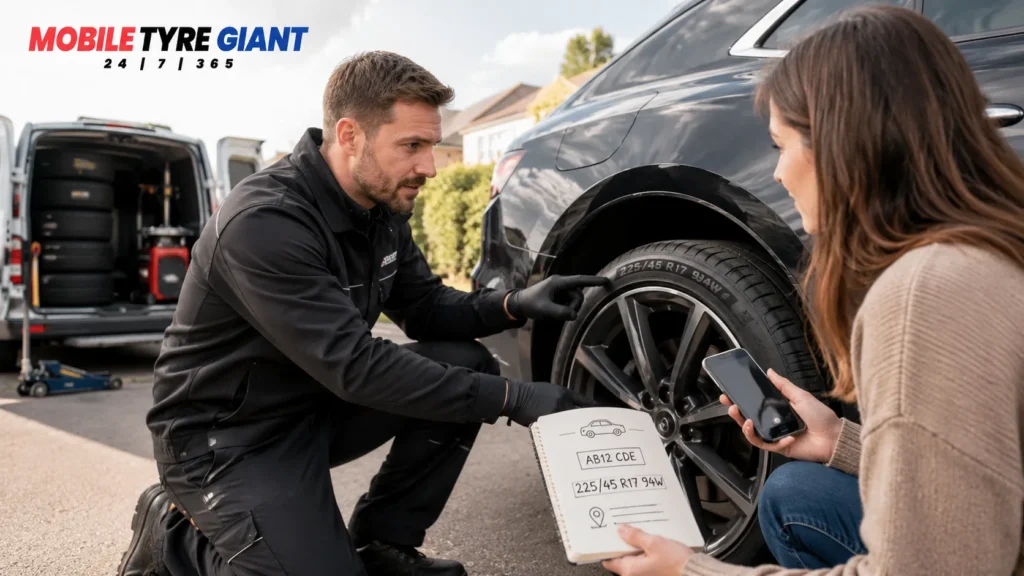
Not knowing your tyre size is extremely common, so it should not stop you from contacting a mobile fitter. Most drivers only look closely at the numbers on a tyre when something has already gone wrong. If the car is safely parked, start by looking at the outer sidewall of the affected tyre and search for a group of numbers similar to 225/45 R18. You can photograph the markings rather than trying to read them over the phone, especially if the lettering is dusty, wet or difficult to see. Combine that photograph with your vehicle registration and make or model if requested. This gives the booking team several pieces of information to work with instead of relying on a single guess.
If the tyre is badly damaged, the car is in an unsafe roadside position, or the markings cannot be reached safely, leave the tyre alone and explain the situation. Safety is more important than collecting perfect photographs or tyre measurements. The fitter may be able to work from the registration and other vehicle details initially, then verify the specification further before the job proceeds. The key rule is simple: do not invent a tyre size just because you feel you should know it. A wrong size can create unnecessary confusion, while an honest “I cannot see the tyre markings clearly” gives the fitter useful context. For someone wondering what information does a mobile tyre fitter need, this is an important reassurance because accurate basic information is more useful than technical information guessed under pressure.
Should You Send Photos to a Mobile Tyre Fitter?
Photos can be one of the quickest ways to explain a tyre problem, particularly when you are unsure how to describe what you can see. A clear sidewall photograph can show the tyre size and other markings, while a second image can show the visible damage itself. For example, a customer might describe a tyre as “split”, but a photograph could reveal whether they are referring to a small tread cut, visible sidewall damage or a tyre that has come away from the rim. A wider picture of the complete wheel can also provide useful context about the wheel position and surrounding area. If the vehicle is parked somewhere unusual, another image showing the space around the car may help explain access conditions before the technician arrives. The purpose of these photographs is not to perform a remote diagnosis, but to give the fitter better information before dispatch.
A useful photo set is simple: one image of the tyre markings, one of the visible problem, and one showing the complete wheel. Keep the pictures sharp enough that the important details can actually be read. If the tyre is on the roadside, do not step into traffic or place yourself in danger just to get a better angle. Send only the photographs you can take safely. Images can help the fitter prepare, but they cannot always confirm whether a tyre is suitable for repair because some damage can only be assessed properly once the tyre is inspected. Think of photographs as the fitter’s first look at the situation rather than the final verdict. Used alongside your location and vehicle details, they can make the booking conversation much clearer and help both sides understand what the job may involve.
What Should You Tell the Fitter About the Tyre Problem?
You do not need to diagnose the tyre yourself, but you should explain clearly what happened and what you can see. Start with the symptoms rather than trying to decide whether the tyre needs repair or replacement. Tell the fitter if the tyre suddenly lost pressure, has been going soft over several days, contains a visible nail or screw, suffered a blowout, or was damaged after hitting a pothole. Mention any obvious sidewall cut, bulge, damaged valve, or tyre pressure warning showing on the dashboard. It is also useful to say whether the vehicle was driven after the tyre lost pressure because driving on a flat tyre can sometimes cause additional damage that is not immediately visible from outside. If the wheel itself appears bent, cracked, or badly marked after an impact, mention that too. These details give the fitter a clearer picture of the situation before travelling without expecting you to make a technical judgement.
Think of it like explaining a fault to a doctor rather than trying to diagnose yourself. Saying “the tyre is broken” gives very little information, while saying “it lost pressure immediately after I hit a pothole and there is a cut on the sidewall” gives the fitter something much more useful to work with. The same principle applies to a slow puncture because a tyre that loses a few PSI overnight may involve a different issue from one that goes completely flat within minutes. A clear description can help determine whether the callout is likely to involve inspection, mobile tyre repair, or replacement, although the final decision should be based on proper inspection of the tyre. Avoid assuming that every nail can simply be plugged or that every flat tyre must automatically be replaced. The condition, location and extent of the damage all matter. When deciding what information does a mobile tyre fitter need, a simple description of what happened is often more valuable than an uncertain diagnosis.
Which Wheel Is Affected and How Many Tyres Have a Problem?
It sounds like a small detail, but telling the fitter exactly which wheel is affected can remove unnecessary confusion. Instead of saying “the tyre on the left”, describe it as front left, front right, rear left, or rear right while looking at the vehicle from the driver’s normal forward-facing position. This becomes even more important if the car uses different tyre sizes on the front and rear axles because the fitter needs to know which specification applies to the damaged wheel. Some performance cars and specialist vehicles use wider tyres at the rear than at the front, so assuming all four tyres are identical can lead to the wrong information being provided. If two tyres have been damaged by the same pothole or road debris, say that before the technician sets off. A two-tyre job can require different stock, more fitting time and additional preparation compared with replacing one tyre. The fitter should know the scope of the problem before arriving rather than discovering the second damaged tyre after the first one has been removed.
A wider photograph of the vehicle can make this information easier to communicate when you are unsure how to describe the wheel position. For example, you could send a full-wheel image and say, “rear passenger-side tyre is completely flat.” That is clearer than sending a close-up of damaged rubber with no context about where it is fitted. If the vehicle is parked tightly against a kerb or another car, also mention whether the affected wheel is difficult to access. These are small pieces of information, but together they create a much more accurate picture of the job. They also help prevent the customer and fitter from talking about different wheels when discussing tyre size or damage. If more than one tyre appears affected, do not assume they all have the same issue. Describe each one separately so the technician knows exactly what has happened.
Should You Mention Run-Flat, XL, EV or Other Specialist Tyres?
If you already know that your vehicle uses run-flat, XL, reinforced, EV-specific, or another specialist tyre type, mention it when arranging the fitting. These details can matter because tyres that share the same basic dimensions may still have different construction, load capabilities or vehicle-specific requirements. A run-flat tyre, for example, is designed differently from a conventional tyre and should not be treated as interchangeable simply because the size numbers look similar. Electric vehicles can also place different demands on tyres because of vehicle weight, torque and manufacturer specifications. Vans, SUVs and performance cars may have higher load requirements or unusual front and rear tyre combinations. You do not need to understand the engineering behind those differences, but telling the fitter what you know can help narrow down the correct replacement. A clear sidewall photo remains useful because specialist markings are often visible directly on the tyre.
Do not worry if terms such as XL or run-flat mean nothing to you. Most drivers are not expected to memorise tyre construction codes, and guessing can create more confusion than simply admitting you are unsure. Give the vehicle registration, tyre size, sidewall photo and make/model, then allow the fitter to work from reliable information. If the vehicle has recently had different wheels fitted, mention that as well because the tyres currently on the car may differ from its original specification. This is especially important on modified or higher-performance vehicles where wheel and tyre combinations may have changed. The purpose of asking what information does a mobile tyre fitter need is not to turn the customer into a tyre specialist. It is to collect enough accurate clues to reduce uncertainty before dispatch. The more unusual the vehicle or tyre setup, the more useful physical confirmation from the sidewall becomes.
Do You Need a Locking Wheel Nut Key for Mobile Tyre Fitting?
If your vehicle has locking wheel nuts, the key is an important part of a normal tyre change because the locking nut must usually be removed before the wheel can come off. Many drivers do not think about the key until the first time a tyre needs replacing, especially if they bought the car used and have never had the wheels removed. Before the fitter travels, take a few minutes to check whether the key is actually in the vehicle. Common places include the glovebox, boot, spare-wheel area, vehicle tool kit, centre console, or one of the boot’s side storage compartments. Do not simply assume it is present because a previous owner, dealership or garage may have stored it somewhere unexpected. If you find the key, keep it somewhere obvious and accessible rather than burying it under luggage or other items. Leaving it on the passenger seat or beside the vehicle keys can save unnecessary searching when the technician arrives.
The locking wheel nut issue is one of the clearest examples of why accurate pre-dispatch information matters. A tyre fitter can arrive with the correct replacement tyre and still face a delay if the wheel cannot be removed normally. This does not necessarily mean the entire job is impossible, but it may change the equipment and service required. If you cannot find the key, tell the booking team before the fitter is dispatched rather than waiting until they are standing beside the car. Mobile Tyre Giant also provides locking wheel nut removal for situations where the correct key is lost, damaged, or unavailable. Giving this information early helps the team understand that the callout may involve more than a straightforward tyre change. That is far better than discovering the problem after you have already waited for the van to arrive.
What If the Locking Wheel Nut Key Is Missing or Damaged?
A missing locking wheel nut key does not automatically mean the vehicle cannot be helped, but it should be treated as a separate issue rather than ignored. Specialist removal tools may be required to remove a locking nut when the original key is unavailable, and the exact approach can depend on the type and condition of the locking nut. If the key is damaged, worn, or no longer engages properly, mention that as well because repeatedly forcing it could make removal more difficult. The same applies if a previous garage has overtightened the locking nut or if the locking pattern appears damaged. A quick photograph of the wheel nut area can give the booking team useful context before dispatch. Do not attempt improvised removal methods that could damage the wheel or make professional extraction harder. The safest approach is to explain exactly what you have and what is missing.
This is another situation where a simple pre-call check can prevent frustration later. Imagine waiting for a tyre replacement, only to hear the metallic click of a locking key slipping because it is the wrong one for that wheel. That is the kind of avoidable problem worth identifying before the technician begins the journey. If you have several similar-looking locking keys in the vehicle, do not assume the first one belongs to the current wheels. Check whether it fits correctly without applying excessive force, or simply show the fitter what you have. When there is uncertainty, clear information is more useful than confidence without evidence. The goal is not to solve the locking nut problem yourself. It is to make sure the fitter knows about it early enough to prepare for the right type of job.
What Does the Fitter Need to Know About Where the Car Is Parked?
The tyre may be the main problem, but the fitter also needs enough suitable space to work around the vehicle. A car sitting on an open driveway is usually straightforward, while a vehicle tightly parked against a wall, kerb, another car, or inside a narrow bay can create additional challenges. Tell the booking team if the affected wheel is difficult to reach or if the vehicle is inside an underground car park. Height restrictions, security gates, locked entrances, parking permits, and workplace access rules are also worth mentioning before the fitter travels. If another vehicle is blocking the damaged side, moving it beforehand may make the appointment simpler where it is safe and practical to do so. The fitter may also need a stable working area around the affected wheel for lifting and tyre-changing equipment. You do not need to measure the space with a tape measure unless specifically asked. A simple description or wider photograph can often explain the situation clearly.
Parking conditions become especially important when deciding what information does a mobile tyre fitter need for a difficult callout. Imagine the technician arriving with the correct tyre but discovering that the damaged wheel is centimetres from a concrete wall and cannot be accessed properly. The tyre identification was correct, but an important part of the job information was still missing. The same problem can occur in multi-storey car parks where van height, ramps, barriers, or restricted entrances affect access. Mentioning these details early gives the booking team the opportunity to understand the situation before dispatch. If the vehicle is parked somewhere unsafe, do not move it purely to make tyre fitting easier unless it is safe and appropriate to do so. Explain the circumstances honestly and allow the fitter to advise on the practical next step. Good preparation is about giving useful information, not creating extra risk.
How Much Working Space Does a Mobile Tyre Fitter Need?
There is no single universal measurement that applies to every vehicle, fitter, and mobile tyre van. A small hatchback parked on a broad driveway may require a different working setup from a large SUV inside a narrow parking bay. What matters is that the technician has safe access to the affected wheel and enough room to use the appropriate lifting and tyre-fitting equipment. If one side of the car is close to a wall, fence, high kerb, or another vehicle, mention it when arranging the appointment. You should also say if the surface is unusually uneven, restricted, or difficult to reach. These details help the fitter understand whether the vehicle can be worked on where it currently sits. If you are unsure whether the space is suitable, a photograph of the complete vehicle and surrounding area can be more useful than trying to estimate dimensions.
The easiest rule is not to decide for the fitter whether the location is definitely suitable. Simply describe what is there. For example, saying “the rear-left tyre is flat and that side of the car is parked close to a brick wall” gives practical information that can be assessed before arrival. Likewise, if the vehicle is inside a gated commercial site, explain whether security approval or a visitor entry process will be needed. These small details can save time once the technician reaches you. They also reduce the chance of discovering an avoidable access problem after the fitting appointment has already started. The more unusual the parking situation is, the more useful a quick photo becomes. Clear information is more valuable than trying to make the situation sound simpler than it really is.
What Extra Information Should You Give During an Emergency Callout?
During an emergency, location information becomes just as important as tyre information. If you are away from home, provide the clearest location you can, such as a road name, nearby junction, landmark, car park name, or live map pin. If you are on a long road, stating your direction of travel can also help distinguish one side from the other. Tell the fitter which tyre is affected, whether the car can move, whether more than one tyre is damaged, and whether the vehicle is safely stopped. A tyre sidewall photo can still be useful if it can be taken without putting you at risk. You should also mention a missing locking wheel nut key, specialist tyre type, or obvious wheel damage before dispatch. These details allow the fitter to understand the situation without forcing you to explain everything again after arrival. For more detail on urgency and dispatch, the guide to same-day and emergency mobile tyre fitting explains the difference between a planned same-day job and a genuinely urgent callout.
The important point is that safety comes before collecting perfect booking information. If the vehicle is stopped somewhere exposed or dangerous, do not step into moving traffic or place yourself in an unsafe position simply to photograph the tyre markings. Give the fitter the safest information you can access first and explain what you cannot safely check. A registration number, vehicle description, location, and explanation of what happened can still provide a useful starting point. Once you are somewhere safe, additional tyre photographs or details can be shared if needed. Emergency customers often feel pressure to answer every question immediately, but accuracy matters more than speed when technical information is uncertain. If you do not know something, say so rather than guessing. A good emergency call should make the situation clearer, not create another problem through incorrect information.
What If You Do Not Know All the Information?
You do not need to know every detail before contacting a mobile tyre fitter. Many customers will not know their tyre load index, speed rating, locking wheel nut type, or even the exact tyre size when they first ask for help. Start with what you confidently know: your location, vehicle registration, what happened, and which wheel appears to have the problem. If possible, add a clear sidewall photo and a picture of the damage. These simple pieces of information can often answer several technical questions without you needing to understand the markings yourself. The most important thing is not to fill in gaps by guessing. An incorrect tyre size or wrong description can create more confusion than simply telling the fitter that you cannot confirm something.
This is why the question what information does a mobile tyre fitter need should not make the booking process sound intimidating. The purpose of the checklist is to make communication easier, not to test your knowledge of tyres. If the car is safely parked, you can usually gather most of the useful details in a couple of minutes. If the circumstances make that difficult, explain the limitation. A technician or booking team can then tell you what information is essential for the next step. Think of the checklist as a shortcut that helps both sides speak the same language. You provide what you can see and confirm, while the fitter handles the technical interpretation. That division keeps the process practical and reduces the pressure on the customer.
What Happens After You Send the Details?
Once the relevant information has been provided, the booking can move from identifying the problem to arranging the appropriate response. The vehicle and tyre information can be reviewed, the required tyre or service can be checked, and the location can be assessed before a technician is sent. If additional information is needed, such as a clearer tyre-sidewall photo or confirmation of a locking wheel nut key, it is better for that question to be resolved before dispatch. The fitter can then travel with a clearer understanding of the job. On arrival, the tyre and wheel still need to be physically inspected because photographs and descriptions cannot reveal every form of damage. The appropriate repair or replacement decision can then be made based on the actual condition found. This is why pre-dispatch information improves preparation without replacing professional inspection.
For customers who are ready to arrange assistance, the mobile tyre fitting service provides the natural next step after the details are gathered. Keep your phone available in case the technician needs help locating the vehicle or confirming access on arrival. Have the vehicle keys and locking wheel nut key ready where required, and make sure personal belongings are not blocking access to the wheel area. If anything changes after booking, such as the vehicle being moved or a second tyre losing pressure, update the fitter rather than waiting until arrival. Clear communication matters from the first message until the job is completed. It reduces surprises for the fitter and gives the customer a better understanding of what is happening. The goal is not simply to send a van, but to make sure the callout begins with the best information available.
Mobile Tyre Fitting Information Checklist
Before you call or message, gather the information that is easy and safe to access. Start with your exact location and vehicle registration, then check the affected tyre for its size markings if possible. Take a clear sidewall photo instead of trying to memorise a long sequence of numbers. Note whether the problem is on the front or rear and the left or right side of the vehicle. Photograph obvious damage such as a nail, cut, or completely deflated tyre when it is safe to do so. Check whether your locking wheel nut key is available and place it somewhere easy to find. Mention any difficult access, underground parking, height restriction, security barrier, or tight parking space. If you know the tyre is run-flat, XL, reinforced, or another specialist type, include that information too.
Your ready-to-send checklist is therefore simple: location, registration, tyre size or sidewall photo, affected wheel, damage description, locking wheel nut status, and access information. Vehicle keys should also be available if access to the car may be required. In an emergency, add a live location, road name, direction of travel, or nearby landmark where useful. Do not worry if one or two technical details are missing because photographs and vehicle information can often provide a useful starting point. More importantly, never put yourself at risk to complete the checklist. The information should help the technician prepare, not make the customer perform a roadside inspection in an unsafe place. If you can provide these details clearly, you have answered the practical question of what information does a mobile tyre fitter need before the appointment. Everything else can be confirmed as the booking and inspection progress.
Final Words: Give the Fitter Clear Information, Not Perfect Technical Knowledge
A mobile tyre fitting callout becomes much easier when the technician understands the vehicle, tyre problem, and location before setting off. You do not need to know every tyre code or diagnose the damage yourself. Start with the basics: exact location, registration, tyre size or a clear sidewall photo, affected wheel, visible problem, locking wheel nut status, and any access restrictions. These details help create a clearer picture of the job and reduce avoidable back-and-forth. If the tyre size looks like a confusing row of numbers, photograph it rather than guessing. If the locking wheel nut key is missing, say so before dispatch. If the car is difficult to locate, send more precise location information. Small pieces of accurate information are more useful than a confident but incorrect answer.
The best approach is to prepare what you can and let the fitter handle the technical assessment. That is ultimately the answer to what information does a mobile tyre fitter need: enough reliable detail to find the vehicle, identify the likely tyre requirement, understand the problem, and prepare for the fitting conditions. You are not expected to become a tyre technician before asking for help. A few clear photos and accurate vehicle details can often communicate far more than a long technical explanation. Once the information is ready, the booking process can move forward with fewer unknowns. Keep the checklist handy whenever you need mobile tyre assistance in the future. It can turn a stressful tyre problem into a much more organised conversation from the first call.
Need a Mobile Tyre Fitter? Have the Right Details Ready
Share your location, vehicle registration, tyre size or sidewall photo, and any locking wheel nut details. We’ll help arrange the right mobile tyre fitting service for your situation.
Frequently Asked Questions
Find quick answers to the most common questions our customers ask.
A mobile tyre fitter will usually need your exact location, vehicle registration, tyre size or a clear sidewall photo, which wheel is affected, a brief description of the tyre problem, and whether a locking wheel nut key is available. You should also mention any access restrictions such as underground parking, security gates, or tight parking spaces.
If you do not know your tyre size, check the sidewall for markings such as 205/55 R16 or take a clear photograph and send it to the fitter. Your vehicle registration and make or model can also provide useful information, but it is better not to guess a tyre size if you are unsure.
Your registration can help identify the vehicle and narrow down possible tyre specifications, but it may not always confirm the tyre currently fitted. Some cars have multiple approved wheel sizes or may have had different wheels fitted, so checking the tyre sidewall is recommended where possible.
Yes, a clear photo can make it easier for the fitter to identify the tyre size and understand the visible problem. Ideally, send one photo of the sidewall markings, another showing the damage, and a wider image of the complete wheel if it can be taken safely.
If your vehicle has locking wheel nuts, the correct key is normally needed to remove the wheel during tyre fitting. Check common storage areas such as the glovebox, boot, tool kit, or spare-wheel compartment before the technician arrives, and tell the fitter in advance if the key cannot be found.
A missing locking wheel nut key does not always prevent the job from being completed because specialist removal may be possible. However, you should tell the fitter before dispatch so the correct equipment and service can be arranged rather than discovering the problem after the technician arrives.
The fitter may need your vehicle keys if the car needs to be moved, repositioned, unlocked, or accessed during the tyre fitting process. Keep the keys available unless the booking team tells you otherwise, especially if you will not be standing beside the vehicle during the appointment.
You may not always need to remain beside the vehicle during the entire fitting, but the technician must have the required access to the car, keys, and locking wheel nut key where applicable. Confirm the arrangement when booking because requirements can vary depending on the vehicle, location, and type of work needed.
For a roadside callout, provide your exact location using a postcode or live location where possible, along with the road name, direction of travel, nearest junction, or recognisable landmark. If you are in a large car park or similar area, include the level, section, or bay information so the fitter can locate the vehicle more easily.
A photo can help the fitter see obvious damage and understand the situation before travelling, but it cannot confirm every form of internal tyre damage. Repairability should be decided after the tyre has been properly inspected, so photographs are best used for preparation rather than as a final diagnosis.