

A flat tyre in an electric car can feel more complicated than the same problem in a petrol or diesel vehicle, especially if there is no spare wheel in the boot. The first priority is not deciding whether the tyre can be repaired, but getting the vehicle and everyone inside it into the safest practical position. If the tyre loses pressure while you are moving, keep a firm grip on the steering wheel, ease off the accelerator and avoid sudden steering or harsh braking. Move towards a safe place such as a lay-by, side road, service area or another location away from moving traffic whenever the vehicle remains controllable. Once stopped, select Park, apply the parking brake, switch on the hazard lights and power the vehicle down. An EV can be almost silent when switched on, so it is worth checking that the car is fully shut down before anyone works near a wheel.
Do not keep driving simply because the car still moves or because your destination is only a short distance away. A conventional tyre with little or no air can fold under the weight of the vehicle, damaging its sidewall internally and potentially harming the wheel or tyre-pressure sensor. Electric vehicles can also be relatively heavy because of their battery packs, which makes unnecessary driving on a deflated tyre an especially poor gamble. The damage may not be obvious from outside once the tyre is reinflated, so getting a visibly flat tyre professionally assessed is safer than assuming it survived. If you are unsure whether any movement is sensible, our guide to driving with a flat tyre explains why a normal deflated tyre should not be treated like a temporary spare or run-flat. A flat tyre is inconvenient, but turning a repairable puncture into a destroyed tyre and damaged alloy makes the situation much worse.
How Do You Know an EV Tyre Is Going Flat?
The first warning is often the tyre pressure monitoring system, but a dashboard alert is not the only sign that pressure is falling. You may notice the car pulling slightly to one side, a heavier feeling through the steering or a dull repeating thump that changes with road speed. A rapidly deflating tyre can make the vehicle feel unsettled, while a slow puncture may only create a subtle change that develops over several journeys. When you walk around the car, one corner may appear lower or the tyre may look visibly compressed where it meets the road. An embedded screw or nail, sidewall cut, bulge or damaged valve can all lead to pressure loss. Sometimes the tyre itself is not punctured at all, because leaks can also develop around the valve or where the tyre seals against the wheel.
Treat a pressure warning as information that needs checking rather than proof that the tyre has already failed. Temperature changes can alter pressure, and a small warning does not always mean the tyre is completely flat. The important question is whether the tyre is holding enough pressure to remain structurally supported and whether there is visible damage. If you are in a safe location, look at the tyre from outside the vehicle without crawling underneath it or placing yourself close to passing traffic. If it looks severely deflated, split, bulged or separated from the wheel, do not experiment by driving farther to see what happens. For slower pressure loss, knowing how to check tyre pressure correctly can help you distinguish a small pressure change from a tyre that is losing air abnormally.
What Should You Do in the First Few Minutes After a Flat Tyre?
Once you recognise that a tyre may be flat, slow the vehicle progressively and concentrate on keeping it stable. Sudden braking can make an already unstable car more difficult to control, particularly if a tyre has failed rapidly rather than losing pressure gradually. Signal early and move away from the main flow of traffic whenever a safe route is available. After stopping, turn on the hazards and consider where passengers will be safest before anyone steps out of the vehicle. On a normal quiet road, that may mean exiting on the side away from traffic and standing somewhere protected. On a high-speed road or motorway, the safest waiting position depends on where the vehicle has stopped and whether occupants can leave without crossing or standing near live lanes.
Do not start unpacking a jack or repair kit until you have decided the location itself is safe enough for roadside work. A perfectly repairable puncture is still not worth changing beside fast-moving traffic, on unstable ground or around a blind bend. If the vehicle is stopped somewhere exposed, personal safety comes before preserving the damaged tyre or avoiding recovery. Keep your phone, location and vehicle details ready so assistance can identify where you are and what tyre is fitted. A photograph of the sidewall marking can also make it easier to communicate the tyre size without trying to remember a string of numbers and letters. The first few minutes should therefore follow a simple order: control the car, reach relative safety, make yourself visible, assess the situation and only then decide how the tyre problem will be dealt with.
Is a Flat Tyre Different on an Electric Car?
The tyre itself follows the same basic principles whether the vehicle is electric, hybrid or powered by a combustion engine. A puncture still allows air to escape, sidewall damage is still serious, and driving on a fully deflated conventional tyre can still destroy it. What changes is the vehicle around the tyre. Electric cars may be heavier, may use tyres with higher load ratings, and can have lifting points that need to be followed carefully because the high-voltage battery is commonly mounted low in the vehicle floor. That means jacking an EV should never become a guesswork exercise using a convenient-looking point underneath the car. The handbook or vehicle instructions should be followed if a wheel ever needs to be lifted.
The second difference is that many modern EVs are supplied without a full-size spare wheel, although this varies by model. Some provide a temporary puncture repair kit, some use run-flat or self-sealing tyre technology, and others rely on roadside support when a damaged tyre cannot be temporarily inflated. Do not assume your EV has a spare simply because older cars you owned always did. Check what equipment is actually supplied before you need it, including whether a sealant bottle has an expiry date and whether the compressor still operates. The best time to discover that your car has only a repair kit is on your driveway, not at night beside a wet road. Knowing the equipment and limitations of your specific EV turns a flat tyre from a surprise into a problem you are better prepared to manage.
Can You Drive an EV on a Flat Tyre?
A normal EV tyre should not be driven on once it is genuinely flat. The battery weight does not create a special exception, and slow driving does not make a conventional tyre safe when its air pressure is no longer supporting the vehicle. As the wheel rolls, the collapsed sidewall is repeatedly crushed between the rim and the road, generating heat and internal damage. The tyre bead can also be affected, while continued movement may damage the alloy wheel. Even if the original problem was a small nail puncture, unnecessary driving can turn it into a tyre that can no longer be repaired. The safest response is to stop once a suitable location can be reached rather than trying to complete the journey.
Run-flat tyres are different because their reinforced construction may allow limited travel after pressure loss, but the exact speed and distance limits come from the tyre and vehicle manufacturer rather than a universal rule. A tyre pressure warning alone also does not prove that a run-flat tyre can simply be driven normally until convenient. If you do not know whether your EV has run-flat tyres, check the tyre markings or vehicle documentation instead of guessing from appearance. Temporary repair kits also do not turn an ordinary tyre into a permanent solution, because they are intended to help with specific types of minor puncture under the instructions supplied with the vehicle. Sidewall damage, wheel damage, a tyre that has come off the rim or a tyre that cannot hold pressure requires a different response. Knowing which tyre technology your EV uses is therefore just as important as knowing where the charging cable is stored when an unexpected journey problem occurs.
Does Your EV Have a Spare Wheel or a Puncture Repair Kit?
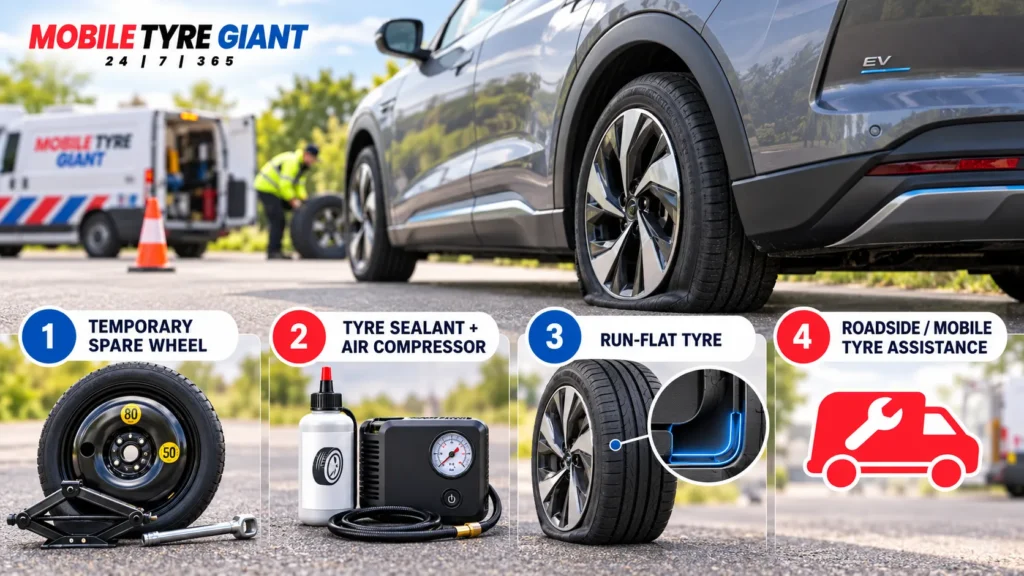
Many electric cars do not carry a conventional full-size spare wheel, so the equipment in the boot may be different from what you expect. Depending on the vehicle, you might find a temporary spare, an air compressor with tyre sealant, a mobility kit or no physical spare at all. Space and vehicle design often influence what the manufacturer provides, which is why it is worth checking before a puncture happens. Look beneath the boot floor and read the vehicle handbook so you know exactly what is supplied. Make sure any compressor cables, valve connectors and adapters are present rather than discovering a missing part at the roadside. Sealant bottles can also have expiry dates, so a kit that has been sitting untouched for years should not automatically be assumed ready to use. If your EV has locking wheel nuts, knowing where the key is stored can save considerable frustration when a wheel needs removing. A little preparation can turn a stressful flat tyre into a much more manageable situation.
It is also useful to understand what each option is actually designed to achieve. A temporary spare can allow limited onward travel when fitted correctly, while a sealant kit is intended only for certain types of minor tyre damage. Neither option should be treated as a permanent repair. Run-flat tyres are another possibility, but their permitted distance and speed after pressure loss depend on the specific tyre and vehicle instructions. Roadside assistance becomes the safer choice when the damage is severe, the tyre will not hold pressure or the location makes working beside the car dangerous. Our emergency tyre kit checklist can help you work out what is worth keeping in the vehicle before an unexpected puncture leaves you searching through an empty boot.
Flat Tyre Option | What It Can Help With | Main Limitation |
Temporary spare wheel | Gets the vehicle moving temporarily | Speed, distance and fitment limits may apply |
Tyre sealant and compressor | Certain small punctures in suitable areas | Not suitable for every type of damage |
Run-flat tyre | May allow limited travel after pressure loss | Limits depend on tyre and vehicle guidance |
Roadside tyre assistance | Inspection, repair or replacement at the vehicle | Requires waiting for professional help |
When Can an EV Puncture Repair Kit Help?
A tyre repair kit can be useful when the pressure loss comes from a relatively small puncture and the tyre has not suffered obvious structural damage. The basic idea is that sealant enters the tyre while the compressor restores enough pressure for temporary onward movement. It sounds simple, but the kit should only be used in the way described by the vehicle manufacturer. Different kits have different procedures, and guessing which hose, bottle or pressure setting to use can create another problem. Before connecting anything, inspect the tyre from a safe position and look for obvious cuts, bulges, exposed material or a tyre that has moved away from the rim. If the wheel itself appears damaged, adding sealant is unlikely to solve the real issue. The same applies if the tyre lost pressure after a severe pothole impact rather than a straightforward puncture.
Even when a repair kit works, think of it as a temporary mobility measure rather than proof that the tyre is permanently safe. The tyre still needs professional inspection because the puncture may be larger than it appears or the sidewall may have been damaged while the vehicle was driven with low pressure. Some sealants can also complicate later inspection, so tell the technician if one has been used. Follow any speed or distance restrictions supplied with the kit instead of assuming the tyre can now be driven normally. Watch the pressure closely because a tyre that starts losing air again is telling you the temporary solution has not held. If the tyre cannot reach or maintain the pressure required by the kit instructions, stop trying to rescue the journey and arrange proper assistance.
When Should You Not Use Tyre Sealant?
Sealant is not a sensible answer to every flat tyre. Large cuts, torn sidewalls, visible bulges, damaged beads and a tyre that has partly separated from the wheel need proper inspection rather than a bottle of sealant. The same caution applies when a wheel is visibly bent or cracked after hitting a pothole or kerb. Sealant works by trying to close certain air leaks, but it cannot rebuild damaged tyre structure or straighten a wheel. If the tyre was driven completely flat for any significant distance, internal damage may also exist even when the outside looks relatively normal. Trying to inflate a badly damaged tyre can waste time and may give a false sense that the problem has been solved. When the damage looks structural, replacement is usually a more realistic possibility than a temporary roadside fix.
Sidewall condition deserves particular attention because this area flexes constantly as the tyre supports the vehicle. Cuts, cords, bubbles and bulges should never be dismissed just because the tread still looks deep. A bulge can indicate damage beneath the visible rubber, while a deep cut can compromise the structure that carries the vehicle’s load. This becomes especially important on heavier electric vehicles because the tyre must continue supporting substantial weight during normal driving. Our guide to tyre sidewall damage explains the difference between superficial marks and the warning signs that deserve professional attention. If you are standing beside the car asking whether damage looks too serious for sealant, that uncertainty itself is a good reason not to gamble on continuing the journey.
Can a Flat EV Tyre Be Repaired?
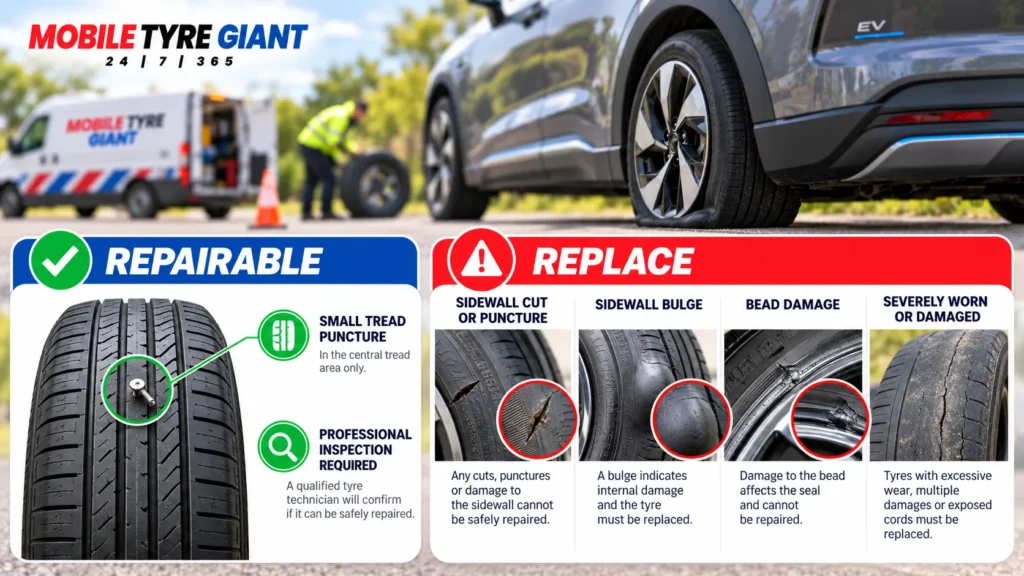
Some flat EV tyres can be repaired, but repairability depends on the damage rather than the fact that the vehicle is electric. A small puncture in a suitable area of the tread may be repairable after the tyre has been removed and inspected properly. The technician needs to consider the size and position of the puncture, the internal condition of the tyre and whether it has been driven while badly underinflated. Damage that looked like a simple screw from outside may have caused more serious internal wear if the tyre travelled several miles without enough air. The tyre’s load rating, acoustic foam or EV-focused construction does not remove the need for those basic checks. A professional repair decision should therefore come after inspection, not from a photograph of the nail alone.
Replacement is more likely when damage affects the sidewall, shoulder, bead or internal structure, or when the tyre has already been badly damaged by running flat. Tread condition also matters because repairing a puncture on a tyre that is already heavily worn may offer very little useful service life. The wheel should be checked too, particularly after a hard pothole impact, because a bent rim can cause pressure loss even when the tyre itself is not punctured. Valve leaks and TPMS-related issues can produce similar symptoms and should not be overlooked. The useful question is not simply, “Can the hole be plugged?” but, “Is the complete tyre and wheel assembly safe to return to normal road use?” That distinction prevents a quick roadside fix from becoming a repeat problem a few days later.
What If the EV Tyre Has Come Off the Rim?
If the tyre has visibly moved away from the rim, treat the problem as more serious than an ordinary slow puncture. The edge of the tyre, known as the bead, needs to sit securely against the wheel so the tyre can hold pressure correctly. Once that seal is lost, the tyre may look folded, twisted or partly detached from the wheel. Severe underinflation, impact damage or driving after pressure loss can all contribute to this type of failure. Do not try to force the tyre back into position with improvised straps, tools or internet tricks. The bead, sidewall, valve and rim may all need checking before anyone can decide whether the tyre is reusable. Inflating it successfully for a moment does not prove that the structure or seal is safe.
Driving further can make the damage much worse because the rim may begin carrying vehicle weight directly while the collapsed tyre is crushed underneath it. This can damage the tyre internally, scrape or bend the wheel and potentially affect the pressure sensor or valve. If this has happened to your EV, our guide on what to do when a tyre has come off the rim explains the warning signs and why further driving should be avoided. Take a clear photograph and note whether the tyre lost pressure before it separated if you can do so safely. When asking for assistance, provide the vehicle details and tyre size so the technician can arrive prepared for inspection or replacement. The aim is to protect both the wheel and the tyre rather than turning a pressure-loss problem into a more expensive roadside repair.
What Should You Do If an EV Gets a Flat Tyre on a Motorway?
A flat tyre on a motorway needs a different mindset because the biggest danger may be the traffic around you rather than the tyre itself. If the car is still controllable, keep both hands on the steering wheel, ease off the accelerator and avoid sudden braking or sharp lane changes. Move towards the safest available place such as a hard shoulder, emergency refuge area or motorway exit if you can reach one safely. Switch on the hazard lights as soon as the vehicle is stopped. If you are in a live lane and cannot reach a safer area, do not attempt to inspect or change the tyre beside moving traffic. In that situation, the priority is to alert the emergency services and follow motorway safety guidance before arranging tyre assistance. Standing beside a damaged tyre while vehicles pass at motorway speed creates far more risk than waiting for the correct help.
If you do reach a safe stopping area, think carefully before opening doors or walking around the vehicle. Exit on the side away from traffic where possible and move behind a safety barrier if there is one. Do not stand between the vehicle and the carriageway, and never place yourself close to a live lane just to inspect the tyre. Keep your phone, vehicle details and tyre size ready so you can describe the situation clearly when asking for help. A mobile service can sometimes inspect and deal with the tyre at the roadside if the location is safe enough for work. The important thing is not to let the urgency of a delayed journey push you into attempting a repair in an unsafe position. On a motorway, personal safety must come before protecting the wheel or getting back on the road quickly.
What If the EV Stops in a Live Lane?
If your EV comes to a stop in a live motorway lane and cannot be moved, treat the situation as an emergency rather than a normal puncture. Keep the hazard lights on and call the emergency services so the lane can be managed safely. Do not try to jack the vehicle up, change a wheel or crouch beside the tyre while traffic is passing. If it is safe to leave the vehicle, use the side away from traffic and move behind a barrier or as far from live traffic as possible. If leaving the vehicle would put you in greater danger, remain inside with your seat belt on and follow emergency-service instructions. The correct action depends on the exact road position and whether a protected escape route is available.
Once the immediate motorway danger is controlled, the tyre problem can be assessed properly. A slow puncture, shredded tyre, sidewall failure and tyre that has left the rim can all lead to the same result of an immobilised vehicle, but they may need very different repairs. If the tyre is damaged but the vehicle is now in a secure location, mobile tyre repair may be possible where the puncture meets repair criteria and the tyre has not suffered structural damage. If the tyre is beyond repair, replacement will be the more appropriate option. Do not assume that because the original problem was only a nail, the tyre remains repairable after being driven flat at motorway speed. The way the vehicle was driven after pressure loss can be just as important as the original puncture itself.

What If Your EV Has Run-Flat Tyres?
Run-flat tyres are designed to support the vehicle for a limited period after pressure loss, using reinforced sidewalls or other supporting technology. This can be useful on an EV because it may allow the driver to move away from a dangerous road position without stopping immediately beside traffic. However, run-flat does not mean puncture-proof, and it does not mean the tyre can be driven normally after losing pressure. The maximum permitted distance and speed depend on the tyre and vehicle manufacturer, so the owner’s manual and tyre guidance should be checked rather than relying on a general rule from another vehicle. Vehicle load, road temperature and the severity of the damage can also affect what the tyre can tolerate.
If the TPMS warning appears on a car fitted with run-flats, slow down and assess the situation rather than continuing at normal motorway speed. The reinforced sidewall can make the tyre look less obviously flat from outside, which means visual inspection alone may not tell you how much pressure has been lost. Follow the vehicle’s instructions and head only towards a suitable safe location if continued movement is permitted. Once stopped, the tyre still needs inspection because heat and internal damage may have developed while it was supporting the vehicle without normal air pressure. A run-flat that successfully gets you off a motorway has done its temporary job, but that does not automatically make it safe for continued everyday use. The correct next step is inspection rather than assuming the tyre has permanently recovered.
Can a Run-Flat EV Tyre Be Repaired After a Puncture?
Sometimes a run-flat tyre may be repairable, but the decision depends heavily on what happened after the pressure was lost. If the puncture is small, located in a repairable area of the tread and the tyre was not driven far while deflated, repair may remain possible after inspection. However, run-flat tyres can develop internal heat and structural damage that is difficult to judge from the outside. If the tyre has been driven for a significant distance without normal pressure, a technician may decide replacement is safer even when the original hole itself is small. Sidewall damage, severe impact damage or visible structural problems also make repair less likely.
The vehicle’s load and the conditions during the puncture matter too. A heavily loaded EV travelling quickly generates more heat and stress than the same car moving slowly for a very short distance. This is why the technician needs the full story rather than just the puncture location. Tell them when the warning appeared, roughly how far the car travelled afterwards and whether the tyre ever looked completely flat. That information can help determine whether the internal structure may have been compromised. Run-flat technology buys time to reach safety, but it should never be used as an excuse to delay inspection indefinitely.
What Should You Check After an EV Flat Tyre Has Been Repaired?
Once the tyre has been repaired or replaced, do not treat the incident as finished the moment the car starts moving again. Check the pressure once the tyre is cold and compare it with the vehicle’s recommended value. Watch the TPMS to make sure the warning clears or the system relearns correctly according to the vehicle instructions. Pay attention to steering feel, vibration and road noise during the first few journeys. A strong vibration at a particular speed can indicate a wheel-balance issue, while pulling to one side may suggest another tyre or alignment problem. If the flat followed a pothole or kerb impact, the wheel and suspension may deserve a closer look as well.
It is also worth checking the other three tyres rather than focusing only on the one that failed. Similar age, pressure or wear conditions may be affecting the rest of the set, especially if the tyres were fitted at the same time. Look for cracking, cuts, bulges and uneven tread wear, and make sure no other tyre is slowly losing pressure. If a screw or road debris caused the original puncture, another tyre may have passed over the same area without showing an immediate warning. Keep an eye on pressures for several days after the incident so a slow leak is not missed. A flat tyre can be an isolated event, but it can also reveal maintenance issues that are easier and cheaper to fix before another tyre leaves you stranded.
When Is Replacement Safer Than Repair for a Flat EV Tyre?
A puncture does not automatically mean an EV needs a new tyre, but there are situations where replacement is the safer option. Sidewall cuts, bulges, exposed cords, severe impact damage and damage around the tyre bead can affect structural strength rather than simply allowing air to escape. A tyre may also become unsuitable for repair if it has been driven while severely underinflated and the sidewall has been crushed repeatedly against the road. This is particularly important on a heavier electric vehicle because the damaged tyre still has to support a substantial load once it is reinflated. A small screw in the tread may look harmless from outside, but the tyre’s internal condition cannot always be judged until it is removed from the wheel. Repair decisions should therefore be based on a proper inspection rather than how small the visible hole appears.
Replacement should also be considered when the tyre is already badly worn or has other signs of deterioration in addition to the puncture. Repairing one small hole may make little practical sense if the remaining tread is close to replacement or the sidewall is cracked and ageing. Damage caused by a pothole can involve the wheel as well as the tyre, so a technician may need to check for distortion before fitting a replacement. Where the tyre is beyond safe repair, mobile tyre replacement can allow a suitable tyre to be supplied and fitted where the vehicle is located. The aim is not simply to make the tyre hold air again, but to return the EV to the road with a wheel and tyre assembly that can safely handle its normal load, braking and acceleration forces.
How Do You Choose the Correct Replacement Tyre for an EV?
The replacement should match the vehicle’s approved tyre specification rather than simply being the same diameter as the damaged tyre. Check the complete sidewall information, including width, profile, wheel diameter, load index, speed rating and any XL, HL or manufacturer-specific requirement. Electric vehicles can place particular emphasis on load capability because of battery weight, while rolling resistance, wet grip and road noise may also influence how the vehicle feels after fitting. Some EVs use different tyre sizes on the front and rear axles, so copying the marking from the wrong corner of the car can cause another problem. If only one tyre is being replaced, the condition and tread depth of the tyre on the opposite side should also be considered.
Price matters, especially when an unexpected flat tyre interrupts a normal day, but it should come after correct fitment and safety. A cheap tyre with the wrong load index is not a bargain, and an expensive EV-labelled tyre is not automatically the right choice either. Compare suitable options within the specification approved for the vehicle and consider how the car is actually driven. A motorway commuter may value low road noise and efficiency, while a powerful EV may place greater emphasis on grip and load capability. If you need to compare suitable options, the tyre brands and sizes available for different vehicles can provide a useful starting point before a replacement is selected. The best replacement is the tyre that fits the vehicle’s requirements first and your driving priorities second.
How Can You Reduce the Chance of Another EV Flat Tyre?
Not every puncture can be prevented because nails, screws, glass and potholes can appear without warning. Good tyre maintenance can still reduce the chance that a small issue develops into a roadside breakdown. Check pressures regularly, especially before longer journeys, and investigate a tyre that repeatedly needs topping up rather than treating the loss as normal. Walk around the car occasionally and look for cuts, bulges, embedded objects or unusual tread wear. Pay particular attention after a hard pothole or kerb impact because damage can appear later rather than causing an immediate flat. Keeping enough tread also helps the tyre deal with wet roads and everyday road hazards more effectively.
The TPMS deserves attention too because an unexplained pressure warning may be the first sign of a slow leak. If the pressures are correct but a warning keeps returning, a faulty or leaking valve can sometimes be part of the problem rather than the tyre tread itself. In that situation, TPMS valve replacement may be relevant after the source of the warning has been diagnosed. Do not simply reset a warning repeatedly without checking why it appeared. A pressure-monitoring system is useful because it gives you an early signal, but it cannot inspect the tyre for cuts, sidewall damage or embedded objects. Combining technology with simple visual checks gives you a better chance of finding a developing problem before the tyre is completely flat.
What Should You Keep in an EV for a Flat Tyre Emergency?
A useful flat-tyre setup starts with knowing what the vehicle already carries. Check whether your EV has a spare wheel, temporary mobility kit, compressor, sealant or run-flat tyres, and make sure you know where everything is stored. Keep the locking wheel nut key with the vehicle if the wheels use one because even a professional fitter cannot easily remove the wheel without access to it. A torch is useful at night, while a charged phone and charging cable can make a major difference when you need roadside assistance. It also helps to keep the vehicle registration and tyre size easy to find so you can give accurate information when arranging help.
Preparation should include checking the condition of the emergency equipment itself. Sealant may have an expiry date, compressors can fail after years of sitting unused, and a temporary spare needs the correct pressure even when it has never been fitted. Do not wait for a cold, wet roadside stop to discover that the kit is incomplete. A pair of gloves can make a simple inspection less unpleasant, but reflective or emergency equipment should be used according to the road environment and local safety guidance rather than encouraging you to stand somewhere dangerous. The most useful emergency kit is not the one with the most tools. It is the one you understand how to use safely and that helps you communicate the problem clearly when professional assistance is the better option.
Final Words: Put Safety Before the Tyre When an EV Goes Flat
When an EV gets a flat tyre, the first decision should always be about where the vehicle and its occupants are safest. Slow down smoothly, avoid harsh inputs and move away from live traffic whenever the car remains controllable. Once stopped, assess the tyre and the location before reaching for a repair kit or jack. A small tread puncture may sometimes be repairable, while sidewall damage, severe impact damage or a tyre driven for too long without pressure may need replacement. Run-flat tyres and mobility kits can provide temporary help in certain situations, but both have limitations that should be followed carefully.
The electric powertrain does not make ordinary tyre safety rules disappear, but EV weight, tyre specifications and vehicle lifting points can make correct procedures especially important. Know what equipment your vehicle carries, check tyre pressure and condition regularly, and do not assume a dashboard warning is something to ignore until the next service. If a tyre cannot be safely repaired, use a replacement that meets the correct size, load and speed requirements for the vehicle. Most importantly, never trade personal safety for the convenience of changing or inspecting a tyre in a dangerous road position. A flat tyre can be repaired or replaced, but the safest response starts with protecting the people around the car.
EV Flat Tyre? Get Help Where You Are
Get fast help with an EV puncture, flat tyre or damaged tyre, including repair assessment and mobile replacement where suitable.
Frequently Asked Questions
Find quick answers to the most common questions our customers ask.
Stay calm, keep a firm grip on the steering wheel and reduce speed gradually without harsh braking or sudden steering. Move to the safest available stopping location away from moving traffic, switch on the hazard lights and secure the vehicle. Once you are safely stopped, assess the location before inspecting the tyre or attempting any repair.
A conventional tyre should not be driven on once it is genuinely flat because the collapsed sidewall can suffer serious internal damage and the wheel may also be damaged. If the vehicle has run-flat tyres, limited travel may be permitted, but the speed and distance limits must come from the tyre and vehicle manufacturer's instructions.
Some do, but many modern EVs are supplied with a puncture repair kit, compressor, temporary mobility equipment or run-flat tyres instead of a full-size spare. Equipment varies by model, so check beneath the boot floor and read the vehicle handbook before you need it in an emergency.
Yes, some punctured EV tyres can be repaired when the damage is small, located in a suitable area of the tread and the tyre has not suffered structural damage. Sidewall damage, serious impact damage or extensive internal damage from being driven flat can make replacement necessary instead. A proper inspection should determine whether repair is safe.
A manufacturer-supplied tyre sealant kit may be suitable for certain small punctures, provided the tyre is not structurally damaged and the kit instructions allow its use. Sealant is a temporary mobility measure rather than a permanent repair. It should not be relied upon for sidewall cuts, bulges, major tears or damaged wheels.
Battery weight can increase the load carried by the tyres, which makes driving unnecessarily on a severely underinflated or flat tyre a poor idea. However, the basic danger is the same as with other vehicles: without enough air pressure, the tyre can no longer support the vehicle correctly and may suffer structural or wheel damage.
Move to a safe stopping area if the vehicle remains controllable and it is possible to do so without creating additional danger. If the vehicle stops in a live lane, treat it as an emergency and contact the emergency services rather than attempting a tyre repair. Do not change or inspect a tyre beside fast-moving traffic when the position is unsafe.
Some run-flat tyres may be repairable after a puncture, but the decision depends on the damage and how far the tyre was driven after losing pressure. Internal heat or structural damage may develop even when the puncture looks small from outside. The tyre should therefore be professionally inspected before a repair is approved.
A recurring warning can be caused by an actual pressure loss, a slow puncture, valve leakage, temperature-related pressure change or a problem within the tyre-pressure monitoring system. Check all tyre pressures when cold and inspect for visible damage. If the pressure is correct but the warning continues, the valve or sensor system may need further diagnosis.
It depends on the remaining tread depth, tyre specification, axle setup and manufacturer requirements. A single replacement may sometimes be appropriate when the other tyre is still closely matched, but a large difference in tread depth or construction can affect vehicle behaviour. Some drivetrain configurations also need closer attention to rolling-circumference differences, so the full set should be assessed before deciding.