
Choosing the best tyre brands for motorway mileage involves more than finding a manufacturer with a reputation for long-lasting tyres. If you regularly travel on the M1, M25, M4 or other major UK motorways, your tyres need to deliver reliable wet-weather grip, comfortable handling and good durability over thousands of miles. A tyre that lasts longer but performs poorly during heavy rain is not necessarily the better investment.
Motorway drivers also have different priorities from motorists who mainly make short city journeys. Sustained speeds, long distances and changing road conditions make factors such as rolling resistance, tyre noise and wear performance particularly relevant. Michelin, Goodyear, Continental, Bridgestone and several mid-range manufacturers offer models worth considering, but the right choice depends on the specific tyre, your vehicle and your annual mileage.
What Makes a Tyre Good for High-Mileage Motorway Driving?
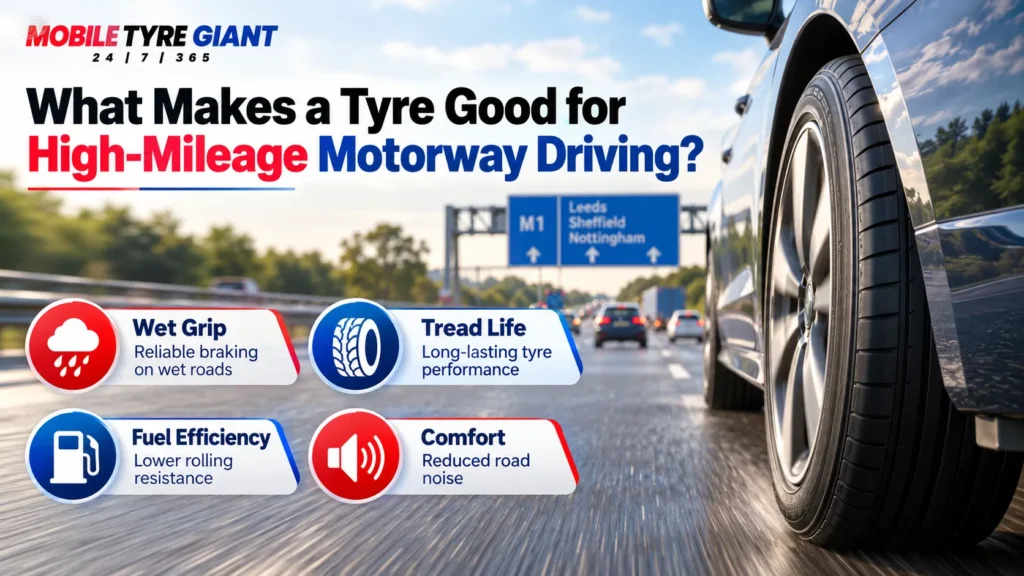
A good motorway tyre needs to balance durability, safety and comfort rather than maximise one characteristic at the expense of everything else. High-mileage drivers should prioritise dependable wet braking, predictable handling, suitable load capacity and resistance to premature tread wear. Rolling resistance also matters because even relatively small efficiency differences can become more noticeable when a vehicle covers thousands of motorway miles every year.
The ideal balance will depend on how you use your car. Someone commuting 80 miles daily may value low running costs and cabin comfort, while a family travelling long distances with luggage needs suitable load capacity and reassuring stability. There is no officially defined motorway-only tyre category. Instead, drivers should compare road tyres designed for their particular vehicle and consider how each model performs in demanding everyday conditions.
Are Touring Tyres Better for Long Motorway Journeys?
Touring tyres are often a sensible starting point for regular motorway driving. They are generally developed to provide a balanced combination of comfort, predictable road behaviour, efficiency and useful tread life. Some models place particular emphasis on reducing road noise or maintaining consistent performance over longer journeys. These characteristics can make touring-oriented tyres attractive for family hatchbacks, saloons and estate cars.
However, touring tyres are not automatically the best choice for every vehicle. A powerful sports saloon may require a tyre with more demanding handling characteristics, while certain SUVs and electric cars need specific load ratings or construction features. The term touring describes a product’s intended priorities rather than guaranteeing superior mileage. Comparing individual model specifications and independent tests is more useful than relying on the category name alone.
Why Must Motorway Mileage Be Balanced With Wet Grip?
Wet-weather performance is particularly important on British motorways, where heavy rain, surface spray and standing water can reduce visibility and road grip. Even when travelling within the speed limit, drivers may need to brake firmly because of sudden congestion or unexpected hazards. Tyres with effective wet braking and predictable handling can make a meaningful difference in these situations.
Long tread life should never be considered separately from wet grip. A tyre designed to resist wear may use different compound and tread characteristics from one developed primarily for maximum traction. Modern tyre engineering can achieve a strong balance, but individual models still have different strengths. Motorway buyers should examine wet braking, aquaplaning resistance and projected durability together rather than selecting whichever tyre advertises the highest mileage.
Which Tyre Brands Should Motorway Drivers Compare?
Several established manufacturers offer tyre ranges that deserve consideration for high-mileage motorway driving. Michelin, Goodyear, Continental, Bridgestone and Pirelli are widely recognised premium brands, while Hankook, Falken, Kumho and other manufacturers offer competitive alternatives. These brands produce different models for touring, performance and everyday driving, so choosing a manufacturer is only the beginning of the comparison.
A brand’s reputation can help you identify products worth researching, but it cannot establish which tyre is best in your specific size. One model may achieve excellent projected wear results yet cost considerably more than a competitor. Another might provide stronger wet braking or quieter operation. The most useful shortlist contains individual models that meet your vehicle’s requirements, rather than a ranking based entirely on brand recognition.
Which Premium Tyre Ranges Suit Frequent Motorway Use?
Michelin’s Primacy range, Goodyear’s EfficientGrip family, Continental’s PremiumContact models and Bridgestone’s Turanza range are useful starting points for drivers researching comfortable everyday tyres. Pirelli’s Cinturato range also includes models intended for regular road use. These families contain products with different design priorities, and particular versions may perform strongly in durability, wet grip or efficiency testing.
For example, the Goodyear EfficientGrip Performance 2 and Michelin Primacy 5 have demonstrated competitive projected tread life in independent comparative testing. Continental’s PremiumContact 7 has also performed strongly in several safety assessments. However, results depend on the tested size and conditions, while price and availability vary. Treat these models as candidates for comparison, not automatic recommendations for every motorway vehicle.
Can Mid-Range Tyre Brands Offer Better Motorway Value?
Mid-range manufacturers can be particularly interesting for motorists who drive long distances but need to manage replacement costs. Hankook, Falken and Kumho offer models that have delivered competitive results in independent European tyre tests. Some have performed well against more expensive alternatives in wet handling, projected mileage or overall value. This makes them worth including when comparing tyres for a high-mileage commuter car.
Hankook’s Ventus ranges, Falken’s ZIEX models and Kumho’s Ecsta family provide examples to investigate, although individual products can differ substantially. A mid-range tyre with reliable wet-weather performance and good projected lifespan may offer better long-term value than a more expensive competitor. Equally, a cheaper tyre is not worthwhile simply because its initial purchase price is lower. Safety, compatibility and complete performance results must come first.
How Do You Build a Shortlist Before Buying Motorway Tyres?
A sensible motorway tyre shortlist begins with the vehicle rather than the manufacturer’s name. Identify the approved tyre specification, the type of journeys you make and approximately how many miles you cover each year. Then decide which characteristics are most important. For many high-mileage drivers, wet grip, tread durability, rolling resistance and comfort deserve particular attention.
Once these priorities are clear, compare a small selection of compatible tyre models across different price categories. Look for independent tests conducted in the same tyre size or a closely comparable specification. Consider how the tyre performs overall rather than concentrating on one favourable rating. A tyre that offers good durability, reassuring wet handling and reasonable efficiency can be a stronger purchase than one that performs exceptionally in only a single category.
Which Tyre Size, Load Index and Speed Rating Do You Need?
The correct tyre size, load index and speed rating are essential when selecting replacements for motorway driving. These markings identify important characteristics, including the tyre’s dimensions and operating capabilities. A tyre must meet the vehicle manufacturer’s applicable requirements, even if a different specification appears cheaper or has attractive independent test results. Some vehicles also require reinforced tyres or different sizes on the front and rear axles.
Check the vehicle handbook, tyre-information label or approved manufacturer specifications before ordering. The markings on your existing tyres are useful, but they should not be your only reference if a previous owner fitted an unsuitable specification. The process of choosing the right tyres for your car helps explain how vehicle requirements, tyre sizes and driving conditions influence replacement decisions.
Can the UK Tyre Label Predict Motorway Tyre Lifespan?
The tyre label provides information about wet grip, rolling resistance and external rolling noise. These characteristics can be useful when comparing models for motorway use. Wet-grip ratings help assess standardised wet-braking performance, while rolling resistance indicates an aspect of energy efficiency. External rolling-noise figures offer another comparison point, although they do not directly measure the noise passengers hear inside the vehicle.
However, tyre labels do not provide a direct tread-life or mileage grade. A tyre with excellent fuel-efficiency and noise ratings is not necessarily the longest-lasting option. To assess durability, look for independent wear testing and remember that projected mileage is not guaranteed. Actual tyre life depends on driving habits, vehicle weight, maintenance and road conditions. The factors affecting how long tyres last are therefore important when interpreting manufacturers’ longevity claims.
How Important Are Wet Braking and Aquaplaning for Motorway Tyres?
Wet braking performance is one of the most important factors when choosing tyres for regular motorway journeys. Heavy rain, surface spray and sudden congestion can create situations where a driver needs to slow down quickly. Although every roadworthy tyre must meet applicable standards, stopping distances can differ considerably between models. For drivers covering thousands of motorway miles each year, dependable wet grip deserves at least as much attention as tread life or purchase price.
Aquaplaning resistance is another important consideration. When water builds up between the tyre and road surface, the tyre may lose contact with the tarmac, reducing steering and braking control. This can happen on sections of motorway affected by standing water, particularly during heavy rainfall. The best tyre brands for motorway mileage should therefore be compared for wet braking and aquaplaning separately, rather than assuming that one favourable result guarantees excellent performance in every wet condition.

Does an A-Rated Wet-Grip Tyre Always Stop Shortest?
An A-rated wet-grip tyre has achieved a strong result in the standardised test used for its label classification. This makes the rating a useful starting point when comparing tyres of the same size. However, two tyres carrying the same wet-grip grade may still produce different braking distances in independent tests. The label places tyres into performance categories rather than providing an exact stopping distance for every vehicle and road condition.
Motorway drivers should therefore examine independent wet-braking results alongside label information. Tests conducted using the same vehicle, tyre size and surface conditions allow more meaningful comparisons. The shortest stopping distance is valuable, but it is not the only measure of wet-weather safety. Predictable cornering, steering response and resistance to aquaplaning also matter when choosing a tyre for frequent long-distance journeys.
Why Can Two Tyres Handle Standing Water Differently?
Tyre tread patterns are designed to move water away from the contact area between the rubber and the road. The arrangement of grooves, tread blocks and channels influences how effectively this happens. Two tyres with similar wet-braking ratings can have different levels of aquaplaning resistance because their tread designs behave differently in deeper water. Rubber compounds and tyre construction also contribute to overall wet-weather performance.
Independent tests sometimes identify separate results for straight-line and cornering aquaplaning resistance. This distinction is important because a tyre may resist losing contact in standing water while travelling straight but perform differently during a bend. For motorway driving, examine both results where available. Even tyres with good aquaplaning resistance cannot eliminate the danger of standing water, so drivers must reduce speed and adapt to weather conditions.
How Does Tread Wear Change Wet Motorway Performance?
As a tyre wears, its grooves become shallower and generally have less capacity to disperse water. This can increase aquaplaning risk, especially during heavy rainfall. A tyre that performed well when new may provide less resistance to standing water later in its life. The rate of deterioration depends on the particular model, remaining tread depth and driving conditions, so mileage alone cannot establish whether a tyre remains suitable.
UK passenger-car tyres must generally have at least 1.6mm of tread depth across the central three-quarters of the tread width and around the entire circumference. However, legal compliance does not guarantee the same wet-weather performance as a new tyre. Regularly checking tyre tread depth helps motorway drivers monitor wear and plan replacements before a tyre approaches the legal minimum.
Do Fuel Efficiency and Noise Ratings Matter for High-Mileage Drivers?
Fuel efficiency and comfort become increasingly relevant when a vehicle covers substantial annual mileage. A tyre’s rolling resistance influences how much energy is required to keep the wheels moving, while its construction and tread design can affect road noise and ride quality. The differences between suitable tyre models may seem small during a short journey, but they can become more noticeable over thousands of motorway miles.
These factors should still be considered alongside safety. A tyre with excellent efficiency but disappointing wet-weather performance may not be the right choice for regular motorway use. Similarly, an exceptionally quiet tyre is not automatically the most durable or comfortable option. The strongest shortlist balances wet braking, aquaplaning resistance, efficiency and refinement rather than focusing on one attractive label rating.
How Does Rolling Resistance Affect Fuel Consumption and EV Range?
Rolling resistance is the energy lost as a tyre deforms and recovers while travelling along the road. A tyre with lower rolling resistance generally requires less energy to maintain movement under comparable conditions. For petrol and diesel vehicles, this can contribute to lower fuel consumption. Electric cars may also benefit through improved energy efficiency and driving range, making rolling resistance particularly relevant for high-mileage motorway commuters.
However, actual savings depend on the vehicle, journey conditions, speed, tyre pressure and other factors. An efficient tyre does not guarantee a particular reduction in fuel costs or increase in electric range. Compare rolling-resistance ratings with independent test results whenever possible. It is also important to consider wet grip and handling because the lowest rolling resistance is not necessarily the best overall choice for motorway driving.
Are Quiet Tyres Always More Comfortable at Motorway Speeds?
Tyre noise can affect how comfortable a journey feels, particularly when travelling for several hours. Different tread patterns and constructions generate different sounds as the tyre contacts the road. Some touring-oriented tyres are developed with reduced noise in mind, making them worth investigating for frequent motorway driving. However, noise levels inside the vehicle also depend on road surfaces, suspension, sound insulation and other components.
The external rolling-noise figure displayed on a tyre label does not directly measure the sound passengers hear inside the cabin. Independent comfort assessments and owner experiences can provide additional context, although results vary between vehicles. Unusual humming or steering vibration should not automatically be blamed on the tyre model. Problems with wheel balancing can also create vibration at motorway speeds and may need correcting before judging a tyre’s ride quality.
What Can Independent Tyre Tests Tell You About Motorway Mileage?
Independent tyre tests provide useful evidence because they compare different products under controlled conditions. Depending on the test, assessments may include wet and dry braking, aquaplaning resistance, handling, rolling resistance, noise and projected tread life. This allows drivers to examine strengths and weaknesses that are not obvious from manufacturer descriptions or tyre labels. A model that appears expensive initially may deliver competitive long-term value when its performance and durability are considered together.
However, not every tyre test measures the same characteristics or uses the same weighting system. Some focus heavily on braking and handling, while others place greater emphasis on efficiency, wear and environmental performance. A tyre finishing first overall is not automatically the best choice for every motorway driver. Understanding what was tested, and why the results matter, is more useful than relying on a single ranking.
Can a High-Mileage Tyre Still Offer Reliable Wet Grip?
Yes. Modern tyre design can combine strong wear resistance with convincing wet-weather performance, although achieving the ideal balance remains challenging. Manufacturers use different rubber compounds, tread structures and construction methods to manage these competing requirements. Some touring-oriented products perform well across both durability and safety assessments, demonstrating that drivers do not always have to choose between reasonable tread life and dependable grip.
For example, the Goodyear EfficientGrip Performance 2 achieved a high projected mileage in the 2026 ADAC summer tyre test while receiving an overall positive safety assessment. However, the same test identified some relative weaknesses in aquaplaning and wet handling. This illustrates why motorway buyers should examine the complete results, not just the longevity figure. A strong high-mileage tyre should demonstrate balanced performance in the conditions the driver is likely to encounter.
How Should You Compare Tyre Tests Across Different Brands and Sizes?
Begin by looking for tests involving the exact tyre model and size required for your vehicle. Performance can vary between sizes, load ratings and model versions, so results from a different specification should be treated as supporting evidence rather than a guaranteed match. Pay attention to the test vehicle, road conditions and assessment categories. A comparison is more useful when the tyres have been evaluated under consistent conditions.
Look for patterns across several independent tests where possible. If a model repeatedly performs well in wet braking, comfort and durability, that provides more confidence than a single favourable result. Consider any weaknesses alongside your own driving requirements, particularly if you frequently travel long distances in heavy rain. The best motorway tyre is not simply the model with the highest score, but one whose overall performance suits your vehicle, mileage and budget.
How Many Miles Can High-Mileage Motorway Tyres Actually Last?
Tyre mileage varies considerably between brands, individual models and vehicles. Some touring tyres are designed to provide extended tread life, while performance-oriented products may prioritise grip and steering response. For regular motorway drivers, choosing a tyre with strong wear-test results can make a noticeable difference to replacement frequency. However, no manufacturer or independent test can guarantee exactly how many miles your tyres will cover.
A tyre that achieves 35,000 miles on one vehicle may wear considerably sooner on another. Vehicle weight, wheel alignment, inflation pressure and driving habits all influence the result. Motorway journeys also involve different operating conditions from city driving. The best tyre brands for motorway mileage should therefore be assessed using credible durability evidence alongside wet-weather safety and the requirements of your particular vehicle.
Do Tyres Last Longer on Motorways Than in City Driving?
Steady motorway journeys can be relatively favourable for tyre wear because they usually involve fewer sharp turns, repeated stops and sudden acceleration events. By comparison, busy urban driving often places additional demands on tyres through frequent braking, steering and speed changes. A driver travelling smoothly over long distances may therefore experience more consistent tread wear than someone regularly navigating congested streets.
However, motorway driving does not automatically guarantee longer tyre life. Sustained high speeds, excessive loading and incorrect inflation can increase operating temperatures and accelerate deterioration. Aggressive acceleration and braking also create unnecessary wear. The most useful comparison involves your actual driving conditions rather than assuming that motorway mileage is always easier on tyres.
What Do Independent Tyre Mileage Tests Really Tell You?
Independent wear tests estimate how long different tyre models may last under specified conditions. These comparisons are particularly useful because tyres are assessed using a consistent method. In the 2026 ADAC summer tyre test, the Goodyear EfficientGrip Performance 2 achieved a projected lifespan of approximately 57,800 kilometres, or 35,900 miles. The Michelin Primacy 5 and Bridgestone Turanza 6 also achieved strong mileage results.
These figures represent projected tread life in the tested specification, not guaranteed mileage for every driver. The same tyre may perform differently in another size or on a heavier vehicle. Independent tests are most valuable when used to compare models within the same assessment. Always consider their wet braking, handling and efficiency results alongside the wear predictions before selecting a tyre for motorway use.
How Do You Calculate the Cost Per Mile of Motorway Tyres?
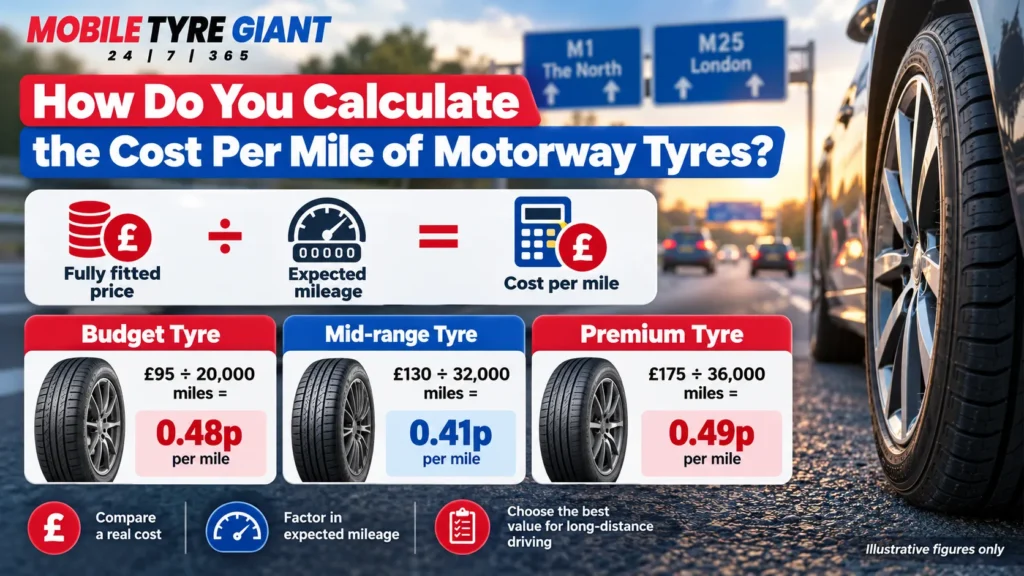
Cost per mile is a useful way to compare tyres with different purchase prices and expected lifespans. Instead of focusing only on the initial cost, divide the fully fitted price of one tyre by its estimated mileage. The result shows approximately how much you are paying for each mile of tyre use. This calculation can help high-mileage drivers identify products that may offer better long-term value.
However, the calculation depends on the quality of the mileage estimate. Independent wear-test projections are generally more useful for comparison than unsupported advertising claims. Real-world results may differ because of driving style, maintenance and vehicle characteristics. Cost per mile should therefore be treated as a buying tool rather than an exact prediction of future expenditure.
Are More Expensive Motorway Tyres Always Better Value?
A higher purchase price can sometimes be justified by longer tread life, stronger performance or greater efficiency. For example, a tyre costing £170 may offer better long-term value than a £100 alternative if it lasts substantially longer. This is particularly relevant for commuters who cover thousands of motorway miles each month and would otherwise face more frequent replacement costs.
Nevertheless, premium tyres are not automatically the most economical option. Some mid-range models combine competitive durability with a lower purchase price. Independent tests have demonstrated that a tyre with a strong wear result is not necessarily the cheapest per mile when its purchase price is considered. The best value comes from balancing credible mileage expectations with safety, suitability and total cost.
What Does a Motorway Tyre Cost-Per-Mile Comparison Look Like?
Consider three tyres with different fully fitted prices and hypothetical lifespans. The budget option costs less initially, while the premium model has the highest projected mileage. However, the mid-range tyre provides the lowest purchase cost per mile in this particular example. This demonstrates why buying the cheapest tyre, or automatically choosing the longest-lasting one, may not produce the best financial result.
For a meaningful comparison, use the same tyre size, compatible specifications and consistent pricing assumptions. Fitting charges should be included where applicable. The calculation should also use comparable wear estimates, ideally from the same independent test. Most importantly, a low cost per mile should never outweigh serious weaknesses in wet braking, handling or other safety-related characteristics.
Should You Include Fuel Efficiency and Fitting Costs?
Purchase cost per mile does not capture every expense associated with a tyre. Rolling resistance can influence fuel consumption or electric driving range, especially when a vehicle covers substantial annual mileage. A more efficient tyre may offer additional savings, although the actual difference depends on the car, driving conditions and inflation pressure. These potential benefits should be considered separately from tread-life calculations.
Fitting costs also matter when tyres need replacing more frequently. Depending on the supplier, balancing, valves and disposal may be included or charged separately. Compare complete quotations rather than tyre-only prices. However, avoid treating minor theoretical fuel savings as more important than wet-weather safety. The strongest long-term value comes from suitable tyres with a balanced combination of performance, durability and reasonable running costs.
Which Motorway Tyres Offer the Best Value for Your Driving Pattern?
The best-value motorway tyre depends on how many miles you cover and the type of vehicle you drive. Someone travelling 20,000 miles annually may benefit from prioritising tested durability, efficiency and comfort. A driver covering only occasional motorway journeys may place greater emphasis on balanced everyday performance and purchase price. Both still need suitable wet-weather grip and the correct vehicle specifications.
A high-mileage commuter should compare touring-oriented models from premium and established mid-range manufacturers. Electric vehicle and SUV owners also need to consider load capacity, rolling resistance and vehicle-specific requirements. Rather than assuming one brand category is always best, identify a shortlist of compatible models and compare their independent results against the journeys you actually make.
What Should a Driver Covering 20,000 Motorway Miles a Year Prioritise?
At 20,000 miles annually, tyre durability can become an important financial consideration because replacement intervals may arrive relatively quickly. Look for strong projected tread life, dependable wet braking and suitable efficiency ratings. Comfort also matters when spending several hours each week at motorway speeds. A tyre with balanced performance may be more satisfying than one designed primarily for maximum grip or minimum purchase price.
Do not rely solely on manufacturer mileage promises. Compare independent tests involving similar tyre specifications and consider how frequently your vehicle carries additional passengers or luggage. If two models provide similar safety results, cost per mile can help distinguish their long-term value. However, a cheaper running cost is only meaningful when the tyre remains appropriate for the vehicle and driving conditions.
How Can Maintenance Protect Your Motorway Tyre Investment?
Even a tyre with excellent wear-test results can deteriorate prematurely if it is poorly maintained. Underinflation increases sidewall flexing and heat generation, while incorrect alignment can create uneven tread wear. Overloading and harsh driving also place unnecessary stress on tyres. Maintaining the manufacturer’s recommended cold inflation pressures and investigating unusual wear are essential steps for protecting tyre life.
Regular inspections and appropriate servicing can help drivers get better value from their tyres. The practical measures for making tyres last longer include managing pressure, alignment and driving habits. Where permitted by the vehicle and tyre manufacturers, suitable tyre rotation patterns may also help distribute wear. Rotation cannot correct existing mechanical problems, but proper maintenance can reduce avoidable replacement costs.
How Do You Make the Final Choice Between Motorway Tyre Models?
Choosing the best tyre brands for motorway mileage involves comparing several characteristics rather than searching for one universally superior manufacturer. The strongest options should offer dependable wet grip, predictable handling, suitable durability and reasonable running costs. Once you have identified tyres that meet your vehicle’s requirements, independent test results can help distinguish models that otherwise appear similar.
Your annual mileage and typical journeys should guide the final decision. A driver covering 25,000 motorway miles each year may prioritise tread life and efficiency, while someone making occasional long journeys might place greater emphasis on purchase price and all-round performance. Neither approach should compromise safety. The most suitable tyre is one that balances the characteristics you need at a price that makes sense.
Are Summer or All-Season Tyres Better for UK Motorway Driving?
Summer tyres are designed primarily for use in milder and warmer conditions, while all-season tyres aim to provide a broader balance across changing weather. For drivers who frequently use UK motorways throughout the year, all-season models may be worth considering, particularly where winter temperatures, occasional snow or mixed weather conditions are common. However, their capabilities vary significantly between models.
A summer tyre may offer stronger performance in certain dry and wet conditions, while a suitable all-season tyre provides additional versatility in colder weather. Neither category is automatically best for every motorway driver. Consider your local climate, annual mileage and whether you regularly travel in winter conditions. Independent comparisons involving the same tyre category are particularly useful when choosing between specific models.
What Buying Mistakes Can Cost High-Mileage Drivers More?
One common mistake is selecting a tyre purely because it advertises a long lifespan. High projected mileage is valuable, but it does not guarantee excellent wet braking, aquaplaning resistance or handling. Another mistake is comparing tyres tested in different sizes and conditions as though the results were directly interchangeable. These comparisons can create unrealistic expectations about performance and durability.
Buying solely on initial price can also lead to disappointing long-term value. A cheaper tyre may need replacing sooner, while an expensive model may not provide enough additional mileage to justify its cost. Avoid relying on brand reputation without examining the actual product. Compare compatible models using consistent test results, full fitted prices and the characteristics that matter most for your journeys.
When Should High-Mileage Motorway Tyres Be Replaced?
Tyres should be replaced when their condition, remaining tread or structural integrity makes them unsuitable for continued use. High annual mileage means drivers may reach important wear limits relatively quickly, particularly if inflation pressure or wheel alignment is incorrect. However, mileage alone cannot determine when replacement is necessary. A tyre that has covered relatively few miles may still require replacement because of damage or deterioration.
Regular inspection is especially important before long motorway journeys. Look for unusual tread wear, cuts, bulges and signs of pressure loss. Check the manufacturer’s recommendations concerning tyre age and condition, particularly if a vehicle is used infrequently. A worn or damaged tyre should never be kept in service simply to achieve an advertised mileage figure or reduce the cost per mile.
Is the Legal Tread Limit Enough for Motorway Safety?
For most UK passenger cars, the legal minimum tread depth is 1.6mm across the central three-quarters of the tread width and around the entire circumference. However, this is a legal minimum rather than a guarantee of strong wet-weather performance. As tread depth reduces, a tyre generally becomes less effective at dispersing standing water, increasing concerns about aquaplaning during heavy rainfall.
Motorway drivers should monitor tread depth well before the legal limit is reached and consider their wet-weather driving needs when planning replacement. Tread depth is not the only concern, because structural defects can also make a tyre unsafe. Understanding the significance of tyre sidewall damage helps identify problems that may require immediate attention even when plenty of tread remains.
Should You Replace One, Two or All Four Motorway Tyres?
Replacing all four tyres is not always necessary when only one or two have reached the end of their usable life. The correct decision depends on the remaining tyres’ condition, tread depth and compatibility with the replacement models. A single tyre may be replaced when an appropriate match is available and the difference in tread wear is acceptable. Otherwise, replacing a matched pair may be preferable.
When fitting two new tyres, manufacturers generally recommend placing the pair with deeper tread on the rear axle to support wet-road stability, subject to vehicle-specific requirements. All-wheel-drive systems may also require closely matched rolling circumferences across all four wheels. Always check the manufacturer’s guidance rather than assuming that replacing the minimum number of tyres is the most economical or suitable decision.
What Should You Check When Buying and Fitting Motorway Tyres?
Once you have chosen a tyre model, confirm that the product supplied matches the agreed specification. Check the tyre size, load index, speed rating and any vehicle-specific requirements before fitting. It is also important to confirm the exact model because different versions from the same manufacturer can have different performance characteristics. A tyre carrying a familiar brand name is not automatically equivalent to the product you researched.
Professional fitting is essential for safe motorway use. The tyre should be installed in the correct orientation, inflated to the vehicle manufacturer’s recommended pressure and balanced as required. The wheel must also be refitted securely using the correct procedures. These details affect the vehicle’s behaviour and should not be overlooked simply because the tyres are new or come from a premium manufacturer.
Should You Compare Fully Fitted Tyre Prices?
Yes. A fair comparison should include the total cost of supplying and fitting the tyres, rather than relying only on an advertised tyre price. Depending on the provider, balancing, valves, old-tyre disposal and other services may already be included or charged separately. Comparing complete quotations helps prevent unexpected expenses and makes long-term value calculations more meaningful.
Convenience is another consideration for drivers with demanding commuting schedules. Professional mobile tyre fitting may be suitable at a home, workplace or another safe location, reducing the need to visit a workshop. Compare the available tyre models, fitting arrangements and total costs before deciding. The priority should be a suitable tyre installed correctly, not simply the quickest or cheapest appointment.
What Should You Check Before Your First Motorway Journey?
After fitting, confirm that the correct tyres have been installed and that their inflation pressures match the vehicle manufacturer’s recommendations. Ask whether the wheels were balanced and whether any tyre pressure monitoring system procedure is required. The vehicle should drive smoothly without unexpected vibration, steering pull or unusual noises. Any significant problem should be investigated before beginning a long motorway journey.
It is sensible to monitor how the vehicle feels during an initial local drive, particularly when changing to a different tyre model. The checks explained in what happens after mobile tyre fitting can help drivers recognise normal differences in tyre behaviour and symptoms that need attention. Continue checking pressures and tyre condition regularly to protect your investment.
Final Words: Which Tyre Brands Are Best for Motorway Mileage?
The best tyre brands for motorway mileage are those offering models that combine dependable safety performance, suitable tread life and reasonable long-term value. Premium manufacturers such as Michelin, Goodyear, Continental and Bridgestone offer strong touring-oriented options, while established mid-range brands can also be competitive. No manufacturer guarantees the best mileage for every vehicle, and the highest-priced tyre is not automatically the best purchase.
A reliable buying framework begins with the correct tyre specification, followed by independent comparisons of wet braking, aquaplaning resistance, durability, efficiency and comfort. Calculate the likely cost per mile using credible evidence, then consider your annual mileage and driving conditions. Proper fitting and ongoing maintenance are equally important. The right decision is the tyre that delivers balanced, suitable performance throughout its usable life.
Need Reliable Tyres for Motorway Driving?
Get suitable tyres for regular motorway journeys, balancing wet grip, mileage and comfort, with fitting at your home or workplace.
Frequently Asked Questions
Find quick answers to the most common questions our customers ask.
Michelin, Goodyear, Continental and Bridgestone offer strong touring models, while some mid-range brands are competitive. Compare individual tyres rather than choosing by manufacturer alone.
Touring tyres with strong independent wear-test results are worth considering. Actual lifespan depends on vehicle weight, inflation, alignment and driving habits.
Yes, suitable Michelin touring models can offer competitive durability, comfort and wet-weather performance. Compare the exact model with alternatives in your required size.
They can be, particularly when stronger durability or efficiency justifies the additional cost. A well-tested mid-range tyre may also offer excellent value.
Yes, suitable all-season tyres can be used on UK motorways. Choose models with appropriate specifications and proven performance in the weather conditions you encounter.
Not necessarily. Smooth motorway driving may cause less wear than frequent urban acceleration and braking, but speed, loading and maintenance still affect durability.
Quiet tyres can improve comfort, but external noise ratings do not directly measure cabin noise. Consider independent comfort tests alongside wet grip and durability.
No. The tyre label covers wet grip, rolling resistance and external noise, not projected tread life. Independent wear tests provide more useful mileage comparisons.
Yes, when correctly specified and roadworthy. However, performance varies considerably, so assess wet braking, handling and durability rather than price alone.
Replace tyres that are unsafe, damaged or below the legal tread limit. Regularly assess remaining tread and wet-weather performance before long journeys.