
Getting a flat tyre while driving through London can turn an ordinary journey into a stressful situation. One moment, you are navigating busy streets, and the next, your steering feels unusually heavy or you hear a rhythmic thumping from one wheel. Finding somewhere safe to stop becomes your immediate priority, but London’s parking restrictions can make that decision complicated. Red routes, yellow lines, bus lanes and controlled parking zones leave little room for mistakes. Knowing where to stop with a flat tyre in London can help you protect yourself, your passengers and other road users.
Unlike breaking down on a quiet residential street, a puncture in central London might leave you surrounded by buses, cyclists and impatient traffic. You may worry about damaging your wheel, blocking the road or receiving a parking ticket while waiting for assistance. However, driving further on a badly damaged tyre can create more serious problems. The safest approach is to assess the situation calmly, find a place of relative safety where possible and arrange appropriate assistance. This London parking guide explains your options, the restrictions to consider and how to handle a tyre-related breakdown responsibly.
What Should You Do Immediately After Getting a Flat Tyre in London?
If you notice a sudden change in steering, unusual vibration or a tyre-pressure warning, pay attention to how the vehicle behaves. A puncture may cause the car to pull towards one side, while a severely deflated tyre can produce a repetitive flapping sound. Avoid sudden steering movements or harsh braking, especially when surrounded by London traffic. Reduce your speed smoothly while maintaining control of the vehicle. Your priority should be reaching a place of relative safety without creating additional danger.
Do not assume that the nearest available kerb is automatically a suitable stopping place. Busy junctions, cycle lanes and narrow streets can expose you and other road users to unnecessary risks. If the vehicle remains controllable, look for a nearby legal parking space, off-street area or other safe stopping location. However, if the tyre has failed badly, continuing to search for parking may cause further damage or become unsafe. In that situation, stop as soon as it is safe to do so and arrange professional assistance.
Stay in Control and Find a Safe Place to Stop
A tyre failure can feel alarming, particularly during rush hour when vehicles are travelling close together. Keep both hands on the steering wheel and allow the car to slow progressively. Check your mirrors and surrounding traffic before moving towards a suitable stopping location. Avoid turning sharply into a side street simply because it appears quieter. Other vehicles, cyclists or pedestrians may be approaching from directions that are difficult to see.
Once you reach a safe position, secure the vehicle and switch off the engine. Apply the parking brake and use hazard warning lights if your vehicle is creating an obstruction or needs to warn approaching drivers. If visibility is poor, appropriate vehicle lighting can also help others recognise the stopped car. Do not attempt to inspect the tyre while standing in moving traffic. A safer location is always preferable to risking an injury just to see how badly the tyre has been damaged.
Keep Passengers Safe Before Checking the Tyre
Your passengers’ safety matters more than immediately identifying the cause of the puncture. If the car is safely parked away from moving traffic, assess whether everyone can leave the vehicle without danger. Before opening any door, check carefully for cyclists, motorcycles and passing vehicles. Children should remain supervised and away from the road. A quiet-looking London street can become busy within seconds, particularly near schools, stations and shopping areas.
If the car is stopped in a dangerous position, avoid gathering around the damaged wheel. Where it is safe to leave, move passengers to a protected location away from moving traffic. If you are trapped in a live traffic lane or cannot leave safely, remain secured inside and contact emergency services when there is immediate danger. Do not attempt roadside repairs in an exposed position. Your safety should determine the next action, not the inconvenience of waiting for help.
Where Can You Park With a Flat Tyre in London?
Finding somewhere to stop is often the most difficult part of dealing with a flat tyre in London. Parking restrictions differ across boroughs, and some roads have strict controls designed to keep traffic moving. A flat tyre does not automatically give you permission to ignore these restrictions. Nevertheless, the immediate safety of the driver, passengers and other road users must come before concerns about parking charges. Aim for a location that allows the vehicle to remain stationary without causing unnecessary obstruction.
The Highway Code identifies places designed for parking as generally the safest locations for a breakdown. Depending on your surroundings, that might mean an available parking bay, a suitable off-street car park or another area where stopping is permitted. However, even a marked space may have conditions attached, including permits, payment requirements or time restrictions. Always check the relevant signs where it is safe to do so. Understanding London’s parking arrangements can help you make a more informed decision during an unexpected breakdown.
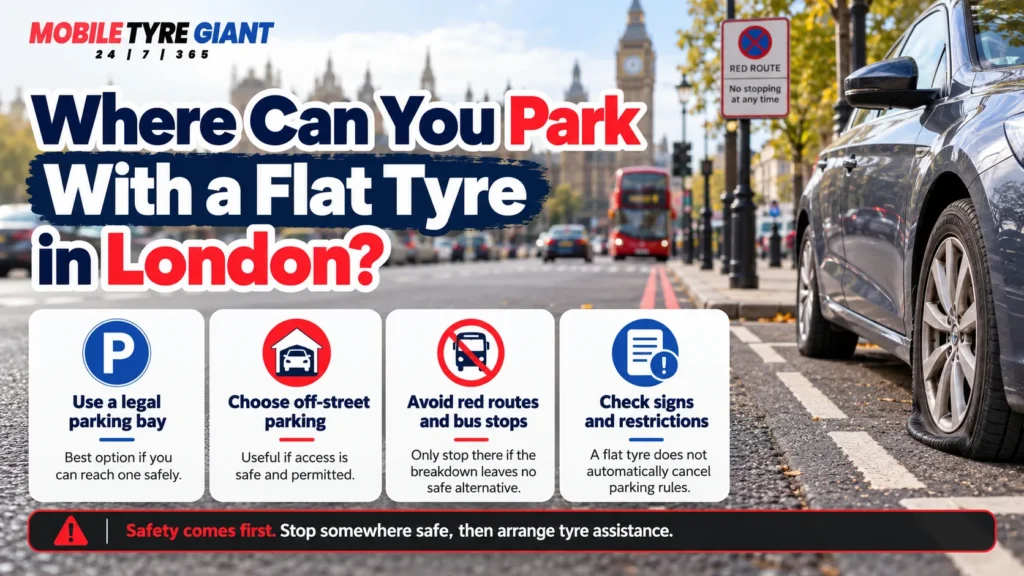
Choose a Legal Parking Bay or Off-Street Space Where Possible
A properly designated parking space can be a practical option when dealing with a puncture. It generally provides a clearer separation from moving traffic than stopping beside a busy junction. For example, if you experience a slow puncture on a residential road and can safely reach an available unrestricted bay before the tyre becomes unsafe, stopping there may reduce the risks. Once parked, check the signs for permit conditions, payment requirements and maximum stay periods. Do not assume that every marked bay is available to every driver.
Off-street parking may also provide a suitable location, provided the entrance can be reached safely and the vehicle is permitted to remain there. A supermarket car park or another managed parking area may have its own restrictions, including customer-only parking and time limits. If you need professional assistance, confirm that access and working space are suitable for the attending technician. Where appropriate, mobile tyre fitting can help drivers arrange tyre replacement at an accessible location without travelling to a garage. Never continue driving on an unsafe tyre simply to reach a more convenient fitting location.
What If There Is No Safe or Legal Parking Space Nearby?
Sometimes a flat tyre leaves you with very limited choices. This is particularly stressful on narrow roads, near busy junctions or along heavily restricted routes. If your vehicle cannot safely continue, you may need to stop somewhere that would not normally be available for parking. That does not create an automatic exemption from parking enforcement. However, immediate road safety takes priority over trying to reach a distant parking bay.
After stopping, assess whether the car is obstructing traffic or creating a danger. Use hazard warning lights where appropriate and contact a breakdown or recovery provider. If the vehicle creates an immediate danger that cannot be managed safely, contact the emergency services. Record the location and circumstances once it is safe, particularly if the car cannot be moved promptly. Photographs, assistance records and recovery documentation may become relevant if a parking penalty is issued and you need to explain the breakdown.
Can You Drive a Short Distance to Find Parking With a Flat Tyre?
Driving on a seriously deflated tyre can damage its internal structure and the wheel beneath it. The flattened rubber may become trapped between the road and wheel rim, particularly during steering or braking. Even travelling slowly can make the tyre unsuitable for repair. Therefore, finding a convenient parking space does not automatically justify continuing to drive. The safest decision depends on the tyre’s condition, the vehicle’s behaviour and the immediate road environment.
A gradual pressure warning is different from a tyre that has visibly collapsed or suffered a blowout. If you are unsure whether the vehicle can move safely, avoid guessing how far it might travel. The explanation of whether you can drive with a flat tyre provides more detail about the risks of continuing on a damaged tyre. Remember that run-flat tyres may have limited manufacturer-approved mobility after pressure loss, but ordinary tyres do not have the same capabilities. If the car cannot be moved safely, arrange assistance rather than attempting to reach another street.
What If Your Flat Tyre Happens on a Major London Road?
Major routes such as busy A-roads and roads approaching the M25 can make breakdown decisions more difficult. Traffic may be moving quickly, and roadside space can be limited or completely unavailable. On an ordinary urban road, a suitable parking area or side road may provide a safer stopping option if the vehicle can still be controlled. On a motorway, different emergency stopping procedures apply. You should never treat a motorway hard shoulder as an ordinary parking space.
If a tyre problem develops on a motorway, aim for a service area or suitable exit if you can reach one safely. Otherwise, follow the relevant emergency-area or hard-shoulder procedures. If you cannot reach a place of relative safety or leave the vehicle safely, keep your seat belt fastened, use hazard warning lights and call 999. Motorway situations require particular care because traffic can approach at high speed. The article on what to do with a flat tyre on a motorway covers those separate emergency procedures in greater detail.
Can You Stop on London’s Red Routes With a Flat Tyre?
London’s red routes are designed to keep traffic moving on some of the capital’s busiest roads. They are common around major junctions, shopping districts and important transport corridors. Parking or stopping on these roads is usually tightly controlled, even for a short time. If you develop a flat tyre on a red route, your immediate concern should be finding somewhere safe rather than assuming you can stop wherever you like. A genuine breakdown may provide grounds for explaining an unavoidable stop, but it does not automatically guarantee exemption from enforcement.
Imagine experiencing a sudden puncture while driving through central London during the morning rush. Cars are passing closely, buses are approaching and the nearest side street appears several hundred metres away. If your vehicle remains safe to control, reaching a permitted stopping place may be the sensible option. However, if the tyre has failed completely, continuing to drive could be dangerous. In that situation, stop as safely as possible, warn approaching traffic and arrange assistance.
Double Red Lines vs Single Red Lines
Double red lines generally mean that stopping is prohibited at any time, unless a specific exemption applies. This includes ordinary parking, waiting and loading activities. Single red lines restrict stopping during the times displayed on nearby signs. Outside those hours, stopping may be permitted, provided no other restrictions apply. Drivers should never assume that a red route becomes unrestricted simply because traffic appears quiet.
Some red routes also contain specially marked bays where parking or loading is permitted under particular conditions. These bays have signs explaining who can use them and when. A permitted parking bay may provide a suitable stopping place if your car can reach it safely. Always check the signs before leaving the vehicle. If you are dealing with a completely flat tyre, do not continue driving simply to find a bay further along the road.
What if Your Vehicle Breaks Down on a Red Route?
A genuine mechanical breakdown can create circumstances beyond a driver’s control. If your tyre fails suddenly and the vehicle cannot safely continue, stopping may be unavoidable. Enforcement authorities can consider evidence of a breakdown when reviewing a parking penalty. However, claiming that a tyre was flat does not automatically establish that the vehicle could not have been moved. The circumstances and available evidence matter.
Once you have stopped safely, record your location and contact an appropriate assistance provider. Photographs of the damaged tyre and the surrounding road may be useful, provided you can take them without entering traffic. Keep records of any repairs, recovery arrangements and the time assistance was requested. If you receive a penalty, this information may help explain why the vehicle remained stationary. Do not put yourself in danger attempting to gather evidence.
Can You Park on Yellow Lines With a Flat Tyre in London?
Yellow lines are common throughout London, particularly around residential streets and commercial areas. They indicate waiting restrictions, but the exact conditions depend on the markings and nearby signs. A flat tyre does not automatically permit a driver to leave a vehicle on a restricted yellow line. Nevertheless, a sudden breakdown may be relevant if the driver had no safe opportunity to move the vehicle elsewhere. The important distinction is between deliberately parking and being genuinely unable to continue.
For example, imagine your tyre losing pressure as you approach a narrow street in Islington. You notice double yellow lines beside the kerb, but the car has become difficult to control. Driving further could damage the wheel or create a safety risk. If stopping is unavoidable, secure the vehicle and arrange assistance rather than attempting to travel on a severely deflated tyre. Keep a record of what happened in case you need to explain the circumstances later.
Single Yellow Lines and Double Yellow Lines Explained
Single yellow lines generally restrict waiting during specified hours. These times may appear on nearby signs or on signs at the entrance to a Controlled Parking Zone. Outside the restriction hours, parking may be allowed unless other rules apply. Double yellow lines usually prohibit waiting at any time, without requiring an additional upright sign. Neither marking should be treated as a general parking opportunity during restricted periods.
Yellow-line restrictions can also apply to the pavement and verge beside the road. Moving two wheels onto the pavement does not remove the restriction and may create another parking offence. Loading and passenger-related exemptions have their own conditions, but they are not permission to park while waiting for tyre assistance. If your car cannot be moved because of a genuine breakdown, explain that situation accurately if enforcement action follows. Supporting evidence will be more useful than simply stating that you had a puncture.
Resident Bays, Pay-and-Display Spaces and Loading Bays
Many London streets contain parking bays reserved for residents, permit holders or paying visitors. A marked bay may look like a convenient place to stop, but its conditions still apply. Some spaces require payment immediately, while others operate only during particular hours. Loading bays are generally intended for permitted loading activities, not ordinary parking. A breakdown does not automatically turn these spaces into unrestricted waiting areas.
If your vehicle can safely reach a permitted bay, check the signs and follow the relevant conditions. Where parking payment is required, use the designated payment method if you are able to do so. If the vehicle becomes immobile in a restricted space, record the circumstances and arrange prompt assistance. Do not assume that leaving a note on the windscreen prevents a parking ticket. Clear documentation and a genuine explanation are more useful if you later need to challenge enforcement.

What About Bus Lanes, Bus Stops and Pavements?
London’s bus lanes, cycle facilities and pedestrian areas require particular care during a breakdown. A flat tyre may leave you searching desperately for somewhere to pull over, but stopping in the wrong place can obstruct other road users. Bus lanes have specific operating times and restrictions, and stopping may be allowed in some circumstances where other signs do not prohibit it. Bus stop clearways are more restrictive and should not be treated as parking bays. Always consider the actual road markings and immediate safety conditions.
Pavement parking is generally prohibited across London unless signs specifically permit it. Blocking a pavement can force wheelchair users, parents with pushchairs and pedestrians into the road. This can create additional danger even when the intention is simply to move a damaged vehicle away from traffic. If your tyre failure leaves the car obstructing a footway or another important route, seek assistance promptly. Avoid attempting to move an unsafe vehicle without appropriate professional advice.
Why a Bus Lane or Cycle Lane Is Not a Safe Parking Plan
A bus lane may appear quieter than the main carriageway, but buses and other authorised vehicles can approach unexpectedly. Stopping restrictions may also apply because of red route markings, bus stop clearways or other signs. Cycle lanes and cycle tracks present another risk, especially where cyclists have limited room to pass. A driver opening a door or inspecting a damaged tyre could move directly into someone’s path. These areas should not be used as convenient waiting spaces for repairs.
If a tyre fails on a major road, focus on reaching a suitable stopping position only if the vehicle remains safe to move. Do not attempt a wheel change beside moving buses or cyclists. Where a breakdown occurs on a faster road, the steps in this article about stopping safely with a flat tyre on an A-road may help you understand the additional risks. If remaining beside the vehicle is dangerous, move to a safer location when possible. Roadside safety must take priority over completing the repair immediately.
Can You Get a Parking Ticket for a Flat Tyre in London?
Yes, receiving a parking ticket is possible even when your vehicle has developed a flat tyre. London’s parking restrictions are enforced through Penalty Charge Notices, commonly called PCNs. Depending on the location and type of restriction, enforcement may be handled by the relevant borough or transport authority. A genuine breakdown may provide grounds for challenging a penalty, particularly when the vehicle could not reasonably be moved. However, every case depends on its individual circumstances.
The fact that a tyre needs attention does not necessarily prove that stopping in a restricted location was unavoidable. For example, a driver who knowingly leaves a car in a restricted bay for several hours may face different circumstances from someone experiencing a sudden blowout. Enforcement authorities may consider whether the vehicle could have been moved and what steps were taken to resolve the problem. Arranging assistance promptly can therefore be important. Never deliberately leave a vehicle in a dangerous position simply because you believe a parking penalty can be appealed.
How to Record Evidence and Challenge a Parking Penalty
If you receive a PCN following a genuine tyre-related breakdown, begin by reading the notice carefully. Check which authority issued it, the alleged contravention and the deadline for making a challenge. Explain what happened, why the vehicle could not safely continue and what action you took to resolve the problem. Relevant photographs, repair invoices and recovery records can help support your explanation. Submit the challenge through the process stated on the notice rather than assuming that the penalty will disappear automatically.
Keep the explanation factual and consistent with the evidence. Record when the tyre failed, when assistance was requested and when the vehicle was moved. If professional repairs were needed, documentation showing the fault and work completed may be particularly useful. For drivers considering roadside assistance, understanding how long mobile puncture repair can take may help with planning, although actual arrival and repair times vary. Remember that even strong evidence does not guarantee cancellation, and you must follow the applicable challenge and appeal deadlines.
What Should You Do While Waiting for Flat Tyre Assistance in London?
Waiting for tyre assistance in London can feel frustrating, especially when your car is stopped somewhere unfamiliar. Traffic may be passing close to your vehicle, parking restrictions could be in force, and other drivers might expect you to move. However, protecting yourself and your passengers is more important than getting back on the road immediately. Once you have stopped safely, assess your surroundings and arrange appropriate help. Avoid attempting repairs if the location exposes you or anyone assisting you to moving traffic.
If your vehicle is in a safe parking space, you may be able to wait nearby while keeping an eye on your surroundings. However, standing beside a busy road or repeatedly opening the car doors could create unnecessary risks. Keep your phone available and provide the assistance provider with accurate information about your location. If the vehicle is creating an obstruction, explain this when requesting help. Remember that a mobile tyre technician may need sufficient space to work safely around the damaged wheel.
Keep Yourself and Other Road Users Safe
Hazard warning lights can help alert approaching drivers when your vehicle is causing an obstruction. If visibility is poor, appropriate vehicle lighting can also make your position easier to recognise. Avoid standing between your vehicle and moving traffic, particularly on narrow London roads. Where possible, move to a protected location away from the carriageway. Make sure passengers understand why they should not gather around the damaged tyre.
On ordinary roads, a warning triangle may be appropriate when it can be placed safely and in accordance with the Highway Code. However, never attempt to position one if doing so would expose you to traffic. Warning triangles must not be placed on motorways. If your car is stranded in a live traffic lane or another immediately dangerous position, contact the emergency services when necessary. Do not risk injury simply to make the vehicle more visible.
Keep Your Breakdown Location and Timing Clear
London streets can be surprisingly difficult to describe, particularly around complex junctions and one-way systems. When requesting assistance, provide the street name, postcode and a nearby landmark if available. Your phone’s location-sharing feature may help the attending technician identify the correct position. However, check that the location pin accurately represents where the vehicle is parked. A pin on the wrong side of a divided road can lead to unnecessary confusion.
Make a note of when the tyre failed and when you contacted the assistance provider. This information can be useful if you later need to explain why the vehicle remained stationary in a restricted location. Keep any booking confirmation, repair invoice or recovery documentation. If it is safe, take photographs showing the damaged tyre and the surrounding parking conditions. Avoid walking into traffic to obtain a better photograph.
What Information Should You Give a Mobile Tyre Technician?
Providing accurate information when requesting tyre assistance can help the technician understand your situation before arriving. Start by explaining whether the tyre is completely flat, losing pressure gradually or visibly damaged. Mention any unusual symptoms, such as a bulge, exposed tyre cords or damage to the wheel. It is also useful to explain whether the car was driven after the tyre lost pressure. These details can influence whether a repair is possible or whether replacement is more appropriate.
You should also describe where the vehicle is parked and whether there is enough room to access the damaged wheel. A car positioned close to a wall or another parked vehicle may offer limited working space. If you are in a restricted bay, narrow street or underground car park, mention this immediately. The technician may need to assess whether the location is suitable for safe tyre work. Clear information helps avoid unnecessary delays and unsuitable repair arrangements.
Share Your Exact Location and Parking Restrictions
Your exact location matters just as much as the tyre problem itself. A postcode may cover several buildings, entrances or parking areas, particularly in central London. If your car is inside a multi-storey car park, provide the floor number, entrance details and any access restrictions. For street parking, mention nearby road signs, restricted bays or whether the vehicle is obstructing traffic. This allows the attending service to assess the practical conditions before travelling.
For example, a driver stranded in an underground car park in Westminster may face different access problems from someone parked on a residential street in Croydon. Height restrictions, narrow entrances and limited lighting can affect whether a mobile service vehicle can reach the car. Private car parks may also require permission for repair work. If access is unsuitable, discuss safe alternatives with the provider rather than driving on a severely damaged tyre. Never assume that a technician can work safely in every parking location.
Check Your Tyre Size and Locking Wheel Nut Key
Knowing your tyre size can make arranging assistance more straightforward. The required dimensions are printed on the tyre sidewall and usually follow a format such as 205/55 R16. However, that marking is only part of the specification, so the appropriate load index, speed rating and vehicle requirements must also be considered. Providing your vehicle registration can help identify suitable replacement options. If you cannot inspect the tyre safely, tell the technician rather than approaching it in moving traffic.
Another important detail is the locking wheel nut key. Some vehicles have locking wheel nuts that require a special key before the wheel can be removed. Check the glovebox, boot or vehicle tool kit if you can access these areas safely. If the key is missing, mention it when booking assistance because additional equipment may be required. Having the correct information ready can make the inspection and repair process more efficient.
Can a Flat Tyre Be Repaired Where Your Car Is Parked?
A punctured tyre can sometimes be repaired without taking the vehicle to a conventional garage. However, whether the work can be completed where the car is parked depends on both the tyre’s condition and the safety of the location. A suitable puncture in the central tread area may be repairable after professional inspection. Damage to the sidewall, internal structure or other restricted areas can make replacement necessary. The tyre must be assessed rather than repaired simply because the puncture appears small.
For example, a car parked in a suitable off-street space may provide enough room for equipment and wheel removal. A vehicle stopped on a narrow road beside moving buses presents a very different situation. Even if the puncture itself is repairable, the working environment must also be safe. Where access and conditions permit, mobile tyre repair can provide an alternative to travelling to a garage. Always confirm that the technician can attend and work safely at your location.
When Is Tyre Replacement the Safer Option?
Not every flat tyre can be repaired safely. A tyre driven while severely underinflated may develop internal damage that cannot be identified from the outside. Deep cuts, exposed reinforcing material and structural sidewall damage can also make a tyre unsuitable for repair. In these situations, simply sealing the puncture does not restore the tyre’s original strength. A professional inspection is necessary before deciding how to proceed.
Imagine hitting a sharp pothole near a busy London junction and noticing a bulge on the tyre afterwards. Even if the tyre still holds some air, the bulge may indicate damaged internal reinforcement. Continuing to drive could increase the risk of tyre failure. If replacement is required, mobile tyre replacement may allow a suitable new tyre to be fitted at an accessible location. The priority should always be a safe, correctly specified tyre rather than the quickest temporary solution.
Dealing With a Flat Tyre in Different London Parking Situations
London’s parking environment varies considerably between residential streets, commercial districts and managed car parks. A flat tyre outside a home in Barnet may be easier to deal with than one near a busy central London junction. Parking restrictions, traffic conditions and access for assistance vehicles can all affect your options. There is no single stopping location that works for every breakdown. The safest decision depends on the circumstances you face.
Before arranging any roadside work, consider whether the car is securely parked and whether people can move around it safely. Check for restrictions that could affect how long the vehicle remains stationary. If the location creates a danger or prevents safe access, explain the problem to your assistance provider. Recovery to a suitable location may sometimes be more appropriate than attempting repairs where the vehicle stopped. Do not let concerns about inconvenience override basic safety.
Flat Tyres on Residential Streets and Controlled Parking Zones
Residential streets may offer more space than London’s busiest main roads, but parking conditions still require attention. Many boroughs operate Controlled Parking Zones with restrictions that apply during specific hours. Resident-only bays and pay-and-display spaces may also have separate requirements. If your vehicle becomes immobile in one of these locations, record the circumstances and arrange assistance promptly. A breakdown does not automatically remove the need to follow parking rules.
If you are parked safely outside a property, check whether the damaged wheel is accessible without obstructing pedestrians or traffic. Avoid placing tools or equipment across the pavement. If repairs are being arranged, explain the available working space to the technician. Keep any documentation confirming that the vehicle was immobilised by a genuine tyre problem. These simple precautions can help you manage the situation more responsibly.
Flat Tyres in Multi-Storey and Private Car Parks
A flat tyre inside a private or multi-storey car park can create different challenges from a roadside breakdown. Restricted entrances, low ceilings and narrow parking bays may prevent larger service vehicles from entering. Some car parks also limit how long a vehicle can remain parked or require permission for maintenance work. If your car is immobilised, contact the car park operator and explain the situation. Ask about access arrangements and any restrictions affecting tyre assistance.
Before requesting a mobile technician, confirm the entrance height, parking level and available working space. If the car is positioned tightly between other vehicles, wheel removal may not be practical without additional arrangements. Do not attempt to drive the vehicle out if the tyre is unsafe. Instead, discuss the circumstances with the assistance provider and car park operator. A suitable working location is essential for completing the job without creating additional risks.
How to Avoid Further Parking Problems During a Flat Tyre Breakdown
A flat tyre in London can create more than one problem, particularly when your vehicle is stopped in a restricted parking area. Even if the breakdown was unavoidable, parking regulations may still apply while you wait for assistance. Leaving the vehicle unattended for an extended period could make the situation more complicated. The best approach is to arrange help promptly, document the circumstances and avoid creating further obstructions.
For example, imagine your car becomes immobilised on a residential street where parking restrictions begin later in the afternoon. You might have stopped legally at first, but the situation could change while you wait. Understanding the parking conditions and communicating with the appropriate people can help you manage the problem responsibly. Never attempt to drive on an unsafe tyre simply to avoid a parking penalty.
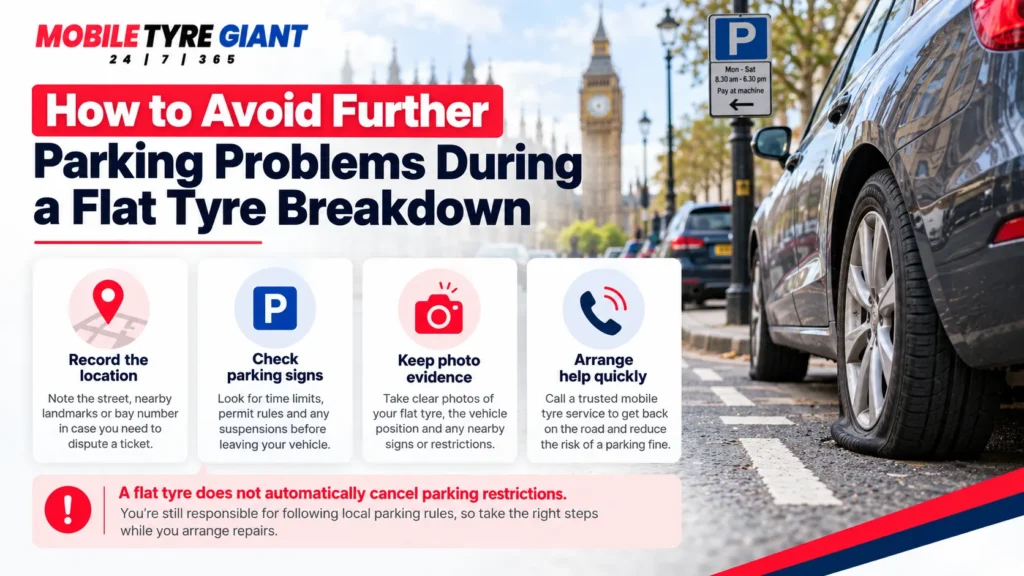
Inform the Parking Operator When Necessary
If your car breaks down inside a private car park, contact the operator as soon as reasonably possible. Explain that a flat tyre has prevented you from moving the vehicle and provide its registration number and location. Ask whether additional parking time or permission for tyre assistance can be arranged. Some operators may offer flexibility, but this depends on their individual policies.
For council-controlled parking spaces, check which authority manages the location and whether any assistance is available. A parking attendant may be able to explain the restrictions, but cannot necessarily authorise an exemption. Keep records of any communication, including reference numbers and the time you contacted the operator. Permission should never be assumed simply because you have reported the breakdown.
Keep Evidence and Arrange Prompt Vehicle Recovery
Good records can be valuable if a genuine breakdown results in a parking penalty. Photograph the damaged tyre, nearby parking signs and vehicle position, provided you can do so safely. Save your assistance booking confirmation, repair receipt or recovery documentation. These records may help establish that the vehicle could not reasonably be moved.
If a Penalty Charge Notice is issued, follow the challenge procedure stated on the notice. Explain why the breakdown was unavoidable and provide relevant supporting evidence. Remember that London boroughs, red-route authorities and private parking operators may follow different processes. A genuine puncture can support a challenge, but it does not guarantee cancellation.
What Should You Check Before Driving Away After a Flat Tyre?
Once your tyre has been repaired or replaced, do not rush straight back into London’s traffic. Before moving, make sure the work is complete and the vehicle is safe to drive. Confirm that the tyre is correctly inflated and suitable for your car. If a wheel was removed, its fixings should have been tightened according to the manufacturer’s requirements.
Take a moment to inspect the area around your vehicle before leaving. Check for pedestrians, cyclists and approaching traffic, particularly when pulling out of a roadside parking space. Make sure no tools or equipment remain near the wheels. If the tyre failure involved a heavy impact or unusual vibration, additional wheel or suspension checks may be necessary.
Confirm the Tyre, Wheel and Pressure Are Correct
The replacement tyre must meet the appropriate size, load and speed specifications for your vehicle. A properly completed repair should also leave the tyre suitable for normal road use. Ask the technician about any damage discovered during inspection, particularly if the tyre had been driven while deflated. Serious internal tyre damage may not be visible from the outside.
After the work is complete, check whether any tyre pressure warning remains on the dashboard. Some vehicles require a specific TPMS reset or recalibration procedure after tyre work. If the warning returns, investigate the cause rather than repeatedly resetting it. Correct inflation and a roadworthy tyre are essential before continuing your journey.
Reduce the Risk of Another Flat Tyre on London Roads
Not every puncture can be prevented, but regular tyre maintenance can help identify developing problems. Check tyre pressures when cold and inspect the tread and sidewalls for visible damage. Pay attention to unusual vibration, repeated pressure loss and changes in steering behaviour. These symptoms can indicate a problem that deserves inspection before another journey.
London’s busy streets can also contain potholes, raised drain covers and damaged road surfaces. A severe impact may damage a tyre or wheel even without causing immediate pressure loss. Recognising the warning signs of pothole tyre damage in London can help you decide when further inspection is necessary. Avoid making sudden, unsafe steering movements to dodge road defects, especially around cyclists and other vehicles.
Final London Flat Tyre and Parking Safety Checklist
Dealing with a flat tyre becomes easier when you know which actions matter most. Your priority should always be finding a place of relative safety and avoiding unnecessary risks. Parking restrictions are important, but they should never encourage you to continue driving on a dangerously damaged tyre. Once stopped, arrange appropriate assistance and keep the necessary information available.
Before leaving the breakdown location, use this checklist to make sure nothing important has been overlooked. It covers the immediate safety measures, parking considerations and practical steps needed before returning to the road.
- Stop somewhere safe without making sudden steering or braking movements.
- Use hazard warning lights when needed to warn approaching traffic.
- Keep passengers away from moving vehicles.
- Check nearby parking signs only when it is safe.
- Record the vehicle’s location and relevant restrictions.
- Contact a suitable tyre assistance or recovery provider.
- Photograph the damaged tyre and keep repair records.
- Check whether the vehicle can be repaired safely at its location.
- Confirm the tyre and wheel are roadworthy before moving.
- Follow the correct procedure if a parking penalty is issued.
Final Words: Handle a Flat Tyre in London Safely and Responsibly
A flat tyre in London can be particularly stressful when busy roads and strict parking restrictions leave you with limited options. The most important decision is finding a place of relative safety without causing further danger. Red routes, yellow lines and restricted bays still require attention, and a breakdown does not automatically prevent enforcement. However, clear evidence and prompt action may help explain an unavoidable stop.
Whether your tyre fails on a residential street or near a busy junction, focus on protecting yourself and arranging appropriate assistance. Avoid unnecessary driving on damaged tyres, keep useful records and ensure the vehicle is roadworthy before setting off again. Knowing how to respond can make an unexpected London tyre breakdown easier to manage.
Flat Tyre in London? Get Help Fast!
Stuck with a flat tyre on a London street or in a car park? Get professional mobile tyre fitting at a safe, accessible location without driving on a damaged tyre.
Frequently Asked Questions
Find quick answers to the most common questions our customers ask.
A flat tyre does not automatically exempt you from double yellow line restrictions. If a genuine breakdown makes stopping unavoidable, you may be able to challenge a penalty with supporting evidence.
Red routes have strict stopping restrictions. If your vehicle cannot safely continue because of a sudden tyre failure, stop as safely as possible, arrange assistance and document the circumstances.
You could receive a Penalty Charge Notice even after a genuine breakdown. Relevant photographs, repair invoices and recovery records may support a challenge, although cancellation is not guaranteed.
You may be able to leave it in a suitable parking space, subject to applicable restrictions. If the car is causing an obstruction or remains in a restricted location, arrange prompt assistance.
Only attempt a tyre change if the location and conditions make it safe. Never work beside dangerous moving traffic or in an exposed live lane.
Repair may be possible if the tyre is suitable and the location provides safe access. Private car parks may require operator permission, and access restrictions should be confirmed before booking.
Yes, you can challenge a penalty using the procedure stated on the notice. Explain the breakdown and provide evidence showing why the vehicle could not reasonably be moved.
No. Driving on a completely flat tyre can damage its internal structure and the wheel. Stop as soon as it is safe and arrange suitable assistance.
A designated parking space or another place of relative safety is preferable where safely reachable. Avoid busy junctions, live traffic lanes and locations that expose passengers to moving vehicles.