

Yes, a professionally repaired puncture can pass an MOT in the UK, provided the tyre meets the required safety and legal standards. The repair itself is not an automatic reason for failure. What matters is whether the tyre remains structurally sound, has sufficient tread depth and shows no unacceptable damage. A small nail hole repaired correctly may cause no issues during testing. However, a poorly repaired or damaged tyre could still fail, even if it appears to hold air.
Imagine booking your MOT after having a puncture repaired a few weeks earlier. You might wonder whether the technician will notice the repair and reject the tyre. Fortunately, a suitable permanent repair does not mean you must automatically buy a replacement. The MOT inspection focuses on the tyre’s condition rather than simply its repair history. Understanding what testers examine can help you avoid unnecessary expense and prepare your vehicle with confidence.
Can a Professionally Repaired Tyre Pass an MOT?
A properly repaired tyre can pass an MOT when it satisfies the relevant inspection requirements. The repair should have been completed using an appropriate method, following British Standard BS AU 159 and the tyre manufacturer’s instructions. The tyre must also remain suitable for road use. A repaired puncture in the permitted tread area is different from damage affecting the shoulder or sidewall. The location, size and condition of the original injury all matter.
An MOT tester does not automatically reject a tyre because it has previously suffered a puncture. Instead, the inspection looks for defects that could affect road safety. These include inadequate tread depth, exposed cords, serious cuts and structural deterioration. If you are uncertain whether an earlier repair was completed correctly, arrange an inspection before your MOT appointment. A professional assessment can identify problems that might otherwise go unnoticed until the test.
What Do MOT Testers Actually Check on Repaired Tyres?
During an MOT, the tester examines the tyres fitted to the vehicle’s road wheels. They assess tread depth, visible structural condition, tyre fitment and other relevant safety requirements. For most passenger cars, the legal minimum tread depth is 1.6mm across the central three-quarters of the tread width, around the entire circumference. A tyre can have an acceptable puncture repair and still fail because its tread is too worn. Passing the repair assessment does not exempt it from normal MOT standards.
The tester also looks for significant cuts, exposed cords, dangerous bulges and other visible defects. A tyre that has been driven while severely underinflated may have suffered damage that inflation cannot reverse. For a broader explanation of these checks, see this tyre safety guide. Checking the tyres before your appointment gives you time to deal with obvious problems. It is particularly worthwhile when the puncture occurred after a pothole impact or alongside noticeable pressure loss.
Does an MOT Tester Remove the Tyre to Inspect the Repair?
An ordinary MOT does not involve removing the tyre from its wheel to inspect an internal puncture repair. The inspection follows defined procedures and focuses on the components and conditions that can be assessed during the test. Consequently, a tester may not be able to establish exactly how a previous repair was carried out. A pass should never be interpreted as proof that an unseen internal repair was completed correctly. That distinction matters when the tyre’s repair history is uncertain.
A responsible tyre repairer follows a different inspection process before completing a permanent repair. The tyre is removed from the wheel so its inner surface and structure can be examined. This allows damage caused by underinflation or penetration to be identified before repair materials are applied. If you purchased a used vehicle with an unknown repair history, consider having suspicious tyres professionally checked. An MOT certificate cannot replace that more detailed assessment.
What Counts as a Safe Puncture Repair in the UK?
A safe permanent puncture repair must meet the applicable British tyre-repair standard and manufacturer requirements. For ordinary passenger car tyres, minor repairs are generally limited to eligible damage within the central tread repair zone. The tyre must be inspected internally and externally before work begins. Serious sidewall damage, exposed cords or deterioration can make an otherwise small puncture unsuitable for repair. The fact that a hole is tiny does not automatically make the tyre repairable.
British Standard BS AU 159g:2013 provides guidance on suitable repair materials, permitted damage and inspection procedures. A trained professional should assess whether the tyre qualifies before proceeding. When a tyre is suitable, a correctly applied permanent repair can restore its intended service capability. If the injury falls outside the permitted limits, replacement may be necessary instead. Understanding these differences helps explain why two punctures of similar size can receive completely different recommendations.

Why Does the Location of a Puncture Matter?
Picture a screw embedded in the middle of your tyre’s tread. If the penetration is small and there is no additional damage, it may fall within the permitted repair area. For many passenger car tyres, eligible penetration damage is limited to a maximum diameter of 6mm. However, the permitted central repair zone varies according to tyre section width. A technician must assess the actual injury against the applicable standard rather than relying on the hole’s appearance.
Damage closer to the shoulder or sidewall raises different concerns. These areas experience substantial movement and stress while driving, making structural repair unsuitable in many circumstances. A repair attempted in an unacceptable location may compromise the tyre’s integrity. Even if the tyre holds pressure afterwards, that alone does not establish its safety. A proper inspection determines whether the puncture is suitable for permanent repair or whether the tyre should be replaced.
Is a Plug-and-Patch Repair Better Than a Temporary Plug?
A permanent combination plug-and-patch repair addresses both the penetration channel and the tyre’s inner liner. It is installed from inside the tyre after removal and inspection, using approved materials and procedures. This approach differs from inserting a simple plug through the outside of a fitted tyre. An external plug may temporarily reduce air loss, but it does not provide the internal examination required for a recognised permanent repair. The difference is important when deciding whether a repaired tyre is suitable for continued road use.
Emergency repair kits and sealants also have limitations. They are generally intended to provide temporary mobility under specified conditions, allowing the driver to reach professional assistance. Using one does not automatically mean the puncture has been permanently repaired. If your tyre needs proper assessment, the available mobile tyre repair service explains the process for checking eligible punctures. Always confirm that the damage is suitable before relying on a permanent repair.
Does a Repaired Puncture Automatically Mean an MOT Advisory?
No, a previous puncture repair does not automatically require an MOT advisory. Advisories are used to identify conditions that deserve attention even when they do not result in failure. If a tyre is in acceptable condition and the tester finds no relevant defect, the repair history alone need not produce an advisory. However, worn tread or other developing problems may still be noted. This is why a passing result and an advisory can sometimes appear together.
An advisory is not the same as a failed MOT, but it should not be ignored. It gives you an opportunity to address a developing issue before it becomes more serious. Equally, a puncture repair that appears satisfactory during an MOT is not a guarantee against future pressure loss or tyre damage. Monitor your tyres after the test and investigate repeated air loss promptly. The next part explains which tyre defects can lead to MOT failure, even after a puncture has been repaired.
Which Tyre Defects Can Cause an MOT Failure After a Puncture Repair?
A puncture repair might be perfectly sound, but that does not guarantee the tyre will pass an MOT. Testers examine the tyre’s overall condition, not just the spot where the puncture occurred. Problems such as inadequate tread depth, exposed cords and structural damage can result in failure. A tyre may also develop damage from being driven underinflated before the repair. Even a small defect deserves attention if it affects the tyre’s safety.
The important distinction is between a previous repair and a current defect. A properly repaired tyre with no other faults can meet MOT requirements. However, an unacceptable cut, structural bulge or insufficient tread can change the result. Some problems receive a minor classification, while others are recorded as major or dangerous. Understanding these differences helps you decide what needs attention before your appointment.
Tyre condition | MOT classification | What it means |
Properly repaired puncture with no other defects | No automatic failure | Can pass if all relevant requirements are met |
Tread below the legal minimum | Dangerous | MOT failure |
Cut exceeding the permitted limits and reaching the cords | Major | MOT failure |
Structural bulge or exposed cords | Dangerous | MOT failure |
Tyre obviously underinflated | Minor | Does not cause failure by itself |
Confirmed TPMS malfunction on an applicable vehicle | Major | MOT failure |
Seriously damaged valve likely to cause sudden deflation | Dangerous | MOT failure |

Tread Depth and Uneven Wear After a Repair
A repaired tyre still needs sufficient tread across the legally required area. For most passenger cars, the minimum is 1.6mm across the central three-quarters of the tread width, around the complete circumference. A tyre below this limit receives a dangerous MOT defect. The puncture repair itself cannot compensate for excessive wear. Even if the tyre holds pressure perfectly, it must meet the tread requirement.
Uneven wear can also create problems, particularly when one section wears faster than the rest. Imagine repairing a nail puncture only to discover that the inner tread is almost smooth. The tyre may be unsuitable for continued use despite the successful repair. Our guide to checking tyre tread depth explains how to measure it correctly. Check several positions rather than relying on one reading from the centre.
Cuts, Bulges and Exposed Tyre Cords
Damage to a tyre’s structure is more serious than an ordinary tread puncture. A bulge may indicate internal separation caused by a pothole impact or driving with insufficient pressure. Exposed cords are another serious warning sign, even when the surrounding rubber appears intact. Under MOT rules, structural bulges and exposed or damaged cords are classified as dangerous defects. Certain deep cuts reaching the reinforcing material are classified as major defects.
Not every small surface mark automatically results in failure, but suspicious damage needs proper assessment. The tester considers the depth, size and nature of a cut against the inspection requirements. A tyre that has suffered structural deterioration may need replacing rather than repairing. If you are unsure when replacement is appropriate, read our guide on when to replace tyres. Never assume a tyre is safe simply because it has not gone flat.
Will a Temporary Puncture Repair Pass an MOT?
A temporary puncture repair does not automatically cause an MOT failure simply because a sealant or external plug has been used. However, the tyre must still satisfy the applicable inspection requirements. MOT testers do not normally remove tyres to assess internal repairs. Consequently, the test cannot confirm whether an emergency repair meets the standards for permanent road use. A passing result should not be treated as approval of an unsuitable temporary repair.
Many motorists use emergency sealant after discovering a puncture away from home. Such products are generally intended to provide limited mobility under the instructions supplied with the kit. They are not automatically equivalent to a professionally completed permanent repair. If your tyre was treated with sealant, tell the technician before further work is attempted. The puncture may require proper inspection, repair or replacement before normal driving resumes.
Why Holding Air Does Not Prove a Tyre Is Safe
A repaired tyre can appear normal while concealing damage beneath its tread or sidewall. Imagine a tyre that lost most of its pressure before the driver noticed. Even after inflation, its internal components may have suffered excessive flexing and heat. A pressure gauge cannot reveal that type of structural deterioration. This is one reason professional tyre inspections involve more than checking for an air leak.
A tyre that repeatedly loses pressure also needs attention, regardless of its previous repair. Air may escape from the original puncture, a valve or the seal between tyre and wheel. Repeatedly inflating it without investigating the cause can leave the underlying problem unresolved. If you experienced significant pressure loss before the repair, explain this during the inspection. Accurate information about the tyre’s history helps a specialist assess whether continued use is appropriate.
Can Low Tyre Pressure or a TPMS Warning Affect an MOT?
Low tyre pressure is another concern when presenting a previously repaired tyre for its MOT. Under the DVSA inspection rules, an obviously underinflated tyre is normally recorded as a minor defect. A minor defect does not cause an MOT failure by itself. However, that classification does not mean severely underinflated tyres are safe to drive on. A tyre with additional structural damage may receive a more serious classification.
Always check inflation pressures before travelling to the test centre. Use the recommendations displayed on your vehicle’s tyre-pressure label or in its handbook. Avoid relying on the maximum pressure moulded into the tyre sidewall. If one tyre loses pressure repeatedly after a puncture repair, arrange an inspection before the appointment. Correct inflation supports safe handling and helps prevent additional tyre damage.
Does an Illuminated TPMS Light Automatically Mean a Fail?
A tyre pressure monitoring system, or TPMS, alerts drivers to possible pressure loss or system problems. During an MOT, TPMS inspection applies to relevant M1 passenger vehicles first used on or after 1 January 2012. A confirmed malfunction or an obviously inoperative system is classified as a major defect. This means the vehicle fails its MOT. However, an illuminated warning light does not always prove that the system itself is faulty.
For example, the warning may remain illuminated because the system has detected genuinely low tyre pressure. In that situation, correcting the pressure and following the vehicle’s calibration instructions may resolve the alert. If the tester cannot determine whether the warning indicates low pressure or a malfunction, the manual calls for advisory information. A dashboard message alone is not automatically a defect. Investigate recurring warnings rather than assuming the sensor needs replacing.
What Is the Difference Between Minor, Major and Dangerous Tyre Defects?
MOT defects are classified according to their nature and potential effect on vehicle safety. A minor defect does not normally prevent the vehicle from passing its test. A major defect results in failure because it may compromise safety or involve significant non-compliance. A dangerous defect represents a direct and immediate risk to road safety. These classifications explain why two tyre problems can lead to very different outcomes.
Consider two cars arriving for an MOT after a puncture repair. One has an acceptable permanent repair and an obviously underinflated tyre, which may receive a minor defect if no other problem exists. The other has exposed reinforcing cords, a dangerous defect that results in failure. The important difference is the condition of each tyre, not simply whether a puncture occurred previously. Part 3 explains how to check your tyres before an MOT and when a professional repair assessment or replacement may be necessary.
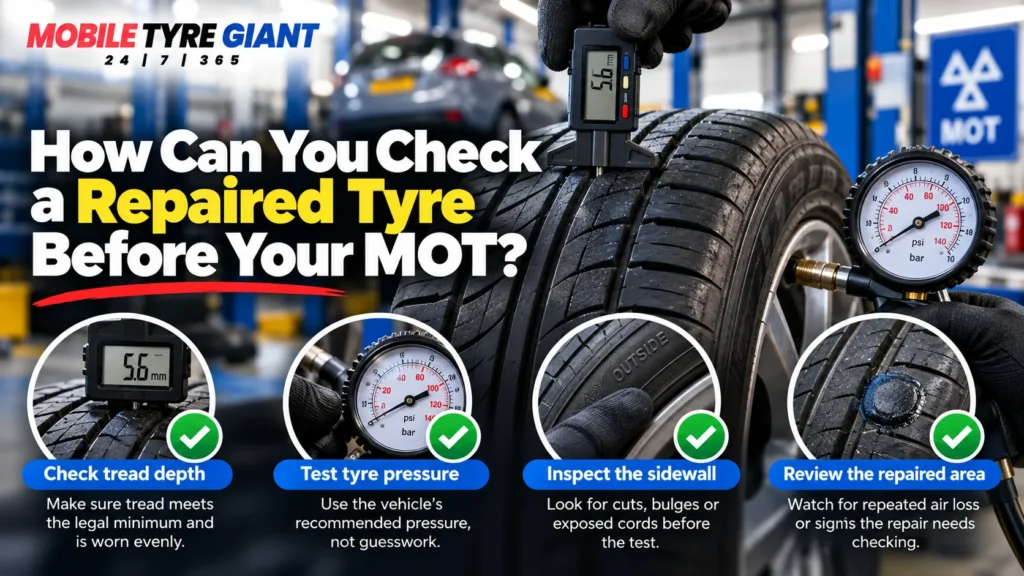
How Can You Check a Repaired Tyre Before Your MOT?
Preparing your tyres before an MOT does not have to involve complicated mechanical work. A few careful checks can reveal problems that might otherwise lead to a failed test. Start by looking at the tyre that previously suffered a puncture, paying attention to its tread, sidewall and general condition. Check for unusual wear, visible damage or signs that the repair may no longer be holding pressure. Even if the tyre looks perfectly normal, a visual inspection cannot confirm its internal condition.
The aim is to identify obvious concerns before travelling to the testing centre. A previously repaired tyre should meet the same legal requirements as every other tyre on the vehicle. If you notice damage, repeated pressure loss or something unusual around the original puncture, arrange a professional inspection. You should also check the remaining tyres rather than focusing entirely on the repaired one. A little preparation can help you avoid unexpected repairs and unnecessary delays on MOT day.
Check Tyre Pressure and Watch for Slow Air Leaks
A slow air leak is one of the easiest problems to overlook after a puncture repair. Imagine checking your tyre on Monday and finding it noticeably softer by Thursday. The tyre might still look inflated, but the repeated pressure loss suggests something needs investigating. Use a reliable pressure gauge when the tyres are cold and compare the readings with your vehicle manufacturer’s recommendations. Never assume that a tyre is holding pressure correctly simply because it looks normal.
If the same tyre repeatedly needs topping up, the previous repair may require assessment. However, air loss can also come from a damaged valve, corroded wheel rim or another puncture. Avoid assuming the original repair is responsible without checking. A professional can identify the source and determine whether further work is appropriate. Correcting the problem before an MOT is more sensible than arriving with a tyre that may be underinflated or unsafe.
Inspect Tread, Sidewalls and Correct Tyre Fitment
Your repaired tyre must have sufficient tread depth and remain free from unacceptable structural damage. Look across the tread for uneven wear, embedded objects and areas that appear unusually smooth. Inspect the visible sidewall for deep cuts, bulges or other signs of deterioration. Remember that some damage may be hidden on the inner side of the tyre. If anything looks suspicious, have it inspected rather than attempting to diagnose internal damage yourself.
Tyre size and fitment also matter during an MOT. Tyres on the same axle must meet the applicable compatibility requirements, including size and construction. A replacement fitted after a puncture should also satisfy the vehicle’s load and speed requirements. If you are unsure about the markings, our correct tyre size guide explains what they mean. Checking these details before the test can help identify unsuitable fitment and avoid preventable problems.
How Can You Tell If an Old Puncture Repair Needs Attention?
An old puncture repair does not automatically become unsafe simply because time has passed. A properly completed repair can remain serviceable while the surrounding tyre continues to meet its operating requirements. However, repeated pressure loss, vibration or visible deterioration should never be dismissed. These symptoms may indicate a problem with the tyre, wheel or original repair. A normal-looking repair does not rule out damage elsewhere.
Suppose you bought a second-hand car and noticed a repaired puncture in one of its tyres. You might not know how long the previous owner drove before discovering the damage. That missing information matters because prolonged underinflation can harm a tyre internally. If the repair method or tyre history is uncertain, professional assessment is the sensible approach. An MOT pass checks compliance with the inspection requirements, but it does not certify the quality of an unseen internal repair.
When Is Replacement Safer Than Another Repair?
Not every damaged tyre can be repaired safely. Structural bulges, exposed cords, unacceptable sidewall damage and evidence of serious deterioration can make replacement necessary. The position and size of a puncture also determine whether it falls within an approved repair area. A tyre that has already been driven extensively while underinflated may have suffered hidden damage. Repairing the visible hole would not reverse that deterioration.
If a specialist determines that replacement is necessary, avoid driving on the damaged tyre merely to reach a garage. Depending on where the vehicle is safely parked, mobile tyre replacement may offer a convenient alternative. The replacement must meet the vehicle’s appropriate tyre specifications, including load capacity and speed rating. It is also worth asking the technician to assess the condition of the other tyres. Replacing an unsafe tyre before your MOT can prevent a dangerous defect from being identified during the test.
Can Fixing Tyre Problems Before an MOT Save You Money?
Discovering a tyre problem before your MOT can help you avoid unexpected expenses. A straightforward inspection may reveal a slow leak, worn tread or damaged valve before the issue becomes more serious. In some circumstances, a suitable puncture may be permanently repaired rather than requiring a replacement. However, repair should only be considered when the tyre meets the necessary safety requirements. Choosing the cheapest option without considering tyre condition can create greater problems later.
Planning ahead can also reduce inconvenience if your vehicle is needed for work or family journeys. A failed MOT may require further repairs, another appointment and potentially an additional fee. Compare the cost of an appropriate repair or replacement with the practical disruption of having your vehicle unavailable. There is no benefit in replacing a tyre that remains safe and compliant merely because it was previously punctured. The sensible approach is to inspect first, establish what is actually needed and address genuine defects.
What Happens If Your Car Needs an MOT Retest?
If your vehicle fails its MOT because of a tyre defect, the problem must be addressed before it can pass. The test centre will record the defect and explain the result. A partial retest may be available once the necessary repairs have been completed. If the vehicle remains at the same testing centre for repairs and is retested within 10 working days, the partial retest is free. This can help avoid paying for another full MOT.
If you take the vehicle away for repairs, different rules apply. Wheels and tyres are among the items eligible for a free partial retest when the vehicle returns to the same centre by the end of the next working day. Returning within 10 working days may still qualify for a partial retest, although a fee can apply. Outside the qualifying period, a full MOT and its associated fee may be necessary. Always check the arrangements with your testing centre before taking the vehicle away.
Can You Drive After Failing an MOT Because of a Tyre?
Whether you can drive after a failed MOT depends on the defect, the vehicle’s roadworthiness and its MOT status. A dangerous tyre defect means you must not drive the vehicle until it has been repaired. Examples include serious structural damage or tread below the required legal minimum. A major defect also requires immediate attention and results in MOT failure. Having time left on an existing MOT certificate does not make an unsafe vehicle legal to drive.
If your previous MOT has expired, driving is generally restricted to permitted journeys for repairs or a pre-arranged MOT, and the vehicle must still be roadworthy. Never attempt to drive on a dangerously damaged tyre simply because a repair appointment has been booked. Arrange suitable assistance if the vehicle cannot be moved safely. Once the identified defects have been corrected, organise the appropriate retest. Taking these steps helps you return to the road without risking further damage or compromising safety.
Should You Have a Puncture Repair Checked Before Your MOT?
If your tyre was professionally repaired and has maintained the correct pressure, another inspection may not be necessary solely because an MOT is approaching. However, an assessment is worthwhile if you are unsure how the repair was completed or whether the tyre suffered internal damage. A tyre that looks normal from outside can still have hidden problems. Knowing its condition before the test can prevent unexpected complications.
Consider a tyre that was punctured several months ago and has needed occasional reinflation ever since. Even if it looks acceptable, that pattern suggests an unresolved issue. A professional can investigate whether air is escaping from the original repair, the valve or another area. Identifying the cause early helps you make an informed decision about repair or replacement. It also reduces the chance of arriving at your MOT appointment with a tyre that is unsafe or losing pressure.
What Can a Tyre Specialist Check That an MOT Cannot?
An MOT inspection assesses a tyre against specific roadworthiness requirements, but it is not a complete internal examination. A specialist can remove the tyre from its wheel and inspect the inner liner, casing and previous repair. This can reveal damage from excessive underinflation or an unsuitable repair method. Such problems may not be visible during an ordinary MOT.
A tyre specialist can also investigate recurring air loss and check whether another permanent repair is permitted. The outcome depends on the tyre’s condition, damage location and applicable repair standards. If the existing repair is unsuitable, replacing the tyre may be necessary. Passing an MOT does not guarantee that every hidden defect has been identified, so unresolved symptoms should always receive attention.
When Should You Consider Mobile Tyre Assistance Before an MOT?
Sometimes a tyre problem becomes obvious only a day or two before an MOT appointment. Perhaps the repaired tyre is losing pressure again, or you discover a suspicious bulge while checking the tread. Driving to a garage on an unsafe tyre could make the situation worse. In these circumstances, arranging suitable professional assistance at your location may be a practical alternative.
Mobile tyre services can help when a vehicle is parked somewhere suitable for safe work. If an inspection confirms that replacement is necessary, mobile tyre fitting can provide an alternative to driving on the damaged tyre. The available service depends on the location, tyre requirements and nature of the problem. Always confirm what work is available before arranging an appointment.
What Information Should You Provide Before Booking?
Before contacting a tyre specialist, gather a few useful details about your vehicle and the puncture. Your registration number, tyre size, location and description of the problem can help explain what assistance is needed. Mention whether the tyre was previously repaired and whether it has been losing pressure again. These details matter because not every puncture can be repaired safely.
It is also helpful to describe visible cuts, bulges or objects embedded in the tread. If the vehicle cannot be driven safely, explain this rather than attempting to reach a garage. You can find more preparation advice in this guide explaining what information a mobile tyre fitter needs. Clear information helps the service provider assess the request and discuss suitable next steps.
How Can You Keep a Repaired Tyre Roadworthy After an MOT?
Passing an MOT is reassuring, but it does not remove the need for ongoing tyre maintenance. A previously repaired tyre should receive the same routine checks as every other tyre. Monitor its pressure, tread condition and visible sidewalls, especially before longer journeys. A correct permanent repair does not eliminate the possibility of another puncture or unrelated tyre damage.
Tyre pressure should be checked regularly, preferably when the tyres are cold. Keep the pressures aligned with your vehicle manufacturer’s recommendations and investigate unusual wear. Avoid potholes where safely possible and inspect the tyres after significant impacts. For additional maintenance advice, read our guide on how to make tyres last longer. Consistent care helps you notice developing problems between MOT appointments.
When Should You Arrange Another Tyre Inspection?
A tyre that suddenly loses pressure, develops a bulge or starts causing unusual vibration should be checked promptly. These symptoms can indicate damage unrelated to the original puncture repair. Even gradual pressure loss deserves attention when it repeatedly affects the same wheel. Continuing to add air without investigating the cause can allow a manageable problem to become more serious.
Pay attention to changes in steering, road noise and tyre wear. If the car begins pulling to one side, do not immediately assume the previous repair is responsible. Wheel alignment, suspension problems and tyre damage can produce similar symptoms. A professional inspection can help identify the actual cause. Addressing problems when they first appear is safer than waiting until the next MOT.
Final Words: Will a Puncture Repair Pass an MOT?
Yes, a properly repaired puncture can pass an MOT in the UK, provided the tyre meets all relevant inspection requirements. The presence of a previous repair does not automatically result in failure or an advisory. However, inadequate tread depth, serious cuts, exposed cords and structural damage can still cause an MOT failure. Temporary repairs should never be confused with approved permanent puncture repairs.
Before your MOT, check the tyre’s pressure, tread and visible condition. If the repair history is uncertain or the tyre continues losing air, arrange a professional assessment. Remember that an MOT pass confirms the vehicle met the inspection requirements at the time of testing, not that every hidden tyre defect has been ruled out. Keeping your tyres in good condition protects your safety throughout the year, not just on MOT day.
Need Tyre Help Before Your MOT?
A repaired puncture can pass an MOT, but tyre damage may still need attention. If replacement is necessary, arrange convenient mobile tyre fitting at your home or workplace.
Frequently Asked Questions
Find quick answers to the most common questions our customers ask.
Yes, a properly repaired puncture can pass an MOT if the tyre meets the required safety standards. The repair itself is not an automatic reason for failure.
A correctly completed permanent repair can be acceptable if the tyre has no relevant defects. The MOT does not normally involve removing the tyre to verify its internal repair.
A temporary plug does not automatically cause an MOT failure if no relevant defect is identified. However, it is not an approved permanent repair and should be professionally assessed.
Tyre sealant does not automatically result in MOT failure, but it is generally a temporary solution. The tyre still needs to meet the inspection requirements and should receive a professional assessment.
Sidewall penetration damage is generally unsuitable for an ordinary permanent puncture repair. A tyre with unacceptable cuts or structural damage can fail its MOT and may require replacement.
No, an ordinary MOT does not involve removing the tyre from the wheel to inspect an internal repair. The tester assesses the tyre using the prescribed inspection procedures.
Yes. For most passenger cars, tread below 1.6mm across the required central three-quarters is a dangerous MOT defect, even when the puncture repair is satisfactory.
Not automatically. However, related damage or other defects may cause failure, and obvious underinflation is a minor defect. A tyre that repeatedly loses pressure needs professional inspection.