

A run flat warning light can turn an ordinary journey into a worrying moment. Perhaps it appears as you join a busy dual carriageway, with traffic rushing past. The safest response is to ease off the accelerator and find somewhere suitable to stop, avoiding sudden lane changes that could make an unstable car harder to control. Whether you can continue depends on the fitted tyre, its condition and your vehicle’s instructions. The dashboard message alone cannot confirm that the tyre is safe.
Some genuine run-flat tyres permit limited travel after pressure loss, but only under specific conditions. A conventional flat tyre offers no equivalent protection, even when the display says Run Flat Indicator. Think of the warning as a smoke alarm: it signals a problem without identifying the cause. Checking carefully can prevent further damage and reduce the risk of losing control. Start with the immediate decisions below before looking at the technical explanation.
What Should You Do When the Run-Flat Warning Light Comes On?
When the run flat warning light appears, avoid pressing on just because the steering feels normal. Reinforced tyres may look inflated despite losing substantial pressure. Slow down smoothly, leave more space ahead and avoid sudden steering movements. Look for a service area, car park or other suitable stopping place. Heavy vibration, pulling to one side or a flapping noise makes stopping safely more urgent.
Once parked, check the dashboard message and examine the tyres from a safe position. Use a gauge if one is available and it is safe to check. Never inspect a wheel beside moving traffic or change a tyre in a live lane. Your next decision depends on whether the tyre is conventional, genuinely run-flat or still unidentified. This simple table gives you a starting point without making unsafe assumptions.
What you find | What to do |
Fitted tyre type unknown | Stop safely and confirm the sidewall markings and vehicle guidance. |
Conventional tyre seriously deflated | Do not drive on it; arrange assistance. |
Run-flat tyre losing pressure | Follow its specific restricted-driving limits only if conditions are safe. |
Bulge, split or unstable handling | Stop safely and seek assistance. |
Tyres look normal | Measure their pressures; visual checks alone are insufficient. |
Slow Down and Find Somewhere Safe to Stop
Imagine the warning appearing on a wet motorway, with spray blurring your view. Your priority is staying in control, not making it to your usual garage. Hold the steering steady, ease off gently and avoid abrupt braking where possible. If the car remains controllable, a motorway service area is generally safer than the hard shoulder. If you cannot reach one, follow the road’s breakdown procedures and your vehicle handbook.
The run flat warning light does not make roadside traffic any less dangerous. Once stopped, use hazard lights when appropriate and move to a place of safety if possible. Never walk around your vehicle or attempt a tyre repair beside live motorway traffic. If you are stranded in a live lane, seek emergency help rather than trying to investigate. Waiting safely is better than turning a pressure warning into a serious roadside incident.
Check Your Tyres for Pressure Loss or Visible Damage
At a safe location, begin with a visual check of each tyre. Look for obvious sagging, cuts, bulges or an object embedded in the tread. Do not pull out a nail or screw, because it may be restricting an air leak. Reinforced run-flat sidewalls can hold their shape despite considerable pressure loss. An apparently normal-looking tyre therefore needs more than a quick glance.
If safe, measure each tyre with a reliable gauge and check the vehicle’s recommended pressures. These figures usually appear on a door label or in the handbook. For more detail, see this guide to checking tyre pressure correctly. Avoid using the maximum pressure printed on a tyre’s sidewall as your normal inflation target. Readings taken after driving may be higher than normal cold-pressure values, so consider the tyre’s temperature when assessing them. Never assume a visibly damaged tyre becomes safe simply because you have added air.
Confirm Whether Your Tyres Are Actually Run-Flat
Here’s an easy mistake: treating the words Run Flat Indicator as proof of run-flat tyres. Some vehicles show that message even when conventional tyres are fitted. A previous owner may also have changed the type originally supplied. When safe, inspect the actual sidewall for manufacturer-specific markings such as RFT, RSC, SSR, ROF or ZP. If you cannot establish the tyre type, do not assume that driving on reduced pressure is permitted.
Genuine run-flat construction can support restricted movement after pressure loss; a deflated conventional tyre cannot. This comparison of run-flat and normal tyres explains the construction differences. Having no spare wheel does not prove that run-flats are fitted, since some vehicles carry repair kits. Likewise, steady steering does not prove that a tyre is properly inflated. Make the decision from the fitted tyre’s specification and its condition, not guesswork.
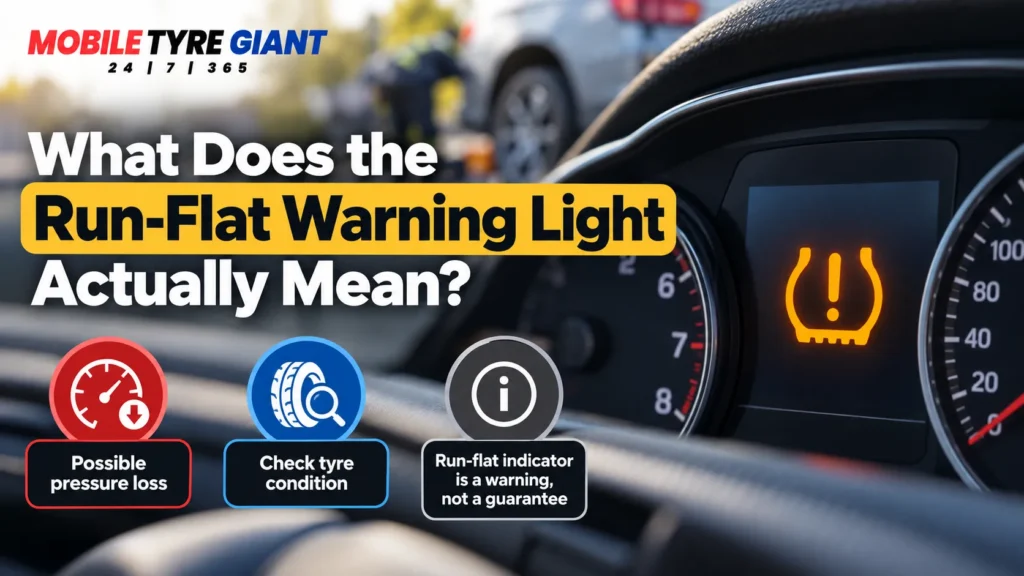
What Does the Run-Flat Warning Light Actually Mean?
A run flat warning light signals possible pressure loss or a related monitoring problem. Some systems compare wheel rotation patterns to detect changes associated with lost air. Others use sensors that measure pressure, depending on the vehicle and equipment. A warning may appear before you notice a change in steering or comfort. That is why checking the tyres matters more than judging how normal the drive feels.
The monitoring system and the tyre’s physical ability are two different things. A display saying Run Flat Indicator is not permission to drive another 50 miles. Even genuine run-flat tyres have limits that depend on tyre specifications and driving conditions. If the warning remains after stopping and checking pressures, do not simply clear it and carry on. A puncture, slow leak, calibration issue or monitoring fault may still need attention.
Run Flat Indicator vs Tyre Pressure Monitoring System
Dashboard wording can mislead because it describes a monitoring system, not necessarily the tyres. On some cars, the Run Flat Indicator (RPA) works indirectly by comparing how quickly the wheels rotate. Pressure loss can change a tyre’s rolling radius, which the system detects. This method does not show the exact pressure inside each tyre. The warning can therefore appear without a visible flat.
Other cars use direct TPMS sensors to report tyre pressure. The two systems have different capabilities and may require different reset procedures. Neither system confirms that a tyre driven underinflated remains structurally sound. Like an alarm and a thermometer, they offer different information. An even, gradual loss across all four tyres can escape some indirect monitoring systems. You still need to check the actual tyre before deciding what to do.
Why BMW and MINI Drivers May See This Warning
A run flat warning light may appear as Run Flat Indicator in BMW and MINI menus. In certain models, the system uses wheel-speed information to identify differences associated with pressure loss. It can also require initialisation after adjusting pressures or replacing wheels and tyres. An incorrect reference can produce misleading alerts. Controls vary by model, so online reset instructions are not universal.
Imagine a used BMW whose original run-flats have been replaced by conventional tyres. The dashboard may still display Run Flat Indicator because the monitoring feature remains installed. That message cannot turn them into run-flat tyres. This is particularly relevant when buying a used car with an incomplete maintenance history. Check the fitted tyre markings and the vehicle handbook, rather than relying on what the screen calls the system. If uncertain, seek advice before driving on a tyre with suspected pressure loss.
How Far Can You Drive With a Run-Flat Warning Light On?
There is no single safe distance for every driver who sees a run flat warning light. It might mean slight pressure loss, a flat conventional tyre or a deflated run-flat. These situations need different decisions. Without confirming the tyre type, no advertised mileage limit applies. Safety comes before finishing the journey.
For compatible run-flat tyres, limited onward travel may be possible under the tyre maker’s instructions. Damage, loading, road conditions and prior travel with low pressure affect the limit. Steady handling does not rule out tyre damage. If the steering changes, the tyre makes unusual sounds or the car feels unstable, stop as soon as it is safe. If those conditions cannot be confirmed, roadside assistance is safer than experimenting with the limits. Do not guess how much range remains.
Understanding the 50-Mile and 50-Mph Guidelines
Some run-flat tyres permit up to 50 miles at no more than 50 mph. These figures do not apply universally. Your tyre or vehicle may require a shorter distance. Load, temperature, road conditions and damage matter too. The purpose is reaching assistance, not continuing your usual journey.
Think of the distance limit as an upper boundary rather than credit you can spend without checking. Pressure loss may have begun before the warning appeared. Stay within manufacturer limits and travel only towards assistance if conditions permit. Some manufacturers prohibit continued driving when multiple tyres are affected. Always check your exact tyre specification, not a generic mileage estimate shown online. Never treat 50 mph as a target speed.
Situation | What the distance guidance means |
Confirmed compatible run-flat tyre | Check its exact restricted speed and distance limits. |
Tyre type unknown | Do not assume the 50-mile guidance applies. |
Handling changes or visible serious damage | Stop safely regardless of remaining distance. |
Conventional tyre flat | Do not drive on the deflated tyre. |

When You Must Stop Driving Rather Than Continue
A run flat warning light should never be ignored because reinforced construction cannot make every puncture safe. Stop safely if the car pulls, vibrates heavily, thumps, smokes or steers abnormally. An exposed cord, deep sidewall cut or bulge is another reason not to continue. A pothole strike can cause hidden structural damage. Learn more about signs of tyre sidewall damage.
On a motorway, reach a suitable safe stopping place if the vehicle remains controllable. Do not try to inspect a tyre while standing next to a live traffic lane. Arrange roadside assistance rather than risk driving to a garage. Conventional tyres are different; read about driving with a flat tyre. Keep passengers well away from passing traffic while you arrange the next steps safely. Protecting the vehicle is secondary to protecting people.
Why Is the Run-Flat Warning Light On When Your Tyres Look Fine?
A run flat warning light can seem baffling when every tyre looks normal. You cannot judge tyre pressure by appearance alone. Run-flat sidewalls can disguise low pressure; conventional tyres may also conceal smaller leaks. Investigate the warning even without obvious damage. It is information to investigate, not a verdict about the cause.
Possible explanations include a slow puncture, a leaking valve, incorrect pressures or a monitoring system that needs recalibration. Falling temperatures may lower pressures further. Do not immediately blame a sensor. Measure pressures safely against the vehicle’s specified values. A colder morning can reveal pressures that were already close to the recommended threshold. If the warning persists, further inspection is sensible.
Slow Punctures, Air Leaks and Hidden Tyre Damage
A small nail in the tread may leak air slowly enough for the car to feel ordinary for several journeys. Leaks can also develop around a valve or where the tyre seals against the wheel rim. The alert may appear hours after the initial puncture. Don’t pull out a nail; it may be restricting the leak. Pressure checks and professional inspection help establish the cause.
Driving underinflated can cause hidden internal tyre damage. Extra sidewall flex generates heat and structural stress. Re-inflating the tyre does not reverse that damage. A normal pressure reading after inflation cannot prove the tyre’s internal structure is sound. If pressure fell significantly, or the duration is unknown, seek an inspection. An inspection can prevent both needless replacement and unsafe reuse.
Incorrect Calibration or a Monitoring-System Fault
A run flat warning light does not always mean a fresh puncture. On vehicles using an indirect monitoring system, the computer compares wheel behaviour against a previously stored reference. If the tyres were inflated, rotated or replaced without the required initialisation, that reference may no longer match the current wheels. Think of a bathroom scale that was never set to zero: the reading might look convincing, but the starting point is wrong.
Direct monitoring systems have different possible faults, including a damaged pressure sensor, communication problems or a leaking valve assembly. Those possibilities should be investigated rather than guessed from the warning symbol alone. A tyre technician can check pressure and physical condition, while a suitable diagnostic check may be needed for an electronic fault. Where a direct system has a confirmed valve problem, TPMS valve replacement may be relevant. It is not an automatic cure for every tyre warning, especially on cars that use indirect monitoring.
Why the Warning Keeps Coming Back
A warning that disappears after adding air and returns a day later deserves attention. Imagine topping up a bicycle tyre each morning while never finding the tiny hole in its tube. The pressure looks right for a while, but the underlying leak has not gone away. Car tyres can lose air through a small tread puncture, a damaged valve or a poor seal at the wheel rim. Cold weather can lower pressure too.
Record the pressures when the tyres are cold, using the values specified for your vehicle and its load. If one tyre repeatedly loses more pressure than the others, arrange a professional inspection rather than repeatedly resetting the run flat warning light. A recurring alert after correct inflation and initialisation could also point to a monitoring fault. If the tyre is clearly deflating, feels unstable or shows damage, stop using the vehicle until appropriate help is arranged.
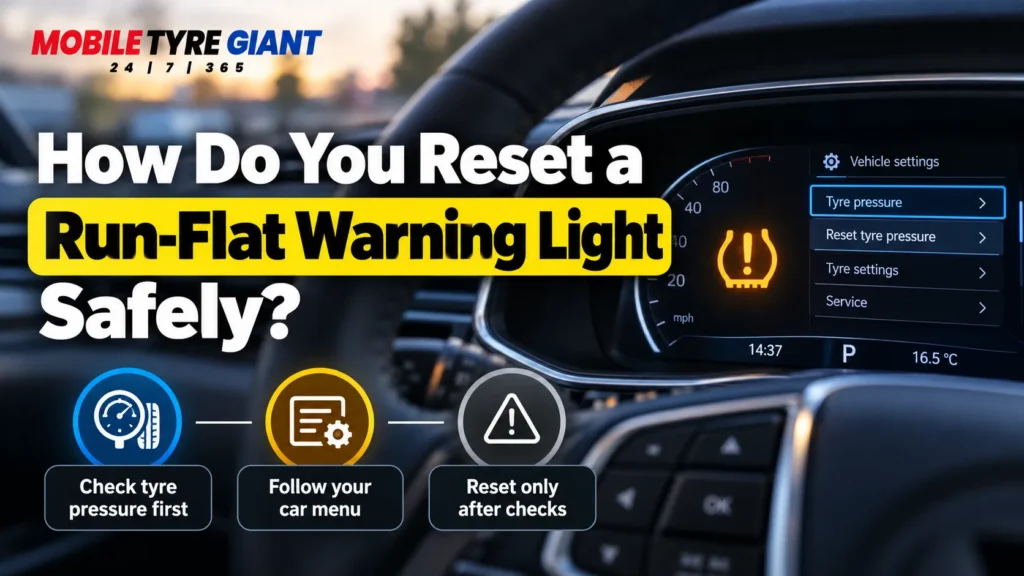
How Do You Reset a Run-Flat Warning Light Safely?
Resetting the run flat warning light should be the last part of a basic check, not the first. Park in a safe place and inspect each tyre for visible damage or objects lodged in the tread. Measure the pressures with a suitable gauge, ideally when the tyres are cold, then correct them to the values on the vehicle’s pressure label or in its handbook. If a tyre has been driven significantly underinflated, it may require inspection before further use, even after reinflation. A reset cannot tell you whether its internal structure is still sound.
Once the tyre condition and pressures have been addressed, use the procedure specified for your exact vehicle. Some cars have an option in the instrument display, while others require a different menu or button sequence. Certain indirect systems complete their initialisation during subsequent normal driving, but you should only do this when the vehicle is safe to drive. If the warning returns, flashes or refuses to clear, stop repeating the reset and investigate what the system is reporting.
Can a Run-Flat Tyre Be Repaired or Does It Need Replacing?
Finding a puncture does not automatically settle the repair-versus-replacement question. Some run-flat tyres may be repaired, but permission depends on the tyre maker’s policy, the damage and what happened while pressure was low. Other run-flat products are not approved for repair after pressure loss. The run flat warning light also cannot reveal whether the inner sidewall was weakened during driving. That uncertainty is why a trained tyre professional needs more information than a quick look at the tread.
A permanent repair normally requires removing the tyre from the wheel so its inside can be examined. The repair must also meet the relevant UK tyre-repair standard and the specific manufacturer’s restrictions. A repair kit or an externally inserted plug should not be presented as an equivalent permanent fix. If the history of low-pressure driving is uncertain, replacement may be the safer conclusion. The aim is not to sell the most expensive option, but to avoid returning a structurally unsafe tyre to the road.
What the inspection finds | Likely outcome |
Small puncture in an eligible tread area | Repair may be considered if the manufacturer permits it |
Sidewall cut, bulge or structural damage | Replacement is normally necessary |
Evidence of harmful low-pressure driving | Repair may be unsafe, even if the puncture is small |
Tyre maker prohibits repair | Replace rather than override its instructions |
Damage or driving history cannot be established | Seek specialist assessment; do not assume repair is safe |
When a Run-Flat Puncture Might Be Repairable
A small nail hole in the central tread area may be a candidate for repair, provided the tyre manufacturer allows it. The tyre must have sufficient tread, no disqualifying structural damage and an acceptable history of use after the puncture. A specialist needs to inspect the inner liner, sidewalls and repair area after removing the tyre from the rim. The position and extent of damage matter just as much as what you can see outside.
Be ready to explain when the run flat warning light appeared and approximately how far you travelled afterwards. Mention any shaking, pulling, thumping noises or noticeable change in handling, even if they stopped later. These details can help a technician assess whether the tyre may have been stressed while underinflated. If you do not know when the pressure loss began, say so rather than inventing a mileage estimate. A responsible repair decision accounts for uncertainty instead of treating the puncture hole as the whole problem.
When Tyre Replacement Is the Safer Option
Replacement is generally necessary when a tyre has a damaged sidewall, exposed cords, separation or other structural defects. Deep cuts, bulges and signs of severe overheating are not ordinary punctures that should be patched and forgotten. The same applies when the tyre manufacturer excludes repair or an inspection finds damage from extended low-pressure driving. A run-flat tyre can remain deceptively firm while its internal components have been stressed. That is why appearances alone cannot settle a safety decision.
Do not drive away on a questionable tyre simply because a run flat warning light has vanished after inflation. A cleared dashboard message says little about internal condition, wheel damage or the suitability of a repair. If replacement is required, match the new tyre to the vehicle’s approved size, load and speed specifications, following its tyre-fitment guidance. Ask for the reason behind the recommendation so you understand what the inspection found. A clear explanation is more useful than either an automatic replacement or an unsafe promise to repair everything.
When Should You Call a Mobile Tyre Specialist?
A run flat warning light becomes more concerning when the tyre is losing pressure, visibly damaged or affecting the car’s handling. If you cannot safely identify the problem, professional assistance is a sensible next step. Continuing to drive on a damaged tyre can harm the wheel and increase the risk of losing control. Finding help early may prevent a manageable puncture from becoming a more serious problem.
You do not always need to drive to a traditional garage for tyre assistance. Mobile services can offer a convenient solution when the vehicle is parked somewhere suitable for work. However, a busy motorway or exposed roadside may be unsafe for tyre fitting, making recovery assistance necessary. Explain your location and the warning symptoms before arranging a visit.
Getting a Replacement Tyre Without Driving on a Damaged One
Imagine discovering a deep tyre cut while parked outside your workplace. Driving to a garage could make the damage worse, particularly if the tyre has already lost pressure. Arranging mobile tyre replacement may provide a practical alternative when the location is suitable. It allows you to discuss the tyre requirement without attempting an unnecessary journey.
Before booking, check whether replacement has been recommended following an appropriate assessment. A pressure warning alone does not establish that a new tyre is needed. If replacement is necessary, the new tyre must meet the vehicle’s approved specifications. Confirm the tyre type, size, availability and fitting arrangements before making a decision.
What Details Should You Have Ready Before Booking?
A little preparation can make arranging tyre assistance easier. Have your vehicle registration, exact location and tyre size ready if possible. Mention whether the run flat warning light appeared suddenly or after several days of pressure loss. Describe any visible cuts, nails, bulges or unusual steering behaviour. These details help explain the problem accurately.
If you cannot identify the tyre size, a clear sidewall photograph may help, provided you can take it safely. You should also mention any locking wheel nut key or vehicle access restrictions. This guide explains what information a mobile tyre fitter needs before attending. Never stand near moving traffic just to photograph a damaged wheel.
What Happens During a Mobile Tyre Visit?
A mobile tyre appointment should begin with confirming the vehicle, tyre specification and reported problem. Depending on the service arranged, the technician may assess visible damage and check whether replacement is appropriate. Not every tyre can be repaired, particularly after structural damage or significant underinflation. The correct decision depends on the actual condition of the tyre.
When replacement is required, the technician can fit a suitable tyre using appropriate equipment and procedures. The available mobile tyre fitting service explains the fitting options in more detail. Ask whether wheel balancing, valve checks and any necessary monitoring-system initialisation are included. Before driving away, ensure the tyre pressures are correct and any remaining warning has been properly addressed.
How Can You Reduce the Risk of Future Run-Flat Warnings?
Although no maintenance routine can prevent every puncture, regular attention makes tyre problems easier to identify. A run flat warning light can sometimes reveal gradual pressure loss that might otherwise go unnoticed. Checking your tyres before a long journey is particularly worthwhile. Look for unusual wear, damaged sidewalls and changes in the way the car handles.
Do not rely entirely on the dashboard to tell you when something is wrong. Some monitoring systems have limitations, especially when pressure changes gradually across several tyres. Correct inflation, sensible driving and regular inspections help maintain tyre condition. After striking a pothole or kerb, examine the tyres and arrange further inspection if you notice damage or vibration.
Build a Simple Tyre Pressure and Inspection Routine
Check your tyre pressures at least monthly and before longer journeys, preferably when the tyres are cold. Use the vehicle manufacturer’s recommended figures rather than guessing from the tyre’s appearance. Remember to account for heavier loads when the handbook specifies different pressures. Inspect tread wear, sidewalls and valves while checking. A few careful minutes can highlight problems before they become more serious.
Pay particular attention to a tyre that repeatedly needs topping up. Air can escape through a small puncture, damaged valve or imperfect wheel seal. Adding pressure may temporarily silence a warning without resolving the cause. If one tyre consistently loses air, arrange an inspection. Treat persistent pressure loss as a problem requiring an explanation, not a routine inconvenience.
Final Words: Never Ignore a Run-Flat Warning Light
A run flat warning light is a reason to investigate, not immediate proof that the tyre must be replaced. The safest response is to slow down, stop somewhere suitable and check the fitted tyre type and condition. Genuine run-flat tyres may permit limited continued driving, but only within their specific manufacturer’s instructions. Conventional tyres cannot be treated the same way when deflated.
Whether the warning comes from pressure loss, damaged rubber or a monitoring-system issue, guessing is never the best approach. Check what you safely can and seek professional assistance when necessary. A correctly diagnosed problem may require inflation, recalibration, repair assessment or replacement. Taking the warning seriously protects more than your tyres. It helps protect everyone travelling in the vehicle.
Run-Flat Warning Light On? Need Tyre Help?
If your tyre needs replacing, avoid driving on a damaged tyre. Arrange convenient mobile tyre fitting at your home or workplace.
Frequently Asked Questions
Find quick answers to the most common questions our customers ask.
A yellow warning does not automatically mean driving is safe. Stop somewhere suitable, check the tyres and follow your vehicle's specific warning instructions before continuing.
No. The indicator identifies a monitoring function, not necessarily the fitted tyre type. Check the actual tyre sidewall markings before relying on run-flat driving capability.
Yes. Reinforced sidewalls can maintain the tyre's shape despite significant pressure loss. Always use a reliable pressure gauge rather than judging inflation by appearance.
Some compatible run-flat tyres permit up to 50 miles at restricted speeds. This is not guaranteed remaining range, and manufacturer limits and tyre condition must be checked.
It may clear automatically or require model-specific initialisation. If the warning remains or returns after correct inflation, investigate possible leaks, tyre damage or monitoring faults.
The system may need recalibration after fitting or pressure adjustment. Incorrect pressures, damage or a monitoring fault are also possible, so check before resetting the warning.
Sometimes. Repair eligibility depends on manufacturer instructions, puncture location and internal condition. A professional inspection is necessary because driving underinflated can cause hidden damage.
Reduce speed smoothly and reach a suitable place of safety if the vehicle remains controllable. Follow motorway breakdown guidance and arrange assistance rather than inspecting tyres beside live traffic.