

A tyre can cause an MOT failure for far more than simply having low tread, which is where many drivers get caught out. Serious cuts, exposed or damaged cords, structural bulges, incorrect tyre fitment, certain mismatched tyres, damaged valves, and some TPMS faults can all affect the result of the test. If you have ever crouched beside your car the night before an MOT and stared at a small crack or scuff wondering whether it looks serious, you are not alone. The difficult part is that a tyre can look rough and still not meet an MOT failure criterion, while another tyre can appear fairly normal but hide a dangerous defect on its inner edge. That is why understanding what tyre defects cause an MOT failure is more useful than simply looking for a bald patch and assuming everything else is fine.
The MOT test looks at whether the tyres meet specific condition, fitment, tread, and safety requirements at the time of inspection. According to the current DVSA MOT inspection manual for tyres, defects can be recorded as Minor, Major, or Dangerous depending on their severity and the risk they create. A genuine structural bulge, for example, is very different from a light cosmetic mark left after brushing a kerb. The same is true of cracking, because shallow surface ageing is not automatically treated in the same way as deterioration that exposes or damages the tyre’s reinforcement. Think of the tyre like the sole of a walking boot: the visible rubber matters, but the hidden structure underneath is what keeps everything together when the load and pressure increase.
Which Tyre Defects Can Fail an MOT? Quick Answer
The quickest answer is that tyres can fail when their tread no longer meets the required standard, when their internal structure is damaged, or when their size, fitment, or condition creates an MOT defect. Some of the clearest examples include tread below the required depth, exposed cords, a qualifying cut reaching the ply or cords, a structural bulge or tear, tyres of different sizes or structures on the same axle, and a tyre that is fouling part of the vehicle. A seriously damaged or misaligned tyre valve can also be classed as Dangerous when it creates a risk of sudden deflation. A tyre incorrectly seated on the wheel rim is a Major defect, while a malfunctioning TPMS is also Major on vehicles to which the TPMS inspection applies. These details matter because saying simply that “damaged tyres fail an MOT” is too vague to help a driver make a sensible decision.
The table below gives a quick overview of the defects we will explain in detail throughout this guide. It is deliberately separated into conditions that normally cause failure and conditions that do not automatically mean the vehicle will fail. For example, a tyre that is obviously under-inflated is currently recorded as a Minor defect on its own, rather than an automatic MOT failure. A superficial sidewall mark also needs to be judged by depth and structural involvement rather than appearance alone. If you are asking what tyre defects cause an MOT failure, this distinction between visible damage and structural damage is one of the most important things to understand.
| Tyre condition | Typical MOT outcome | DVSA defect level |
|---|---|---|
| Tread below the applicable requirement | Fail | Dangerous |
| Structural lump, bulge, or tear | Fail | Dangerous |
| Exposed or damaged cords | Fail | Dangerous |
| Qualifying cut deep enough to reach ply or cords | Fail | Major |
| Different tyre sizes on the same axle | Fail | Major |
| Different tyre structures on the same axle | Fail | Major |
| Tyre fouling part of the vehicle during the test | Fail | Major |
| TPMS malfunction on an applicable vehicle | Fail | Major |
| Seriously damaged valve with sudden-deflation risk | Fail | Dangerous |
| Tyre incorrectly seated on the wheel rim | Fail | Major |
| Obviously under-inflated tyre alone | Not an automatic fail | Minor |
| Small superficial scuff with no structural damage | Not automatically a fail | Depends on condition |
What Does an MOT Tester Actually Check on Your Tyres?
An MOT tester looks at much more than the amount of rubber left in the tread grooves. The inspection covers tyre size, construction, load and speed suitability, condition, tread depth, fitment, valves, contact with other parts of the vehicle, and TPMS operation where the system falls within the MOT rules. This means a tyre with apparently healthy tread can still fail because of a deep cut, damaged reinforcement, a structural bulge, or incorrect fitment. The tester also considers whether tyres fitted on the same axle are compatible in size and construction, which is why two tyres that look similar at a glance may still need closer inspection. If you picture the tester moving around the vehicle with the wheel turned and the tread exposed, the aim is not to judge how attractive the tyre looks but whether it meets the defined inspection standard.
Tread remains one of the most important checks, but it needs to be measured in the correct area rather than at one convenient point in the middle of the tyre. For most passenger cars covered by the 1.6mm rule, the primary tread grooves must maintain at least 1.6mm across the central three-quarters of the tread breadth and around the entire outer circumference. Uneven wear can therefore catch drivers by surprise, particularly when the visible outer tread still looks healthy but an inner section has worn much more heavily. If you want to inspect this properly before test day, this guide on how to check tyre tread correctly explains where and how to take measurements instead of relying on a quick glance. A careful pre-MOT check should also include the sidewalls, tyre shoulders, inner edges, valves, and any unusual lumps or areas where the rubber looks stretched, split, or distorted.
What Is the Difference Between Minor, Major and Dangerous Tyre Defects?
A Minor defect means the issue does not currently meet the threshold for an MOT failure, although it should still be corrected or monitored. One useful example is an obviously under-inflated tyre, which the current DVSA inspection criteria classify as Minor when that is the defect on its own. A Major defect causes the MOT to fail because it may affect safety, the environment, or other required standards and needs to be repaired. Tyre examples include an excessive cut reaching the ply or cords, incompatible tyre sizes on the same axle, a malfunctioning TPMS where the inspection applies, or a tyre incorrectly seated on its wheel rim. Understanding these categories prevents a common mistake where every note on an MOT sheet is treated as equally serious.
A Dangerous defect is the highest level and represents an immediate and serious risk to road safety. On tyres, this category includes tread depth below the applicable requirement, exposed or damaged cords associated with serious structural damage, certain structural bulges or tears, and a valve damaged badly enough to risk sudden deflation. Imagine squeezing a balloon with a weakened patch in its skin: the pressure inside has not disappeared just because the damage looks small from the outside. A tyre carries vehicle weight, absorbs road impacts, flexes through corners, and holds pressurised air, so structural damage deserves more attention than its size alone might suggest. In the next sections, we will look at the individual defects one by one, starting with tread depth and then moving into cuts, exposed cords, bulges, cracking, and the problems drivers most often misunderstand.
When Does Tyre Tread Cause an MOT Failure?
For most passenger cars, tyre tread becomes an MOT failure when the required tread depth falls below 1.6mm across the central three-quarters of the breadth of the tread and around the entire outer circumference. That wording matters because an MOT tester does not simply place a gauge in one convenient groove and judge the whole tyre from that single reading. The primary grooves within the required central area need to maintain the minimum depth as the tyre rotates through its full circumference. If the tread falls below the applicable limit, the defect is treated as Dangerous rather than as a minor warning to deal with later. A tyre can therefore look acceptable from one angle while a heavily worn section farther around the wheel causes the vehicle to fail.
Drivers often focus on the tread blocks they can see while the car is parked, but that is only a snapshot of the tyre’s condition. Imagine checking the sole of a shoe while only seeing the heel, even though the worn patch is hidden underneath the toe. The same problem can happen with tyres when wear is concentrated on one section or closer to the inner shoulder. Tread-wear indicators can provide a useful visual warning, but an accurate measurement is better when the tyre is approaching the legal minimum. This is why identifying what tyre defects cause an MOT failure requires looking at the whole tyre rather than relying on a quick glance at the most visible part.

Will 2mm Tyre Tread Pass an MOT?
A tyre measuring 2mm can still pass the tread-depth part of an MOT on a normal passenger car if that depth is maintained throughout the legally assessed area and there are no other failing defects. The important number is not whether one groove happens to show 2mm, but whether at least 1.6mm remains across the required central three-quarters and around the full circumference. In practical terms, 2mm leaves only a small margin above the MOT minimum. That means a tyre can technically meet the tread requirement today while being much closer to the limit than a tyre with deeper, more even tread. It is therefore misleading to describe 2mm as either an automatic failure or as a tyre that can simply be forgotten about.
The MOT threshold is a minimum inspection standard, not a promise that the tyre will remain comfortably above that limit for months of further driving. Tread continues to wear every time the tyre accelerates, brakes, corners, and rolls over the road surface. Wet roads can also make reduced tread depth more noticeable because the grooves have less depth available to clear water from the contact area. If your MOT is approaching and a tyre is already close to 1.6mm, checking several points around the circumference gives a much more useful picture than measuring only the deepest-looking groove. A 2mm reading may pass, but the overall condition, wear pattern, and remaining margin should still influence what you do next.
Can Uneven or Inner-Edge Tyre Wear Fail an MOT?
Yes, uneven wear can result in an MOT failure when part of the legally assessed tread area falls below the required depth or when the wear develops into another qualifying defect. Inner-edge wear is especially easy to miss because most drivers naturally look at the outer shoulder when standing beside the car. From that position, the visible tread can look deep and sharply defined while the rubber closer to the suspension side of the wheel is significantly more worn. This can happen gradually, so the car may not suddenly feel different from the driver’s seat. By the time the inner section becomes obvious, the tyre may already be close to or beyond the acceptable limit.
Uneven wear can develop for several reasons, including wheel alignment problems, suspension issues, incorrect pressure, or wear patterns associated with how the vehicle is used. The MOT test is concerned with the tyre condition that exists on test day, while the underlying cause may need separate investigation. Running your hand carefully over an accessible stationary tyre can sometimes reveal a difference in tread level, but a proper visual inspection and measurement are more reliable. Look at both shoulders and as much of the circumference as can be inspected safely rather than judging the tyre from the first section you see. A tyre with a healthy-looking outer edge can still be the reason a car fails its MOT if serious wear is hiding farther inward.
Will a Cut in a Tyre Fail an MOT?
A cut in a tyre does not automatically mean an MOT failure, and this is one of the areas where drivers receive the most confusing advice. A shallow scrape in the outer rubber is very different from a cut that reaches the reinforcing material inside the tyre. Under the MOT inspection criteria, the tester considers whether the ply or cords are exposed or can be reached through the damaged area, as well as the characteristics of the cut itself. One relevant threshold involves a cut longer than 25mm or 10% of the tyre’s section width, whichever is greater, where cords can be felt even if they are not immediately visible. This is why simply measuring the visible length of a sidewall mark does not tell the entire story.
A short cut can potentially be deeper than a longer surface scrape, and a tyre that continues holding pressure can still have structural damage. Think of a thick winter coat with reinforced material sewn underneath the outer fabric: scratching the surface is not the same as cutting through to the supporting layer. That difference is explored more fully in this guide to tyre sidewall damage, cuts, cracks and bulges, which explains how different marks can appear after kerbs, potholes, and general wear. What matters for the MOT is not whether the damage looks ugly from a distance, but how deeply it affects the tyre and whether its reinforcing structure has been compromised. If the depth cannot be judged confidently, guessing from appearance alone is a poor substitute for a proper inspection.
Does Every Sidewall Cut Fail an MOT?
No, every sidewall cut does not automatically cause an MOT failure. A light scuff, superficial nick, or small area of surface rubber damage may not reach the structural layers beneath the visible sidewall. This is why two cuts that look similar in a photograph can receive very different assessments once they are examined closely. One may only affect the protective outer rubber, while the other may extend far enough to reveal or damage the reinforcement underneath. The fact that a tyre remains inflated does not prove which of those situations you have.
Drivers often become worried after touching a kerb and later spotting a thin rubber flap on the sidewall. It is tempting either to panic and assume the tyre must immediately fail, or to push the flap back into place and forget about it because no air is escaping. Neither reaction tells you what has happened below the surface. Look for changes in shape, visible reinforcement, deep splitting, or a developing bulge around the damaged area, and avoid pulling aggressively at the rubber to investigate it yourself. The sensible approach is to separate cosmetic damage from structural damage rather than applying the same verdict to every mark.
What If the Tyre Ply or Cords Are Visible?
Visible or damaged cords are a much more serious finding than a superficial rubber mark because the cords form part of the tyre’s reinforcing structure. If you can see the reinforcing material through a cut or damaged area, the issue is no longer simply cosmetic sidewall appearance. Under the MOT criteria, exposed or damaged cords associated with tyre damage are treated seriously, and certain conditions are classified as Dangerous. The tyre may still look round, hold pressure, and feel normal during a short drive, but none of those observations restores the strength of damaged reinforcement. Structural damage can therefore exist even when the tyre has not gone visibly flat.
This is where judging a tyre only by tread depth becomes particularly risky. A tyre might have several millimetres of tread remaining and still fail because the structure beneath its rubber has been compromised elsewhere. Picture a climbing rope with a healthy outer section but damaged internal fibres at one point: plenty of material remaining along the rest of the rope does not make that weakened area irrelevant. If cords are exposed, damaged, or clearly involved in a cut, the tyre needs proper attention rather than being treated as something to monitor until the next MOT.
Will a Tyre Bulge Fail an MOT?
Yes, a genuine tyre bulge caused by separation or partial failure of the tyre’s internal structure can cause an MOT failure and is treated as a Dangerous defect. A bulge often looks like a rounded bubble pushing outward from the sidewall, almost as if pressure is trying to escape through a weakened patch of rubber. It may appear after hitting a pothole, clipping a kerb, or driving over a sharp road edge with enough force to damage the internal reinforcement. The confusing part is that the tyre may continue holding air and the steering may still feel completely normal from the driver’s seat. That does not mean the structure beneath the rubber is still sound.
When drivers ask what tyre defects cause an MOT failure, a structural bulge is one defect that should not be judged simply by how small it looks. The visible bump can be relatively modest while the internal cords have already been weakened or separated. Continuing to drive repeatedly flexes that damaged area as the tyre rotates, heats up, carries weight, and absorbs road impacts. Imagine repeatedly bending a cracked plastic ruler at exactly the same weakened point, because every bend places more stress on the damage that already exists. If a genuine structural bulge is present, waiting for tread to wear out before dealing with the tyre misses the real problem.
Is Every Sidewall Lump or Indentation Dangerous?
Not every change in a tyre’s sidewall shape is a dangerous structural bulge, which is why accurate identification matters. Radial tyres can show slight inward indentations or gentle undulations caused by the way reinforcing cords overlap inside the carcass during manufacturing. These marks can look strange when sunlight catches the sidewall at an angle, particularly on a clean tyre with smooth rubber. They are different from a localised outward bubble that appears as though the sidewall is swelling away from its normal shape. MOT testers are expected to distinguish normal carcass undulations from lumps or bulges caused by structural deterioration.
The practical rule for a driver is not to poke, press, or aggressively manipulate a suspicious area in an attempt to diagnose it at home. Instead, look at the tyre from several angles in good light and compare the shape with the same area on the opposite tyre where possible. A normal indentation usually pulls slightly inward and follows the construction of the tyre, while structural damage more often produces a localised outward distortion. If the change appeared after a hard kerb or pothole impact, that history also deserves attention. A proper inspection is the safer choice when the shape cannot be confidently identified, because guessing incorrectly about structural tyre damage carries much greater consequences than arranging a check.
Will Cracked or Perished Tyres Fail an MOT?
Cracking does not automatically mean that every tyre will fail its MOT, because the severity and location of the deterioration matter. Fine surface lines can develop as rubber ages and is exposed to heat, sunlight, road contamination, repeated flexing, and changing temperatures. You might notice tiny dry-looking lines between tread blocks or around the sidewall that resemble faint wrinkles rather than an open split. Those marks should still be monitored, but visible cracking alone does not tell you whether the tyre’s reinforcement has been compromised. The assessment becomes much more serious when deterioration develops into deep splitting, exposes reinforcing material, or accompanies distortion and other structural damage.
This distinction is important because drivers sometimes fall into one of two extremes when researching what tyre defects cause an MOT failure. One person assumes every hairline crack means immediate failure, while another sees plenty of tread remaining and assumes the tyre must be fine. Neither approach considers the complete condition of the tyre. Rubber can age even when a car covers relatively few miles, so a low-mileage vehicle can sometimes have older tyres with deep tread but obvious deterioration. Treat visible cracking as a reason to inspect the tyre more carefully, particularly around the sidewall, tread grooves, shoulders, and areas that flex heavily while the vehicle is moving.
Can Mismatched Tyres Cause an MOT Failure?
Yes, certain tyre mismatches can cause an MOT failure, but this does not mean all four tyres must have the same brand name printed on their sidewalls. The current MOT rules focus on important compatibility issues such as tyres of different sizes on the same axle and tyres of different structures on the same axle. For example, combining radial-ply and cross-ply construction where the rules prohibit it is not simply a styling difference, because the tyres can respond differently when braking, steering, and cornering. Size differences can also change rolling circumference and how the tyres interact with the road and vehicle systems. That is why reading the complete tyre marking is much more useful than judging two tyres only by whether their tread patterns look similar.
A sidewall marking such as 205/55 R16 91V tells you far more than the width of the tyre. It identifies characteristics including width, aspect ratio, radial construction, rim diameter, load index, and speed rating, all of which help determine whether the tyre is suitable for the vehicle. If you are unsure what those numbers and letters mean, the guide to choosing and reading the correct tyre size explains the markings in more detail. Check the tyres on the same axle carefully after buying a used car, because a previous owner may have replaced one tyre without paying enough attention to the other side. Matching tyres correctly is not about making the wheels look symmetrical, but about maintaining appropriate fitment and predictable behaviour.
Do Different Tyre Brands Fail an MOT?
Different tyre brands on the same axle do not automatically cause an MOT failure simply because the manufacturer names are different. Two tyres could come from different manufacturers while still sharing the correct size and compatible construction required for the vehicle. This is where online advice can become misleading, because the phrase “mismatched tyres” is often used without explaining what is actually mismatched. Brand, tread pattern, tyre size, construction, load capability, and overall condition are separate characteristics. From an MOT perspective, the important question is whether the fitted tyres meet the required size, structure, condition, and suitability rules rather than whether their logos match.
That does not mean mixing tyres randomly is a good idea whenever the MOT rules allow it. Tyres from different ranges can have different grip characteristics, tread designs, compounds, wet-weather performance, and stages of wear, which can affect how consistently the vehicle behaves. A driver may notice the difference most clearly during heavy rain or firm braking, when grip from each side becomes more important. Manufacturers may also have specific tyre-fitment recommendations that should be followed separately from the minimum MOT inspection requirements. So if different brands are already fitted, check the full specification rather than automatically assuming either that they will fail or that brand difference makes every combination ideal.
Can a TPMS Warning Light Fail an MOT?
A TPMS warning light can contribute to an MOT failure when the tyre pressure monitoring system is malfunctioning or obviously not working on a vehicle to which the MOT TPMS inspection applies. For M1 vehicles first used on or after 1 January 2012, the system is included in the inspection, subject to the applicable vehicle exceptions. The important detail is that an illuminated warning does not always mean the monitoring system itself has failed. A functioning system can illuminate the warning because it has correctly detected pressure loss in one or more tyres. An actual system malfunction and an accurate low-pressure warning are therefore two different situations that should not be treated as interchangeable.
If the tyres have been inflated correctly but the warning persists, the cause may need further diagnosis rather than repeatedly adding air and hoping the light disappears. Depending on the vehicle and fault, the problem may involve a valve, sensor, communication issue, or another part of the monitoring system. Where a valve problem is responsible for pressure loss or persistent warnings, information about TPMS valve replacement can help explain what the valve does and when it may need attention. Avoid assuming that every warning light needs an expensive sensor replacement, because the correct solution depends on the fault that has actually been identified. The sensible sequence is to check tyre pressure first, look for genuine pressure loss, and then investigate the monitoring system if the warning remains unexplained.
Will Low Tyre Pressure Fail an MOT?
An obviously under-inflated tyre is currently classified as a Minor defect, so low pressure by itself is not automatically the same as an MOT failure. This is one of the clearest examples of why accurate information matters when discussing what tyre defects cause an MOT failure. Some drivers see an under-inflated tyre and assume it must immediately produce a Major defect, while others ignore it because the tyre has not gone completely flat. The correct MOT classification sits between those assumptions, but the safety issue should still be taken seriously. An under-inflated tyre flexes more than intended and can generate additional heat, alter handling, increase wear, and eventually contribute to more serious damage if the underlying pressure loss continues.
Before an MOT, pressures should be checked when the tyres are suitable for an accurate reading and adjusted according to the vehicle manufacturer’s recommended figures. If one tyre repeatedly loses pressure after being inflated, simply topping it up every few days does not identify why the air is escaping. The cause could be a puncture, leaking valve, wheel-related sealing issue, or another fault that requires inspection. Picture slowly filling a bucket with a tiny hole in the bottom: keeping the water level high hides the symptom for a while but does nothing to repair the leak. Correct pressure is therefore part of sensible pre-MOT preparation even though obvious under-inflation alone carries a Minor classification rather than an automatic fail.
What Other Tyre Defects Can Cause an MOT Failure?
Tread, cuts, bulges, and exposed cords attract most of the attention, but an MOT tester checks several other parts of the tyre and wheel assembly as well. A tyre can fail because it is not seated correctly on the wheel rim, because its valve is seriously damaged, or because it physically fouls another part of the vehicle during the test. These issues are less obvious to someone carrying out a quick check on the driveway, which is why they sometimes come as a surprise on the MOT result sheet. A tyre may look reasonably healthy from the outside while the problem sits closer to the bead, valve, or inner wheel area. Looking beyond tread depth gives you a much more realistic picture of whether the tyre is ready for the test.
This is also why the answer to what tyre defects cause an MOT failure cannot be reduced to a simple 1.6mm rule. The MOT considers the complete fitted tyre, including how securely and appropriately it sits on the wheel and whether its condition creates a serious risk. A driver might spend ten minutes checking tread with a gauge and still miss a badly damaged valve or a tyre that catches against part of the vehicle. Think of the wheel and tyre as one working assembly rather than two completely separate components. The tyre must have sufficient tread, remain structurally sound, fit correctly, and operate without creating another obvious safety problem.
Can a Damaged Tyre Valve Fail an MOT?
Yes, a tyre valve can cause an MOT failure when it is seriously damaged or misaligned in a way that creates a risk of sudden deflation. A valve may look like a tiny component compared with the tyre surrounding it, but it is responsible for keeping pressurised air sealed inside. Cracking around the valve stem, obvious physical damage, or severe misalignment deserves attention rather than being dismissed because the tyre itself still looks healthy. A slow leak around the valve can also cause pressure to fall repeatedly, making the driver believe the tyre has an unexplained puncture. If one tyre needs topping up much more often than the others, the valve should be included in the inspection.
You do not need to twist or pull the valve aggressively to test it yourself. Instead, look for obvious cracking, damage, unusual movement, or a pattern of repeated pressure loss and have the cause checked properly. A damaged valve can be a relatively small fault to correct compared with replacing a complete tyre, so accurate diagnosis matters. The important point is not to assume that every pressure problem comes from a nail in the tread. Sometimes the leak is happening at the part most drivers barely notice when they walk around the car.
Will a Tyre Incorrectly Seated on the Wheel Rim Fail an MOT?
A tyre that is incorrectly seated on its wheel rim can cause an MOT failure because the tyre is not fitted in the position intended for safe operation. The bead of the tyre should sit correctly against the rim so that the assembly holds pressure and rotates as designed. Incorrect seating may become visible as an uneven line around the rim, an unusual bulge close to the bead, or a tyre that does not appear to run evenly. This is not the sort of problem a driver should attempt to correct by deflating or manipulating the tyre at home. Proper seating requires the correct equipment and an inspection of both the tyre and the wheel.
Problems around the bead can occasionally appear after tyre fitting, wheel damage, a hard road impact, or loss of pressure. If the tyre seems distorted close to the rim or you notice recurring air loss after a tyre has recently been fitted, arrange an inspection instead of assuming the tyre simply needs more air. The rim itself may also have damage that affects the seal. A correctly fitted tyre should look consistent around the wheel and maintain pressure normally. When something appears visibly uneven at the bead, the safest approach is to have the fitment checked before MOT day.
Can a Tyre Rubbing Against the Vehicle Fail an MOT?
A tyre can fail the MOT if it is actually fouling another part of the vehicle during the inspection. This can happen when an incorrect tyre size has been fitted, suspension or body modifications reduce clearance, wheel fitment is unsuitable, or another mechanical issue changes the position of the wheel. The tyre might contact an arch liner, suspension component, bodywork, or another nearby part when the steering moves or the suspension changes position. Repeated contact can leave polished rubber, scuffing, grooves, or marks inside the wheel arch. Those clues are worth investigating before they develop into deeper tyre damage.
There is an important distinction between evidence that a tyre touched something in the past and the tyre actually fouling the vehicle during the MOT. Old marks do not automatically prove that the problem is currently present, but they should still prompt a closer check because tyre clearance matters throughout steering and suspension movement. If you recently changed wheel or tyre sizes and started hearing a scraping sound on full steering lock, do not simply turn the radio louder and ignore it. That sound is the vehicle telling you that two components may be meeting when they should not. Confirming correct tyre size and wheel clearance before the test can prevent a small fitment mistake becoming a bigger problem.
How Should You Check Your Tyres Before an MOT?
A useful pre-MOT tyre check should take more than a quick kick of each tyre in the driveway. Start with tread depth, then inspect the visible tread surface, outer and inner shoulders, sidewalls, valves, and any areas showing cuts, cracking, lumps, or unusual distortion. Check tyre pressures against the vehicle manufacturer’s recommended figures and make sure any pressure warning has been investigated rather than simply cleared. Look at the tyre markings on each axle if you have recently replaced one tyre or bought the vehicle second-hand. A few deliberate minutes with good lighting can reveal problems that are almost invisible when you are standing upright beside the car.
Pay particular attention to areas drivers naturally miss, especially the inside edge of the tread and the inward-facing sidewall. Turning the steering can sometimes improve visibility of the front tyres while the vehicle is safely parked, but do not crawl underneath an unsupported vehicle to inspect the rears. This broader tyre safety guide can help you understand tread, pressure, and wear patterns as part of routine checks rather than only on MOT week. The goal is not to perform your own MOT or make a technical diagnosis from a driveway inspection. It is to spot obvious warning signs early enough to have them assessed before the tester finds them for you.
Which Areas of a Tyre Do Drivers Commonly Miss?
The inner shoulder is one of the easiest areas to overlook because it faces away from you when the car is parked. A tyre can look healthy across the visible outer half while the inside edge is considerably more worn because of alignment, suspension geometry, or another issue. Drivers also tend to inspect the tread but forget the inward-facing sidewall, where cuts, cracking, or impact damage can remain hidden. Valve condition is another commonly ignored area because the component looks too small to seem important. Even a subtle outward bulge can be missed if you only view the tyre from directly above.
A good inspection changes viewing angle rather than relying on one glance. Stand in front of and behind the wheel where it is safe to do so, use daylight or a torch, and compare suspicious shapes with the tyre on the opposite side. You are looking for differences rather than trying to memorise every possible defect. A patch of tread that looks smoother, a shoulder that suddenly disappears, or a sidewall that pushes outward in one localised area deserves attention. Small observations like these often give you enough warning to arrange a proper inspection before the MOT.
Can a Damaged Tyre Be Repaired Before the MOT?
Some tyre problems can be repaired, but an MOT failure does not automatically tell you whether repair is technically suitable. A simple puncture in an appropriate area of the tread may be repairable if the tyre’s structure remains sound and the damage meets recognised repair criteria. By contrast, a bulge, exposed reinforcement, serious sidewall damage, or major structural deterioration is a very different problem. That is why the useful question is not simply, “Can you plug the hole?” but, “Is the tyre still structurally suitable for a permanent repair?” A professional assessment should answer that before repair work begins.
If the problem appears to be a puncture rather than structural failure, mobile tyre repair may be appropriate when the location and condition of the damage allow a safe repair. The tyre still needs to be inspected because a nail visible from the outside does not reveal what has happened internally or whether the vehicle was driven while pressure was very low. Driving on an under-inflated tyre can create additional internal damage that changes the repair decision. Repair should therefore be based on the complete tyre condition, not simply the diameter of the object you pulled out.
Which Tyre Defects Usually Need Replacement Instead of Puncture Repair?
Structural sidewall bulges are not ordinary punctures and should not be treated as though inserting a repair can restore the tyre’s internal strength. The same principle applies to exposed or damaged cords, severe deterioration, serious tears, and tread that has worn below the applicable minimum. A puncture can sometimes be repaired because the basic tyre structure remains intact, while structural failure means the supporting construction itself has been compromised. Imagine patching a hole in a raincoat compared with repairing a broken rib in an umbrella. Both involve damage, but the second problem affects the framework holding everything together.
Replacement may also be necessary when a puncture sits outside an acceptable repair area or when previous damage has made the tyre unsuitable for another repair. The correct decision depends on tyre type, condition, location of damage, and what is found during inspection. Drivers understandably prefer a repair when it is safe because it can avoid the cost of a replacement, but trying to save a tyre that is structurally unsound is false economy. The aim should be to preserve a serviceable tyre where appropriate and replace one when its condition no longer supports safe continued use.
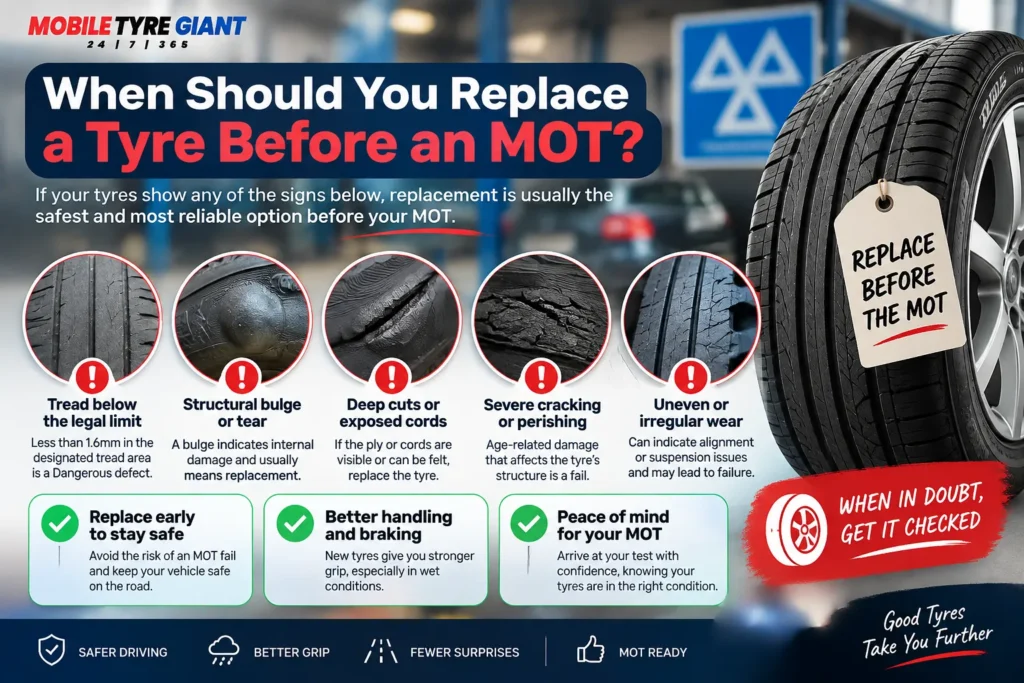
When Should You Replace a Tyre Before an MOT?
Replacement is usually the sensible route when the tyre has reached the end of its usable condition rather than suffering a simple repairable puncture. Examples include tread below the applicable legal requirement, a genuine structural bulge, exposed or damaged cords, serious structural deterioration, or damage that cannot be repaired safely. You may also decide to replace a tyre before it reaches an MOT failure point if it is very close to the limit and showing additional wear or deterioration. Passing the MOT today is not the only consideration when the remaining margin is already small.
When replacement is genuinely needed, mobile tyre replacement allows the damaged tyre to be dealt with at the vehicle’s location rather than driving unnecessarily on a tyre whose condition is already questionable. The key word is genuinely, because not every surface mark or advisory means an immediate new tyre is required. A proper inspection should distinguish repairable punctures, cosmetic damage, developing wear, and defects that make replacement the appropriate choice. That approach protects both safety and your budget instead of assuming that the most expensive option must always be the correct one.
What Happens If Your Car Fails the MOT Because of a Tyre?
If an MOT result lists a Major or Dangerous tyre defect, the vehicle has failed and the defect needs to be corrected. The failure record should identify what the tester found, which gives you a useful starting point when arranging the repair or replacement. If the defect is Dangerous, the vehicle should not simply be driven away because you intend to replace the tyre later. Current UK rules place particular restrictions on driving a vehicle after an MOT failure, and the vehicle must remain roadworthy even where an existing MOT certificate has not yet expired.
Once the tyre problem has been corrected, the vehicle can be presented for a retest under the applicable MOT retest rules. Depending on whether the vehicle stays at the test centre, is taken away, how quickly it returns, and which items failed, the retest may be free, charged at a partial rate, or require another full MOT fee. Wheels and tyres are among the items that can qualify for a free partial retest when the vehicle is taken back to the same test centre by the end of the next working day, subject to the GOV.UK conditions. Returning within 10 working days can also qualify for a partial retest in relevant circumstances.
Can You Drive After an MOT Failure Caused by a Tyre?
Do not assume that an MOT certificate which has not yet reached its expiry date automatically gives you permission to drive after a failure. GOV.UK states that you can take the vehicle away after a failed MOT if the existing MOT is still valid and no Dangerous problems were listed, but the vehicle must still meet minimum roadworthiness standards. A Dangerous tyre defect therefore changes the situation significantly. Driving a vehicle that has failed because of a Dangerous defect can lead to serious penalties.
Even where the recorded tyre problem is not classified as Dangerous, roadworthiness still matters independently of the certificate date. A tyre can worsen between the test centre and your destination, particularly if it is losing pressure or already badly damaged. If you are unsure whether the vehicle can safely and lawfully be moved, arrange the repair or replacement without assuming the safest option is to drive it somewhere else. MOT paperwork tells you the recorded defect, but it does not physically prevent a damaged tyre from deteriorating further.
Do You Need Another Full MOT After Replacing the Tyre?
Not necessarily. Depending on the timing and circumstances, a failed vehicle may only need a partial retest after the tyre defect has been fixed rather than another complete MOT. If the vehicle remains at the test centre for repairs and is retested within the relevant period, the partial retest can be free. There are also specific rules where the vehicle is taken away and returned to the same test centre within the required timeframe.
The practical lesson is to ask the MOT centre about the retest conditions before leaving with a failed vehicle. Knowing whether you need to return by the next working day or within 10 working days can affect the retest fee and what part of the vehicle is checked again. Keep the failure record and confirm that the tyre defect has been properly corrected rather than simply clearing the immediate symptom. A repaired or replaced tyre should leave the vehicle genuinely roadworthy, not merely prepared to obtain a certificate.
MOT Pass vs Tyre Safety: Are They Always the Same Thing?
An MOT pass and perfect tyre condition are not identical concepts. The MOT checks whether the vehicle meets defined minimum standards at the time of the inspection, which is why some developing issues may appear as Minor defects or advisories rather than failures. A tyre with 2mm of correctly measured tread may pass the tread requirement, but it has far less remaining margin than one with substantially deeper tread. Likewise, an area of superficial cracking may not meet the failure threshold while still deserving monitoring as the tyre continues to age. Treating every pass as permission to ignore the tyres until next year’s test misses the purpose of routine tyre maintenance.
The same distinction works in the other direction because an ugly-looking mark does not automatically mean the tyre is structurally unsafe. Good decisions come from understanding the defect rather than reacting to appearance alone. Ask what is damaged, how severe it is, whether the reinforcement is involved, whether the tyre still meets the required standard, and whether the condition is changing. That gives you a much more useful answer than simply asking whether the tyre will scrape through an MOT today. The best outcome is not just passing the test, but knowing why the tyre is suitable to remain in service.
Final Words: Check More Than Tread Before Your MOT
Understanding what tyre defects cause an MOT failure means looking beyond the familiar 1.6mm tread figure. Low tread can certainly cause failure, but structural bulges, exposed or damaged cords, qualifying cuts, incompatible tyre fitment, serious valve damage, incorrect seating, tyre fouling, and applicable TPMS faults can matter just as much. Some of these defects are easy to see, while others hide on the inner shoulder or appear as a small change in shape rather than dramatic tyre damage. A careful pre-MOT inspection gives you a chance to identify those warning signs before test day.
At the same time, do not assume every scratch, crack, nail, pressure warning, or different brand name automatically means the vehicle will fail. MOT decisions depend on the actual defect and the applicable inspection criteria, which is why accurate diagnosis is more valuable than guessing from photographs or general internet advice. Check the complete tyre, investigate anything unusual, and distinguish a repairable problem from structural damage that requires replacement. That approach gives you the best chance of arriving at the MOT with tyres that are not only capable of passing the test but suitable for continued use afterwards.
Tyre Defect Before Your MOT?
If your tyre has low tread, a bulge, exposed cords, or damage that could cause an MOT failure, arrange a mobile tyre replacement at your location before test day.
Frequently Asked Questions
Find quick answers to the most common questions our customers ask.
Tyre defects that can cause an MOT failure include tread below the applicable minimum, structural bulges or tears, exposed or damaged cords, qualifying cuts affecting the ply or cords, prohibited tyre size or structure combinations, serious valve damage, incorrect seating on the wheel rim, tyre fouling, and a malfunctioning TPMS where the inspection applies. The exact MOT classification depends on the defect, with serious structural problems potentially recorded as Dangerous.
For most passenger cars, 2mm of tread can still meet the MOT tread requirement if at least 1.6mm remains throughout the required central three-quarters of the tread breadth and around the full circumference. However, 2mm leaves relatively little margin above the minimum, so tread should be checked at several points rather than relying on one reading.
Not every small sidewall cut automatically fails an MOT because depth and structural involvement matter. A superficial mark that only affects outer rubber is different from damage that reaches the tyre's ply or cords, so the visible length of a cut alone is not enough to determine the outcome.
A genuine bulge caused by separation or partial failure of the tyre's structure is a serious defect and can result in an MOT failure. Structural bulges should not be confused with normal inward indentations or harmless carcass undulations that can appear on some radial tyres.
Cracked tyres do not automatically fail simply because small surface cracks are visible. The severity, depth, location, and effect on the tyre's structure matter, with deeper deterioration, exposed reinforcement, or other serious structural defects creating a much greater MOT concern.
Yes, exposed or damaged tyre cords indicate that the reinforcing structure has been affected and are treated seriously under MOT inspection criteria. A tyre can therefore have adequate tread depth and still fail because its structural reinforcement is visible or damaged elsewhere.
A nail or screw does not automatically create an MOT failure simply because the foreign object is present. What matters is the condition it has caused, including pressure loss, structural damage, a qualifying cut, or exposed cords, and the tyre should be inspected to determine whether a safe repair is possible.
An obviously under-inflated tyre is currently treated as a Minor defect on its own rather than an automatic MOT failure. Low pressure should still be corrected because continued under-inflation can affect handling, tyre wear, temperature, and potentially lead to more serious damage.
Different brand names alone do not automatically cause an MOT failure. The important MOT considerations include correct tyre size, compatible structure, condition, and suitability, particularly for tyres fitted on the same axle, so brand difference should not be confused with an illegal size or construction mismatch.
A malfunctioning or obviously inoperative TPMS can cause an MOT failure on vehicles to which the TPMS inspection applies, but a warning caused by genuine low tyre pressure does not automatically mean the monitoring system itself has failed. Check the tyre pressures first, then investigate the system if the warning remains.
A spare tyre that is not fitted to a road wheel is not normally part of the standard MOT tyre inspection. A tester may still point out an obvious problem if one is noticed, but the MOT tyre inspection itself applies to the tyres fitted to the road wheels at the time of the test.
Yes, one tyre with a Major or Dangerous defect is enough for the vehicle to fail its MOT. All four tyres do not need to have the same problem, so a single structural bulge, seriously damaged tyre, or tyre below the applicable tread requirement can determine the result.