

A flat tyre can turn an ordinary journey into an awkward decision within minutes, especially when you are unsure what is sitting under the boot floor. You may have a temporary spare tyre ready to use, an inflation kit designed for limited types of puncture, or no spare wheel at all. The choice between a temporary spare tyre vs mobile tyre replacement is not simply about which option gets the vehicle moving fastest. It depends on where the car has stopped, whether the spare is compatible and usable, how safely the wheel can be changed, and what type of journey remains. A space saver can be genuinely useful when it is suitable for the vehicle and used within its restrictions. Its purpose, however, is to provide temporary mobility rather than become a long-term substitute for the damaged road tyre.
Mobile replacement solves a different problem because the normal road tyre can be restored without relying on a restricted temporary wheel for the next stage of the journey. That does not mean every flat tyre automatically requires replacement, because some punctures may be repairable after a proper inspection. The first priority is understanding what has happened to the tyre and avoiding unnecessary driving if it is flat or visibly damaged. If you are unsure whether the vehicle should be moved, our guide to driving with a flat tyre explains why continuing on a deflated standard tyre can worsen the damage. Once the vehicle is safely positioned, it becomes much easier to decide whether the spare, a repair, or a replacement is the most practical next step.
Temporary Spare Tyre vs Mobile Replacement: The Quick Answer
A compatible temporary spare can make sense when the vehicle is already in a safe location, the spare is in usable condition, and you only need short-term mobility within the restrictions set for that wheel. It can get the damaged tyre off the road and allow the car to move again without waiting immediately for a replacement to be fitted. However, a temporary spare is not designed to behave exactly like the normal tyres on the vehicle. Speed, distance, handling and fitting instructions therefore need to be taken seriously. Mobile tyre replacement becomes more practical when there is no usable spare, the wheel cannot be changed safely, or the vehicle needs to return to normal road use before continuing. This is why temporary spare tyre vs mobile tyre replacement should be treated as a situational decision rather than a simple question of which option is always better.
Imagine the car has a puncture while sitting on your driveway and the correct space saver is properly inflated and ready to fit. In that situation, using the spare for a limited journey may be perfectly practical if you can change the wheel safely and follow the vehicle manufacturer’s instructions. Now imagine the same puncture happens before a long journey, the spare is missing, or you discover that the temporary wheel has been sitting flat in the boot for years. The practical answer changes because the spare no longer provides a reliable route forward. A sensible decision starts with four questions: is the vehicle somewhere safe, is the spare correct and usable, can it be fitted safely, and does temporary mobility actually suit the journey that remains?
What Is a Temporary Spare Tyre and What Is It Designed For?
A temporary spare tyre, often called a space saver, is a compact spare wheel designed to help you move the vehicle after one of the normal road tyres can no longer be used. It is usually narrower than the standard wheel and tyre combination fitted to the car, which helps reduce weight and save boot space. That compact design is convenient for storage, but it also means the wheel may come with operating restrictions that do not apply to the normal tyres. Those restrictions can vary between vehicles and spare-wheel designs, so the markings on the temporary wheel and the instructions in the vehicle handbook should take priority over general advice. The safest way to think about a space saver is as emergency mobility equipment. It is there to help you deal with an unexpected tyre problem, not to replace the normal wheel indefinitely.
A temporary spare is most useful when it gives you enough mobility to leave a problem behind without creating another one. For example, a correctly specified spare can be valuable when a puncture occurs in a safe car park and you need to reach an appropriate place where the damaged tyre can be dealt with properly. It becomes much less useful if it is underinflated, badly aged, visibly damaged, incompatible with the vehicle, or impossible to fit safely where the car has stopped. This is why checking the spare before an emergency matters, rather than discovering its condition at the roadside with traffic rushing past. A wheel that has spent years hidden under luggage can still lose pressure or deteriorate over time. Simply having a space saver in the boot does not automatically mean you have a ready-to-use solution.
Is a Space Saver the Same as a Full-Size Spare?
No, a space saver and a full-size spare are not the same thing, even though both may casually be described as spare tyres. A full-size spare is normally much closer to the regular wheel and tyre setup used on the vehicle, while a space saver is a compact temporary-use assembly. This distinction matters because drivers sometimes hear the word “spare” and assume they can continue exactly as they did before the puncture. With a temporary spare, the vehicle may feel different under steering, braking or cornering, and the manufacturer’s limitations still need to be followed. With a correctly specified full-size spare, the situation may be less restrictive, although the tyre’s condition, pressure and specification still need to be checked. Neither type should be used blindly simply because it physically appears to fit the car.
The difference becomes particularly important when comparing temporary spare tyre vs mobile tyre replacement because not every driver begins from the same position. Someone with a matching full-size spare may have a very different onward journey from someone using a narrow temporary wheel intended only for limited use. The age of the tyre also matters because a spare can look almost unused while still having spent many years exposed to temperature changes and gradual pressure loss. Before relying on any spare, look for visible damage, check its pressure against the correct specification, and confirm that the wheel is intended for the vehicle. A quick inspection before a long journey can prevent an unpleasant surprise later. Treating every spare as interchangeable is one of the easiest ways to turn a manageable puncture into a compatibility or safety problem.
What Does Mobile Tyre Replacement Actually Mean?
Mobile tyre replacement means the damaged or unsuitable tyre is dealt with at the vehicle’s location rather than requiring you to drive the car to a tyre garage first. A properly equipped fitter can attend a suitable home, workplace, car park or safely accessible roadside location with the equipment required to remove the damaged tyre and fit a suitable replacement. This can be particularly useful when the vehicle has no spare, when the temporary wheel cannot be used, or when continuing a journey on a restricted spare would be inconvenient. The main advantage is not simply convenience. It is that the vehicle can be returned to a proper road tyre before the journey continues. You can see how mobile tyre replacement works when a damaged tyre needs to be replaced where the vehicle is located.
Mobile replacement should still begin with the correct vehicle and tyre information rather than someone simply arriving with any tyre that appears close enough in size. Registration details, tyre size, vehicle type and the nature of the damage can all help determine what equipment or tyre may be required. The vehicle also needs to be in a location where tyre work can be carried out safely, because professional fitting does not make an unsafe traffic position suitable for working beside the car. Once the correct tyre is fitted properly, the driver avoids making an extra journey on a temporary spare just to reach a garage. This can be particularly useful for drivers with work commitments, family passengers or a longer journey still ahead. That is where mobile replacement differs most clearly from a space saver: one provides temporary mobility, while the other aims to restore the vehicle to a proper road-ready tyre setup.
Can a Mobile Tyre Fitter Repair the Tyre Instead of Replacing It?
Yes, some punctured tyres may be repairable, which is why a flat tyre should not automatically be treated as a tyre replacement job. The tyre needs to be inspected because repairability depends on factors such as where the damage occurred, how severe it is, the overall condition of the tyre, and whether the vehicle was driven while the tyre was deflated. A straightforward tread puncture can present a very different situation from sidewall damage, a blowout or structural damage caused by driving on little or no air pressure. Looking at the tyre from the outside may not reveal everything that has happened internally. A careful assessment is therefore more useful than assuming that either a repair or replacement will definitely be possible before the tyre has been examined. This approach also helps avoid replacing a tyre unnecessarily when a safe repair may be possible.
That is why mobile tyre repair belongs in the decision alongside the temporary spare and replacement options. If the original tyre can be repaired safely, that may restore normal use without the need for a new tyre. If the damage is unsuitable for repair, replacement becomes the more appropriate route. The temporary spare can still be useful while the permanent solution is being arranged, but it does not answer whether the damaged tyre itself can be saved. Think of the spare as a bridge between the tyre problem and the permanent fix, rather than the fix itself. Understanding that distinction helps prevent both unnecessary replacement and unnecessary driving on a temporary wheel.
Temporary Spare Tyre vs Mobile Replacement at a Glance
The difference between a temporary spare and mobile replacement becomes clearer when you look at what each option is actually meant to achieve. A space saver is designed to give the vehicle limited mobility after one of its normal tyres can no longer be used. Mobile replacement is intended to restore the vehicle with a suitable road tyre at its current location. The spare can therefore be useful when you simply need a short-term way to move the car, while replacement is more suitable when you want the tyre problem properly resolved before continuing. Neither option is automatically right for every puncture, because the safest choice depends on the condition of the tyre, the location of the vehicle, and the journey still ahead.
The practical difference becomes obvious if you imagine two identical cars with the same puncture but very different circumstances. One is sitting on a level driveway with a correct space saver, jack, wheel brace, and enough room to work safely. The other is parked far from home before a long journey and has no usable spare wheel at all. Using the temporary spare could be perfectly reasonable for the first driver, while waiting for proper tyre assistance would make far more sense for the second. Cost, convenience, tyre availability, and personal confidence can influence the choice, but they should come after safety and suitability. The table below gives a simple comparison without pretending that one solution wins in every situation.
Factor | Temporary Spare Tyre | Mobile Tyre Replacement |
Main purpose | Temporary mobility | Restore a suitable road tyre |
Spare wheel required | Yes | No |
Driving restrictions | Usually apply | Normal use after correct fitting |
Need to change the wheel yourself | Possibly | No |
Need to drive afterwards | Usually yes | No garage journey required for fitting |
Best for long onward journeys | Less practical | Generally more practical |
Helps assess damaged tyre | No | Damage can be professionally assessed |
Suitable when no spare is supplied | No | Yes |
Convenience | Depends on equipment and ability | Fitting is carried out at the vehicle |
Permanent solution | No | Usually yes when replacement is required |
When Does Using a Temporary Spare Tyre Make Sense?
Using a temporary spare makes the most sense when the car is safely positioned and the wheel is genuinely ready to use. For example, discovering a puncture on your driveway is very different from noticing a flat tyre beside fast-moving traffic. On a driveway, you can inspect the situation calmly, find the vehicle handbook, locate the tools, and confirm that the spare is intended for the vehicle. If the space saver is properly inflated and in good condition, it can provide enough temporary mobility to deal with the immediate problem. This can be especially useful when you only need to reach a nearby safe destination or arrange the damaged tyre’s permanent repair or replacement later.
A temporary spare can also give drivers something that is easy to overlook during an emergency, control over what happens next. Instead of accepting the first available replacement simply because the vehicle is stranded, the driver may be able to move the car within the spare’s restrictions and arrange a more suitable solution. That flexibility is one reason many motorists still prefer carrying a physical spare rather than relying entirely on sealant or recovery. However, the advantage disappears if the spare has been neglected, does not fit correctly, or requires a wheel change in an unsafe location. A space saver should therefore be treated as useful emergency equipment, not an automatic answer to every tyre problem. The best time to discover whether yours is usable is before the day you actually need it.
You Have a Correct, Usable Spare and a Safe Place to Fit It
Having a wheel in the boot does not automatically mean it is the correct spare for the vehicle. Before fitting it, the wheel needs to be compatible with the car and suitable for the position in which it will be used. The tyre should also be checked for obvious cracking, damage, severe ageing, or insufficient pressure before the vehicle’s weight is placed on it. A temporary wheel that has not been touched for years can look clean simply because it has never been on the road, yet still be underinflated when you finally need it. The vehicle handbook and markings on the spare provide far more reliable guidance than assuming a compact wheel from another model will work because it looks similar.
The location matters just as much as the condition of the spare. A level driveway with space around the vehicle gives you time to position the jack properly, remove the wheel, and work without rushing. A narrow roadside, soft verge, steep surface, or area exposed to passing vehicles creates a completely different level of risk. Even someone who has changed several wheels before can struggle when rain is hitting the ground, visibility is poor, or traffic is rushing past only a short distance away. If the wheel cannot be changed without placing yourself or someone else in danger, the fact that a spare exists becomes irrelevant. The temporary spare is useful only when both the equipment and the surroundings allow it to be fitted safely.
You Only Need Short-Term Mobility
A space saver is at its most useful when the remaining journey is genuinely short and the driver understands that the tyre problem has not been permanently solved. Think of it like using a compact emergency phone charger when your battery is nearly empty. It gives you enough power to reach the next sensible step, but you would not treat it as a permanent replacement for a proper charger. A temporary spare works in a similar way because it allows limited movement while operating under its own restrictions. If the vehicle only needs to travel a modest distance to reach home, a suitable garage, or another safe destination, the temporary wheel may provide exactly the mobility required.
The calculation changes when the remaining journey involves significant distance, motorway driving, heavy traffic, or several hours behind the wheel. A driver may technically have a temporary solution fitted, but that does not mean continuing the original journey is the most sensible option. Reduced speed and different handling characteristics can make a long journey tiring and inconvenient, while the damaged normal tyre still needs attention afterwards. This is where drivers sometimes focus too heavily on whether the car can move and not enough on whether continuing that way is practical. The better question is whether the spare comfortably suits the journey you actually need to make. If it does not, resolving the tyre problem before travelling further can remove an unnecessary second stage from the journey.
When Is Mobile Tyre Replacement the Better Option?
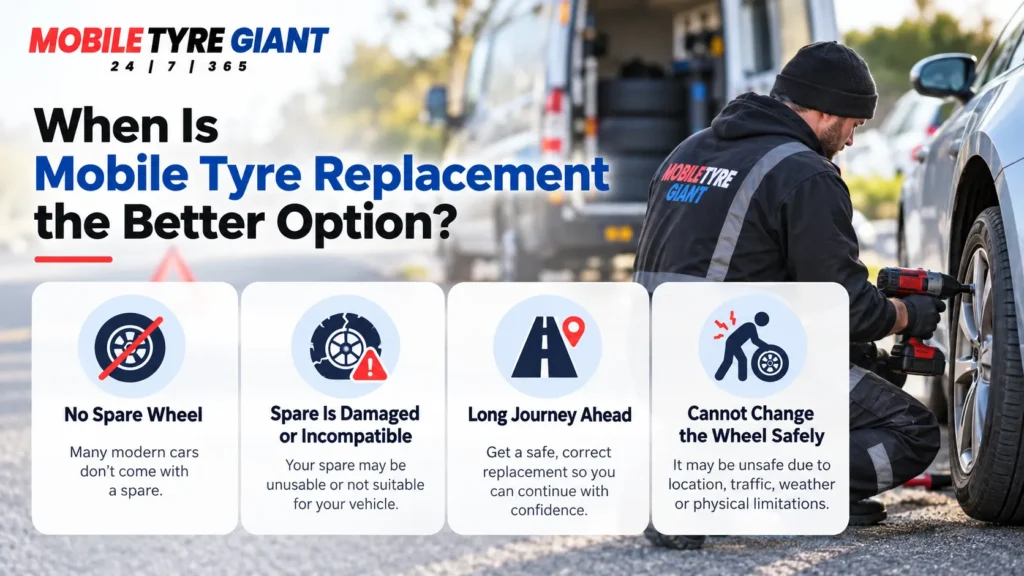
Mobile tyre replacement becomes more practical when the temporary spare cannot provide a safe or useful route forward. The most obvious example is a vehicle that simply has no spare wheel, which is increasingly common on cars supplied with an inflator or sealant kit instead. It can also make sense when the spare is damaged, flat, incompatible, or inaccessible because the required tools are missing. A long onward journey can strengthen the case further because fitting the proper road tyre removes the restrictions associated with continuing on a temporary wheel. Drivers who are not confident changing a wheel should not feel pressured into attempting the job beside a road simply because a jack and spare happen to be in the boot.
There can also be practical obstacles that have nothing to do with the tyre itself. A missing locking wheel nut key can prevent the damaged wheel from being removed, while a seized or damaged locking nut may turn a straightforward change into a specialist job. In that situation, professional locking wheel nut removal may be needed before the tyre can be dealt with properly. Urgency should also be judged realistically, because a flat tyre on a secure driveway is different from a vehicle stranded during an active journey. The guide to same-day vs emergency mobile tyre fitting explains how location, safety, mobility, and urgency can affect which type of assistance is appropriate. The strongest choice is the one that resolves the tyre problem without asking the driver to take unnecessary risks simply to avoid professional help.
How Fast Can You Drive on a Space Saver Tyre?
A space saver is designed for temporary use, so it should not be driven as if it were one of the vehicle’s normal road tyres. Many temporary spare wheels carry a reduced maximum speed, but the correct limit is the one shown on the spare and specified by the vehicle manufacturer. You should check those instructions before setting off rather than assuming that advice for another vehicle applies to yours. The narrower tyre and different construction can change how the car responds when steering, braking, or changing direction. Even if the road ahead looks clear, higher speed places greater demands on a wheel that was designed only to get you through an emergency. Smooth acceleration and gentle steering inputs are far more appropriate than trying to maintain your normal driving pace.
Speed matters because a temporary wheel may provide different levels of grip from the tyres fitted to the other corners of the vehicle. Imagine walking with one shoe that has a noticeably different sole from the other. You could still move forward, but you would naturally adjust your pace because the two sides do not feel identical. A car using a space saver deserves the same cautious approach, particularly on wet roads or during sudden changes in traffic. Keep enough distance from the vehicle ahead and avoid unnecessary sharp braking wherever possible. The goal is not to discover how quickly the temporary spare can travel, but to use it carefully until the normal tyre problem can be resolved.
How Far Can You Drive on a Temporary Spare Tyre?
There is no sensible universal distance that can be applied to every temporary spare tyre, because the permitted use can vary according to the wheel, tyre, and vehicle manufacturer. Drivers often hear a single mileage figure repeated online and assume it applies to every car, but that can create false confidence. The markings on the temporary wheel and the vehicle handbook should always take priority. A space saver is intended for the minimum journey reasonably needed to deal with the original tyre problem, rather than becoming the tyre you use for the rest of the week. If the damaged tyre can be repaired or replaced sooner, there is little benefit in putting unnecessary distance on the temporary wheel. Think of the spare as a short bridge to the next safe solution rather than a new route for normal driving.
The journey itself matters just as much as the number of miles involved. Ten miles through slow local streets can place very different demands on the vehicle compared with ten miles on a fast dual carriageway in heavy rain. Road surface, traffic, vehicle load, weather, and the condition of the spare can all affect how comfortable and sensible the journey feels. If you notice unusual vibration, steering changes, noise, or any sign that the temporary wheel is not behaving correctly, continuing simply because you have not reached an assumed mileage limit is the wrong approach. The original tyre should still be dealt with as soon as practical. Temporary mobility is useful, but the aim should always be to return the vehicle to its correct normal tyre setup.
Can You Drive on a Motorway With a Space Saver Tyre?
A temporary spare may allow limited onward driving, but motorway conditions make its restrictions much more noticeable. Traffic can be moving significantly faster than the permitted speed of the temporary wheel, which can leave the vehicle travelling well below surrounding traffic. That difference in speed requires greater awareness when merging, changing lanes, and approaching exits. The car may also feel different when braking or changing direction, particularly if the road is wet or the vehicle is heavily loaded. This does not mean every correctly fitted space saver instantly becomes unsafe on a motorway, but it does mean motorway driving should not be treated as normal use. If there is a safer and more practical way to restore the correct tyre before a long high-speed journey, that is often the better option.
A separate issue arises when the tyre problem actually happens while you are already on a motorway. The first priority is reaching a place of relative safety if the vehicle can be moved safely, not immediately getting out and attempting a wheel change beside fast-moving traffic. A live lane is not an appropriate location for DIY tyre work, and even a motorway breakdown area requires careful judgement before anyone works around the vehicle. Our guide to dealing with a flat tyre on a motorway explains the safety steps in more detail. If the tyre fails suddenly at speed, the driver’s immediate job is to maintain control and reduce speed progressively rather than reacting with violent steering or braking. A sudden failure can feel dramatic, and the separate guide to a tyre blowout while driving covers what to do when the tyre loses pressure or structure rapidly.
Does a Space Saver Affect Braking, Grip and Handling?
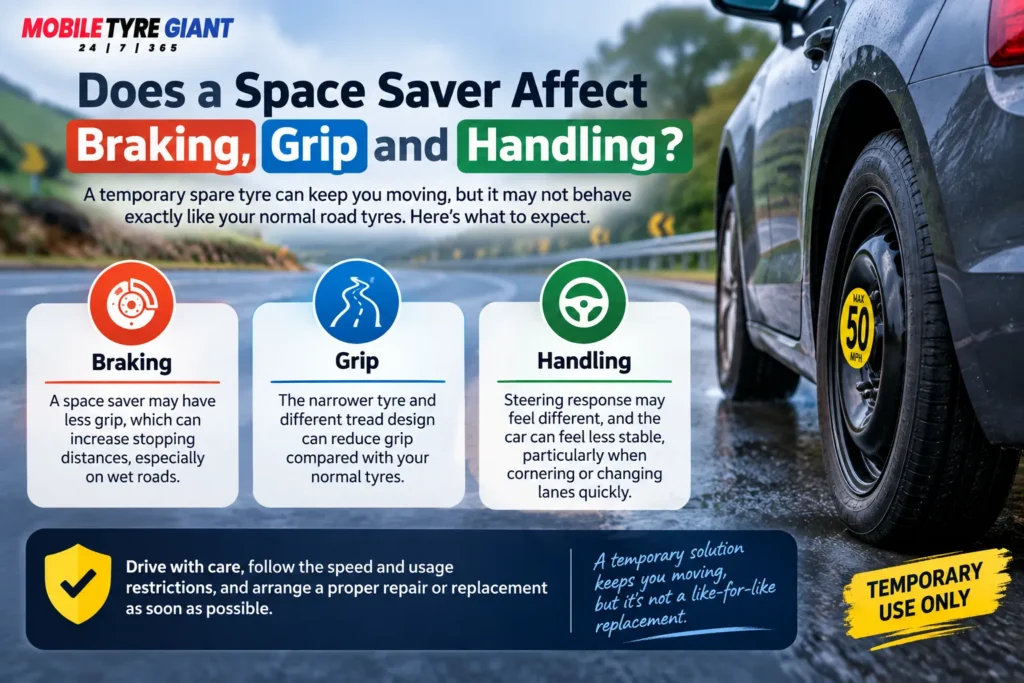
A space saver can change the way a vehicle feels because it does not necessarily provide the same contact area, construction, or performance characteristics as the normal road tyre it replaces. Drivers may notice different steering weight, reduced confidence through bends, or a general sense that one corner of the car feels different. The effect may be subtle during gentle urban driving and more obvious when the vehicle is asked to brake hard or change direction quickly. Wet roads can make those differences more important because tyre grip is already being tested by a layer of water between the rubber and the road. This is another reason why temporary spare instructions usually encourage restrained driving rather than normal performance. The temporary wheel is doing an emergency job, not trying to match the behaviour of the rest of the tyre set.
Modern cars also rely on systems such as ABS and electronic stability control to help manage grip and vehicle movement, but those systems do not remove the need for sensible driving. A temporary wheel can have different dimensions or grip characteristics while still being approved for restricted use on that particular vehicle. The driver should therefore leave more space, avoid abrupt steering, and plan braking earlier than usual. You do not need to crawl along nervously if the spare is correctly fitted and the vehicle manufacturer allows its use, but you should recognise that the car may not respond exactly as it did before the puncture. If the steering suddenly pulls strongly, the wheel vibrates heavily, or the vehicle feels unstable, stop somewhere safe and investigate rather than assuming the behaviour is normal. Temporary use should still feel controlled and predictable.
Can Any Temporary Spare Tyre Fit Any Car?
No, temporary spare wheels are not universal, and visual similarity is not enough to prove that one is suitable for another vehicle. Two wheels can both be described as 16-inch, for example, while having different fixing patterns, centre dimensions, offsets, tyre profiles, or brake-clearance requirements. The space saver also needs to work with the vehicle’s overall wheel and tyre setup rather than simply fitting over the hub. This is why buying a second-hand spare based only on the rim diameter can be risky. The vehicle handbook, manufacturer information, or confirmed fitment data should be used before relying on a temporary spare. If you have recently bought a used vehicle, it is worth checking that the spare left in the boot actually belongs with that model rather than assuming the previous owner got it right.
The same principle applies when choosing the permanent road tyre after the puncture has been dealt with. Tyre width, profile, rim diameter, load index, and speed rating all contribute to correct fitment, and the approved specification can vary between models and wheel packages. Our guide to finding the correct tyre size for your car explains how the sidewall markings relate to the vehicle’s specification. A temporary spare may look unusually narrow compared with the normal tyres and still be correct because it has been specifically designed for restricted emergency use. What matters is whether that complete spare assembly is approved for the vehicle, not whether it visually matches the normal wheel. When there is any doubt, confirming fitment before an emergency is much easier than discovering the problem after the car is already sitting on a flat tyre.
Why Rim Diameter Alone Does Not Confirm Compatibility
Rim diameter is only one part of wheel fitment, so matching the number printed after the letter R on the normal tyre does not prove that a temporary spare will work. The wheel also needs the correct bolt pattern or fixing arrangement so it can attach securely to the hub. Centre bore and wheel offset affect how the wheel sits in relation to the hub, suspension, bodywork, and brakes. Brake clearance can be particularly important because a wheel that appears to fit the hub may still interfere with the brake components behind it. The complete tyre diameter also matters because the temporary assembly needs to operate within the limits intended for the vehicle. This is why a physically smaller-looking space saver can sometimes be correct while another wheel with the same nominal rim diameter may not be suitable at all.
A common question is whether a 16-inch space saver can be used on a car that normally has 17, 18, or even 19-inch wheels. The answer cannot be decided from those rim sizes alone because a smaller rim can be paired with a tyre profile that creates an appropriate overall rolling diameter, provided the manufacturer has approved that setup and there is sufficient brake clearance. The reverse is also true, because a wheel that seems close in size may still be wrong if the mounting dimensions do not match. Guessing based on appearance is therefore a poor substitute for confirmed vehicle compatibility. The safest approach is to identify the exact spare specified for your model, wheel setup, and in some cases the axle position where it is permitted to be used. That small check can prevent a roadside situation where the spare comes out of the boot but cannot actually be fitted.
Temporary Spare or Mobile Replacement? Use These Real-World Scenarios
The easiest way to choose between a temporary spare tyre and mobile replacement is to look at the situation rather than searching for one universal answer. If the car is safely parked on your driveway, the correct space saver is properly inflated, and you only need a short local journey, fitting the temporary spare can be a sensible option. If the vehicle has no spare at all, the space saver is damaged, or you still have a long journey ahead, arranging professional tyre assistance becomes more practical. A driver facing a simple puncture in a supermarket car park has different needs from someone dealing with serious sidewall damage before a motorway journey. Weather also matters because changing a wheel on a dry, level surface is very different from trying to work beside the car in heavy rain or poor visibility.
The condition of the damaged tyre should also influence the decision because not every flat tyre requires exactly the same response. A small puncture in a repairable area may have a different outcome from a torn sidewall or tyre that has been driven while completely deflated. The temporary spare can restore mobility, but it does not tell you whether the original tyre is safe to repair or needs replacing. Drivers should also consider whether they are confident using the jack, wheel brace, and locking wheel nut equipment correctly. If you feel rushed, exposed to traffic, or uncertain about the wheel change, forcing yourself to use the spare simply because it is available is not worthwhile. Safety should decide the first step, while convenience and cost come afterwards.
Temporary Spare or Mobile Replacement? Use This Decision Guide
Start with one question: is the vehicle somewhere that allows the tyre problem to be dealt with safely? If the answer is no, moving yourself and your passengers away from danger takes priority over changing a wheel or arranging normal roadside tyre work. If the car is safely positioned, check whether you actually have a compatible and usable spare. A space saver that is flat, cracked, visibly damaged, or not intended for your vehicle is not a useful emergency solution. If the spare is suitable, consider whether you can fit it safely and whether its restrictions match the journey you still need to make. This simple sequence prevents the decision from becoming an argument about whether temporary spare tyres or mobile replacement are always better.
If you have a correct spare, a safe place to work, and only limited temporary travel ahead, using the spare may solve the immediate problem well. If any of those conditions are missing, professional assistance becomes more attractive because it can remove the need to make an additional journey on a restricted wheel. The condition of your other tyres is worth considering at the same time, particularly if the puncture has highlighted wider wear or damage. Our tyre safety guide explains the main checks for tread, pressure, and visible tyre condition. A puncture can sometimes be an isolated event, but it can also be the moment that makes you notice cracking, uneven wear, or another tyre that is approaching replacement. Looking at the whole vehicle rather than only the flat corner can prevent another avoidable tyre problem soon afterwards.
Already Driving on a Space Saver? What Should You Do Next?
If the temporary spare is already fitted, the most important step is to treat it as a temporary solution rather than forgetting about the damaged tyre in the boot. Follow the operating restrictions shown on the spare and in the vehicle handbook, and drive more smoothly than you normally would. Leave additional braking space, avoid aggressive cornering, and pay attention to any unusual vibration or steering behaviour. If the vehicle begins pulling noticeably, the spare loses pressure, or the wheel feels unstable, stop somewhere safe rather than continuing simply because you are close to your destination. The purpose of the space saver is to help you reach the next appropriate solution without exposing the damaged normal tyre to further road use.
Once you reach a safe destination, arrange an inspection of the original tyre rather than continuing to use the space saver for everyday journeys. If the tyre cannot be repaired safely, it should be replaced with one that meets the vehicle’s correct specification. Our guide to when tyres should be replaced can help identify other signs that a tyre has reached the end of its usable life. After the normal wheel is restored, do not simply throw the space saver back into the boot without checking it. Make sure it has not suffered damage during use and ensure its pressure is corrected before storage. A spare that helped you once is only useful in the next emergency if it remains ready to use.
What Information Should You Have Ready for Mobile Tyre Assistance?
Having the right information ready can make arranging tyre assistance much simpler. Start with the vehicle registration because it can help identify the model and suitable tyre options, but also check the tyre sidewall if it is safe and easy to see. The tyre size normally appears as a sequence such as 205/55 R16, followed by additional load and speed information. Your exact location is equally important, especially if the vehicle is inside a car park, workplace, residential development, or somewhere that requires specific access instructions. Explain whether the tyre is simply flat, visibly punctured, split at the sidewall, or damaged after hitting a kerb or pothole. Mentioning whether a temporary spare is already fitted can also help clarify what assistance is actually required.
It is also worth checking whether the vehicle uses locking wheel nuts and whether the locking key is available before help arrives. If you already know the damaged tyre will need replacing, having an idea of the type of tyre you prefer can make the conversation easier, although the replacement still needs to meet the vehicle’s required specification. Our guide to choosing the right tyres for your car explains the factors that matter beyond simply finding the same rim diameter. Do not guess the tyre size from memory if the information is available on the tyre or vehicle documentation. A few accurate details at the beginning can prevent delays caused by incorrect assumptions. The goal is straightforward: identify the vehicle, identify the tyre, describe the damage, and confirm that the car is somewhere the work can be carried out safely.
Final Words: Temporary Spare Tyre vs Mobile Tyre Replacement
A temporary spare tyre and mobile tyre replacement are not competing versions of exactly the same solution. The space saver is designed to provide limited emergency mobility, while mobile replacement is intended to restore the vehicle with a suitable normal road tyre where the car is safely accessible. A usable temporary spare can be extremely valuable when the car is in a safe location and only a short, restricted journey is needed. It gives the driver flexibility and can prevent a simple puncture from turning into hours of waiting. However, that convenience depends on the spare being compatible, properly inflated, in good condition, and suitable for the journey ahead.
Mobile replacement becomes more practical when there is no spare, the temporary wheel cannot be used, changing the wheel would be unsafe, or the remaining journey makes temporary driving inconvenient. The damaged tyre should also be assessed rather than assuming automatically that it must be replaced, because some punctures may still be repairable. The strongest decision is therefore not based on which option sounds quicker or cheaper in isolation. Look first at safety, then spare compatibility, the nature of the tyre damage, road type, and how far you still need to travel. If those factors are considered in that order, the choice between a temporary spare tyre and mobile replacement becomes much easier to make.
Temporary Spare Not the Right Fit?
If the space saver is missing, damaged, unsuitable, or you need the car back on a normal road tyre, arrange mobile tyre replacement at your location.
Frequently Asked Questions
Find quick answers to the most common questions our customers ask.
No. A temporary spare, commonly called a space saver, is usually narrower and designed for restricted emergency use, while a full-size spare is closer to the vehicle's normal wheel and tyre setup. Always follow the instructions provided for the specific spare fitted to your vehicle.
Temporary spare tyres normally have a reduced maximum speed, but you should follow the limit shown on the wheel or tyre and the instructions in the vehicle handbook. Do not assume that the restriction used by another vehicle automatically applies to yours.
There is no single distance that should be applied to every space saver. A temporary spare should be used only as long as reasonably necessary to reach an appropriate solution, while following any distance or usage restrictions specified for that particular vehicle and spare wheel.
A correctly specified space saver may permit limited emergency driving, but motorway conditions can make its reduced speed and different handling characteristics more significant. Follow the manufacturer's restrictions and arrange restoration of the normal road tyre as soon as practical rather than treating the temporary wheel as suitable for normal motorway use.
No. Space saver wheels are not universal, and matching the rim diameter alone does not prove compatibility. Bolt pattern, centre bore, wheel dimensions, brake clearance, tyre diameter, and vehicle-specific requirements can all affect whether a temporary spare is suitable.
Drivers are not generally required to carry a spare wheel in the UK, which is why many modern vehicles are supplied with a tyre inflator or emergency sealant kit instead. However, knowing what equipment your vehicle actually has before a puncture occurs can save considerable confusion during an emergency.
Some punctures can be repaired, but the tyre needs to be inspected before repairability can be confirmed. The location and severity of the damage, tyre condition, and whether the tyre has been driven while deflated can all affect whether repair or replacement is appropriate.
Check whether the vehicle has an emergency inflator or sealant kit and follow the manufacturer's instructions if the damage is suitable for that equipment. If the tyre has serious damage, the kit cannot be used, or you are unsure about the condition of the tyre, professional tyre assistance may be required.
It depends on the situation. A compatible temporary spare can be practical for a short restricted journey, while mobile replacement can be more convenient when the driver has no usable spare, cannot safely change the wheel, or wants the normal road tyre restored before continuing a longer journey.
Arrange for the damaged normal tyre to be inspected, repaired, or replaced as soon as reasonably possible and continue following the temporary spare's restrictions until the correct road wheel is restored. Once removed, inspect the spare and correct its pressure before storing it so it is ready if another genuine emergency occurs.