

A flat tyre on a motorway can turn a normal journey into a serious roadside situation within seconds. You may first notice a dull thumping sound, a tyre-pressure warning, heavier steering, or a sudden pull towards one side of the road. If the tyre fails quickly, the noise can be much more dramatic, with a sharp bang followed by vibration or the sound of loose rubber striking the wheel arch. The natural reaction is often to brake hard and get off the road as quickly as possible, but sudden movements can make an already unstable vehicle harder to control. Your first priority is not saving the tyre, protecting the alloy wheel, or finding someone to repair the puncture. It is keeping control of the vehicle and reducing the risk to yourself, your passengers, and other motorway users.
What happens next depends heavily on where the vehicle can safely reach. A car that reaches motorway services is in a very different situation from one that stops on the hard shoulder, inside an emergency area, or in a live traffic lane. Think of it like dealing with smoke in a building: before worrying about what caused the problem, you first move people away from the immediate danger. The same principle applies to a flat tyre on a motorway, because fast-moving traffic creates a greater immediate risk than the damaged tyre itself. Current motorway safety guidance is built around reaching a place of relative safety where possible, warning other road users, getting occupants away from traffic when it is safe, and then arranging help. Once those priorities are handled, you can start thinking about whether the tyre needs repair, replacement, or another form of assistance.
Flat Tyre on a Motorway? Follow These Steps First
If you realise you have a flat tyre on a motorway while the vehicle is still moving, keep your eyes on the road and hold the steering wheel securely. Ease away from the accelerator rather than making an abrupt braking movement, especially if the steering feels unstable or the tyre has failed suddenly. Allow the vehicle to lose speed progressively while checking the traffic around you and looking for the safest route towards the left. If the car remains controllable, aim to leave the motorway at the next suitable exit or enter a service area where this can be done safely. If that is not possible, an emergency area or hard shoulder may provide a place of relative safety where available. Do not continue driving simply because you want to avoid stopping on the motorway if the damaged tyre is making the vehicle difficult to control.
Switch on the hazard warning lights when you can do so without distracting yourself from steering the vehicle. If it is dark or visibility is poor, keeping the appropriate vehicle lights on also helps other motorists recognise that something is wrong. Move progressively rather than cutting across several lanes in one sudden manoeuvre, because surrounding drivers may not immediately understand why your vehicle is slowing. Once stopped, the correct next action depends on whether you are genuinely away from live traffic or whether the vehicle remains exposed. If you can safely leave the vehicle from the side furthest from traffic, occupants should move well away from the carriageway and behind a safety barrier where one is available and safe to reach. If the vehicle is trapped in a live lane and getting out would expose you to greater danger, the response is different and will be covered in detail later in this guide.
Keep Control if the Tyre Loses Pressure or Blows Out
A slow puncture and a sudden tyre blowout can feel completely different from behind the wheel, but both require smooth reactions. With gradual pressure loss, you might first feel the steering becoming heavier, notice the vehicle drifting slightly, or hear a repetitive thumping noise that becomes louder with speed. A blowout can arrive with a much sharper bang and strong vibration, particularly if part of the tyre has separated from the wheel. In either situation, gripping the wheel firmly and keeping the vehicle moving in a predictable direction is more useful than trying to make an instant escape towards the roadside. Imagine carrying a full cup of tea down a moving train carriage: sharp movements make the situation worse, while controlled adjustments help keep everything balanced. This is why harsh steering, panic braking, and sudden lane changes should be avoided while the vehicle is unstable.
If a sudden failure is causing strong vibration or steering pull, concentrate on stabilising the car before worrying about the exact condition of the tyre. Ease off the accelerator and allow speed to fall while making small steering corrections instead of fighting the wheel aggressively. Once the vehicle responds predictably, check your mirrors carefully and begin moving towards the left when there is a suitable gap. Drivers dealing with a violent tyre failure can find more detailed guidance on how to stay in control during a tyre blowout, including the differences between front and rear tyre failure. Do not assume that because the car is still moving it is safe to continue your journey, as a badly damaged tyre can deteriorate further and may also damage the wheel. The goal is to reach the nearest appropriate place of relative safety, not to nurse the car several miles simply to reach a preferred destination.
Move Left Where Possible and Make the Vehicle Visible
Once the car feels stable enough to manoeuvre, work progressively towards the left side of the motorway rather than making a rushed lane change. Check mirrors carefully because vehicles behind may still be travelling at motorway speed while your own car is slowing more quickly than usual. Where possible, leaving the motorway or reaching a service area provides better separation from fast-moving traffic than stopping immediately beside the carriageway. If those options are not available, look for an emergency area or hard shoulder and position the vehicle as far to the left as practical. Keep the hazard warning lights operating so approaching drivers can see that the vehicle has developed a problem. When stopping in a motorway refuge position, leave enough room on the traffic-free side for occupants to exit if doing so is safe.
Do not immediately open the driver’s door or step out simply because the car has stopped moving. Look around first and identify where live traffic is passing, whether a safety barrier is present, and whether the ground beyond it can be reached without creating another risk. If it is safe to leave, use the doors furthest from moving traffic and keep passengers together away from the carriageway. Children should remain under close control, and nobody should stand beside the damaged tyre inspecting it while vehicles pass only a short distance away. A flat tyre on a motorway can feel strangely quiet once the engine is switched off, but that quiet can be misleading because traffic is still moving rapidly around you. Only after everyone is in the safest available position should attention shift from the motorway environment to the condition of the tyre.
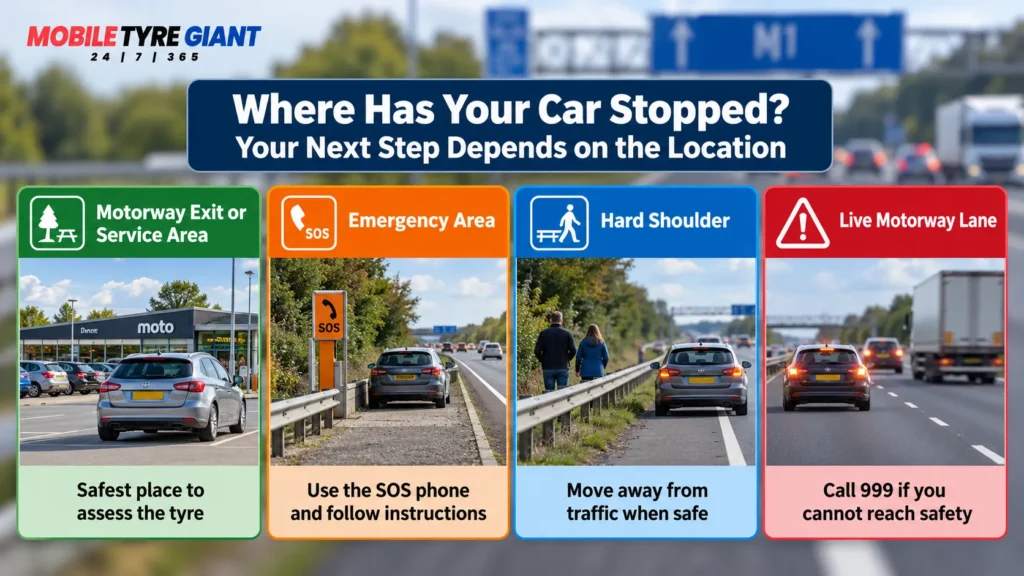
Where Has Your Car Stopped? Your Next Step Depends on the Location
The place where your vehicle finally stops changes almost everything about the next step. Reaching a motorway service area or leaving through an exit usually puts much more distance between you and high-speed traffic, making it easier to arrange tyre assistance. An emergency area is designed for breakdowns and emergencies, but it still has specific procedures that drivers need to follow. A hard shoulder provides some separation from the live lanes, yet it should never be treated like an ordinary car park because traffic may be passing only metres away. The most serious situation is a vehicle that cannot reach the left side and becomes stationary in a live motorway lane. That is why a useful motorway flat tyre guide must separate these situations rather than giving every stranded driver the same instructions.
The table below gives a quick overview, but it does not replace the more detailed safety guidance for each scenario later in this article. A driver safely parked at motorway services may be ready to assess tyre-help options, while someone stuck in a live lane needs emergency assistance before anyone thinks about repairing the tyre. The same distinction applies to an emergency area, where contacting the motorway operator may be part of the process before the vehicle can later rejoin traffic. If you have stopped on a hard shoulder, remain aware that it offers less protection than a location designed for parking. Never assume that being out of the main lane automatically makes it suitable for changing a wheel or carrying out a roadside repair. The safest decision always starts with your actual road position, not simply with how quickly you want the tyre problem solved.
Where the Vehicle Has Stopped | Immediate Priority | Likely Next Step |
Motorway exit or service area | Park in a suitable place away from moving traffic | Assess the tyre and arrange appropriate assistance |
Emergency area | Keep occupants protected and follow motorway emergency procedures | Contact the appropriate motorway operator or assistance service |
Hard shoulder | Keep people well away from fast-moving traffic when safe | Arrange appropriate help rather than attempting roadside repairs |
Live motorway lane | Treat the situation as an immediate traffic danger | Keep hazards and seatbelts on if you cannot safely exit and call 999 |

What If Your Car Stops in a Live Motorway Lane?
A vehicle that becomes stationary in a live motorway lane creates a much more urgent situation than a car that reaches the hard shoulder or an emergency area. Keep the hazard warning lights on and make sure everyone remains secured by a seatbelt if leaving the vehicle would mean stepping into live traffic. Do not get out simply to look at the tyre, photograph the damage, or check whether a wheel can be changed. Traffic approaching from behind may be travelling at motorway speed, and drivers may have only a few seconds to recognise that your vehicle is stationary. If you cannot reach a place of relative safety and cannot safely leave the vehicle, call 999 and ask for the police. Give the operator as much information as you safely can about the motorway, your direction of travel, nearby junctions, and the position of the vehicle.
It can be tempting to think that standing outside makes you easier for other motorists to see, but a person beside a stationary vehicle in a live lane is extremely exposed. Do not stand in front of or behind the vehicle, and never attempt to push it while traffic is still using the lane around you. If your vehicle has an emergency SOS or eCall function and you understand how to use it, this may also help you contact emergency assistance and communicate your position. Stay alert to instructions from the emergency services because traffic management may be needed before you or the vehicle can be moved safely. The tyre is no longer the immediate problem at this stage, even if it was the reason the vehicle stopped. The priority is preventing a tyre failure from becoming a more serious motorway incident.
What Should You Do While Waiting for Emergency Help?
Once emergency assistance has been contacted, avoid making new decisions that increase your exposure to traffic. Keep your seatbelt fastened if you have been advised or need to remain inside because getting out is unsafe, and leave the hazard warning lights operating. Make sure passengers understand that they should not open doors or step onto the carriageway to investigate what has happened. If the vehicle is positioned somewhere that allows everyone to leave safely and move away from traffic, follow the appropriate instructions for that situation rather than remaining beside the car. The correct action depends on where the vehicle has stopped, which is why motorway incidents cannot be reduced to one universal rule. Stay focused on your surroundings and follow instructions from the police or motorway operator when they arrive or make contact.
Waiting can feel much longer when vehicles are passing nearby and you cannot see when assistance will arrive. That pressure can push people into poor decisions, such as getting out to inspect the tyre or attempting to move the car themselves. Resist the urge to solve the mechanical problem while the traffic situation is still dangerous. A shredded tyre, damaged wheel, or puncture can be assessed later when the vehicle is somewhere suitable for inspection. If another motorist stops, do not encourage anyone to stand in the carriageway or begin a roadside wheel change in a dangerous position. The safest help at that moment is usually the help that makes the traffic situation safer first. Once the vehicle has been protected or moved to an appropriate location, the tyre problem can become the next priority.
What Should You Do If There Is No Hard Shoulder?
Some motorway sections do not have a permanent hard shoulder available for broken-down vehicles, which can make a tyre problem feel especially worrying. If the vehicle remains controllable, move towards the left and look for the next motorway exit, service area, or clearly marked emergency area. Emergency areas are intended for situations such as breakdowns and are normally identified with blue signage carrying an orange SOS symbol. Do not keep driving simply because you are searching for a perfect place to stop if the tyre is making the vehicle difficult or unsafe to control. Equally, do not make a sudden move across lanes because you have spotted an emergency area at the last moment. Smooth steering, controlled speed reduction, and awareness of surrounding traffic remain important throughout the manoeuvre.
If the vehicle cannot reach an emergency area and becomes stationary in a live lane, treat the situation as an immediate motorway emergency rather than a normal flat tyre. Keep the hazards on, remain belted in if getting out is unsafe, and contact 999 for the police. Do not try to walk along the motorway looking for the next refuge area, and do not stand beside the vehicle waiting for someone to arrive. Overhead motorway signs and lane-control signals may be used to warn approaching traffic, but you should not assume other motorists will immediately notice the problem. A Red X displayed above a lane means that lane is closed to traffic, but stranded occupants should still follow the instructions provided by the emergency services or motorway operator. The absence of a hard shoulder changes the stopping options, but it does not change the basic principle that protecting people comes before protecting the tyre.
Should You Stay Inside or Leave the Car After a Motorway Tyre Breakdown?
There is no safe one-line answer that says motorists should always stay inside or always get out. If the vehicle has reached a place of relative safety and you can leave without stepping into live traffic, occupants should move away from the vehicle and the carriageway where it is safe to do so. Exit from the side furthest from moving traffic when possible, and move behind a safety barrier if one is available and can be reached safely. Do not stand between the vehicle and the barrier or gather near the damaged wheel while waiting for assistance. A hard shoulder may look calm for a few seconds between passing vehicles, but motorway traffic can approach very quickly. The goal is to create as much separation as reasonably possible between people and moving vehicles.
The advice changes if the car is stranded in a live lane or if leaving would expose occupants directly to traffic. In that situation, remaining inside with seatbelts fastened can be safer while emergency help is contacted. This is why drivers should look at the actual road position rather than following a remembered rule from an ordinary roadside breakdown. If you are unsure whether an exit route is safe, do not climb over obstacles or cross live lanes to reach a barrier. Keep passengers calm and avoid repeatedly moving in and out of the vehicle while trying to decide what to do. Once professional motorway assistance is involved, follow the instructions given for your specific position. The safest place can change depending on the carriageway layout, traffic conditions, barriers, and whether the vehicle can still move.
What If You Have Children, Pets or Vulnerable Passengers With You?
A motorway tyre emergency becomes more complicated when children, older passengers, disabled occupants, or anyone with limited mobility is travelling with you. If you can safely leave the vehicle, keep children close and under direct supervision rather than allowing them to walk around the roadside area. Do not ask them to carry bags, tools, or emergency equipment while everyone is moving away from the vehicle. An older or disabled passenger may need more time or physical assistance to exit, and trying to rush that process beside fast traffic can create another hazard. If someone cannot safely leave the vehicle, explain this clearly when you contact the emergency services or motorway operator. That information helps the people responding understand that additional support may be required.
Pets create another difficulty because an anxious animal can behave unpredictably when exposed to traffic noise, flashing lights, and unfamiliar surroundings. In many situations, keeping a pet inside the vehicle may be safer than allowing it onto the motorway verge, especially if there is any risk of it escaping towards traffic. If an animal must be moved, keep it under secure control and follow any instructions given by the emergency services. A family travelling with a baby, two young children, and luggage faces a completely different practical problem from a driver travelling alone, so rigid advice rarely works well. The same applies to passengers with medical, sensory, or mobility needs. When requesting help, mention anything that may affect how safely occupants can move or wait. Good motorway safety advice should account for the people inside the car, not only the condition of the tyre.
Can You Use a Warning Triangle on a Motorway?
No, you should not place a warning triangle on a motorway. Although warning triangles can be useful on some other roads, walking along a motorway carriageway or hard shoulder to position one would expose you to fast-moving traffic. The safest approach is to use the vehicle’s hazard warning lights and follow the motorway breakdown procedure that applies to your location. Do not walk behind the vehicle carrying a triangle simply because you want to give approaching drivers more warning. Motorway traffic can close distance much faster than it appears to when you are standing still at the roadside. The time spent placing or retrieving the triangle creates unnecessary exposure to that traffic.
This is an area where advice remembered from driving abroad or from ordinary road breakdowns can cause confusion. A driver may carry a warning triangle as part of an emergency kit and naturally assume it should be used whenever the car breaks down. Motorways are different because the speed, lane layout, and limited pedestrian space make stepping onto or alongside the carriageway particularly dangerous. Keep the triangle in the vehicle and focus instead on hazards, safe positioning, moving occupants away from traffic when possible, and contacting the appropriate assistance. The same principle applies to other equipment in the boot: owning a jack, spare wheel, or tyre repair kit does not mean the motorway roadside is automatically a suitable place to use it. Equipment becomes useful only when the location is safe enough for the task. The next stage of this guide will explain when tyre repair, replacement, recovery, or mobile tyre assistance becomes the appropriate solution.
Can You Change a Tyre on the Motorway?
Having a spare wheel, jack, and wheel brace in the boot can make changing a flat tyre feel like the obvious solution, but a motorway is not an ordinary roadside environment. Current motorway safety guidance is clear that drivers should not attempt vehicle repairs while exposed beside motorway traffic. Even on a hard shoulder, vehicles may pass only a short distance away at high speed, creating wind, noise, and very little margin for error. The danger becomes even greater when the damaged tyre is on the side facing traffic because the person changing it would need to work closer to the live carriageway. A wheel change also involves crouching beside the vehicle, loosening wheel nuts, positioning a jack, and remaining exposed for several minutes. What sounds like a quick ten-minute job at home can feel completely different when heavy vehicles are rushing past.
If the vehicle has reached a genuinely appropriate off-motorway location, the available options may change, but safety should still come before convenience. Do not attempt to change a tyre simply because recovery appears slow or because you are worried about the cost of calling for assistance. Real drivers often describe motorway wheel changes as far more intimidating than expected once they experience the noise and force of nearby traffic. If you want more detail on wider roadside tyre situations, the flat tyre emergency guide explains how the correct response changes depending on where the vehicle has stopped. A spare wheel is useful equipment, but it should never pressure you into attempting a repair in an unsafe place. The right question is not only whether you know how to change the wheel, but whether the location makes it sensible to do so.
Can You Drive to the Next Motorway Services With a Flat Tyre?
Driving on a completely flat conventional tyre can affect steering, braking, and stability while also damaging the tyre and wheel. There is no universal distance that makes it safe to keep driving simply because a service area is visible on a map. A tyre with only a gradual pressure loss may behave very differently from one that has suddenly deflated, shredded, or come away from the rim. If the vehicle becomes difficult to control, continuing for several miles in search of a more convenient destination can create a bigger problem than the original puncture. Drivers sometimes focus on saving time or avoiding a roadside stop, but the condition of the vehicle must remain the deciding factor. If the tyre is flat, the priority is to stop as soon as it is safe rather than treating the next service station as a guaranteed target.
There is also an important difference between moving a short distance to get out of immediate danger and continuing a journey on a damaged tyre. The first may be necessary in a motorway emergency, while the second can expose the vehicle to further tyre, wheel, suspension, or handling problems. If you are unsure how a flat tyre affects continued driving, the guide on driving with a flat tyre explains the risks in more detail. Listen for changes in noise, vibration, steering weight, or wheel contact rather than assuming the tyre can tolerate more distance because the car still moves. Never use a fixed mileage figure from a forum as proof that your own damaged tyre is safe. Tyre construction, the type of damage, vehicle load, speed, and how long the tyre has already been underinflated can all change the outcome.
What About Run-Flat Tyres After a Motorway Puncture?
Run-flat tyres can give a driver more control after pressure loss because their reinforced construction is designed to support the vehicle for a limited period after a puncture. That does not mean a run-flat tyre can be driven indefinitely or treated as if nothing has happened. The permitted speed and distance depend on the tyre manufacturer, vehicle manufacturer, tyre size, vehicle load, and the nature of the damage. A dashboard tyre-pressure warning should therefore be treated as useful information rather than permission to continue normally. If the vehicle has run-flat tyres, check the manufacturer’s instructions as soon as you are somewhere safe enough to do so. Do not rely on a universal rule such as “50 miles at 50 mph” because that figure does not automatically apply to every run-flat system.
A run-flat can also suffer damage that makes continued driving inappropriate, especially after a major impact, sidewall cut, or severe blowout. The fact that the tyre still supports the vehicle does not prove that its internal structure remains suitable for further use. After a motorway puncture, the tyre should still be professionally inspected before anyone assumes it can be repaired or returned to normal service. A functioning TPMS is particularly important with run-flat tyres because drivers may not always feel pressure loss as quickly as they would with a conventional tyre. If the warning appeared without obvious handling changes, do not simply reset the system and continue driving. Treat the warning as a reason to check the tyre condition at an appropriate location. Run-flat technology can provide valuable mobility, but it is a temporary safety feature rather than a substitute for repairing or replacing a damaged tyre.
What If Your Car Has No Spare Tyre?
Many modern cars no longer carry a full-size spare wheel, and some do not have a temporary space-saver wheel either. Instead, the vehicle may have a tyre inflator, sealant kit, run-flat tyres, or simply rely on roadside assistance. This often surprises drivers because they only discover the missing spare after a puncture has already happened. Before using any repair kit, first consider where the car has stopped and whether it is safe to work around the vehicle. A motorway hard shoulder or emergency situation is not automatically suitable for kneeling beside the tyre and connecting an inflator. The safety of the location comes before whether the kit might repair the puncture.
Tyre sealant kits also have limitations and cannot solve every type of failure. A small tread puncture may sometimes be manageable temporarily according to the kit instructions, while a split sidewall, shredded tyre, large hole, or tyre that has come away from the rim will usually require a different solution. Sealant should never be treated as a way to rescue any flat tyre regardless of damage. If you are planning longer motorway journeys, checking what emergency equipment your car actually carries can prevent a stressful surprise later. The emergency tyre kit checklist can help you review what should be available before the next journey. Knowing whether your vehicle has a spare, sealant, locking wheel nut key, inflator, or run-flat system makes it much easier to explain the situation when professional help is needed.
Can the Motorway Puncture Be Repaired, or Will the Tyre Need Replacing?
Not every motorway puncture means the tyre has to be replaced, but repairability cannot be confirmed safely from a roadside description alone. A small puncture in an appropriate part of the tread may sometimes be repairable after the tyre has been removed and inspected properly. The technician needs to check the location and size of the damage as well as the condition of the tyre internally. A tyre that has been driven while significantly underinflated may have suffered internal damage that cannot be seen from the outside. This is one reason a tyre that looks relatively normal after reinflation should not automatically be considered safe. Professional mobile tyre repair may be possible where the damage and location meet the necessary repair requirements.
Replacement becomes more likely when there is sidewall damage, severe tearing, exposed cords, a major blowout, or damage caused by driving for too long on a deflated tyre. A tyre that has separated from the rim or been badly shredded should not be treated as a simple puncture. The same caution applies where the wheel itself has been damaged by an impact or prolonged driving without enough tyre pressure. In these situations, mobile tyre replacement may be the more appropriate solution once the vehicle is somewhere suitable for the work to take place. Do not try to diagnose repairability solely by looking at the nail or object in the tread while standing beside motorway traffic. The safest sequence is always to deal with the motorway position first, then assess the tyre properly. That approach protects both the people around the vehicle and the quality of the final tyre decision.
Who Should You Call After a Motorway Flat Tyre?
Who you contact depends mainly on where the vehicle has stopped and whether anyone is in immediate danger. If the car is stranded in a live motorway lane and you cannot reach a place of relative safety or leave the vehicle safely, call 999 and ask for the police. If you have reached an emergency area, hard shoulder, motorway services, or another suitable location, the next step may involve the motorway operator, breakdown assistance, or a tyre service depending on the circumstances. Do not treat every flat tyre as a 999 emergency, but equally, do not call a tyre fitter first when the vehicle is still exposed in a live lane. The traffic situation must be made safe before the tyre problem becomes the priority. A clear decision at this stage can prevent delays and reduce unnecessary risk.
Once the vehicle is in a suitable position, you can start arranging the right type of help for the damaged tyre. Recovery may be required if the vehicle cannot be safely worked on where it has stopped, while tyre assistance may be appropriate once the car is somewhere accessible and suitable for inspection or replacement. Explain the situation clearly rather than simply saying that you have a puncture. The person taking the call needs to know whether you are at services, in an emergency area, on a hard shoulder, or already off the motorway. That location can determine whether a technician can attend directly or whether the vehicle needs to be moved first. Making that distinction early avoids sending the wrong type of assistance.
Can a Mobile Tyre Fitter Help After a Motorway Puncture?
A mobile tyre fitter may be able to help after a motorway puncture, but the answer depends on where the vehicle is located. A car that has reached motorway services, a nearby exit, or another suitable off-carriageway location is usually a very different situation from one stranded beside fast-moving traffic. Emergency areas and hard shoulders may involve additional safety restrictions, while a live lane should be treated as a traffic emergency rather than a normal tyre callout. This is why it is better to describe your exact location before assuming that a tyre can be repaired or replaced where the vehicle currently sits. The tyre itself may be straightforward to deal with, but the working environment has to be appropriate first.
If you are unsure whether professional tyre work can take place where you have stopped, the guide explaining whether a mobile tyre fitter can work on a motorway covers the issue in more detail. Once the vehicle is in a suitable place, a technician can assess whether the problem involves a repairable puncture, an irreparable tyre, a damaged valve, or another issue. Give accurate information when booking so the correct tyre and equipment can be prepared before arrival. Avoid leaving the vehicle or walking beside motorway traffic simply to read the tyre sidewall if doing so would put you at risk. Vehicle registration and tyre details already known from previous paperwork may help instead. Safety should never be traded for faster booking information.
What Information Should You Give When Requesting Tyre Assistance?
Start with your location because it is usually the most important detail. Give the motorway number, direction of travel, nearest junction, service area, or emergency area if you know it. If you can safely see a driver location sign or marker without walking into an exposed area, that information can also help identify your position more accurately. Then provide the vehicle registration, make and model, and explain what happened to the tyre. Mention whether the tyre is slowly losing pressure, completely flat, shredded, damaged at the sidewall, or visibly separated from the rim. Also explain whether the car can move or whether it is completely immobilised.
Tyre size is useful when arranging replacement, but do not put yourself in danger just to find it. If you already know the size from previous invoices, vehicle records, or a saved photograph, provide it during the call. If you do not know it, say so rather than guessing because an incorrect tyre size can cause delays. Mention whether the vehicle uses run-flat tyres or whether any dashboard tyre-pressure warning appeared before the failure. If a locking wheel nut key is required and you know where it is stored, tell the technician that as well. Clear information allows the right type of assistance to be prepared and reduces unnecessary back-and-forth while you are already dealing with a stressful situation.
How Do You Safely Leave a Motorway Emergency Area After the Tyre Is Fixed?
Getting the tyre problem resolved does not mean you should immediately accelerate out of an emergency area and join motorway traffic. Before leaving, use the emergency telephone and follow the instructions given by the motorway operator. Traffic may be moving quickly in the left-hand lane, and visibility from the refuge area can be limited depending on the road layout. The operator may need to manage traffic or arrange for a lane to be closed temporarily so that the vehicle can rejoin safely. Follow those instructions even if the car appears ready to drive. The final few seconds of leaving the emergency area are still part of the motorway emergency procedure.
Check that everyone is back inside, seatbelts are fastened, doors are secure, and the vehicle is ready to move before attempting to rejoin. Make sure no tools, damaged tyre parts, or personal belongings have been left outside the car. Accelerate progressively when instructed so that you can match motorway traffic safely rather than entering the lane too slowly. Keep watching mirrors and surrounding traffic as you merge. If anything about the repaired vehicle still feels wrong, such as vibration, pulling, or unusual noise, do not ignore it simply because the tyre has been changed. A safe repair should be followed by a safe return to the road.
Common Mistakes to Avoid After a Motorway Flat Tyre
One of the biggest mistakes is focusing on the tyre before focusing on the traffic around the vehicle. Drivers may step out to inspect the damage, start unloading tools, or attempt a wheel change because the mechanical problem feels urgent. Another mistake is assuming that a hard shoulder is automatically safe enough for repairs because it is outside the main traffic lane. Standing beside the traffic-facing wheel, walking behind the vehicle, or placing a warning triangle on the motorway can create unnecessary exposure. Continuing for several miles on a fully deflated tyre is another risky decision because vehicle control and wheel condition may deteriorate. A motorway puncture should be managed as a road-safety situation first and a tyre problem second.
Poor communication can also make the situation harder than it needs to be. Giving the wrong motorway, incorrect direction of travel, or guessed tyre size can delay assistance. Another common mistake is assuming that every puncture can be repaired or that every run-flat tyre can continue for the same distance. Tyre damage needs proper assessment, and manufacturer limits differ between vehicles and tyre systems. It is also worth avoiding the temptation to return repeatedly to the vehicle while waiting if you are already in a safer position away from traffic. Calm, accurate decisions usually achieve more than rushing to fix the problem yourself.
Final Words: Safety Comes Before the Tyre
A flat tyre on a motorway is not just a tyre problem because the traffic environment determines how serious the situation can become. Keep control of the vehicle, move towards relative safety where possible, make the car visible, and protect yourself and your passengers before thinking about repair or replacement. A vehicle at motorway services, in an emergency area, on a hard shoulder, or stranded in a live lane requires a different response. Knowing those differences helps prevent rushed decisions such as attempting repairs beside traffic or continuing too far on a damaged tyre. If the vehicle cannot reach relative safety and you cannot safely leave it, treat the situation as an emergency and contact the police through 999. Once the immediate motorway risk has been dealt with, the tyre can be assessed properly.
Preparation also makes these situations easier to manage. Knowing whether your car carries a spare wheel, repair kit, run-flat tyres, or a locking wheel nut key can save time when assistance is needed. Keeping your vehicle information accessible and understanding how to describe your motorway location can also prevent delays. Most importantly, do not let the pressure to continue your journey push you into taking unnecessary risks beside fast-moving traffic. Tyres can be repaired or replaced once the vehicle is somewhere suitable, but roadside safety has to come first. A calm sequence of safe positioning, correct assistance, and professional tyre assessment gives you the best chance of getting back on the road without turning a flat tyre into a more serious incident.
Need Help After a Flat Tyre on the Motorway?
Get safe first, then arrange the right tyre assistance once your vehicle is in a suitable location.
Frequently Asked Questions
Find quick answers to the most common questions our customers ask.
Keep control of the vehicle, reduce speed gradually, and move towards the left where possible. Aim for the next exit, motorway service area, emergency area, or hard shoulder if one is available and the vehicle can reach it safely. Switch on your hazard warning lights, protect passengers from traffic, and arrange appropriate help once you are in the safest available position.
You should not attempt to change or repair a tyre while exposed beside motorway traffic. Even a hard shoulder can be a dangerous working environment because vehicles may pass close by at high speed. Get yourself and your passengers to relative safety first and arrange professional assistance where the vehicle can be handled appropriately.
A flat tyre does not automatically mean you should call 999. However, if the vehicle is stranded in a live lane, cannot reach a place of relative safety, or you cannot safely get out, keep the hazard lights and seatbelts on and call 999 for the police. Once you are safely away from live traffic, another form of motorway, recovery, or tyre assistance may be more appropriate.
Move towards the left and try to reach the next motorway exit, service area, or emergency area if the vehicle remains safe enough to control. Do not make a sudden lane change just to reach a refuge. If the vehicle becomes stationary in a live lane and you cannot safely leave, keep everyone belted in, switch on the hazards, and call 999.
It depends on where the vehicle has stopped. If you have reached a place of relative safety and can leave without entering live traffic, move away from the vehicle and carriageway, preferably behind a safety barrier where one is available and safe to reach. If the car is stranded in a live lane and getting out would put you in greater danger, remain inside with seatbelts fastened and call 999.
No, you should not place a warning triangle on a motorway. Walking along the carriageway or hard shoulder to position or retrieve one exposes you to fast-moving traffic. Keep your hazard warning lights on instead and follow the correct motorway breakdown procedure for the location where your vehicle has stopped.
Do not assume there is a safe distance for driving on a conventional flat tyre. A badly deflated or damaged tyre can affect steering and stability and may also damage the wheel. If the tyre is flat, stop as soon as it is safe to do so rather than continuing for several miles simply because motorway services are ahead.
Your vehicle may use a tyre sealant and inflator kit, run-flat tyres, or roadside assistance instead of carrying a spare wheel. These options do not work for every type of tyre damage, especially severe sidewall cuts, blowouts, shredding, or a tyre that has come away from the rim. Once you are in a suitable location, the tyre can be assessed to determine whether repair or replacement is required.
A run-flat tyre may allow limited continued driving after pressure loss, but there is no single speed or distance that applies to every tyre and vehicle. Follow the instructions provided by the tyre and vehicle manufacturer and treat a TPMS warning seriously. Major sidewall damage, impact damage, or unusual vehicle behaviour may make continued driving inappropriate even if the tyre is designed as a run-flat.
Give the motorway number, direction of travel, nearest junction, and any nearby service area, emergency area, driver location sign, or marker you can identify safely. Vehicle registration and a clear description of the tyre problem also help. Do not walk beside motorway traffic simply to find a sign or read the tyre size if doing so would put you at risk.