

A tyre problem can look minor when a vehicle is parked, but for a working fleet it can quickly become an operational headache. One van with a flat tyre may mean a delayed customer visit, a missed delivery, or a driver standing beside a vehicle instead of doing productive work. That is why mobile tyre fitting for fleets is not simply about convenience; it is about dealing with tyre work in a way that fits around the vehicle’s working schedule. A van discovered with worn tyres at 7am in a depot creates a very different situation from a vehicle that develops a puncture halfway through its route. In the first case, the work may be planned before the vehicle leaves base, while the second situation may require a more urgent response.
The useful question for a fleet manager is therefore not only, “Can this tyre be fitted?” but also, “Where should the work happen with the least disruption?” Depot, workplace and roadside fitting each solve a different operational problem, and treating them as interchangeable can lead to unnecessary downtime. A business with several vans returning to the same yard may benefit from planned fitting at base, while a company car parked for hours at an office may be better suited to workplace fitting. Roadside tyre fitting becomes more relevant when an unexpected problem leaves a vehicle unable to continue its normal journey. This guide explains those differences so fleet managers, operations teams and businesses running working vehicles can make a practical choice rather than automatically treating every tyre problem as an emergency.
What Is Mobile Tyre Fitting for Fleets?
Mobile tyre fitting for fleets means the tyre service travels to the vehicle rather than requiring the vehicle to visit a traditional tyre centre. Depending on the situation, fitting may take place at a depot, workplace, business premises or another suitable location where the vehicle can be accessed safely. For a fleet, that changes the normal maintenance routine because tyre work can potentially be arranged around where vehicles already spend time. Think of it like repairing a piece of work equipment where it is already stored instead of transporting it somewhere else before anyone can begin. The same principle can be useful for company cars, pool vehicles, working vans and suitable light commercial vehicles that need to remain available throughout the working day.
The service can support planned tyre replacement as well as unexpected tyre problems, but mobile does not mean that every tyre can be repaired or every location is suitable for fitting. A puncture, for example, needs to be assessed properly because the condition and location of the damage determine whether repair is appropriate or whether mobile tyre replacement is required. Correct tyre specification also matters, particularly where vans or light commercial vehicles have specific size, load and performance requirements. Access to the wheel is another practical consideration, which is why locking wheel nut keys should be available where the vehicle uses them. Used properly, mobile tyre fitting becomes part of how a fleet manages vehicle availability rather than simply a service called after something has already gone wrong.
How Does Mobile Fleet Tyre Fitting Work?
The process normally begins with accurate vehicle and tyre information because sending a technician to the correct location with incomplete details can create unnecessary delays. Fleet managers should be ready to provide the vehicle registration, vehicle type, current location and tyre size where it is known, along with a clear description of the tyre problem. If the markings on the tyre sidewall are unfamiliar, the correct tyre size guide explains how tyre width, profile, wheel diameter, load index and speed rating are shown. The location also needs to be confirmed so the fitter knows whether the vehicle is at a depot, workplace or another suitable site. Once the visit is arranged, the technician can attend the vehicle and assess the tyre before the appropriate fitting, repair or replacement work is carried out.
The process sounds simple, but the small details often determine whether the visit runs smoothly or turns into another delay. Imagine four vans ready for planned tyre work but parked tightly behind loading equipment with no clear access around the wheels; the technician may be on site, yet the vehicles are not genuinely ready. Now imagine those same vans positioned in an accessible area with vehicle details, keys and locking wheel nut keys prepared before the appointment. The tyre work itself has not changed, but the second situation removes avoidable friction and makes the visit easier to organise. This is especially important with multiple vehicles, where one missing key or inaccessible van can interrupt the order of planned work. Effective mobile fleet tyre fitting therefore depends on both professional tyre work and sensible preparation by the business before the technician arrives.
Why Does Tyre Fitting Location Matter for a Fleet?
For a private driver, visiting a tyre centre may simply be an inconvenience, but a fleet vehicle can be tied directly to customer appointments, deliveries, site visits or revenue-generating work. A trades van may be carrying the tools required for several jobs, while a courier vehicle could already have timed deliveries allocated for the day. If that vehicle spends part of its working schedule travelling to a tyre centre and waiting for fitting, the lost time affects more than the driver. This is why the location of fleet tyre fitting can matter almost as much as the tyre work itself. Choosing where to deal with the problem allows the business to consider vehicle availability, driver time, urgency and the number of vehicles that require attention.
Depot fitting generally suits planned work where vehicles naturally return to one base, while workplace fitting can be useful when an individual company vehicle is already stationary for a meaningful part of the day. Roadside fitting is different because the disruption has usually already happened, and the priority becomes dealing with an unexpected tyre problem while considering whether the location is suitable and safe for the work. A crowded loading bay with forklifts moving nearby is not automatically a good fitting location simply because it belongs to the business, just as a roadside position exposed to fast-moving traffic may require a different approach from a quiet depot yard. Planned fitting gives the fleet greater control over parking, access and timing before the tyre work begins, while unexpected failures naturally offer less control. For businesses looking to identify tyre wear, pressure issues or visible damage across several vehicles before problems reach that stage, a planned fleet tyre check service provides a more preventive route than waiting for individual tyres to cause disruption.
Depot Tyre Fitting: When Is It the Best Option for a Fleet?
Depot tyre fitting is usually the most practical option when several vehicles return to the same base and the work can be planned before a tyre becomes an emergency. A depot, yard or fleet base gives the business more control over access, vehicle availability and timing than a roadside location ever can. Imagine six vans finishing their routes in the evening and parking in the same yard overnight. If two of those vehicles are already showing noticeable tread wear or pressure concerns, arranging tyre work while they are parked can be far less disruptive than sending them individually to a tyre centre during the working day. This approach is particularly useful for planned replacements, routine inspections and tyre issues identified before the next shift begins. It also gives fleet managers an opportunity to group work together rather than reacting to each vehicle separately.
The main advantage is not simply that the fitter comes to the depot, but that the fleet can prepare the environment before the work begins. Vehicles can be positioned with enough space around the wheels, locking wheel nut keys can be located, and registrations or tyre details can be gathered in advance. The working area should also be reasonably level, accessible and away from busy vehicle movements wherever possible. A technician trying to work beside a loading bay while forklifts, delivery vans and staff are constantly moving through the same space is not an ideal setup. Good planning makes the visit smoother and reduces avoidable interruptions. For fleets that regularly identify tyre issues before vehicles leave base, depot fitting can become part of a more organised maintenance routine rather than something used only after a breakdown.
Workplace Tyre Fitting: When Does It Make Sense?
Workplace tyre fitting can be useful when an individual company vehicle is already going to remain parked for part of the working day. This is especially relevant for company cars, pool vehicles, sales cars, service vans and other business vehicles that do not necessarily return to one central depot every evening. A sales representative may spend several hours inside an office while the company car sits outside doing nothing, which creates a natural window for planned tyre work. The same idea applies to a trades van parked at a business site between jobs or a pool vehicle that remains in a company car park for most of the day. Instead of arranging a separate journey to a tyre centre, the fitting can potentially take place while the vehicle is already stationary. That can reduce the amount of productive time lost purely because the vehicle needs tyre attention.
The important point is that a workplace must still be suitable for safe mobile fitting. A parking space squeezed between moving delivery vehicles, narrow walls or heavy site traffic may not provide enough room for the technician to work properly. Businesses should make sure the vehicle is accessible, the surface is appropriate and the fitter has enough clear space around the affected wheel. Site permission may also be required on managed business parks, shared car parks or premises controlled by another company. The driver should also leave the necessary keys and any locking wheel nut key available if the wheel needs to be removed. These small preparations are easy to overlook when the vehicle is being dealt with during a normal working day. When the location is suitable, however, workplace fitting can turn tyre maintenance into something that happens in the background rather than an appointment that interrupts the whole day.
Roadside Fleet Tyre Fitting: When Is It Necessary?
Roadside fleet tyre fitting is different from depot or workplace fitting because the problem is normally unexpected and the disruption has already started. A van may suffer rapid pressure loss halfway through its route, a tyre may be visibly damaged after striking a pothole, or a flat tyre may leave the vehicle unable to continue safely. At that point, the priority is no longer planning a convenient maintenance window. The first concern is the safety of the driver, the vehicle and anyone attending the location. If the vehicle is in an unsafe position, especially close to fast-moving traffic, the immediate priority may be reaching or being moved to a safer location before tyre work can take place. Mobile assistance should never be treated as permission to remain in a dangerous roadside position simply because a fitter can travel to the vehicle.
Once the vehicle is somewhere suitable for attendance, the tyre can be assessed to determine the appropriate next step. Some punctures may be suitable for mobile tyre repair, while other damage may require replacement depending on the tyre’s condition and where the damage is located. Fleet managers should avoid assuming that every flat tyre needs a new tyre or that every puncture can be repaired. This is also where the difference between planned and urgent tyre work becomes obvious. A worn tyre identified at the depot can often be scheduled, while a vehicle already immobilised away from base requires a more immediate response. The existing guide to same-day vs emergency mobile tyre fitting explains that distinction in more detail. For fleets, the practical lesson is simple: roadside fitting is valuable when something unexpected happens, but it should not become the normal maintenance strategy for problems that could have been identified earlier.
Depot vs Workplace vs Roadside Fleet Tyre Fitting
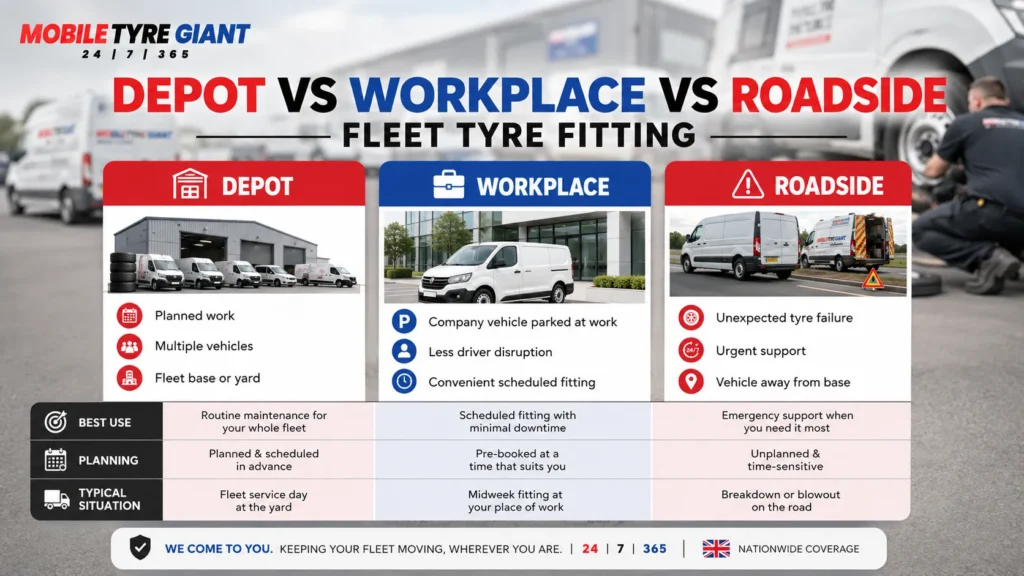
There is no single best location for every fleet tyre job because each option solves a different operational problem. Depot fitting generally works best when the job is planned, several vehicles may require attention and the fleet has control over where the vehicles are parked. Workplace fitting is more suitable when an individual business vehicle is already parked for a useful period and sending the driver elsewhere would create unnecessary interruption. Roadside fitting is mainly a reactive solution for an unexpected tyre problem that prevents the vehicle from continuing normally. The key factors are urgency, vehicle location, number of affected vehicles and whether the business can control the working environment. Looking at those factors together makes the choice much clearer than simply asking which type of mobile fitting is fastest.A useful way to think about the choice is to ask where the vehicle would already be if there were no tyre problem at all. If several vans naturally return to the same depot, planned work at that location is often the most logical option. If a company car is going to sit in an office car park for four hours, workplace fitting may use that idle time more effectively. If the vehicle has already stopped miles away from base because of an unexpected tyre failure, roadside assistance becomes the relevant route. This decision model also helps fleets separate routine maintenance from genuine emergencies. The more tyre work that can be identified and handled while vehicles are already parked in controlled environments, the less often the business has to deal with the pressure, noise and unpredictability of a roadside situation.
Scheduled vs Emergency Fleet Tyre Fitting: What Is the Difference?
Scheduled fleet tyre fitting is designed around a problem that has been identified before the vehicle becomes unusable. A fleet manager might notice that two vans are approaching replacement time, a driver may report gradual pressure loss, or a routine inspection may identify visible damage that needs attention. In situations like these, the business has some control over when and where the work happens. Vehicles can be positioned at a depot or workplace, the correct tyre information can be gathered, and the visit can be arranged around periods when those vehicles are already parked. This is usually a calmer process than dealing with a driver who is stranded halfway through a working route. Planned work also makes it easier to organise several vehicles without turning each tyre requirement into a separate interruption.
Emergency fleet tyre fitting begins from a very different position because the vehicle has normally developed an unexpected problem and normal operations have already been affected. A sudden flat tyre, serious pressure loss or visible damage may leave a driver unable to continue safely, which changes the priority from convenient scheduling to getting the situation assessed appropriately. That does not mean every tyre concern should automatically trigger an emergency callout. A slowly wearing tyre found during an inspection is usually a planning issue, while a vehicle immobilised away from base presents an immediate operational problem. Fleets benefit from separating these two situations instead of treating every tyre job with the same urgency. The more faults that can be identified while vehicles are still at a depot or workplace, the easier it becomes to reserve urgent mobile support for genuinely unexpected failures.
What Can a Mobile Tyre Fitter Do On-Site for a Fleet?
The exact work required depends on the tyre problem, but mobile fitting can cover more than simply removing an old tyre and installing a replacement. A technician may inspect the tyre, assess visible damage, check whether an appropriate puncture can be repaired, replace a tyre that is no longer suitable for use, and check pressures before the vehicle returns to service. Wheel balancing is also an important part of tyre fitting because fitting a different tyre changes the tyre and wheel assembly, and an imbalance can lead to noticeable vibration when the vehicle is driven. Mobile Tyre Giant’s current mobile wheel balancing service uses on-site digital balancing equipment and includes balancing with its tyre fitting service. For fleets, completing related tyre work during the same visit can be particularly useful when vehicles have been deliberately taken out of their working schedule for maintenance.
There are still limits to what should be assumed from the word “mobile.” A tyre technician is not a substitute for every piece of workshop equipment, and a separate mechanical or wheel-alignment issue may require a different type of inspection or repair. Access can also affect what happens on site, particularly when a locking wheel nut key is missing or a nut is seized or damaged. MTG has a dedicated locking wheel nut removal service for situations where normal wheel removal is prevented by the locking nut. Modern fleet vehicles may also have tyre pressure monitoring systems, so a leaking or faulty valve should not simply be ignored because a new tyre has been fitted. Where a relevant valve or sensor issue is identified, the dedicated TPMS valve replacement service provides a more specific route for that problem.
What Information Should a Fleet Manager Provide Before Tyre Fitting?
Good preparation can make mobile tyre fitting for fleets considerably easier to organise, especially when several vehicles are involved. Start with the vehicle registration and vehicle type, then provide the tyre size if it can be read clearly from the sidewall. The exact location is equally important because “at our depot” may still leave a technician searching across a large industrial site for the correct entrance or parking area. If several vans need attention, list the affected registrations rather than assuming they all use the same tyre size or specification. Describe the problem as accurately as possible, such as visible sidewall damage, a flat tyre, gradual pressure loss or planned replacement because of wear. It is better to provide clear information before the visit than to discover after arrival that the vehicle or tyre requirement is different from what was expected.
The fleet should also make sure the vehicles will actually be accessible when the technician arrives. A van parked behind five other vehicles may technically be on site, but it is not ready for efficient tyre work. Keys should be available where required, and any locking wheel nut key should be located before the appointment instead of searching gloveboxes and storage areas while the fitter waits. Fleet managers should also mention whether the job concerns one vehicle or several because a multi-vehicle depot visit needs different planning from a single roadside problem. If a tyre pressure warning is part of the issue, sharing that information beforehand can also provide useful context. A simple preparation routine may only take a few minutes, but across several vehicles it can prevent a planned visit from becoming a sequence of avoidable delays.
Why Does Correct Tyre Specification Matter for Fleet Vehicles?
Tyres that look similar from a distance can have very different specifications, which is why fleet purchasing should never be based on wheel diameter alone. The sidewall contains information such as tyre width, aspect ratio, construction, wheel diameter, load index and speed rating, and these markings help identify what the vehicle requires. Load capability deserves particular attention on working vans because the tyre must be suitable for the vehicle and its approved operating requirements. Two vans parked side by side may look almost identical but use different tyre sizes or ratings depending on model, wheel option and manufacturer specification. This becomes even more important in mixed fleets where cars, SUVs and light commercial vehicles are maintained together. Guessing from another vehicle in the yard is therefore a poor substitute for checking the actual specification of the vehicle being serviced.
Fleet managers should also avoid the assumption that every van automatically needs exactly the same category of commercial tyre. The appropriate tyre depends on the vehicle’s approved specification, so size, load index, speed rating and any manufacturer requirements need to be considered together. This matters for both planned replacements and emergency situations because the goal is not simply to fit something that physically goes onto the wheel. Correct tyre selection supports the handling and load requirements the vehicle was designed around. It also prevents a rushed replacement from becoming another problem once the vehicle returns to work. Where fleets manage a mixture of vehicle types, keeping accurate tyre information alongside registration and maintenance records can make future mobile visits much easier to arrange.
Is Mobile Tyre Fitting Better Than Sending Fleet Vehicles to a Garage?
Neither option is automatically better in every situation, and pretending otherwise would make the comparison less useful. Mobile tyre fitting for fleets has a clear advantage when the main problem is moving the vehicle away from where it already needs to be. A van parked at the depot overnight, a company car sitting in an office car park or an immobilised vehicle away from base may all be strong candidates for mobile assistance. The driver does not necessarily need to make a separate journey simply to reach a tyre centre, and planned work can often be organised around time when the vehicle is already stationary. For businesses running several working vehicles, that flexibility can be more important than the simple question of where the tyre machine is located. The real comparison should therefore include vehicle availability and driver disruption as well as the fitting itself.
A garage can still be the more appropriate environment when the vehicle needs work that goes beyond what the mobile tyre visit is intended to provide. For example, a tyre may show unusual wear that points toward an alignment or suspension issue requiring further investigation rather than repeatedly replacing rubber and hoping the symptom disappears. That is similar to replacing a worn shoe when the real problem is the way someone is walking: the new item may temporarily hide the symptom without addressing the cause. Fleet managers should therefore treat mobile fitting and workshop services as complementary options rather than competing solutions for every vehicle problem. Use mobile fitting where bringing the tyre service to the vehicle genuinely reduces unnecessary disruption, and use an appropriate workshop when the underlying issue requires equipment or diagnosis that belongs there. The strongest fleet maintenance strategy is the one that chooses the right environment for the actual problem rather than defaulting to the same solution every time.
Can Planned Fleet Tyre Checks Reduce Roadside Problems?
Planned fleet tyre checks can help identify some issues before they turn into roadside disruptions, although they cannot prevent every puncture or sudden tyre failure. Regular checks can bring attention to low tyre pressure, visible cuts, uneven wear, reduced tread depth and other signs that a tyre may need closer inspection. For a business running several vehicles, this is especially useful because the same small problem can otherwise remain unnoticed until a driver is already away from base. Think of it like checking a delivery van’s fuel level before a long route rather than waiting for the warning light miles from the depot. A tyre that is inspected while the vehicle is parked gives the fleet more options because the work can potentially be scheduled instead of becoming an emergency. Drivers should also report anything unusual, such as repeated pressure loss, vibration or visible damage, rather than assuming the issue can wait until the next service.
A planned fleet tyre check can be particularly useful for businesses that want several vehicles assessed at the same location. This does not mean every tyre found with wear needs immediate replacement, but it gives fleet managers better visibility over which vehicles may need attention soon. That makes it easier to prioritise work, arrange tyre fitting around operating schedules and avoid sending every vehicle separately to a tyre centre. It also helps create a clearer distinction between maintenance that can be organised calmly and genuine roadside problems that require a faster response. The goal is not to eliminate every unexpected tyre issue because that is unrealistic. The goal is to reduce avoidable disruption by finding manageable problems while the business still has control over where the vehicle is and when the work can take place.
Which Types of Fleets Can Benefit From Mobile Tyre Fitting?
Mobile tyre fitting can make sense for many businesses that rely on cars, vans and suitable light commercial vehicles to keep their operations moving. Delivery fleets may need vehicles available for scheduled routes, while trades businesses often depend on vans carrying tools and equipment between customer locations. Company cars and sales vehicles may spend several hours parked at offices or customer sites, creating opportunities for workplace fitting without requiring the driver to visit a tyre centre. Pool vehicles can also benefit when tyre work is identified while the vehicle is not booked for immediate use. Courier businesses, service engineers, property maintenance companies and other organisations operating multiple working vehicles may all face the same basic problem: a tyre issue can remove a useful vehicle from the schedule at exactly the wrong time.
The best fitting arrangement will still depend on how the fleet operates. A business where every vehicle returns to one yard at the end of the day may find depot fitting relatively easy to organise, while a distributed fleet with employees working from different locations may rely more heavily on workplace or site-based fitting. Some fleets may use all three approaches depending on the situation. Planned replacements might happen at the depot, individual company cars could be handled at workplaces, and roadside assistance may be needed when an unexpected failure occurs during a journey. There is no need to force every vehicle into one maintenance model simply because it belongs to the same business. A flexible fleet tyre strategy should reflect where vehicles actually spend their time and how quickly the business needs them back in operation.
Which Fleet Tyre Fitting Option Should You Choose?
The simplest way to choose between depot, workplace and roadside fitting is to look at where the vehicle is, whether the problem is planned and how many vehicles need attention. If several vans are already returning to one fleet base and the work can be scheduled, depot fitting is usually the most logical option. If an individual company vehicle will already be parked at work for several hours, workplace fitting may reduce unnecessary driver disruption. If the vehicle is immobilised away from base because of an unexpected tyre problem, roadside support becomes more relevant. The important point is that urgency should not be created artificially. A worn tyre identified early does not need to be treated in the same way as a sudden flat that has already stopped a working vehicle.
Fleet managers should also consider whether the location itself is suitable for mobile tyre work. A controlled depot with good access may be ideal, while a cramped or busy site may need vehicles repositioned before the technician arrives. Workplace fitting is useful only where permission, access and working space are appropriate. Roadside fitting depends even more heavily on safety because a vehicle close to fast-moving traffic may need to be moved before work can happen. Once these practical factors are considered, the decision becomes much clearer. Choose the option that solves the actual operational problem rather than simply choosing whichever sounds fastest.
How to Prepare for Mobile Fleet Tyre Fitting
Preparation starts with identifying exactly which vehicles need attention and gathering the correct information before booking. Fleet managers should have the registrations available, confirm the location of each vehicle and note the tyre size where it is known. It is also useful to explain whether the problem is planned wear, pressure loss, visible damage, a puncture or an unexpected failure. If several vehicles need work, list them individually rather than assuming the same tyre specification applies across the fleet. Locking wheel nut keys should be found before the fitter arrives, and vehicles should be positioned where there is safe access around the wheels. These basic steps may seem obvious, but they are often what separates an efficient planned visit from one slowed down by missing information or inaccessible vehicles.
The final part of preparation is deciding whether the issue really needs urgent assistance or can be scheduled around the business. A vehicle safely parked at base with a tyre that is approaching replacement can usually be handled differently from a van already stranded during a route. Giving the fitter an accurate description of the situation helps the correct service be arranged from the start. Fleet managers should also make sure drivers know who to contact and what information to provide if a tyre problem happens away from base. A clear process avoids confusion when the pressure is on. In practice, the best mobile tyre fitting experience often starts before the technician arrives, with accurate information, accessible vehicles and a realistic understanding of what the job requires.
Final Words: Choosing the Right Mobile Tyre Fitting Approach for Your Fleet
Mobile tyre fitting for fleets is most useful when it matches the way the business actually operates. Depot fitting is generally strongest for planned work and multiple vehicles, workplace fitting suits individual business vehicles that are already parked during the day, and roadside fitting is mainly for unexpected tyre failures that interrupt a journey. The important difference is whether the fleet still has control over the situation. When tyre wear or damage is identified early, the work can often be scheduled around vehicle availability. Once a vehicle is already immobilised away from base, the business has fewer choices and the priority shifts toward dealing with the immediate problem safely.
A practical fleet tyre strategy therefore combines prevention, preparation and the right type of mobile support. Regular tyre checks can help identify manageable issues earlier, accurate vehicle information makes fitting easier to organise, and choosing the correct location can reduce unnecessary disruption. Not every problem needs to become an emergency, and not every vehicle needs to be sent to a traditional tyre centre. The strongest approach is simply to deal with tyre work where it makes the most operational sense. For businesses managing several working vehicles, that can mean using depot, workplace and roadside fitting as different tools for different situations rather than treating them as one identical service.
Need a Smarter Way to Manage Fleet Tyre Problems?
Arrange mobile tyre fitting for your fleet at a depot, workplace, or suitable roadside location, with support for planned tyre work and unexpected tyre issues.
Frequently Asked Questions
Find quick answers to the most common questions our customers ask.
Yes, depot tyre fitting can be a practical option when vehicles are already parked at the same base and the location provides enough safe working space. It is particularly useful for planned replacements, inspections and multi-vehicle work where the fleet can organise access in advance.
Potentially, yes. Several vehicles may be handled during a planned depot visit depending on the number of vehicles, tyre requirements, access and the amount of work needed on each one. Providing accurate vehicle details before the appointment makes planning much easier.
Yes, workplace tyre fitting can be suitable when the vehicle is parked somewhere accessible and there is enough safe working space around it. Company cars, pool vehicles and working vans may be good candidates when they are already stationary during the working day.
Depot fitting is usually best for planned multi-vehicle work, workplace fitting suits individual business vehicles already parked at work, and roadside fitting is mainly for unexpected tyre failures where the vehicle cannot safely continue. The best choice depends on urgency, location and operational disruption.
Roadside tyre fitting is most relevant when a tyre problem happens unexpectedly and leaves the vehicle unable to continue safely. The vehicle still needs to be in a suitable location for attendance, and safety should always come before convenience.
The fleet provides the vehicle details, tyre information and location, then a mobile technician attends the vehicle and assesses the tyre. Depending on the issue, the tyre may be repaired or replaced where appropriate, and related fitting checks can be completed before the vehicle returns to service.
Useful information includes the vehicle registration, vehicle type, tyre size where known, current location, number of affected vehicles and a description of the tyre problem. It is also helpful to confirm whether locking wheel nuts are fitted and whether the job is planned or urgent.
Sometimes, but not every puncture is suitable for repair. The location and extent of the damage, the condition of the tyre and whether the tyre has been driven while underinflated can all affect whether a safe repair is possible.
Mobile tyre fitters with the correct equipment can carry out wheel balancing on-site as part of tyre fitting. Correct balancing is important because an imbalance can cause vibration and may affect how smoothly the vehicle drives after a tyre has been replaced.
Regular fleet tyre checks can identify issues such as low pressure, visible damage, tread wear and irregular wear before they become more serious, although no inspection can prevent every unexpected puncture or tyre failure. Planned checks simply give the business more opportunities to deal with problems before vehicles leave base.