

Yes, a mobile tyre fitter may be able to help when a tyre problem happens during a motorway journey, but the exact stopping location makes a major difference. A vehicle parked safely in a motorway service area creates very different working conditions from a car sitting on an exposed hard shoulder or stranded in a live traffic lane. The technician needs enough room around the damaged wheel, safe access to the vehicle and a working position that does not expose them unnecessarily to fast-moving traffic. Think of it like trying to repair something on a busy building site: having the right tools is only useful once there is a safe place to use them. This is why motorway attendance should never be interpreted as a promise that tyre work can take place anywhere a vehicle happens to stop.
For the driver, the first priority is getting into the safest practical position rather than immediately deciding whether the tyre can be repaired or replaced. If the vehicle is already somewhere that can be approached and worked around safely, professional mobile tyre fitting may provide a practical way to deal with the problem without driving to a garage. If the car is in an unsafe position, however, motorway assistance or recovery may need to come before the tyre work itself. A responsible mobile tyre fitter should consider the surroundings as carefully as the damaged tyre because the job involves people working close to the vehicle as well as the vehicle itself. Understanding that distinction makes it much easier to decide what to do when a puncture, sudden pressure loss or blowout interrupts a motorway journey.
What Should You Do If You Get a Flat Tyre on a Motorway?
A flat tyre on a motorway does not always begin with a dramatic bang, and the first warning may be a dashboard light, a rhythmic thumping sound or steering that suddenly feels heavier on one side. If something feels wrong, keep your attention on controlling the vehicle rather than looking down repeatedly at the dashboard or making abrupt movements. Ease off the accelerator progressively, maintain a steady direction and move towards the left only when traffic conditions allow you to do so safely. If the vehicle remains controllable, aim for an emergency area, lay-by, hard shoulder where available, or another suitable place away from live traffic. The sensation can be unsettling, especially when the road noise is loud and vehicles are passing quickly, but smooth actions give you more time to understand what the car is doing.
Once you have stopped, switch on the hazard warning lights and think about personal safety before inspecting the tyre. Where it is safe to leave the vehicle, occupants should use the side away from moving traffic and wait well clear of the carriageway, preferably behind a safety barrier where one is available and safe to reach. A warning triangle should not be placed on a motorway, and walking around the vehicle simply to see which tyre is flat can create unnecessary exposure to passing traffic. Our flat tyre emergency guide explains the wider process of assessing a flat tyre and deciding between repair, replacement and recovery once the immediate danger has been dealt with. Only after the vehicle and its occupants are in the safest practical situation should you consider whether a mobile tyre fitter can attend the location or whether the car needs to be moved first.
What If Your Tyre Blows Out While Driving?
A tyre blowout can feel much more violent than an ordinary puncture because the change in the vehicle may happen almost instantly. You may hear a sharp bang followed by a heavy flapping noise, vibration through the steering wheel or seat, or a noticeable pull towards one side of the road. The natural reaction can be to brake hard or turn sharply against the pull, but sudden inputs can make an already unstable vehicle harder to manage. Hold the steering wheel firmly, keep looking along the road ahead and allow the vehicle to slow progressively as you ease off the accelerator. Think of carrying a full mug of hot coffee across a moving train: steady corrections usually give you more control than one sudden movement.
As the vehicle slows and becomes easier to control, check your mirrors and move left when a safe opportunity appears rather than cutting abruptly across motorway lanes. A tyre that has torn, shredded or lost most of its air should not be treated like a minor pressure warning simply because an exit or service area looks close on a navigation screen. Continuing on badly damaged rubber can increase damage to the tyre and wheel and may make the vehicle more difficult to control. Our guide to a tyre blowout while driving goes into more detail about the warning signs and the steps that help drivers stay in control during this type of sudden failure. Once the vehicle has reached a safer stopping position, a mobile tyre fitter can then assess whether attendance is practical, but controlling the vehicle and protecting the people inside it must always come first.
What If You Cannot Reach the Hard Shoulder or an Emergency Area?
A tyre failure becomes a much more serious motorway incident if the vehicle cannot reach an emergency area, hard shoulder or another place away from live traffic. If the car stops in a live lane and you cannot safely leave it and get clear of the carriageway, keep the hazard warning lights on, remain inside with your seat belt fastened and call 999 for emergency assistance. This is not a situation where the driver should get out with a jack, crouch beside the wheel or begin arranging an ordinary roadside tyre change while traffic is still moving around the vehicle. Even a well-equipped mobile tyre fitter cannot treat an unprotected live lane like a driveway or quiet roadside because the danger comes from the surrounding traffic rather than the tyre alone. Emergency motorway procedures therefore take priority until the vehicle and occupants are protected from the immediate risk.
The situation changes once the vehicle has been moved or secured in a location where assistance can be considered safely, but even then the stopping place needs to be assessed rather than assumed suitable. A hard shoulder, for example, may provide separation from the running lanes, yet the roar of passing vehicles and limited working space can still make tyre work difficult or unsafe in some circumstances. An emergency area provides another type of stopping environment, while a motorway service area gives a fitter a completely different amount of space and separation from moving traffic. This is why the question is not simply whether a mobile tyre fitter works on motorways, but whether the exact location can be accessed and worked in safely. The next part will examine service areas, emergency areas, hard shoulders and live lanes separately so the differences between those motorway situations are clear.
Where Can a Mobile Tyre Fitter Work on a Motorway?
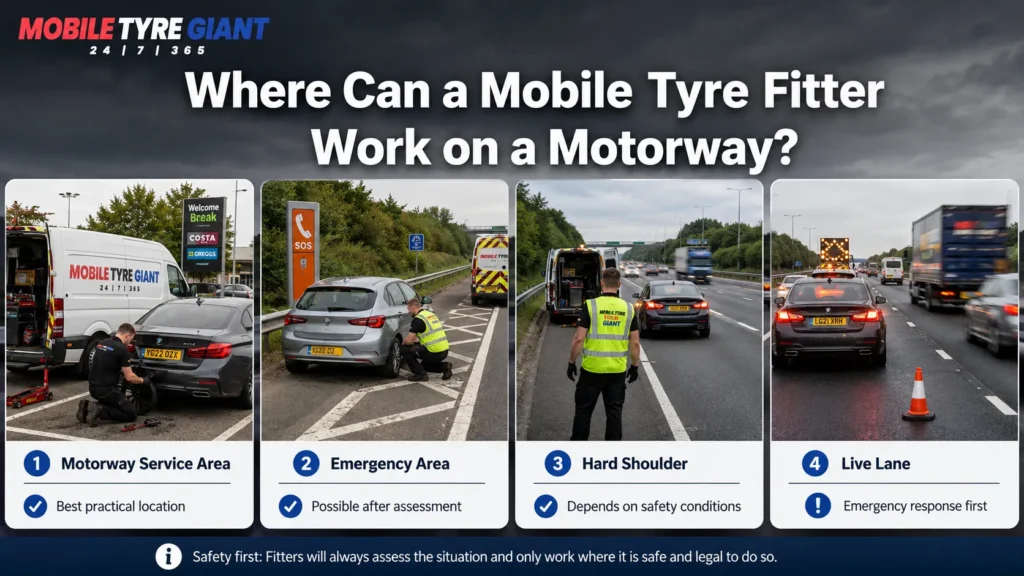
Whether a mobile tyre fitter can work at your motorway location depends less on the road number and more on the exact place where the vehicle has stopped. A service area, emergency area, hard shoulder and live lane expose the vehicle and technician to very different levels of risk. Space around the damaged wheel matters because the fitter may need to position equipment, remove the wheel and work beside the vehicle. Traffic speed, visibility and the distance between the car and passing vehicles also affect whether the location is practical. A quiet parking bay at motorway services can feel almost like an ordinary car park, while a hard shoulder can be filled with the constant rush and vibration of traffic only a short distance away.
This is why saying that mobile tyre fitting is available on or around motorways should never be interpreted as meaning that every stopping position is suitable for tyre work. The technician may need to assess the surroundings before deciding whether the job can be completed where the car is standing. In some cases, the vehicle may first need to reach a more protected location or be moved by recovery assistance. Drivers travelling around London can also find specific information about mobile tyre fitting around the M25 when a tyre problem occurs during an M25 journey. The table below gives a simple overview, but the individual motorway situations need a little more explanation before deciding what action is appropriate.
Motorway Location | Can Tyre Fitting Be Considered? | Main Issue |
Motorway service area | Often practical if safely parked | Space and safe access |
Emergency area | May be possible after the situation is assessed | Restricted area and safe access |
Hard shoulder | Depends heavily on conditions and fitter assessment | Exposure to high-speed traffic |
Live traffic lane | Not a normal tyre fitting location | Immediate danger from moving traffic |
Motorway Service Areas
A motorway service area will often provide a much more practical environment for a mobile tyre fitter than the edge of the carriageway. Cars can usually be parked away from fast-moving traffic, giving the technician more room to inspect the damaged tyre and work around the wheel. If you notice a slow puncture, pressure warning or another developing tyre problem while the vehicle is still controllable, reaching services safely can therefore make the situation much easier to manage. Picture the difference between trying to open a toolbox while lorries thunder past a few metres away and doing the same job in a marked parking bay. The tyre fault has not changed, but the working environment has.
Reaching a service area should only be considered when the vehicle can still be driven there safely, because protecting a wheel is never more important than maintaining control of the car. A completely deflated, shredded or severely damaged tyre may make continuing the journey unsafe even if motorway services appear close on your navigation screen. Once safely parked, you can provide the fitter with your location, vehicle details and tyre size so they can understand what may be required before attending. It is also worth choosing a parking position that leaves reasonable space around the damaged side of the vehicle rather than squeezing tightly between other cars. For many tyre-only problems, a safely accessible service-area car park gives mobile tyre fitting the sort of stable, separated environment that is much easier to work in than an exposed motorway edge.
Can a Mobile Tyre Fitter Work in an Emergency Area?
Emergency areas are provided for genuine emergencies and breakdowns where a driver cannot leave the motorway or reach another suitable place to stop. They are normally more separated from live traffic than simply stopping in a running lane, but that does not automatically turn every emergency area into a standard tyre-fitting bay. The vehicle’s position, available space, surrounding traffic and access for the service vehicle still need to be considered. If you stop there because of a tyre problem, move as far into the designated area as safely possible and use your hazard warning lights. The bright road markings and physical separation may feel reassuring after the noise and pressure of the carriageway, but you are still within a motorway environment that requires care.
When contacting a mobile tyre fitter, make it clear that the vehicle is in an emergency area rather than simply saying you are somewhere on the motorway. Give the motorway number, direction of travel, nearest junction and any visible location information so the situation can be understood before anyone travels to you. The fitter can then determine whether attendance and tyre work can be carried out safely or whether another step is required first. You should also avoid wandering around the vehicle or standing close to moving traffic while waiting simply because the car is no longer in a live lane. Another important point is that leaving an emergency area after the problem has been dealt with follows a specific motorway procedure, which we will cover later in the guide.
Can a Mobile Tyre Fitter Work on the Hard Shoulder?
A hard shoulder can provide somewhere to stop when a genuine vehicle emergency prevents you from safely continuing to the next junction or service area, but it remains an exposed place. The solid white line may separate the vehicle from the running lanes, yet high-speed traffic can still pass extremely close to the people and equipment beside the car. Anyone who has stood near motorway traffic will recognise the physical sensation: the rush of air, tyre roar and vibration make the environment very different from changing a wheel on a quiet residential street. A mobile tyre fitter therefore needs to consider the actual working space and traffic exposure before beginning work. The fact that the vehicle has successfully reached the hard shoulder does not by itself prove that the location is suitable for tyre replacement.
Conditions can also vary considerably from one section of motorway to another, so a universal answer would be misleading. A wide, clearly visible area with good separation may present a different risk from a narrow section near a bend, bridge, junction or other restricted location. The damaged wheel position can matter too because working on the traffic-facing side of the vehicle may expose the technician differently from working on the side furthest from moving vehicles. For that reason, a responsible mobile tyre fitter may assess the location and decide that the vehicle should be moved before work begins. That decision should be viewed as professional judgement rather than an inconvenience, because repairing the tyre quickly is pointless if doing so creates an unacceptable risk to the people beside the car.
What If the Vehicle Is Stopped in a Live Motorway Lane?
A vehicle stopped in a live motorway lane is fundamentally different from every other situation discussed above. If a tyre failure leaves the car unable to reach a place of relative safety and you cannot safely exit and get clear of the carriageway, keep the hazard warning lights on, remain inside with your seat belt fastened and call 999. Do not step into the road to inspect the tyre, remove luggage, search for tools or take photographs of the damage. The immediate problem is no longer simply a flat tyre because other vehicles may be approaching the stationary car at motorway speed. In those circumstances, emergency motorway safety takes priority over arranging normal tyre fitting.
A mobile tyre fitter should not be treated as the first solution while the vehicle remains unprotected in a live lane. The vehicle and occupants first need to be protected through the appropriate motorway incident response, after which the tyre problem can be dealt with from a safer position. This distinction is important because people searching for emergency mobile tyre fitting may understandably focus on getting the damaged tyre changed as quickly as possible. Speed matters, but the order of actions matters more, much like dealing with a burst pipe near live electrical equipment where the immediate hazard has to be controlled before the repair starts. Once the vehicle reaches a location that can be safely assessed, the question can return to whether a mobile tyre fitter can repair or replace the tyre or whether recovery is still required.
Why Might a Mobile Tyre Fitter Refuse to Work Where Your Car Has Stopped?
A mobile tyre fitter may reach your vehicle and still decide that the exact stopping position is not safe enough to begin work. This can be frustrating when you are already delayed, but the technician has to assess more than the condition of the tyre. They need enough space to position themselves and their equipment without being dangerously exposed to passing vehicles. Poor visibility, a narrow hard shoulder, a bend in the road or a damaged wheel facing the traffic can all affect that decision. Even the surface beneath the vehicle matters because lifting a car requires a stable working position. On a quiet driveway these details barely attract attention, but beside motorway traffic they can become critical. The constant rush of air from passing lorries and the vibration beneath your feet give a good sense of how different roadside work is from fitting a tyre in a workshop. A technician also needs to consider whether other drivers can clearly see the stopped vehicle and working area. If those conditions are unsuitable, refusing to begin immediately can be the responsible choice rather than poor service.
In some situations, the safest solution is to move the vehicle before any repair or replacement begins. That might mean reaching a service area, leaving the motorway at the next safe opportunity or arranging recovery when the car cannot be moved safely under its own power. A mobile tyre fitter should not be expected to take unnecessary risks simply because the tyre itself looks straightforward to replace. Imagine trying to repair a garden fence while someone repeatedly drives past your shoulder at motorway speed; the technical job may be simple, but the surroundings completely change the risk. This is also why drivers should describe their stopping location accurately when requesting assistance instead of saying only that they are “on the motorway.” Whether the vehicle is in a service area, emergency area, hard shoulder or another location can influence what type of help is appropriate. A professional assessment protects the technician, the driver, passengers and other road users. Once the vehicle is somewhere that can be worked around safely, attention can return to the tyre itself and the quickest suitable way to get the journey moving again.
Do You Need Breakdown Recovery or a Mobile Tyre Fitter?
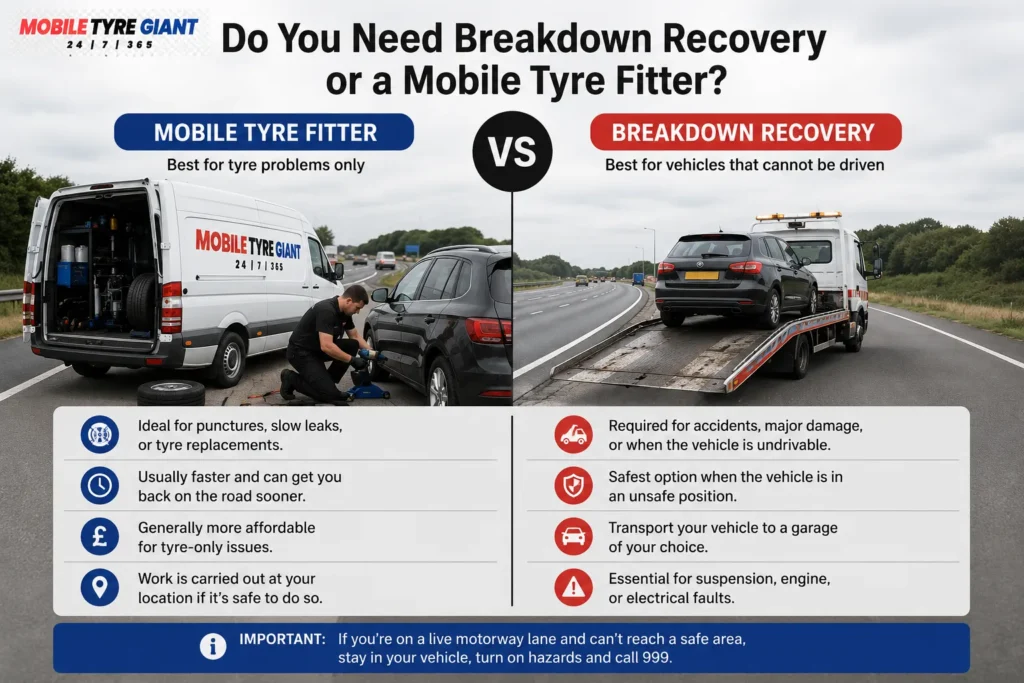
A tyre problem does not automatically mean the entire vehicle needs to be recovered. If the car is safely parked, the wheel is accessible and the fault is limited to a tyre that can be repaired or replaced, a mobile tyre fitter may be able to deal with the problem where the vehicle is located. This can be particularly useful when the driver has no usable spare wheel or does not have the equipment or confidence to change one. The important point is that the service required should match the actual problem rather than being chosen simply because both options provide roadside assistance. A tyre fitter specialises in tyre-related work, while vehicle recovery becomes more important when the car cannot remain or be worked on safely where it has stopped. The difference is similar to calling an electrician for a failed socket rather than automatically moving all of your appliances to another building. If the fault can be dealt with safely at the location, transporting the whole vehicle may not always be necessary. However, that judgment can only be made after the situation itself is understood. The tyre problem, vehicle condition and motorway location all need to be considered together.
Recovery may be required when the vehicle is in an unsafe position, when there is significant wheel damage or when the problem goes beyond the tyre itself. A severe impact can sometimes damage a wheel, suspension component or another part of the vehicle, meaning that simply fitting fresh rubber would not make the car safe to drive. Recovery can also become necessary when the tyre fitter cannot safely access the damaged side of the vehicle or when traffic conditions make roadside work unsuitable. This is why telling the service exactly what happened can be as important as giving the tyre size. Mention whether the tyre gradually lost pressure, suffered a sudden blowout, struck a pothole or appears to have damaged the wheel as well. Photos can sometimes help explain visible damage when they can be taken safely from a protected location, but nobody should step into an exposed motorway area simply to get a better picture. A good decision is based on getting the vehicle safely mobile again, not merely changing a tyre as quickly as possible. In some cases that means fitting at the roadside, while in others recovery is the safer first step.
Can a Motorway Puncture Be Repaired or Does the Tyre Need Replacing?
Not every motorway puncture automatically requires a new tyre, but repair should never be promised before the tyre has been properly assessed. A small penetration in a suitable part of the tread may present a very different situation from damage close to the sidewall, a torn tyre or one that has been driven while badly deflated. The technician also needs to consider the overall condition of the tyre rather than focusing only on the visible object that caused the puncture. A nail sitting neatly in the tread can look harmless from the outside, yet the tyre may have suffered internal damage if it was driven for some distance with very low pressure. That is why simply pulling out the object and plugging the hole at the roadside is not a sensible universal solution. The tyre has to be judged on the location and severity of the damage as well as its general condition. If a safe repair is appropriate, that may solve the problem without replacing the tyre. If it is not suitable for repair, replacement becomes the safer option. A mobile tyre fitter should therefore inspect the actual problem rather than guessing from a phone description alone.
Motorway speed can make tyre condition particularly important because the repaired or replacement tyre must be capable of returning to normal road use safely. Sidewall cuts, major tears, exposed internal structure or severe damage caused by running flat are examples of faults that should not be treated like an ordinary small puncture. The wheel itself should also be considered if the vehicle struck debris, a pothole or another object before the tyre lost pressure. Sometimes what initially appears to be a simple puncture turns out to involve damage that requires a different solution. Drivers can help by explaining exactly what they felt and heard before stopping, such as a sudden bang, a gradual pressure warning, steering vibration or the sound of rubber striking the wheel arch. These details do not replace inspection, but they give the technician useful context before examining the tyre. The goal is not to save a tyre at any cost but to choose a repair or replacement that is appropriate for its actual condition. That approach is safer and more reliable than assuming every visible puncture can be fixed in the same way.
What If Your Car Has No Spare Tyre?
Many drivers only discover that their car has no conventional spare wheel when a puncture actually happens. Open the boot expecting to find a wheel and jack, and you may instead see an inflator, a bottle of sealant or an empty-looking storage compartment beneath the floor. That can turn a routine tyre problem into a confusing situation, particularly on a motorway where driving around looking for a garage may not be possible. A missing spare does not automatically mean the vehicle needs recovery, because the best solution depends on the tyre damage and where the car has stopped. A mobile tyre service may be able to provide a replacement when the vehicle is in a suitable working location and the correct tyre can be supplied. The driver should provide the full tyre size and vehicle details when arranging assistance so the fitter can prepare for the job. It is also worth checking whether the locking wheel nut key is present because a replacement tyre cannot be fitted normally if the wheel cannot be removed. Looking for these details while safely parked can save unnecessary confusion later. The important thing is not to improvise a risky solution simply because there is no spare in the boot.
Tyre sealant and inflation kits can be useful in certain limited situations, but they should not be treated as a universal answer to every motorway tyre failure. A large tear, badly damaged sidewall, shredded tyre or wheel damage may be beyond what a temporary kit can deal with. Even when sealant appears to restore some pressure, the driver still needs to follow the vehicle and repair-kit instructions and consider whether the tyre is suitable for continued use. A repair kit should never become an excuse to continue driving a tyre that is clearly structurally damaged. If the kit does not work or the damage is unsuitable, the practical alternatives are usually professional tyre assistance or recovery depending on the vehicle’s location and condition. This is another reason why describing the damage clearly when contacting a mobile tyre fitter is useful. The technician can arrive with a better understanding of whether the likely job involves inspection, puncture assessment or replacement. Having no spare can feel like being locked out without a key, but it does not leave the driver without options when the situation is handled calmly and safely.
What Information Should You Give a Mobile Tyre Fitter on a Motorway?
Clear information can make a motorway tyre call-out much easier to organise. Start with the motorway number, direction of travel, nearest junction and your exact stopping location, whether that is a service area, emergency area or another safe position. A live location pin can be particularly useful when road names and junctions are confusing. You should also provide the vehicle registration, make and model, the affected wheel and the full tyre size printed on the sidewall. Explain whether the tyre lost pressure slowly, suffered a sudden blowout or appears visibly torn. The more accurately you describe the situation, the easier it is for the fitter to understand what may be required before travelling.
It is also worth mentioning whether the wheel appears damaged and whether the vehicle has a locking wheel nut. Mobile Tyre Giant has a detailed guide explaining what information a mobile tyre fitter needs if you want to prepare these details before requesting assistance. Think of the call-out like ordering the correct replacement part for an appliance: saying “the washing machine is broken” gives far less useful information than providing the exact model and fault. Accurate tyre information can reduce unnecessary back-and-forth and help prevent the wrong tyre from being prepared. Never put yourself at risk by stepping close to motorway traffic simply to read the tyre size or take a photograph. If the information cannot be obtained safely, explain that when requesting assistance.
What If You Cannot Find the Locking Wheel Nut Key?
A missing locking wheel nut key can turn an otherwise straightforward tyre replacement into a more complicated job. Many vehicles have one locking nut on each alloy wheel, and the matching key is normally needed before that wheel can be removed using standard tools. Check the glovebox, boot storage compartments, spare-wheel area and the pouch containing the vehicle tools if it is safe to do so. Drivers sometimes forget that the key was moved during a previous tyre change or service. If you still cannot find it, tell the fitter before they travel rather than waiting until they arrive beside the vehicle.
Specialist equipment may be required when a locking wheel nut key is lost, damaged or unavailable. Mobile Tyre Giant provides mobile locking wheel nut removal for situations where the wheel cannot be removed normally. Do not try improvised roadside methods with hammers, grinders or unsuitable sockets, particularly beside a motorway. Damaging the nut can make removal more difficult and may also damage the surrounding alloy wheel. A missing key is inconvenient, but it is much easier to manage when the fitter knows about it before the call-out begins.
What Happens When the Mobile Tyre Fitter Arrives?
The first thing a professional mobile tyre fitter should consider is whether the vehicle can be worked on safely in its current position. The tyre may be completely flat, but rushing directly towards the wheel without looking at the surroundings would ignore one of the biggest risks of motorway work. The fitter may assess the available space, traffic exposure, ground conditions and access to the damaged side of the vehicle. They can then inspect the tyre and wheel to understand whether the problem is a repairable puncture, a tyre requiring replacement or something involving additional damage. A tyre that looked like a simple puncture over the phone can sometimes reveal sidewall damage or signs of being driven while underinflated once it is examined properly.
If fitting can take place safely, the wheel can then be removed and the appropriate tyre work carried out. The fitter should also consider the tyre pressure, wheel security and the condition of the wheel before the vehicle continues its journey. If the damage turns out to involve more than the tyre, fitting new rubber alone may not solve the problem. For example, a wheel damaged after striking a pothole or debris may need further attention before the vehicle is suitable for motorway speeds. This is why inspection remains important even when the customer already believes they know exactly what caused the failure.
What Happens After the Tyre Has Been Changed?
A successful tyre replacement does not always mean you should immediately pull back into motorway traffic. Before moving, make sure the fitter has completed the necessary checks and that there are no obvious signs of additional damage affecting the vehicle. If you are parked at motorway services, leaving the parking area is usually very different from rejoining directly from a hard shoulder or emergency area. Take a moment to settle back into the car, check the surroundings and make sure everyone is safely seated before continuing. After the stress and noise of a tyre failure, rushing the final few minutes makes little sense.
The way you return to the motorway depends on where the vehicle has been stopped. A driver leaving a normal service-area parking space will follow the usual exit route, while an emergency area has a specific re-entry procedure. The important point is not to assume that because the tyre is fixed, the motorway environment around you has suddenly become safe. Passing traffic is still moving quickly, visibility may be restricted and you need enough space to return to the carriageway safely. Treat the final stage with the same care you used when bringing the vehicle to a stop.
How Do You Leave a Motorway Emergency Area Safely?
If your tyre has been repaired or replaced while the vehicle is in a motorway emergency area, do not simply accelerate out of the area and merge into traffic. The emergency telephone provided there should be used and the operator’s instructions followed before you leave. This matters because traffic management may be required to create a safe opportunity for the vehicle to rejoin the motorway. Even when the vehicle itself is ready, the surrounding traffic conditions still determine when it is safe to move.
Drivers can easily overlook this step because the feeling of relief after a tyre has been changed makes continuing the journey seem like the obvious next action. Imagine finishing a repair behind a closed gate: the repair may be complete, but you still need the gate opened before you can safely continue. Follow the instructions given for leaving the emergency area rather than relying only on your own view of the traffic. Safe re-entry completes the tyre emergency properly.
How Mobile Tyre Giant Can Help With a Motorway Tyre Problem
A motorway tyre problem can involve anything from a manageable puncture at a service area to a severely damaged tyre that leaves the vehicle unable to continue. Mobile Tyre Giant can provide mobile tyre assistance when the vehicle is in a location where the work can be carried out appropriately. Providing your tyre size, registration, location and a clear description of the damage helps the team understand the situation before attendance. If the vehicle cannot be worked on safely where it has stopped, moving it to a safer location may need to happen before tyre work begins. The objective should always be to solve the tyre problem without compromising roadside safety.
Drivers around London and the surrounding motorway network should also remember that not every call-out will look the same. The damaged tyre, vehicle type, available working space and exact motorway location can all change what happens next. A puncture in a spacious service-area car park is a very different job from a blowout beside fast-moving traffic. Providing accurate information from the beginning allows the safest practical option to be considered rather than making assumptions. That combination of preparation and professional assessment is what makes mobile fitting genuinely useful during an unexpected motorway tyre problem.
Final Words: Can a Mobile Tyre Fitter Work on a Motorway Safely?
So, can a mobile tyre fitter work on a motorway? The answer is that a fitter may be able to assist with a motorway tyre problem, but the vehicle’s exact stopping position determines whether the work can safely happen there. Motorway service areas, emergency areas, hard shoulders and live lanes should never be treated as identical environments. If the vehicle is somewhere safely accessible, mobile tyre fitting may provide a practical way to repair or replace the tyre without travelling to a garage. If the position is unsafe, emergency assistance or recovery may need to come first.
The most important thing is to deal with the situation in the correct order. Control the vehicle, move to a safer location where possible, protect yourself and your passengers, and then consider the tyre itself. Give the fitter accurate location and tyre information and mention issues such as a missing locking wheel nut key before they travel. A motorway puncture is stressful, but making calm decisions is far more useful than rushing towards the quickest-looking solution. Safety first, correct assessment second, and tyre repair or replacement third gives you the best path back to your journey.
Motorway Tyre Problem? Get Help Where It’s Safe
If you have a puncture, blowout or damaged tyre during a motorway journey, contact Mobile Tyre Giant for professional mobile tyre assistance at a suitable safe location.
Frequently Asked Questions
Find quick answers to the most common questions our customers ask.
A mobile tyre fitter may be able to change your tyre if the vehicle is in a location that can be accessed and worked around safely. The fitter needs enough working space and reasonable protection from fast-moving traffic before starting the job. A motorway service area, emergency area, hard shoulder and live lane all create different conditions, so motorway attendance should never be taken to mean that tyre fitting can safely happen in every location.
A mobile tyre fitter may assess a hard-shoulder location, but fitting cannot automatically be guaranteed there. Traffic speed, available working space, visibility, vehicle position and which wheel is damaged can all affect whether the job can be completed safely. If the location is too exposed, the vehicle may need to be moved to a safer place before repair or replacement begins.
Keep control of the vehicle, avoid sudden steering or braking, and move towards a suitable place away from live traffic when it is safe to do so. Once stopped, switch on your hazard warning lights and focus on keeping yourself and your passengers safe before inspecting the tyre. Do not attempt a roadside tyre change if doing so would expose you to fast-moving motorway traffic.
If your vehicle stops in a live motorway lane and you cannot safely reach a place of relative safety or safely exit the vehicle, keep your hazard warning lights on, remain inside with your seat belt fastened and call 999. Do not get out to inspect the tyre or attempt a wheel change while the vehicle remains exposed to live traffic, as the immediate motorway hazard must be dealt with before tyre assistance can begin.
A mobile tyre fitter may be able to attend a motorway emergency area depending on safe access, the available working space and the fitter's operating procedures. When requesting assistance, provide the motorway number, direction of travel, nearest junction and exact emergency-area location. The fitter can then assess whether tyre work can safely take place there or whether the vehicle needs another form of assistance first.
You should not assume that driving even a short distance on a flat tyre is safe. A severely deflated, shredded or structurally damaged tyre can affect vehicle control and may also damage the wheel. Whether the vehicle can move safely depends on the type and severity of the tyre failure, so there is no single safe driving distance that applies to every flat tyre.
A mobile tyre fitter may be suitable when the vehicle is in a safely accessible location and the problem is limited to the tyre. Recovery may be required if the vehicle has stopped somewhere unsafe, cannot be accessed safely, or has additional wheel, suspension or mechanical damage. The correct option depends on both the condition of the vehicle and the location where it has stopped.
Many modern cars come with an inflator or tyre sealant kit rather than a conventional spare wheel, but these systems cannot deal with every type of tyre damage. A badly damaged, shredded or unsuitable tyre may still require professional mobile replacement or recovery. If you have no spare, provide the fitter with your exact tyre size, vehicle details and a clear description of the damage before they travel.
Give the fitter the motorway number, direction of travel, nearest junction, exact location or map pin, vehicle registration, full tyre size and which wheel is affected. You should also explain whether the tyre has suffered a puncture, blowout or visible damage and mention whether the locking wheel nut key is available. Accurate information helps the fitter understand the likely job and prepare appropriately before attending.
After the tyre problem has been resolved in a motorway emergency area, do not simply pull back into traffic. Use the emergency telephone provided and follow the operator's instructions before leaving, as motorway traffic may need to be managed so you can rejoin safely. Completing the tyre repair is only one part of the process, and safe re-entry is equally important.