

Tyre age is one of those subjects that sounds straightforward until you start searching for an actual legal answer. One website says five years, another mentions six, while many drivers have heard that tyres become illegal once they reach ten years old. For an ordinary passenger car, however, the tyre age legal limit in the UK is not a simple expiry date stamped into law. A car tyre does not automatically become illegal just because it reaches a particular birthday. What matters legally is whether the tyre remains suitable, correctly fitted and roadworthy when the vehicle is being driven. That distinction is important because an eight-year-old tyre with plenty of tread can raise very different questions from a much newer tyre with a bulge, deep cut or exposed cord.
Think of tyre age in the same way you might think about the condition of an older pair of walking boots. The date they were bought tells you something, but it does not tell you whether the sole is cracked, the material has hardened or the stitching has started separating. Tyres are similar because mileage, storage, temperature, sunlight, inflation and general use can all affect how they age. This is why drivers should look at tyre age alongside tread depth and visible condition rather than relying on one number alone. If you want a broader overview of the checks that matter throughout the year, our tyre safety guide explains the main areas worth monitoring.
Is There a Legal Age Limit for Car Tyres in the UK?
For ordinary passenger cars, there is no fixed maximum age that automatically makes a tyre illegal purely because of the date it was manufactured. This is the most important point to understand when discussing the legal age limit for car tyres in the UK. Drivers sometimes hear the phrase “10-year tyre rule” and assume it applies equally to every vehicle on the road, but that is not the case. A normal car tyre is judged primarily on whether it meets the relevant roadworthiness requirements, including condition, tread and suitability. That means an older tyre cannot simply be declared legal because its age is not restricted, just as it cannot automatically be declared illegal simply because it is old.
The practical distinction is between legal age, physical condition and manufacturer guidance. These are related subjects, but they are not interchangeable. A tyre can remain within the legal tread requirement while showing cracking or another form of deterioration that deserves closer attention. In the same way, a manufacturer may recommend increased inspection or precautionary replacement at a particular stage without that recommendation becoming a universal UK legal expiry date. Understanding this difference prevents drivers from making two opposite mistakes: replacing perfectly serviceable tyres simply because of a misunderstood age rule, or ignoring deterioration because they have discovered that ordinary car tyres have no fixed legal age limit.
Tyre-age question | What it means for an ordinary car |
Is there a fixed legal expiry age? | No fixed maximum age applies solely because of tyre age |
Does the 10-year rule automatically apply? | No, the specific rule applies to defined larger vehicle categories |
Can an old tyre still become illegal? | Yes, if its condition or other legal requirements are not met |
Does good tread guarantee the tyre is suitable? | No, tread depth is only one part of tyre condition |
Is manufacturer advice the same as law? | No, recommendations and statutory requirements are different |
What Is the 10-Year Tyre Rule in the UK?
The 10-year tyre rule is real, but its scope is much narrower than many car owners realise. In Great Britain, specific age restrictions apply to certain heavy goods vehicles and passenger-carrying vehicles, including buses, coaches and relevant minibuses in specified wheel positions. The rule was introduced because tyre failure on large vehicles carrying heavy loads or multiple passengers can have particularly serious consequences. This is where much of the confusion around the tyre age legal limit UK searches begins, because people often read about the 10-year restriction without noticing which vehicle categories the regulation actually covers. A headline saying “tyres over ten years old are banned” can therefore sound far broader than the law really is.
For a normal family hatchback, saloon, estate or SUV, reaching ten years does not automatically trigger that specific statutory ban. That does not mean a 10-year-old car tyre should be ignored or assumed to be suitable simply because it remains legal by age alone. Ageing rubber can be influenced by environmental exposure, use and storage, and some tyre manufacturers recommend additional inspections or precautionary replacement as tyres become older. The key is to avoid turning manufacturer guidance into legislation or legislation for heavy vehicles into a rule for ordinary cars. Drivers who want to understand how age fits into the wider question of tyre lifespan can also read our guide on how long tyres typically last, which looks at mileage, condition and other factors beyond the calendar date.
Which Vehicles Are Covered by the 10-Year Tyre Rule?
The specific 10-year restriction is aimed at defined larger vehicle categories rather than every vehicle using UK roads. It includes certain heavy goods vehicles over 3.5 tonnes and passenger vehicles such as buses, coaches and relevant minibuses, with the rule applying to specified wheel positions and configurations. These details matter because simply saying “commercial vehicles have a 10-year limit” can still be too vague. Vehicle weight, passenger capacity and where the tyre is fitted all influence whether the statutory age restriction applies. For example, the law pays particular attention to tyres fitted to front steered axles on affected vehicles because a tyre failure in that position can have major consequences for vehicle control.
This is also why private motorists should not copy a rule written for a coach or heavy goods vehicle and automatically apply it to their own car. Imagine reading a weight restriction sign intended for a large lorry and assuming the same limit had been written specifically for your small hatchback. The sign may be genuine, but the vehicle category matters. Tyre-age legislation works in a similar way, so the legal wording has to be read together with the type of vehicle and tyre position it covers. When discussing the maximum age of car tyres in the UK, this distinction should always come before any recommendation about whether an individual tyre should remain in service.
Does the 10-Year Tyre Rule Apply to Ordinary Cars?
No, the specific 10-year tyre restriction does not automatically apply to ordinary passenger cars simply because a tyre reaches ten years from its manufacture date. This is the clearest answer for drivers searching whether 10-year-old tyres are illegal in the UK. A normal car tyre still has to meet the usual legal standards for condition, tread, fitment and roadworthiness, but age alone does not create the same automatic prohibition that applies to specified larger vehicles. That means a tester, technician or driver should not treat the tenth birthday as if an invisible switch suddenly changes the tyre from legal to illegal. The real assessment remains more practical and condition-based.
At the same time, drivers should resist using that legal distinction as permission to ignore a very old tyre. If the sidewall looks dry and cracked, the tread is damaged, cords are visible or a bulge has developed, the important question is no longer simply how many years old the tyre is. It is whether the tyre remains roadworthy and suitable for continued use.
Does Tyre Age Affect an MOT for a Car?
For an ordinary passenger car, tyre age on its own does not create an automatic MOT failure simply because the tyre has reached a particular number of years. This is where many drivers become confused after hearing about the 10-year tyre rule discussed in Part 1. The MOT looks at whether the tyres fitted to the car meet the required standards for condition, tread, suitability and structural integrity. In other words, an older tyre is not judged only by the manufacturing date printed on its sidewall. A tyre that is several years old may still have legal tread, while a much newer tyre could fail because of serious damage, an exposed cord or another defect. Age matters because deterioration can develop over time, but the MOT decision for an ordinary car is based on the defects that are actually present rather than an automatic birthday cut-off.
That difference matters especially for low-mileage cars because the tyres may still look almost new from a tread-depth perspective. A car used mainly for short local journeys could retain deep tread for years, yet the rubber may still have been exposed to sunlight, temperature changes and long periods of inactivity. This is why looking only at tread depth can give a false sense of certainty. If you want to understand the legal tread requirement and how to inspect it properly, our guide on how to check tyre tread explains the process in more detail. Tyre age should therefore be considered as one part of the wider MOT and roadworthiness picture, not as a stand-alone pass or fail rule for an ordinary car.
Will a 10-Year-Old Car Tyre Automatically Fail an MOT?
No, a 10-year-old tyre fitted to an ordinary passenger car does not automatically fail an MOT simply because it is ten years old. This is one of the most important misconceptions to clear up because many drivers assume that the legal rule applying to certain larger vehicles also applies to their family car. For normal passenger cars, the MOT does not use the tenth birthday as an automatic rejection point. The tyre still has to satisfy the relevant standards for tread, condition, fitment and structural safety. That means a 10-year-old tyre with no specific MOT defect is treated differently from a tyre that shows a serious cut, exposed reinforcement or a dangerous bulge. Age can prompt closer attention, but the actual defect is what matters.
This does not mean keeping a tyre indefinitely is sensible simply because it continues to pass an annual MOT. Think of the MOT as a snapshot of the car’s condition on the day it is inspected, rather than a promise that every component will stay suitable for the next twelve months. A tyre can pass today and begin showing more obvious deterioration months later, especially if its use, storage or environmental exposure changes. One recurring concern in UK motoring discussions comes from drivers whose tyres have several millimetres of tread remaining but still receive comments about ageing or perishing. The practical lesson is simple: an MOT pass should be treated as useful evidence about the car’s condition at that moment, not as a reason to stop checking older tyres between tests.
Can Age-Related Cracking or Damage Cause an MOT Problem?
Yes, age-related deterioration can become relevant if it develops into a defect that affects the tyre’s condition or structure. Cracking, cuts, bulges, exposed cords and other forms of damage deserve attention because the legal question is not simply how old the tyre is, but whether it remains roadworthy. Fine surface marks and serious structural deterioration are not the same thing, so drivers should avoid diagnosing a tyre from a photograph or the manufacturing date alone. A tyre technician can assess the location, depth and extent of visible damage more accurately. This is particularly important when deterioration appears close to the sidewall, where the tyre flexes constantly during normal driving.
A useful rule is to separate appearance from severity. Small marks may look dramatic under bright light, while deeper damage can sometimes be less obvious until the tyre is examined properly. If you notice cuts, cracks, bulges or unusual sidewall changes, our guide to tyre sidewall damage explains the main warning signs in more detail. The key point is that a tyre does not fail because it is “old” in the abstract. It becomes a concern when ageing contributes to a condition that affects safety, legality or continued suitability. That distinction keeps the advice accurate without pretending that every visible mark means immediate replacement.
Can a Tyre Pass an MOT and Still Need Monitoring?
Yes. An MOT pass means the tyre met the relevant test requirements at the time of inspection, but it does not freeze the tyre’s condition for the next year. Tyres continue to wear, heat up, cool down, flex and experience changes in pressure every time the vehicle is used. Older tyres may also need closer observation because age-related changes can progress gradually. This is why a driver who receives an advisory about deterioration should not simply ignore it until the next MOT date arrives. The advisory may not mean the tyre is immediately illegal, but it does mean the condition deserves attention and regular checking.
A simple example is a rear tyre with around 5 mm of tread that shows early signs of perishing. The tread measurement looks reassuring because it remains comfortably above the legal minimum, yet the visible condition tells a different part of the story. Drivers discussing this type of situation often ask whether they can safely complete several long motorway journeys before replacing the tyres. There is no responsible one-line answer based only on tread depth or age. The better approach is to have questionable deterioration professionally assessed, particularly before long-distance driving, high-speed motorway use or carrying a heavily loaded vehicle.
How Do You Check the Age of a Car Tyre?
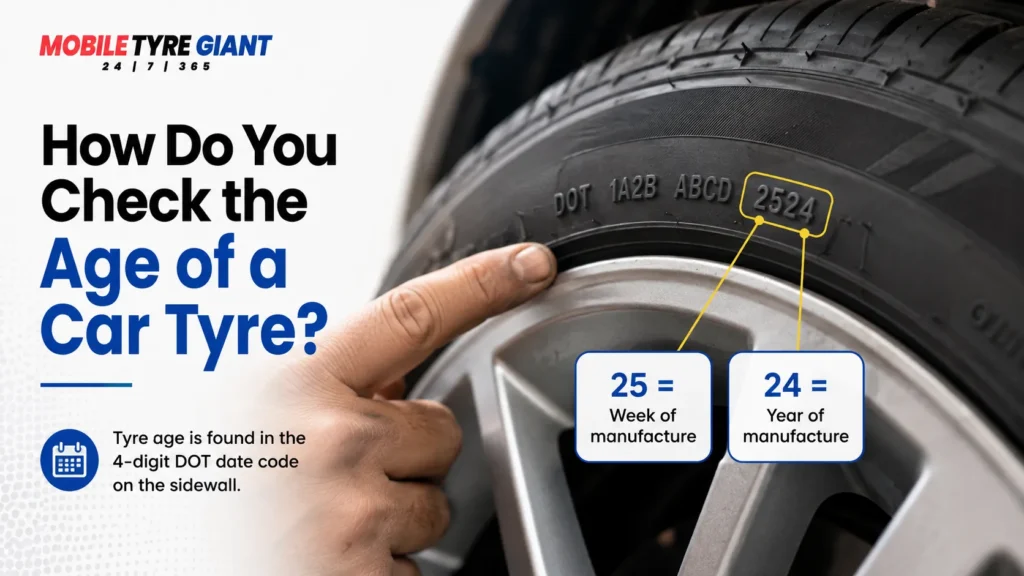
The easiest way to identify tyre age is to find the four-digit manufacture date code moulded into the sidewall. The first two digits show the week of manufacture and the final two show the year. For example, a code reading 2524 means the tyre was manufactured in the 25th week of 2024. This date tells you when the tyre was made, not when it was purchased or fitted to the vehicle. That distinction can be surprisingly important on used cars, low-mileage vehicles and tyres that spent time in storage before being sold. A tyre fitted last year could therefore have been manufactured several years earlier.
Checking this code takes only a few moments once you know what you are looking for. It is worth checking all four road tyres individually rather than assuming they are the same age, because tyres may have been replaced at different times. The spare tyre should also be checked if the vehicle carries one, especially if it has rarely or never been used. Drivers often focus on tread because it is visible and familiar, but the manufacture code adds another useful piece of information about the tyre’s history. Used together with tread depth and a visual condition check, it gives you a much clearer picture than any single measurement on its own.
Where Is the Tyre Manufacture Date Located?
The manufacture date is moulded into the tyre sidewall among the other letters, numbers and identification markings. On many tyres, it appears with or near the tyre identification information often associated with the DOT marking, but drivers should not assume it will always appear in exactly the same position. Depending on the tyre, the full date code may be easier to see on one sidewall than the other. If you cannot locate it on the outward-facing side, the marking may be on the inner side of the tyre. You should not crawl underneath an unstable vehicle or place yourself in an unsafe position simply to find the code.
The easiest approach is to inspect the tyre in good daylight and slowly scan the sidewall for a four-digit number that makes sense as a week and year. For example, 4822 would represent week 48 of 2022, while 0725 would represent week 7 of 2025. Once you understand the format, the code becomes much easier to recognise among the other sidewall markings. If the tyre is dirty, a soft cloth can help make the moulded characters more visible. When the code cannot be located confidently, a tyre professional can normally identify the relevant marking during an inspection.
How Do You Read the Four-Digit Tyre Date Code?
Reading the date code is straightforward once the number has been identified. Take 2524 as an example. The first pair, 25, tells you the tyre was manufactured during the 25th week of the year. The second pair, 24, means that year was 2024. You do not need to calculate the exact day the tyre left the factory because the weekly manufacture code is enough to establish its approximate age. This gives drivers a quick way to compare tyres on the same vehicle and spot unusually old ones.
The important thing is not to treat the code as an automatic expiry date. Its job is to tell you when the tyre was manufactured so that age can be considered alongside condition, tread, mileage, storage and manufacturer guidance. A tyre with a recent date code can still be damaged, while an older tyre may retain substantial tread because the vehicle has covered very little mileage.
Can a Tyre Be Too Old Even If It Has Plenty of Tread?
Yes, a tyre can have plenty of tread remaining and still deserve closer attention because tread depth and tyre age measure two different things. Tread tells you how much usable rubber remains on the road surface, while age gives you information about how long the tyre has existed and been exposed to storage and operating conditions. This situation is especially common on cars that cover only a few thousand miles each year. A driver might look at a tyre with 5 mm of tread and understandably assume it has years of life left, yet the manufacture date could show that the tyre is much older than expected. That does not automatically make the tyre illegal or unsafe, but it means tread depth should not be used as the only deciding factor.
Think of a low-mileage tyre as a coat that has spent years hanging beside a sunny window rather than being worn every day. It may still look thick and hardly used, but time, heat and environmental exposure can affect the material even without heavy use. Tyres can experience similar changes because rubber is exposed to temperature cycles, sunlight, ozone, moisture and repeated flexing once the car is driven. This is why tyre condition should be assessed alongside age rather than choosing one measurement over the other. Our guide on how long tyres last explains how mileage, driving conditions and maintenance can influence overall tyre lifespan. A tyre with deep tread is reassuring, but it is not a complete health certificate for the tyre.
What Happens to Car Tyres as They Age?
Tyre rubber does not remain exactly the same throughout its entire service life, even when the tyre has not covered particularly high mileage. Over time, environmental and operating conditions can contribute to changes in the rubber and other tyre components. The rate of ageing is not identical for every tyre because storage, inflation, heat, vehicle load, driving habits and exposure to sunlight can all differ considerably. A car kept outside throughout the year may experience different conditions from a weekend vehicle stored in a cool garage. This is one reason a universal calendar age cannot tell you everything about whether a particular passenger-car tyre remains suitable.
Ageing may eventually become visible through changes such as cracking, crazing or other signs of deterioration, although not every important change will necessarily be obvious from a quick glance. Drivers should therefore pay attention to how the tyre looks and behaves rather than waiting for the tread to reach the legal minimum before checking anything else. Unusual vibration, recurring pressure loss or visible changes around the tread and sidewall are all reasons to investigate further. The aim is not to make drivers nervous every time they discover an older manufacture date. Instead, tyre age should act as useful background information that encourages more careful inspection as the tyre becomes older. Regular tyre safety checks help put age into context with pressure, tread and physical condition.
Are Cracking and Crazing Always Caused by Tyre Age?
Cracking and crazing can be associated with tyre ageing, but it would be inaccurate to say that every small crack proves a tyre is extremely old. Tyres experience different environmental conditions, and factors such as sunlight, temperature, inflation and use can influence how the rubber surface changes. Fine surface crazing may look very different from a deep crack that reaches into the tyre structure. This is why judging severity from age alone is unreliable. A two or three-year-old tyre can sometimes show visible surface changes, while another older tyre may appear relatively clean from the outside.
What matters is the location, depth and extent of the deterioration rather than simply counting the number of lines visible on the sidewall. Deep cracking, exposed cords, bulges or other structural concerns require much more attention than light cosmetic markings. Drivers who are unsure should avoid poking, cutting or manipulating the tyre in an attempt to diagnose the damage themselves. A professional inspection can determine whether what looks like harmless surface ageing is actually affecting the tyre’s continued suitability. Our detailed guide to tyre sidewall damage, cuts, cracks and bulges explains the differences more clearly. The useful lesson is that cracking should trigger inspection, not an automatic conclusion based only on the tyre’s birthday.
Why Can Low-Mileage Cars Still Have Ageing Tyres?
Low annual mileage often allows tyres to keep their tread for much longer because fewer miles are being driven across the road surface. This can create the impression that the tyres are almost new when their manufacture dates tell a very different story. Second cars, classic cars, weekend vehicles and cars used mainly for short local journeys are particularly likely to reach an older age before their tread is worn down. A tyre may therefore spend several years carrying the vehicle, sitting parked and experiencing seasonal temperature changes without losing much tread. The low mileage is real, but so is the passage of time.
This explains why a car showing only 20,000 miles on the odometer does not automatically have young tyres. The tyres may even have been fitted early in the vehicle’s life and remained there because the tread never appeared close to replacement. Owners of low-mileage cars should therefore check manufacture dates rather than estimating tyre age from vehicle mileage alone. The same principle applies when buying a used vehicle that appears exceptionally clean and lightly driven. Deep tread is still valuable information, but it should sit alongside a visual inspection and the tyre’s date code. A few seconds spent reading the sidewall can reveal far more than assumptions based on mileage.
Should Car Tyres Automatically Be Replaced After Five Years?
No, five years is not a universal UK legal expiry date for tyres fitted to ordinary passenger cars. This is one of the most common points of confusion because drivers often see five-year inspection guidance online and interpret it as a legal replacement rule. Some tyre manufacturers recommend that tyres receive closer or more regular professional inspection after they have been in service for several years. That type of recommendation is intended to help identify ageing or deterioration earlier, but it should not be rewritten as “all five-year-old tyres are illegal.” Manufacturer guidance and statutory road law serve different purposes.
A five-year-old tyre could have covered high motorway mileage, while another tyre of the same age may have spent most of its life on a lightly used car. Their tread, condition and exposure could therefore be completely different even though the date code shows the same year. Drivers should follow the relevant vehicle and tyre manufacturer guidance while continuing routine checks for tread, damage and pressure. If visible deterioration develops, the condition may justify professional attention regardless of whether the tyre is four, five or eight years old. The better question is not simply “Has this tyre reached five years?” but “What does its age, condition and usage tell me together?” That approach avoids both premature replacement and the opposite mistake of keeping deteriorating tyres simply because they remain above the legal tread minimum.
What Should You Do When a Car Tyre Reaches 10 Years Old?
When an ordinary car tyre reaches ten years from its manufacture date, the first step is to avoid confusing manufacturer recommendations with the specific legal 10-year restriction discussed earlier. For a normal passenger car, reaching ten years does not automatically make the tyre illegal purely because of age. However, ten years is still a significant age for a tyre, and several tyre manufacturers advise precautionary replacement by this stage even if tread remains. The date should therefore prompt a careful review of the tyre’s condition, history and applicable manufacturer guidance. Treating the tenth birthday as irrelevant simply because the passenger-car law does not impose an automatic age ban would be just as misleading as calling every 10-year-old car tyre legally prohibited.
Imagine finding a 10-year-old tyre with 5 mm of tread and no immediately obvious damage. The remaining tread answers one question, but it does not tell you how the tyre has aged internally or what environmental exposure it has experienced over a decade. If a tyre is approaching this age, professional assessment and manufacturer recommendations become increasingly important when deciding whether it should remain in service. Where replacement is recommended, our guide on when to replace car tyres explains the other signs that can influence the decision.
Do Spare Tyres Age Even When They Are Not Used?
Yes, spare tyres still age even if they have spent most of their life untouched in the boot. Because the tread has barely contacted the road, a spare can look almost new while being considerably older than the tyres currently fitted to the car. This is particularly common on older vehicles where the original spare has remained in place for many years. The manufacture date should therefore be checked in exactly the same way as the four road tyres. Look for the four-digit date code on the sidewall and inspect the rubber for cracking, deterioration, deformation or other obvious signs that deserve attention.
A spare tyre is easy to forget because it is usually hidden until an emergency happens, which is precisely when you need confidence that it can be used. Imagine discovering a puncture late at night, opening the boot and finding a spare with deep tread but a manufacture date from more than a decade ago. That is not the moment to start investigating whether the tyre is suitable. Including the spare in routine tyre checks is a far better approach, particularly before long journeys. Age, condition, inflation and the vehicle or tyre manufacturer’s guidance should all be considered before relying on an older spare.
Can a New Tyre Already Be Several Years Old?
Yes, the manufacture date of a tyre can be earlier than the date on which you buy or fit it. Tyres may spend time in storage and distribution before eventually reaching the vehicle, which means “new tyre” and “recently manufactured tyre” do not necessarily describe the same thing. This surprises many drivers because it is natural to assume that a newly purchased tyre was also made recently. The four-digit manufacture code provides the quickest way to find out. A tyre bought in 2026, for example, could have been manufactured in an earlier year without having previously been used on a vehicle.
That does not mean every tyre manufactured some time before sale is automatically unsuitable. Storage conditions, tyre design, manufacturer guidance and physical condition all matter, so it would be wrong to create another artificial expiry rule. However, drivers who cover very little annual mileage may reasonably want to know the manufacturing date because they could keep the same tyres for many years. Checking the code before or soon after fitting helps avoid confusion later and gives you a clear starting point for monitoring tyre age. It is a simple habit that takes seconds and can be useful whenever new tyres are fitted.
Should You Check Tyre Age When Buying a Used Car?
Yes, tyre age is worth checking when inspecting a used car because the vehicle’s mileage does not tell you how old its tyres are. A low-mileage car may still be sitting on tyres fitted many years earlier, particularly if it has been used occasionally or stored for long periods. Check the manufacture date on all four tyres rather than assuming they were replaced together. One axle may have newer tyres while the other pair is significantly older. Tread depth, sidewall condition and visible damage should also be inspected separately because none of these checks replaces the others.
The spare tyre should be included where the car carries one, and it is worth looking for obvious differences between tyre brands, dates and condition across the vehicle. Tyre age alone should not become a reason to reject an otherwise good used car, but it can reveal upcoming maintenance costs that are easy to miss during a quick viewing. If the tyres are approaching an age where the manufacturer recommends closer inspection or replacement, that information can help you budget properly. A shiny bodywork finish is easy to notice, but four small date codes can sometimes tell you more about the maintenance decisions that may be coming next.
When Should an Older Tyre Be Checked or Replaced?
There is no single calendar age that answers every replacement decision for an ordinary car tyre. Instead, age should be considered alongside tread depth, visible deterioration, pressure history, vehicle use and manufacturer recommendations. Cracking, bulges, exposed cords, significant cuts, repeated pressure loss or unusual deterioration should not be dismissed simply because the tyre still has legal tread. If you are unsure whether visible changes are superficial or more serious, professional inspection is the sensible next step. The purpose of checking an older tyre is not to find an excuse to replace it, but to establish whether it remains suitable for continued use.
Where inspection confirms that replacement is required, delaying the job simply to extract a few more miles from an ageing or damaged tyre rarely makes sense. This is particularly true before long motorway journeys or when the tyre shows structural concerns. Mobile Tyre Giant can provide mobile tyre replacement at your location, which can be useful when you would rather not continue driving on a tyre you are concerned about. If you are still assessing the wider condition of your tyres, our tyre safety guide can also help you review tread, pressure and visible condition together.
Final Words: What Car Drivers Should Remember About Tyre Age
There is no fixed legal age that automatically makes an ordinary passenger-car tyre illegal simply because it has reached five, six or ten years old. The widely discussed 10-year restriction applies to defined larger goods and passenger vehicles rather than normal private cars. However, that does not make tyre age irrelevant. An older tyre must still remain roadworthy, and its tread, structure, visible condition and manufacturer guidance should all be considered. The four-digit manufacture date gives you useful context, but it should never be treated as the only measurement that matters.
The most practical approach is to check age and condition together. Deep tread does not guarantee that an older tyre has no deterioration, while a relatively young tyre can still suffer damage that requires attention. Check the manufacture date, inspect the tread and sidewalls, pay attention to MOT advisories and seek professional advice when the condition is unclear. This balanced approach avoids unnecessary panic while also avoiding the dangerous assumption that a tyre is fine simply because it has not reached a supposed legal expiry date.
Concerned About an Older Tyre?
If an older tyre is cracked, damaged or needs replacing, Mobile Tyre Giant can fit a replacement at your home, workplace or roadside.
Frequently Asked Questions
Find quick answers to the most common questions our customers ask.
No fixed maximum age automatically makes a normal passenger-car tyre illegal solely because of its manufacture date. The tyre must still meet the relevant requirements for tread, condition, suitability and roadworthiness whenever the vehicle is used.
No, a 10-year-old tyre is not automatically illegal simply because it is fitted to an ordinary passenger car. The specific 10-year restriction applies to defined larger vehicle categories, although an older car tyre must still be roadworthy.
No. The specific legal restriction on tyres aged over ten years applies to certain heavy goods and passenger-carrying vehicles in defined positions, not to ordinary private passenger cars simply because their tyres reach ten years old.
No. A normal car tyre does not automatically fail an MOT simply because it is ten years old. However, defects such as insufficient tread, serious cuts, exposed cords, bulges or other condition problems can still result in an MOT failure.
Find the four-digit manufacture date code moulded into the tyre sidewall. The first two numbers show the manufacturing week and the final two show the year, allowing you to work out approximately how old the tyre is.
A tyre date code of 2524 means the tyre was manufactured during the 25th week of 2024. The code shows when the tyre was made rather than the date on which it was purchased or fitted to the car.
Yes, an older tyre can retain significant tread when the vehicle covers low mileage. Tread depth measures wear, while tyre age and condition provide different information, so cracking, deterioration and manufacturer guidance should also be considered.
No. Five years is not a universal legal expiry point for ordinary car tyres. Some manufacturers recommend closer inspection as tyres become older, but replacement decisions should consider condition, use and the relevant manufacturer guidance rather than age alone.
Yes. A spare tyre can age despite having almost no tread wear because time and environmental conditions still affect the tyre. Check its manufacture date, inflation and physical condition before relying on it during an emergency.
Yes. Manufacture date and purchase date are different, so a tyre may have been produced some time before it is sold and fitted. Checking the four-digit sidewall date code tells you when the tyre was actually manufactured.