

SUV tyres can look similar to ordinary car tyres, but choosing the right set involves more than finding a wide tyre that fills a large wheel arch. Many SUVs are heavier, taller and capable of carrying more passengers or luggage than a typical hatchback, which changes the demands placed on the tyre. The tyre still has to provide dependable braking, steering and wet grip while supporting the vehicle’s approved load. Wheel sizes are often larger too, so small mistakes in width, profile or load rating can become expensive very quickly. A family crossover used almost entirely on tarmac may need something completely different from a large 4×4 that regularly travels across gravel, wet fields or farm tracks.
This is why SUV tyre choice should begin with the vehicle specification and the way the vehicle is actually driven. Think of it like choosing footwear for a long walk, because a comfortable road trainer and a chunky hiking boot can both fit your foot but are built for very different surfaces. The same principle applies to tyres designed for quiet motorway use, mixed terrain or serious off-road work. Size, load capacity and tread design all need to work together rather than being judged separately. Understanding those basics helps you avoid buying a tyre that looks suitably rugged but creates unnecessary road noise, poor comfort or the wrong handling characteristics for everyday driving.
Are SUV Tyres Different From Normal Car Tyres?
SUV tyres are not automatically a completely separate type of tyre from those used on ordinary passenger cars. Most modern crossovers and road-focused SUVs use the same familiar metric sizing system found on hatchbacks, saloons and estates. The important difference is that the tyre specification may be adapted to the weight, wheel size, performance and load requirements of the larger vehicle. Some models therefore use reinforced or Extra Load tyres, while others simply require a higher load index within an otherwise familiar tyre size. The correct specification depends on the exact vehicle rather than the letters SUV appearing in a tyre description.
This matters because the SUV category covers an enormous range of vehicles. A compact crossover taking children to school has very different demands from a large luxury SUV carrying five adults and luggage at motorway speeds. Add a tow bar, large wheels, four-wheel drive or regular rough-road use and the demands change again. That is why copying a tyre choice from another SUV owner can be misleading even when the vehicles appear similar in size. A better approach is to check the approved fitment first and then use a practical guide to choosing the right tyres for your car based on vehicle type, driving conditions and the performance characteristics you actually need.
What Makes a Tyre Suitable for an SUV?
A suitable tyre needs to carry the vehicle safely while providing stable behaviour during braking, cornering and sudden changes of direction. Weight is important, but it is only one part of the picture because grip, sidewall behaviour, speed rating and tyre pressure also affect how the vehicle feels. A taller and heavier vehicle can place considerable forces through the tyres when it changes direction quickly or stops hard on a wet road. The tyre therefore needs the correct construction and load capability instead of simply having an aggressive-looking tread pattern. On a road-focused SUV, predictable wet grip and motorway stability are usually far more useful than deep off-road blocks that spend almost all of their life on tarmac.
The driver’s actual routine should influence the choice as much as the shape of the vehicle. Someone covering long motorway journeys may value low road noise, stable handling and good wet braking, while a driver regularly entering muddy tracks may need stronger mixed-terrain capability. A large SUV used for towing may also place different demands on its tyres when the vehicle is loaded compared with normal solo driving. This is where the manufacturer-approved size, load index and pressure information becomes more useful than general recommendations from friends or online groups. Good SUV tyres should match the job the vehicle really performs rather than an imagined off-road lifestyle that never leaves the supermarket car park.
SUV Tyre Size Explained: What Do the Numbers Mean?
The tyre size printed on an SUV sidewall may look something like 235/55 R19 105W XL, and every part of that code provides useful information. The number 235 represents the nominal tyre width in millimetres, while 55 describes the sidewall height as a percentage of that width. The letter R indicates radial construction, and 19 means the tyre is designed to fit a 19-inch wheel. After the main dimensions come the load index and speed rating, which are just as important as the physical size. If XL appears at the end, it indicates Extra Load construction, but that marking should only be used according to the requirements approved for the vehicle.
Drivers sometimes remember only the first three parts, such as 235/55 R19, and assume any tyre carrying those dimensions will be suitable. That can be a mistake because two tyres with identical width, profile and rim diameter can still have different load or speed capabilities. SUV fitments can also differ between trim levels, engine versions and wheel packages, so the tyres already on a used vehicle should not automatically be treated as proof of the correct original specification. The safest starting point is the vehicle handbook, tyre placard or manufacturer-approved fitment information. Our detailed correct tyre size guide explains how width, profile, wheel diameter, load index and speed rating work together when identifying a replacement.
Why Correct Tyre Size Matters More Than Simply Filling the Wheel Arch
Large wheels are a common feature on modern SUVs, and that can tempt drivers to think mainly about appearance when replacing tyres. A wider tyre or lower profile may look more purposeful, but changing dimensions can alter rolling circumference, steering response, ride comfort and clearance around the suspension or wheel arch. The vehicle’s electronic systems are also calibrated around approved wheel and tyre combinations, so unnecessary size changes should not be treated like choosing a different style of shoe. Even when a different tyre physically mounts on the wheel, that does not automatically make it suitable for the vehicle. Correct sizing is about maintaining the relationship between the wheel, tyre, suspension and road rather than simply avoiding visible rubbing.
The issue becomes even more important on four-wheel-drive and all-wheel-drive SUVs because differences in rolling circumference can affect how the drivetrain sees wheel speeds. Tyre wear itself can create small circumference differences, which is one reason replacement decisions on these vehicles deserve more thought than simply fitting whatever is available. Front and rear tyres may also be different sizes on some performance SUVs, so assuming all four corners should always carry identical dimensions can be wrong. When replacing a tyre, check the full marking rather than reading only the rim diameter or tyre width. A few seconds spent confirming the specification can prevent poor handling, unnecessary wear and the frustration of discovering that a brand-new tyre was never the correct fitment in the first place.
SUV Tyre Load Index Explained: Why Weight Matters
The load index tells you how much weight a tyre is designed to support under specified conditions, and it is particularly important on an SUV. These vehicles can be heavier than ordinary passenger cars and may regularly carry several people, luggage, sports equipment or towing loads. That extra weight has to pass through four relatively small patches of rubber where the tyres meet the road. If the tyres do not have the correct load capability, simply matching the width and wheel diameter is not enough. The vehicle may still look perfectly normal when parked, but the tyres can be working outside the specification intended for safe braking, cornering and motorway driving.
Load index is shown as a number on the tyre sidewall, usually beside the speed rating. A larger number represents a greater rated carrying capacity, but drivers should not simply choose the highest number available and assume it is better. The correct figure should match or exceed the approved requirement for the particular SUV and tyre fitment. Front and rear axle loads can also differ, especially when the vehicle is carrying passengers, luggage or towing equipment. This is why the tyre placard, handbook or manufacturer-approved fitment information should be checked before replacement. Load capacity is a safety specification first, not a performance feature that should be guessed from the size of the vehicle.

Load Index, XL and HL Tyres: What Is the Difference?
Load index, XL and HL are related to tyre load capability, but they do not mean exactly the same thing. The load index is a numerical code showing the rated load capability of that particular tyre. XL stands for Extra Load and identifies a reinforced tyre construction designed to carry greater loads than a comparable standard-load tyre when used at the appropriate pressure. HL means High Load and is used on certain tyres that provide still greater carrying capability for vehicles where additional load support is required. These markings can appear on heavier SUVs, electric SUVs and other vehicles with demanding axle loads.
Drivers sometimes see XL on their existing SUV tyres and assume every replacement must simply have the letters XL somewhere on the sidewall. The better approach is to check the complete approved specification because size, load index, speed rating and construction all work together. A tyre with an XL marking can still be unsuitable if its other ratings do not match the vehicle. Likewise, a tyre should not be upgraded to a different construction without confirming that the fitment is appropriate. The table below separates the terms so they are easier to understand when comparing SUV tyres.
Tyre Term | What It Means | What SUV Drivers Should Check |
Load Index | Numerical code for tyre load capability | Must meet the approved vehicle requirement |
Standard Load | Conventional passenger-tyre construction | Suitable only where approved for the SUV |
XL | Extra Load reinforced construction | Check load index and required pressure as well |
HL | High Load construction for greater load demands | Use only where suitable for the vehicle |
Speed Rating | Letter showing rated speed capability | Must also meet the approved specification |
How Passengers, Luggage and Towing Change Tyre Demands
An SUV that feels lightly loaded during the working week can become a very different vehicle once a family, suitcases and holiday equipment are added. The suspension sits under more weight, the tyres carry a greater load, and braking or cornering places more demand on the contact patches. Roof boxes and equipment can add further weight, while towing introduces additional forces at the rear of the vehicle. That does not mean a correctly specified SUV suddenly needs different tyres every time it is loaded. It means the tyres already fitted must have sufficient approved capacity and be maintained according to the vehicle’s loaded-use recommendations.
This is particularly important before long motorway journeys, where the tyres may spend hours carrying a full vehicle at sustained speed. Check the vehicle’s maximum permitted loads rather than estimating how much luggage seems reasonable by eye. If the manufacturer provides separate tyre-pressure settings for normal and fully loaded driving, use the setting appropriate to your situation. Do not assume that adding extra pressure beyond the recommended loaded figure creates additional safety. Excessive pressure can change ride quality and the way the tyre contacts the road. The safest setup is the manufacturer’s approved load and pressure combination for the journey you are actually making.

Why Tyre Pressure Matters When an SUV Is Heavily Loaded
Tyre pressure helps the casing support the vehicle correctly, which makes it especially important when an SUV carries more passengers or luggage than usual. An underinflated tyre flexes more as it rolls and can generate additional heat, while the vehicle may feel less precise through bends or during sudden direction changes. Wear can also become concentrated in the wrong areas of the tread if pressure remains incorrect for a long period. On a heavy SUV, those effects can become more noticeable because the tyre is already carrying a substantial load. The correct pressure is therefore not a generic figure that applies to every SUV or even every journey.
Many vehicles list different pressures for light and fully loaded conditions, often on a label around the driver’s door opening, fuel-filler area or in the handbook. Check the tyres when they are cold because driving heats the air inside and temporarily increases the reading. If you are unsure about the process, this guide explains how to check tyre pressure correctly and where to find the vehicle’s recommended values. Do not use the maximum pressure printed on the tyre sidewall as the normal operating pressure for the vehicle. The sidewall marking and the vehicle manufacturer’s recommended pressure serve different purposes. Correct inflation helps the tyre carry its load as intended while supporting predictable braking, steering and tread wear.
Does an SUV Need Different Tyre Pressure When Fully Loaded?
It may, depending on the vehicle. Many SUVs have one recommended pressure for normal everyday use and another for situations involving several passengers, heavy luggage or sustained loaded driving. The rear tyres may require a different pressure from the front because the distribution of weight changes when the boot is full or a trailer is attached. This is why copying the same PSI into all four tyres is not always correct. The required values depend on the vehicle, wheel and tyre combination rather than simply whether it is classed as an SUV.
Before a long family trip, check the pressures while the tyres are cold and compare them with the loaded figures supplied for that specific vehicle. Once the trip is over and the SUV returns to normal use, check whether the manufacturer advises returning to the standard pressure setting. TPMS can warn about significant pressure loss, but it should not replace manual checks before carrying a heavy load. A tyre can be at the wrong pressure for the journey without immediately producing a dashboard warning. Regular pressure, tread and condition checks form part of sensible tyre safety and become even more important when the vehicle is carrying extra weight.
SUV Speed Ratings Still Matter, Even If You Never Drive Fast
Speed rating is easy to overlook because many drivers assume it only matters to people driving at very high speeds. In reality, the rating forms part of the tyre’s overall specification and relates to its tested capability under particular load and operating conditions. An SUV tyre therefore needs the correct speed rating even if the vehicle spends most of its life in city traffic or on UK motorways. Choosing a lower-rated tyre simply because you never intend to approach its maximum rated speed is not a sensible shortcut. The vehicle was designed and approved around tyres with particular capabilities, and replacement tyres should respect those requirements.
The speed-rating letter normally appears immediately after the load index, which is why both should be read together rather than separately. For example, two tyres can share exactly the same physical size but have different load and speed ratings. That difference may make one appropriate for a particular SUV while the other is not. Drivers should therefore avoid shopping by tyre dimensions alone, especially on heavier or higher-performance SUVs. Check the complete sidewall code against the approved fitment before making a replacement decision. Size tells you whether a tyre fits the wheel, but load and speed ratings help tell you whether it is designed to do the job the vehicle requires.
Road Tyres vs All-Terrain Tyres: Which Is Better for an SUV?
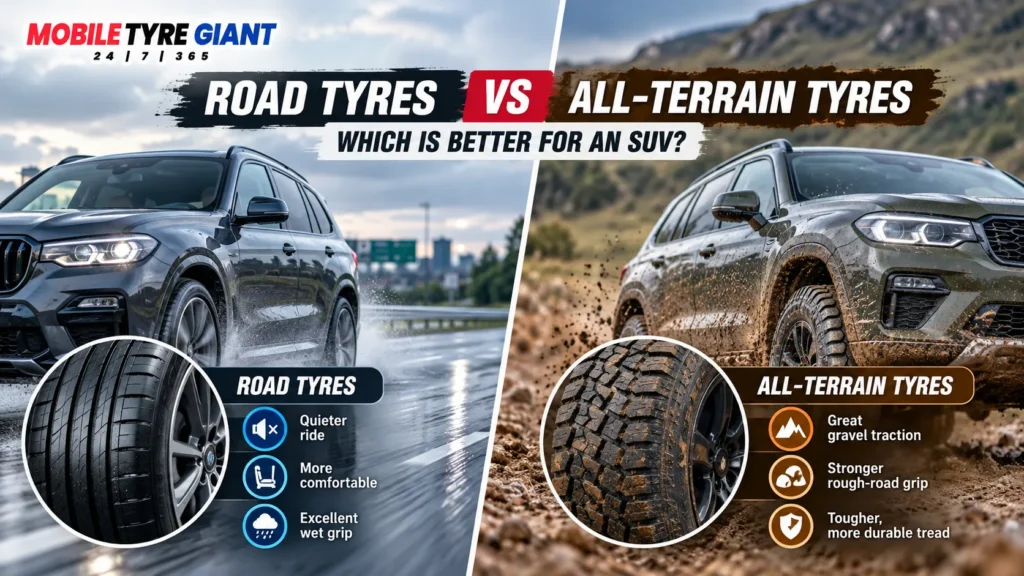
The best SUV tyre depends less on how rugged the vehicle looks and more on where it actually spends its time. A road-focused SUV that handles school runs, commuting and motorway journeys usually benefits from tyres designed primarily for tarmac. These tyres tend to prioritise wet grip, steering response, lower road noise and more predictable braking on paved surfaces. All-terrain tyres use a more aggressive tread pattern to improve traction on gravel, mud and rough ground, but that extra capability can come with compromises on normal roads. They may produce more noise, feel less refined and use more energy than a comparable road-oriented tyre. A driver who only leaves tarmac a few times a year may therefore gain very little from fitting an aggressive mixed-terrain pattern.
All-terrain tyres make more sense when the SUV genuinely sees regular unpaved use, such as farm tracks, construction sites, gravel roads or muddy access routes. The larger tread blocks and stronger-looking construction are designed to deal with loose surfaces where a smooth road tyre can struggle for traction. However, the correct tyre still needs the approved size, load index and speed rating for the vehicle. Off-road appearance should never replace those basic fitment checks. If most journeys involve wet UK roads and motorways, a high-quality road tyre may deliver a better overall balance of comfort, braking and stability. Matching the tyre to the real journey prevents the vehicle from carrying unnecessary compromises every day.
How Motorway Driving Changes What You Need From SUV Tyres
Motorway driving places different demands on SUV tyres because the vehicle may spend long periods travelling at steady speed while carrying substantial weight. Stability becomes especially important because taller vehicles can feel more sensitive to crosswinds, lane changes and sudden steering corrections. The tyre needs to maintain a consistent contact patch while also dealing with heat generated during sustained driving. Low road noise becomes more noticeable on long journeys too, especially when passengers are sitting in the vehicle for several hours. A tyre that feels acceptable around town can become tiring if it produces a constant hum on coarse motorway surfaces. Wet motorway conditions add another challenge because standing water can reduce grip quickly when speed remains high.
Before a long journey, check tread depth, pressure and visible tyre condition rather than waiting for a dashboard warning. Uneven wear can reduce the amount of usable tread even when one part of the tyre still looks healthy. A proper inspection across the full width of the tread is therefore more useful than glancing at the outer shoulder. This guide on how to check tyre tread explains practical ways to measure tread and spot uneven wear before a longer trip. If the SUV is heavily loaded, compare the tyre pressure with the manufacturer’s loaded-use recommendation as well. Good motorway performance starts before the vehicle joins the carriageway, because small tyre problems become more serious when speed, distance and vehicle weight all increase together.
Why Wet Grip Matters So Much on SUV Tyres
Wet grip should be a major consideration when choosing SUV tyres for UK road use. SUVs are often heavier than smaller cars, which means the tyres may have more mass to control during braking and sudden changes of direction. Rain can reduce the amount of grip available, especially when water collects on polished road surfaces or motorway lanes. Tread grooves help move water away from the contact patch so the tyre can maintain contact with the road. If the tread is too worn or the tyre design is poorly suited to wet conditions, braking distances and steering confidence can deteriorate. This is why an aggressive-looking tread does not automatically mean strong wet-road performance.
Drivers should look at the tyre’s wet-grip rating alongside other important characteristics rather than choosing based on price or appearance alone. A tyre designed mainly for dry performance may behave differently in heavy rain from one developed around all-weather road use. Tyre pressure also matters because incorrect inflation can change the shape of the contact patch and affect how the tread meets the surface. Worn tyres deserve particular attention because their ability to clear water usually reduces as tread depth falls. Heavy SUVs can make that loss of confidence feel more noticeable under braking or through fast bends. Wet grip is therefore not a minor specification on a label, but a practical safety factor for everyday road driving.
What Happens When SUV Tyres Wear Unevenly?
Uneven wear can appear in several forms, and the pattern often gives clues about what needs checking. Wear concentrated on one edge may be associated with alignment problems, while wear across both shoulders can be linked with running the tyre underinflated for too long. Excessive centre wear can occur when the tyre spends significant time overinflated, although real-world causes can be more complex. Patchy wear or vibration may also point towards balancing or suspension issues. On a heavy SUV, these problems can become expensive quickly because large tyres are often costly to replace. Ignoring the pattern and fitting new tyres without investigating the cause can lead to the same wear returning.
Drivers should pay attention to how the vehicle feels as well as how the tread looks. A steering wheel that shakes at certain speeds, a vehicle that pulls to one side or a humming vibration can indicate that the tyres or wheels need attention. In cases where imbalance is suspected, mobile wheel balancing can help correct uneven weight distribution around the wheel and tyre assembly. Alignment, pressure and suspension condition should also be considered where the wear pattern points in those directions. The aim is to understand why the tyre is wearing abnormally rather than simply replacing it earlier than expected. Correcting the cause protects the next set of tyres and helps the SUV feel more stable on the road.
How Driving Style Affects SUV Tyre Wear and Road Performance
Driving style can have a noticeable effect on SUV tyre life because a heavier vehicle places more force through the tread during acceleration, braking and cornering. Hard acceleration asks the tyres to transfer more torque to the road, while heavy braking creates high loads through the contact patch. Fast cornering can increase wear on the outer shoulders, especially if tyre pressure or alignment is already slightly wrong. Frequent kerb impacts and potholes can also damage tyres or knock wheel alignment out of specification. The effect may be gradual, which is why drivers sometimes notice the wear only when the tread is already uneven. Smooth inputs can reduce unnecessary stress without making the vehicle slow or difficult to drive.
Road type makes a difference too because rough urban roads, long motorway journeys and rural tracks all challenge tyres in different ways. A vehicle covering high mileage on smooth motorways may wear tyres evenly but accumulate tread loss quickly simply through distance. An SUV used mainly in towns may experience more kerb contact, potholes and repeated braking. Mixed-terrain use adds cuts, stones and sidewall impacts that normal road tyres may not encounter as often. Regular inspections are therefore more useful than relying on a single mileage figure for replacement. Practical habits such as maintaining pressure, avoiding repeated hard inputs and checking for unusual wear can help make tyres last longer without compromising normal driving.
When Should You Reconsider the Type of SUV Tyre You Use?
If your driving pattern changes, the tyre that once suited the vehicle may no longer be the best choice. Someone who previously used an SUV almost entirely in town may begin towing, travelling long distances or using unpaved roads more regularly. In that situation, the priorities may shift from quiet road comfort towards stronger load capability, durability or mixed-terrain traction. The opposite can happen too, where a vehicle fitted with aggressive all-terrain tyres is later used almost exclusively on motorways. Keeping the same tyre type out of habit may mean accepting unnecessary noise or reduced refinement. Tyre choice should reflect current use rather than the way the vehicle was driven several years ago.
The best time to reconsider is usually when replacement is already due, because that allows you to compare options without wasting usable tread. Start with the approved size and load requirements, then think about road surface, mileage, weather exposure and how often the vehicle carries heavy loads. If most driving is on tarmac, a road-focused SUV tyre is usually the more sensible starting point. If regular off-road or rough-track use is genuinely part of the vehicle’s routine, an all-terrain design may make more sense. The goal is not to fit the most aggressive or expensive tyre available. It is to choose the tyre that best matches the SUV’s real workload, road conditions and safety requirements.
How to Choose Replacement Tyres for an SUV
Choosing replacement SUV tyres should begin with the full approved specification rather than the tyre’s appearance, price or tread pattern. Check the width, profile, wheel diameter, load index, speed rating and any XL or higher-load requirement before comparing different options. After that, consider how the SUV is actually used because a vehicle covering mostly motorways needs a different balance from one that regularly travels over gravel or muddy tracks. Wet grip, road noise, ride comfort and durability should all influence the decision. A heavy SUV carrying passengers and luggage regularly also needs tyres capable of handling that load without compromising stability. The best replacement is therefore not automatically the most expensive or the most rugged-looking tyre available.
It is also worth checking all four tyres before deciding what needs replacing. Look at tread depth, visible damage and the way each tyre has worn because those details can reveal pressure, alignment or suspension problems that should be addressed first. Some SUVs use different tyre sizes on the front and rear axles, while certain all-wheel-drive systems can be sensitive to large differences in rolling circumference. That makes it important to think about the set as a whole rather than treating every tyre as an isolated component. If the correct specification is available but you cannot safely reach a garage, mobile tyre replacement can provide a practical option at home, work or roadside. The priority should always be restoring the vehicle with a tyre that suits both its technical requirements and everyday use.
Should You Replace One SUV Tyre or More Than One?
Replacing only one SUV tyre may be possible in some situations, but the condition of the other tyres matters. If the remaining tyre on the same axle has plenty of tread and matches the required size and specification, a single replacement may be reasonable after proper assessment. A very large difference in tread depth, tyre construction or overall diameter can change how the vehicle behaves, particularly on wet roads. All-wheel-drive and four-wheel-drive vehicles may deserve extra attention because their drivetrains can respond differently when the rolling circumference varies significantly between wheels. The vehicle manufacturer’s guidance should therefore be checked rather than assuming the same replacement rule applies to every SUV.
Replacing tyres in pairs can sometimes provide more consistent grip and behaviour across an axle, especially when the existing tyre is already heavily worn. However, replacing two tyres simply because a vehicle is an SUV is not automatically necessary. The correct decision depends on tread depth, tyre condition, drivetrain design and the manufacturer’s requirements. If one tyre has suffered impact damage, inspect the opposite tyre and wheel as well because both may have experienced the same pothole or road hazard. The aim is to maintain balanced grip and predictable handling rather than buying more tyres than the vehicle genuinely needs.
When Should SUV Tyres Be Replaced?
SUV tyres should be replaced when they are worn beyond a safe limit, damaged beyond repair or no longer suitable for the vehicle’s operating conditions. Tread depth is one obvious factor, but cuts, bulges, cracking, exposed cords and serious sidewall damage can make replacement necessary even when plenty of tread remains. A tyre that repeatedly loses pressure should also be inspected rather than simply being topped up every few days. Impact damage from potholes or kerbs can affect internal construction without producing an immediate flat tyre. On a heavier SUV, ignoring those signs can create unnecessary risk because the tyre continues carrying a substantial load.
Age and condition should be considered together rather than relying on mileage alone. An SUV that covers relatively few miles may still develop cracked or hardened tyres if it spends years parked outside, while a high-mileage motorway vehicle may wear through its tread much sooner. Uneven wear is another warning sign because replacing the tyre without finding the reason can lead to the new one wearing in exactly the same way. Pressure, alignment, balancing and suspension condition should therefore be checked where the tread pattern looks abnormal. A replacement decision should be based on the tyre’s real condition and performance rather than waiting for a fixed mileage figure.
Can SUV Tyres Be Fitted at Home or Roadside?
SUV tyres can often be fitted at home, work or roadside when suitable equipment and safe working space are available. Larger wheels and heavier vehicles make correct lifting points, wheel handling and fitting procedures especially important. The replacement tyre still needs to match the approved size, load index and speed rating, and pressure should be set according to the vehicle manufacturer’s guidance after installation. TPMS sensors should also be considered when the vehicle uses them because a warning light may need to clear or the system may require relearning after tyre work. Proper fitting is about more than mounting rubber onto a wheel.
For drivers dealing with a damaged tyre away from a garage, mobile tyre fitting can reduce the need to continue driving on a tyre that may already be unsafe. Providing the full tyre size and vehicle details before the fitter arrives helps ensure the correct replacement is brought to the vehicle. After fitting, monitor tyre pressure, steering feel and vibration during the first journeys. A new tyre may feel slightly different from a heavily worn one, but strong pulling, persistent vibration or warning lights should not simply be ignored. The SUV should leave the fitting with the correct specification and predictable road behaviour.
Final Words: Choose SUV Tyres for the Vehicle and the Roads You Actually Use
SUV tyres have to balance size, load capacity, road grip, comfort and durability, which is why choosing them by appearance alone rarely makes sense. The correct tyre begins with the approved dimensions, load index and speed rating, followed by the construction required for that particular vehicle. Road use then determines which characteristics deserve the most attention. A motorway-focused SUV may benefit from quiet, stable road tyres, while a vehicle regularly travelling over rough tracks may need stronger mixed-terrain capability. Neither option is automatically better because the right tyre is the one that matches the work the SUV genuinely performs.
Regular pressure checks, tread inspections and attention to uneven wear help those tyres perform as intended once they are fitted. Extra passengers, luggage or towing can increase the demands placed on the tyres, so loaded-use recommendations should not be overlooked. Drivers should also avoid assuming every SUV needs XL tyres, all-terrain tread or oversized wheels simply because those choices look appropriate for a larger vehicle. Start with the approved specification, consider how the vehicle is used and then choose the tyre that gives the right balance of wet grip, stability, comfort and durability. That approach keeps the decision practical, safe and easier to justify.
Need the Right Tyres for Your SUV?
Get SUV tyres matched to the correct size, load rating and road use, with mobile fitting wherever you need it.
Frequently Asked Questions
Find quick answers to the most common questions our customers ask.
SUVs do not automatically require a completely separate category of tyre, but many models need tyres with specific size, load and speed ratings suited to their weight and performance. Some use reinforced or Extra Load constructions, while others can use conventional passenger-style tyres that meet the approved specification. Always check the requirements for the exact vehicle rather than choosing a tyre simply because it is marketed for SUVs.
They can be. SUV tyres may use higher load ratings, reinforced construction or tread designs intended for heavier vehicles and different road conditions. However, modern crossovers often use tyre technology similar to ordinary passenger cars. The important differences are the approved size, load capacity, speed rating and intended road use rather than the SUV label alone.
XL means Extra Load and indicates that the tyre uses reinforced construction designed to carry a greater load than a comparable standard-load tyre when used correctly. It does not mean the tyre is automatically suitable for every SUV. The tyre's size, load index and speed rating must still match the vehicle's approved specification.
No. Some SUVs require XL tyres because of their weight and axle loads, while others use different approved tyre constructions. The requirement depends on the specific vehicle, wheel size and manufacturer specification. Fitting XL tyres simply because the vehicle is large is not a reliable substitute for checking the correct fitment.
A passenger-car-style tyre may be suitable for some crossovers or road-focused SUVs if it meets the vehicle's approved size, load index, speed rating and construction requirements. A tyre should never be chosen simply because the dimensions fit the wheel. Load capability is particularly important on heavier SUVs.
Not necessarily. All-terrain tyres are useful for regular gravel, mud or rough-track driving, but they can bring additional road noise and different handling characteristics on tarmac. An SUV used almost entirely on normal roads will often be better suited to road-focused tyres designed for wet grip, comfort and motorway stability.
The correct pressure depends on the specific SUV, tyre size and vehicle load. Many vehicles provide separate recommendations for normal driving and fully loaded conditions. Use the manufacturer's stated cold-tyre pressure rather than the maximum pressure printed on the tyre sidewall or a generic value found online.
Not automatically. SUV weight can increase tyre load, but tread life also depends on pressure, alignment, driving style, tyre compound, road conditions and mileage. A well-maintained SUV driven smoothly may achieve even tyre wear, while poor pressure or alignment can shorten tyre life regardless of vehicle type.
Sometimes, but the remaining tread depth, axle setup and drivetrain should be considered first. Large differences in tread depth or rolling circumference may affect grip and can be particularly important on some all-wheel-drive systems. Check the vehicle manufacturer's guidance and the condition of the other tyres before replacing only one.
Check the complete tyre size, load index, speed rating and any XL, HL or reinforced requirement first. Then consider wet grip, road noise, expected road use and whether the SUV frequently carries heavy loads or travels off-road. Inspect the existing tyres for uneven wear as well, because fitting new tyres without addressing the cause can lead to the same problem returning.