

A loose wheel does not always announce itself with an obvious mechanical failure. You may first notice a faint vibration through the steering wheel, a dull knock when braking, or a wobble that was not there yesterday. These symptoms are easy to dismiss because tyre imbalance, damaged tyres, wheel bearings and suspension problems can sometimes feel similar from behind the wheel. The important point is that loose wheel nuts affect wheel security, so they deserve prompt attention rather than guesswork. A driver who keeps increasing speed just to see whether the vibration becomes worse may be turning a warning sign into a more serious problem.
Think of the wheel like a heavy door held firmly against its frame by several secure fixings. If those fixings begin losing their clamping force, small movements can become increasingly noticeable as the car accelerates, brakes or changes direction. That does not mean every clicking sound or steering shake confirms a loose wheel, but sudden changes should never be ignored. The safest response is to notice the pattern, reduce unnecessary driving and have the wheel security checked if there is genuine concern. This is especially important when the symptoms begin shortly after tyre, brake or other work that required the wheel to be removed.
What Are the Warning Signs of Loose Wheel Nuts?
The warning signs can vary depending on how much movement is occurring and which wheel is affected. Common reports include new vibration, wheel wobble, steering shake, clicking, knocking, clunking and a car that suddenly feels less settled on the road. You may also notice a wheel nut or bolt sitting differently from the others, or discover that one fastener is missing completely. Sometimes the symptoms are subtle at first and become more obvious during braking, cornering or acceleration. The problem is that several other faults can create similar sensations, which is why diagnosis should not rely on a single symptom.
What matters most is a change from the vehicle’s normal behaviour. If your car was smooth yesterday but suddenly feels as though one corner is trembling or knocking today, that change deserves attention. Recent tyre or brake work makes the timing particularly useful because the wheel may have been removed during the job. However, recent workshop work does not automatically prove that anything was fitted incorrectly. A professional inspection should consider wheel security alongside tyre condition, balancing, bearings and other possible causes.
Warning sign | What the driver may notice | Why it matters |
Vibration | Shaking through the steering wheel, seat or body | May indicate wheel movement or another wheel-related fault |
Wheel wobble | Vehicle feels less stable or one corner feels unusual | Needs prompt investigation |
Clicking or clunking | Repetitive metallic noise as the wheel rotates | Can suggest unwanted movement around the wheel assembly |
Steering change | Car feels less planted or steering feedback changes | May indicate a wheel, tyre or suspension problem |
Loose or missing fastener | One nut or bolt looks different or is absent | Wheel security needs checking |
Symptoms after wheel work | Noise or vibration begins after tyre or brake work | Recent wheel removal is diagnostically relevant |
Vibration or Wheel Wobble That Starts Suddenly
Vibration is one of the symptoms drivers most commonly associate with a wheel problem, but it needs careful interpretation. You may feel shaking through the steering wheel, a buzzing sensation through the floor, or a repeated tremor through the seat as road speed increases. Loose wheel nuts can allow unwanted movement between the wheel and its mounting surface, which can produce vibration or wobbling. The sensation may feel alarming because the car can suddenly seem less planted than it normally does. However, vibration alone does not prove that the fasteners are responsible.
An unbalanced wheel can also create strong vibration, especially at particular road speeds, which is why comparing symptoms matters. If the fasteners are found to be secure but vibration remains, mobile wheel balancing may be the next relevant check rather than continuing to blame the wheel nuts. Tyre damage, a bent wheel, worn bearings and suspension faults can also produce shaking that feels surprisingly similar from inside the cabin. The safest approach is to treat new vibration as evidence that something needs inspection, not as a complete diagnosis. If the wobble becomes severe or the vehicle feels difficult to control, do not keep driving merely to gather more clues.
Clicking, Clunking or Knocking From One Wheel
A new sound from one corner of the vehicle can be an important clue because moving wheel components often produce noise before the driver understands what is happening. The sound may be a light click at low speed, a deeper clunk while braking, or a repetitive knock that appears to follow wheel rotation. Some drivers describe it as if a small metal object is moving somewhere behind the wheel, especially when the vehicle changes direction. Loose wheel nuts are one possible cause because movement around the wheel and fasteners can create repeated contact under changing loads. The sound may become easier to notice with the windows open or when driving slowly beside a wall where the noise reflects back toward the car.
Still, a clunk does not automatically mean that the wheel fasteners are loose. Brake components, suspension joints, driveshaft parts and damaged tyres can create their own clicks and knocks. Pay particular attention when the sound appears together with vibration, wobble or symptoms that began after the wheel was removed. That combination gives a technician more useful information than simply saying the car “sounds strange.” Do not repeatedly accelerate, brake hard or corner sharply just to reproduce the noise, because deliberately stressing an uncertain wheel is not a sensible diagnostic method.
Steering Suddenly Feels Unstable or Different
Drivers know the normal feel of their own car better than they often realise. A steering wheel that suddenly shakes, feels unusually light, wanders or requires constant correction is therefore difficult to ignore. When a wheel is not behaving normally, the vehicle can feel as though it is floating slightly rather than tracking cleanly along the road. In more noticeable cases, the instability may become clearer during braking or when changing direction. These sensations can occur alongside other warning signs of loose wheel nuts, but steering behaviour on its own cannot tell you exactly which component is responsible.
Wheel imbalance, alignment problems, tyre damage, suspension wear and steering faults all belong on the list of possible causes. The useful clue is a sudden change, particularly when nothing similar was present before recent tyre or brake work. If the steering becomes progressively worse during the same journey, continuing simply because the vehicle still moves is a poor risk calculation. Find a safe place to stop and reassess the situation rather than waiting for the steering to become dramatically unstable. A vehicle does not need to become uncontrollable before a wheel-related symptom deserves professional attention.
A Wheel Nut, Bolt or Fastener Looks Loose or Is Missing
Sometimes the warning is visual rather than something you feel from the driver’s seat. One fastener may appear to sit farther out than the others, a nut may be missing completely, or there may be obvious marks suggesting movement around the wheel holes. A loose-looking wheel fastener deserves attention even when the vehicle has not yet developed noticeable vibration or noise. The remaining fasteners should not be treated as an automatic guarantee that normal driving is safe. Wheel security depends on the complete assembly working as intended.
Visual checks should also be carried out sensibly. Do not stand beside fast-moving traffic, crouch next to an exposed wheel on a motorway lane, or place yourself in danger just to inspect a nut more closely. If the vehicle is already somewhere safe, look for obvious differences between the fasteners without attempting a roadside mechanical investigation you are not equipped to perform. Where wheel security is uncertain and the car should not be moved unnecessarily, a mobile tyre fitting service can provide a more practical route to professional inspection. The goal is to confirm what is wrong without creating another safety problem in the process.
Symptoms Started After Tyre, Brake or Wheel Work
The timing of a new symptom can be one of the most useful pieces of information you give a technician. If vibration, knocking or wobbling appears soon after tyre replacement, brake servicing, a puncture repair involving wheel removal, wheel rotation or alloy replacement, make a note of when the change started. Loose wheel nuts should be considered among the possible causes because the wheel has recently been removed and refitted. That does not mean the previous technician definitely made a mistake, and the article should not encourage drivers to jump immediately to that conclusion. The issue could still be balancing, a tyre problem or another mechanical fault that happened to become noticeable at the same time.
What matters is that you do not dismiss a new symptom simply because the vehicle has just come back from professional work. A freshly fitted tyre should not require you to accept strong knocking, severe wobbling or a steering wheel that suddenly shakes as normal behaviour. If the vehicle becomes unsafe or cannot reasonably continue its journey, the distinction between routine and urgent assistance becomes important, which is explained further in the guide to same-day vs emergency mobile tyre fitting. Keep the description simple when requesting help: explain what you feel, what you hear, when it started and whether the wheel was recently removed. Those details give the technician a much better starting point than trying to diagnose the entire problem yourself.
What Should You Do If You Suspect Loose Wheel Nuts?
If you genuinely suspect a wheel is loose, the first priority is not diagnosing the exact cause while driving. Reduce your speed smoothly, avoid sudden steering inputs where possible, and move toward a safe stopping place. Do not accelerate just to see whether the vibration gets worse, because that tells you very little and may place more load on a wheel that is already moving abnormally. Once you are safely stopped, think about what changed before the symptom appeared, such as recent tyre fitting, brake work, wheel removal or a sudden impact. Those details are useful when the vehicle is inspected.
The safest response depends on how serious the symptoms are, but uncertainty about wheel security should never be treated casually. Strong wobbling, increasing vibration, visible wheel movement or more than one loose or missing fastener are reasons to avoid continuing normal driving. Even if the car still appears capable of moving, that does not prove the wheel is securely clamped against the hub. If the vehicle should not be driven to a tyre centre, arranging professional help at the vehicle can be more sensible than testing it on the road. The aim is to stop a small warning from developing into wheel, stud or hub damage.
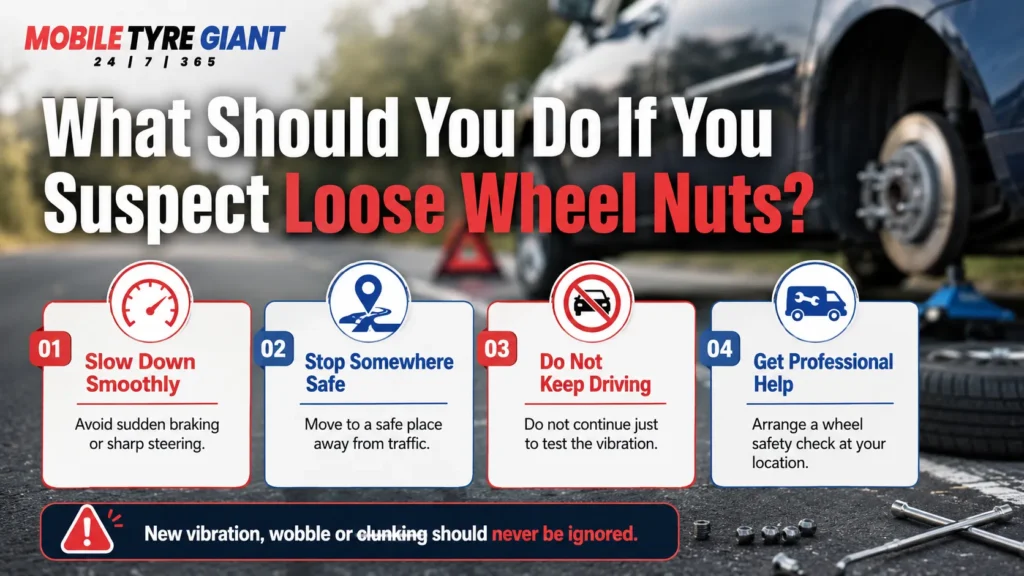
Slow Down Smoothly and Avoid Sudden Movements
When a wheel-related problem appears while driving, instinct may tell you to brake sharply or make an immediate steering correction. That can make the vehicle feel even more unsettled, especially if one wheel is already behaving differently from the others. Ease off the accelerator and reduce speed in a controlled way while keeping the steering as smooth as the road conditions allow. If traffic around you is heavy, concentrate first on reaching a safer position rather than trying to identify which wheel is making the noise. Mechanical diagnosis can wait until the vehicle is no longer moving.
Smooth inputs also make it easier to notice whether the vibration is changing without deliberately stressing the car. A loose wheel may react differently under acceleration, braking or cornering, but there is no benefit in intentionally repeating those conditions to “test” the fault. If the steering begins shaking more strongly or a clunk becomes heavier, treat that as a reason to stop rather than as useful evidence to keep driving. The same applies if the car suddenly feels as though one corner is moving independently from the rest of the vehicle. A short delay to stop safely is better than gambling on the remaining distance.
Stop Somewhere Safe Before Inspecting the Wheel
Where you stop matters just as much as how quickly you stop. A driveway, car park, service area, lay-by or another location away from moving traffic gives you far more room to assess the situation safely. Do not stand in a live traffic lane or crouch beside a wheel where passing vehicles place you at risk. If you are on a fast road and cannot safely inspect the vehicle, the correct priority is personal safety rather than getting a close look at the wheel nuts. Once the car is secure, you can check for obvious signs such as a missing fastener or a nut sitting differently from the others.
A visual inspection can provide clues, but it is not a substitute for a proper wheel-security check. A fastener may look normal while still being incorrectly torqued, and a wheel may already have moved enough to damage its mounting holes or hardware. If the car is safely parked but you are unsure whether it should be driven further, a mobile tyre fitting service can avoid unnecessary travel. This is particularly useful when the concern is not simply a tyre issue but whether the wheel itself is safely attached. The important decision is whether the car should move again before professional inspection.
Do Not Assume Tightening One Nut Solves the Problem
Finding one loose nut can make the solution look simple: tighten it and carry on. The problem is that the fastener may have loosened because of incorrect torque, damaged threads, poor seating, incompatible hardware or movement between the wheel and hub. If the wheel has already been shifting while the vehicle was moving, the surrounding components may have been loaded in ways they were not designed to handle. A nut that becomes tight again does not automatically prove that the wheel holes, studs, bolts or mounting surfaces are still undamaged. This is especially important where the same fastener has come loose more than once.
Repeated loosening should always be treated as a clue that something else needs investigation. The correct response is to inspect the complete wheel fastening system rather than repeatedly applying more force. If a locking fastener is damaged, seized or cannot be removed correctly, that is a separate issue and may require specialist locking wheel nut removal. The distinction matters because a locking nut problem is not the same as ordinary wheel nuts losing clamping force. A technician should identify the actual cause before deciding whether the fastener simply needs correcting or whether components need replacement.
Can You Drive With Loose Wheel Nuts?
You should not continue normal driving if you genuinely believe the wheel fasteners are loose. A wheel depends on the correct clamping force to remain firmly seated against the hub, and reduced clamping can allow movement that becomes more severe under braking, cornering and acceleration. The vehicle may still feel manageable at low speed, but that is not a reliable safety test. Some wheel problems progress gradually, while others can become noticeably worse during the same journey. The fact that the car can move does not mean it should continue moving.
The sensible decision is based on wheel security, not how close you are to home or a garage. If the wheel is visibly moving, several fasteners are loose or missing, or the vehicle has developed serious wobbling or knocking, stop and arrange assistance. Where the car is safely parked and the problem appears less obvious, a proper inspection is still preferable to simply assuming the vibration will disappear. If you are unsure whether the situation needs routine or urgent assistance, the guide to same-day vs emergency mobile tyre fitting explains the difference between an inconvenient tyre issue and one that may make continued driving unsafe.
What If Only One Wheel Nut Is Loose?
One loose wheel nut should not be dismissed simply because several other fasteners remain in place. The load on a wheel is intended to be shared correctly across all of its fasteners, so losing the proper clamping force at one position changes how the assembly is secured. It may also be a sign of a wider issue with torque, threads, seating or hardware rather than an isolated problem. The safest response is to have the wheel checked rather than deciding that the remaining nuts will automatically make normal driving acceptable. This is particularly important if the loose fastener is accompanied by noise, vibration or visible movement.
The current UK MOT approach also reflects the seriousness of wheel security. One loose or missing wheel nut, bolt or stud is treated as a Major defect, while more than one loose or missing fastener on the same wheel is treated more seriously. That classification does not mean every loose nut will cause immediate wheel separation, but it does confirm that the issue is not considered minor. Drivers should therefore avoid treating one missing or loose fastener as a harmless inconvenience. Correct inspection is the better response than relying on the remaining hardware and continuing the journey.
What If the Garage Is Only a Short Distance Away?
Drivers often judge risk by distance and think that one or two miles must be safe because the garage is nearby. The problem is that distance alone tells you nothing about the condition of the fasteners, wheel holes, hub or studs. A wheel that is securely fitted does not become safer because the destination is close, and a wheel that is already moving does not become less risky because the journey is short. If you genuinely suspect the wheel is loose, the right question is not “How far is the garage?” but “Is the wheel secure enough for the car to be driven?”
If the answer is uncertain, arrange inspection where the vehicle is rather than using the road as a test. This is one of the situations where mobile assistance has a practical advantage, because the technician can come to the car instead of asking the driver to move it first. You can also check whether your location is covered through the service areas page before arranging help. That keeps the decision focused on safety rather than convenience. A short journey is still a journey, and loose wheel hardware should be assessed on condition, not mileage.
Is a Loose or Missing Wheel Nut an MOT Failure?
Yes, wheel fastener security is directly relevant to the MOT test. A wheel with one loose or missing wheel nut, bolt or stud is treated as a Major defect under the current UK inspection standard. If more than one fastener is loose or missing on the same wheel, the defect is classified as Dangerous. This distinction is useful because it shows that even a single loose fastener is not regarded as a trivial issue. It also reinforces why a visibly loose or missing nut should be corrected before the vehicle is relied on for normal driving.
An MOT classification is not a substitute for diagnosing the mechanical cause, because the test result only tells you that the defect is serious enough to fail. The technician still needs to understand why the fastener became loose, whether the wheel has moved, and whether any threads, studs, bolts or mounting surfaces have been damaged. If the problem happened shortly after tyre or brake work, that timing should be mentioned during inspection. The aim is not simply to tighten the hardware enough to pass a test, but to restore the wheel to a secure and correctly fitted condition.
Wheel fastener condition | MOT classification | Practical meaning |
One loose or missing wheel nut, bolt or stud | Major | The defect must be repaired |
More than one loose or missing fastener on the same wheel | Dangerous | The vehicle should not be used until the defect is corrected |
H2: Why Do Wheel Nuts Come Loose?
Wheel nuts can loosen when the wheel is not clamped to the hub with the correct and even force. Incorrect tightening is one possible cause, but it is not the only explanation, which is why repeatedly tightening the same fastener without inspection can miss the real problem. Dirt, corrosion or debris between the wheel and hub may affect how the wheel sits against the mounting surface. Damaged threads, worn wheel studs, unsuitable fasteners or incorrect wheel seating can also prevent the assembly from remaining secure. In some cases, the first noticeable clue is not a visibly loose nut but a new vibration or faint knock that appears after the vehicle has been driven.
Think of the wheel and hub like two flat surfaces that need to sit firmly together without anything trapped between them. If they are not seated correctly, tightening the fasteners can create the impression that everything is secure even though the contact between the components is not as intended. Road loads then repeatedly act on the assembly through acceleration, braking, bumps and cornering. Over time, that movement can reduce the effective clamping force or expose an existing fitting problem. Understanding the cause matters because a wheel nut that keeps becoming loose is a symptom, not the complete diagnosis.
Incorrect Wheel Nut Torque During Installation
Correct wheel nut torque is important because both insufficient and excessive tightening can create problems. If a fastener is not tightened enough, it may fail to generate the clamping force needed to keep the wheel securely seated against the hub. On the other hand, simply applying as much force as possible is not good practice either. Excessive tightening can place unnecessary stress on the fastener and may damage threads or other components. This is why professional fitting should follow the torque specification intended for the particular vehicle and wheel combination.
Drivers sometimes assume that a nut that feels extremely tight must be safer than one tightened to a measured specification. That is similar to overtightening the lid on a glass jar and assuming more force automatically makes the seal better. Wheel fastening depends on controlled force rather than brute strength. A torque wrench allows that force to be applied more consistently instead of relying entirely on feel. If a wheel has already experienced repeated loosening, correcting the torque is only part of the job because the hardware and mounting surfaces may also need to be checked.
Poor Wheel Seating, Dirt or Corrosion Around the Hub
A wheel needs to sit correctly against its mounting surface before the fasteners can secure it properly. Rust, dirt, grit or other contamination around the hub can interfere with that contact and create uneven seating. The difference may be difficult to see once the wheel is installed, especially if the contamination is trapped between the two surfaces. A technician may initially feel resistance while tightening even though the wheel is not sitting as evenly as expected. Once the vehicle is driven and the trapped material settles or shifts, the effective clamping condition can change.
Corrosion also deserves attention on vehicles that have spent years exposed to wet roads, road salt and changing temperatures. A heavily corroded mounting surface can make wheel removal and refitting more difficult, while damaged surfaces may prevent the wheel from sitting cleanly against the hub. This does not mean every rusty hub will cause loose wheel nuts, but it is one reason the complete fitting area matters. The wheel, fasteners and mounting surfaces work as one assembly rather than as isolated parts. If the same wheel repeatedly develops problems, simply fitting a new nut without checking the surrounding components may leave the underlying issue untouched.
Why Can Wheel Nuts Come Loose After a Tyre Change?
A new vibration, knock or wobble after tyre fitting naturally makes drivers wonder whether something happened during the work. That concern is understandable because tyre replacement normally involves removing and refitting the wheel, but timing alone does not prove that the fitter made an error. A wheel may have an existing damaged thread, corrosion around the hub or another problem that becomes noticeable after it has been disturbed. There may also be a completely separate cause, such as wheel imbalance, that appears immediately after new tyres are installed. The useful point is that symptoms beginning soon after wheel removal should be reported rather than dismissed as something the tyre simply needs time to “settle into.”
When contacting the fitter or another technician, explain exactly what has changed since the tyre work. Mention whether the vibration is felt through the steering wheel or seat, whether there is clicking or knocking, and whether the problem becomes stronger when braking or turning. Those details help separate possible wheel-security problems from balancing and other mechanical causes. Professional tyre fitting should include proper wheel refitting and appropriate fastener tightening rather than relying on guesswork. If the vehicle cannot safely be taken back for inspection, assistance at the vehicle may be more sensible than driving it simply because the tyres were recently changed.
Should Wheel Nuts Be Checked Again After Tyre Fitting?
Drivers are sometimes advised to have wheel fasteners checked again after the wheels have been removed and refitted. The correct advice depends on the vehicle, wheel type and instructions provided by the manufacturer or fitter, so one universal distance should not be treated as a rule for every car. If you are given a follow-up torque-check instruction, take it seriously rather than assuming the initial fitting makes another check pointless. The purpose is to confirm that the wheel remains correctly seated and the fasteners are still at the required setting after normal use. It is a preventive check, not an admission that wheel nuts are expected to become loose.
The same principle applies after roadside wheel replacement or other work that involves removing a wheel. Keep any fitting instructions provided and ask when the fasteners should next be checked if that information is unclear. Avoid relying on hand feel alone because a fastener can feel tight without being at the correct specified torque. If the wheel develops new vibration or knocking before the suggested recheck, do not wait for the planned inspection interval. New symptoms should be investigated when they appear, especially when wheel security may be involved.
Loose Wheel Nuts vs Wheel Balancing Problems: What Is the Difference?
Loose wheel hardware and wheel imbalance can both produce vibration, which explains why drivers often confuse the two problems. Wheel imbalance usually relates to uneven weight distribution around the rotating wheel and tyre assembly, while loose fasteners concern how securely the wheel is attached to the hub. From the driver’s seat, both may initially feel like shaking that becomes noticeable as the car moves. Loose hardware may also produce knocking, clicking, clunking or a sensation that the wheel is moving abnormally, although these symptoms are not exclusive to wheel-security problems. This overlap is exactly why diagnosis should be based on inspection rather than one sensation alone.
The urgency is also different because an unbalanced wheel and an insecure wheel do not represent the same mechanical condition. Balancing problems still deserve correction because they affect comfort, tyre wear and vehicle behaviour, but suspected looseness raises an immediate question about how securely the wheel is attached. If the fasteners are confirmed secure and the main complaint is speed-related vibration, mobile wheel balancing may be the appropriate next step. If there is visible movement, missing hardware or strong clunking after recent wheel removal, wheel security should be checked first. The comparison below is useful for understanding patterns, but it should not be used as a substitute for physical inspection.
Symptom or clue | Loose wheel hardware | Wheel imbalance |
Vibration | Possible | Common |
Steering wheel shake | Possible | Common, especially at certain speeds |
Clicking or clunking | More concerning | Not usually the main symptom |
Visible loose or missing fastener | Strong warning sign | Not caused by imbalance |
Symptoms after wheel removal | Possible | Possible |
Wheel security affected | Potentially yes | No |
Correct next step | Inspect wheel fastening system | Check wheel and tyre balance |
What Damage Can Loose Wheel Nuts Cause?
If a wheel moves against its mounting points while the vehicle is being driven, the problem may extend beyond the original loose fastener. Repeated movement can load the wheel studs or bolts unevenly and may damage their threads. The holes in the wheel can also suffer wear if the wheel repeatedly shifts against the fasteners instead of remaining firmly clamped to the hub. Depending on the severity and duration of the movement, the mounting face or surrounding components may require inspection as well. This is one reason a wheel that has been driven while noticeably loose should not automatically be considered repaired simply because the nuts have been tightened again.
The extent of any damage cannot be judged accurately from the driver’s seat, and not every loose fastener causes extensive damage. A vehicle that was stopped quickly after the first warning may have a very different condition from one driven for many miles with heavy wobbling. During inspection, the technician may need to look at the fasteners, studs or bolts, threads, wheel holes, mounting surfaces and general wheel condition. If the tyre or wheel has also suffered damage that makes continued use unsuitable, mobile tyre replacement may become relevant, but loose wheel nuts do not automatically mean a tyre needs replacing. The correct repair should always be based on what is actually damaged rather than replacing parts simply because they are nearby.
How Should Wheel Nuts Be Tightened Correctly?
Wheel nuts or bolts should be tightened using the torque specification set for the particular vehicle and wheel combination. There is no single torque value that is correct for every car, so copying a figure from another vehicle can create more problems than it solves. The correct setting creates the clamping force needed to hold the wheel securely against the hub without unnecessarily overstressing the fasteners. A calibrated torque wrench is normally used for the final tightening because it provides far more control than judging tightness by hand. Professional fitting should also make sure the wheel is seated correctly before the final torque is applied.
Correct tightening is not simply about applying maximum force. A fastener that has been overtightened can suffer thread damage or place excessive stress on the stud or bolt, while one that is undertightened may not produce enough clamping force. The condition of the threads, wheel seats and mounting surfaces also matters because torque alone cannot compensate for damaged or incompatible hardware. If a wheel nut repeatedly becomes loose after being tightened correctly, the cause should be investigated rather than solved by applying more force next time. That is especially important when the same wheel has already developed vibration, clunking or visible movement.
Why a Torque Wrench Matters
A torque wrench allows a technician to tighten the wheel fasteners to a measured setting instead of relying entirely on feel. This matters because different people can interpret “tight enough” very differently, particularly when using a long wheel brace or impact tool. The final torque should match the specification for the vehicle rather than whatever force happens to feel secure. Think of it like tightening a precision fitting rather than forcing a stubborn lid closed. More effort does not automatically produce a safer result.
The torque wrench is only one part of correct wheel installation, though. Fasteners should also be in suitable condition, threads should engage properly, and the wheel should sit correctly against the hub. If a nut suddenly becomes difficult to turn, feels rough or does not seat correctly, that may point to a thread or hardware problem rather than a need for extra force. Damaged locking fasteners can create a separate problem when the wheel needs to be removed, and specialist locking wheel nut removal may be required where the locking hardware is seized or damaged. The goal is controlled, correct fastening, not simply the tightest possible result.
Why the Tightening Sequence Is Important
Wheel fasteners are normally tightened in a sequence that helps the wheel seat evenly against the hub. Depending on the number and arrangement of fasteners, this commonly means working across the wheel rather than tightening every nut fully in a circle one after another. The purpose is to distribute clamping force more evenly while the wheel settles against its mounting surface. An unevenly seated wheel can create problems even when individual fasteners appear tight. Correct procedure therefore considers the whole wheel rather than each nut in isolation.
This is another reason why fast wheel fitting should not mean careless wheel fitting. A technician may use powered equipment during part of the process, but the final fastening still needs to follow the correct procedure and specification. Drivers do not need to memorise every tightening pattern for every vehicle, but they should understand that professional wheel fitting involves more than putting the wheel on and tightening until nothing moves. When symptoms develop after wheel work, explaining exactly when they began gives the technician useful information about whether seating, torque, balance or another issue should be checked first.
Should Wheel Nuts Be Retorqued After a Tyre Change?
A follow-up wheel-fastener check may be recommended after tyre fitting or other work where a wheel has been removed. The exact guidance depends on the vehicle, wheel type, manufacturer recommendations and instructions given by the fitter, so there should not be one universal mileage figure presented as a rule for every car. If you are advised to return for a torque check, it is sensible to follow that instruction. The purpose is to confirm that the wheel remains correctly seated and the fasteners still have the required clamping force after the vehicle has been driven.
A scheduled recheck should not be confused with waiting for an obvious problem to develop. If you notice new vibration, clicking, knocking or wobbling before the planned check, the symptoms should be investigated sooner. Similarly, a wheel nut that repeatedly loses torque needs diagnosis rather than an endless cycle of retightening. Drivers should also avoid using random internet torque values because the correct figure can differ between vehicles and wheel setups. The safest approach is to follow the correct vehicle-specific specification and the instructions supplied after professional wheel work.
When Should You Stop Driving and Call a Professional?
Professional help is appropriate whenever there is genuine doubt about whether the wheel is securely attached. Strong wobbling, increasingly severe vibration, visible wheel movement, several loose or missing fasteners, recurring loosening or damaged wheel hardware should all be treated seriously. The same applies when the vehicle has developed unusual wheel noise shortly after tyre or brake work and you cannot confidently rule out a security problem. Continuing to drive just because the vehicle still moves may allow an existing problem to become worse.
A proper inspection should look beyond the nut that first drew attention to the issue. The technician may need to check the wheel nuts or bolts, studs, threads, wheel holes, mounting face, hub and general condition of the wheel and tyre. Where the vehicle should not be driven to a workshop, professional mobile tyre fitting can provide a practical way to have the wheel assessed at the vehicle’s location. You can also use the service areas page to check whether assistance is available in your area before moving the vehicle unnecessarily.
Final Words: Do Not Ignore New Wheel Vibration, Wobble or Knocking
Loose wheel nuts can begin with symptoms that are easy to confuse with other faults, including wheel imbalance, tyre damage, bearing problems or suspension wear. New vibration, clicking, clunking, steering shake or wheel wobble therefore does not automatically prove that the fasteners are loose. However, because wheel security is critical, these symptoms deserve prompt attention when they appear suddenly or follow recent tyre, brake or wheel work. A visual warning such as a missing or obviously loose fastener makes the need for inspection even clearer.
The safest approach is simple: notice the change, reduce speed smoothly, stop somewhere safe and avoid continuing the journey purely to see whether the problem becomes worse. Correct wheel installation depends on proper seating, suitable hardware and the correct manufacturer-specified torque, not guesswork or excessive force. Repeated loosening should always be investigated rather than treated as a routine need for retightening. If the vehicle cannot reasonably be driven to a tyre centre, professional mobile assistance can help identify the problem at the vehicle’s location and reduce the risk of further wheel, stud or hub damage.
Worried Your Wheel Nuts May Be Loose?
If you notice vibration, clunking, wheel wobble or a loose fastener, avoid unnecessary driving and arrange a professional wheel check at your location.
Frequently Asked Questions
Find quick answers to the most common questions our customers ask.
Common warning signs can include new vibration, wheel wobble, steering shake, clicking, knocking, clunking or a visibly loose or missing fastener. These symptoms can also come from wheel imbalance, tyre damage, bearings or suspension faults, so they should be treated as reasons for inspection rather than a confirmed diagnosis.
Yes, loose wheel nuts can contribute to vibration if the wheel is no longer held firmly against the hub and begins to move slightly under load. However, vibration is also commonly associated with wheel imbalance and several other mechanical faults, so wheel security should be checked before assuming the cause.
Loose wheel hardware may produce clicking, clunking, knocking, ticking or other repetitive noises that appear to follow wheel rotation. The exact sound can vary, and similar noises can come from brakes or suspension, so sound alone should not be used to confirm the problem.
You should not continue normal driving if you genuinely suspect that the wheel fasteners are loose. Reduce speed smoothly, stop somewhere safe and arrange for the wheel security to be checked rather than driving farther simply to test whether the vibration or noise becomes worse.
One loose wheel nut should not be dismissed because all of the wheel fasteners are intended to work together to hold the wheel securely against the hub. In UK MOT terms, one loose or missing wheel nut, bolt or stud is treated as a Major defect, which shows that the issue is not considered minor.
Possible causes include incorrect torque, poor wheel seating, contamination around the mounting surfaces, damaged threads or unsuitable hardware. If symptoms begin after a tyre change, the timing is important information for the technician, but it does not automatically prove that the fitter made an error.
Repeated loosening can point to an underlying problem such as damaged threads, incorrect wheel hardware, poor seating, corrosion or another fastener-related issue. Continually tightening the same nut without identifying the cause may leave the original problem unresolved.
A follow-up torque check may be recommended after tyre fitting, depending on the vehicle, wheel type and guidance provided by the manufacturer or fitter. Follow the instructions given for your vehicle rather than assuming that one universal mileage or torque value applies to every car.
There is no universal wheel nut torque that is correct for every vehicle. The correct value should come from the vehicle or wheel manufacturer's specification and should normally be applied using a suitable torque wrench rather than judging tightness by feel.
Yes, a missing wheel fastener is taken seriously during a UK MOT inspection. One loose or missing wheel nut, bolt or stud is classed as a Major defect, while more than one loose or missing fastener on the same wheel is treated as Dangerous.