

Hitting a kerb can leave you wondering whether you have only scraped the tyre or caused damage that could affect safe driving. Sometimes the contact is a slow parking rub, with a scraping sound and a fresh mark on the sidewall. A harder strike feels different, sending a thump through the steering wheel and making you check the tyre as soon as you can stop safely. Kerb impact tyre damage can range from superficial rubber abrasion to damage involving deeper parts of the tyre. The difficult part is that the tyre may still look round, hold pressure and feel normal immediately afterwards.
The useful question is not only, “Did I hit the kerb?” but “What changed after I hit it?” Look at the tyre shape, visible sidewall, wheel rim and any new behaviour from the car. A shallow scuff and a genuine outward bulge are very different conditions, even though both can follow the same parking mistake. Think of the tyre like a padded jacket around a reinforced frame: scratching the outer layer is not the same as damaging the support underneath. If the impact has left a cut, gouge or missing rubber, our guide to tyre sidewall damage explains those defects in more detail.
What Damage Can Happen When You Hit a Kerb?
A kerb strike concentrates force into a small area of the tyre and wheel, so the angle and severity of contact matter. A tyre that brushes along concrete may show scuffed rubber, a shallow gouge or a small flap near the rim-protection area. A more direct impact can compress the sidewall between the kerb and wheel, placing greater stress on the tyre structure. The visible mark may look dramatic while remaining superficial, but a small-looking defect can still matter if it reaches deeper layers. Kerb impact tyre damage should therefore be judged by the type of mark, its depth and whether the tyre’s normal shape has changed.
The wheel can take part of the impact too, so looking only at the tyre may give an incomplete picture. A hard strike may leave alloy damage, while subtler problems may show up as pressure loss, vibration or steering that feels different. That does not mean every kerb touch damages alignment or suspension, and treating every parking scuff like a major failure would be misleading. The sensible approach is to judge the actual symptoms rather than how loud or embarrassing the incident felt. Once you know whether you are looking at a surface scrape, cut, bulge or possible hidden damage, it becomes easier to decide what needs attention.
Can a Kerb Impact Damage the Tyre Sidewall?
Yes, the sidewall is one of the areas most exposed when a tyre rubs against or strikes a kerb. A light scrape may only roughen the outer rubber, leaving a patch that looks as though an eraser has been dragged across concrete. Sharper contact can create a cut, gouge or missing piece of rubber, and depth matters more than length alone. A short but deep cut can be more significant than a longer surface scrape that has not reached reinforcing layers. If cords, ply or deeper material are visible, the damage is clearly different from ordinary cosmetic rubbing.
Sidewall marks can be confusing because some tyres include extra rubber around the rim-protection area, which may become scuffed during parking. Damage to that outer protective rubber does not automatically mean the tyre structure has failed, but depth can be difficult to judge roadside. Avoid pulling hard on a loose flap or digging into a cut just to see how far it goes. If the area is clearly superficial, the tyre keeps its normal shape and there are no other symptoms, the situation may be less concerning than it first appears. If the depth is uncertain or the impact was noticeable, proper inspection is more reliable than assuming either that the tyre is ruined or definitely safe.
Can Hitting a Kerb Cause a Tyre Bulge?
A genuine outward bulge after a kerb impact deserves more attention than a simple scratch. The swelling can develop when internal reinforcing material has been weakened while the outer rubber remains intact enough for the tyre to stay inflated. Imagine squeezing a layered cushion against a solid edge: the cover may remain unbroken even though the support underneath has been disturbed. That is why a bulging tyre can still hold air and may not trigger an immediate pressure warning. The important visual clue is a new area pushing outward from the normal sidewall contour rather than a flat surface scuff.
Not every irregular line or slight indentation on a radial tyre is impact damage, so shape and direction matter. Some normal manufacturing features can look like shallow inward lines, while structural deterioration may produce an outward swelling. If a new protrusion appears after hitting a kerb, it should not be dismissed simply because the car still feels normal. Driving faster to “see if it is okay” is not a sensible test, because tyre failure at speed leaves less room for correction. A visible change in sidewall shape is a strong reason to have the tyre assessed rather than relying on air pressure alone.
Can a Kerb Damage a Tyre Without Causing a Puncture?
Yes, a kerb can damage a tyre without making it go flat immediately. Drivers naturally associate tyre trouble with escaping air, so an inflated tyre often feels reassuring during the first inspection. However, impact forces can affect the sidewall or internal reinforcement while the layers responsible for holding air remain sealed. The tyre may therefore look normal even though the impact deserves closer attention. Pressure retention is useful information, but it should not be treated as a complete safety verdict after a noticeable strike.
The inner sidewall is another reason visual inspection has limits because it is harder to see during a quick walk around the car. A slow pressure drop, new vibration or change in tyre shape later can provide clues that the contact was more than cosmetic. To check whether the tyre is maintaining the manufacturer-recommended inflation level, use the tyre pressure guide rather than judging pressure by appearance. At the same time, do not assume hidden damage exists simply because you touched a kerb, since many light scrapes remain cosmetic. Good judgement sits between panic and false reassurance: notice meaningful changes and seek inspection when the condition cannot be judged confidently.
What Should You Check Immediately After Hitting a Kerb?
After hitting a kerb, the most useful thing you can do is inspect the tyre and wheel in a calm, sensible order rather than focusing on the first mark you notice. Start only once the car is parked somewhere safe, the handbrake is applied and you are away from moving traffic. Look at the affected tyre from several angles because a cut can appear shallow from one position and deeper from another. Check the sidewall for fresh scrapes, missing rubber, cuts, bulges or areas that no longer follow the tyre’s normal rounded shape. Then look closely at the wheel rim because a strong impact can mark, bend or crack the alloy as well as affect the tyre. If the contact happened at speed or produced a heavy thud through the steering wheel, take the inspection more seriously than you would a gentle parking scrape.
The next step is to think about what has changed since the impact rather than relying only on appearance. Ask whether the tyre is losing pressure, whether the steering wheel sits differently, whether the car pulls to one side or whether a new vibration appears while driving. These symptoms can help separate a superficial kerb mark from a problem involving the tyre, wheel or vehicle geometry. Avoid testing a questionable tyre by accelerating hard or deliberately driving faster to see whether the vibration becomes worse. A proper inspection should reduce uncertainty, not create more risk. If anything looks unusual and you cannot confidently judge whether the damage is superficial, treating the tyre cautiously is more sensible than guessing.

Check the Outer Sidewall for Cuts, Gouges and Missing Rubber
The outer sidewall is usually the easiest place to inspect because it is directly visible when you stand beside the car. Look for fresh grey or black abrasion marks, small rubber flaps, deep slices and sections where rubber appears to have been torn away. A superficial scuff can look rough and unpleasant without necessarily affecting the reinforcing layers underneath. A deeper cut is different because it may extend towards the internal structure that helps the tyre maintain its shape and strength. Pay attention to any fibres, cords or deeper material visible beneath the rubber surface, as these are not typical cosmetic kerb marks. Also check whether the damaged area has changed shape since the initial impact, especially if the tyre was inspected immediately after the incident and then again later.
Do not use a screwdriver, knife or other sharp object to probe the cut because doing so can make the damage worse and tells you very little about the tyre’s true internal condition. Gently viewing the area under good light is usually more useful than trying to pull apart the rubber. If the mark is beside the wheel rim, remember that some tyres have extra protective rubber in this area, which can become scraped without the underlying structure being affected. However, the presence of rim-protection rubber should never be used as an automatic excuse to ignore a deep-looking gouge. If you are unsure whether a mark is superficial or structural, visual inspection alone may not provide a reliable answer. The aim at this stage is to identify warning signs, not to perform a roadside repair.
Check the Inner Sidewall Even If the Outer Side Looks Fine
The inner sidewall is easy to forget because most drivers naturally inspect only the part of the tyre facing them. A kerb impact can compress the tyre against the wheel, and damage does not always appear on the visible side. This is particularly important after a stronger impact where the wheel has struck the edge of the kerb rather than simply brushing along it. If you can safely see the inner sidewall without placing yourself underneath the vehicle, look for bulges, cuts, unusual shaping or fresh rubbing marks. A torch can help reveal damage that disappears into shadow behind the wheel. Do not crawl under a vehicle supported only by a jack just to inspect the inner sidewall, because the inspection itself should never create another safety risk.
Hidden damage is one reason photographs posted online can be difficult to judge accurately. A picture of the outer sidewall may look completely normal while the inner tyre or wheel shows the more meaningful mark. This also explains why a tyre remaining inflated does not always settle the question after a hard impact. If the kerb strike was severe enough to make the steering feel different, damage to areas you cannot easily see becomes more relevant. A professional tyre inspection may involve viewing the wheel and tyre from angles that are difficult to access at the roadside. The more uncertain the impact or symptoms are, the less useful a quick glance becomes.
Inspect the Alloy Wheel and Rim for Damage
The wheel should be checked at the same time as the tyre because both absorb the force of a kerb strike. Light kerb rash usually appears as scratches or scraped paint along the outer edge of an alloy wheel. That can be frustrating, especially on a clean wheel, but cosmetic damage is not the same as a wheel that has been bent or cracked. Look for sections of the rim that no longer follow a smooth circular line, especially near the point where the impact occurred. Check for fresh cracks, sharp dents or areas where the tyre bead appears to sit differently against the rim. If the wheel looks visibly distorted, the tyre may also struggle to seal correctly and could begin losing pressure.
Wheel damage can also show itself through changes in how the car feels rather than through an obvious crack. A wheel that has been affected by an impact may contribute to vibration, especially as road speed increases. If vibration begins only after hitting the kerb, it is worth checking the tyre and wheel before assuming the problem is purely alignment related. In cases where the wheel and tyre remain structurally sound but vibration is linked to imbalance, mobile wheel balancing may be relevant after the cause has been properly identified. Balancing and alignment are different issues, so one should not automatically be used as a replacement for diagnosing the other. The goal is to identify what the impact changed rather than choosing a service based on one symptom alone.
Watch for Pressure Loss or a Slow Puncture
A tyre that becomes visibly flat soon after hitting a kerb clearly needs attention, but pressure loss is not always immediate. A small leak can develop around a damaged tyre, bead or wheel rim and may only become obvious over several hours or days. If your vehicle has a tyre pressure monitoring system, take any warning that appears after the impact seriously rather than simply resetting it and continuing. A sudden warning may indicate that pressure has dropped, although the system does not tell you exactly why. If you have a reliable pressure gauge and know the correct recommended pressure for the vehicle, comparing readings can help identify whether the tyre is losing air. What matters most is whether the pressure continues to fall after being corrected.
A slow puncture after a kerb impact can be confusing because the tyre may look normal every time you walk past the car. You may only notice that one tyre repeatedly needs more air than the others or that the steering begins to feel slightly heavier. Avoid repeatedly topping up the tyre for days without investigating why the pressure is dropping. Pressure loss can come from several places, including the tyre itself, the bead area, the valve or a damaged wheel, so guessing the cause from appearance is unreliable. If the leak turns out to be a repairable tread puncture rather than structural sidewall damage, mobile tyre repair may be appropriate after the tyre has been properly assessed. Structural sidewall damage, however, should not be treated like an ordinary puncture simply because air loss is slow.
Notice Any New Vibration, Pulling or Steering Changes
How the car behaves after the impact can provide clues that are not visible during a stationary inspection. If the steering wheel now sits slightly off-centre when travelling straight, the vehicle pulls towards one side or the steering feels different from before, the kerb strike may have affected more than the tyre surface. A noticeable vibration through the steering wheel can point towards a tyre or wheel issue, while a stronger impact may also justify checking wheel alignment or other steering components. Listen for new knocking or rubbing sounds as well, especially when turning or travelling over uneven road surfaces. The important detail is whether the symptom appeared immediately after the kerb strike or was already present beforehand. New behaviour following the impact should not be dismissed just because the tyre looks acceptable from the outside.
At the same time, do not diagnose every steering symptom as wheel alignment without checking the basics first. Low tyre pressure, wheel damage, tyre deformation and imbalance can all create sensations that drivers may describe as pulling or vibration. Think of the inspection as following clues rather than jumping to the first explanation that sounds familiar. If the tyre is visibly damaged and the steering also feels abnormal, the two symptoms together deserve more attention than either one alone. A professional inspection can help separate a tyre problem from a wheel or geometry issue before unnecessary work is carried out. That is especially important if the vehicle is normally used for motorway journeys, where small problems can become far more noticeable at sustained speed.
Is It Safe to Drive After Hitting a Kerb?
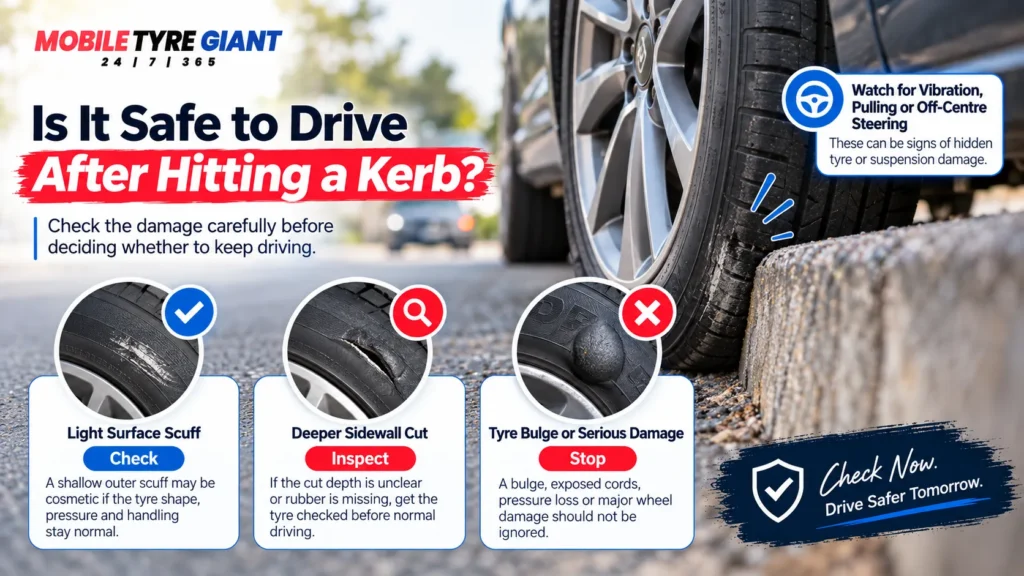
Whether it is safe to drive after hitting a kerb depends on what the impact has actually damaged, not simply on how hard the contact felt. A slow parking scrape may leave only a superficial mark, while a sharper strike can affect the tyre structure, wheel or steering geometry. The first sign to consider is whether the tyre still has its normal shape and pressure, but those checks should not be used on their own. You also need to look for a bulge, deep cut, exposed material, wheel deformation or any new change in steering behaviour. If the tyre looks normal, holds pressure and the car behaves exactly as it did before, the situation may be less concerning than one involving obvious structural damage. Even then, uncertainty about the depth of a cut or hidden impact damage is a good reason to arrange an inspection.
The safest decision comes from combining several clues rather than relying on one reassuring sign. For example, a tyre may still hold air but develop a visible bulge, which changes the situation completely. A wheel may look only lightly scratched while the steering wheel now sits off-centre, suggesting the impact deserves more investigation. Think of it like checking a phone after dropping it: an intact screen is reassuring, but it does not prove every internal component escaped the impact. The same logic applies to kerb impact tyre damage because the visible mark is only part of the story. If you cannot confidently decide whether the problem is cosmetic or structural, inspection is more sensible than testing the tyre through normal high-speed driving.
What you notice after the impact | What it may indicate | Sensible next step |
Light surface scuff, normal tyre shape, no other symptoms | Possible cosmetic damage | Inspect carefully and continue monitoring |
Cut with uncertain depth | Possible deeper sidewall involvement | Arrange professional inspection |
Genuine outward bulge | Possible internal structural damage | Avoid normal driving and have the tyre assessed |
Exposed cords or ply | Serious structural tyre damage | Tyre replacement is required |
Repeated pressure loss | Tyre, bead, valve or wheel problem | Identify the cause before normal driving |
New vibration | Tyre, wheel or balance-related issue | Inspect the tyre and wheel |
Car pulls or steering sits off-centre | Possible alignment or geometry change | Arrange further inspection |
When Kerb Damage May Be Only Cosmetic
Some kerb marks affect only the outer surface of the tyre or wheel and do not automatically mean that a tyre has become unsafe. A common example is a shallow abrasion created when the sidewall brushes the kerb during a slow parking manoeuvre. The rubber may look rough, slightly discoloured or scraped where it touched the concrete, while the tyre keeps its normal shape and pressure. Tyres with a raised rim-protection area can also lose a small amount of outer rubber without necessarily exposing structural material underneath. In situations like this, the appearance of the mark can be more dramatic than the actual damage. However, the word “cosmetic” should only be used once there is reasonable confidence that the deeper tyre structure is not involved.
Look at the damaged area under good light and compare its shape with the same area on another tyre if that helps you understand what is normal. A superficial mark generally sits on the surface rather than opening into a deep cut or causing the sidewall to push outward. The car should also feel normal, with no new vibration, pulling, pressure warning or unusual steering behaviour. Avoid assuming that every small mark is harmless simply because the tyre is relatively new or has plenty of tread remaining. Tread depth tells you how much usable tread is available, but it does not confirm the condition of the sidewall after an impact. If the damage looks deeper each time you inspect it or you are simply not sure what you are seeing, a professional opinion can prevent both unnecessary replacement and unsafe reassurance.
Is the Tyre Safe If It Is Still Holding Air?
A tyre remaining inflated after a kerb strike is a positive sign, but it does not provide a complete answer about structural safety. The air-retaining inner layer can remain sealed even when impact forces have affected other parts of the tyre. This means you may return to the car several hours later, see a normally inflated tyre and assume nothing serious happened. Pressure retention tells you that there is no obvious rapid leak at that moment, but it does not rule out a cut, internal weakening or developing bulge. This distinction is especially important after a hard strike that produced a noticeable thump through the steering wheel. Treat pressure as one part of the inspection rather than the final verdict.
You should also watch whether the pressure changes over the following period because a slow leak may not become obvious immediately. If one tyre repeatedly needs more air than the others after the impact, there may be an issue involving the tyre, bead, valve or wheel rim. A dashboard pressure warning that appears after the incident should also be investigated rather than repeatedly reset. If the tyre becomes significantly deflated, continuing to use it can create additional damage beyond the original kerb strike. Our guide on driving with a flat tyre explains why running on a tyre with insufficient pressure can quickly make the situation worse. The practical lesson is simple: holding air is reassuring, but it should never override visible structural warning signs.
No Cords Are Showing. Does That Mean the Tyre Is Safe?
Visible cords or ply are an obvious warning that sidewall damage has reached deeper than the outer rubber, but not seeing them does not automatically make the tyre safe. This is one of the most common shortcuts drivers use when judging photographs of damaged tyres online. A shallow scrape with no exposed reinforcement may genuinely be superficial, but damage can also exist underneath rubber that still appears intact. The depth, shape and location of the cut matter, as does whether the tyre has developed any deformation. A new bulge, for example, can indicate internal structural trouble even though no cords are visible from the outside. That is why “no cords showing” should be treated as useful information rather than a guarantee.
Imagine a layered cable covered in thick insulation: you might damage some internal strands without completely tearing away the outer covering. A tyre is more complex, but the analogy helps explain why appearance alone has limits. If the mark is shallow, stable and accompanied by no pressure or handling changes, the situation may be less concerning. If the cut is deep enough that you cannot confidently see where it ends, relying on the absence of exposed cords becomes less sensible. Avoid peeling back rubber aggressively in an attempt to inspect deeper layers yourself because that can worsen the visible damage. When the structure is uncertain, a proper inspection gives you a far better answer than a roadside guess.
When Should You Stop Normal Driving After a Kerb Impact?
Normal driving should not continue when the tyre or wheel shows clear signs that structural safety may have been affected. A genuine sidewall bulge, exposed ply or cords, rapid pressure loss, severe cut or visibly deformed wheel are all signs that deserve prompt attention. The same caution applies if the vehicle suddenly feels unstable, the steering behaviour changes significantly or a strong vibration begins immediately after the impact. These symptoms do not all prove the same fault, but they indicate that something has changed enough to require investigation. This is not the time to test the vehicle by increasing speed or starting a long motorway journey. If the tyre is clearly damaged, replacing it where appropriate is safer than trying to get extra mileage from it.
The next step should match the condition rather than the inconvenience of the situation. If structural tyre damage is confirmed, mobile tyre replacement can avoid the need to drive a questionable tyre to another location. If the wheel, steering or suspension appears to have been affected as well, those issues may require separate inspection because fitting a new tyre alone will not correct a bent wheel or altered geometry. Drivers sometimes focus entirely on saving the tyre because it still has good tread, but usable tread does not cancel out structural sidewall damage. Safety decisions should be based on the tyre’s current condition, not how recently it was purchased. Once a serious warning sign appears, the sensible goal changes from “Can I keep using this?” to “How do I get the vehicle dealt with safely?”
Can Hitting a Kerb Damage More Than the Tyre?
A noticeable kerb impact can affect more than the rubber touching the road. The force travels through the tyre into the wheel, hub and other components around that corner of the vehicle. A light parking scrape may leave little more than cosmetic alloy damage, while a harder sideways strike can create symptoms that deserve further investigation. You might notice the steering wheel no longer sitting straight, the car beginning to pull towards one side or a vibration that was not present before. None of these symptoms automatically proves that a particular component is damaged, but their appearance immediately after the impact is worth taking seriously. The useful approach is to look at the whole wheel corner rather than assuming a new tyre will solve every post-impact problem.
Think of the wheel and tyre as the first line of contact in a chain rather than two completely separate parts. If the tyre compresses heavily against the kerb, the wheel can absorb some of that force, and a stronger impact can pass loads further into the steering or suspension system. This is why two cars with similar-looking tyre marks can behave very differently afterwards. One may drive exactly as before, while another may begin pulling or feel unsettled through the steering wheel. That does not mean you should expect hidden suspension damage after every minor kerb touch. It means new mechanical symptoms after a significant strike should be investigated instead of being dismissed as coincidence.
Can Hitting a Kerb Affect Wheel Alignment?
Yes, a sufficiently hard kerb impact can alter wheel alignment or steering geometry. One of the more noticeable signs is a steering wheel that sits slightly to one side while the vehicle is travelling straight on a level road. The car may also begin drifting or pulling left or right, although tyre pressure and other tyre or wheel problems can create similar sensations. Alignment describes the angles at which the wheels sit relative to the vehicle and road, so even a small change can influence handling and tyre wear. You should not diagnose alignment solely because the steering feels unusual for a few seconds after hitting a kerb. However, a lasting change that began immediately after the impact deserves proper checking.
Poor alignment may also begin affecting the tyre gradually rather than producing a dramatic symptom on the same day. Over time, one shoulder of the tyre may wear faster than expected, or the steering may require constant small corrections on a straight road. This is different from wheel imbalance, which more commonly presents as vibration at certain speeds. Mixing those two problems together can lead to unnecessary work and leave the actual cause unresolved. If a kerb impact has produced pulling, an off-centre steering wheel or abnormal tyre wear, an alignment or geometry assessment may be appropriate. The important point is to diagnose the symptom rather than automatically choosing a service because the word “kerb” is involved.
Can a Kerb Impact Damage Steering or Suspension Components?
A severe kerb strike can place stress on steering or suspension components, particularly if the wheel hits the kerb at an awkward angle or with significant speed. Possible warning signs include new knocking sounds, unusual steering resistance, a wheel that appears to sit differently in the arch or handling that feels noticeably unstable. These symptoms do not mean that a suspension arm, joint or steering component is definitely bent or broken. A damaged tyre or wheel can sometimes create surprisingly similar sensations from the driver’s seat. That is why replacing the visible tyre and assuming the entire problem has disappeared can be a mistake after a particularly hard impact. The vehicle should be assessed further if mechanical symptoms remain after the tyre and wheel have been checked.
Listen to what the car is telling you compared with how it behaved before the incident. A fresh clunk while turning, scraping near the wheel arch or a sudden change in steering response is more meaningful when it starts directly after the kerb strike. Avoid crawling underneath the car at the roadside or trying to judge suspension geometry by eye unless you have appropriate equipment and knowledge. Modern suspension systems contain several interconnected components, and small changes are not always visually obvious. If the wheel looks displaced or the car feels unsafe to steer, normal driving should stop until the cause is understood. A calm inspection is useful, but some problems need workshop-level assessment rather than roadside guesswork.
Will Kerb Damage to a Tyre Fail an MOT?
A simple cosmetic kerb mark does not automatically mean a tyre will fail its MOT. What matters is whether the damage meets the criteria for a tyre defect, particularly where cuts, exposed reinforcement or structural failure are involved. Under current UK MOT inspection rules, a qualifying cut that is deep enough to reach the ply or cords is treated as a major defect. A lump, bulge or tear caused by separation or partial failure of the tyre structure is more serious and can be classified as dangerous. This is why two tyres that both look “damaged” can receive very different assessments. Surface appearance alone is not the legal test.
It is also important not to use an MOT certificate as proof that a newly damaged tyre is safe until the next test date. An MOT reflects the condition of the vehicle at the time it was examined and does not protect against damage caused afterwards. If you hit a kerb the following week and create a serious tyre defect, the existing certificate does not make that defect acceptable. The same roadworthiness principle applies even when there are months remaining before the next MOT. If the tyre develops a bulge, exposed structural material or another significant defect, deal with the condition itself rather than waiting for an MOT tester to find it. Safety and roadworthiness are ongoing responsibilities, not annual events.
Can Kerb Impact Tyre Damage Be Repaired?
Whether anything can be repaired depends on what was actually damaged. A superficial sidewall scrape may require no structural repair at all, while a conventional puncture in an approved part of the tread can be a completely different repair situation. Structural sidewall damage should not be treated like a nail hole in the central tread because the sidewall flexes continuously as the tyre rolls and carries load. A bulge, serious cut or exposed reinforcement indicates a problem that cannot simply be restored by filling the area with rubber or sealant. Cosmetic wheel damage may also be repairable independently of the tyre, depending on the condition of the rim. The correct decision starts with identifying the damaged component rather than applying one solution to every kerb strike.
Drivers understandably want to save a tyre that still has plenty of tread, especially if it was fitted recently. Unfortunately, tread depth does not restore strength to a structurally damaged sidewall. If the tyre is no longer suitable for continued use, arranging mobile tyre fitting can avoid driving the affected vehicle unnecessarily to another location where conditions allow safe fitting. A tyre technician can also identify whether the visible mark is consistent with superficial outer damage or something that requires replacement. If the wheel itself is cracked, badly deformed or another mechanical problem is suspected, additional repair or recovery may still be necessary. The goal should be to solve the complete problem, not simply make the visible mark disappear.
Final Words: Inspect the Damage, Not Just the Kerb Mark
Kerb impact tyre damage can be minor, but the appearance of the initial scrape does not always tell the entire story. A shallow abrasion on outer rubber is very different from a deep sidewall cut, outward bulge, repeated pressure loss or exposed cords. The wheel should be checked at the same time, and changes in vibration, steering position or vehicle pull can point towards problems beyond the tyre surface. A tyre that is still holding air gives useful information but does not prove that its internal structure escaped the impact. Likewise, having no visible cords is reassuring but should not override other warning signs. The best decision comes from combining what you can see with how the car behaves afterwards.
Most importantly, avoid the two extremes that often appear in online advice. Not every kerb scrape means that a perfectly usable tyre needs replacing, but not every inflated tyre with a small-looking mark is automatically safe either. If the damage is genuinely superficial and the vehicle remains completely normal, careful monitoring may be reasonable. If a bulge, deep cut, pressure loss, damaged wheel or abnormal handling appears, further assessment becomes the sensible next step. If a weakened tyre later fails while driving, knowing how to respond to a tyre blowout while driving can also help you stay composed in an emergency. The safest approach is simple: judge the actual condition of the tyre, wheel and vehicle rather than relying on one reassuring sign.
Worried About Tyre Damage After Hitting a Kerb?
If you notice a cut, bulge, pressure loss or unusual steering, get the tyre checked before continuing your journey.
Frequently Asked Questions
Find quick answers to the most common questions our customers ask.
A tyre that looks normal after a light kerb contact may have escaped meaningful damage, but appearance alone cannot prove this after a harder impact. Check the sidewalls, pressure, wheel condition and whether the car has developed vibration, pulling or an off-centre steering wheel. If everything remains normal and there are no structural warning signs, the situation is less concerning, but uncertain damage should still be professionally assessed.
Yes, an impact can affect the sidewall or internal tyre structure without creating an immediate air leak. The tyre may remain fully inflated even though deeper layers have been stressed or damaged. This is why pressure retention should be considered alongside cuts, bulges, deformation and changes in vehicle behaviour rather than being used as the only safety test.
Not necessarily. The absence of visible cords is reassuring because exposed reinforcement indicates significant damage, but internal damage or a developing bulge may still exist beneath intact outer rubber. If the cut is deep, the tyre has changed shape or you cannot confidently judge the damage, professional inspection is more reliable than assuming it is safe.
Yes, a bulge may become noticeable after an impact rather than appearing immediately. It can indicate that internal reinforcement has been weakened while the outer rubber remains intact. If a genuine outward bulge develops after hitting a kerb, the tyre should be assessed promptly and should not be treated as an ordinary cosmetic scuff.
Yes, kerb impact can sometimes lead to gradual pressure loss if the tyre, bead area, valve or wheel rim has been affected. You may notice one tyre repeatedly needing air or a pressure warning returning after inflation. Repeatedly topping the tyre up without identifying the cause can hide the problem rather than solve it.
A sufficiently hard kerb strike can alter wheel alignment or steering geometry. Common clues include a steering wheel that no longer sits straight, the vehicle pulling to one side or unusual tyre wear developing afterwards. These symptoms can have other causes too, so alignment should be checked rather than diagnosed purely from the fact that the car hit a kerb.
New vibration after a kerb impact can come from tyre damage, a bent or damaged wheel, imbalance or another issue around the wheel assembly. Alignment itself is not the only possible cause, and vibration should not automatically be labelled as a tracking problem. If the vibration started directly after the impact, have the tyre and wheel inspected before continuing regular high-speed driving.
A superficial kerb scuff does not automatically cause an MOT failure. However, a qualifying cut that reaches the ply or cords is treated as a major defect, while a structural lump, bulge or tear caused by separation or partial failure can be classed as dangerous. The condition of the tyre determines the result, not simply whether there is a visible kerb mark.
Structural sidewall damage is generally not repaired in the same way as a suitable puncture in the central tread area. A serious sidewall cut, bulge or exposed reinforcement usually means replacement is the appropriate route. Superficial outer-rubber damage may not need repair at all, which is why proper assessment matters before deciding.
Only consider motorway driving if the tyre and wheel have no concerning damage and the vehicle behaves normally. A bulge, deep cut, pressure loss, vibration, pulling or uncertainty about structural damage should be dealt with before committing to sustained higher-speed driving. Motorway speeds leave less margin if a weakened tyre or damaged wheel develops into a more serious failure.