
Getting a flat tyre on the A13 can be frightening, especially when traffic is moving quickly around you. One moment, you are travelling towards Essex or heading back into East London, and the next, your steering feels heavy or a loud thumping noise comes from one wheel. With busy junctions, fast-moving vehicles and limited stopping space on certain stretches, finding somewhere safe becomes your immediate priority. Knowing what to do can help you avoid further danger and unnecessary vehicle damage.
The A13 connects Central London with East London, Thurrock and South Essex, carrying commuters, delivery vehicles and heavy goods traffic. A breakdown near Canning Town can present different challenges from one around the M25 junction or Basildon. Some sections have several traffic lanes, while others pass through junctions and built-up areas. This guide explains how to respond to a flat tyre on the A13, where to stop safely and what to consider before arranging roadside assistance.
What Should You Do Immediately After Getting a Flat Tyre on the A13?
The first thing to remember is not to panic or brake suddenly. A tyre failure can cause the vehicle to pull towards one side, particularly when travelling at higher speeds. Keep both hands firmly on the steering wheel, ease off the accelerator and allow the vehicle to slow gradually. Check your mirrors before changing position and avoid making sharp steering movements. Your main objective is to maintain control while looking for the nearest place of relative safety.
If your vehicle remains controllable, you may be able to reach a nearby exit, suitable lay-by or another safe stopping location. However, driving further on a severely deflated tyre can damage its internal structure and the wheel. Do not continue simply because you know there is a convenient garage several miles ahead. The safest stopping decision depends on the vehicle’s condition, the surrounding traffic and the available road space. A dangerous tyre failure requires prompt action rather than searching indefinitely for the perfect place to park.
Recognising the Warning Signs of a Tyre Failure
Not every flat tyre starts with a dramatic blowout. Sometimes the first warning is a slight vibration through the steering wheel or a tyre-pressure warning appearing on the dashboard. You might also hear a repeated flapping sound that becomes more noticeable as the vehicle moves. If the tyre loses pressure rapidly, the car may begin pulling to one side or feel unstable. These symptoms should never be ignored while travelling along a busy route like the A13.
Imagine driving eastbound near Beckton when you suddenly notice the steering becoming unusually heavy. It may be tempting to continue towards the next familiar junction, hoping the problem will disappear. However, continued driving could turn a repairable puncture into extensive tyre or wheel damage. Reduce your speed smoothly and assess the nearest safe stopping opportunity. The information about stopping safely with a flat tyre on an A-road also explains why road layout and traffic exposure matter during a breakdown.
How to Slow Down and Move Towards Safety
When you realise a tyre has failed, keep your steering movements steady and controlled. Avoid harsh braking, sudden lane changes or turning sharply towards the roadside. Check the position of surrounding vehicles and move towards the left when it is safe. If your vehicle is creating a hazard, use your hazard warning lights to alert approaching traffic. Do not assume that other drivers have already noticed your problem.
The A13 carries a mixture of cars, vans and heavy goods vehicles, so traffic conditions can change quickly. A gap that looks large enough in your mirror may close rapidly when vehicles are travelling at speed. Concentrate on controlling the car rather than immediately inspecting the damaged tyre. If a suitable exit or stopping area is safely reachable, use it without making unpredictable movements. If the vehicle cannot continue safely, stop as safely as possible and arrange appropriate help.
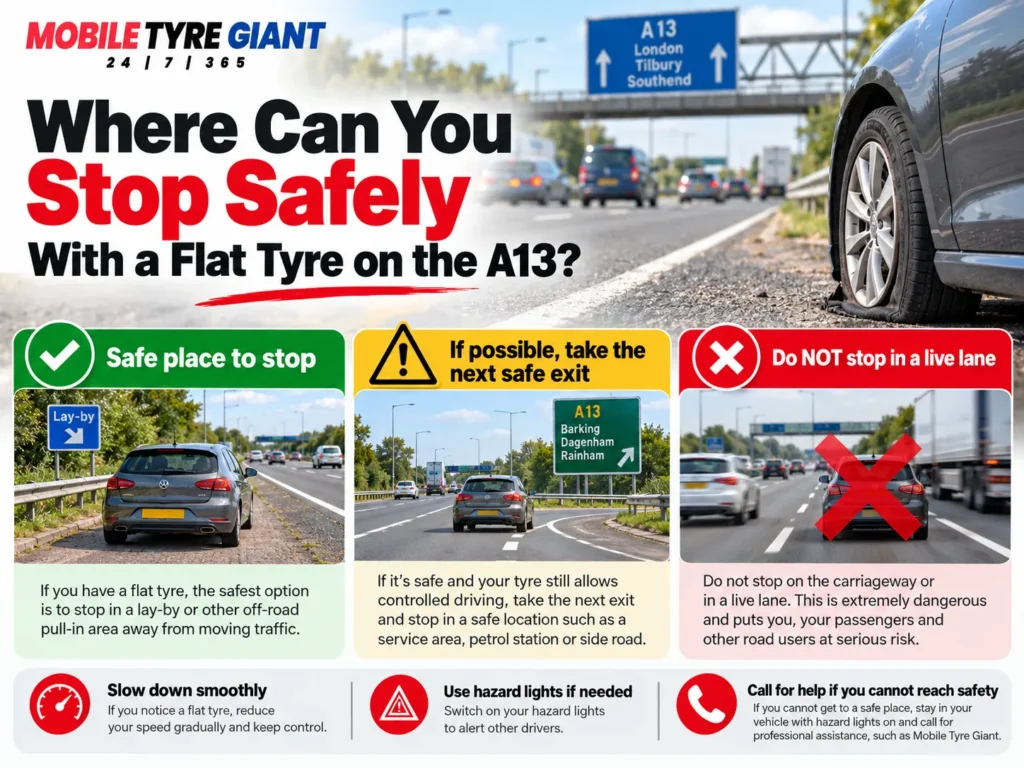
Where Can You Stop Safely With a Flat Tyre on the A13?
The safest place to stop is generally somewhere that separates your vehicle from moving traffic. Depending on your location, this might be a suitable lay-by, service area, side road or other designated stopping place. However, not every section of the A13 provides the same roadside facilities. Some stretches have barriers, narrow edges or multiple traffic lanes with little usable space. Never assume that the road has a continuous hard shoulder.
When choosing where to stop, consider whether the whole vehicle can move clear of the running lanes. A narrow strip beside the carriageway may still leave part of your car exposed to passing traffic. If an exit is safely reachable, leaving the main road can provide a better environment for assessing the problem. However, you should not travel an unnecessary distance on a badly damaged tyre. Your priority is the nearest reasonably safe location, not necessarily the most convenient one.
Flat Tyre Near Canning Town, Beckton or Newham
The western sections of the A13 pass through busy parts of East London, including the Canning Town and Beckton corridors. These areas contain major junctions, slip roads and connections serving nearby residential and commercial districts. A sudden tyre failure can be particularly stressful when traffic is closely spaced. Avoid stopping on an exposed slip road or beside a busy junction if a safer position is reasonably available. Never reverse along the carriageway or cross traffic lanes to reach an exit you have already passed.
If you can safely leave the A13 and reach a suitable parking area, arranging assistance may become more straightforward. However, a location that looks convenient on a map may still have restricted access or insufficient working space. Describe the road, nearest junction and actual stopping position when requesting help. Where the vehicle is safely accessible, mobile tyre fitting in Newham may be an option for drivers who need a replacement tyre. Roadside work should only proceed when the location is suitable for the technician and other road users.
Flat Tyre Near Barking, Dagenham, Rainham or Thurrock
As the A13 continues eastwards, it passes the Barking, Dagenham and Rainham corridors before reaching the Thurrock area. The road carries significant commuter and commercial traffic, particularly around major junctions and connections towards the M25. A flat tyre near one of these interchanges can leave drivers with limited stopping options. Never attempt to cross several lanes suddenly because an exit appears on the opposite side of the carriageway. Maintaining control is more important than reaching a particular junction.
If you are travelling towards Essex, pay attention to the nearest signed exit and the available roadside space. Around the M25 Junction 30 interchange, traffic movements and lane arrangements can be complex. If your vehicle remains safe to control, look for a suitable location away from the main carriageway. Otherwise, stop as safely as possible and explain your position when requesting assistance. Always provide your direction of travel because the same junction may be approached from several different roads.
Does the A13 Have a Hard Shoulder Like a Motorway?
The A13 is an A-road, not a motorway, although some sections are high-speed dual carriageways. Its layout changes along the route, and a continuous motorway-style hard shoulder should never be assumed. Some areas have barriers close to the carriageway, while others provide different types of roadside space. The presence of a wide road or several traffic lanes does not automatically mean there is somewhere safe to stop. Drivers should assess the actual road conditions rather than relying on the road classification alone.
A suitable service area or designated stopping place generally offers better protection than a narrow exposed road edge. If your vehicle stops near moving traffic, consider the risks before opening a door or approaching the damaged wheel. Where it is safe to leave the vehicle, use the side furthest from traffic and move to a protected location. Keep passengers away from the carriageway and do not attempt repairs in an unsafe position. The immediate surroundings should determine whether you can safely leave the car.
What if Your Car Stops in a Live Lane on the A13?
A vehicle immobilised in a live traffic lane presents a serious danger, particularly on a fast dual carriageway. Switch on your hazard warning lights and assess whether the car can be moved to a place of relative safety without creating further risk. Do not attempt to change the wheel or inspect the tyre while exposed to moving traffic. If you cannot move the vehicle clear of the carriageway or leave it safely, remain inside with your seat belt fastened. Call 999 immediately and ask for the police.
When contacting the emergency services, provide your location as accurately as possible. Explain that you are on the A13, state whether you are travelling eastbound or westbound and identify the nearest junction or landmark. Tell the operator if the vehicle is blocking a lane or if passengers are unable to reach safety. Follow the instructions provided and avoid taking unnecessary risks while waiting. Once the immediate danger has been managed, suitable tyre assistance or recovery can be arranged.
How to Handle a Flat Tyre Near the A13 and M25 Junction
The A13 and M25 interchange near Thurrock is one of the more challenging places to experience a tyre failure. Traffic approaching Junction 30 may be changing lanes to join the motorway, continue towards Essex or travel towards East London. With heavy goods vehicles and multiple connecting roads, a sudden puncture can make an already demanding driving situation more stressful. If you notice a tyre problem, avoid changing lanes abruptly or making last-minute movements towards an exit. Concentrate on keeping the vehicle under control while looking for the nearest place of relative safety.
The road layout around the interchange means drivers must pay particular attention to signs and traffic conditions. You should never reverse along a slip road or stop on a junction simply because you have missed an exit. If your vehicle remains safe to control, follow the road towards a suitable stopping location. However, if the tyre has failed completely, continuing for several miles could create additional danger. When the vehicle cannot be moved safely, stop as safely as possible and request appropriate assistance.
Understand the Difference Between the A13 and M25
Although the A13 connects directly with the M25, the two roads do not have identical layouts or stopping facilities. The A13 includes busy dual carriageway sections, while the M25 is a motorway with its own emergency procedures. Some drivers assume that every high-speed road has a hard shoulder, but this is not the case. A wide-looking road edge may provide very little protection from moving traffic. Always assess the actual stopping space rather than relying on the road’s appearance.
If you have already joined the M25, follow the motorway breakdown procedures instead of treating the situation as an ordinary A-road stop. A service area or designated emergency stopping place is preferable where safely reachable. If you cannot reach a safe location and become stranded in a live lane, keep your seat belt fastened, switch on your hazard warning lights and call 999. Do not attempt to walk across traffic lanes or carry out repairs beside moving vehicles. Your safety must take priority over the damaged tyre.
What if Your Tyre Fails During Heavy Traffic?
A flat tyre during rush hour can feel particularly unsettling because traffic may be moving unpredictably. Vehicles might slow suddenly, while motorcycles and larger vehicles continue filtering or changing lanes nearby. Keep your steering movements smooth and avoid braking sharply unless necessary to prevent a collision. If the vehicle remains controllable, move towards a safer position when traffic conditions allow. Do not assume that slower traffic makes stopping in a live lane safe.
Once the vehicle is stationary, assess whether you are protected from passing traffic. A narrow road edge can remain dangerous even when congestion appears to have brought vehicles almost to a standstill. If you cannot safely leave the vehicle, remain inside with your seat belt fastened and seek emergency assistance where there is immediate danger. Avoid standing beside the damaged wheel or asking passengers to direct traffic. A tyre problem should never become an avoidable roadside injury.
What Should You Do While Waiting for Tyre Assistance on the A13?
Waiting for help after a breakdown can be frustrating, particularly when traffic is passing close to your vehicle. You may feel tempted to inspect the tyre immediately or retrieve equipment from the boot. However, these actions can be dangerous on exposed sections of the A13. Before doing anything else, assess whether you and your passengers are in a place of relative safety. If your vehicle is creating an obstruction, use hazard warning lights to alert approaching drivers and arrange appropriate assistance.
If you have reached a suitable parking area or another protected location, waiting may be more straightforward. Keep your phone available and make sure the assistance provider knows where the vehicle is positioned. Do not repeatedly approach the roadside simply to check whether help is arriving. If the car is stopped in a dangerous location, emergency services or road authorities may need to make the area safe before recovery or tyre work can begin. A repair should never be attempted where the technician would be exposed to unacceptable traffic risks.
Where Should You and Your Passengers Wait?
Where it is safe to leave the vehicle, exit on the side furthest from moving traffic. Move everyone well away from the carriageway and keep children under close supervision. If a safety barrier is available, a suitable protected position behind it may offer additional separation from passing vehicles. However, check for steep drops, uneven ground or other hidden hazards before moving behind a barrier. Avoid standing directly in front of or behind the stopped vehicle where it could be pushed towards you by another vehicle.
If the vehicle is stranded in a live lane and you cannot leave safely, remain inside with your seat belt fastened and call 999. Keep hazard warning lights operating and follow the emergency operator’s instructions. Do not attempt to place a warning triangle on an exposed high-speed carriageway. If you have reached safety away from the vehicle, remain there until the appropriate assistance arrives. Returning to retrieve personal belongings is not worth the risk of entering a dangerous roadside area.
How to Explain Your Exact Location on the A13
Giving an accurate location can help emergency services or breakdown providers find you without unnecessary confusion. Start by stating that you are on the A13 and whether you were travelling eastbound towards Essex or westbound towards London. Mention the nearest junction, visible road sign or recognisable landmark if you know it. A location pin from your phone can also help, provided it accurately identifies your position. Never walk along the carriageway to look for a road sign.
For example, saying that your vehicle is near the A13 and M25 Junction 30 interchange is more useful than simply describing yourself as being somewhere in Thurrock. Explain whether the car is on the main carriageway, a slip road or a suitable stopping area. Tell the provider if the damaged wheel faces moving traffic or if the vehicle is blocking a lane. These details help determine whether mobile assistance is suitable or whether recovery and traffic management are required first.

Can a Flat Tyre Be Repaired at the Roadside on the A13?
Some punctures can be repaired without replacing the entire tyre, but the location and condition of the vehicle are important. A repair may be possible when the damage is within the approved tread repair area and the tyre remains structurally sound. However, a blowout, serious sidewall damage or prolonged driving while deflated can make the tyre unsuitable for repair. A professional inspection is needed before deciding whether the tyre can safely return to service. Appearance alone is not enough to establish repairability.
Roadside access matters just as much as the type of puncture. A technician may be able to work safely in a suitable off-road parking area, but an exposed section of dual carriageway is a different situation. Where the vehicle is safely accessible, mobile tyre repair can provide an option for dealing with an eligible puncture. If the location is unsafe, recovery to a more suitable area may be necessary before any work begins.
How to Tell Whether Your Tyre Might Need Replacing
A small nail or screw in the central tread does not always mean the tyre needs replacing. However, the puncture must meet the applicable repair requirements, and the tyre’s internal condition must be checked. Damage near the shoulder or sidewall is more concerning because these areas experience significant flexing during driving. A tyre that has been driven while completely flat may also have hidden internal damage. Continuing to use it without inspection could increase the risk of further failure.
A visible bulge, deep cut or exposed reinforcing material is a warning sign that should not be ignored. Even if the tyre still holds some air, damage to its internal structure may make it unsafe. The explanation of tyre sidewall damage covers the differences between surface marks and potentially serious defects. Avoid pressing into damaged rubber or attempting temporary repairs on a high-speed roadside. A qualified technician should determine whether repair or replacement is appropriate.
When Is Vehicle Recovery Safer Than Roadside Tyre Fitting?
There are situations where recovery is the safest option, even if the tyre problem appears relatively straightforward. A car stranded beside fast-moving traffic may not provide enough working space for a technician to remove a wheel. Narrow verges, barriers and poor visibility can make lifting the vehicle especially hazardous. In these circumstances, attempting roadside fitting could expose both the driver and technician to unnecessary danger. Moving the vehicle to a suitable location under controlled conditions may be the better choice.
For example, a car immobilised near a busy A13 slip road may need traffic protection or recovery before tyre work can begin. By contrast, a vehicle already parked safely in a suitable off-road area may be easier to inspect. Always explain the exact stopping conditions when requesting assistance. If the vehicle needs to be recovered, follow the instructions from the recovery provider or emergency services rather than trying to drive on a destroyed tyre. Getting everyone away from danger matters more than completing the repair at the original breakdown location.
What Information Should You Give a Tyre Technician After an A13 Breakdown?
When arranging tyre assistance after a breakdown on the A13, accurate information can make the process more straightforward. The technician needs to understand your vehicle, the tyre problem and where the car is located. Simply saying you have a flat tyre somewhere near Essex may not provide enough detail. The A13 covers a considerable distance, passing through busy junctions and different road layouts. Giving a clear description helps the provider assess what assistance is appropriate.
Start by explaining whether the tyre has lost pressure gradually, suffered a blowout or developed visible damage. Mention if you heard a loud bang, noticed unusual vibrations or continued driving after the pressure dropped. These details can help the technician prepare for the possible repair or replacement. You should also explain whether the car is safely parked or still exposed to moving traffic. If the location is dangerous, emergency assistance or recovery may be necessary before tyre work can begin.
Share Your Vehicle Registration, Tyre Size and Damage Details
Your vehicle registration is useful when arranging a replacement tyre because it helps identify the car’s original specifications. However, the registration alone may not confirm the tyres currently fitted, especially if the wheels have been changed. The tyre size is printed on the sidewall and normally includes numbers such as 205/55 R16. The correct load index and speed rating also matter when selecting a suitable replacement. Providing these details can reduce confusion when discussing available tyres.
If you can safely inspect the wheel, check whether the tyre is visibly flat, torn or separated from the wheel rim. A photograph may help explain the damage, but never approach a wheel facing live traffic simply to take one. Describe any visible wheel damage or unusual steering behaviour that occurred before stopping. If you cannot identify the tyre size safely, explain this when contacting the service provider. Your safety matters more than collecting every technical detail immediately.
Mention Missing Locking Wheel Nut Keys and Access Problems
Many modern cars use locking wheel nuts to help protect their alloy wheels from theft. These require a matching key or specialist equipment before the wheel can be removed. Unfortunately, drivers sometimes discover that the key is missing only after experiencing a puncture. Before requesting tyre assistance, check whether the key is available in the glovebox, boot or vehicle tool kit, provided these areas are safe to access. Tell the technician if you cannot find it.
A missing key does not always mean the tyre replacement must be abandoned. Specialist equipment may allow the locking wheel nut to be removed without the original key. The locking wheel nut removal service explains how damaged or missing locking nuts can be dealt with professionally. Mention any suspected damage to the wheel bolts or locking nut before work begins. Also describe roadside barriers, narrow parking spaces or other conditions that might prevent safe access to the wheel.
Flat Tyre Breakdown Situations Across East London and Essex
The A13 passes through different driving environments, from busy East London roads to major routes serving Thurrock and South Essex. The safest response to a tyre failure can vary depending on your exact location. A vehicle that develops a slow puncture near a suitable exit may have different options from one that suffers a sudden blowout beside a barrier. Traffic speed, visibility and available stopping space all influence what happens next. Never assume that every stretch offers the same roadside facilities.
It is also worth remembering that an A13 breakdown does not always happen directly on the main carriageway. A tyre may lose pressure after you leave the road and enter a nearby residential street, industrial estate or car park. These locations can sometimes provide better conditions for inspection and tyre fitting. However, access restrictions and parking regulations still need attention. The most appropriate solution depends on whether the vehicle can be reached and worked on safely.
Flat Tyre Near Barking, Dagenham or Rainham
The A13 corridor through Barking, Dagenham and Rainham carries a mixture of commuters, commercial vehicles and local traffic. Drivers may encounter busy slip roads, industrial access routes and congestion around major junctions. A tyre failure in these conditions can become particularly stressful when other vehicles are travelling close behind. Avoid suddenly crossing lanes to reach an unfamiliar exit. Keep the vehicle under control and look for a place of relative safety.
Imagine noticing a tyre-pressure warning while travelling eastbound towards Rainham. If the car remains controllable and the tyre has not suffered a serious failure, you may be able to reach a suitable stopping location without making abrupt movements. However, a collapsed tyre or damaged wheel may make continued driving unsafe. Once stationary, record your direction of travel and the nearest identifiable junction. This information helps the assistance provider understand exactly where you are rather than searching a long section of road.
Flat Tyre Near Thurrock, Stanford-le-Hope or Basildon
Further east, the A13 serves important routes around Thurrock, Stanford-le-Hope and the Basildon area. These sections connect residential communities with commercial centres, industrial sites and major transport routes. Heavy goods vehicles are common along parts of this corridor, making an exposed roadside breakdown especially hazardous. If a tyre fails, avoid stopping on a narrow verge when a safer location is reasonably reachable. Never continue on a severely damaged tyre simply to reach a particular town.
For example, a driver who safely exits the A13 near Basildon may be able to arrange assistance from a suitable parking area rather than remaining beside fast-moving traffic. Where the vehicle is safely accessible, mobile tyre fitting in Basildon may provide a practical option for replacing a damaged tyre. However, availability and safe working conditions should always be confirmed before booking. If your car remains stranded in a dangerous position, recovery or traffic management may be required first. Getting away from moving traffic takes priority over arranging an immediate roadside repair.
What Should You Check After a Tyre Repair or Replacement on the A13?
Once the damaged tyre has been repaired or replaced, it is tempting to get straight back on the road. However, a few final checks are important before rejoining traffic. Confirm that the tyre is suitable for your vehicle and has been inflated to the correct pressure. If the wheel was removed, its fixings should have been tightened to the manufacturer’s specified torque. Any additional damage discovered during the inspection should also be addressed.
Remember that a sudden tyre failure may affect more than the rubber itself. Driving on a completely flat tyre or striking a pothole can damage the wheel and potentially other components. Ask the technician whether any further inspection is recommended before continuing your journey. If the vehicle still feels unusual after the repair, do not ignore the problem. A tyre that has been fixed does not automatically mean every possible cause of instability has been resolved.
Confirm Tyre Pressure, Wheel Fixings and TPMS Warnings
Correct tyre pressure helps the replacement or repaired tyre perform as intended. Check that the inflation pressure matches the vehicle manufacturer’s recommendation for the fitted tyre size and loading conditions. Some cars specify different values for the front and rear axles. If you are unfamiliar with pressure measurements, the instructions for checking tyre pressure correctly explain how to identify and measure the recommended settings. Avoid using the maximum pressure printed on the sidewall as a universal inflation target.
If a wheel has been removed, confirm that the wheel nuts or bolts have been tightened using the correct procedure. Also check whether the Tyre Pressure Monitoring System requires resetting or recalibration. A dashboard warning may remain after the pressure has been corrected, depending on the vehicle. Follow the manufacturer’s instructions rather than repeatedly clearing the warning without investigation. If the light returns, have the cause checked before continuing a longer journey.
Rejoin the A13 Safely and Watch for Unusual Vibrations
After the tyre work is complete, assess the surrounding traffic before moving away. If the car is parked in a suitable off-road area, check your mirrors and blind spots before pulling out. Give way to approaching vehicles and allow enough space to accelerate safely. Do not rush back into a fast-moving lane because other drivers appear impatient. Follow any instructions from police, traffic officers or recovery personnel managing the incident.
Once driving again, pay attention to unusual vibrations, steering movements or noises from the repaired wheel. These symptoms can indicate an issue that needs further investigation, such as wheel imbalance, wheel damage or another mechanical fault. If the car pulls to one side or feels unstable, reduce speed and stop somewhere safe for another inspection. Do not assume that every vibration is normal after a tyre change. Returning to the A13 should only happen when the vehicle is roadworthy and you can rejoin traffic safely.
Common Mistakes to Avoid During an A13 Flat Tyre Breakdown
A flat tyre on the A13 can put drivers under considerable pressure, especially when traffic is moving quickly around them. The noise of passing lorries, limited roadside space and uncertainty about where to stop can make even simple decisions difficult. Unfortunately, rushing to solve the problem can create additional risks. Some drivers attempt to continue driving, while others leave their vehicles to inspect the damaged wheel in an unsafe location. Recognising these mistakes can help you respond more safely.
The most important thing is to avoid treating a high-speed roadside breakdown like a puncture on a quiet residential street. Traffic conditions, visibility and the available stopping space should influence every decision. A repair that would be straightforward on a driveway may be dangerous beside a busy dual carriageway. Focus on protecting yourself and other road users before considering how the tyre will be repaired.
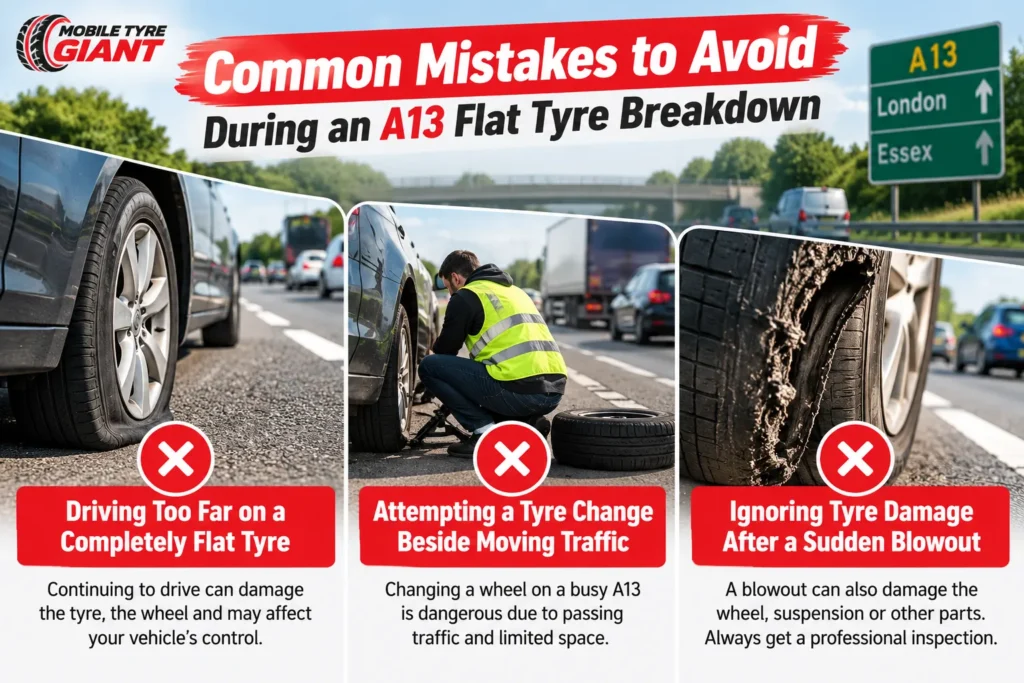
Driving Too Far on a Completely Flat Tyre
One common mistake is continuing towards a familiar garage or junction after a tyre has completely deflated. Drivers sometimes assume that travelling slowly will prevent further damage. However, the flattened tyre can become trapped between the wheel rim and the road surface. This may damage the tyre’s internal structure and potentially the wheel itself. Continuing to drive can also affect steering and vehicle control.
Imagine experiencing a puncture while travelling eastbound towards Basildon. You may know a convenient petrol station several miles ahead, but reaching it could be unsafe if the tyre has collapsed. Instead, assess the nearest place of relative safety and stop as soon as it is safe. Do not sacrifice vehicle control simply to reach a more convenient location. If the vehicle cannot continue safely, arrange appropriate assistance.
Attempting a Tyre Change Beside Moving Traffic
Changing a wheel might seem like a quick solution, particularly if you have a spare tyre and the necessary tools. However, removing a wheel requires enough space to position equipment and work safely around the vehicle. Narrow verges, passing traffic and uneven ground can make this extremely dangerous. A vehicle may also become unstable if lifting equipment is used on an unsuitable surface. Never attempt a tyre change in an exposed live traffic lane.
Even experienced drivers should avoid roadside repairs when passing vehicles are dangerously close. A sudden movement from another vehicle could place anyone working beside the wheel at serious risk. If the car is stopped in an unsafe position, contact the appropriate emergency or recovery service. The vehicle may need to be moved to a safer location before repairs can begin. Completing the repair quickly is never more important than avoiding injury.
Ignoring Tyre Damage After a Sudden Blowout
A tyre blowout can sometimes affect more than the tyre itself. The wheel rim may be damaged, and the sudden loss of pressure can affect the vehicle’s stability. If you experienced unusual vibration or a heavy impact before the failure, additional components may need inspection. Replacing the tyre without checking these warning signs could leave another problem unresolved. Always explain the circumstances of the failure to the attending technician.
A damaged tyre should also be checked for signs of internal failure, particularly if the vehicle continued moving after losing pressure. Cuts, bulges and exposed reinforcing material are serious warning signs. The information in this tyre safety guide explains the importance of checking pressure, tread depth and visible damage. If further inspection is recommended, have the problem addressed before continuing your journey. A new tyre alone cannot correct damaged suspension or wheel components.
Final A13 Flat Tyre Breakdown Safety Checklist
Knowing what to do before a tyre emergency can make a difficult situation easier to manage. The A13 carries busy traffic through East London, Thurrock and South Essex, so roadside conditions can change quickly. A breakdown near a major interchange may require different precautions from one in a suitable off-road parking area. You should always prioritise a place of relative safety and avoid unnecessary exposure to moving vehicles. The following checklist brings together the essential actions.
- Keep both hands on the steering wheel and reduce speed smoothly.
- Avoid sudden braking or unpredictable lane changes.
- Move towards a place of relative safety if the vehicle can be controlled.
- Use hazard warning lights when necessary to warn approaching traffic.
- Keep passengers away from the carriageway where it is safe to leave the vehicle.
- Call 999 if your vehicle is stranded in a live lane and you cannot safely move or leave it.
- Provide your A13 direction of travel and nearest known junction.
- Arrange appropriate tyre assistance or vehicle recovery.
- Never attempt repairs where traffic makes the location unsafe.
- Confirm the vehicle is roadworthy before rejoining traffic.
These steps should be treated as a practical reminder rather than a replacement for assessing the immediate situation. A vehicle stopped behind a protective barrier may present different risks from one blocking a live lane. If you cannot safely leave the vehicle, stay inside with your seat belt fastened and call 999. Follow instructions from emergency services or traffic officers when they attend. Never return to an exposed vehicle simply to collect belongings.
What to Check Before Roadside Help Arrives
Once you have contacted an assistance provider, make sure they understand exactly where the vehicle is located. Confirm whether you are travelling eastbound or westbound and identify the nearest junction or road sign if possible. Explain whether the car is on a slip road, in a lay-by or stopped beside moving traffic. Accurate information helps the provider determine whether roadside tyre work is suitable. You should also mention any damage that may affect wheel removal.
Keep your phone accessible and remain in a safe position while waiting. Avoid repeatedly approaching the damaged wheel or standing behind the vehicle to watch for assistance. If the car is safely accessible, a technician may be able to inspect and replace the tyre at the location. Otherwise, recovery to a safer working area may be required. Do not attempt to move a vehicle with a severely damaged tyre unless advised that it can be done safely.
Essential Checks Before Continuing Your Journey
Before returning to the A13, confirm that the tyre has been repaired or replaced correctly. Check that it matches the vehicle’s required specifications and has been inflated to the manufacturer’s recommended pressure. If the wheel was removed, its fixings should have been tightened according to the correct procedure. Any remaining dashboard warning lights should also be investigated. Never assume the car is roadworthy simply because the damaged tyre has been removed.
If your tyre was damaged beyond repair, mobile tyre replacement may be suitable once the vehicle is in a safe, accessible location. After fitting, pay attention to unusual steering movements, vibration or noises during the journey. These can indicate another problem requiring inspection. If anything feels wrong, find a safe place to stop and arrange further checks. Returning to normal driving should only happen when the vehicle is safe.
Final Words: Stay Safe When Dealing With a Flat Tyre on the A13
Experiencing a flat tyre on the A13 can be stressful, particularly around busy East London junctions and high-speed stretches approaching Essex. The most important thing is to maintain control, avoid sudden movements and reach a place of relative safety whenever possible. Never assume that every section has a hard shoulder or suitable roadside space. If the vehicle becomes stranded in a dangerous position, seek emergency assistance rather than attempting repairs.
Whether the breakdown happens near Canning Town, Rainham, Thurrock or Basildon, the same safety principles apply. Protect yourself and your passengers, share your exact location and arrange assistance appropriate to the road conditions. A timely repair or replacement can help you continue your journey, but only when the vehicle and working location are safe. Understanding these steps beforehand can make an unexpected A13 breakdown easier to handle responsibly.
Flat Tyre on the A13? Get Tyre Help!
Stranded with a flat tyre on the A13 in East London or Essex? Get professional mobile tyre fitting at a safe, accessible location without driving on a damaged tyre.
Frequently Asked Questions
Find quick answers to the most common questions our customers ask.
Keep control of the steering wheel, reduce speed smoothly and move towards a place of relative safety if possible. Avoid sudden braking and arrange assistance once safely stopped.
Not throughout the route. The A13 has different road layouts, and some sections provide very limited roadside space. Never assume a hard shoulder is available.
Only consider a wheel change if the vehicle is in a genuinely safe location with suitable working space. Never attempt repairs beside dangerous moving traffic.
Call 999 if the breakdown creates immediate danger, particularly if you are stranded in a live traffic lane and cannot move or leave safely. For non-emergency breakdowns, contact a suitable assistance provider.
Mobile tyre fitting may be possible when the vehicle is in a safe, accessible location. Exposed roadside positions may require recovery before a technician can work safely.
Driving on a completely flat tyre can damage its internal structure and the wheel. Stop as soon as it is safe and arrange assistance rather than continuing towards a garage.
Provide your vehicle registration, tyre size if known, damage details and exact location. Include your direction of travel and nearest A13 junction or landmark.
Maintain control, slow down smoothly and avoid sudden lane changes. Reach a place of relative safety if possible, and seek emergency assistance if the vehicle is dangerously positioned.
A professional inspection determines whether repair is suitable. The damage location, tyre condition and any internal deterioration influence whether repair or replacement is necessary.
Yes, provided the replacement is correctly specified and fitted, the vehicle is roadworthy and no other damage remains. Investigate persistent vibration, steering problems or warning lights before continuing.