

Electric cars feel smooth and quiet, but their tyres often deal with loads and forces drivers rarely think about. Battery packs can increase vehicle weight, electric motors can deliver torque instantly, and less engine noise makes road sound easier to notice. These differences explain why EV tyres are often discussed separately from tyres fitted to petrol or diesel cars. Still, the answer is not as simple as looking for an EV badge on the sidewall. A tyre must first be correctly specified for the vehicle and suitable for the way that vehicle is actually used.
Think of a tyre as the shoe between a heavy machine and a contact patch only about the size of your palm. It carries the car, transfers acceleration and braking, clears water, absorbs bumps and rolls with as little wasted energy as possible. On an electric vehicle, those jobs put extra attention on load capacity, rolling resistance, noise and tread wear. Understanding those four areas helps you avoid choosing replacements purely by price, branding or familiar names. This guide explains EV tyres in practical terms so you can judge what matters before you buy or replace them.
Do Electric Cars Need Special Tyres?
Electric cars do not automatically need a tyre simply because it is marketed as an EV-specific product. The tyre must first match the approved size, load index, speed rating and any other requirements set for the vehicle. Some EV tyres are designed around higher loads, lower rolling resistance or reduced road noise, while other suitable tyres may not carry an EV label. That means a tyre can physically fit the wheel and still be the wrong choice for the car. If the sidewall markings look confusing, this guide to the correct tyre size explains the basic numbers and letters clearly.
The confusion comes from treating “EV tyre” as if it were a completely separate category with one fixed design. In reality, a compact city EV and a heavy electric SUV can place very different demands on their tyres. A powerful dual-motor car may also stress its driven tyres differently from a modest commuter EV. The sensible approach is to start with the vehicle specification, then compare grip, efficiency, comfort and expected wear. This keeps the buying decision focused on what the car actually needs rather than what a marketing label appears to promise.
What Actually Makes a Tyre Suitable for an EV?
A suitable electric car tyre needs enough load capacity, but weight is only one part of the decision. It must also handle torque without giving away unnecessary grip or developing poor wear characteristics too quickly. Rolling resistance matters because energy lost through the tyres ultimately has to come from the battery. Wet grip remains critical on UK roads, especially when rain leaves roundabouts, bends and motorway slip roads slick and reflective. Noise also matters because a quiet electric drivetrain leaves less mechanical sound to hide the hum coming from the tyres.
Fitment details matter just as much, including tyre width, profile, wheel diameter, load index, speed rating and any XL or HL requirement. Tyre pressure then affects how that tyre carries its load, rolls on the road and wears across the tread. The tyre must also work properly with the car’s suspension, braking and electronic safety systems rather than simply supporting its weight. This is why EV tyres should be chosen as a balance of safety, efficiency, comfort and durability, not by one headline feature. A low rolling-resistance tyre is only useful if it also meets the vehicle specification and suits the conditions in which you drive.
EV-Specific Does Not Always Mean EV-Only
The phrase EV-specific can be useful, but it can also make drivers think every other tyre is automatically unsuitable. That is too simple because the car responds to a tyre’s construction and specification, not the wording used to advertise it. A correctly rated tyre may meet the required size, load and speed specifications even if it is not promoted mainly for electric vehicles. At the same time, dedicated electric car tyres may offer useful engineering around rolling resistance, noise control, higher loads or torque-related wear. The important difference is between genuine tyre characteristics and assuming that the letters “EV” alone guarantee the best fit.
Drivers should also avoid copying another owner’s tyre choice without checking their own model, trim and wheel setup. Even versions of the same car can use different wheel sizes, axle loads or front and rear tyre specifications. If you are comparing replacements, this guide on how to choose the right tyres for your car is a useful starting point for matching tyre characteristics to real driving needs. It is like buying walking shoes: two pairs can be the same size but behave very differently on a wet, long journey. Correct fitment gets you through the door, while design choices decide how the tyre feels, grips, rolls and wears in everyday use.
EV Tyres vs Normal Tyres: What Is Actually Different?
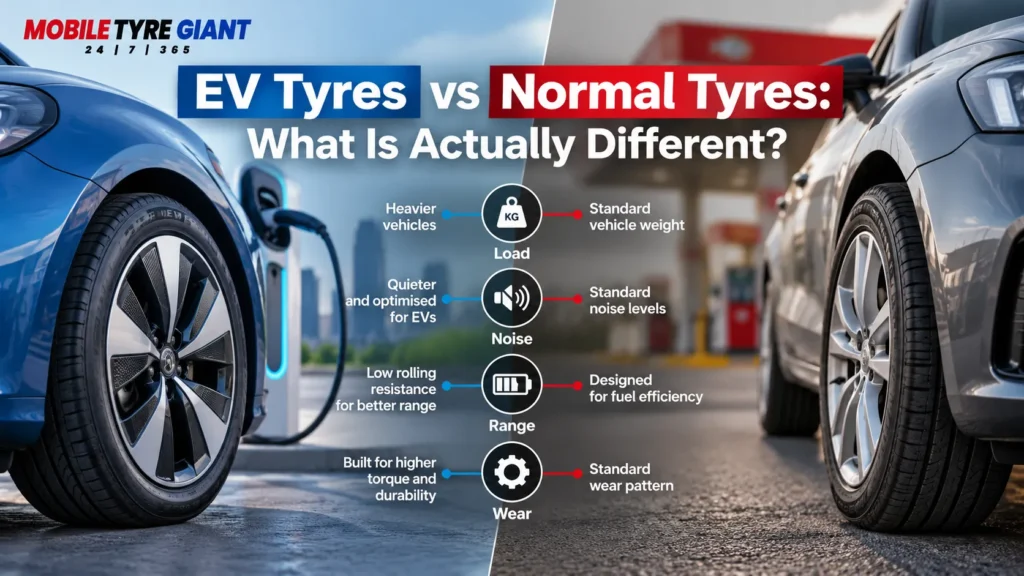
The main differences usually appear in load handling, torque response, rolling resistance, noise control and wear characteristics. Electric vehicles are often heavier than similar combustion cars because of their battery packs, so some need tyres with greater load capacity. Electric motors can also deliver strong torque immediately, asking the tread to transmit high forces from a standstill. Manufacturers may reduce rolling resistance so less battery energy is spent simply keeping the tyres moving. Because the powertrain is quiet, EV tyres may also be designed to control tread noise, cavity resonance and vibration reaching the cabin.
None of this means a normal tyre is automatically weak, noisy or inefficient, and no EV tyre is best at everything. Tyre design involves trade-offs between wet grip, efficiency, steering response, ride comfort, durability and cost. A motorway driver in frequent UK rain may value wet grip and quiet cruising more than someone using a small EV for short urban journeys.
EV Tyre Load Index Explained: What the Numbers Really Mean
Load index is one of the most important figures on an EV tyre because it tells you how much weight the tyre is designed to support under specified conditions. Electric vehicles often carry substantial battery weight, so choosing a tyre simply because the width and wheel diameter look correct is not enough. A tyre with an unsuitable load capacity can affect safety, handling and how the vehicle responds when fully loaded with passengers or luggage. This becomes especially important with larger electric SUVs and high-performance EVs, where the weight carried by each tyre can be significant. The correct load index should always come from the vehicle’s approved specification rather than a guess based on another electric car.
Think of load index like the weight rating printed on a strong ladder. Two ladders can look almost identical, but one may be designed to carry considerably more weight than the other. Tyres work in a similar way because the visible dimensions do not tell the whole story about their load capability. A correctly rated tyre must support the vehicle while also coping with acceleration, braking, cornering and road impacts. Using the correct rating is therefore a basic fitment requirement rather than an optional EV performance upgrade. Once you understand the sidewall markings, checking this information becomes much easier.
How to Read 235/45 R19 99W XL on an EV Tyre
A marking such as 235/45 R19 99W XL can look like a random string of numbers and letters until each part is separated. The first number, 235, represents the nominal tyre width in millimetres, while 45 describes the sidewall height as a percentage of that width. The letter R indicates radial construction, which is standard on most modern passenger-car tyres. The number 19 tells you that the tyre is designed for a 19-inch wheel. These dimensions help identify physical fitment, but they do not tell you whether the tyre can safely carry the vehicle on their own.
The final markings provide more information about capability. In this example, 99 is the load index, W is the speed rating, and XL means Extra Load. The load index is a code rather than the actual weight printed in kilograms, so it needs to correspond with an approved load-capacity table and the vehicle requirement. The speed rating indicates the tyre’s tested speed capability under specified conditions, but it should still match the manufacturer’s fitment specification. XL tells you the tyre uses a reinforced design intended to carry more load at the appropriate pressure than a comparable standard-load tyre. The table below makes the example easier to scan before you check the markings on your own tyres.
Sidewall Marking | Meaning | Why It Matters |
235 | Tyre width in millimetres | Affects fitment, contact area and handling |
45 | Sidewall height as a percentage of width | Influences ride, handling and wheel protection |
R | Radial construction | Standard construction type for most modern cars |
19 | Wheel diameter in inches | Must match the wheel size |
99 | Load index | Shows the tyre’s rated load capability |
W | Speed rating | Must suit the vehicle’s approved specification |
XL | Extra Load | Indicates reinforced higher-load construction |
Do All Electric Cars Need XL or HL Tyres?
Not every electric vehicle automatically requires an XL tyre. Some EVs use Extra Load tyres because the vehicle’s weight and axle loads demand greater carrying capacity, while others may have a different approved specification. The correct choice depends on the particular model, wheel size and manufacturer requirements rather than the fact that the car has an electric motor. Installing XL tyres simply because a vehicle is electric is not a reliable rule. What matters is whether the tyre’s full specification is appropriate for that vehicle.
You may also come across HL, which means High Load, on some modern tyres designed to carry more weight than comparable conventional or XL fitments of the same size. These tyres can be useful for heavier vehicles where manufacturers need greater load capability without dramatically increasing tyre dimensions. However, HL should not be treated as an automatic upgrade for every EV either. A tyre can have greater carrying capacity and still be unsuitable if another part of its specification does not match the car. The safest approach is to follow the approved fitment and use XL or HL only where the vehicle requires or permits it.
Why Is Tyre Noise More Noticeable in an EV?
Tyre noise often feels more obvious in an electric car because there is less engine and exhaust sound covering it. On a smooth road at low speed, an EV can feel almost silent, but move onto coarse motorway tarmac and the steady hum from the tyres can suddenly become much more noticeable. The tyre is constantly flexing, displacing air and interacting with thousands of tiny surface irregularities in the road. Tread blocks also contact and release from the surface many times every second as the wheel rotates. Without the familiar background sound of a combustion engine, your ears naturally pick up more of these noises.
This does not mean electric-car tyres are automatically louder than normal tyres. In fact, many EV-focused designs try to reduce noise through tread layout, internal construction and compounds chosen to control vibration. Wheel size, tyre width and road surface can still have a major influence on what reaches the cabin. Large wheels with lower-profile tyres may feel and sound different from smaller wheels with more sidewall cushioning, even on the same vehicle. That is why drivers comparing replacement tyres should think about real-world comfort rather than judging a tyre only by whether it is advertised as quiet.
How Tread Design and Acoustic Foam Can Reduce EV Tyre Noise
Tyre engineers can reduce noise by changing how tread blocks are arranged and how sound travels through the tyre. If tread blocks hit the road in a repetitive pattern, they can create a noticeable tone that becomes tiring on a long motorway journey. Varying their size, position and spacing can help spread those sound frequencies so the tyre produces less obvious humming. Compounds and internal tyre construction can also influence the amount of vibration transferred through the wheel and suspension. These small design changes become easier to appreciate in an EV because the drivetrain itself contributes so little background noise.
Some tyres also contain acoustic foam attached to the inside of the tyre to help reduce cavity resonance. You can imagine the empty tyre cavity like a small drum, where vibration can create sound that travels into the vehicle. The foam is intended to absorb some of that energy before it reaches the cabin. It can improve comfort in certain vehicle and tyre combinations, but it does not make a tyre completely silent and it is not required on every EV. Road texture, vehicle insulation and wheel design still play a major role in what the driver actually hears.
External Tyre Noise and Cabin Noise Are Not the Same Thing
The noise figure shown on a tyre label can be useful, but it is easy to misunderstand what it represents. That value relates to the tyre’s external rolling noise, meaning the sound the tyre produces outside the vehicle during standardised testing. It is not a direct measurement of how quiet that tyre will sound from the driver’s seat. A tyre with a lower external noise rating may still sound different inside two separate vehicles because their suspension, insulation and wheel designs are not identical. Road surface can also completely change the experience, especially when moving from smooth asphalt to rougher concrete or coarse motorway sections.
Drivers should therefore avoid choosing a tyre purely because one label shows a slightly lower noise figure. Cabin comfort is influenced by tyre construction, tread design, wheel size, vehicle sound insulation and the type of roads you normally use. A new vibration should also not automatically be confused with ordinary road noise, particularly if it appears at a specific speed after tyres or wheels have been changed. In that situation, incorrect balance can be one possible cause, and professional mobile wheel balancing can help identify and correct imbalance when appropriate. Understanding the difference between normal tyre sound and an abnormal vibration makes it much easier to decide whether you are dealing with tyre characteristics or a problem that needs attention.

How Do Tyres Affect Electric-Car Range?
Tyres can influence electric-car range because every tyre resists movement slightly as it rolls along the road. The car’s motor has to overcome that resistance, which means some battery energy is used simply to keep the tyres moving. Tyre construction, compound, tread design, width and inflation pressure can all change how much energy is lost in this process. This is why efficiency-focused EV tyres often pay close attention to rolling resistance rather than concentrating only on grip or handling. The difference may feel invisible from the driver’s seat because there is no warning light telling you that a tyre needs a little more energy to roll. Instead, you may notice the effect gradually through average energy consumption or the distance achieved between charges. Temperature, speed, traffic and road conditions can affect range at the same time, so tyre choice should never be blamed for every change. A cold motorway journey, for example, can produce very different efficiency from a warm urban drive even with exactly the same tyres. New tyres can also behave differently from heavily worn ones because their tread depth and flexibility are not identical. This is why there is no trustworthy universal percentage showing exactly how much range one replacement tyre will gain or lose on every EV.
Range is also only one part of choosing a suitable tyre. A driver who focuses entirely on maximum efficiency could overlook wet grip, braking performance, load capacity or durability, all of which matter on real UK roads. Imagine choosing the lightest pair of walking shoes simply because they require less effort, only to discover they feel insecure whenever the pavement is wet. Tyres involve similar compromises, although the engineering behind them is much more complex. A well-chosen EV tyre should provide a sensible balance between energy efficiency, grip, comfort and wear rather than chasing one figure at the expense of everything else. Vehicle manufacturers select tyre specifications around the complete behaviour of the car, not just headline range. Drivers should therefore start with the correct approved fitment and then compare the characteristics that matter most for their journeys. Someone spending hours on the motorway may value efficiency and low noise, while an urban driver may prioritise wet grip and resistance to kerb or pothole damage. A heavy electric SUV may place greater emphasis on load capability than a small city EV. Looking at range in this broader context leads to a safer and more useful tyre decision.
What Is Rolling Resistance and Why Does Tyre Pressure Matter?
Rolling resistance is the energy lost as a tyre flexes, compresses and returns to shape while moving along the road. A tyre is not a solid wheel, so its sidewall and tread are constantly bending under the weight of the vehicle. Each deformation uses a small amount of energy, rather like repeatedly squeezing a rubber ball in your hand. Lower rolling resistance means less energy is lost during this repeated flexing, which can help an electric vehicle use its stored battery energy more efficiently. Tyre manufacturers can influence this behaviour through compounds, construction and tread design, but pressure plays an important role too. An underinflated tyre deforms more as it rolls, increasing heat and changing the way the tread sits on the road. That can increase energy consumption while also affecting handling and wear. Overinflation is not the solution because excessive pressure can reduce ride comfort and contribute to an undesirable wear pattern. Drivers should use the pressure specified for their own vehicle rather than copying figures from another EV. If you are unsure how to measure it properly, this guide explains how to check tyre pressure correctly when the tyres are cold.
Tyre pressure can change naturally with temperature, which is another reason EV efficiency sometimes seems different without any obvious mechanical problem. A cool morning can produce a lower pressure reading than a warmer afternoon because the air inside the tyre contracts as temperature falls. Carrying several passengers or heavy luggage may also change the pressure requirement on vehicles where the manufacturer provides separate loaded settings. Checking the door-jamb label, handbook or approved vehicle information is therefore more reliable than choosing a generic PSI figure from the internet. Pressure also needs to be checked across all tyres because one soft tyre can behave differently from the others. TPMS is useful for warning about significant pressure loss, but it should not replace normal manual checks with an accurate gauge. Small pressure differences may matter to wear and efficiency before they are dramatic enough to trigger a warning. Regular checks can also reveal a slow puncture before it leaves you facing a flat tyre on a journey. Think of pressure as part of routine EV efficiency maintenance rather than something to inspect only when a warning light appears. Keeping it correct supports range, tyre life and predictable handling at the same time.
Do EV Tyres Wear Faster?
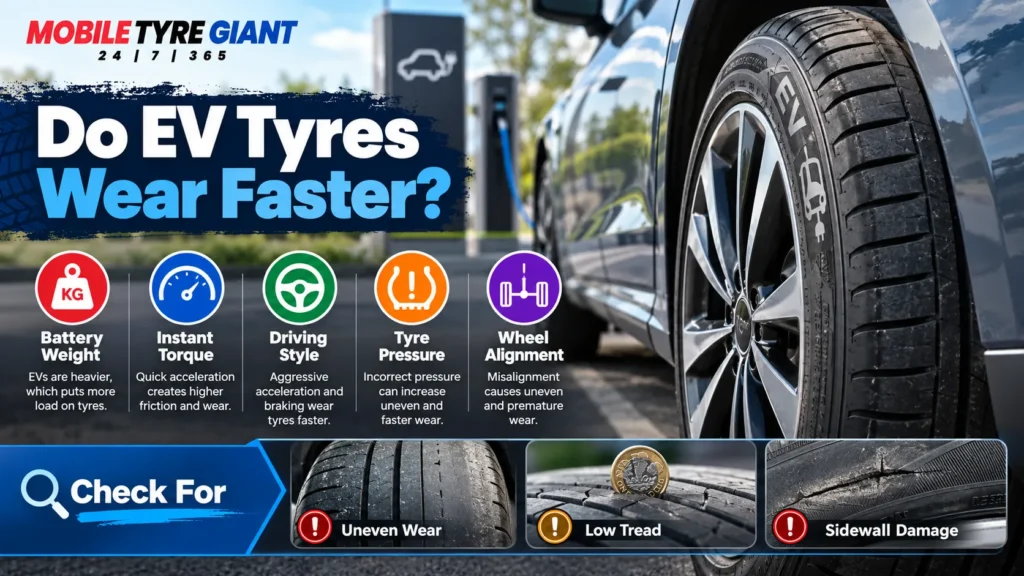
EV tyres can wear faster in some situations, but electric vehicles do not automatically destroy their tyres. Battery weight can increase the load carried by the tyres, while strong electric-motor torque can place significant forces through the tread during acceleration. A powerful EV repeatedly launched hard from traffic lights may therefore place very different demands on its tyres from the same model driven smoothly. Tyre compound matters as well because softer performance-focused rubber may trade some longevity for stronger grip. Road surface, wheel alignment, pressure and suspension condition can further influence how quickly the tread disappears. This explains why two owners driving apparently similar electric cars can report completely different tyre life. One may spend most of the time cruising gently on motorways, while another deals with stop-start traffic, potholes and frequent hard acceleration. Even front and rear tyres may wear differently depending on drivetrain layout and how torque is distributed. It is therefore misleading to promise a fixed mileage or claim every EV tyre wears a certain percentage faster. The useful question is not simply how fast the tyre is wearing, but why it is wearing at that rate.
The pattern across the tread can often reveal more than mileage alone. Wear concentrated in the centre may point towards a pressure issue, while wear along both shoulders can be associated with running a tyre too soft. Heavy wear on one inner or outer edge can suggest alignment needs investigation rather than the battery simply being too heavy. Patchy or cupped areas may also deserve checks for balancing or suspension-related problems. Drivers should inspect the tread across its full width instead of glancing only at the easy-to-see outer shoulder. A tread gauge gives a clearer picture than trying to judge depth by eye, especially when wear is uneven. This guide on how to check tyre tread explains practical ways to inspect depth and condition. Catching an unusual pattern early can prevent a new set of tyres from suffering the same problem. Replacing worn rubber without correcting the underlying cause can become an expensive cycle. Good tyre life starts with understanding the wear pattern rather than automatically blaming the electric powertrain.
How Weight, Instant Torque and Driving Style Affect EV Tyre Wear
Vehicle weight increases the work a tyre must do during acceleration, braking and cornering, but weight alone does not determine tread life. The electric motor’s ability to deliver strong torque immediately can add another layer of stress when that performance is used aggressively. Press the accelerator hard from a standstill and the tread has to transfer a large amount of force through a small contact patch almost instantly. Repeat that behaviour every day and the tyres are likely to experience more stress than they would under gentle acceleration. This does not mean drivers need to crawl away from every junction, but smooth inputs can reduce unnecessary load on the tread. Performance EVs make this especially tempting because rapid acceleration feels effortless and almost silent compared with a powerful combustion car. The lack of engine drama can make the forces involved seem smaller than they actually are. Heavy braking, sharp cornering and repeated high-speed acceleration can all add to tyre wear regardless of what powers the car. Road quality also matters because potholes and rough surfaces create additional impacts through the tyre and wheel. Tyre life is therefore the result of several interacting factors rather than one EV-specific weakness.
Routine maintenance can make those factors much easier to manage. Correct pressure helps the tread sit on the road as intended instead of concentrating wear in the wrong area. Good wheel alignment helps prevent one edge from being scrubbed away while the rest of the tyre still looks healthy. Periodic visual checks can reveal cuts, bulges, cracking or unusual wear before they develop into a larger problem. Drivers covering high mileage should pay particular attention because small alignment or pressure issues can create significant wear over thousands of miles. Tyre rotation can help on vehicles where the manufacturer permits it and where front and rear tyre sizes allow it, but it should not be treated as a universal rule for every EV. Driving more smoothly can also help without turning every journey into an exercise in extreme economy. If longevity is a priority, the practical habits in this guide on how to make tyres last longer can help build a sensible maintenance routine. The aim is not to squeeze an unrealistic mileage from every tyre, but to achieve even, predictable wear while keeping grip and safety intact. A tyre that wears evenly and performs consistently is far more useful than one kept on the car simply to chase a mileage target. Regular checks, correct fitment and sensible driving give EV tyres the best chance of delivering the life they were designed to provide.
How to Choose the Right Tyres for an Electric Car
Choosing replacement EV tyres should start with the vehicle specification rather than price, appearance or an EV badge on the sidewall. Check the full tyre size, load index, speed rating and any XL, HL or reinforced requirement before comparing brands or performance features. Once those basics are confirmed, look at wet grip, rolling resistance, noise characteristics and expected wear. A tyre that performs well for a lightweight city EV may not be the best choice for a heavy electric SUV or a powerful dual-motor model. Your normal driving pattern matters too because motorway commuters, urban drivers and performance-focused owners place different demands on their tyres. Someone covering long distances may value low rolling resistance and quiet cruising, while a driver using wet country roads may put extra emphasis on grip and predictable handling. The aim is to find a tyre that fits the vehicle correctly and suits the way it is genuinely used. That is far more useful than chasing a single number on a label.
It also helps to think of tyre selection as balancing several priorities rather than finding one perfect characteristic. Maximum efficiency sounds attractive, but it should not come at the expense of safe wet-weather performance. Likewise, a very performance-focused tyre may deliver strong grip while producing more road noise or using slightly more energy. Drivers should also check whether their EV uses the same tyre size front and rear because some performance models use staggered setups. If the original tyres have worn unevenly, investigate the cause before fitting a fresh set so the same pattern does not return. The correct tyre should feel predictable, stable and appropriate for the vehicle rather than simply matching what another owner happens to use. Taking a few minutes to check the complete specification can prevent expensive mistakes later.
What Should You Check Before Buying EV Tyres?
Start by reading the complete tyre markings on the existing tyre and comparing them with the approved vehicle information. Confirm the width, profile, rim diameter, load index and speed rating before looking at performance characteristics. Check whether the vehicle requires XL, HL or another reinforced construction because the physical tyre size alone does not confirm load suitability. Wet grip deserves particular attention on UK roads, where rain can quickly turn a familiar roundabout or motorway slip road into a much less forgiving surface. Rolling resistance is worth comparing if efficiency and driving range are important, but it should remain one part of the decision. Noise ratings can help with comparison, although they refer to external rolling noise rather than guaranteeing a quiet cabin. If the vehicle uses different front and rear sizes, make sure each axle receives the correct fitment. You should also check existing tread wear because fitting new tyres without dealing with pressure or alignment issues can shorten their useful life.
Once you have narrowed the options, think about the journeys the car makes most often. A quiet tyre may matter more to someone who spends two hours a day on the motorway than to a driver completing short city trips. A performance EV may benefit from a tyre that prioritises strong grip and stability, while a high-mileage commuter may care more about efficiency and durability. Owners of heavy electric SUVs should pay close attention to load capability because the vehicle may carry passengers and luggage regularly. Do not assume the most expensive tyre is automatically the most suitable, and do not assume a cheaper tyre is unsuitable simply because it lacks EV-focused branding. The right choice is the one that meets the approved specification while offering the best balance for your actual driving. That is the point where technical numbers become a practical buying decision.
When Does an EV Tyre Need Repairing or Replacing?
Not every damaged EV tyre needs immediate replacement, but not every puncture can be safely repaired either. A small puncture in a suitable part of the tread may sometimes be repairable after professional inspection, while sidewall damage, bulges, serious cuts or structural damage usually require a different approach. Driving on a badly underinflated tyre can also damage its internal structure even if the original puncture looks small from the outside. This is why looking at the nail or screw alone does not tell you whether the tyre is safe to repair. Acoustic foam inside some EV tyres can make inspection and repair more involved, but the presence of foam does not automatically mean the tyre must be discarded. The overall condition, location of the damage and tyre construction need to be assessed together. If the tread is already close to its replacement point, repairing one puncture may also make little practical sense. A proper inspection should come before the repair-or-replace decision.
Replacement becomes the safer option when damage affects the sidewall, tyre structure or an area that cannot be repaired correctly. Bulges are particularly important because they can indicate internal damage even when the tyre is still holding air. Deep cuts, exposed cords and significant impact damage should also be treated seriously. If replacement is needed, mobile tyre replacement can be useful when the vehicle is at home, at work or unable to continue safely after tyre damage. The replacement still needs to match the required size, load index and speed rating rather than simply being an available tyre that fits the wheel. The condition of the other tyres should also be considered because large tread or construction differences can affect how the vehicle behaves. The goal is not only to get the car moving again, but to restore safe and predictable tyre performance.
Can EV Tyres Be Replaced at Home or Roadside?
EV tyres can often be fitted at home, work or roadside in much the same way as tyres on other modern vehicles, provided the correct equipment and safe working conditions are available. The fitter still needs to pay attention to the vehicle’s jacking points, wheel design, tyre specification and any manufacturer-specific requirements. Heavy electric vehicles and large alloy wheels can make correct lifting and handling especially important. The new tyre should be checked for size, load and speed suitability before fitting, and the wheel should be installed using the correct procedures. Tyre pressure should then be set to the vehicle’s recommended level rather than a generic value. The TPMS may also need time or a reset procedure to recognise the correct pressure after fitting. A careful installation matters because even a technically correct tyre can perform poorly if it is fitted or inflated incorrectly.
For drivers who cannot conveniently reach a garage, mobile tyre fitting offers a practical way to have a suitable tyre installed where the vehicle is located. This can be particularly useful after a puncture, sidewall impact or sudden loss of pressure when continuing to drive could cause more damage. Before the fitting takes place, providing the complete tyre size and vehicle details helps reduce the chance of an unsuitable replacement being selected. After installation, the driver should monitor pressure, vibration and general handling rather than assuming every change in feel is normal. A fresh tyre may feel slightly different from a heavily worn one, but persistent vibration, pulling or warning lights deserve attention. The fitting process should leave the vehicle safe, correctly specified and ready for normal use rather than simply getting a new piece of rubber onto the wheel.
Final Words: Choose EV Tyres by Specification, Not Just the Label
EV tyres need to do several jobs at once. They must safely carry the vehicle’s weight, transfer strong torque, provide dependable wet grip, keep rolling resistance under control and remain comfortable enough for a quiet electric drivetrain. That makes tyre choice more complex than simply searching for a product with “EV” written in the description. Start with the approved tyre size, load index and speed rating, then compare efficiency, noise, grip and wear according to the way you actually drive. A city EV, a motorway commuter and a heavy electric SUV may all need a different balance of those characteristics. Correct pressure and regular tread checks then help the tyre deliver the performance it was designed to provide.
The most useful approach is to ignore exaggerated claims and treat EV tyre selection as a specification and safety decision first. Electric vehicles can place greater demands on their tyres, but that does not mean every EV will wear tyres quickly or that every EV-specific tyre will outperform every conventional option. Look at how the tyre carries load, how it behaves in wet conditions, how efficiently it rolls and whether it suits the vehicle’s approved fitment. If a tyre becomes damaged or reaches the end of its safe service life, have it inspected and replaced with a suitable specification rather than choosing the quickest available alternative. Getting those basics right gives your EV a better foundation for predictable grip, efficiency, comfort and tyre life.
Need the Right Tyres for Your EV?
Get the correct EV tyres fitted for your vehicle’s load, range, noise and driving needs, wherever you are.
Frequently Asked Questions
Find quick answers to the most common questions our customers ask.
Not every electric car requires a tyre specifically marketed as an EV tyre. What matters first is that the tyre meets the vehicle's approved size, load index, speed rating and any additional manufacturer requirements. EV-focused tyres may provide benefits such as lower rolling resistance, greater load capacity or reduced noise, but the EV label itself does not guarantee suitability. Always check the complete specification before buying.
A conventional tyre can sometimes be fitted to an electric car if it meets the correct specification for that particular vehicle. The tyre must have the right size, load capacity, speed rating and any required reinforced construction. Drivers should not choose a tyre simply because it physically fits the wheel. Suitability depends on the complete technical specification and how the tyre performs under the vehicle's weight and torque.
EV tyres can wear faster in some situations, but rapid wear is not guaranteed. Vehicle weight, instant torque, tyre compound, pressure, wheel alignment, road conditions and driving style all influence tread life. A powerful EV driven aggressively may wear tyres differently from the same model driven smoothly. Uneven wear should also be investigated rather than automatically being blamed on the electric powertrain.
There is no single mileage figure that applies to every electric vehicle. Tyre life varies according to vehicle weight, tyre design, road conditions, pressure, alignment, driving style and how much torque is regularly used. Two drivers with the same EV can therefore achieve very different results. Regular tread checks and even wear are more useful indicators than trying to reach a fixed mileage target.
Yes, tyres can influence electric-car range because rolling resistance affects how much energy the vehicle needs to keep moving. Pressure, tyre design, compound, size and tread depth can all play a role in efficiency. However, the effect varies between vehicles and tyres, so there is no universal percentage that applies to every EV. Range should also be balanced against wet grip, braking and safe load capability.
Electric vehicles produce much less engine and exhaust noise, so tyre and road sounds are easier to hear inside the cabin. Tread design, wheel size, tyre construction, acoustic foam, vehicle insulation and road surface can all affect the noise level. A tyre's external noise rating does not directly tell you how quiet it will feel inside a particular car.
The correct load index depends on the exact vehicle, tyre size and approved manufacturer specification. Some EVs require higher-load tyres because of battery weight, while others use more conventional ratings. Never reduce the load index simply because another tyre has the same width and wheel diameter. The vehicle's approved specification should always be the starting point.
No, not every EV requires an Extra Load tyre. Some electric vehicles use XL tyres, some may use HL or other higher-load fitments, and others can use tyres with different approved constructions. The correct requirement depends on the vehicle and wheel setup. XL should not be treated as a universal EV rule.
Yes, incorrect tyre pressure can affect rolling resistance, handling and tread wear, which can influence energy consumption. Underinflated tyres usually flex more as they roll, while excessive pressure can create other handling and wear issues. Drivers should use the pressure recommended for their own vehicle and check it when the tyres are cold rather than relying on a generic PSI figure.
Some EV tyre punctures can be repaired, but the decision depends on the location and extent of the damage, the tyre's condition and whether it has suffered internal damage while underinflated. Sidewall damage and major structural issues are generally more serious than small tread-area punctures. Acoustic foam does not automatically make a tyre unrepairable, but professional inspection is important before deciding.