

Directional tyres are designed to roll in one specific direction, making correct fitting essential for their intended performance. They usually feature a distinctive tread pattern that helps channel water away from the contact area, particularly on wet roads. Unlike conventional symmetrical tyres, they cannot simply be moved between every wheel position without considering their direction of rotation. An arrow on the sidewall indicates which way the tyre must turn when the vehicle moves forwards.
Imagine replacing two worn tyres before a long motorway journey and noticing that their tread patterns seem to point in opposite directions. It might look like a fitting mistake, but appearances can be misleading. Understanding the sidewall markings is the most reliable way to check. This guide explains how directional tyre fitting works, which rotation patterns are suitable and what to check before driving.
What Are Directional Tyres and How Do They Work?
Directional tyres have a tread design intended to work in one specified rolling direction. Their grooves frequently form a V-shaped or arrowhead pattern across the tread surface. This arrangement helps move water away from the tyre’s contact patch as the wheel rotates. When fitted correctly, the tread operates in the direction intended by its manufacturer. Fitting the same tyre backwards can compromise those designed performance characteristics.
These tyres are available for various vehicles, including everyday passenger cars and some performance-oriented models. Directional tread designs are also used on certain winter and all-season tyres. However, not every tyre with diagonal grooves is directional. Different tread designs serve different purposes, so identifying the manufacturer’s actual fitting instructions matters more than recognising a particular shape. The sidewall markings provide the starting point.
How Does Directional Tread Help With Wet-Road Grip?
When driving through rain, the tyre must move water away from the rubber touching the road. If water builds up faster than the tread can disperse it, the tyre may lose contact with the surface. This is known as aquaplaning. A directional tread pattern is designed to help channel water through its grooves as the tyre rolls in the intended direction. Its effectiveness depends on correct fitting and the tyre’s overall condition.
Picture driving along a rain-soaked dual carriageway, with water spraying from the vehicles ahead. Your tyres must maintain contact with the tarmac while clearing water from their tread grooves. Directional patterns can support this process, but they cannot eliminate aquaplaning risk. Worn tread, incorrect pressure and excessive speed can still reduce grip significantly. Proper fitting works alongside sensible driving and regular maintenance, not instead of them.
How Can You Identify Directional Tyres on Your Car?
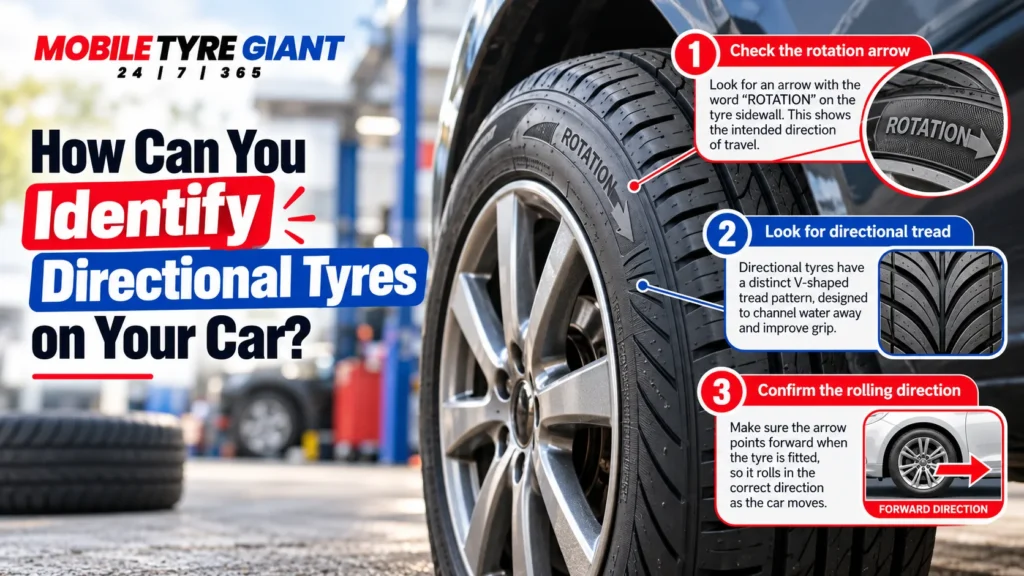
The most reliable way to identify directional tyres is to check their sidewall markings. Look for an arrow, often accompanied by the word ROTATION or DIRECTION. This arrow indicates the intended rolling direction when the vehicle moves forwards. It may be moulded into the rubber and difficult to notice when the sidewall is dusty. Examine the tyre carefully while the vehicle is safely parked.
You should also check the tyre’s model information if its markings are unclear. The numbers and letters on the sidewall describe other important specifications, including size, load index and speed rating. These are separate from the rotation marking. Our correct tyre size guide explains how to understand these markings. Do not mistake a tyre’s size code or branding for an instruction about its rolling direction.
What Does the Rotation Arrow on a Tyre Mean?
The rotation arrow shows which way the tyre must turn during normal forward driving. When viewing the upper part of a correctly fitted wheel from the side, the arrow should point towards the front of the vehicle. This applies to both sides of the car, although the arrow’s appearance may differ depending on where it sits around the sidewall. The key is to establish the wheel’s actual forward rolling direction.
For example, imagine checking the front-left tyre while your car is parked. Find the rotation arrow and compare its direction with the way that wheel would turn when the car moves forwards. Repeat the check on the opposite side rather than assuming both wheels are correct. If an arrow appears to indicate reverse rotation, have the installation checked professionally. Do not attempt to correct the fitting by simply switching the complete wheels from left to right.
Can You Identify a Directional Tyre by Its V-Shaped Tread?
Many directional tread designs feature grooves that resemble a V or chevron. This appearance can be a useful clue, especially when comparing the tyres on your vehicle. However, tread appearance alone is not enough to establish the correct fitting direction. Some asymmetric tread patterns also contain angled grooves, making them look directional when they are not. Always prioritise the actual sidewall instructions.
A common source of confusion occurs when the tread appears to lean in different directions on opposite sides of the car. Drivers sometimes assume one tyre must have been fitted backwards. That conclusion may be incorrect, particularly with asymmetric tyres. The correct way to judge the installation is to identify whether the tyre carries a rotation arrow, an OUTSIDE marking or both. Each instruction has a different purpose.
How Should Directional Tyres Be Fitted Correctly?
Correct directional tyre fitting begins before the tyre is installed on the wheel. The fitter must identify the tyre’s rotation marking and establish which side of the vehicle the completed wheel assembly will occupy. The tyre is then mounted so its arrow agrees with forward wheel rotation. The technician should also confirm that the tyre size and other specifications are suitable for the vehicle.
After fitting, the wheel must be installed securely, inflated to the recommended pressure and balanced as appropriate. Before leaving, check that the rotation marking is pointing the correct way. This post-fitting tyre checklist explains other useful checks after installation. If the direction looks incorrect, ask the fitter to inspect it before normal driving. Correct fitting should be verified rather than assumed.
Do Directional Tyres Need Separate Left and Right Versions?
Most ordinary directional tyres are not manufactured as separate left- and right-hand products. Instead, the fitter determines the suitable orientation when mounting each tyre onto its wheel. A tyre intended for the left side may be mounted differently from an identical tyre intended for the right. Once fitted to a wheel, however, the complete assembly generally has a designated side because its rolling direction must remain correct.
There are exceptions, including specialised designs that combine directional and asymmetric requirements. Such tyres may need specific left- and right-hand versions to satisfy both the rotation arrow and the OUTSIDE marking. Never assume every directional model follows identical mounting rules. Check the manufacturer’s instructions for the particular tyre. A qualified fitter can establish the correct arrangement before installation.
How Are Directional and Asymmetric Tyres Different?
Directional and asymmetric tyres are often confused because both can have specific fitting instructions. The key difference is what those instructions control. A directional tyre must rotate the specified way, indicated by its arrow. An asymmetric tyre normally has INSIDE and OUTSIDE markings, which determine which sidewall faces away from the vehicle. The markings describe different aspects of tyre orientation.
For an ordinary asymmetric tyre without a directional requirement, the complete wheel assembly may be moved between different vehicle positions while keeping its marked outside facing outwards. A directional tyre has stricter movement restrictions because changing sides would usually reverse its rolling direction. Some specialised tyres combine both features and require both instructions to be satisfied. Recognising this difference helps avoid fitting errors and unnecessary confusion during maintenance.
Can You Rotate Directional Tyres From Front to Rear?
Yes, directional tyres can generally be rotated between the front and rear axles while remaining on the same side of the vehicle. The front-left wheel moves to the rear-left position, and the rear-left wheel moves forwards. The same principle applies on the right side. This arrangement preserves the intended rolling direction without removing the tyres from their wheels. However, both axle positions must accept the same tyre and wheel specifications.
Some vehicles use different front and rear tyre sizes, wheel widths or other fitment requirements that prevent a straightforward swap. All-wheel-drive vehicles may also have particular restrictions concerning tread-depth differences. Always follow the vehicle manufacturer’s guidance before rotating the tyres. The purpose is to manage tyre wear without compromising safe fitment. Moving tyres around simply because a generic rotation diagram recommends it can create avoidable problems.
What Is the Correct Rotation Pattern for Directional Tyres?
The correct directional tyre rotation pattern usually involves moving wheels between the front and rear of the vehicle while keeping them on the same side. This allows the tyres to continue rolling in the direction indicated by their sidewall arrows. Unlike ordinary non-directional tyres, they cannot simply follow a diagonal rotation pattern. Doing so would reverse their intended rolling direction and could compromise their designed wet-road performance.
For example, the front-left wheel moves to the rear-left position, while the rear-left wheel moves forwards. The same arrangement applies on the right side. This straightforward method works when the front and rear tyres and wheels are compatible and the vehicle manufacturer permits rotation. Always check the recommended pattern before moving anything. The table below illustrates the standard arrangement for directional tyres.
Original wheel position | New position | Rolling direction maintained? |
Front left | Rear left | Yes |
Rear left | Front left | Yes |
Front right | Rear right | Yes |
Rear right | Front right | Yes |
Front left | Rear right | No, not without suitable remounting |
Front right | Rear left | No, not without suitable remounting |
Can You Swap Directional Tyres From Left to Right?
Swapping complete directional wheel assemblies from left to right is generally unsuitable because it reverses their intended rotation. A tyre mounted correctly on the left side will normally face the wrong rolling direction when installed on the right. This mistake can happen when someone follows a generic tyre rotation diagram without checking the sidewall markings. The direction arrow should always agree with forward travel.
Changing sides may still be possible if a professional removes the tyre and remounts it in the correct orientation. However, that involves more work than simply exchanging wheels. The tyre’s construction, sidewall instructions and wheel compatibility must all be considered. Specialised directional-asymmetric tyres may also have separate left- and right-hand versions. Never assume that turning a wheel around will solve the problem.
Does the Rotation Pattern Change for Front-Wheel, Rear-Wheel and All-Wheel Drive?
For compatible directional tyres, the basic same-side, front-to-rear pattern generally remains unchanged regardless of whether the vehicle uses front-wheel drive, rear-wheel drive or all-wheel drive. What differs is how the tyres experience wear. Front-wheel-drive cars often place greater demands on their front tyres through steering, acceleration and braking. Rear-wheel-drive vehicles may experience greater wear on the driven rear axle, depending on driving conditions.
All-wheel-drive vehicles require additional attention because some systems are sensitive to differences in tyre circumference and tread depth. Moving tyres between axles without considering these requirements may create problems. The vehicle handbook should always take priority over a general rotation recommendation. Tyre pressures may also differ between front and rear positions. Correct directional fitting must work alongside the vehicle’s drivetrain and wheel specifications.

Can Directional Tyres Be Rotated on Cars With Different Front and Rear Sizes?
Not every vehicle allows directional tyres to be moved between the front and rear axles. Some performance cars, sports saloons and other vehicles use different tyre sizes at each end. For example, the rear tyres may be wider than those fitted at the front. In these situations, swapping complete wheels between axles may be prohibited by the vehicle manufacturer’s specifications. A tyre’s directional design does not override those fitment requirements.
Drivers sometimes assume that regular rotation is essential for every vehicle. However, rotating incompatible tyres can introduce more problems than it solves. Incorrect sizing may affect handling, clearance, electronic systems and the vehicle’s intended performance. If the front and rear fitments differ, check the manufacturer’s guidance before considering any movement. Proper maintenance remains important even when conventional tyre rotation is not possible.
What Does a Staggered Wheel Setup Mean for Rotation?
A staggered wheel setup uses different tyre or wheel dimensions between the front and rear axles. This arrangement is common on certain performance-oriented vehicles and may be intended to support specific handling characteristics. Wider rear tyres cannot automatically be moved to the front simply to distribute tread wear. Even when the wheel diameter matches, differences in width, offset or approved tyre fitment can prevent rotation.
For directional tyres, a staggered setup may restrict the available options even further. Front-to-rear movement may be unsuitable because of size differences, while a straightforward left-to-right swap would reverse the rolling direction. Some arrangements may permit professional remounting, but only when every fitment requirement can still be satisfied. If rotation is not appropriate, focus on correct inflation, alignment and regular tyre inspections.
Can You Change Sides by Removing and Remounting the Tyre?
In certain circumstances, a directional tyre can be moved to the opposite side by removing it from the wheel and remounting it correctly. This allows the technician to ensure that the rotation arrow matches the new wheel position. However, it is not the same as moving an assembled wheel from one side to another. The tyre must be suitable for remounting, and the wheel must meet the vehicle’s specifications.
Additional restrictions apply when a tyre has both directional and asymmetric fitting requirements. A tyre carrying a rotation arrow and an OUTSIDE marking must satisfy both instructions. Some specialised designs require a particular left-hand or right-hand version, making a simple side change unsuitable. Professional assessment is necessary before making these changes. Remounting also requires suitable equipment and wheel balancing afterwards.
How Often Should Directional Tyres Be Rotated?
Directional tyres should be rotated according to the vehicle manufacturer’s recommended schedule, provided rotation is permitted. A commonly suggested interval is around 5,000 to 6,000 miles, although recommendations vary between tyre and vehicle manufacturers. Driving style, road conditions and tyre wear can also influence the appropriate timing. There is no universal mileage at which every directional tyre must be rotated.
For drivers covering long motorway distances, checking tyre condition during regular servicing is a practical approach. Frequent acceleration, heavy loads and urban driving may produce different wear patterns. Rotation can help distribute normal wear between compatible axle positions, but it cannot repair existing tyre damage. If your handbook provides a specific rotation schedule, follow that guidance rather than relying on a general mileage estimate.
What Do Uneven Tread Wear and Tyre Age Tell You?
Uneven tread wear may indicate that the tyres are not experiencing equal loads or operating under suitable conditions. Excessive wear along one edge can suggest alignment problems, while wear across both shoulders may be associated with underinflation. Irregular patches can have several causes, including suspension or wheel-balance issues. Rotating the tyres may help manage ordinary differences in wear, but it will not correct an underlying mechanical fault.
Inspect tread depth at several positions and compare the condition of all four tyres. Check their age and look for cracking, bulges or other signs of deterioration. If you want to understand the factors affecting longevity, this guide explains how to make tyres last longer. Remember that tyres requiring replacement should not simply be moved to another axle to extend their use.
What Should Be Checked After Rotating Directional Tyres?
After rotating directional tyres, check every wheel to confirm that its rotation arrow still points in the correct forward rolling direction. This is particularly important if the wheels have been removed and refitted during maintenance. The technician should also ensure that the wheels are securely installed using the vehicle manufacturer’s tightening specifications. Correct fitment matters just as much after rotation as it does when fitting new tyres.
Tyre pressures should be adjusted to match their new front or rear positions where the manufacturer specifies different values. Check that the vehicle drives normally and that there are no unexpected warning messages. A routine rotation should not create unusual vibration, pulling or steering problems. If anything feels different, arrange a suitable inspection instead of assuming the symptoms will disappear after further driving.
Do Wheel Balancing and TPMS Need Attention After Rotation?
Moving complete wheel assemblies between positions does not automatically mean wheel balancing is required. However, balancing becomes necessary when tyres are removed and remounted, and it may also be appropriate if vibration is present. Incorrect wheel balance can cause noticeable steering or vehicle vibration, particularly at certain speeds. If you experience these symptoms, professional mobile wheel balancing may help identify and correct an imbalance.
Some vehicles also require their tyre pressure monitoring system to recognise the wheels’ new positions. Direct TPMS systems may need a relearn procedure, while other systems require initialisation after adjusting pressures. The correct process depends on the vehicle. A successful directional tyre rotation should leave the tyres correctly orientated, properly inflated and securely fitted, with the monitoring system operating as intended.
What Happens If Directional Tyres Are Fitted the Wrong Way?
Directional tyres are designed to rotate in a specific direction, so incorrect fitting can affect their intended performance. When the rotation arrow points backwards during forward travel, the tread grooves no longer work exactly as designed. This is particularly important on wet roads, where the grooves help disperse water from beneath the tyre. Although the tyre may still feel normal during everyday driving, its wet-weather performance can be compromised. Correct orientation is therefore an important part of tyre safety.
Imagine driving along a rain-soaked motorway with water spraying from the vehicles ahead. Your tyres need to maintain grip while moving water away from the contact area. A directional tyre fitted backwards may not disperse water as effectively as intended. That does not mean it will automatically burst or lose control, but it creates an avoidable risk. If you discover incorrect fitting, arrange professional correction rather than continuing to use the tyre normally.
Why Can Incorrect Rotation Affect Wet-Weather Grip?
Directional tread patterns commonly feature angled grooves that channel water through the tyre’s contact area. These grooves are engineered to work most effectively when the tyre rolls in the specified direction. Reversing that movement can reduce the intended water-dispersal performance and affect resistance to aquaplaning. The difference may become more noticeable during heavy rain or when travelling over standing water. Correct fitting helps the tyre deliver the performance for which it was designed.
Aquaplaning occurs when water prevents the tyre from maintaining proper contact with the road surface. Steering and braking control can become seriously reduced when this happens. Incorrectly fitted directional tyres may increase that risk, especially when combined with worn tread or excessive speed. Even correctly installed tyres cannot eliminate aquaplaning completely. Maintaining suitable tread depth, tyre pressure and driving speed remains essential.
Will a Directional Tyre Fitted Backwards Fail an MOT?
A directional tyre fitted backwards is not automatically an MOT failure under the standard DVSA passenger-car inspection criteria. The MOT examines tyre condition, tread depth, construction and other specified requirements. However, passing an MOT does not mean that a tyre has been installed according to its manufacturer’s performance instructions. Incorrect orientation should still be corrected because it can affect the tyre’s intended handling characteristics.
For example, a directional tyre may have sufficient tread and no visible structural damage but still face the wrong rolling direction. The MOT result and the manufacturer’s fitting requirements are separate considerations. You should never use an MOT pass as justification for leaving a directional tyre incorrectly installed. Check the proper rotation marking and arrange correction when necessary. Safety depends on correct tyre fitment as well as meeting inspection requirements.
How Can You Spot Incorrect Directional Tyre Fitting?
The easiest way to check directional tyre fitting is to inspect the sidewall while your vehicle is safely parked. Find the ROTATION marking and its associated arrow, then compare it with the wheel’s forward rolling direction. When looking at the visible sidewall, an arrow at the top of the wheel should point towards the front of the car. Repeat this check on every directional tyre rather than assuming all four have been installed correctly.
Do not rely only on the appearance of the tread pattern. Some tyre designs look different when viewed from opposite sides of the vehicle, even when correctly fitted. Dirt and road grime can also make sidewall markings difficult to identify. If the arrow is unclear, consult the tyre manufacturer’s instructions or ask a qualified fitter. A quick professional inspection is preferable to making changes based on guesswork.
What if the Rotation Arrow and OUTSIDE Marking Look Confusing?
The ROTATION arrow and OUTSIDE marking provide different fitting instructions. A rotation arrow identifies the direction in which the tyre must roll during forward driving. An OUTSIDE marking identifies which sidewall must face away from the vehicle. Asymmetric tyres commonly use INSIDE and OUTSIDE markings without requiring a particular rolling direction. These instructions should not be treated as interchangeable.
Some specialised tyres combine directional and asymmetric construction, meaning both requirements must be satisfied. Such designs may require specific left-hand and right-hand versions. If a tyre has both markings, the fitter must ensure that its outside faces outwards while the rotation arrow points correctly. Turning the tyre around to correct one marking could make the other incorrect. Always follow the exact fitting instructions for the tyre model.
Can You Correct a Directional Tyre by Swapping Wheels?
Simply swapping complete wheels from left to right will normally make the problem worse rather than solve it. A directional tyre mounted for the left side typically needs the opposite mounting orientation when used on the right. Moving the whole wheel assembly across the car reverses its intended rotation. This is why ordinary cross-rotation patterns are unsuitable for most directional tyres.
If a directional tyre needs to change sides, a technician may be able to remove and remount it correctly. The process depends on the tyre’s construction, sidewall markings and wheel compatibility. Once the tyre has been remounted, appropriate wheel balancing should be carried out before normal use. Specialised tyre designs may prevent the change entirely. Professional fitting ensures that the resulting wheel assembly meets the necessary requirements.
What Should You Consider When Replacing One Directional Tyre?
Replacing a single directional tyre requires more consideration than simply finding another tyre with a similar tread pattern. The replacement must meet the vehicle’s approved size, load index and speed-rating requirements. Its construction and performance characteristics should also be compatible with the other fitted tyres. A tyre that looks almost identical may have different specifications. Matching the existing tyre model is often preferable where appropriate.
Tread depth differences also matter, particularly when the other tyre on the axle is significantly worn. A new tyre may provide different wet-road grip from an older tyre with less tread remaining. Some vehicles, especially certain all-wheel-drive models, have strict requirements concerning differences in rolling circumference. Check the vehicle manufacturer’s recommendations before replacing only one tyre. If the remaining tyres are close to their replacement limits, fitting a suitable pair may be more sensible.
Can You Mix Directional and Non-Directional Tyres?
Different tread patterns are not automatically illegal to combine on a UK passenger car, provided all applicable tyre regulations and vehicle requirements are satisfied. However, mixing tyres with different handling characteristics can affect how consistently the vehicle responds. Directional and non-directional tyres may disperse water differently, particularly during heavy rain. Using closely matched tyres on the same axle is generally preferable for predictable handling.
If you must replace one damaged tyre, ask whether the existing model is available. Where an exact match is unavailable, a specialist can recommend a compatible alternative based on the vehicle’s specifications. Check the condition and remaining tread depth of the other tyres before making a decision. You can find practical measurement advice in our guide on how to check tyre tread depth. Avoid choosing a tyre based solely on price or visual similarity.
Should New Tyres Be Fitted to the Front or Rear Axle?
When replacing only two tyres, many tyre manufacturers recommend fitting the pair with deeper tread to the rear axle. This can help maintain rear-axle stability, particularly on wet roads. The recommendation can apply even to front-wheel-drive vehicles. However, it does not override specific vehicle requirements, staggered wheel sizes or manufacturer restrictions. The correct arrangement depends on the complete tyre and wheel setup.
Directional tyres introduce an additional consideration because their rotation arrows must remain correctly aligned. The fitter must establish which wheel positions are suitable before fitting the new tyres. If different front and rear sizes are specified, a general recommendation cannot replace the vehicle’s approved fitment instructions. Proper tyre selection and positioning work together to support predictable handling. Always confirm both requirements before leaving the fitting location.
When Should You Have Directional Tyres Professionally Refitted?
Professional attention is necessary when a directional tyre has been installed against its rotation marking or when its mounting instructions cannot be satisfied. Refitting may also be required after an unsuitable wheel-position change. If the tyre is otherwise undamaged and compatible, correcting the mounting may resolve the problem without requiring replacement. However, visible structural damage, unsuitable specifications or excessive wear may make a new tyre necessary.
Before arranging work, explain which tyres appear incorrectly orientated and whether they have recently been rotated or replaced. A qualified fitter can check the sidewall instructions, wheel positions and vehicle requirements before recommending the appropriate solution. If inspection shows that a tyre needs replacing, mobile tyre replacement may offer a convenient option at a suitable location. Correct installation should always be confirmed before returning to normal driving.
What Should You Check After Directional Tyres Have Been Fitted?
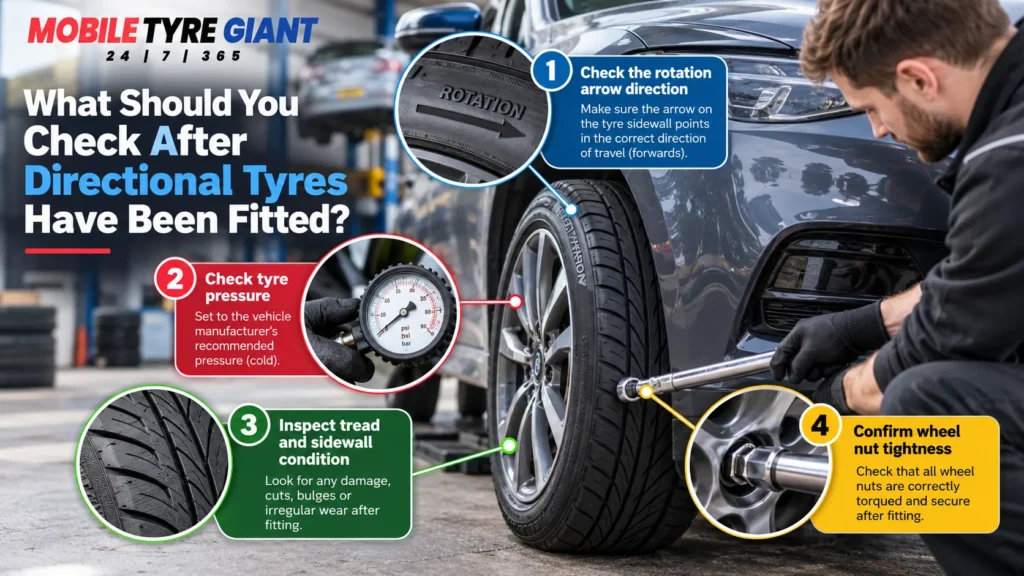
After fitting directional tyres, checking their orientation is essential before returning to normal driving. Every tyre should rotate in the direction indicated by its sidewall markings when the vehicle moves forwards. Incorrect installation can affect the tread’s intended performance, particularly when driving on wet roads. The wheels must also be securely fitted according to the vehicle manufacturer’s specifications. A few final checks can help identify avoidable fitting problems.
Imagine collecting your car after having two new tyres installed. Everything looks normal, but you notice that the tread patterns appear different on opposite sides. Rather than assuming a mistake, inspect the rotation markings on each tyre. Directional designs can look confusing when viewed from different angles. If you cannot confirm the correct orientation, ask the fitter to check before driving away.
How Do You Confirm Correct Rotation and Tyre Pressure?
Start by locating the rotation arrow on each directional tyre’s sidewall. When examining the upper part of a correctly fitted wheel, the arrow should point towards the front of the vehicle. Repeat this check on every directional tyre, particularly if the wheels were recently rotated. Never rely solely on the appearance of the V-shaped tread pattern. The manufacturer’s markings provide the proper fitting instructions.
Tyre pressure also needs attention after fitting or rotation. Front and rear positions may require different pressures depending on the vehicle and its loading. Use the manufacturer’s recommended cold inflation values rather than the maximum pressure printed on the sidewall. Our guide on how to check tyre pressure explains the correct measurement process. If your vehicle requires TPMS initialisation after pressure adjustment or wheel movement, follow its handbook instructions.
What if Your Car Vibrates or Pulls After Tyre Fitting?
Unusual vibration or pulling after tyre fitting should not be ignored. These symptoms can have several causes, including incorrect wheel balance, tyre irregularities, alignment problems or other mechanical faults. They do not automatically mean that a directional tyre has been fitted backwards. However, checking the rotation arrows is a sensible first step. Pay attention to whether the symptoms develop at particular speeds.
If the steering feels unstable or vibration becomes severe, stop somewhere safe rather than continuing your journey. A qualified technician can assess wheel balance, tyre condition and the installation. Correcting the problem early may help prevent unnecessary wear and further complications. Do not attempt to solve persistent vibration simply by swapping directional wheels between opposite sides. Any change must preserve the required tyre orientation and vehicle fitment.
How Can You Maintain Directional Tyres for Longer?
Directional tyres need the same basic maintenance as other road tyres, with additional attention to their rotation restrictions. Correct inflation, regular tread inspections and appropriate wheel alignment can help manage wear. Rotation may also distribute normal wear between compatible axle positions. However, moving tyres to unsuitable positions can create problems rather than improve their service life.
Regularly examine the tread for unusual patterns, particularly along its inner and outer edges. Uneven wear may indicate incorrect inflation, alignment issues or suspension-related problems. If one tyre wears significantly faster than the others, investigate the cause instead of simply changing its position. Directional tyre rotation is a maintenance technique, not a repair for existing mechanical faults.
What if Your Vehicle Does Not Allow Directional Tyre Rotation?
Some vehicles use staggered wheel setups or manufacturer-specific fitments that prevent conventional front-to-rear rotation. In these situations, the front and rear tyres may have different sizes or wheel specifications. Moving them between axles could affect clearance, handling or drivetrain operation. The vehicle handbook should determine whether rotation is permitted.
When rotation is restricted, focus on maintaining correct pressure, alignment and tyre condition. Monitor tread depth regularly and arrange an inspection if wear becomes uneven. Some specialised setups may allow professional tyre remounting, but this depends on their construction and fitting requirements. Never force a rotation pattern that conflicts with the vehicle’s approved specifications. Correct maintenance is more important than following a generic mileage schedule.
When Should You Seek Professional Directional Tyre Fitting?
Professional assistance is advisable when tyre markings are unclear, a directional tyre appears incorrectly installed or you need to move tyres between incompatible positions. A qualified fitter can check the rotation arrows, tyre specifications and wheel arrangement before performing the work. This is particularly important for vehicles with staggered wheels or specialised directional-asymmetric tyres. Correct installation helps preserve the tyre’s intended handling and wet-weather performance.
If a tyre needs fitting or remounting, a suitable mobile tyre fitting service may offer a convenient option at your home or workplace. Explain that the vehicle uses directional tyres so the fitting requirements can be considered. Any new tyre must meet the vehicle’s approved specifications. After installation, confirm the orientation and relevant safety checks before driving normally.
What Information Should You Provide Before Booking?
Before arranging tyre fitting, gather your vehicle registration number, tyre size and the position of the affected wheel. Mention whether the tyre carries a ROTATION arrow, an OUTSIDE marking or both. This is especially useful if you suspect an orientation problem following a previous fitting or rotation. Clear information helps the technician understand the work required.
If possible, take a clear photograph of the tyre’s sidewall markings while the vehicle is safely parked. You should also mention any unusual vibration, pressure warning or visible damage. If your car has different front and rear wheel sizes, explain this during booking. Never guess at a tyre specification when you are unsure. A professional can confirm the correct requirements before fitting.
Final Words: Understanding Directional Tyre Rotation and Fitting Rules
Directional tyres are designed to work in a specified rolling direction, making correct installation essential. Their sidewall rotation arrows determine how they should be fitted, while compatible wheels can generally be rotated from front to rear on the same side. Moving complete directional wheel assemblies across the vehicle usually reverses their intended direction. Specialised tyre designs and staggered wheel setups may introduce further restrictions.
Before driving, confirm the rotation arrows, inflation pressures and overall tyre condition. Follow your vehicle manufacturer’s rotation recommendations and investigate unusual wear or handling changes promptly. If you are uncertain about fitting orientation, professional advice is preferable to guesswork. Understanding these directional tyre rules helps maintain predictable handling and appropriate tyre performance throughout their service life.
Need Help Fitting Directional Tyres?
Not sure your directional tyres are fitted correctly? Correct rotation direction is essential for safe driving. If you need new tyres, arrange professional mobile tyre fitting at your home or workplace.
Frequently Asked Questions
Find quick answers to the most common questions our customers ask.
Look for a ROTATION or DIRECTION marking with an arrow on the tyre's sidewall. This identifies the required rolling direction when driving forwards.
Many directional tyres can be fitted on either side when mounted in the correct orientation. Specialised directional-asymmetric designs may require specific left- or right-hand versions.
Yes, compatible directional tyres can generally move between front and rear positions on the same side. This maintains the correct rolling direction without remounting.
Not as complete wheel assemblies because diagonal movement normally reverses the intended rotation. Professional remounting may be possible if tyre and vehicle specifications permit.
Incorrect fitting can compromise the tyre's intended water-dispersal performance and wet-road handling. Have the orientation corrected rather than continuing normal driving.
No. Directional tyres have a specified rolling direction, while asymmetric tyres have designated inner and outer sides. Some specialised tyres combine both requirements.
Incorrect rotation direction is not automatically a reason for rejection under the standard passenger-car MOT criteria. However, the fitting should still be corrected according to manufacturer instructions.
Moving complete wheels between compatible positions does not automatically require rebalancing. However, tyres that are removed and remounted should be balanced, and unusual vibration needs investigation.