
A delivery van can have tyres that meet the legal tread-depth requirement and still be approaching the point where replacement makes operational sense. For fleet managers, this creates an important question: should tyres remain in service until they reach the legal minimum, or should the business replace them earlier? A fleet tyre tread-depth policy helps answer that question by setting clear inspection standards, replacement criteria and responsibilities across working vehicles.
Imagine managing twenty delivery vans covering busy London streets, motorways and rural roads. One van has tyres measuring 3mm, another has 2mm, and several others show uneven wear. Simply checking whether each tyre remains above the legal limit does not provide enough information to plan maintenance effectively. A sensible policy considers the law, expected mileage, tyre condition, road conditions and the time needed to arrange replacements before vehicles become unsafe.
What Is a Fleet Tyre Tread-Depth Policy?
A fleet tyre tread-depth policy is a written set of rules explaining how a business checks, monitors and replaces tyres across its vehicles. It identifies the legal standards that apply to different vehicle types and establishes when tyres should be inspected or replaced. The policy may also specify how measurements are recorded, who reviews them and what happens when a tyre approaches the company’s chosen replacement threshold. These arrangements help create consistency across vehicles and drivers.
Without a clear policy, replacement decisions can vary between depots, technicians and individual drivers. One employee might report a tyre at 3mm, while another waits until it is close to the legal limit. This inconsistency makes maintenance planning more difficult and can increase the risk of unexpected downtime. A documented approach helps fleet managers make decisions based on measured condition and operating requirements rather than personal judgement alone.
Legal Minimum vs Replacement Trigger: What Is the Difference?
The legal minimum is the tread depth below which a tyre does not comply with the applicable UK regulations. It establishes a legal requirement, not a guarantee that a tyre will perform equally well in every road condition. A tyre can also be unsafe because of damage or other defects even when its tread remains above the minimum. Fleet operators must therefore consider more than the tread measurement when deciding whether a vehicle is roadworthy.
A replacement trigger is a limit chosen by a business to determine when a tyre should be replaced or when replacement must be arranged. For example, a fleet may adopt a 3mm replacement threshold for its cars and light vans. This creates a margin above the 1.6mm legal minimum for those vehicles. However, an internal threshold is a company policy decision, not an additional nationwide legal requirement. The chosen figure should reflect vehicle type, operating conditions and the organisation’s maintenance strategy.
What Is the Legal Minimum Tyre Tread Depth for UK Fleet Vehicles?
UK tyre tread-depth requirements depend on the type and classification of vehicle. Most company cars and light vans are subject to a 1.6mm minimum, while many heavier commercial vehicles have a 1mm requirement. The rules also specify where the tread must be present across the tyre. A fleet containing different vehicle categories cannot safely rely on one simplified legal figure for every vehicle.
Fleet managers should check each vehicle’s approved specifications and the regulations applicable to its category. Vehicle weight, passenger capacity and certain zero-emission vehicle provisions can affect the requirements. These distinctions are especially important for mixed fleets containing company cars, delivery vans, heavier goods vehicles and minibuses. The correct legal standard should be recorded before any internal replacement trigger is introduced.
Legal Tread Depth for Company Cars and Light Vans
For most UK company cars and goods vehicles with a maximum gross weight of 3,500kg or less, the legal minimum tyre tread depth is 1.6mm. This depth must be present throughout a continuous band covering the central three-quarters of the breadth of the tread and around the entire circumference. The requirement applies to the relevant primary tread grooves, not simply one convenient measurement taken near the centre.
Consider a delivery van with 2mm of tread measured in one groove. That reading does not automatically prove that the entire tyre meets the law. Another section of the tread could be more worn, particularly where the vehicle has alignment or inflation problems. Regular measurements at several positions help identify these differences. Fleet managers can also refer to the explanation of when tyres need replacing when reviewing tyre wear and other replacement indicators.
Legal Tread Depth for HGVs and Larger Commercial Vehicles
For most goods vehicles exceeding 3,500kg gross vehicle weight, the UK minimum is 1mm. This must be present in a continuous band covering at least three-quarters of the tread breadth around the tyre’s entire circumference. The original tread pattern must also remain visible in the remaining quarter. Certain passenger-carrying vehicles with more than eight passenger seats have similar 1mm requirements.
The lower legal figure does not mean HGV tyres can be maintained without careful monitoring. Heavy vehicles operate under substantial loads, and their tyres may have different construction, wear characteristics and maintenance requirements from those fitted to cars. Fleet managers should use a vehicle-specific tyre management policy and follow relevant inspection guidance. A 3mm threshold designed for company cars should not be applied automatically to every HGV tyre without considering its intended use and operating requirements.
Do Electric Fleet Vehicles Have Different Tread-Depth Rules?
Electric vehicles are not automatically subject to a different tread-depth minimum merely because they use an electric powertrain. Most electric company cars and light vans follow the same requirements as comparable conventional vehicles. However, UK legislation includes a specific provision for certain zero-emission goods vehicles with a maximum gross weight above 3,500kg but not exceeding 4,250kg. These vehicles remain subject to the 1.6mm tread-depth requirement.
This distinction matters when businesses operate heavier electric vans under applicable weight allowances. A manager might assume that every goods vehicle above 3,500kg follows the 1mm rule, but that would overlook the zero-emission exception. Fleet records should identify the correct vehicle classification rather than relying only on whether a vehicle is described as a van or lorry. Legal compliance must be checked separately from any earlier replacement threshold adopted by the business.
Should Fleet Tyres Be Replaced at 3mm Instead of 1.6mm?
For cars and light vans, 3mm is a commonly recommended replacement point because tyre performance in wet conditions can deteriorate as tread wears down. Tyre grooves help move water away from the contact area between the tyre and the road. Reduced tread depth can affect wet grip and increase the risk of aquaplaning. These concerns matter for fleets operating regularly on motorways, in heavy rain or across demanding routes.
However, 3mm should not be presented as a new legal minimum or an absolute rule for every vehicle and tyre type. Some businesses use 3mm as the point at which replacement is required, while others use it to trigger an inspection or planned appointment. The distinction must be clear in the written policy. Managers should also consider tyre condition, expected mileage before the next inspection and any manufacturer or operational requirements.
Why Waiting Until the Legal Limit Can Create Fleet Risks
A tyre that measures just above the legal minimum may continue wearing during normal business journeys. If the next scheduled inspection is too far away, its tread could fall below the required depth before the problem is identified. The rate of wear depends on factors such as mileage, vehicle loading, tyre pressure and alignment. There is no reliable fixed number of miles that every tyre can travel between 3mm and 1.6mm.
For a high-mileage fleet, monitoring tyre wear and arranging timely replacements can help reduce this uncertainty. A business operating vehicles across several locations may benefit from scheduled fleet tyre checks to identify tyres approaching their policy threshold. The goal is to make replacement decisions before an avoidable defect disrupts operations. A legal minimum should be treated as the boundary for compliance, not the default target for routine maintenance.
Why Every Fleet Needs a Clear Replacement Decision
A useful tyre policy must explain what happens when a measurement reaches a defined threshold. For example, a company might require replacement at 3mm on its passenger cars, while using a separately assessed policy for larger commercial vehicles. The procedure should also identify defects that require immediate attention regardless of tread depth. This removes uncertainty when drivers or maintenance teams discover a potentially unsafe tyre.
The policy should be realistic enough to follow during busy operating periods. Fleet managers need clear records of tyre condition, expected maintenance dates and outstanding defects. Drivers must know how to report concerns, while the person responsible for maintenance must have authority to arrange suitable action. Establishing these foundations makes tyre replacement more predictable and provides a starting point for a consistent, legally informed fleet maintenance programme.
How to Set the Right Fleet Tyre Replacement Trigger
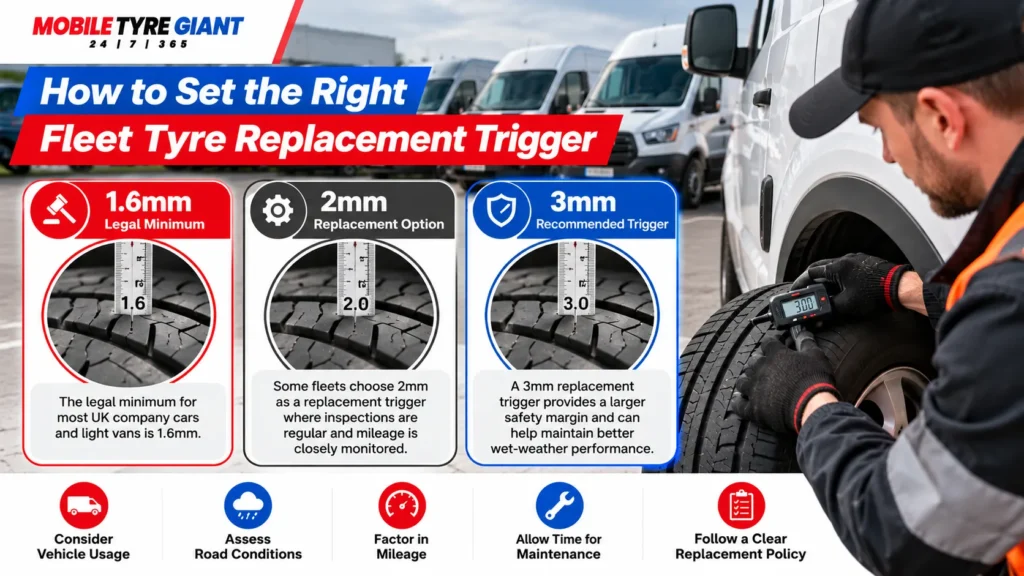
Setting a fleet tyre replacement trigger involves deciding how much tread should remain before a tyre is scheduled for replacement. For cars and most light vans, the UK legal minimum is 1.6mm, but fleet operators may choose an earlier threshold to support safety and maintenance planning. A business operating high-mileage delivery vehicles may need a different approach from one managing company cars used occasionally. The aim is to establish a clear, practical limit that reflects how the vehicles are driven.
A replacement policy should also explain what happens when a tyre reaches its chosen threshold. Simply recording a measurement without arranging follow-up action can leave a vehicle operating until the tread becomes insufficient. Fleet managers need to consider inspection frequency, daily mileage, wet-weather exposure and appointment availability. The selected trigger should allow necessary maintenance to be completed before the tyre becomes illegal or unsafe.
Is 3mm a Sensible Replacement Trigger for Company Cars and Vans?
A 3mm replacement trigger is a reasonable option for fleets seeking a larger margin above the 1.6mm legal minimum. It is commonly recommended by road safety organisations because tread depth influences how effectively tyres disperse water. Replacing tyres earlier can be particularly relevant for company cars and vans regularly travelling on wet motorways or busy roads. However, the precise benefits depend on the tyre model, road surface, speed and weather conditions.
For example, a fleet manager responsible for delivery vans travelling throughout London might set a policy requiring replacement when tread reaches 3mm. This would create a consistent standard across the relevant vehicles and help reduce uncertainty about replacement timing. The policy should still require immediate attention for serious tyre damage regardless of tread depth. A 3mm threshold is a preventive maintenance decision, not an additional legal requirement for every UK fleet.
Should Fleet Managers Use a 2mm Tyre Replacement Policy?
Some fleet operators choose a 2mm replacement threshold for cars and light vans to make greater use of the tyre’s remaining tread. This approach can be considered where inspections are reliable, mileage is closely monitored and replacements can be arranged promptly. However, it leaves a smaller margin above the legal minimum. A tyre close to 2mm may require particularly careful monitoring if the vehicle covers substantial distances between scheduled checks.
Imagine a service van measuring 2.1mm before beginning several days of motorway journeys. If the fleet only checks tread occasionally, postponing replacement could allow the tyre to reach the legal minimum before its next inspection. The actual rate of wear cannot be predicted accurately from tread depth alone. A 2mm trigger therefore needs dependable monitoring and a clear response procedure. It should not be treated as an automatically suitable option for every fleet.
Why Does Tyre Tread Depth Matter More in Wet Driving Conditions?
Tyre tread helps manage the water between the tyre and the road surface. As the grooves become shallower, their ability to displace water can decrease, particularly during heavy rain or when vehicles travel through standing water. This can affect grip and braking behaviour. For fleet vehicles operating in the UK’s frequently wet conditions, tread depth deserves attention well before the legal minimum is reached.
However, tread depth is only one factor influencing wet-road performance. Tyre design, rubber compound, inflation pressure, vehicle loading, speed and road conditions also matter. Two tyres with the same remaining tread depth may perform differently. Fleet managers should avoid assuming that a particular measurement guarantees a fixed stopping distance. A sensible replacement policy considers the wider conditions in which vehicles operate.
How Worn Tyres Can Affect Wet Braking and Aquaplaning
Aquaplaning occurs when water builds up between a tyre and the road, reducing the tyre’s contact with the surface. Worn tread can make water clearance less effective and increase the risk under suitable conditions. This matters when fleet vehicles travel on motorways during heavy rainfall or encounter standing water on poorly drained roads. Tyres with more remaining tread may offer advantages, but they cannot eliminate the possibility of aquaplaning.
Wet braking performance can also change as tyres wear. The explanation of how tyres affect braking distance provides further context about tyre condition and road grip. Fleet managers should consider these risks when deciding whether to adopt a 2mm or 3mm replacement trigger. Drivers must still reduce speed when conditions require it, maintain appropriate following distances and avoid sudden manoeuvres on slippery roads.
Why Tread Depth Alone Cannot Confirm a Tyre Is Safe
A tyre with 4mm or 5mm of tread is not necessarily safe for continued use. Damage to the sidewall, exposed reinforcing material, significant cracking or other structural defects may require immediate attention. A tyre may also show uneven wear that indicates a problem with alignment, suspension or inflation pressure. Fleet inspections must therefore examine the whole tyre rather than relying on a single tread measurement.
Consider a van tyre with 4mm remaining in its main grooves but a visible outward bulge on the sidewall. The remaining tread does not make the structural concern acceptable. The information on tyre sidewall damage explains why bulges, cuts and suspected internal damage require careful assessment. A written fleet policy should identify serious damage as a separate reason for immediate action, even when the tyre has not reached its scheduled replacement threshold.
Should Different Fleet Vehicles Have Different Replacement Thresholds?
A mixed fleet may contain company cars, light commercial vehicles, heavier goods vehicles and specialised transport. These vehicles have different operating demands and may be subject to different legal tread-depth requirements. Applying a single 3mm replacement rule without distinguishing vehicle categories can lead to unnecessary expenditure or inappropriate maintenance decisions. Fleet managers should establish the correct legal standards before setting any additional internal thresholds.
The same principle applies to vehicle usage. A company car covering occasional local journeys may experience different tyre wear from a van carrying heavy loads across several counties each day. Operating conditions, tyre specifications and inspection arrangements should influence the decision. A fleet-wide policy can remain consistent in its responsibilities and reporting procedures while allowing suitable replacement thresholds for different vehicle groups.
Replacement Planning for High-Mileage Vans and Delivery Vehicles
High-mileage vans may need more frequent tread assessments because they cover substantial distances between maintenance appointments. Frequent stopping, kerb contact and changing loads can also affect tyre condition. A manager responsible for busy delivery routes should consider how much mileage vehicles are expected to complete before their next inspection. This helps determine whether an early replacement trigger provides a useful maintenance margin.
Tyre pressure is another important consideration. Incorrect inflation can contribute to uneven wear and reduce the useful life of a tyre. The explanation of correct tyre pressure and its effect on wear highlights why pressures should be checked against manufacturer recommendations. For vans carrying variable loads, the appropriate inflation settings may also change. A replacement policy works best alongside reliable pressure management and regular condition checks.
Replacement Triggers for HGVs and Heavier Commercial Vehicles
Most HGVs over 3,500kg are subject to a 1mm legal tread-depth requirement, unlike most cars and light vans. Certain zero-emission goods vehicles above 3,500kg and not exceeding 4,250kg have a 1.6mm requirement. These distinctions must be recognised when creating a mixed-fleet tyre policy. A business should not assume that every vehicle described as a commercial van or lorry follows the same rule.
Heavier vehicles may use specialist tyres designed for different axle positions, loads and operating conditions. Tyre management decisions should reflect those specifications and any relevant maintenance guidance. The company may adopt earlier replacement limits, but the thresholds need a clear operational justification. Regular inspections, documented defects and professional assessment remain essential regardless of the chosen figure.
How to Turn a Tread-Depth Threshold Into a Practical Fleet Policy
Choosing a replacement figure is only the beginning. Fleet managers need a process that explains how tyre measurements lead to maintenance decisions. The policy should identify when a tyre requires routine monitoring, when replacement must be arranged and when a vehicle must not continue operating. These distinctions help avoid confusion between planned maintenance and urgent safety defects.
For example, a company using 3mm as its replacement trigger could require the maintenance team to arrange replacement when the measurement reaches that figure. A tyre showing serious damage would follow a separate immediate-action process regardless of depth. The policy should specify who authorises replacement, who arranges the work and how completion is recorded. This makes the chosen threshold meaningful in daily fleet operations.

Set Clear Inspection, Replacement and Immediate-Action Rules
A practical fleet policy can distinguish three types of maintenance decisions. The first involves monitoring tyres with satisfactory condition and sufficient tread. The second covers tyres approaching or reaching the company’s planned replacement threshold. The third involves tyres with illegal tread or defects that make them unsafe. Each situation requires an appropriate response rather than one blanket rule.
The maintenance team should also identify vehicles likely to cover substantial mileage before their next inspection. Tyres approaching the internal trigger may require an earlier appointment or closer monitoring. Any tyre below the applicable legal minimum must not remain in normal road use. Where damage makes roadworthiness uncertain, the vehicle should be professionally assessed before continuing. Clear instructions help drivers and fleet managers respond consistently.
Review Replacement Triggers Against Actual Fleet Performance
A replacement policy should be reviewed using real maintenance records rather than assumptions about tyre lifespan. Fleet managers can compare tread measurements, mileage between inspections, replacement frequency and unexpected tyre-related incidents. If vehicles regularly reach their replacement threshold sooner than expected, inspection intervals may need adjustment. If tyres show recurring uneven wear, the underlying mechanical or inflation issue should be investigated.
A useful policy also considers the practical cost of taking vehicles out of service. Planned fitting may allow businesses to replace tyres during quieter periods rather than interrupting scheduled deliveries. The correct approach is not automatically the earliest or latest possible replacement. It is the one that maintains roadworthiness, reflects operating conditions and provides enough time for safe, organised maintenance decisions.
How Should Fleet Managers Measure Tyre Tread Depth Accurately?
Accurate tread-depth measurements are essential for a reliable fleet tyre replacement policy. A tyre may appear to have sufficient tread when viewed from the outside, while another section is considerably more worn. This is particularly important for vehicles covering substantial daily mileage, where unnoticed wear could lead to unexpected replacement requirements. Fleet managers should establish a consistent measurement method so results can be compared across vehicles and inspections.
A proper tread-depth gauge provides a numerical reading in millimetres, making it more useful for maintenance records than a visual estimate. Measurements should be taken in the relevant principal tread grooves at several positions around the tyre. The lowest relevant reading helps determine whether a tyre meets the applicable legal requirement and the company’s replacement policy. Drivers should also check for visible damage that might require immediate attention regardless of tread depth.
Use a Tread-Depth Gauge and Check Several Positions
To measure tread depth, park the vehicle safely on level ground and ensure it cannot move. Remove loose debris from the groove before placing the gauge into the tread. Measure several principal grooves across the relevant tread area and repeat the process at different points around the circumference. This helps identify localised wear that a single measurement could miss. Always follow the appropriate requirements for the vehicle category being inspected.
For example, a delivery van might show 3.5mm in one section but only 2.4mm elsewhere. Recording only the higher figure could delay a replacement decision under a 3mm company policy. The explanation of how to check tyre tread depth provides additional guidance on using a gauge and examining different areas of a tyre. Consistent measurements help fleet managers make decisions based on actual condition rather than estimates.
Understand the Limitations of the 20p Tyre Test
The familiar 20p coin test can provide a quick indication of whether a car tyre may be approaching its legal tread-depth limit. When the coin is inserted into a principal tread groove, a visible outer band suggests the tyre needs closer inspection. However, this is a screening method rather than a precise measurement. It cannot reliably determine whether a tyre meets an internal 2mm or 3mm replacement trigger.
For a fleet maintaining detailed inspection records, a suitable gauge is the better choice. It allows measurements to be recorded consistently and compared with earlier readings. Tread wear indicators can also highlight when certain tyres approach their designed wear limits, but they should not replace proper measurements. Where tread depth appears close to the legal minimum or is difficult to assess, arrange a professional inspection before deciding whether the vehicle can remain in service.
How Often Should Fleet Tyre Tread Depth Be Inspected?
Inspection frequency should reflect vehicle usage, expected mileage and operating conditions. A company car covering relatively few miles may not require the same detailed measurement schedule as a delivery van travelling long distances every day. However, every vehicle must remain roadworthy whenever it is used. Fleet managers should establish suitable routine checks and additional inspections when drivers report unusual tyre wear or damage.
The policy should distinguish between quick visual checks and detailed tread-depth measurements. Drivers can identify obvious problems before journeys, while scheduled inspections provide the opportunity to record actual measurements. The information on creating a tyre maintenance schedule can help businesses organise regular tyre checks. For fleets subject to formal commercial vehicle maintenance requirements, the inspection arrangements must also meet the applicable operator obligations.
Include Tyre Condition in Daily Vehicle Walkaround Checks
Daily walkaround checks help drivers identify visible tyre problems before beginning their journeys. Drivers should look for cuts, bulges, unusual wear, embedded objects and signs of significant pressure loss. They should also report any tyre-related warning lights or handling problems. These checks are particularly important for commercial vehicles operating under demanding schedules or carrying substantial loads.
For HGV operators, a meaningful walkaround check must be carried out before use, with at least one check during each 24-hour period in service. Relevant defects must be reported through the required system. Light van operators and company car fleets should also establish suitable pre-use checks according to their vehicle responsibilities and operating risks. A visual walkaround does not replace detailed tread measurements when those are required.
Adjust Inspection Intervals for High-Mileage Fleet Vehicles
A fixed inspection interval may not suit every vehicle within a mixed fleet. High-mileage vans can experience substantial tread wear between scheduled maintenance appointments. Vehicles frequently carrying heavy loads or travelling on demanding routes may also require closer monitoring. Fleet managers should review mileage, previous measurements and reported defects when deciding how often detailed tyre inspections are necessary.
Consider two company vehicles inspected on the same day. One covers 300 miles each week, while the other travels several times that distance. Their next tread-depth checks may need to be scheduled differently. Managers should avoid assuming that all tyres wear at a predictable rate. If measurements reveal unusually rapid deterioration, investigate the cause and adjust the inspection schedule rather than relying on a fixed replacement date.
How Should Drivers Report Tyre Wear and Fleet Managers Record Defects?
A tread-depth policy only works when measurements lead to appropriate action. Drivers need a straightforward way to report concerns, while managers must know which vehicles require inspection or replacement. Verbal warnings can be forgotten during shift changes, particularly in businesses operating several depots. Written or electronic records create a clearer history of tyre condition and maintenance decisions.
An effective system should allow managers to identify vehicles approaching their chosen replacement trigger and distinguish those from vehicles with immediate safety concerns. Records can also help explain why a tyre was replaced earlier than expected. For commercial vehicle operators subject to DVSA maintenance requirements, defect reporting and record retention must follow the relevant guidance. Consistent information helps prevent outstanding problems from remaining unresolved.
What Information Should Be Included in a Fleet Tyre Inspection Record?
A useful tyre inspection record should identify the vehicle registration, inspection date, mileage and tyre position. It should include measured tread depths, visible defects and any relevant pressure concerns. Recording the tyre brand, size and specification can also help when arranging replacements. The person conducting the inspection should be identifiable so any unusual findings can be reviewed or clarified.
For example, an entry for the front-left tyre might show measurements of 3.2mm, 2.9mm and 2.7mm in different principal grooves. This provides more useful information than recording the tyre as simply satisfactory. The lowest relevant measurement can then be assessed against the fleet’s replacement trigger. Managers should also record the required action, its priority and confirmation that any replacement or repair has been completed.
Create a Clear Process for Reporting and Resolving Defects
Drivers should know exactly who receives tyre defect reports and what information must be supplied. The policy should explain which findings require monitoring, which need a planned replacement and which prevent further vehicle use. A tyre with illegal tread or a dangerous structural defect must not remain in normal road service. Where the condition is uncertain, professional assessment should take place before the vehicle continues.
For relevant commercial vehicle operations, DVSA guidance requires a system for recording defects and the work completed to resolve them. Reported defect records and associated rectification details must generally be retained for at least 15 months. Company car fleets can adopt similar record-keeping principles without assuming every HGV-specific requirement applies to them. The important operational point is that each reported defect must have a documented outcome.
How Can Fleet Managers Control Tyre Replacement Costs?
An effective replacement policy should protect roadworthiness while avoiding unnecessary expenditure. Replacing tyres too early without a clear reason can increase costs, but delaying essential work can create safety risks and unexpected vehicle downtime. Fleet managers should monitor tyre condition, wear rates and maintenance history to understand where money is being spent. The chosen replacement trigger should support consistent decisions rather than encourage automatic replacement of every tyre at the same age or mileage.
Cost control also depends on addressing problems that cause premature wear. Incorrect tyre pressure, alignment issues, overloading and suspension defects can shorten tyre life. Replacing a worn tyre without investigating these factors may result in the same problem returning. Managers should examine repeated patterns across individual vehicles and identify whether maintenance procedures need improvement.
Investigate Uneven Wear Before Replacing Fleet Tyres
Uneven tyre wear may suggest that a vehicle requires more than a replacement tyre. Excessive wear along one shoulder can indicate an alignment problem, while irregular patches may be associated with suspension or other mechanical issues. These patterns are not definitive diagnoses, so professional inspection is important. Identifying the underlying cause can help prevent a replacement tyre from developing similar wear.
Fleet managers should pay particular attention to vehicles requiring frequent tyre replacements despite covering comparable mileage to others. The explanation of cupped and scalloped tyre wear describes how irregular tread patterns can develop. Records showing repeated problems on the same vehicle may justify additional mechanical checks. This makes tyre replacement part of a wider maintenance strategy rather than an isolated purchasing decision.
Plan Replacements Before Tyres Reach Their Policy Trigger
Maintenance records can help identify which vehicles are approaching their replacement threshold. Rather than waiting until a driver reports an urgent problem, fleet managers can arrange suitable tyres and fitting appointments in advance. Scheduling replacements around depot availability or quieter operating periods may reduce disruption. This is especially useful for delivery and service fleets with tightly planned daily routes.
The process should remain flexible enough to respond when tyres wear faster than expected or suffer damage. Managers should review replacement costs alongside downtime, tread measurements and recurring defects. A tyre policy is successful when vehicles remain roadworthy and maintenance decisions can be explained through accurate records. Consistent inspections and planned replacements help businesses manage costs without treating the legal tread-depth minimum as their routine maintenance target.
Common Fleet Tyre Tread-Depth Policy Mistakes to Avoid
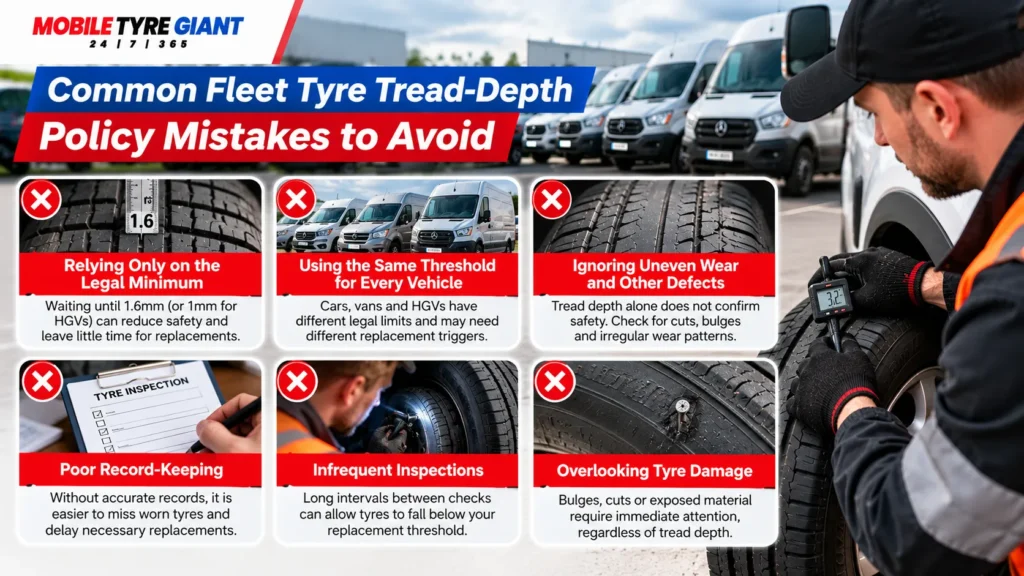
A fleet tyre tread-depth policy can look effective on paper but still fail to prevent problems if its rules are unclear or inconsistently followed. Some businesses focus only on the legal minimum, while others introduce an early replacement threshold without explaining how it should be applied. Both approaches can lead to poor maintenance decisions. A reliable policy must distinguish between legal compliance, planned replacement and defects requiring immediate attention.
Mistakes become more likely when a business operates different vehicle types across multiple locations. Drivers may use different inspection methods, maintenance teams may interpret thresholds differently, and replacement appointments may be delayed during busy periods. Fleet managers should review these risks and ensure that everyone follows the same reporting and decision-making process.
Treating the Legal Minimum as the Normal Replacement Target
One common mistake is using the legal tread-depth minimum as the standard point for routine replacement. For most cars and light vans, 1.6mm is the legal minimum, but that does not mean waiting until a tyre reaches this figure is the best maintenance strategy. A vehicle covering substantial mileage could fall below the requirement before its next inspection. Wet-road performance and other aspects of tyre condition must also be considered.
Fleet managers should establish an earlier replacement trigger where justified by their operating conditions. For example, a 3mm policy for company cars may provide additional time to arrange replacements. The chosen threshold should be documented and supported by a clear action procedure. The broader tyre safety guidance on tread depth and wear also reinforces why legal tread depth is only one part of assessing tyre condition.
Applying the Same Replacement Threshold to Every Vehicle
Another mistake is assuming that all fleet vehicles must follow identical tread-depth rules. Most company cars and light vans require at least 1.6mm, while many heavier commercial vehicles have a 1mm legal requirement. Certain zero-emission goods vehicles weighing more than 3,500kg but no more than 4,250kg are subject to the 1.6mm requirement. These distinctions can make a single fleet-wide legal threshold inaccurate.
Internal replacement triggers should also reflect vehicle usage and tyre specifications. A business operating company cars, delivery vans and HGVs may need separate thresholds for different groups. The policy should identify the applicable legal requirement before introducing any additional safety or maintenance margin. This prevents confusion and makes the replacement process more appropriate for each vehicle category.
Ignoring Uneven Wear and Other Tyre Defects
A tyre can show an acceptable tread-depth measurement in one area while being significantly more worn elsewhere. Measuring only the centre of the tyre or recording a single reading can therefore provide an incomplete picture. Drivers and technicians should check the relevant principal grooves at several positions around the circumference. Any unusual pattern should be investigated rather than dismissed as normal wear.
Tread depth alone cannot confirm that a tyre is roadworthy. Bulges, serious cuts, exposed reinforcing material and other structural defects may require immediate attention regardless of remaining tread. A fleet policy must include separate instructions for identifying and reporting these problems. Replacing a tyre at the correct tread-depth threshold is important, but it does not replace a complete condition inspection.
Final Fleet Tyre Tread-Depth Policy Checklist
A practical checklist helps fleet managers turn their written policy into consistent maintenance decisions. It should explain which legal standard applies to each vehicle, how tread measurements are recorded and what action follows when a tyre approaches its replacement threshold. The objective is to prevent important decisions from depending entirely on individual judgement.
The following checklist can be adapted for company cars, delivery vans and heavier commercial vehicles. Businesses should also consider any vehicle-specific maintenance instructions and additional requirements that apply to their operations. A useful policy is clear enough for drivers to understand and detailed enough for maintenance teams to follow.
- Confirm the correct legal tread-depth requirement for each vehicle category.
- Establish an appropriate internal replacement trigger.
- Use a suitable tread-depth gauge for recorded inspections.
- Measure the relevant tread grooves at several positions around each tyre.
- Inspect tyres for uneven wear, cuts, bulges and other defects.
- Record vehicle registration, mileage, tyre position and tread measurements.
- Identify who is responsible for reporting and approving tyre replacements.
- Remove unsafe or illegal tyres from normal road service.
- Arrange replacements before vehicles exceed their maintenance limits.
- Record completed work and review recurring tyre problems.
Establish Clear Actions for Each Inspection Result
The checklist should lead to a clear decision whenever a tyre is inspected. A tyre with adequate tread and no identified defects may remain in service under the appropriate monitoring schedule. A tyre approaching the company’s replacement threshold may require an earlier inspection or planned fitting appointment. A tyre that has reached the mandatory replacement point must be dealt with according to the written policy.
Unsafe tyres require a different response. If tread depth falls below the applicable legal minimum or a dangerous defect is identified, the vehicle must not continue in normal road use until the issue is resolved. The policy should state who can take a vehicle out of service and who authorises its return. This prevents operational pressure from overriding essential roadworthiness decisions.
Confirm Replacement Work and Update Fleet Records
A fleet tyre inspection is not complete simply because a defect has been reported. Managers need confirmation that the required action has taken place. This may involve fitting a replacement tyre, investigating uneven wear or correcting a related mechanical problem. Records should show the work completed and whether the vehicle has been confirmed fit for service.
For businesses operating vehicles across multiple sites, arranging mobile tyre fitting for fleets may help organise suitable replacement work around depot schedules. After fitting, appropriate checks should confirm that the replacement meets the vehicle’s specifications and has been installed correctly. The information on checks after mobile tyre fitting provides additional context for the handover process. Proper records help ensure outstanding problems are not forgotten.
How to Keep Your Fleet Tread-Depth Policy Effective Over Time
A replacement policy should be reviewed as vehicles, routes and operating demands change. A business expanding its delivery area or introducing heavier vehicles may need to reconsider inspection intervals and replacement thresholds. Tyre wear can also vary with changes in load, mileage and vehicle maintenance. Reviewing actual inspection results helps managers identify whether the existing policy remains appropriate.
Fleet managers should monitor repeated defects, unexpected replacements and vehicles frequently approaching the legal minimum between inspections. These findings may reveal that checks are too far apart or that drivers need additional training. Reviewing the policy periodically is more effective than assuming a replacement threshold will remain suitable indefinitely.
Use Maintenance Records to Improve Future Replacement Decisions
Maintenance records can reveal whether the chosen replacement trigger provides enough time to arrange fitting. For example, if several high-mileage vans regularly reach 1.7mm before a scheduled replacement, the fleet may need earlier inspections or a higher planning threshold. Managers should investigate the circumstances rather than automatically changing the policy for every vehicle.
The review should also consider avoidable downtime and recurring tyre defects. If the same vehicles experience unusual wear, examine pressure management, loading practices and possible mechanical causes. The goal is to improve roadworthiness and replacement planning while keeping maintenance decisions proportionate to actual risks. Reliable records provide a stronger basis for these decisions than estimates or assumptions.
Final Words: Build a Fleet Tyre Replacement Policy That Goes Beyond the Legal Minimum
An effective fleet tyre tread-depth policy clearly separates the legal minimum from the company’s planned replacement trigger. For most cars and light vans, the law requires at least 1.6mm, but an earlier threshold such as 2mm or 3mm may be appropriate depending on vehicle usage and maintenance arrangements. Heavier vehicles can have different requirements, making vehicle classification an essential part of policy development.
The strongest approach combines accurate measurements, regular inspections, prompt defect reporting and planned replacements. Fleet managers should ensure that dangerous tyres are removed from service, replacement work is recorded and internal thresholds are reviewed against actual vehicle performance. A consistent policy helps businesses maintain roadworthy vehicles, manage tyre costs and reduce avoidable operational disruption.
Fleet Tyres Wearing Down? Get Them Replaced!
Are your fleet tyres approaching their replacement threshold? Arrange professional mobile tyre fitting for vans and company vehicles at your depot or another safe, accessible location, helping reduce downtime and keep your fleet roadworthy.
Frequently Asked Questions
Find quick answers to the most common questions our customers ask.
Most UK company cars require at least 1.6mm of tread across the central three-quarters of the tyre and around its entire circumference.
No. For most cars and light vans, the legal minimum is 1.6mm. A 3mm replacement trigger is an earlier maintenance policy choice.
Most HGVs over 3,500kg require at least 1mm of tread. Certain zero-emission goods vehicles up to 4,250kg have a 1.6mm requirement.
Yes. Serious cuts, sidewall bulges, exposed reinforcing material or other dangerous defects can make a tyre unsafe regardless of its tread depth.
Inspection frequency should reflect vehicle mileage, operating conditions and applicable maintenance requirements. High-mileage vehicles may need more frequent measurements.
The 20p test is a useful quick screening method, but it cannot provide a precise measurement. A tread-depth gauge is better for fleet records.
Not always. The required action depends on the advisory and tyre condition. Fleet managers should assess the defect and follow their replacement policy.
Yes. Internal thresholds can reflect vehicle category, tyre specifications and operating conditions, provided the applicable legal requirements are always met.
The vehicle must not continue in normal road use with an illegal tyre. Arrange suitable replacement or recovery before returning it to service.
Drivers must ensure vehicles are safe to use, while operators have maintenance responsibilities. The fleet policy should clearly assign inspection and reporting duties.
Use accurate tread measurements, investigate uneven wear and schedule replacements before problems become urgent. Addressing underlying faults can also prevent premature wear.
Either may be selected as an internal trigger for suitable vehicles. The decision should consider mileage, wet-weather exposure and inspection frequency.