

A tyre should normally wear gradually and reasonably evenly across its tread, so a series of strange dips or scooped-out patches deserves attention. This pattern is commonly called tyre cupping or scalloping. Instead of the tread simply becoming shallower across one edge or through the centre, individual areas around the circumference wear lower than the sections beside them. Run your hand carefully around the tread and it can feel wavy, with alternating high and low spots rather than one smooth surface.
Cupping matters because the tyre is often showing you a problem somewhere else on the vehicle. Weak damping, worn suspension components, wheel imbalance, wheel or tyre runout and other mechanical issues can all create repeated changes in how firmly the tyre contacts the road. The tyre then wears in patches rather than evenly. Replacing the tyre without finding the cause may simply allow the same pattern to develop again on the replacement.
What Is Cupped or Scalloped Tyre Wear?
Cupped tyre wear is a repeating pattern of localised low spots around the tyre’s circumference. Imagine small sections of tread being scooped away every few inches while the areas between them remain noticeably higher. The pattern may be concentrated around one shoulder, appear across sections of the tread or develop in a diagonal sequence depending on the underlying problem. “Scalloped wear” is another common name for essentially the same irregular pattern.
The easiest way to understand it is to compare it with normal tread wear. A healthy tyre gradually loses rubber as it rolls thousands of miles across the road. A cupped tyre is losing more rubber at particular points because the contact load is repeatedly changing as the wheel rotates. This is why cupping belongs in a wider tyre safety check rather than being treated simply as cosmetic tread wear.
What Does Tyre Cupping Look Like?
Visually, cupping often appears as a sequence of dips, scallops or worn patches spaced around the tyre. One part of a tread block may look noticeably lower than the next, creating a wave-like surface when viewed from the side. On some tyres the pattern is obvious, while on others it is much easier to feel than see. Turning the front wheels can help expose the tread so the inner and outer areas can be inspected more closely.
A useful check is to compare several points around the complete circumference instead of looking only at the section touching the ground. Cupping may be present on one section that is hidden when the vehicle is parked. If you want to measure the remaining tread rather than relying on appearance alone, our guide on how to check tyre tread explains how to measure inner, centre and outer areas at several points around the tyre.
What Does a Cupped Tyre Feel Like?
Cupping can sometimes be felt through the vehicle before the tread pattern becomes obvious to the driver. Depending on which wheel is affected and how severe the wear has become, you may notice vibration through the steering wheel, seat or floor. The vibration can change with road speed because the uneven tread is repeatedly contacting the road as the wheel rotates.
The vehicle may also feel less smooth than it used to, particularly on otherwise good road surfaces. However, vibration alone does not prove the tyre is cupped. Wheel imbalance, bent wheels, damaged tyres, wheel bearings and other faults can produce similar symptoms. The tread pattern therefore needs to be inspected alongside the way the vehicle behaves.
What Does Tyre Cupping Sound Like?
A cupped tyre can produce a rhythmic humming, droning or thumping noise that becomes more noticeable as speed increases. Because the high and low tread sections reach the road repeatedly, the sound can rise and fall in a regular pattern. Drivers sometimes mistake this for a worn wheel bearing because both faults can create a noticeable road-speed-related hum.
The sound may also change depending on the road surface. Coarse tarmac can make irregular tyre wear considerably louder, while a smoother road may temporarily make it less obvious. A noise diagnosis should therefore consider the tyre, wheel and suspension together rather than assuming the loudest component must automatically be the source.
How Is Cupping Different From Normal Uneven Tyre Wear?
Uneven tyre wear is a broad description that includes several completely different patterns. Under-inflation may wear both shoulders faster than the centre, while over-inflation can concentrate wear through the middle of the tread. Alignment problems often produce heavier wear along one inner or outer edge. Cupping looks different because the wear repeatedly rises and falls around the circumference rather than remaining consistently heavy across one continuous section.
Recognising the shape of the wear helps narrow down what needs inspecting. If both shoulders are consistently worn, tyre pressure deserves attention. If one edge is continuously worn, alignment or suspension geometry may be involved. If individual patches are repeatedly lower than the surrounding tread, a dynamic problem such as poor damping, imbalance or wheel movement becomes more relevant.
What Is the Difference Between Cupping and Tyre Feathering?
Tyre feathering normally affects the edges of individual tread ribs. If you run your hand across the tread in one direction, it may feel relatively smooth, while moving your hand back the opposite way reveals sharp or raised edges. Feathering is commonly associated with toe alignment because the tyre is being scrubbed slightly sideways as it rolls.
Cupping instead creates distinct high and low areas around the circumference. The tyre feels wavy rather than simply sharp on one side of each tread block. The two wear patterns can sometimes exist together if the vehicle has more than one mechanical issue, which is why a visual diagnosis should not be reduced to one symptom alone.
What Causes Tyre Cupping?
Cupping develops when sections of the tyre repeatedly experience different loads as the wheel rotates. Ideally, the suspension keeps the tyre firmly and consistently in contact with the road. If the wheel begins bouncing, vibrating or moving in a way it should not, certain tread sections can hit or scrub the surface harder than others. Over thousands of rotations, those repeated differences remove rubber unevenly.
Several faults can create this behaviour. Worn shock absorbers or dampers are a well-known cause, but wheel imbalance, worn bushes, joint or bearing movement, bent wheels, excessive wheel or tyre runout and alignment problems can also contribute. The correct question is therefore not simply “Which part causes cupping?” but “What is making this wheel load the tyre unevenly?”
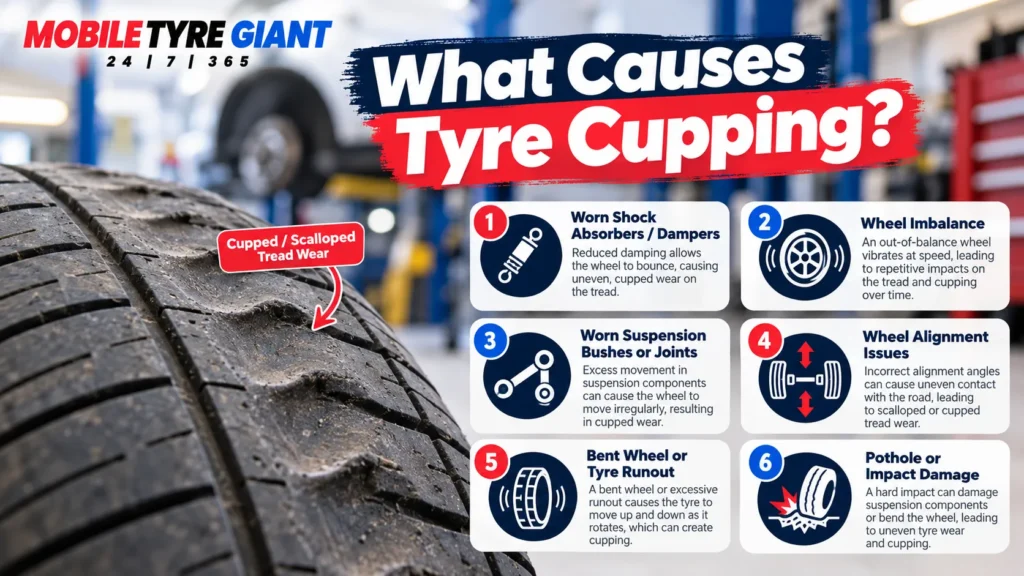
Can Worn Shock Absorbers Cause Scalloped Tyre Wear?
Yes. Shock absorbers or dampers help control how the wheel and suspension move after bumps and changes in the road surface. If damping becomes weak, the wheel can continue moving up and down more than intended instead of settling quickly. That repeated movement can change the load placed on the tyre as it travels along the road.
Over time, the bouncing action can contribute to scalloped or cupped wear. However, seeing a cupped tyre does not prove that the shock absorber is definitely faulty. Suspension joints, bushes, wheel balance and other wheel-end components still need checking because replacing dampers based on tread appearance alone risks missing the actual cause.
Can Wheel Imbalance Cause Tyre Cupping?
Yes. An imbalanced wheel has uneven mass distribution around the rotating assembly. As speed rises, the heavy area creates repeated forces that can make the wheel vibrate rather than rotate smoothly. If that vibration continues for long enough, it can contribute to irregular patch wear and may worsen an existing cupping problem.
This is why balancing should be included in the diagnostic process, especially when the driver reports vibration at particular speeds. Professional mobile wheel balancing measures how weight is distributed around the complete wheel and tyre assembly and adds corrective weights where necessary. Balancing can correct an imbalance that is contributing to future wear, but it cannot put rubber back onto areas of a tyre that have already been cupped.
Will Balancing Fix a Tyre That Is Already Cupped?
No. Wheel balancing may correct one of the conditions that caused or contributed to the wear, but existing scallops remain physically worn into the tread. The tyre will not become smooth again simply because the rotating assembly has been balanced. Noise or vibration from the uneven tread may therefore continue even after the original imbalance has been corrected.
The purpose of balancing is to prevent the mechanical cause from continuing to damage the tyre. Whether the existing tyre can remain in service then depends on tread depth, severity of the wear, grip, noise and overall condition. A lightly affected tyre may still have usable life after the cause is corrected, whereas severe cupping can make replacement the more practical option.
Can Suspension Bushes or Joints Cause Cupped Tyres?
Yes. Suspension bushes, ball joints and other locating components help keep the wheel positioned correctly as the vehicle moves. Wear or looseness can allow unwanted movement that changes the way the tyre contacts the road. Instead of maintaining a stable footprint, the wheel may move or oscillate under braking, acceleration or road impacts.
The resulting wear does not always appear as textbook cupping because worn components can also alter alignment and create one-sided or feathered wear. This is why inspecting the complete suspension and steering system matters. A tyre pattern provides an important clue, but it should guide diagnosis rather than replace mechanical testing.
Can One Cupped Tyre Point to a Problem on One Corner?
It can. If only one tyre shows obvious scalloping while the other three remain relatively even, a corner-specific issue becomes more likely. That could include a weak damper, worn bush or joint, wheel imbalance, damaged wheel, bearing movement or another problem affecting that particular wheel assembly.
Compare the tread pattern, pressure and condition of all four tyres before reaching a conclusion. It is also useful to check whether that wheel recently hit a pothole, lost a balance weight or received suspension work. The history can help explain why one corner developed a problem while the others remained normal.
Why Should Cupped Tyre Wear Be Investigated Early?
Cupping tends to become more noticeable once it has started because the uneven tread itself can add vibration as the wheel rotates. That does not mean the wear will always progress at exactly the same rate, but allowing the mechanical cause to continue can remove more tread and make noise or vibration increasingly intrusive. Waiting until the tyre becomes extremely uneven can also make it harder to separate the original fault from secondary symptoms.
Early inspection can protect the replacement tyre as well as the current one. If a suspension or wheel problem is responsible, fitting a new tyre before correcting that problem can start the same wear cycle again. Diagnosing the vehicle first gives the next tyre a much better chance of wearing normally and prevents repeated replacement from becoming an expensive substitute for fixing the actual cause.
How Do Worn Dampers Cause Tyre Cupping?
Dampers help control the movement of the wheel after the tyre passes over bumps, dips and uneven road surfaces. A healthy damper allows the suspension to move but brings that movement back under control quickly. When damping becomes weak, the wheel may continue bouncing vertically instead of settling smoothly. Each bounce changes how firmly the tyre presses against the road, so some areas of tread repeatedly carry more load than others.
Over thousands of miles, this repeated variation can create the characteristic dips associated with scalloped tyre wear. The tyre itself is not causing the suspension to bounce, although severe cupping can later add its own vibration. If a vehicle feels unusually floaty, continues bouncing after bumps or develops patchy tread wear, the suspension should be investigated. Our guide on how suspension problems damage tyres explains how dampers, bushes, springs and other components can produce different wear patterns.
Can You Test Shock Absorbers by Pushing Down on the Car?
The traditional bounce test can sometimes reveal an obviously weak damper, but it should not be treated as a complete diagnosis. Pressing firmly on one corner of the vehicle and watching how quickly it settles may highlight excessive movement, but modern suspension systems vary greatly in stiffness and design. A vehicle can also have degraded damping without producing a dramatic result during a simple driveway test.
A professional inspection is more reliable because the damper can be assessed alongside springs, bushes, joints, tyre wear and wheel movement. Fluid leakage around a damper may provide another clue, but not every failed damper visibly leaks. The cupped tread itself should therefore be used as evidence that something needs investigating rather than proof that one particular part must be replaced.
Can Wheel Alignment Cause Cupped or Scalloped Tyre Wear?
Wheel alignment can contribute to irregular tyre wear, although incorrect alignment more commonly produces continuous inner-edge, outer-edge or feathered wear rather than classic isolated cups. If camber, toe or another geometry angle is outside specification, the tyre can contact the road unevenly. Combined with weak damping or looseness elsewhere in the suspension, this can make a scalloped pattern more pronounced.
This is why alignment should be checked as part of a broader diagnosis instead of being blamed automatically. Correcting alignment may prevent further abnormal wear if the geometry is wrong, but it will not restore tread that has already been worn away. If a new tyre is fitted without correcting a significant alignment issue, the replacement may begin developing its own uneven pattern.
Can Incorrect Camber Create Cupping on One Shoulder?
Incorrect camber changes how much of the inner or outer side of the tyre carries load. When camber is significantly outside specification, one shoulder may wear more quickly than the rest of the tread. If another dynamic problem such as weak damping or wheel movement is also present, that shoulder can develop alternating high and low patches rather than one continuous band of wear.
This combination can make diagnosis more complicated because the tyre may show more than one wear pattern at the same time. One section may appear scalloped while the overall shoulder is also wearing faster. Looking at the complete tread across several points around the circumference helps reveal whether you are dealing with one fault or several contributing issues.
Can a Bent Wheel or Tyre Runout Cause Scalloped Wear?
Yes. A wheel that is bent or a tyre that does not rotate perfectly round can create runout, meaning the assembly moves slightly up and down or side to side as it turns. Even a relatively small variation can create repeated forces at road speed. If that movement is significant enough, the tyre may load the road unevenly and develop irregular wear over time.
Runout can result from wheel damage, tyre construction issues, incorrect seating or a strong road impact. A technician can measure the wheel and tyre while they rotate to determine whether movement exceeds acceptable limits. Simply adding balance weights does not correct every runout problem because balancing addresses weight distribution rather than whether the wheel or tyre is physically round and true.
Can a Pothole Cause Tyre Cupping Later?
A pothole does not usually create a complete cupping pattern instantly. However, a hard impact can bend a wheel, disturb alignment, damage suspension components or create tyre damage that later contributes to irregular wear. The driver may notice nothing immediately and only discover scalloped tread several thousand miles afterwards.
If cupping develops after a memorable pothole strike, that history is worth mentioning during diagnosis. Inspecting the tyre alone may miss wheel or suspension damage caused by the same impact. Our guide on pothole tyre damage in London explains why tyres, wheels, alignment and suspension should all be considered after a strong road impact.
Can Worn Wheel Bearings Cause Cupped Tyres?
A worn wheel bearing can allow movement or vibration at the wheel hub, although bearing faults are not the most common cause of tyre cupping. As wear increases, the wheel may no longer remain as stable as intended under load. That movement can affect tyre contact and may contribute to irregular tread wear alongside other suspension or alignment problems.
Wheel bearings can also create a humming or growling noise that drivers sometimes mistake for cupped tyre noise. Because both symptoms often become louder with speed, visual tyre inspection and mechanical checks are important. A technician may check for hub play, roughness or noise while rotating the wheel to determine whether the sound comes from the tyre, bearing or both.
How Can You Tell Wheel-Bearing Noise From Cupped Tyre Noise?
Cupped tyre noise often changes noticeably with road surface because the tread pattern itself is interacting with the tarmac. A worn bearing can produce a more consistent growl or hum and may change when vehicle load shifts during gentle cornering. These clues can help, but neither is reliable enough to make a diagnosis without inspection.
The tyre should be checked for repeated dips around its circumference while the wheel and bearing are assessed separately. It is also possible for both problems to exist at the same time. Replacing a bearing will not remove tread scalloping that has already formed, just as replacing a cupped tyre will not repair a worn bearing.

Can Incorrect Tyre Pressure Cause Cupping?
Incorrect inflation is more commonly associated with predictable wear patterns such as excessive shoulder or centre wear, but it can contribute to irregular wear when combined with another mechanical problem. An under-inflated tyre flexes more through the sidewall and shoulder, while an over-inflated tyre changes how load is distributed across the tread. Either condition can make an existing suspension or wheel problem harder on the tyre.
Pressure should therefore be checked during any cupping diagnosis even when it does not appear to be the primary cause. Compare the cold pressure with the vehicle manufacturer’s specification and check whether one tyre has been running consistently lower than the others. Our guide on under-inflated tyres explains how low pressure changes heat, flex and tread wear.
Will Correcting Tyre Pressure Remove Existing Cupping?
No. Correcting pressure can prevent additional pressure-related stress, but the worn low spots remain in the tread. Rubber that has already been removed cannot grow back, so an established cupping pattern may continue producing noise even after inflation has been corrected.
The value of correcting pressure is preventive. It gives the tyre a better chance of wearing normally once the underlying mechanical cause has also been resolved. If the cupping has become severe enough to affect comfort, grip or usable tread depth, replacement may still be needed even though the pressure is now correct.
Does Tyre Rotation Help With Cupped Tyres?
Rotation may help distribute mild normal wear when tyres are healthy, but it is not a cure for existing cupping. Moving a scalloped tyre to another corner simply moves the worn pattern with it. In some cases, the change in position can make the noise or vibration feel different because the tyre is now transmitting forces through another part of the vehicle.
Rotation should therefore happen only after the underlying cause has been assessed. If a suspension or wheel problem is still present, moving tyres around can make diagnosis harder and may allow additional tyres to develop abnormal wear. The priority is to identify why the tyre became cupped before deciding whether any remaining serviceable tyres should change positions.
Can Rotation Prevent Cupping Before It Starts?
Regular rotation can help distribute normal position-related wear on vehicles and tyre setups where rotation is permitted. However, it cannot compensate for a failed damper, badly imbalanced wheel or loose suspension component. If the mechanical problem is strong enough to make the tyre bounce or move irregularly, the tyre can still develop scalloping after rotation.
Rotation works best as preventive maintenance on a mechanically healthy vehicle. It can help stop one axle or corner from wearing significantly faster under normal conditions. Once abnormal patch wear appears, diagnosis becomes more important than simply following the next scheduled rotation interval.
How Is Tyre Cupping Different From Flat Spotting?
Flat spotting usually creates one localised flattened area rather than a repeating pattern of dips around much of the circumference. Temporary flat spots can develop when a vehicle remains parked for a long period and the tyre takes a temporary set where it contacts the ground. These may reduce as the tyre warms and returns to normal shape during driving.
Permanent flat spots can also result from severe braking without ABS or from tyre damage. Cupping, by comparison, normally appears as multiple alternating high and low sections caused by repeated dynamic loading. Both conditions can create vibration, but their appearance and underlying causes are different.
Can a Parked Car Develop Cupped Tyres?
Simply leaving a vehicle parked is more likely to create temporary flat spotting than traditional tyre cupping. Cupping usually develops through repeated wheel movement and uneven loading while the vehicle is being driven. If a car has been stationary for months and vibrates when first driven, flat spotting should therefore be considered before assuming the tread is scalloped.
If the vibration does not improve after the tyres have warmed or visible dips appear repeatedly around the circumference, further inspection is needed. Older tyres can also develop age-related deterioration during long storage, so pressure, cracking and tyre condition should be checked alongside the wear pattern.
Why Does Cupping Sometimes Appear Mainly on the Tyre Shoulders?
Shoulder cupping can develop when the outer or inner areas of the tyre experience repeated changes in load. Suspension geometry, weak damping and incorrect pressure can all influence how much work the shoulder performs. If the wheel is also moving vertically or laterally, individual shoulder sections can wear lower than neighbouring areas.
The location of the cups can provide useful diagnostic clues but should not be treated as a perfect fault code. Inner-shoulder scalloping does not automatically mean one specific component has failed, just as outer-shoulder cupping does not prove another. Compare the wear with alignment measurements, suspension condition, pressure history and wheel balance before reaching a conclusion.
Is Inner-Edge Cupping Harder to Spot?
Yes. Inner-edge wear is easy to miss because most drivers naturally inspect the outer shoulder when standing beside the vehicle. The inner tread may be much more uneven while the visible section still looks acceptable. This can allow cupping or other abnormal wear to progress for a long time without being noticed.
Use a torch where necessary and inspect across the complete tread width when the vehicle is safely parked. During servicing or tyre work, the inner area becomes easier to examine properly. Finding hidden wear early can prevent a driver from assuming the tyre is healthy based only on the most visible outer edge.
Is It Safe to Drive on Cupped Tyres?
Whether a cupped tyre is safe to continue using depends on how severe the wear has become and whether the underlying mechanical problem is still present. Mild scalloping with plenty of usable tread may not require immediate tyre replacement, but it should still be investigated because the wear pattern shows that the tyre has not been contacting the road evenly. As the cups become deeper, the tyre can create more vibration, road noise and inconsistent contact with the road surface.
Severe cupping deserves much more caution. If some areas of the tread are approaching the legal limit, the tyre is vibrating strongly, the vehicle feels unstable or another defect such as a bulge or exposed reinforcement is present, continued normal driving may no longer be appropriate. The tyre and vehicle should be assessed together because repairing only the tyre symptom without correcting the mechanical cause can allow the problem to continue.
Can Cupped Tyres Affect Braking?
Yes. A badly cupped tyre does not place the tread on the road as evenly as a healthy tyre. As the wheel rotates, alternating high and low sections pass through the contact patch, which can reduce the consistency of the grip available during braking. The effect may be relatively small with light cupping but becomes more relevant as the wear pattern becomes deeper.
The vehicle’s braking system may still function normally, but the tyre is the component transferring braking force to the road. If the tyre contact is irregular, particularly on wet or slippery surfaces, the available grip may become less predictable. Cupping should therefore not be dismissed simply because the car still stops normally during gentle everyday driving.
Does Tyre Cupping Reduce Wet Grip?
It can. Cupped tread is no longer wearing in the uniform way the tyre was designed to operate. Localised low spots may reduce how consistently the tread blocks contact the road and manage water beneath the tyre. If cupping has also reduced tread depth significantly in certain areas, wet-weather performance can become a greater concern.
The risk increases when abnormal wear combines with another condition such as under-inflation, ageing rubber or a suspension fault. Wet roads already reduce the margin of available grip, so a tyre with severe irregular wear has less tolerance for sudden braking or steering. Checking the lowest tread areas is particularly important because an average measurement can hide individual cups that are considerably more worn.
Can a Cupped Tyre Aquaplane More Easily?
Aquaplaning depends on several factors including water depth, speed, tread depth, tyre pressure and tread design. Cupping alone does not guarantee aquaplaning, but severely uneven tread can reduce the tyre’s ability to manage water consistently. The deepest-worn areas may have less usable groove depth than the rest of the tyre.
This is another reason to measure tread at several positions around the circumference. A tyre may appear to have acceptable tread when measured on a high section while the next low spot is much closer to the replacement threshold. The condition should be judged from the worst areas rather than the healthiest-looking part of the tread.
Can You Drive on the Motorway With Cupped Tyres?
Motorway driving can make cupping symptoms more noticeable because wheel speed increases and the uneven tread contacts the road more frequently. A tyre that produces a mild hum around town may become noticeably louder at motorway speeds, while vibration from imbalance or severe scalloping can also increase. Sustained high-speed driving places greater demands on the tyre, wheel and suspension.
If the cupping is minor, the tyre has been inspected and the mechanical cause has been corrected, the vehicle may still be usable. Severe vibration, deep wear or an unresolved suspension or wheel problem should be dealt with before a long motorway journey. A tyre that already feels unstable at moderate speeds should not be tested at higher speed simply to see whether the vibration improves.
Should You Stop Driving if Cupping Causes Strong Vibration?
Strong or suddenly worsening vibration should be investigated rather than accepted as a normal characteristic of an old tyre. Reduce speed safely and arrange inspection, particularly if the vibration is accompanied by steering movement, knocking, unusual noise or visible tyre damage. Several faults beyond cupping can create similar symptoms, including wheel damage, imbalance and looseness in suspension or steering components.
If the tyre has already become too worn or uncomfortable to remain in service, mobile tyre replacement can replace the affected tyre, but the mechanical cause should still be identified. A new tyre fitted to a vehicle with an unresolved fault may begin developing the same scalloped wear.
Does Tyre Cupping Get Worse Over Time?
It often can if the cause remains present. A weak damper, imbalanced wheel or loose suspension component continues affecting the tyre every time the vehicle is driven. The existing high and low tread sections can also produce additional vibration as the wheel rotates, making the symptoms increasingly noticeable even if the original fault does not become dramatically worse.
The rate of progression varies. Some light cupping may develop slowly over thousands of miles, while a stronger mechanical fault can create visible wear much faster. Checking the tread regularly can help determine whether the pattern is stable or still developing. Increasing noise, deeper cups or faster tread loss are signs that the problem should not be postponed.
Can Cupping Stop Getting Worse After the Cause Is Fixed?
Yes, correcting the underlying fault can stop or greatly reduce further abnormal wear. For example, replacing a failed damper, correcting wheel balance or repairing suspension movement may allow the tyre to contact the road more consistently again. The existing scalloped areas, however, remain physically worn into the tyre.
The tyre may continue to sound noisy or feel slightly rough even after the mechanical repair because the tread surface is still uneven. Whether it can remain in use depends on the amount of tread left, severity of the cupping and how the vehicle behaves. Fixing the cause protects future tread, but it cannot reverse existing wear.
How Is Cupped Tyre Wear Diagnosed Properly?
Diagnosis should begin with all four tyres rather than focusing only on the loudest or most visibly worn one. Inspect the tread around the complete circumference, compare inner, centre and outer sections and note whether the cups appear on one tyre, one axle or several wheels. Measure pressures and tread depths, then record any vibration, humming or handling symptoms reported by the driver.
The next stage is to inspect the components that control how the wheel rotates and moves. This can include wheel balance, wheel and tyre runout, dampers, springs, bushes, ball joints, wheel bearings and alignment. Recent pothole impacts or repairs should also be considered. The aim is to identify the reason the tyre was loaded unevenly rather than simply confirming that the tread looks scalloped.
Should Wheel Balance or Suspension Be Checked First?
There is no universal order that proves one fault before another because both can contribute to cupping. If the driver reports a speed-related vibration, wheel balance becomes an obvious early check. If the vehicle bounces excessively, feels unstable or shows one-corner wear, suspension condition deserves particular attention. In practice, a good diagnosis checks both rather than assuming one excludes the other.
Alignment should also be measured if the tread shows edge wear, feathering or steering symptoms. Cupping sometimes develops alongside another wear pattern, so the vehicle may have more than one fault. Finding all contributing causes before fitting replacement tyres reduces the risk of the new set wearing abnormally.
Can a Cupped Tyre Become Smooth Again?
Not completely. Once rubber has worn away from individual sections, it cannot grow back. Some drivers notice that light cupping becomes less noticeable after the mechanical cause is repaired and the tyre continues wearing, because the surrounding tread gradually wears closer to the same level. However, this should not be treated as a reliable repair method.
Waiting for a severely cupped tyre to “wear itself smooth” can sacrifice a large amount of usable tread and may leave the driver with persistent noise and vibration. The decision should be based on remaining tread and tyre condition rather than hoping normal driving will restore the original profile. Severe or uncomfortable cupping often makes replacement more practical.
Will New Shock Absorbers Make Cupped Tyres Quiet Again?
Replacing worn dampers may stop the condition that contributed to further cupping, but it cannot remove the uneven tread already present. Noise may improve slightly because the wheel movement is now better controlled, yet the high and low tread areas can continue producing a humming or droning sound against the road.
If the tyre remains very noisy after suspension repairs, inspect its remaining tread and overall condition. In some cases, the tyre can continue safely until normal replacement is due. In others, the noise, vibration or depth of the scallops makes earlier replacement a better option.
When Should a Cupped Tyre Be Replaced?
Replacement should be considered when the cups are deep enough to reduce usable tread significantly, when one or more sections are near the legal limit, or when vibration and noise have become excessive. Replacement is also necessary if another tyre defect such as a bulge, exposed reinforcement, severe cracking or structural damage is present. The lowest-worn part of the tyre matters more than the best-looking section.
Even when tread depth remains legal, replacement may still be sensible if severe scalloping is affecting ride quality or confidence in wet conditions. Our guide on when to replace tyres explains why tread depth is only one part of the decision. Overall condition, damage and wear pattern also need to be considered.
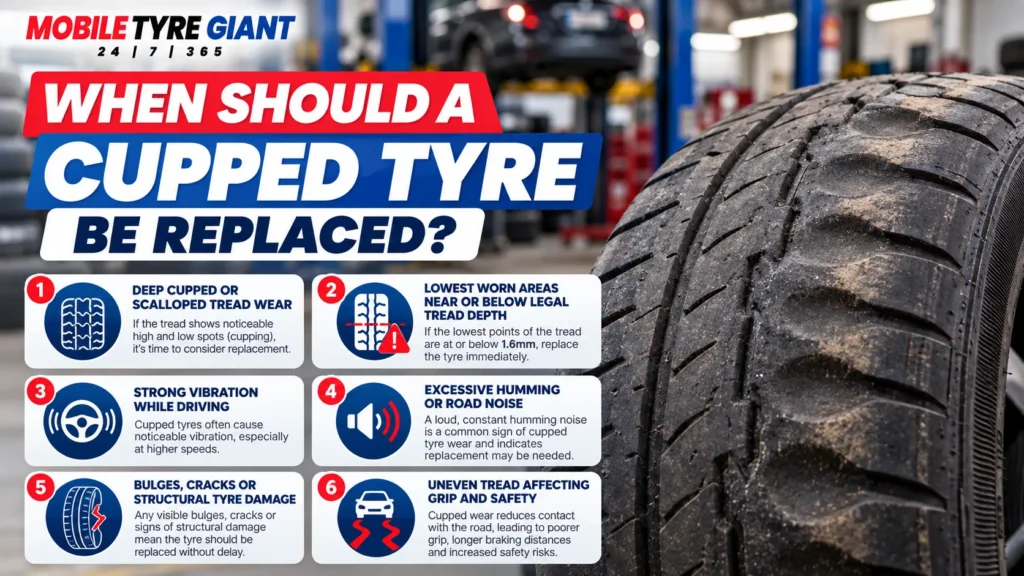
Can a Cupped Tyre Be Repaired Instead of Replaced?
Cupping itself cannot be repaired because the problem involves missing tread rubber rather than a puncture that can potentially be patched. Mechanical repairs can stop the cause, but there is no safe process that restores the worn tread blocks to their original height.
A tyre may remain usable after the vehicle fault is corrected if the cupping is mild and sufficient tread remains. Severe wear generally leaves replacement as the practical solution. Any decision to continue using the tyre should be based on professional inspection rather than an attempt to fill or reshape the worn areas.
Do You Need to Replace One or Two Cupped Tyres?
If only one tyre is cupped and the other tyre on the same axle remains in good condition with similar tread depth, replacing a single tyre may sometimes be appropriate. The replacement must be compatible in size, load rating and other relevant specifications. The remaining tyre should be inspected carefully because it may have been exposed to the same suspension or alignment conditions even if the wear is less obvious.
If both tyres on the axle show similar scalloping or the remaining tyre is already heavily worn, replacing the pair may provide a more balanced result. AWD and some performance vehicles can also have manufacturer-specific requirements regarding tread-depth differences. The vehicle configuration should therefore be checked before deciding how many tyres to replace.
Should the Mechanical Fault Be Fixed Before Fitting New Tyres?
Yes, wherever practical. Installing a new tyre on a vehicle with a failed damper, serious imbalance or worn suspension component risks starting the same cupping process again. The new tyre may initially feel quieter and smoother, which can hide the fact that the underlying mechanical fault remains.
A better sequence is to diagnose the wear, repair the vehicle fault, verify wheel balance and alignment where relevant, then replace tyres that are no longer suitable for service. This approach protects the new tyre and prevents replacement from becoming an expensive temporary solution.
How Can You Stop New Tyres From Cupping Again?
Start by repairing the cause of the original wear. Check dampers, suspension joints, bushes, wheel bearings, balance, alignment and wheel condition rather than assuming the old tyre was simply defective. Correct tyre pressure should then be maintained because inappropriate inflation can increase the stresses placed on the tread and sidewalls.
Regular inspections can catch early scalloping before it becomes severe. Look at all four tyres during pressure checks and compare tread height around the circumference instead of only across the width. If vibration, humming or unusual wear starts to return after fitting new tyres, investigate early. Preventing a small mechanical problem from continuing for thousands of miles is usually much cheaper than replacing another prematurely worn tyre.
What Should Be Checked After Cupped Tyre Wear Is Found?
Finding the scalloped tread pattern is only the beginning of the diagnosis. The next step is to compare all four tyres, check cold pressures and inspect the wheel and suspension components on the affected corner. Look for differences in tread depth, unusual shoulder wear, missing wheel weights and visible wheel damage. If only one tyre is affected, a corner-specific problem becomes more likely, while similar cupping across an axle may point towards a condition affecting both sides.
The vehicle’s behaviour should also be considered. Note whether there is vibration at a particular speed, a humming or droning noise, excessive bouncing after bumps, steering movement or pulling. These symptoms can help narrow down whether wheel balance, suspension, alignment or another wheel-end component needs closer attention. A complete inspection is more useful than replacing the tyre first and trying to diagnose the vehicle afterwards.
Should All Four Tyres Be Inspected if Only One Is Cupped?
Yes. One obviously scalloped tyre can draw attention away from early wear developing elsewhere. Compare each tyre around its full circumference and across the inner, centre and outer tread. A second tyre may already show smaller dips that are difficult to notice until you know what pattern you are looking for.
Checking the complete set also helps reveal whether the problem is isolated or systematic. Two front tyres with similar wear might suggest a different diagnostic direction from one rear tyre showing severe scalloping. Comparing all four tyres before repairs provides useful evidence and gives you a baseline for future checks.
Should Tyres Be Rotated After the Cause of Cupping Is Fixed?
Rotation may be appropriate if the remaining tyres are still serviceable and the vehicle and tyre configuration allow it. The purpose would be to manage normal future wear rather than to cure the scalloping that has already formed. Directional tyres, staggered wheel sizes and manufacturer-specific rotation instructions can limit which tyres may move to different positions.
The tread condition should be assessed before rotation. Moving a severely cupped tyre to another axle may simply move the noise and vibration with it, while placing a badly worn tyre in a position where more grip is needed may be undesirable. If rotation is appropriate after repairs, it should follow a proper pattern rather than randomly swapping wheel positions.
Can Regular Tyre Rotation Help Prevent Scalloped Wear?
Regular rotation can help distribute normal position-related tyre wear when the vehicle is mechanically healthy. It may prevent one axle or corner from developing a large wear difference simply because of normal steering, braking or drivetrain loads. However, rotation cannot compensate for weak dampers, wheel imbalance, looseness or a bent wheel.
This is why rotation works best as part of preventive maintenance rather than as a treatment for existing cupping. If you already know the tyre has developed scallops, diagnose the cause first. Future rotations can then help the replacement or remaining healthy tyres wear more evenly once the mechanical problem has been corrected.
How Soon Should You Recheck the Tyres After Repairs?
After the suspension, balancing or alignment issue has been corrected, inspect the tyres again during the following weeks and routine pressure checks. You are looking for evidence that the wear pattern is no longer progressing. Existing cups will still be visible, so the important question is whether they are becoming deeper or whether new irregular sections are developing.
A follow-up check is particularly useful after fitting replacement tyres. New tread makes abnormal wear easier to identify because any developing pattern stands out against an otherwise uniform surface. If scalloping begins appearing again relatively quickly, the original diagnosis may have missed another contributing problem and the vehicle should be rechecked.
What if a New Tyre Starts Cupping Again?
Recurring cupping suggests that the underlying cause has not been completely resolved or another fault is present. Recheck wheel balance, alignment, dampers, bushes, joints, wheel bearings and wheel runout. Also confirm that pressures have been maintained correctly and that the wheel has not suffered another pothole or kerb impact.
Do not simply replace another tyre and repeat the cycle. Rapid recurrence is useful diagnostic information because it proves the vehicle is still creating an abnormal loading pattern. Addressing the mechanical cause protects the next tyre and avoids repeated premature replacement.
Can Cupped Tyres Affect MOT Results?
Tyre cupping itself is not judged simply by the name of the wear pattern. What matters during an MOT is whether the tyre meets the required tread-depth and condition standards and whether there are defects that make it unsafe. Severe scalloping can become relevant if parts of the tread have worn below the permitted limit or if other damage is present.
An MOT should also not be treated as the only time to deal with cupping. A tyre can develop significant noise, vibration or abnormal wear long before an annual test. If the pattern is becoming worse, investigating it early can protect the tyre and reveal a suspension or wheel fault before it becomes more expensive.
Can a Tyre Pass an MOT but Still Need Attention for Cupping?
Yes. A tyre may still have sufficient legal tread and no immediately disqualifying structural defect while showing noticeable scalloped wear. Passing the minimum inspection standard does not mean the wear pattern should be ignored. The tyre may still be noisy, uncomfortable or evidence of a mechanical issue that continues damaging the tread.
This is why the practical standard for maintenance can be higher than simply asking whether the vehicle would pass an MOT today. Investigating abnormal wear early helps maintain handling, tyre life and ride quality even before the wear becomes legally unacceptable.
Cupped or Scalloped Tyre Wear Diagnosis Checklist
Use the following checklist when a tyre shows repeated dips or a wave-like tread pattern.
Check | What to Look For |
Tread pattern | Repeating high and low sections around the tyre |
Tread depth | Lowest worn areas, not only the highest sections |
Tyre pressure | Correct cold pressure for the vehicle |
Wheel balance | Missing weights or measurable imbalance |
Dampers | Weak control, leakage or excessive movement |
Suspension | Worn bushes, joints or looseness |
Wheel bearings | Play, roughness or unusual noise |
Wheel condition | Bends, impact damage or excessive runout |
Alignment | Incorrect toe, camber or other geometry |
Tyre condition | Cracks, bulges, cuts or other damage |
Road-test symptoms | Vibration, humming, bouncing or instability |
This checklist helps organise the diagnosis but should not be used to decide that one visible symptom proves a specific component has failed. Several problems can create similar tyre wear, and more than one fault can exist at the same time. The most reliable approach combines tread inspection with mechanical checks and driver symptoms.
When Should Professional Tyre Help Be Arranged?
Professional assessment is sensible when the cupping is clearly visible, vibration is strong, the tread is approaching its limit or you cannot identify why the wear developed. It is also worth arranging help when a recently fitted tyre begins wearing unevenly because correcting the cause early may save much of the remaining tread. Waiting until the tyre becomes severely scalloped can turn a mechanical repair into a mechanical repair plus another tyre replacement.
If the tyre is already too worn or uncomfortable to remain in service, professional mobile tyre fitting can deal with the tyre while the likely cause is considered. Replacement should ideally happen after or alongside the required vehicle repairs so the new tyre is not exposed to the same problem immediately.
Should You Replace the Tyre Before Diagnosing the Vehicle?
Where possible, diagnose the vehicle first. The old tyre contains useful evidence because the exact position and shape of the wear can help identify what has been happening at the wheel. Removing it without recording the pattern can make diagnosis slightly harder, particularly if the replacement tyre temporarily hides the vibration or noise.
There are exceptions where the tyre is already unsafe and needs to come off immediately. In that situation, photograph or record the wear before disposal and continue investigating the vehicle rather than treating replacement as the complete repair. The objective is to make sure the new tyre has a healthy mechanical environment in which to operate.
Final Words: Cupped Tyres Are Usually a Symptom, Not the Root Problem
Cupped or scalloped tyre wear creates a distinctive series of dips around the tread, often accompanied by humming, vibration or a rougher ride. The wear can be linked to weak dampers, wheel imbalance, suspension movement, alignment issues, wheel runout or other faults that prevent the tyre from maintaining consistent contact with the road. Recognising the pattern early gives you the best opportunity to protect the remaining tread and find the mechanical cause.
The most important lesson is not to treat tyre replacement as the only repair. Existing scalloping cannot be reversed, but the fault that caused it can often be corrected before another tyre is damaged. Inspect all four tyres, diagnose the wheel and suspension system, correct pressure and balance issues, and monitor the replacement or remaining tyres afterwards. If the tyre itself has become badly worn, noisy or unsafe, replacement may be necessary, but the vehicle fault should be addressed at the same time.
Cupped Tyres Causing Noise, Vibration or Uneven Wear?
If your tyres show scalloped wear, strong vibration, humming noise or uneven tread, get the cause checked before the damage gets worse.
Frequently Asked Questions
Find quick answers to the most common questions our customers ask.
Tyre cupping is usually caused by repeated changes in how firmly the tyre contacts the road. Worn dampers, wheel imbalance, suspension looseness, wheel or tyre runout, bearing problems and alignment issues can all contribute, which is why the complete wheel and suspension system should be inspected rather than assuming one component is always responsible.
A cupped tyre has repeated dips or scalloped low spots around its circumference, creating a wavy surface instead of uniform tread wear. The pattern may appear along one shoulder or across sections of the tread and is often easier to feel by carefully running a hand around the tyre than to see from a distance.
Cupped tyres can produce a humming, droning or rhythmic road noise that often becomes more noticeable as speed increases. The sound can change depending on the road surface and may sometimes be confused with wheel-bearing noise, so the tread and wheel components should both be inspected.
Yes. Weak shock absorbers or dampers may allow the wheel to continue bouncing after road disturbances, creating repeated changes in tyre loading. Over time, this movement can contribute to scalloped tread wear, although other causes such as imbalance and suspension looseness should also be checked.
Wheel balancing can correct an imbalance that may be causing or contributing to the problem, but it cannot restore tread that has already worn away. Existing cups remain in the tyre, so balancing is aimed at stopping further abnormal wear rather than physically repairing the scalloped tread.
Mild cupping may still leave a tyre serviceable if enough tread remains and the underlying fault has been corrected, but severe cupping can affect noise, vibration and consistent road contact. If the tyre has deep wear, strong vibration, low tread or additional damage, professional assessment and replacement may be necessary.
Yes. The alternating high and low areas of tread can create vibration as they contact the road at each wheel rotation. The original cause, such as wheel imbalance or suspension movement, may also produce vibration, so the tyre and mechanical components should be diagnosed together.
The worn tread itself cannot be repaired because rubber has already been removed from the low spots. Mechanical repairs can stop the cause from continuing, but severe existing cupping may still require tyre replacement if tread depth, noise, vibration or grip has been significantly affected.
No. Rotation only moves the worn tyre to another position and does not remove the scalloped tread pattern. Rotation can help manage normal tyre wear on a healthy vehicle, but an already cupped tyre should first trigger investigation of suspension, balance, alignment and other possible causes.
Not every lightly cupped tyre requires immediate replacement. The decision depends on remaining tread, severity of the scallops, vibration, noise and overall tyre condition. Deep cupping, low tread, structural damage or significant handling problems make replacement more urgent, while mild wear may sometimes remain usable after the underlying fault has been corrected.