

A flat tyre on an A-road can turn an ordinary journey into a stressful roadside situation within seconds. You may hear a repetitive thumping sound, feel the steering become heavier, notice the car pulling to one side, or see the tyre-pressure warning appear on the dashboard. Your instinct may be to stop immediately, but the exact place where you bring the car to a halt matters just as much as how quickly you stop. A vehicle parked partly in a live lane, just beyond a blind bend, or on an unstable verge can create a greater danger than the damaged tyre itself. The priority is to keep control, reduce speed smoothly and look for somewhere that gives you and your passengers more separation from moving traffic. Ideally, this means a lay-by, a suitable side road, a safe parking area, or another position where the whole vehicle can get clear of the running lane.
That does not mean driving for miles on a deflated tyre in search of the perfect stopping place. Continued driving can damage the tyre internally and may also harm the wheel, so the aim is to stop as soon as it is safe to do so. Think of the situation like discovering a small fire while standing in the middle of a busy doorway: dealing with the problem matters, but first you need to move out of the path of everyone around you. The same principle applies when a flat tyre develops on an A-road. A quiet-looking verge may be soft, narrow or sloped towards a drainage ditch, while a nearby lay-by may provide considerably more protection from traffic. Road layout, visibility, traffic speed and ground conditions all influence the safest choice. Understanding those differences helps you avoid turning a tyre problem into a roadside emergency.
What Should You Do the Moment a Tyre Goes Flat on an A-Road?
The first few seconds after a tyre loses pressure should be about keeping the car stable rather than rushing to the roadside. Hold the steering wheel firmly, keep your eyes on the road ahead and avoid sudden steering movements that could unsettle the vehicle further. Ease away from the accelerator and let the speed fall progressively while you assess the traffic and the road around you. If the failure is sudden and accompanied by a bang, heavy vibration or strong steering pull, the situation may be closer to a blowout than a gradual puncture. Drivers dealing with that type of sudden failure can find more detailed guidance in the guide to a tyre blowout while driving. Whether the pressure disappeared quickly or gradually, harsh braking while the vehicle is unsettled can make an already difficult situation harder to control.
Once the car feels stable enough, check your mirrors, use your hazard warning lights when appropriate and begin looking for a safer place to stop. Do not become so focused on the flat tyre that you stop noticing bends, junctions, approaching traffic or the condition of the verge. One driver describing a high-speed roadside tyre failure summed up the real dilemma with the words, “I’ll take a damaged rim over the alternatives.” That does not mean deliberately driving any significant distance on a flat tyre, but it captures why personal safety cannot be treated as secondary to protecting a wheel. If a properly separated lay-by or safe exit is immediately reachable, that may be a much better option than stopping abruptly where other drivers have little time to react. The right response is controlled and deliberate: stabilise the vehicle first, identify the safest realistic stopping position, then stop without travelling farther than necessary.
Where Should You Stop With a Flat Tyre on an A-Road?
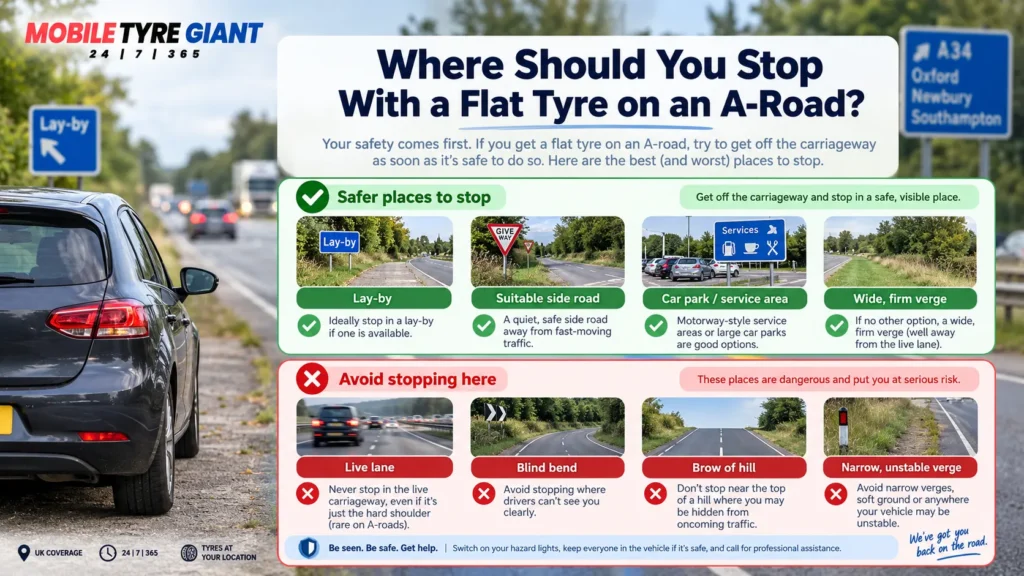
The best place to stop with a flat tyre on an A-road is somewhere that removes the vehicle from the normal path of moving traffic as completely as possible. A proper lay-by is often one of the clearest choices because it is specifically separated from the running lane and normally gives approaching drivers more space to pass. A suitable side road, service area or parking area may be even better if it can be reached safely without continuing unnecessarily on the damaged tyre. What matters is not simply whether the car has moved to the left, but whether it is genuinely clear of traffic and visible to other road users. A narrow strip of tarmac beside the carriageway can look reassuring from the driver’s seat while still leaving the offside of the car dangerously close to passing vehicles. Before committing to a stopping position, consider how much of the vehicle will actually be outside the traffic lane and where the occupants will be able to wait.
The road ahead also matters because a safe stopping position needs adequate visibility from both directions where relevant. Avoid stopping immediately after a blind bend, near the brow of a hill or somewhere that gives approaching traffic very little warning that a stationary vehicle is ahead. On rural A-roads, the edge of the carriageway can change quickly from firm ground to mud, loose gravel or a deep drainage channel hidden by grass. At night or in heavy rain, those hazards may be difficult to judge through the windscreen, so a verge that appears wide enough may not actually provide stable ground. The goal is therefore not to find the nearest patch of empty space at any cost. It is to find the nearest reasonably safe stopping position that reduces exposure to traffic without creating another hazard underneath or beside the vehicle. That distinction becomes especially important when deciding between a lay-by and a grass verge.
Is a Lay-By the Best Place to Stop?
A lay-by is usually one of the better places to stop after a flat tyre on an A-road because it creates physical separation between the stationary vehicle and through traffic. If one is safely reachable, enter it smoothly and position the car as far from the running lane as the available space reasonably allows. Do not stop with the rear or side of the vehicle projecting back into traffic simply because the front wheels have entered the lay-by. Once stationary, keep checking the surrounding environment before anyone opens a door or approaches the damaged tyre. Some lay-bys are wide and well surfaced, while others are narrow, uneven or heavily used by larger vehicles, so the label “lay-by” does not automatically make every position equally safe. You still need enough room for occupants to stay away from moving traffic and, later, enough working space if the tyre is going to be inspected or replaced.
A lay-by can also remove one of the biggest pressures drivers feel after a puncture: the urge to deal with the tyre immediately while traffic is passing close by. Once you are properly separated from the main carriageway, you have more opportunity to check the situation calmly and decide whether the tyre needs professional attention. Listen to the traffic around you and look at how vehicles are entering or leaving the lay-by before assuming it is safe to stand beside the car. If large vehicles are regularly cutting close to your position, moving farther into the available space may make a substantial difference. The safest approach is to treat the lay-by as a place to reduce roadside exposure first and a place to deal with the tyre second. That order matters because being able to see the flat tyre does not mean you should immediately kneel beside it. Make sure the surroundings are suitable before turning your attention from traffic to the wheel.
Is a Side Road or Car Park Safer Than the Verge?
If a suitable side road, parking area or service area is immediately accessible, leaving the main A-road completely can often give you more separation from fast-moving traffic than stopping on the verge. The key word is suitable, because turning into a narrow entrance, blocking a junction or stopping somewhere with poor visibility can simply replace one problem with another. A side road with slower traffic and enough room to pull clear may give you a much calmer environment in which to assess the tyre. A proper parking area can be better still because the surface is more likely to be firm and level if the vehicle later needs to be lifted safely. You should still avoid continuing unnecessarily just because you know there is a convenient car park much farther ahead. The objective remains the nearest practical place where the vehicle and its occupants face less immediate risk.
A verge is more difficult to judge because appearance can be misleading, particularly after rain or on rural roads. Long grass can hide a soft shoulder, steep drop, broken edge or drainage ditch, and a heavy car may sink further once it stops. Even if the vehicle itself feels stable, soft ground may be unsuitable for a jack if someone later tries to change the wheel. Imagine putting one leg of a chair on thick mud: it may look steady until weight is applied, then suddenly sink or tilt. The same basic problem can occur when a vehicle is supported on unstable roadside ground. If the choice is between a clearly separated, firm side road and a questionable soft verge, the firmer location may provide a safer overall environment. Every A-road is different, which is why the stopping decision should be based on traffic exposure, visibility and ground conditions rather than one rigid rule.
Should You Stop Immediately or Reach a Safer Place?
When a tyre goes flat on an A-road, the phrase “stop immediately” can be misleading because the safest place to stop may not be exactly where the problem begins. If the car is still controllable and there is a clearly safer position immediately ahead, such as a lay-by or suitable exit, it may be better to reach that location rather than stopping in a live lane or on a blind bend. The key is not to continue driving simply for convenience or to reach a destination several miles away. A deflated tyre can become damaged internally very quickly, and continued movement can also place extra stress on the wheel. At the same time, stopping where approaching drivers cannot see you properly may create a much more serious danger. The practical rule is to reduce speed smoothly, stay in control and stop as soon as you can do so safely.
Think of the decision as balancing two risks rather than following a fixed distance. On one side, every unnecessary metre travelled on a conventional flat tyre can increase the chance of tyre or wheel damage. On the other side, stopping with half the car exposed to fast traffic can put people at immediate risk. There is no sensible universal rule saying that every driver can travel 50 metres, 100 metres or any other fixed distance after a puncture because the tyre damage, road layout and vehicle response can all be different. If a safer stopping position is close and clearly reachable, focus on reaching it carefully. If the vehicle becomes difficult to control, the tyre begins breaking apart or the road ahead does not offer a safer option, the decision may need to change quickly.
Can Driving Further Damage the Tyre or Wheel?
Yes, driving on a conventional flat tyre can cause damage beyond the original puncture. When air pressure disappears, the sidewall can become trapped and flex heavily between the wheel and the road surface, generating heat and damaging the internal structure. A puncture that might originally have been repairable can therefore become unsuitable for repair after the tyre has been driven while severely deflated. The wheel itself may also begin contacting the road surface if the tyre collapses enough, increasing the risk of damage to the rim. You may hear harsher thumping, scraping or vibration as the condition worsens. These sounds are a warning that continuing the journey normally is not an acceptable solution.
That does not mean protecting the wheel should become more important than protecting people. A driver who stops immediately in an exposed lane simply to prevent possible rim damage may be accepting a much bigger roadside risk. The aim is to move only as far as reasonably necessary to reach a safer stopping position, not to keep driving until a convenient garage appears. Once stopped, avoid repeatedly moving the vehicle unless the current position itself presents a greater danger. If the tyre looks shredded, has separated from the wheel or the vehicle is sitting unusually low on one corner, the damage may already be significant. At that stage, a professional assessment is more useful than guessing whether the original puncture could have been repaired.
Does Safety Take Priority Over Saving the Tyre?
Personal safety comes before trying to preserve a tyre or alloy wheel, especially on a fast A-road. Tyres and wheels can be replaced, but the consequences of a collision with a stationary vehicle or someone standing close to moving traffic can be far more serious. That is why the safest decision may sometimes involve accepting that the tyre could suffer additional damage while the car is moved a very short distance into a safer position. This should not be interpreted as permission to continue the journey on a flat tyre. It simply recognises that road safety cannot be reduced to the condition of one component. The correct decision depends on what is happening around the vehicle at that exact moment.
A good way to judge the situation is to ask what will happen after you stop. If the position leaves you unable to open a door safely, gives passengers nowhere to wait, or forces anyone inspecting the tyre to stand inches from passing traffic, it is probably not a good stopping point. A safer location gives you space to think, check the vehicle and decide what help is actually required. This is particularly important on unfamiliar A-roads where traffic speed can change suddenly and bends may restrict visibility. Do not let embarrassment about slowing other drivers pressure you into making a rushed manoeuvre. Smooth control and a safer stopping position matter more than getting out of everyone’s way within a few seconds.
Does It Matter Whether the A-Road Is Single or Dual Carriageway?
Yes, because “A-road” describes the road classification, not one specific road layout. Some A-roads are narrow single carriageways through rural areas, while others are wide dual carriageways carrying fast traffic over long distances. The risks around a flat tyre are therefore different depending on where the vehicle is travelling. On a single carriageway, you may have traffic approaching from both directions, limited verge space and more blind bends. On a dual carriageway, traffic usually moves in the same direction on your side but may be travelling at higher speeds across several lanes. Understanding the layout helps you assess which side of the road presents the greatest danger and where a safer stopping position may exist.
The stopping principle remains the same in both situations: reduce your exposure to moving traffic as much as possible. What changes is the way you achieve it. A wide lay-by on a rural single carriageway may give very good separation from traffic, while a narrow verge beside a fast dual carriageway may still leave the vehicle dangerously exposed. Similarly, a side road that is easy to enter from a slower single carriageway may not be available on a high-speed divided road. Do not rely on the road number alone to decide what to do. Look at the actual traffic speed, lane arrangement, visibility, verge width and nearby exits before choosing where to stop.
Flat Tyre on a Single-Carriageway A-Road
A flat tyre on a single-carriageway A-road can be challenging because traffic may approach from both directions and the road edge may offer very little usable space. Rural routes can include stone walls, hedges, narrow grass verges, drainage ditches and sharp bends that make an apparently simple stop more complicated. If possible, look ahead for a lay-by, side road, wide gateway or other place that moves the whole vehicle away from the normal traffic path. Avoid stopping just beyond a bend or over the brow of a hill where an approaching driver may have only a few seconds to react. At night, headlights can make distances difficult to judge, so visibility becomes even more important. The safest position is not necessarily the widest patch of grass, but the place where other road users can see the stationary vehicle early and pass safely.
Once stopped, think carefully about which side of the vehicle occupants should use if they need to get out. The side furthest from moving traffic is generally preferable when it can be used safely, but every roadside layout is different. A deep ditch, wall or unstable verge on one side may change what is practical. Do not stand behind the vehicle in a position where an approaching car could push it towards you if struck. If traffic is heavy, stepping out simply to inspect the tyre may be unnecessary until the situation is calmer or help is arranged. The damaged tyre can wait for a few minutes if leaving the vehicle immediately would expose you to greater risk.
Flat Tyre on a Dual-Carriageway A-Road
A dual-carriageway A-road often creates a different type of danger because traffic can be moving quickly across two or more lanes in the same direction. If a tyre begins losing pressure, check your mirrors early and move progressively towards the left when it is safe rather than making a sudden lane change. Look for a lay-by, signed service area, exit or another place that allows the vehicle to clear the running lanes completely. A narrow edge beside lane one should not be treated as equivalent to a proper stopping area just because the car can physically fit there. Fast-moving vehicles create significant noise and air movement, and standing close to them can feel much more exposed than it appeared from inside the car. The priority is to separate people from that traffic whenever the road layout allows.
If the vehicle reaches a safer area, take a moment before opening the doors. Check whether traffic is still passing close to the car and whether a barrier, slope or other obstacle affects the escape route. A dual carriageway can look temporarily quiet between groups of vehicles, but another fast-moving stream of traffic may arrive within seconds. Never assume that a short gap means it is safe to begin changing a wheel beside the carriageway. If the location does not provide enough working room, professional roadside help or recovery may be the safer option. The fact that a driver owns a jack and spare wheel does not make every roadside position suitable for using them.
What If There Is No Lay-By Nearby?
The absence of a lay-by is one of the situations that causes drivers the most uncertainty because there may be no obviously good option. Start by looking for the nearest realistic place that offers better separation from traffic, such as a suitable side road, parking entrance or sufficiently wide and firm verge. Do not chase a theoretically perfect location that is a long distance away while continuing on a severely deflated tyre. At the same time, avoid an automatic stop in a live lane simply because the tyre problem began there. The safest decision depends on what you can actually see and how well the vehicle is responding. A flat tyre on a quiet rural stretch with a firm wide verge creates a very different situation from one on a narrow section bordered by barriers or steep ground.
When there is no ideal option, choose the position that reduces the greatest immediate danger. If a verge is available, assess whether it is wide enough for the whole car and whether the surface appears stable rather than waterlogged, steep or broken. If the road bends sharply, try to avoid stopping where the vehicle will be hidden from approaching traffic. Use hazard lights appropriately and concentrate on keeping movements predictable for other drivers. Once the car is stopped, reassess the situation instead of immediately focusing on the damaged tyre. If the location still feels exposed, you may need emergency or recovery assistance rather than attempting any roadside repair.
What Should You Do If Your Car Stops in a Live Lane?
A car stopped in a live lane is no longer just a tyre problem. It is an immediate traffic hazard, particularly on a fast dual carriageway where other drivers may have very little time to react. Switch on the hazard warning lights and assess whether the vehicle can safely reach a position away from the running lane. If it cannot and you are stranded in a dangerous traffic position, do not get out simply to inspect the tyre. Remaining belted inside may be safer when leaving the vehicle would put you directly into moving traffic. In a situation where the vehicle and occupants are in immediate danger and there is no safe way to get clear, contact the emergency services and explain your exact location and the lane in which the vehicle has stopped.
Do not try to change the tyre while the vehicle is sitting in a live lane, even if the wheel can technically be accessed. Other drivers may not expect a stationary vehicle ahead, particularly at night, in rain or around bends. If you can communicate your road number, direction of travel, nearest junction or visible landmark, emergency responders can understand your location more quickly. Keep passengers calm and discourage anyone from stepping into traffic to wave vehicles around the car. The tyre can be assessed only after the immediate collision risk has been controlled. In this situation, getting people safe is the entire priority.
What Should You Do After Reaching a Safe Stopping Place?
Once the vehicle is away from moving traffic, resist the urge to jump out and inspect the tyre immediately. Take a few seconds to look through the mirrors and windows and understand what is happening around the car. Keep the hazard warning lights on where they are needed, particularly if the vehicle could still be difficult for approaching drivers to notice. If passengers are travelling with you, explain what has happened and tell them not to open doors until you know which side is safer. Where possible, occupants should leave from the side furthest from moving traffic and move to a protected location away from the carriageway. Children and pets need particular attention because an unfamiliar roadside can become chaotic very quickly. The aim is to create a calm, controlled situation before anyone starts thinking about the wheel.
Only inspect the tyre when you can do so without standing dangerously close to passing vehicles. A completely flat tyre may be obvious from inside the car, while a slow puncture may simply leave one corner of the vehicle sitting slightly lower than normal. Look for visible cuts, bulges, objects embedded in the tread or signs that the tyre has begun to separate, but do not put your hands underneath the vehicle or between the tyre and road. If the wheel has been driven while deflated, damage may not be visible from the outside, so appearance alone cannot confirm whether the tyre is safe to repair. At this point, the important decision is whether the location is suitable for a safe wheel change or whether professional help is more sensible. Being parked away from traffic gives you time to make that decision properly instead of rushing because vehicles are passing close by.
Should You Use a Warning Triangle on an A-Road?
A warning triangle can help alert approaching drivers to a stationary vehicle on a suitable non-motorway road, but only when placing it does not put you at greater risk. The usual guidance is to position it at least 45 metres behind the vehicle on the same side of the road, where it can be seen by approaching traffic. That distance sounds straightforward on paper, but real A-roads can include bends, narrow verges, fast traffic and poor weather that make walking back along the roadside dangerous. Do not step into a live traffic lane simply to achieve an exact distance. If you cannot place the triangle safely, your personal safety matters more than using the equipment. Hazard warning lights and a safely positioned vehicle are still important ways to make the situation more visible.
The road layout should guide the decision rather than habit. On a quiet single-carriageway A-road with a wide verge and good visibility, placing a warning triangle may be practical without getting close to moving vehicles. On a fast dual carriageway or narrow rural road, walking behind the vehicle may expose you to traffic for longer than is sensible. Darkness, fog and heavy rain can make the task even more difficult because drivers may see you later than expected. High-visibility clothing can improve visibility if you need to be outside the vehicle, but it does not make an unsafe roadside suddenly safe. Never assume that carrying safety equipment means you must use every item in every situation. The safest action is the one that warns other road users without forcing you into the path of the danger you are trying to avoid.
Can You Change a Flat Tyre Yourself on an A-Road?
You may be able to change a wheel yourself if the vehicle is completely away from moving traffic and the ground is firm, level and stable. You also need enough working room around the damaged wheel, the correct jack and wheel tools, and a suitable spare wheel that is ready to use. Mechanical confidence matters too, because roadside conditions are not the ideal place to learn how a jack works for the first time. Before lifting the vehicle, check that the parking brake is applied and that the car cannot roll or shift unexpectedly. If passing traffic is close enough that you would need to step into the carriageway while working, the location is not suitable for a DIY wheel change. The ability to change a tyre does not cancel out the risk created by the road around you.
There is no prize for completing the job yourself if calling for assistance would be safer. Rain can make tools slippery and soften roadside ground, while darkness can make it difficult to position the jack correctly or notice unstable surfaces. Large vehicles passing nearby can also create strong air movement that feels very different when you are kneeling beside a car rather than sitting inside it. If the spare wheel is missing, damaged, underinflated or inaccessible, do not improvise with equipment that is not designed for the vehicle. Similarly, never crawl underneath a car supported only by the emergency jack supplied for a wheel change. A roadside tyre problem is inconvenient, but rushing a repair in a poor location can turn a manageable problem into a serious injury risk.
What If Your Car Does Not Have a Spare Wheel?
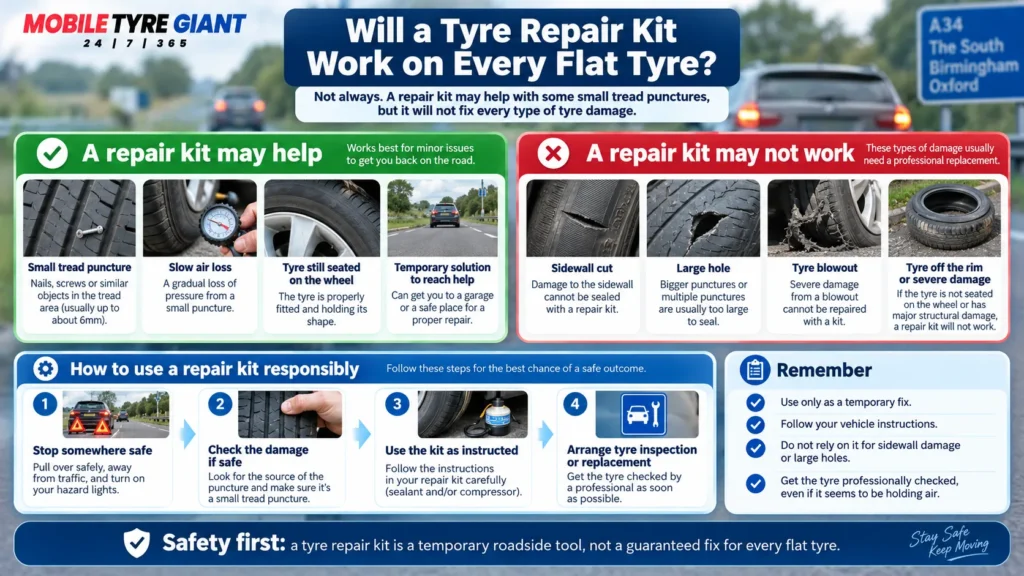
Many modern cars are supplied without a full-size spare wheel and may instead carry a tyre repair kit, compressor or temporary sealant system. If that applies to your vehicle, check the equipment only after you are safely stopped and away from traffic. A repair kit may help with some small punctures in the tread area, but it cannot solve every type of tyre failure. Large cuts, severe damage, sidewall problems or a tyre that has come away from the wheel may be beyond what a temporary kit can handle. Drivers often discover this limitation only when they actually need the kit, which is why knowing what is stored in the boot before a long journey is worthwhile. If the kit cannot restore pressure or the tyre loses pressure again quickly, continuing to rely on it is unlikely to solve the underlying problem.
If roadside assistance or a mobile tyre service is needed, having the correct tyre information can make the next step easier. The tyre size is normally printed on the sidewall in a sequence such as 205/55 R16, although you should only approach the tyre to read it when doing so is safe. If you are unsure what those numbers mean, the guide explaining the correct tyre size for your car provides a clearer breakdown. A photo of the tyre size or visible damage can also be useful if it can be taken without stepping close to traffic. Remember that a repair kit is a temporary solution rather than proof that the tyre is permanently safe. The tyre should still be professionally checked because internal damage may not be visible from the roadside.
Will a Tyre Repair Kit Work on Every Flat Tyre?
No tyre repair kit can deal with every puncture or tyre failure. Most sealant-based kits are designed for limited types of tread-area punctures and rely on the tyre still being structurally capable of holding pressure. They are not a reliable answer for a torn sidewall, large hole, damaged bead, severe blowout or a tyre that has been driven until the structure has broken down. A kit may also fail if the puncture is too large for the sealant to close or if the tyre cannot be reseated properly against the wheel. That is why repeatedly adding air to a tyre that immediately collapses is not a sensible roadside strategy. If the kit does not work as intended, stop and arrange appropriate assistance rather than trying to force the vehicle farther down the road.
Even when the tyre appears to hold pressure after sealant is used, treat the repair as temporary and follow the instructions supplied with the vehicle or kit. The repaired tyre may have specific speed or distance restrictions, and those limits can differ between products. Do not assume that because the car is moving normally again the original damage has disappeared. Sealant can mask the immediate symptom while the puncture or internal damage still needs professional assessment. If you reach a safe location where the tyre can be inspected, explain that a repair product has already been used because this may affect how the tyre is assessed. The goal of an emergency kit is to help you manage certain punctures safely, not to replace a proper inspection.
Can You Keep Driving After a Puncture With Run-Flat Tyres?
Run-flat tyres are designed differently from conventional tyres and may allow limited driving after pressure has been lost, but that does not mean they can be treated as normal indefinitely. Reinforced sidewalls help support the vehicle for a limited period, giving the driver an opportunity to reach a safer stopping location or suitable tyre facility. The exact permitted speed and distance depend on the tyre design and the vehicle manufacturer’s instructions, so a universal figure should not be applied to every run-flat tyre. If the tyre-pressure monitoring system shows a warning, reduce speed, avoid aggressive driving and check the manufacturer’s guidance as soon as it is safe. A run-flat tyre can still suffer damage, especially if it is driven beyond its intended limits. The purpose of the technology is to improve mobility after pressure loss, not to make punctures irrelevant.
Drivers who are unsure whether their vehicle uses this type of tyre can read the comparison between run-flat tyres and normal tyres for a clearer explanation of how they differ. Even with run-flats, the same A-road safety principles still apply because the road environment can be more dangerous than the tyre itself. If the vehicle feels unstable, the tyre begins breaking apart or the steering becomes difficult, continuing simply because the tyre is labelled run-flat would be a poor decision. Once you have reached a safe place, arrange an inspection because some run-flat damage cannot be judged accurately just by looking at the sidewall. The ability to move after pressure loss is useful, but it should be treated as a controlled safety feature rather than permission to continue the full journey.
Can the Flat Tyre Be Repaired or Will It Need Replacing?
Whether a flat tyre can be repaired depends on where the damage is, how large it is, the overall condition of the tyre and whether the tyre has been driven while badly deflated. A small puncture in the central tread area may sometimes be suitable for professional repair, but this cannot be confirmed safely from a quick roadside glance. Damage to the sidewall, shoulder or internal structure is much more serious because these areas flex heavily while the tyre is supporting the vehicle. Bulges, deep cuts, exposed cords and severe blowout damage normally indicate that the tyre should not simply be patched and reused. Driving after the tyre has lost pressure can also turn an initially repairable puncture into more extensive internal damage. For that reason, a proper inspection should determine the next step rather than assuming that every nail or screw can be repaired.
If the damage appears minor and the tyre has not been driven extensively while flat, a professional mobile tyre repair assessment can determine whether repair is appropriate. If the sidewall is damaged, the tyre has shredded, or the structure is no longer safe, mobile tyre replacement may be the correct solution instead. This distinction matters because repairing an unsuitable tyre can create another failure later, while replacing a tyre that is safely repairable may be unnecessary. The safest approach is therefore to assess the actual damage, tyre condition and roadside circumstances together. A tyre is not judged only by whether it still holds some air. Its structural condition is what ultimately determines whether it can return to normal road use.
Tyre condition | Likely next step | Why |
Small puncture in suitable tread area | Professional repair may be possible | Damage may be repairable if the tyre remains structurally sound |
Sidewall cut or puncture | Replacement likely | Sidewall repairs are generally unsafe |
Visible bulge | Replacement | May indicate structural damage |
Severe blowout or shredded tyre | Replacement | Tyre structure has been compromised |
Tyre driven while fully deflated | Full inspection required | Internal damage may not be visible externally |
Can a Mobile Tyre Fitter Help on an A-Road?
A mobile tyre fitter may be able to repair or replace the tyre once the vehicle is positioned somewhere where roadside work can be carried out safely. A lay-by, suitable side road, car park or another position clearly separated from moving traffic can provide a much better working environment than a narrow live carriageway edge. Before arranging attendance, explain exactly where the vehicle has stopped and whether the entire car is clear of the running lane. That information allows the situation to be understood before anyone arrives with equipment. A fitter still needs enough room to work around the wheel and stable ground for lifting the vehicle if necessary. Roadside convenience should never override the safety of the driver, passengers, technician or passing traffic.
If the vehicle is in a suitable position, mobile tyre fitting can remove the need to drive a damaged tyre to a garage. However, not every breakdown position is safe enough for tyre work, even when the vehicle itself has stopped moving. A narrow verge, unstable surface or location immediately beside fast traffic may mean that recovery or relocation is needed first. Being clear about this makes the service more trustworthy because it avoids suggesting that a tyre can be changed anywhere regardless of the circumstances. The first objective remains getting the car somewhere safe enough for people to work around it. Once that has been achieved, the tyre problem becomes much easier to deal with properly.
What Information Should You Give a Mobile Tyre Fitter?
Clear location information can make roadside assistance much easier to arrange, especially on a long A-road where the same road number may cover many miles. Start with the A-road number and your direction of travel, then add the nearest junction, roundabout, village, service area or recognisable landmark. If your phone allows it, sending a live location or map pin can remove much of the uncertainty. You should also provide the vehicle registration and, if it is safe to check, the complete tyre size from the sidewall. Describe what happened in simple terms, such as a slow puncture, sudden blowout, sidewall cut or tyre that will no longer hold air. Most importantly, state whether the vehicle is completely off the carriageway and whether there is enough safe space around the affected wheel.
Photographs can also help when they can be taken without standing close to moving traffic. A clear image of the tyre damage and sidewall markings may provide useful information before the fitter reaches you. Do not crouch beside the wheel or walk into a dangerous position just to obtain a better picture. If a locking wheel nut is fitted, knowing where the key is stored can also prevent unnecessary delays once help arrives. The same applies to unusual wheel sizes, run-flat tyres or previous use of tyre sealant. Accurate information helps the correct equipment and tyre solution to be prepared before attendance. In a stressful roadside situation, a short checklist on your phone can be much more reliable than trying to remember everything at once.
What Should You Do While Waiting for Roadside Tyre Help?
Once assistance has been arranged, stay in the safest available position rather than repeatedly returning to inspect the tyre. If you and your passengers can wait somewhere well away from moving traffic, keep everyone together and make sure children and pets cannot wander towards the road. In darkness or poor weather, visibility becomes even more important, so use appropriate vehicle lighting and high-visibility clothing if you have it and can put it on safely. Keep your phone available in case the fitter needs to confirm the location or access route. Avoid standing directly in front of or behind the vehicle where you could be injured if another vehicle struck it. The safest waiting place depends on the exact road layout, so use the surrounding barriers, distance from traffic and available safe ground to guide the decision.
If conditions change while you are waiting, reassess the situation. Heavy rain may make a verge softer, traffic levels may increase, or poor visibility may make a previously manageable position feel more exposed. Do not attempt a last-minute DIY repair simply because help has not arrived as quickly as expected. Remaining patient in a safe location is usually better than introducing a new risk by moving around the roadside unnecessarily. Keep hazard lights operating where appropriate and make sure your location information remains accurate if the vehicle has had to be moved. When assistance arrives, allow the fitter to assess both the tyre and the working environment before deciding how the job should be completed. A safe roadside repair starts with a safe roadside position.
Common Mistakes to Avoid After a Flat Tyre on an A-Road
One common mistake is braking sharply the moment the tyre fails, which can make the vehicle harder to control if the steering is already affected. Another is stopping at the first available patch of road without considering visibility, traffic speed or whether the whole vehicle is actually clear of the lane. Drivers can also underestimate how dangerous it is to stand between the car and moving traffic while examining the wheel. A grass verge may look inviting but can hide soft ground, a ditch or an unstable edge that makes tyre work difficult. Some drivers also assume that owning a spare wheel means they should automatically change it themselves, regardless of where they have stopped. The safer approach is to judge the roadside environment first and only then decide what should happen to the tyre.
Another mistake is continuing farther than necessary because the car still moves despite the tyre being flat. A conventional tyre can suffer serious structural damage when driven without adequate pressure, and the wheel itself may also be damaged. Drivers with run-flat tyres can make the opposite mistake by assuming that the technology allows unrestricted driving after pressure loss. Repair kits are sometimes treated as a universal answer too, even though they cannot deal with every type of puncture or sidewall failure. Finally, people can delay asking for help because they feel they should be able to solve the problem themselves. Good roadside judgement is not about proving mechanical ability. It is about choosing the option that creates the least risk for everyone involved.
How Can You Reduce the Risk of a Flat Tyre on an A-Road?
You cannot prevent every puncture, but basic tyre checks can reduce the chance of setting off with a developing problem. Check tyre pressures regularly and investigate repeated pressure loss rather than simply topping the tyre up every few days. Look across the tread and sidewalls for cuts, bulges, embedded objects and unusual wear. A tyre-pressure warning should not be ignored, especially before a long journey on fast A-roads. Pothole and kerb impacts can also damage tyres and wheels even when the problem is not immediately obvious. If the steering begins vibrating or the vehicle starts pulling after an impact, arranging an inspection before the next long trip is sensible.
It is also worth knowing what equipment the vehicle actually carries before you need it. Check whether you have a full-size spare, space-saver, repair kit, compressor or run-flat tyres, and understand the basic limitations of each option. Make sure any spare tyre is correctly inflated and that the jack and wheel tools are present rather than discovering they are missing at the roadside. Keep a charged phone, high-visibility clothing and useful location tools available for longer journeys. Preparation will not make every tyre failure simple, but it can remove some of the uncertainty when something goes wrong. On an A-road, that extra confidence can help you focus on the most important decision first: reaching a safer place to stop.
Final Words: Flat Tyre on an A-Road? Safety Comes Before the Tyre
A flat tyre on an A-road is not only a mechanical problem because the place where you stop can determine how dangerous the situation becomes. Keep control of the vehicle, reduce speed progressively and aim for the nearest practical place that provides better separation from moving traffic. A lay-by, suitable side road or parking area is generally preferable to an exposed lane or questionable roadside edge. If no ideal stopping place exists, assess visibility, traffic speed, verge condition and the behaviour of the vehicle before choosing the safest realistic option. Do not drive farther than necessary on a conventional flat tyre simply to reach a more convenient destination. Once you are safely stopped, the tyre can be assessed properly and the right repair or replacement decision can be made.
The most important principle throughout the situation is simple: people come before the tyre. Do not change a wheel beside fast-moving traffic just because you have the tools, and do not walk into a dangerous position simply to inspect the damage. If professional roadside help is required, provide accurate location and tyre information and explain whether the vehicle is fully clear of the carriageway. A damaged tyre can usually be dealt with once the road-safety risk has been controlled. Staying calm, choosing the stopping location carefully and avoiding rushed decisions can prevent a frustrating puncture from becoming a much more serious incident. The tyre may be what caused you to stop, but where and how you stop is what matters first.
Flat Tyre on an A-Road? Need Roadside Help?
Once your vehicle is safely away from moving traffic, get the tyre checked and arrange the right repair or replacement before continuing your journey.
Frequently Asked Questions
Find quick answers to the most common questions our customers ask.
Try to stop somewhere that gives the vehicle and occupants as much separation from moving traffic as possible, ideally a lay-by, suitable side road, service area or another safe parking location. Avoid live lanes, blind bends, hill crests and narrow exposed verges where possible. The aim is to stop as soon as it is safe without continuing unnecessarily on the damaged tyre.
You should stop as soon as it is safe to do so, but that does not always mean stopping at the exact point where the tyre loses pressure. If the vehicle remains controllable and a clearly safer stopping place is immediately ahead, reaching that position may reduce roadside risk. Do not continue farther than necessary simply to find a more convenient location.
Look for the nearest realistic location that reduces your exposure to traffic, such as a suitable side road, parking entrance or wide, firm verge. Avoid stopping on blind bends, hill crests or unstable ground where possible. There is no universal safe distance to drive on a flat tyre, so balance the need to stop promptly with the need to avoid an obviously dangerous position.
A grass verge may be suitable only if it is wide, firm, reasonably level and provides enough separation from traffic. Soft ground, steep slopes, hidden drainage ditches or narrow verges can make the vehicle unstable and may also be unsuitable for using a jack. Assess the ground carefully before treating a verge as a safe stopping or working area.
Switch on the hazard lights and assess whether the vehicle can safely be moved away from the running lane. If the car cannot be moved and occupants cannot leave safely because of moving traffic, stay belted in the vehicle and contact the emergency services where there is immediate danger. Do not attempt to change or inspect the tyre while exposed in a live lane.
A flat tyre on its own does not normally require a 999 call, but the situation changes if the vehicle is stranded in a dangerous live lane or the occupants are at immediate risk and cannot reach safety. In that situation, explain your road number, direction of travel, nearest junction or landmark and the lane in which the vehicle is stopped.
You may be able to change the wheel if the vehicle is fully clear of traffic, the ground is firm and level, there is enough working space and you have the correct equipment and confidence to complete the job safely. If traffic is passing close by, the verge is unstable or visibility is poor, professional assistance is usually the safer option.
A warning triangle may be used on an appropriate non-motorway road when it can be placed safely, usually at least 45 metres behind the vehicle on the same side of the road. Do not walk into a live lane or expose yourself to fast traffic simply to position it. Road conditions and personal safety should determine whether using the triangle is sensible.
A conventional flat tyre should only be moved as far as reasonably necessary to reach a safer stopping position, because continued driving can damage the tyre structure and wheel. There is no fixed distance that is safe for every puncture. If the vehicle becomes difficult to control or the tyre begins breaking apart, continuing farther may create additional risks.
Roadside tyre assistance may be possible once the vehicle is in a location where the work can be carried out safely. A proper lay-by, side road or parking area is generally more suitable than a narrow exposed verge or live lane. Give the fitter your road number, direction of travel, live location, vehicle registration and tyre details so the situation can be assessed accurately before attendance.