

A tyre problem can feel more complicated when the car has carbon-ceramic brakes sitting just behind the wheels. Owners of performance cars often know that these braking systems are valuable, so a puncture or worn tyre can create an immediate second concern about whether removing the wheel could damage the brake disc. The good news is that mobile tyre fitting for cars with ceramic brakes is possible when the vehicle, wheel and braking system are handled correctly. The tyre itself is not fitted while the wheel remains on the car, because the complete wheel is first removed from the hub before tyre-changing equipment is used. This means the main ceramic-brake-specific consideration is usually the way the wheel is removed and later guided back into position.
That distinction matters because it changes what the owner should actually be worried about. A technician does not need to dismantle the carbon-ceramic braking system simply to replace a tyre, but the large wheel may pass close to the brake disc and caliper as it comes away from the hub. Careless movement can therefore create unnecessary risk around components that deserve controlled handling. Performance cars can also introduce other considerations such as low-profile tyres, large alloy wheels, staggered tyre sizes, TPMS sensors and sometimes unusual wheel-retention systems. Each of these needs to be treated as its own part of the job rather than assuming that every challenge comes from the ceramic brakes. Understanding how these systems interact makes it much easier to judge whether a tyre fitting service is suitable for a particular vehicle.
What Are Carbon-Ceramic Brakes, and Why Do They Matter During Tyre Fitting?
Carbon-ceramic brakes use specialised composite brake discs rather than the conventional cast-iron discs fitted to most everyday vehicles. They are commonly associated with high-performance cars because they can cope with demanding braking conditions while also reducing unsprung weight compared with equivalent iron discs. Systems such as Porsche Ceramic Composite Brake, commonly known as PCCB, are familiar examples, although several performance manufacturers offer their own carbon-ceramic braking systems. The material is engineered to operate under high temperatures and substantial braking loads, so describing these discs as simply delicate or weak would be misleading. The servicing concern is more specific: a carbon-ceramic disc should be protected from unnecessary concentrated mechanical impacts when nearby components, particularly the wheel, are being handled.
During a tyre change, the brake disc stays attached to the vehicle after the wheel has been removed. The tyre and wheel assembly then move away from the braking system before the old tyre is taken off the rim, so the tyre machine itself should not need to work anywhere near the ceramic disc. However, many performance wheels are large, wide and relatively heavy, which means controlling them as they come off the hub becomes important. A wide rear wheel from a powerful sports car can be much more awkward to manoeuvre than a small hatchback wheel, especially when there is limited clearance around a large brake caliper. This is why knowledgeable tyre fitting is about understanding the whole wheel and brake area rather than treating the job as nothing more than replacing rubber on a rim.
Carbon-Ceramic Brake Discs vs Ceramic Brake Pads
Carbon-ceramic brake discs should not be confused with ordinary brake pads that use ceramic materials in their friction compound. Ceramic brake pads can be fitted to vehicles that still use conventional metal brake discs, so a car advertised as having ceramic pads does not automatically have a carbon-ceramic braking system. A true carbon-ceramic system refers primarily to the specialised composite rotor or brake disc behind the wheel. This difference matters when discussing tyre fitting because the concern around wheel contact applies specifically to the physical brake disc sitting close to the inside of the wheel. If an owner simply tells a fitter that the car has “ceramic brakes,” it can therefore be useful to clarify exactly what braking system is fitted.
Performance-car owners can usually confirm the specification through the vehicle documentation, manufacturer information or visible characteristics of the braking system, rather than guessing from the colour of the caliper alone. Brake caliper colour is not reliable proof that a vehicle has carbon-ceramic discs because manufacturers can use similar caliper designs across different brake packages. The same caution applies when choosing tyres, as appearance alone cannot confirm whether a tyre has the correct size, load capability or speed rating for a performance vehicle. Drivers who are unsure about their tyre markings can use this guide to choosing the right tyres for your car before arranging replacement. Correctly identifying both the tyre specification and braking system helps prevent assumptions before any wheel is removed from the vehicle.
Are Carbon-Ceramic Brake Discs Fragile?
Calling a carbon-ceramic brake disc “fragile” without qualification gives the wrong impression. These brakes are designed to cope with forces and temperatures that would be demanding for many conventional braking systems, particularly on powerful performance cars. Their ability to tolerate hard braking does not mean, however, that every kind of physical force is harmless. A concentrated blow against the edge or surface of a ceramic composite disc is different from the evenly distributed friction and heat generated during normal braking. That is why care around the brake disc becomes particularly relevant when a large wheel is being removed or installed.
Think of the difference between using a strong component for the job it was designed to perform and accidentally striking it with another heavy object. The brake disc may be perfectly capable of repeatedly slowing a high-performance car from motorway speeds while still deserving protection from an uncontrolled wheel impact during servicing. This is also why frightening claims that ceramic discs will break merely because a tyre is being changed are equally unhelpful. A careful tyre replacement should involve controlled handling rather than treating the braking system as something that cannot be worked around. For the owner, the sensible concern is therefore not whether the brakes are too fragile for mobile tyre fitting, but whether the wheel-removal process is appropriate for the particular vehicle.
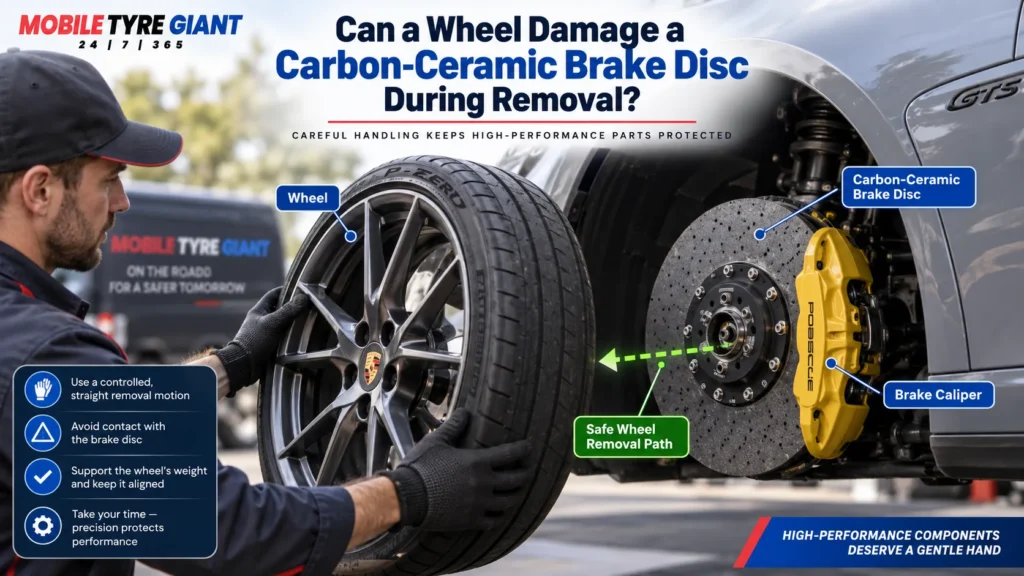
Can a Wheel Damage a Carbon-Ceramic Brake Disc During Removal?
A wheel can potentially damage a carbon-ceramic brake disc if it is allowed to move uncontrollably and strike the disc while being removed or refitted. The inner barrel of the wheel sits around the brake assembly, so there can be relatively little space between the wheel, caliper and rotor on some performance cars. As the wheel comes away from the hub, its weight needs to remain controlled rather than being allowed to drop inward, tilt sharply or hang against nearby components. Larger performance wheels can make this more important because their size and weight can make precise movement more difficult. The exact removal method varies between vehicles, which is why manufacturer-specific procedures and suitable equipment matter more than relying on one universal technique.
This also explains why the tyre-changing machine should not be viewed as the main threat to the ceramic brakes. Once the wheel is safely away from the vehicle, the brake disc remains behind on the hub while the wheel and tyre are taken to the fitting equipment. The ceramic-brake-sensitive part of the process has therefore largely occurred before the tyre is removed from the rim. After the new tyre has been fitted and the wheel has been balanced where required, careful wheel installation becomes important again as the wheel approaches the brake assembly. For an owner watching the job, the key signs of competent work are controlled wheel handling, attention to the vehicle’s specific wheel system and no unnecessary contact with the brake disc or caliper.
Can Mobile Tyre Fitting Be Done Safely on Cars With Carbon-Ceramic Brakes?
Yes, mobile tyre fitting can be carried out on cars with carbon-ceramic brakes when the vehicle can be worked on safely and the correct wheel-removal procedure is followed. The presence of ceramic brake discs does not automatically mean the car needs to be transported to a dealership or workshop simply because a tyre requires replacement. What matters more is whether the technician understands the vehicle, has suitable equipment and can control the wheel as it comes away from the hub. A suitable working surface, correct lifting points and enough space around the vehicle are also important because performance cars can sit low to the ground and may need more careful positioning. The actual tyre replacement still takes place away from the braking system once the wheel has been removed.
For an owner, the easiest way to think about the job is to separate wheel handling from tyre fitting. The wheel first needs to come off the vehicle without striking the brake disc or caliper, after which the tyre can be removed from the rim using normal professional fitting equipment appropriate for that wheel and tyre combination. The new tyre is then installed, checked and prepared before the wheel goes back onto the vehicle. A professional mobile tyre fitting service can therefore be suitable for performance cars when the vehicle-specific requirements have been assessed before the job starts. The important point is not whether the equipment arrives in a van or sits inside a workshop, but whether the work can be completed properly for that particular car.
What Actually Changes During a Tyre Change on a Car With Ceramic Brakes?
Most of the tyre-changing process remains familiar, but greater attention may be needed during the stages when the wheel is physically close to the ceramic brake disc. Before the wheel comes off, the vehicle needs to be positioned on a suitable surface and lifted at the correct jacking point. Low sports cars, aerodynamic undertrays and specialised suspension systems can make this more important than on an ordinary family car. Once the vehicle is supported correctly, the wheel should be handled in a controlled way rather than being pulled off suddenly and allowed to drop inward. The goal is to create a smooth path away from the hub while maintaining clearance around the brake disc and caliper.
After the wheel has been removed, the process becomes much more like any other professional tyre change, although the wheel itself may still demand specialist care because of its size, finish or tyre profile. The old tyre is removed from the rim, the wheel and tyre are inspected, and the replacement tyre is installed according to its directional or asymmetric requirements where applicable. The tyre is then inflated and checked before balancing is completed when required. Once the wheel is ready to return to the car, careful handling becomes important again because the wheel must pass back around the braking system and align correctly with the hub. This is why the phrase “ceramic brake tyre fitting” can be misleading if it makes the entire job sound unusual, when the main difference is really the care needed at the wheel-removal and wheel-refitting stages.
Does the Tyre Fitting Machine Touch the Ceramic Brake Disc?
No, the tyre fitting machine should not touch the carbon-ceramic brake disc because the brake disc remains attached to the vehicle after the wheel has been removed. The tyre machine works on the detached wheel and tyre assembly, so by that stage the ceramic rotor is physically separate from the fitting equipment. This is an important point because some owners understandably imagine that large tyre-changing tools are being used close to the braking system while the wheel is still on the car. In reality, the machine interacts with the tyre and wheel rim rather than the vehicle’s brake disc. The ceramic-brake-specific concern therefore occurs before and after the tyre machine is used.
That does not mean the rest of the fitting process can be treated casually, especially on large or expensive performance wheels. Low-profile tyres can have stiff sidewalls, some wheels have delicate finishes, and TPMS components may also be present inside the wheel assembly. The technician still needs to use suitable tyre-changing techniques to avoid rim damage and protect other components, but these are separate concerns from the ceramic brake disc itself. Once the new tyre has been mounted correctly, the wheel can be prepared for balancing and then returned to the vehicle. Understanding this sequence often removes much of the fear around mobile tyre fitting because the ceramic brake does not sit next to the tyre machine during the actual tyre replacement.
What Are Wheel Guide Pins, and Why Can They Matter?
Wheel guide pins, sometimes described as wheel hanger pins or assembly pins, are temporary guides that can help support and align a wheel as it is removed from or fitted back onto the hub. They thread into suitable mounting points and provide a controlled path for the wheel rather than leaving the technician to support its entire weight while also trying to align the mounting holes. On a car with a large wheel and carbon-ceramic brake disc, that extra control can be useful because it helps limit unnecessary sideways or downward movement near the rotor. The principle is simple: instead of letting a heavy wheel search for its position around the hub, the guide provides a more predictable route. This can be particularly useful when clearances are tight.
However, it would be wrong to claim that every car with carbon-ceramic brakes requires the same number or type of guide pins. Manufacturer procedures vary between models, wheel designs and brake systems, and some vehicles may use different assembly aids altogether. The correct approach is to follow the requirements that apply to the specific vehicle rather than assuming that one Porsche procedure, for example, applies to every performance car. Guide pins should therefore be understood as one possible method of controlled wheel handling, not a universal rule for all ceramic-brake cars. For the owner, the practical question is whether the person carrying out the work knows how that particular wheel should be removed and supported without allowing uncontrolled contact with the brake assembly.
Do Cars With Ceramic Brakes Need Special Tyre Fitting Equipment?
There is no single tyre machine designed only for cars with carbon-ceramic brakes, because the ceramic brake disc is not part of the tyre-changing operation once the wheel is off the car. The equipment requirements usually relate more to the vehicle and wheel system than to the brake material alone. A low vehicle may need an appropriate jack, a large performance wheel may require careful support, and a particular model may use guide pins or other wheel assembly aids. The technician also needs tools suitable for the wheel bolts or fastening system and should follow the vehicle’s correct tightening procedure when the wheel goes back on. This is why asking simply whether someone has a “ceramic brake tool” does not really tell you enough.
The tyre itself can introduce additional equipment considerations, especially if it is very wide, low-profile or fitted to a large alloy wheel. These tyres can be more demanding to remove and install without marking the wheel, so suitable tyre-changing equipment and technique remain important even though they are not specific to the brake system. The same applies to balancing, which may be required after the new tyre is fitted to help the wheel and tyre assembly rotate smoothly. If balancing forms part of the job, a dedicated mobile wheel balancing service can address that requirement separately from the ceramic brakes. The safest approach is therefore to assess the complete vehicle setup rather than treating the brake disc as the only feature that matters.
Are Centre-Lock Wheels the Same as Carbon-Ceramic Brakes?
No, centre-lock wheels and carbon-ceramic brakes are completely different systems, even though both can appear on the same high-performance car. Carbon-ceramic brakes are part of the braking system, while a centre lock is a method of securing the wheel to the hub using a single central fastening mechanism rather than several conventional wheel bolts or nuts. A vehicle can therefore have ceramic brakes with ordinary wheel bolts, centre-lock wheels with conventional brake discs, or both systems together. The confusion happens because cars such as high-performance Porsche models can sometimes combine these features. Treating them as one system can lead to incorrect assumptions about what equipment or procedure is required.
Centre-lock wheels can make wheel removal and refitting more specialised because the fastening system may require specific tools, tightening procedures and manufacturer instructions. That complexity exists regardless of whether the vehicle also has carbon-ceramic brakes. If both systems are fitted, the technician needs to consider two separate issues at the same time: correctly handling the centre-lock mechanism and preventing unnecessary contact with the ceramic brake disc. This is why owners should mention centre locks before booking rather than assuming every mobile tyre fitter will arrive prepared for them. Clear information about the vehicle specification before the appointment allows the fitting requirements to be assessed properly instead of discovering an unusual wheel system only after the technician arrives.
What Should Be Checked Before Fitting a New Tyre to a Performance Car?
A performance car needs more than a tyre that simply fits the wheel, because the correct size, load capability and speed rating all matter to how the vehicle is designed to perform. Cars fitted with carbon-ceramic brakes are often high-powered models, so the tyres may be designed to handle greater loads, higher speeds and more aggressive braking forces than ordinary road tyres. Before fitting begins, the tyre markings should be checked carefully against the vehicle requirements rather than relying on appearance or assuming that a similar size will be acceptable. The width, aspect ratio and rim diameter all need to match the intended setup, while the load index and speed rating must also be suitable for the vehicle. Some performance cars also use manufacturer-approved tyre specifications that add another layer of compatibility. Getting these details right matters just as much as careful wheel removal because the wrong tyre specification can undermine the performance the braking system was designed to support.
The condition of the other tyres should also be considered before replacing only one tyre, especially on powerful rear-wheel-drive or all-wheel-drive vehicles. A new tyre with full tread can behave differently from a heavily worn tyre on the same axle, and large differences in tread depth may affect grip and handling. Directional tyres must be installed in the correct rotation direction, while asymmetric tyres need the correct side facing outward. Some cars also use different tyre sizes front and rear, which means a tyre that looks correct on one axle may be completely wrong for the other. Drivers who are unsure about the markings can check this guide to understanding the correct tyre size before arranging fitting. The safest approach is to confirm the complete specification first, rather than treating tyre replacement as a simple size-matching exercise.

Why Load Index and Speed Rating Matter on Performance Cars
The load index tells you how much weight a tyre is designed to support, while the speed rating indicates the maximum speed capability the tyre is engineered to handle under specified conditions. On a performance car, these figures are not small details hidden on the sidewall. They are part of the tyre’s suitability for the vehicle and should match or exceed the required specification where appropriate. A tyre may physically fit the wheel but still be unsuitable if its load or speed rating is too low. This becomes especially important on heavy performance SUVs, powerful electric vehicles and high-speed sports cars, where tyre loads can be significant. Choosing the correct ratings helps preserve predictable braking, cornering and stability.
It is also worth remembering that carbon-ceramic brakes can provide very strong stopping performance, but the tyre remains the car’s only contact point with the road. Even the most advanced brake system cannot create grip that the tyre does not have. In wet weather, during emergency braking or under hard acceleration, the tyre’s construction and condition directly influence how effectively the vehicle can use its braking and handling capability. This is why selecting a tyre only because it is cheaper or visually similar to the original is a poor strategy on a performance vehicle. The brake system and tyres work as part of the same overall safety package, even though they are physically separate components. Correct tyre specification therefore supports the performance the vehicle was designed to deliver.
What Is a Staggered Tyre Setup?
A staggered tyre setup uses different tyre sizes on the front and rear axles, with the rear tyres often being wider than the front. This arrangement is common on many high-performance cars because it can help manage power delivery, traction and handling characteristics. A driver might see the same wheel diameter at both ends of the car but still have different tyre widths and sidewall profiles between the front and rear. That can create problems if someone assumes all four tyres are identical without checking the sidewall markings. On a car with expensive wheels and ceramic brakes, fitting the wrong tyre to the wrong axle would turn a careful technical job into an avoidable mistake. The tyre position should therefore be confirmed before any replacement is ordered or fitted.
Staggered setups can also affect tyre rotation options because the front and rear tyres may not be interchangeable. If directional tyres are also involved, the possibilities become even more restricted. This is why owners should provide the exact tyre position when booking, such as front left, front right, rear left or rear right, rather than simply saying that one tyre needs replacing. The same principle applies when a performance vehicle uses different wheel widths front and rear. Clear information before the appointment helps ensure the correct tyre arrives with the fitter and reduces the chance of delays. It also allows the technician to prepare for the actual wheel and tyre combination rather than working from a generic vehicle description.
Do Cars With Carbon-Ceramic Brakes Still Need Wheel Balancing?
Yes, cars with carbon-ceramic brakes still need wheel balancing when a tyre replacement or wheel condition makes balancing necessary. The brake-disc material does not change the basic physics of the rotating wheel and tyre assembly. If weight is distributed unevenly around the wheel, the assembly can create vibration as speed increases. This may be felt through the steering wheel, floor or seat depending on which wheel is affected. Balancing corrects this by identifying the heavy and light points of the assembly and adding small weights where required. The ceramic brake disc remains separate from this process because balancing is carried out on the removed wheel and tyre.
Good wheel balance is particularly important on performance cars because stiff suspension, low-profile tyres and large wheels can make small vibrations more noticeable. A slight imbalance that might feel minor in an ordinary car can become obvious at motorway speeds in a tightly controlled sports car. Balancing also helps the tyre and wheel assembly run smoothly, which supports comfort and consistent road contact. It is not correct to assume that carbon-ceramic brakes somehow remove the need for balancing because the two systems perform completely different jobs. One controls braking force, while the other ensures the rotating wheel and tyre assembly is properly balanced. Treating each system according to its own function leads to a much more accurate tyre fitting process.
Does TPMS Need Special Attention During Tyre Fitting?
Tyre Pressure Monitoring System sensors need careful handling during tyre fitting, but their presence is not directly related to carbon-ceramic brakes. A TPMS sensor is usually associated with the wheel and tyre assembly, where it monitors tyre pressure and sends information to the vehicle. During tyre removal, the fitter needs to know where the sensor is located so tyre-changing tools do not damage it. The valve stem, sensor body and sealing components can all be affected by careless handling. On a performance car, a TPMS warning after fitting may create unnecessary concern if the sensor has been disturbed or not correctly recognised by the vehicle. This is why TPMS should be treated as a separate technical consideration during the tyre change.
The useful distinction for the owner is simple: ceramic brakes matter most when the wheel is being removed and refitted, while TPMS matters when the tyre is being removed from or installed onto the wheel. These risks happen at different stages of the job. A technician who understands the full process should be thinking about both, but not confusing one with the other. After fitting, the tyre should be inflated to the correct pressure and the TPMS checked for normal operation where applicable. If a sensor was already faulty before the tyre change, that should also be identified rather than automatically blaming the fitting process. Keeping these systems conceptually separate makes the whole job easier to understand and diagnose.
Can Low-Profile and High-Performance Tyres Be Fitted Mobile?
Yes, many low-profile and high-performance tyres can be fitted through a mobile service when the equipment is suitable for the wheel and tyre combination. Low-profile tyres have shorter, often stiffer sidewalls, which can make them more demanding to remove and install than a conventional tyre with a taller sidewall. Large-diameter alloy wheels can also have delicate finishes that owners are understandably keen to protect. The challenge here is not the carbon-ceramic brake disc itself, because that disc stays on the vehicle after the wheel is removed. Instead, the tyre fitter needs to use appropriate equipment and technique to manage the stiff tyre bead without marking the wheel. This is another reason why the complete vehicle specification matters before the appointment.
Some performance tyres are also very wide, which adds physical weight and makes both wheel handling and tyre-machine setup more demanding. A wide rear tyre on a high-powered sports car can require more controlled handling than a standard family-car tyre, especially if the wheel is large and valuable. Mobile fitting is therefore not automatically unsuitable simply because the tyre is low-profile or performance-focused. The key question is whether the mobile setup can safely handle that specific wheel and tyre combination. If the tyre or wheel requires equipment beyond what is available, the correct response is to identify that limitation rather than forcing the job. Honest compatibility assessment is more important than pretending every tyre can be fitted in every location.
Can a Car With Carbon-Ceramic Brakes Have Tyres Fitted at Home?
Yes, a car with carbon-ceramic brakes can often have tyres fitted at home if the vehicle is parked in a suitable working area and the correct equipment is available. A level, stable surface gives the technician a safer environment for lifting the vehicle and controlling the wheel as it comes away from the hub. There also needs to be enough space around the car to work without forcing the wheel into a tight gap between a wall, kerb or another vehicle. Low performance cars may require additional care when positioning lifting equipment because their jacking points can be less accessible. The presence of ceramic brakes does not change these basic requirements, but it makes controlled wheel handling even more important once the vehicle is raised.
Home fitting can be convenient for owners who do not want to drive on a damaged tyre or leave a high-value vehicle at a busy tyre centre. It also gives the owner the opportunity to provide detailed information about the vehicle before work begins, including brake type, wheel system and tyre specification. However, a driveway is not automatically suitable simply because the car is parked there. Loose gravel, steep slopes or cramped access can make safe lifting difficult and may mean another location is more appropriate. The decision should therefore be based on the working conditions and vehicle requirements rather than convenience alone. A suitable home environment can work well, but safety and access must come first.
Can a Performance Car With Ceramic Brakes Have a Tyre Changed Roadside?
A roadside tyre change may be possible on a car with carbon-ceramic brakes, but the location has to be safe enough for the work to be completed properly. The biggest issue is often not the brake system but the environment around the vehicle. Fast-moving traffic, soft verges, uneven ground or a very narrow shoulder can make lifting the car and handling a large wheel unsafe. Performance cars may also sit low, which can make access more difficult if the tyre is completely deflated. If the car uses centre-lock wheels or another specialised wheel system, the fitter also needs the correct equipment before attempting the job. Ceramic brakes add another reason to avoid rushed or poorly controlled wheel removal.
When the roadside position is unsafe, moving or recovering the vehicle may be a better option than trying to force a tyre change in unsuitable conditions. This is particularly important if there is not enough room to support and guide a heavy wheel away from the brake disc safely. The goal should be to solve the tyre problem without creating another problem involving the wheel, bodywork or braking system. Drivers should therefore provide an accurate description of the location when booking, including whether the vehicle is on a motorway shoulder, residential road, car park or other accessible area. That information helps determine whether mobile fitting is realistic at the current position. A safe decision is more valuable than the fastest possible decision.
What Should You Tell the Mobile Tyre Fitter Before Booking?
Before booking, give as much accurate vehicle information as possible so the fitting requirements can be assessed before the technician arrives. The most useful details include the make, model, registration, tyre size, tyre position, whether the car has carbon-ceramic brakes, and whether the wheels use conventional bolts or a centre-lock system. If the car has a locking wheel nut, confirm whether the locking key is available. It is also helpful to explain the tyre problem, such as a puncture, sidewall damage, pressure loss or worn tread. This information can prevent delays and reduce the risk of the fitter arriving without the correct tyre or wheel-removal equipment.
The location matters as well, especially if the car is on a roadside, narrow driveway, underground car park or uneven surface. A performance car may need extra working clearance because of low ground clearance, large wheels or awkward jacking points. Telling the fitter about carbon-ceramic brakes before arrival is particularly useful because it gives them the opportunity to consider the correct wheel-handling procedure in advance. The same applies to centre-lock wheels, which should never be treated as an ordinary wheel-bolt setup. Good communication before the job often makes the actual tyre replacement smoother, safer and more predictable.
Should You Use a Specialist Tyre Fitter for a Car With Carbon-Ceramic Brakes?
You do not necessarily need a dealership simply because the car has carbon-ceramic brakes, but you should choose someone who understands performance vehicles and is comfortable working around expensive brake hardware. The important factors are appropriate equipment, controlled wheel handling, knowledge of the vehicle’s wheel system and a willingness to follow model-specific procedures. A fitter who treats every wheel the same way may not be suitable for a car with PCCB, large performance wheels or centre locks. The best sign of competence is not a vague claim about working on supercars, but a clear understanding of what needs to be checked before the wheel comes off.
It is also worth paying attention to how the fitter responds when you mention ceramic brakes. Someone experienced should understand why wheel control, correct jacking and vehicle-specific wheel removal matter. They should also be able to tell you whether the job can be completed with the equipment available or whether another solution is more appropriate. A trustworthy technician should not force a job that cannot be done properly at the location. For owners of valuable performance cars, that kind of judgement is often more important than simply choosing the fastest appointment.
Is Mobile Tyre Fitting Suitable for Porsche PCCB and Similar Ceramic Brake Systems?
Mobile tyre fitting can be suitable for vehicles equipped with Porsche PCCB and other carbon-ceramic braking systems, provided the specific wheel and vehicle requirements can be handled correctly. PCCB does not stop a tyre from being removed from the wheel once the wheel is safely off the car. The main concern remains careful wheel removal and refitting around the ceramic disc. Depending on the model, wheel guide pins or other manufacturer-recommended aids may be relevant. Different Porsche models can also use different wheel systems, so a procedure suitable for one car should not automatically be applied to another.
The same principle applies to other performance brands using carbon-ceramic brakes. BMW M, Mercedes-AMG, Audi RS, Ferrari, Lamborghini and McLaren models may all have different wheel sizes, jacking requirements, tyre specifications and fastening systems. The presence of ceramic brakes tells you that extra care around the brake disc may be appropriate, but it does not give you the full fitting procedure. That is why vehicle identification before booking matters so much. The fitter needs to assess the complete setup rather than working from the brake type alone.
Common Mistakes to Avoid With Ceramic-Brake Tyre Fitting
One common mistake is assuming that every car with carbon-ceramic brakes needs the same tools and procedure. Another is focusing so heavily on the brake disc that other important tyre-fitting details are ignored, such as correct tyre size, TPMS, balancing, load index and speed rating. Centre-lock wheels can also be overlooked because they are sometimes wrongly treated as part of the ceramic braking system. They are actually separate, and they can introduce their own equipment and fastening requirements. Rushing wheel removal because the tyre problem seems simple is another avoidable error.
Owners can also make the process harder by failing to mention important vehicle details before the appointment. If the fitter only learns about centre locks, unusual wheel sizes or ceramic brakes after arrival, the job may be delayed or may not be suitable to complete at that location. The same applies if the locking wheel nut key is missing or the tyre size has been given incorrectly. Good tyre fitting starts before the vehicle is lifted, with accurate information and proper preparation. A careful process protects more than the tyre because it also reduces unnecessary risk around the wheel, brake disc, caliper and TPMS system.
Final Words: Can Mobile Tyre Fitting Be a Safe Choice for Cars With Ceramic Brakes?
Cars with carbon-ceramic brakes can still use mobile tyre fitting when the wheel can be removed and refitted correctly and the working environment is suitable. The brake disc does not go onto the tyre fitting machine, so the main ceramic-brake-specific concern is controlled wheel handling while the wheel is close to the rotor and caliper. Vehicle-specific procedures, guide pins where appropriate, correct lifting and suitable wheel tools can all contribute to a more controlled job. The tyre itself still needs the correct size, load index, speed rating and specification, while balancing and TPMS remain separate parts of the fitting process.
The best approach is to provide full vehicle and tyre details before booking and avoid assuming that every performance car is the same. A Porsche with PCCB and centre-lock wheels may need a different setup from another vehicle that uses ceramic brakes with conventional wheel bolts. Home or roadside fitting can be practical when access, ground conditions and equipment are suitable. If the location or wheel system makes safe fitting unrealistic, another solution may be more appropriate. The goal is not simply to change the tyre quickly, but to complete the job without creating unnecessary risk around high-value components.
Need Tyre Fitting for a Car With Ceramic Brakes?
Get the correct tyre fitted with careful wheel handling, balancing and the right checks for your performance car.
Frequently Asked Questions
Find quick answers to the most common questions our customers ask.
Yes, mobile tyre fitting can be carried out on cars with carbon-ceramic brakes when the wheel can be removed and refitted safely. The main concern is preventing unnecessary contact between the wheel and the ceramic brake disc, so the fitter should understand the vehicle's wheel system and use the correct procedure.
Yes, damage can potentially occur if a heavy wheel is allowed to strike the ceramic brake disc during removal or refitting. Controlled wheel handling, suitable support and vehicle-specific procedures help reduce that risk.
Not every ceramic-brake vehicle needs the same tools. Some models may use wheel guide pins or assembly aids, while cars with centre-lock wheels can require separate specialist equipment and procedures.
Wheel guide pins are temporary threaded guides that help support and align the wheel as it moves on or off the hub. They can make wheel handling more controlled and may help reduce accidental movement near the brake disc on vehicles where their use is appropriate.
No, the tyre fitting machine works on the wheel after it has been removed from the car. The ceramic brake disc remains attached to the vehicle, so it should not come into contact with the tyre-changing equipment.
Yes, mention the brake type before the appointment. This gives the fitter the chance to check the correct wheel-removal procedure, equipment requirements and any other vehicle-specific details before arriving.
Yes, mobile tyre fitting can be suitable for Porsche models with PCCB when the specific model and wheel system can be handled correctly. The fitter should consider the correct wheel-removal procedure and any guide pins, centre-lock requirements or other model-specific equipment.
Yes, ceramic brakes do not remove the need for wheel balancing. The wheel and tyre assembly can still develop imbalance after a tyre change, so balancing remains important where required for smooth and stable driving.
No, centre-lock wheels and carbon-ceramic brakes are separate systems. Centre locks secure the wheel to the hub, while carbon-ceramic brakes are part of the braking system, although some performance cars may be equipped with both.
Yes, tyres can often be changed at home or roadside if the location provides a safe surface, enough working space and suitable access for the vehicle. If the position is unsafe or the car requires equipment that is not available, moving or recovering the vehicle may be the safer option.