

Choosing tyres for wet weather is not as simple as finding the deepest-looking tread or picking the most expensive option on the shelf. A tyre can stop exceptionally well on a wet road yet perform differently when it hits deeper standing water, because wet braking and aquaplaning resistance are not the same thing. Tread depth also matters, but it is only one part of the picture. Tyre pressure, condition, construction, vehicle specification and the temperatures you normally drive in can all influence how secure a tyre feels in rain. This is why judging a tyre from one rating or one feature can give you an incomplete picture.
For a UK driver, the useful question is not simply, “Which tyre is best in rain?” It is, “Which tyre characteristics matter for the way and conditions in which I actually drive?” Think about a motorway journey during persistent rain, where standing water can collect in wheel tracks, compared with a slow urban journey on merely damp tarmac. Both involve wet roads, but they challenge the tyre differently. Understanding those differences makes it easier to compare tyres without getting distracted by marketing language. It also helps you recognise when the tyres already fitted to your car need closer attention. Mobile Tyre Giant’s tyre safety guide covers the wider checks that every driver should make, including tread, pressure and tyre condition.
What Actually Makes a Tyre Good in Wet Weather?
A good wet-weather tyre must maintain useful contact with the road while dealing with water underneath its footprint. That sounds simple, but several different jobs are happening at once. The tyre needs enough grip to stop effectively, enough lateral grip to respond predictably when you steer, and a tread design capable of moving water away from the contact area. It also needs sufficient remaining tread to keep doing that job as it wears. Correct tyre pressure helps the tread and structure operate as intended, while the rubber compound and overall design affect how the tyre behaves on a wet surface. None of these factors should be considered completely in isolation.
This explains why two tyres that look similar can feel noticeably different on the same rainy road. One may provide confident braking on wet tarmac but feel less settled when it encounters deeper water, while another may be particularly good at clearing standing water but offer different steering feedback. The right tyres for wet weather therefore need to be judged as a complete package rather than by appearance alone. Your vehicle matters as well, because the tyre must meet the correct size and specification requirements before any performance comparison becomes useful. Driving conditions matter too, since a city commuter, a high-mileage motorway driver and someone regularly travelling on rural roads may value different characteristics. The goal is not to find a magical “rain tyre”, but to understand which measurable features are most relevant to your use.
The Six Factors That Matter Most in the Rain
The first factor is wet braking, which tells you how effectively a tyre can slow the vehicle on a wet surface. The second is aquaplaning resistance, which concerns how well the tyre continues to clear water when the road is covered by a deeper layer of it. Third comes tread depth, because the grooves have less capacity to move water as the tread becomes increasingly worn. Fourth is tyre pressure, since a tyre needs to operate at the vehicle manufacturer’s recommended pressure rather than being significantly under-inflated or incorrectly inflated. Fifth is the physical condition of the tyre, including wear, damage and other defects that may affect safe operation.
The sixth factor is suitability for the vehicle and the conditions in which it will be used. A tyre with impressive test results is still the wrong choice if its size, load capability or other specification is unsuitable for the vehicle. Seasonal requirements should also be considered in context rather than assuming that one category is always best whenever it rains. If you are unsure where to start, Mobile Tyre Giant’s guide to choosing the right tyres for your car explains the broader selection process. The important point is that no single number gives you the complete answer. Good wet-weather performance comes from several characteristics working together.
Factor | What It Tells You | Why It Matters in Wet Weather |
Wet braking | How effectively the tyre can stop on a wet road | Helps assess braking performance |
Aquaplaning resistance | How the tyre behaves through standing water | Shows how well water can be displaced |
Tread depth | How much usable groove depth remains | Influences the tyre’s ability to evacuate water |
Tyre pressure | Whether the tyre is operating at its intended pressure | Affects tyre behaviour and road contact |
Tyre condition | Whether wear or damage is present | Damaged or badly worn tyres may perform poorly |
Correct specification | Whether the tyre suits the vehicle | Correct fitment comes before performance comparisons |
What Does a Tyre’s Wet Grip Rating Actually Tell You?
The wet grip rating is useful, but it is frequently asked to do more than it was designed to do. In simple terms, it gives drivers a way to compare a tyre’s wet braking performance under a standardised test system. That makes it useful when you are comparing tyres because braking on wet roads is obviously an important safety consideration. However, the rating should not be read as an overall score for every situation involving rain. It does not tell you everything about how the tyre will feel while cornering, how it will behave after substantial wear, or how effectively it will resist aquaplaning through deeper standing water. Those characteristics require additional information.
This distinction matters because the words “wet grip” sound much broader than the measurement actually is. A driver could reasonably see a strong wet grip grade and assume it means the tyre must be exceptional in every wet-weather situation. That conclusion goes too far. A useful analogy is a car receiving a strong braking result in a test: it tells you something important about braking, but it does not automatically tell you everything about the car’s steering, comfort or fuel economy. The same principle applies here. Use the wet grip rating as an important piece of the puzzle, not the entire picture when choosing tyres for wet weather.
Wet Grip Mainly Tells You About Wet Braking
Wet braking matters because a wet road can change the amount of grip available between the tyre and the surface. When you press the brake pedal, the tyre still has to transfer braking force through a contact area that may be dealing with water at the same time. A tyre designed to perform strongly under these conditions can provide better wet braking performance than one that struggles to maintain effective contact. That is why the wet grip information on the tyre label deserves attention when comparing suitable replacement tyres. It provides a standardised point of comparison rather than asking drivers to judge performance by the shape of the tread.
The mistake is turning that useful comparison into a universal verdict. Wet braking is one discipline, while wet handling and aquaplaning introduce different demands. Imagine braking on damp tarmac at a junction and then imagine driving through a deep patch of standing water on a motorway. Both situations involve rain, yet the tyre is being challenged in very different ways. This is one reason independent tyre testing often separates wet braking, wet handling and aquaplaning rather than combining everything into a single figure. Drivers should think in the same way when comparing tyres. A strong wet braking result is valuable, but it should sit alongside other evidence rather than replacing it.
Does the Wet Grip Rating Include Aquaplaning?
No. A tyre’s wet grip rating should not be treated as a direct measurement of its aquaplaning resistance. Wet braking looks at the tyre’s ability to stop on a wet surface under specified test conditions, while aquaplaning occurs when enough water builds between the tyre and road to reduce effective contact. That difference is important because a tyre can perform strongly in one area without necessarily being the strongest performer in the other. Standing water creates a different challenge from an ordinary wet road because the tyre has to displace water quickly enough to keep its footprint connected with the surface.
This is one of the most useful distinctions to understand when choosing tyres for wet weather. Seeing a strong wet grip grade should increase your confidence in the tyre’s tested wet braking capability, but it should not lead to the belief that aquaplaning is impossible. No road tyre can make a vehicle immune to standing water, particularly when speed, water depth, tread condition and other factors combine unfavourably. Drivers should therefore look beyond a single label when wet-weather performance is a priority. In the next part, we will look closely at aquaplaning, why it happens, how tread depth changes the tyre’s ability to move water and what drivers should understand about legal tread depth versus real wet-weather performance.
What Is Aquaplaning and Why Does It Happen?
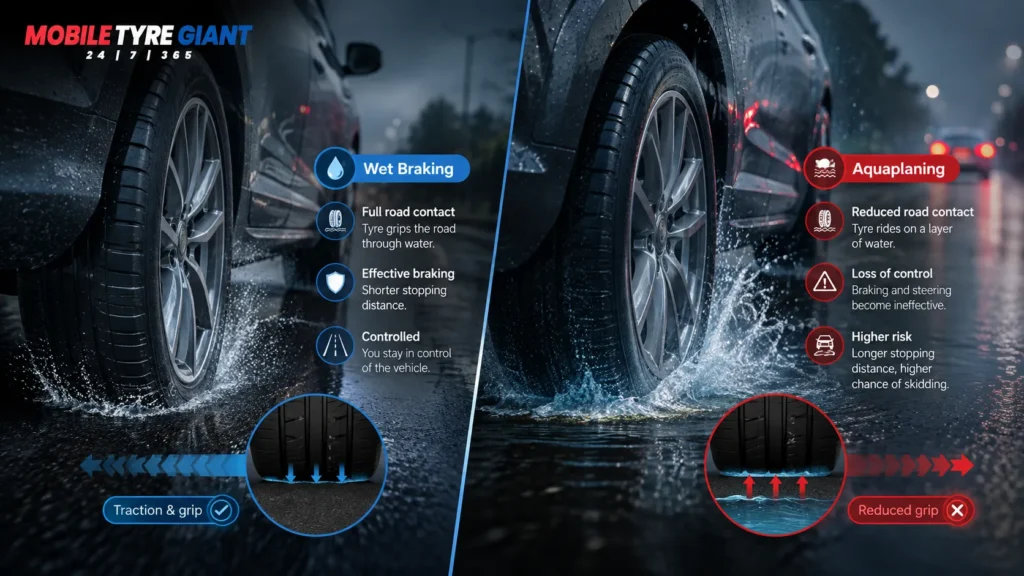
Aquaplaning happens when a layer of water builds between the tyres and the road surface faster than the tread can move that water away. As effective contact with the road reduces, the driver may suddenly feel that the steering has become unusually light or that the vehicle is no longer responding in the normal way. It can be an unnerving sensation because the change may happen quickly when a car reaches deeper standing water. This is different from simply having less grip on a damp road. During aquaplaning, the tyre is struggling to maintain proper contact because water is interfering with the contact patch itself. That is why aquaplaning resistance deserves separate attention when comparing tyres for wet weather.
No tyre can make a vehicle completely immune to aquaplaning. Even a high-quality tyre in good condition has a limit to how much water it can clear at a particular moment. Think of the tread grooves like drainage channels: if more water arrives than those channels can deal with, the tyre can begin to ride over the water instead of cutting through it effectively. This is also why a tyre that performs brilliantly under wet braking tests should not automatically be assumed to be the strongest through deep standing water. Speed, water depth, remaining tread, tyre pressure and tyre design can all change the situation. Understanding those variables is more useful than looking for a tyre advertised as being somehow impossible to aquaplane.
What Increases the Risk of Aquaplaning?
Standing water is one of the clearest risk factors because the tyre has a larger volume of water to displace before it can maintain useful contact with the road. Vehicle speed also matters because the faster the tyre reaches that water, the less time it has to clear it from beneath the footprint. This does not mean aquaplaning starts at one universal speed, however. There is no single number that applies to every car, tyre, road and depth of water. A badly worn tyre may respond differently from the same tyre when it was new, while an incorrectly inflated tyre may also behave differently from one operating at the manufacturer’s recommended pressure. Road drainage and the amount of water collecting in wheel tracks can change the risk further.
This explains why drivers sometimes report aquaplaning even when they believe they were travelling at a reasonable speed. A legal speed limit is not a guarantee that the same speed remains appropriate through deep standing water. Imagine two stretches of the same motorway during rain: one is simply wet, while another has water visibly collecting across the lane. The tyres are being asked to perform a much harder job in the second situation. If the steering starts to feel unresponsive because the tyres are losing effective contact, the sensible response is to ease off the accelerator and allow the vehicle to slow gradually rather than making sudden inputs. Good tyres are important, but driving according to the actual road conditions remains part of wet-weather safety.
How Much Tyre Tread Do You Need for Wet Weather?
For most cars and light vans in the UK, the legal minimum tread depth is 1.6mm across the central three-quarters of the tread and around the entire circumference. That number matters legally, but it should not be mistaken for a point at which tyre performance suddenly changes from excellent to poor. Tread wears gradually, and the grooves available to move water away become shallower during that process. A tyre with considerably more tread can generally provide more capacity for water displacement than the same tyre when it is approaching the legal minimum. This becomes particularly relevant on roads where standing water is present. The difference may be less obvious on a dry summer afternoon than during persistent rain on a busy motorway.
That is why wet-weather tyre decisions should consider remaining tread rather than asking only whether the tyre is technically legal. You should also inspect the whole condition of the tyre because tread depth alone cannot reveal cuts, bulges, cracking or unusual wear patterns. Uneven wear can leave one part of the tyre noticeably weaker even when another area still appears healthy at a glance. Checking several points across the tread gives a more realistic picture than looking at one groove and assuming the whole tyre is fine. If you are unsure whether wear has reached the point where replacement makes sense, our guide explaining when your tyres need replacing covers tread depth, age, visible damage and other warning signs in more detail. For tyres for wet weather, condition and remaining tread should be considered together rather than treated as separate concerns.
Is 1.6mm Tread Enough for Driving in Rain?
A tyre at 1.6mm may meet the legal tread requirement, but that does not mean it will retain the same wet-weather ability it had with substantially deeper tread. This distinction is important because drivers sometimes treat the legal minimum as if it were a performance target. It is not. As the grooves become shallower, their capacity to deal with water reduces, so wet braking and standing-water behaviour can change before the tyre actually becomes illegal. The effect is particularly relevant in persistent rain, where the tread may repeatedly have to move water out from underneath the tyre. A driver who regularly uses motorways or poorly drained roads may therefore pay closer attention to tread condition well before the final legal limit is reached.
That does not mean every tyre must automatically be discarded the moment it reaches an arbitrary figure above 1.6mm. Tyre model, wear pattern, age, condition, mileage and the way the vehicle is used all provide important context. A sensible approach is to monitor tread regularly and make a replacement decision based on the complete condition of the tyre rather than waiting for it to become illegal. Picture a tyre with 2.5mm remaining but severe uneven wear on one shoulder compared with another tyre that is evenly worn and otherwise healthy. The number alone does not tell the complete story. The key lesson is simple: legal tread depth establishes a minimum requirement, while good wet-weather performance is a broader question.
Does Tyre Pressure Affect Wet Grip and Aquaplaning?
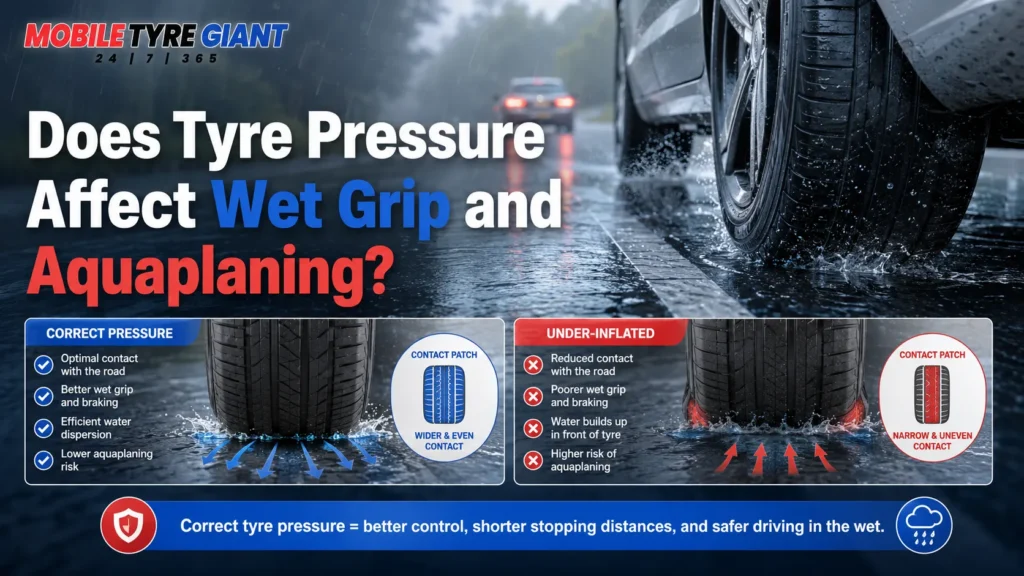
Yes, tyre pressure can influence the way a tyre behaves on wet roads because the tyre is designed to operate within the pressure specified by the vehicle manufacturer for the relevant load. When pressure is significantly incorrect, the tyre’s shape and contact with the road can change. Under-inflation can also increase heat generation, rolling resistance and uneven wear, which may gradually affect the tyre’s condition as well as how the vehicle feels. In wet conditions, you want the tread and tyre structure working as they were designed to work, not distorted because the pressure has been neglected. This is why pressure belongs in the same conversation as tread depth and wet braking when discussing tyres for wet weather. It is a basic maintenance item, but its effects are not trivial.
The correct response is not to deliberately add extra pressure whenever rain is forecast. Drivers should use the pressure recommended for their vehicle and load, normally found in the handbook, door area or other manufacturer information. Pressures should also be checked when the tyres are cold, using a reliable gauge, because pressure naturally changes as tyres heat during driving. A tyre that repeatedly loses pressure needs investigation rather than constant topping up without finding the cause. Our detailed guide on how under-inflated tyres affect your vehicle explains the wider effects on handling, wear and efficiency. Good wet-weather performance begins with choosing suitable tyres, but it depends just as much on keeping those tyres in the condition and pressure range in which they were designed to operate.
Summer vs All-Season Tyres in Rain: Which Is Better?
Neither summer tyres nor all-season tyres are automatically better simply because the road is wet. A good summer tyre can deliver excellent wet braking and handling when temperatures are within the range it was designed for, while an all-season tyre is built to work across a wider spread of temperatures and changing seasonal conditions. The important point is that rain on a mild day is not the same challenge as rain combined with cold temperatures, frost or occasional snow. That is why choosing tyres for wet weather should start with the conditions you actually drive in rather than the name printed on the tyre category. Someone driving mainly around London may have different priorities from a driver regularly travelling through colder rural areas.
All-season tyres can make sense for drivers who want one tyre type throughout the year and regularly experience a mixture of rain, lower temperatures and occasional winter conditions. Summer tyres can still be an excellent choice for drivers who mainly operate in milder weather and want strong dry and wet-road performance during those conditions. The mistake is assuming that all-season automatically means “better in rain” or that summer tyres are somehow intended only for dry roads. Modern tyre categories involve trade-offs, and the exact model matters just as much as the category itself. If you are comparing different tyre types, Mobile Tyre Giant’s guide to choosing the right tyres for your car provides a broader look at how vehicle requirements and driving conditions should influence the decision.
Are Summer Tyres Good in the Rain?
Yes, quality summer tyres can perform very well on wet roads when temperatures are suitable for them. Summer tyres are designed to provide useful grip across both dry and wet surfaces during milder and warmer conditions, so it would be wrong to treat them as fair-weather tyres. Many independent tyre tests measure wet braking, wet handling and aquaplaning on summer tyres precisely because wet-road performance is one of the most important parts of their design. The key is to judge the exact tyre rather than assuming that every summer tyre performs the same. A strong model may provide excellent braking confidence and predictable steering in rain, while another may be weaker in one or more wet disciplines.
This is where real driving conditions matter more than labels alone. Imagine a driver who spends most of the year travelling around urban and motorway roads in relatively mild temperatures. That person may have little reason to sacrifice some warm-weather characteristics simply because the UK experiences frequent rain. On the other hand, someone who regularly drives in colder weather, early-morning frost or occasional snow may value the broader operating range of an all-season tyre. The best answer therefore depends on temperature, route and use rather than rainfall by itself. In simple terms, summer tyres can be very good in rain, but their suitability still depends on the wider conditions in which the vehicle is used.
Are All-Season Tyres Better in the Rain?
Not automatically. All-season tyres are designed to balance performance across a broader range of temperatures and weather conditions, which can make them attractive for UK drivers who want one set of tyres throughout the year. That wider capability does not mean they will always outperform a strong summer tyre on a wet road in mild temperatures. One all-season tyre may be excellent at wet braking while another may focus more heavily on cold-weather or light-snow capability. The same applies to summer tyres, which can vary significantly from one model to another. Category alone is therefore not enough to judge which tyre will perform better in rain.
A better approach is to think about how often you encounter genuinely cold conditions as well as wet ones. If your driving regularly includes winter temperatures, exposed roads or areas where frost and occasional snow are realistic concerns, an all-season tyre may offer a useful balance. If most of your driving takes place in milder conditions, a good summer tyre may still be entirely suitable for wet-weather use. Neither choice should be made just because one name sounds more appropriate for the climate. The exact tyre, vehicle specification and actual driving conditions should carry more weight than the category label.
Are Premium Tyres Always Better in Wet Weather?
Premium tyres often perform strongly because large manufacturers invest heavily in tyre development, compounds and testing, but price alone is not a wet-weather performance rating. A more expensive tyre should not automatically be assumed to be the best option for every vehicle or every driver. Different models are designed with different priorities, and one tyre may lead in wet braking while another provides better aquaplaning resistance, comfort or wear. Mid-range tyres can also perform very well in particular tests, while some lower-cost options may show bigger compromises. That is why comparing tyres purely as budget, mid-range and premium can oversimplify the decision.
The better question is whether the exact tyre offers the right balance for the way you drive. A motorway driver may place greater value on wet braking and standing-water performance, while an urban driver may also care about durability, comfort and price. Someone covering high annual mileage may pay more attention to tread life and rolling resistance because those costs continue long after the tyre is fitted. Spending more can be worthwhile, but only if the tyre’s characteristics actually match your needs. The goal should be to choose a suitable, well-tested tyre rather than assuming the highest price automatically guarantees the best result.
Why the Exact Tyre Model Matters More Than the Brand Tier
Two tyres from the same manufacturer can behave differently because they may be designed for different vehicles, markets or performance priorities. One model could focus on touring comfort and longevity, while another may place greater emphasis on steering response or wet braking. Tyre size can also affect test results and label grades, which is why it is sensible to look for information that matches your own tyre specification as closely as possible. A tyre that performs brilliantly in one tested size should not automatically be assumed to behave identically in every other size. This level of detail matters more as the buyer moves from general research toward an actual purchase.
Before comparing wet-weather results, make sure you are starting with the correct fitment. The tyre needs the appropriate size, load capability and speed rating for the vehicle. Mobile Tyre Giant’s correct tyre size guide explains where drivers can find their tyre specification and what the markings mean. Once that basic requirement is confirmed, wet braking, aquaplaning, seasonal suitability and other characteristics become meaningful comparison points. Choosing the wrong specification because another tyre has a better headline rating would be a serious mistake.
Why Independent Wet-Weather Tyre Tests Matter
Independent tyre testing is useful because it breaks wet-weather performance into separate disciplines instead of giving a tyre one vague overall score. A good test may measure wet braking, wet handling, lateral grip and aquaplaning separately, allowing drivers to see where each tyre is strong and where compromises appear. This is particularly useful because tyre labels do not describe every aspect of driving in rain. A tyre that stops in a short distance on wet tarmac may not necessarily rank first through deeper standing water. Looking at several test categories therefore creates a more realistic picture than relying on a single number.
The challenge is not to become obsessed with tiny differences between rankings. Test results should help identify meaningful strengths and weaknesses rather than convince a normal road driver that a tyre in second place is automatically unsuitable. Look for consistent performance across the areas that matter to you, then consider wear, noise, efficiency and price alongside the wet results. A tyre that performs well across several categories may be a better everyday choice than one that wins a single test but compromises heavily elsewhere. Independent testing works best as a decision tool, not as a scoreboard.
Are Wider Tyres Better in the Rain?
Wider tyres are not automatically better in wet weather. A wider tyre can offer strong grip on an ordinary wet surface, but it also presents a larger footprint that must deal with water when the vehicle reaches deeper standing water. Aquaplaning behaviour depends on several factors, including tread design, water depth, speed, tyre pressure and the overall construction of the tyre. That means a simple rule such as “wider is safer” or “narrower is always better” is too crude. The right width begins with what the vehicle manufacturer has approved for the car.
Drivers should therefore avoid changing tyre width simply because they believe it will improve wet grip. Changing size can affect fitment, load capability, speedometer behaviour and other aspects of vehicle operation if it is not properly specified. The sensible approach is to use an approved tyre size and then compare suitable models within that specification. Wet-weather performance should be judged through braking, aquaplaning, tread condition and proper maintenance rather than by width alone.
How to Choose Tyres for Wet UK Roads
Choosing tyres for wet UK roads should start with the vehicle, not with whichever tyre has the boldest wet-weather claim. First confirm the correct tyre size, load index and speed rating, then compare suitable models within that specification. Wet grip is an important filter because braking performance matters every time the road is damp, but the label should not be your final decision. Look beyond it for information about aquaplaning, wet handling and how the tyre performs as part of a broader test. Then consider whether a summer or all-season tyre better matches the temperatures and conditions in which you normally drive. A motorway driver encountering standing water regularly may have different priorities from someone whose journeys are mainly short urban trips.
Once the safety and suitability factors are covered, compare the everyday trade-offs such as tread life, road noise, comfort, efficiency and price. There is little value in choosing a tyre solely because it wins one wet test if it performs poorly in areas that matter throughout the rest of your ownership. Think of tyre choice like choosing a good pair of walking shoes: excellent grip matters, but the shoes still need to fit correctly and suit where you actually use them. The same principle applies to tyres for wet weather. Mobile Tyre Giant provides a range of replacement tyres for different vehicles and tyre sizes, allowing the final choice to begin with the correct specification rather than a generic recommendation. The best decision is usually the tyre that provides a strong overall balance for your vehicle, route, climate and budget.
A Simple Wet-Weather Tyre Buying Order
A practical buying order makes the process easier. Start by confirming the correct tyre specification, then check the wet grip rating of the suitable options. After that, look for broader wet-weather testing that separates wet braking from aquaplaning and handling. Consider how much cold-weather driving you actually do before deciding between summer and all-season tyres. Check expected wear, efficiency, comfort and noise rather than looking only at one performance category. Finally, make sure the tyre is fitted correctly and maintained at the pressure recommended by the vehicle manufacturer.
This order also prevents common buying mistakes. Choosing an A-rated tyre but ignoring an unsuitable size is not sensible, just as choosing an all-season tyre solely because Britain receives plenty of rain misses the purpose of the category. Likewise, buying the most expensive option without comparing the exact model does not guarantee the best result for your car. The process should move from correct fitment to relevant performance to everyday ownership factors. That approach is less exciting than a list claiming one tyre is universally best, but it is far more useful. Tyre choice is ultimately about matching several characteristics rather than chasing one headline number.
When Should Wet-Weather Concerns Lead to Tyre Replacement?
Poor confidence in rain does not automatically prove that a tyre needs replacing, but it is a reason to inspect the tyres properly. Check remaining tread depth, pressure, visible condition and wear across the full width of each tyre. Cuts, bulges, cracking, repeated pressure loss or severe uneven wear should not be ignored simply because the centre tread still looks acceptable. A tyre approaching the legal tread limit may also behave differently in standing water from the way it did with deeper tread. If the vehicle suddenly feels less predictable in wet conditions, the cause should be investigated rather than assuming that rain alone explains the change. Steering, suspension, alignment and road conditions can also influence what the driver feels.
Replacement becomes the sensible next step when the tyre is damaged, no longer legally compliant, unsuitable for the vehicle or judged unfit for continued safe use. Drivers should not deliberately run a questionable tyre until the last possible millimetre simply because it has not yet crossed a legal threshold. At the same time, there is no need to replace a healthy tyre just because a marketing article suggests one arbitrary tread figure applies to every situation. The complete condition of the tyre matters. Where replacement is required, a mobile tyre replacement service can provide a practical option when visiting a traditional fitting location is inconvenient or the vehicle cannot reasonably be driven there.
Wet-Weather Tyre Checklist Before the Next Heavy Rain
Before a period of heavy rain, check the basics while the car is parked rather than discovering a problem after hitting a waterlogged road. Confirm that the tyres have sufficient legal tread across the required area and inspect them for obvious cuts, bulges and abnormal wear. Check tyre pressures when cold and adjust them to the vehicle manufacturer’s recommended settings for the relevant load. Make sure the tyres fitted are the correct specification for the vehicle. If replacement is approaching, compare wet braking as well as broader wet-weather characteristics rather than judging the next tyre by appearance alone. These simple checks take far less effort than dealing with a tyre problem during a dark, wet motorway journey.
The most important lesson is that even excellent tyres still need sensible maintenance and driving. Deep tread does not justify travelling too quickly through standing water, just as a premium badge cannot make aquaplaning impossible. Wet-weather safety comes from several layers working together: suitable tyres, adequate tread, correct pressure, sound condition and driving appropriate to what is happening on the road. If one of those layers is neglected, the others cannot completely compensate for it. That is why choosing tyres for wet weather should be treated as an ongoing process rather than a decision made only on the day the tyres are purchased.
Final Words: There Is More to Wet-Weather Tyres Than the Label
The best tyres for wet weather cannot be identified from one number, one tread pattern or one marketing description. Wet braking matters, but so do aquaplaning resistance, tread depth, pressure, tyre condition and correct vehicle specification. A strong wet grip rating is useful information, yet it does not tell you how the tyre performs in every situation involving rain. Summer and all-season tyres can both provide strong wet performance when they are used in suitable conditions, while premium pricing alone does not guarantee superiority in every wet test. The most sensible approach is to compare the complete tyre rather than chasing one feature.
For UK drivers, that means starting with the correct specification, checking reliable performance information and then keeping the tyres properly maintained after fitting. If your current tyres are worn, damaged or unsuitable, dealing with the problem before poor weather arrives is better than hoping they will cope when conditions deteriorate. Mobile Tyre Giant’s mobile tyre fitting service provides an on-site option when replacement tyres are needed. Ultimately, good wet-weather performance comes from choosing the right tyre, looking after it and adjusting your driving when the road becomes more demanding.
Need Safer Tyres for Wet Weather?
Choose the right replacement tyres for better wet-road confidence, with mobile tyre fitting at a convenient location when your current tyres are worn, damaged or no longer suitable.
Frequently Asked Questions
Find quick answers to the most common questions our customers ask.
A good wet-weather tyre combines effective wet braking, water evacuation, aquaplaning resistance and predictable handling with sufficient tread and correct pressure. The exact tyre must also be suitable for the vehicle, because a strong performance rating cannot compensate for an incorrect specification.
The wet grip rating provides information about a tyre's wet braking performance under standardised testing. It is useful when comparing suitable tyres, but it should not be treated as an overall score covering aquaplaning, wet cornering, wear and every other aspect of driving in rain.
No. Wet braking and aquaplaning resistance measure different aspects of tyre performance. A tyre can perform strongly when braking on a wet surface but rank differently when tested through deeper standing water.
Yes. No road tyre is immune to aquaplaning because there is a limit to how much water the tread can move away. Water depth, speed, tread condition, tyre pressure and tyre design all influence whether effective road contact can be maintained.
If steering response is lost through standing water, ease off the accelerator and allow the vehicle to slow gradually while avoiding abrupt steering inputs. The aim is to let the tyres regain effective contact with the road rather than reacting aggressively while grip is reduced.
For applicable car tyres, 1.6mm is the UK legal minimum across the required tread area, but it is not a guarantee of optimum wet-weather performance. Water-clearing ability can reduce as tread becomes shallower, so tyre condition should be monitored before the legal limit is reached.
Incorrect tyre pressure can affect the way the tyre contacts the road and behaves in standing water. Rather than guessing a pressure specifically for rain, use the vehicle manufacturer's recommended pressures and investigate any tyre that repeatedly loses air.
Not automatically. Quality summer tyres can perform extremely well on wet roads in suitable temperatures, while all-season tyres are designed to provide a broader compromise across changing temperatures and seasonal conditions. The exact tyre and your driving environment matter more than the category name alone.
Wider tyres are not automatically better or worse in every wet situation. Width is only one factor affecting tyre behaviour, and drivers should use a manufacturer-approved specification rather than changing tyre width simply because they believe it will improve performance in rain.
No. Premium tyres often perform strongly, but price category alone does not determine wet braking, aquaplaning or handling performance. Compare the exact tyre model, correct specification and relevant performance information rather than assuming that the most expensive option must be the best.