

If you are replacing a worn, punctured or damaged tyre, it is reasonable to ask what does tyre fitting include before agreeing to the work. A proper fitting is more involved than simply removing one piece of rubber and putting another onto the wheel. The fitter needs to confirm that the replacement tyre suits the vehicle, remove the wheel safely, take the old tyre from the rim and mount the new one correctly. The tyre then needs to be inflated, the wheel and tyre assembly should be balanced where included, and the wheel must be securely refitted. Final checks matter because a tyre can look perfectly normal while a poor fit, incorrect pressure or wheel imbalance creates problems once the car is moving.
Understanding what does tyre fitting include also makes it easier to compare quotes without being distracted by the headline tyre price alone. Some services, such as wheel balancing, are commonly part of a professional fitting package, while wheel alignment is usually treated as a different job. Standard valve replacement and old tyre disposal may also be included, although drivers should confirm exactly what their chosen fitter provides. TPMS sensors require separate consideration because an electronic tyre pressure sensor is not the same thing as a basic rubber valve. If you are arranging mobile tyre fitting, the same basic questions still apply because you want to know what will happen from the moment the technician arrives until the vehicle is ready to drive again.
What Does Tyre Fitting Normally Include?
When drivers ask what does tyre fitting include, they are usually trying to understand which jobs form part of a complete tyre change and which may appear as additional work. The core process begins with removing the wheel and taking the existing tyre off the rim without unnecessarily damaging the wheel. The fitter then checks the replacement tyre specification before mounting it in the correct orientation and seating it properly on the rim. Air is added to the appropriate pressure, and the wheel and tyre assembly can then be balanced so its weight is distributed evenly as it rotates. Finally, the wheel is refitted to the vehicle, the fixings are tightened correctly and basic final checks are completed before the vehicle is returned to the driver.
Where confusion begins is with services that sit around the core fitting process. A standard rubber valve may be changed during fitting, but it is better to confirm this rather than assume that every fitting package in the UK is identical. Old tyre disposal is also commonly offered, while alignment, wheel repairs and replacement TPMS components are generally separate issues that depend on the vehicle and the condition found. A clear quote should make these differences understandable before work starts, not leave the driver trying to decode an invoice afterwards. Thinking in terms of what is essential, what is commonly included and what is conditional makes it much easier to judge whether a tyre-fitting service is genuinely complete.
Service or check | Typical position in tyre fitting | What the driver should know |
Removing the old tyre | Core fitting step | Required before a replacement can be mounted |
Mounting the new tyre | Core fitting step | Correct size and orientation must be confirmed |
Correct inflation | Core fitting step | Pressure should suit the vehicle specification |
Wheel balancing | Commonly included | Helps prevent vibration from wheel imbalance |
Standard rubber valve | Often included | Confirm the fitter’s package |
Old tyre disposal | Often included | Confirm if disposal is part of the quote |
Wheel alignment | Usually separate | Different from wheel balancing |
TPMS sensor replacement | Usually separate if required | A sensor is not automatically replaced with every tyre |
Wheel or rim repair | Separate work | Damage may need specialist attention |
Locking wheel nut extraction | Separate if required | May be necessary if the correct key is unavailable |
What Does “Fully Fitted Tyres” Actually Mean?
The phrase “fully fitted tyres” sounds straightforward, but the useful question is what the quoted package actually contains. In practical terms, a fully fitted service should cover the work needed to put the replacement tyre onto the vehicle correctly rather than quoting only for the tyre itself. That normally means removal of the existing tyre, mounting and inflation of the replacement, refitting the wheel and the associated fitting work agreed by the provider. Balancing, valve work and disposal are also frequently bundled into fitted prices, but there is no benefit in relying on assumptions when a quick confirmation can remove uncertainty. If one quote looks dramatically cheaper than another, comparing the included work often tells you more than comparing the headline numbers.
This distinction matters because a low tyre price and a low completed-job price are not always the same thing. Imagine buying a plane ticket that looks cheap until baggage, seat choice and other essentials appear at checkout; tyre fitting can create a similar frustration when inclusions are unclear. A useful fitting quote should allow the driver to understand what is being supplied and whether anything additional may be required after inspection. That is especially important for TPMS faults, damaged rims, wheel alignment problems or missing locking wheel nut keys because these are not simply another part of mounting a tyre. The best approach is therefore to treat “fully fitted” as a description that still deserves a clear breakdown rather than as a guarantee that every possible tyre-related service is included.
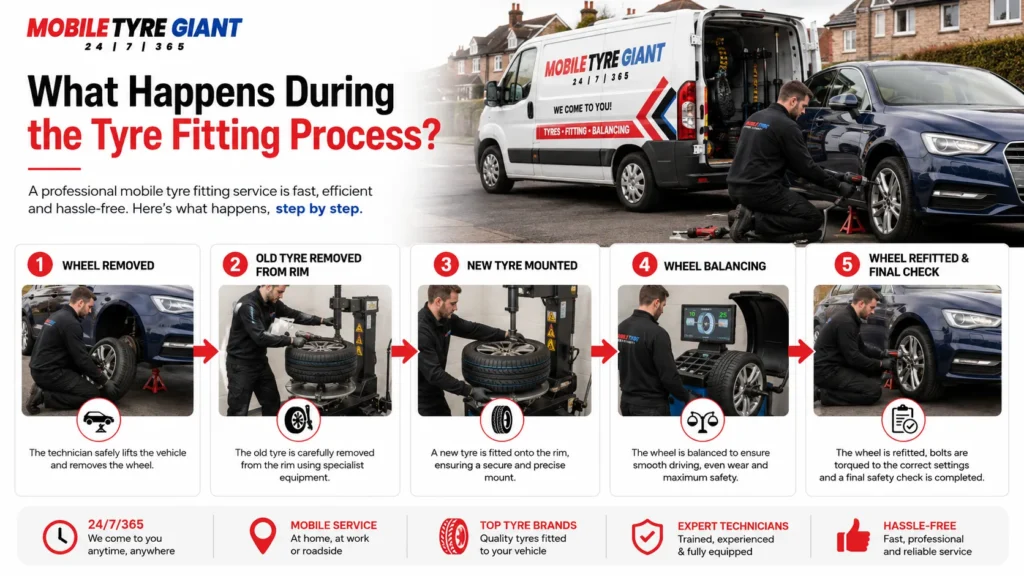
What Happens During the Tyre Fitting Process?
Knowing what does tyre fitting include becomes much easier when the job is viewed as a sequence rather than a single action. A fitter first needs to make sure the replacement tyre is suitable for the vehicle before touching the wheel, because fitting the wrong specification correctly would still leave the vehicle with the wrong tyre. Once the vehicle is positioned safely, the relevant wheel can be removed and the existing tyre taken from the rim using tyre-changing equipment. With the tyre off, the fitter has an opportunity to look at areas that are normally hidden, including the bead seating surface and visible valve condition. The new tyre can then be mounted in the correct direction, seated, inflated and prepared for balancing before the wheel goes back onto the car.
After fitting, the wheel needs to be secured correctly and checked rather than simply bolted back on as quickly as possible. This is where details such as pressure, balance and correct wheel-fixing torque become important because they affect how the vehicle feels once it is moving again. A driver should not expect a full mechanical inspection as part of ordinary tyre fitting, but obvious fitting-related problems should not simply be ignored either. The entire process should feel methodical, from confirming the tyre to the final visual and pressure checks, rather than like a hurried wheel swap beside the vehicle. In the next stages of the process, balancing, valves, TPMS and alignment each need to be understood separately because they are often where customers become unsure about what is actually included.
Step 1: The Correct Tyre Is Confirmed
Before any tyre is fitted, the technician needs to confirm that the replacement is suitable for the vehicle. The familiar string of numbers and letters printed on a tyre sidewall provides information such as width, aspect ratio, rim diameter, load index and speed rating. Two tyres can look almost identical from a short distance but still have specifications that make them unsuitable substitutes for one another. That is why guessing from wheel appearance alone is a poor way to choose a replacement, particularly on vehicles with different approved fitments or higher load requirements. Drivers who are unsure about these markings can use the correct tyre size guide to understand what the sidewall information means before arranging a fitting.
The fitter should also consider whether the tyre is directional or asymmetric because correct orientation matters during installation. A directional tyre normally has an arrow showing its intended rotation, while an asymmetric tyre typically identifies which side should face outward. The load and speed ratings also need attention because the replacement should meet the specification required for the vehicle rather than merely sharing the same rim diameter. Providing the registration, vehicle details or confirmed tyre size before a mobile appointment can help reduce the chance of the wrong tyre arriving at the vehicle. This first step may seem less dramatic than using the tyre machine, but getting the specification right is one of the most important parts of a professional fitting.
Step 2: The Vehicle Is Safely Positioned and the Wheel Is Removed
Once the tyre specification is confirmed, the vehicle needs to be positioned so the wheel can be removed safely. On a driveway or at a workplace, that generally means choosing stable ground with enough space around the relevant side of the vehicle for the technician and equipment to work. Roadside situations can be more complicated because passing traffic, surface conditions and the exact location may affect whether work can be carried out safely where the vehicle has stopped. The technician then raises the vehicle using suitable lifting equipment before removing the wheel nuts or bolts that secure the wheel. This stage should be controlled and methodical because rushing the lifting or removal process creates unnecessary risk before tyre fitting has even begun.
A locking wheel nut can become the first practical obstacle if the vehicle uses one and the correct key cannot be found. Drivers who know their wheels have locking nuts should locate the key before the appointment where possible rather than discovering it when the technician is ready to remove the wheel. A damaged or missing key does not always make the job impossible, but it can turn a normal fitting into a specialist removal task. Mobile Tyre Giant provides a separate locking wheel nut removal service for situations where a locking nut is seized, damaged or cannot be removed normally. Once the wheel is safely off the vehicle, the fitter can move on to removing the old tyre from the rim and inspecting the areas that are hidden while the tyre is installed.
What Happens During the Tyre Fitting Process After the Wheel Is Removed?
Once the wheel has been removed from the vehicle, the tyre fitting process moves from the car itself to the wheel and tyre assembly. This is the point where professional equipment becomes important because the old tyre must be separated from the rim without causing unnecessary damage. The fitter also gets a much clearer view of the areas normally hidden by the tyre, including the bead seating surface and valve area. Any obvious issue found here can affect whether the replacement tyre will seal properly once inflated. The process should therefore be treated as more than simply pulling the old tyre off and forcing a new one onto the wheel.
The fitter will normally work through several controlled stages before the wheel is ready to go back onto the vehicle. The old tyre is removed, visible fitting surfaces are checked, the replacement tyre is mounted in the correct orientation and the assembly is inflated and balanced. Each stage has a practical purpose, even though much of the work happens quickly when carried out by an experienced technician. Skipping one of these steps can lead to problems such as pressure loss, vibration or an incorrectly fitted tyre. Understanding this sequence gives drivers a much clearer answer to what does tyre fitting include than simply describing it as a tyre change.
Step 3: The Old Tyre Is Removed From the Wheel Rim
Before the old tyre can come off, the air inside it needs to be released so the tyre can be safely separated from the wheel. The fitter then breaks the tyre bead away from the rim, which means releasing the tightly sealed edge of the tyre from the wheel. Specialist tyre-changing equipment is normally used to help remove the tyre without placing unnecessary stress on the rim. On an alloy wheel, careful handling is especially important because marks or damage to the visible surface are not something a customer should simply expect as part of fitting. The process can look quite forceful from the outside, but the equipment is designed to control the tyre while keeping the wheel securely positioned.
Once the bead has been released, the tyre can be lifted away from the rim and removed completely. At this point, the fitter can see whether there are obvious issues around the wheel edge that were hidden when the old tyre was mounted. The removed tyre itself can also tell a story, particularly if one shoulder is heavily worn, the tread is uneven or there are signs of previous damage. Those patterns do not automatically mean a particular mechanical fault, but they may justify further investigation rather than being ignored. If the tyre was removed because of a puncture, it may also become clearer whether the damage could have been suitable for professional mobile tyre repair or whether replacement was the more appropriate option.
Step 4: The Rim, Bead Area and Tyre Valve Are Checked
With the old tyre removed, the fitter has direct access to the wheel rim and the area where the new tyre will need to create an airtight seal. The bead seating surface should be in a condition that allows the replacement tyre to sit correctly against the rim. Heavy corrosion, obvious physical damage or contamination around this area can interfere with sealing and may contribute to pressure loss later. This does not mean every mark on a wheel requires repair, but obvious problems should not simply be hidden underneath a new tyre. A careful fitter will recognise when something needs to be mentioned before the fitting continues.
The valve area also deserves attention because a tyre cannot maintain pressure properly if air is escaping through a faulty valve or associated component. Traditional rubber valves are relatively simple, while many modern vehicles use a tyre pressure monitoring system that introduces additional components. A TPMS-equipped wheel may include a sensor attached to the valve assembly, so replacing or servicing it is not the same as changing an ordinary rubber valve. If a warning light is already showing before the fitting appointment, the driver should mention it rather than assuming the new tyre will automatically solve the issue. Where a valve or monitoring component has failed, a dedicated TPMS valve replacement service may be required rather than treating the fault as a normal part of fitting.
Step 5: The New Tyre Is Mounted and Inflated Correctly
The replacement tyre can be mounted once the wheel and fitting surfaces are ready. Lubrication designed for tyre fitting is normally applied around the bead so the tyre can move over the rim smoothly and seat correctly. The technician also needs to pay attention to tyre orientation because directional and asymmetric tyres cannot simply be fitted whichever way looks convenient. Directional tyres normally have an arrow showing the intended direction of rotation, while asymmetric tyres indicate which side should face outward. These markings matter because the tread pattern has been designed to operate in a particular orientation.
After mounting, the tyre is inflated so the bead can seat securely against the wheel. A distinct change in sound can sometimes be heard as the bead settles into position, although the technician relies on proper equipment and inspection rather than sound alone to confirm the fit. The pressure then needs to be set appropriately for the vehicle rather than using one universal figure for every car. Tyre pressures vary according to the vehicle, load and manufacturer specifications, which is why copying the pressure from another vehicle is unreliable. Once the tyre is seated and inflated correctly, the wheel and tyre assembly is ready for one of the most important parts of professional fitting, wheel balancing.
Step 6: The Wheel and New Tyre Are Balanced
A newly fitted tyre does not automatically mean the complete wheel assembly is perfectly balanced. Small differences in weight around the tyre and wheel can create an imbalance when the assembly begins rotating at road speed. To identify these differences, the wheel is mounted onto a balancing machine that spins the assembly and measures where correction is needed. The technician then adds small balance weights at the positions indicated by the machine. These weights may look insignificant, but even a relatively small imbalance can become noticeable as the wheel rotates faster.
Balancing is important because an incorrectly balanced wheel may create vibration through the steering wheel, seat or vehicle body depending on which wheel is affected and how severe the imbalance is. It may also contribute to irregular tyre wear over time, although vibration can have several other causes and should not automatically be blamed on balancing alone. Mobile Tyre Giant states that digital balancing is included with its tyre fitting work, which means the tyre and wheel assembly can be checked before the wheel returns to the vehicle. Drivers who need balancing as a separate service can also read more about mobile wheel balancing. This step is one reason a complete fitting service is more involved than simply mounting a tyre onto the rim.
Does Tyre Fitting Include Wheel Balancing?
Wheel balancing is commonly carried out as part of professional tyre fitting because installing a different tyre changes the weight characteristics of the complete wheel and tyre assembly. Even a brand-new tyre can have tiny variations in material distribution, while the wheel itself is rarely perfectly uniform. Once the two are assembled, those small differences can create a heavier point that becomes more noticeable as rotational speed increases. Balancing allows the fitter to identify and compensate for this rather than waiting for the driver to discover vibration after leaving. For this reason, drivers comparing fitting services should check whether balancing is included rather than judging the job only by the price of the tyre.
For Mobile Tyre Giant customers, digital wheel balancing is included as part of the fitting process rather than being treated as an afterthought. That is particularly relevant for mobile fitting because some drivers assume balancing equipment can only be used inside a conventional garage. Modern mobile fitting vans can carry specialist equipment designed to carry out the same core balancing process on-site when the setup is appropriate. The important question is not whether the fitter is working from a van or workshop, but whether the correct equipment is available and the job is completed properly. If a car develops new vibration after tyre fitting, that should be investigated rather than accepted as a normal characteristic of having new tyres.
Why Do New Tyres Need Balancing?
A common assumption is that balancing is only necessary when a wheel is old, damaged or already vibrating, but that is not how wheel balance works. A new tyre and a clean wheel can both be in excellent condition while still producing an uneven distribution of weight when combined. Manufacturing tolerances are extremely precise, but neither component is perfectly identical at every point around its circumference. The valve and other small components also contribute weight to one area of the wheel. Once the assembly spins quickly, these differences can create forces that were not obvious when the vehicle was stationary.
Think of a washing machine with a heavy item trapped on one side of the drum. At low speed, the imbalance may barely be noticeable, but as the drum accelerates the shaking becomes much stronger. A wheel behaves differently mechanically, but the analogy helps explain why a small weight difference can become noticeable at driving speeds. Balancing weights act as the correction, helping the assembly rotate more evenly around its centre. That is why balancing a replacement tyre before the wheel is refitted makes more sense than waiting for a customer to report shaking later. It is a routine part of making the newly fitted tyre feel smooth and predictable on the road.
Is Wheel Alignment Included With Tyre Fitting?
Wheel alignment is not normally included as a standard part of tyre fitting because it is a different procedure from mounting and balancing a tyre. During fitting, the technician works mainly with the tyre and wheel assembly, while alignment involves checking and adjusting the angles at which the wheels sit relative to the vehicle. This distinction matters because drivers often hear the words balancing, tracking and alignment during the same appointment and assume they describe parts of one service. A new tyre does not automatically change the vehicle’s wheel geometry simply because the old tyre has been removed. For that reason, replacing tyres does not mean every vehicle automatically needs an alignment afterwards.
There are situations where checking alignment can still make sense when tyres are replaced. If the old tyres show noticeably uneven wear, the vehicle pulls consistently to one side, the steering wheel sits off-centre or the car has recently hit a substantial pothole or kerb, the underlying geometry may deserve attention. Think of fitting new shoes when the soles of the old pair have worn heavily on one edge; replacing the shoes solves the worn material, but it does not necessarily address the reason they wore unevenly. The same logic applies to tyres, although many different factors can affect tyre wear and handling. A responsible fitter should therefore distinguish between fitting work and a separate alignment issue rather than presenting alignment as an automatic requirement with every new tyre.
Wheel Balancing vs Wheel Alignment: What Is the Difference?
Wheel balancing and wheel alignment solve different problems, even though both can influence how a vehicle feels on the road. Balancing deals with weight distribution around the rotating wheel and tyre assembly, using small weights to correct heavier and lighter areas. Alignment deals with the direction and angles of the wheels relative to the vehicle and road. An imbalance is more commonly associated with vibration that becomes noticeable as speed increases, while an alignment issue may contribute to pulling, an off-centre steering wheel or certain patterns of uneven tyre wear. Understanding this difference helps drivers avoid assuming that one service can automatically correct a problem caused by the other.
A simple way to picture the difference is to imagine a spinning desk fan. If one blade were slightly heavier than the others, the fan could shake as it spins, which is similar to the principle behind wheel imbalance. Alignment is closer to changing the direction in which that fan is pointing, because the problem relates to angle rather than rotating weight. The comparison is not mechanically exact, but it makes the distinction easier to understand without burying the driver in workshop terminology. If a newly fitted tyre produces vibration, balancing is one of the areas that may need checking, but a technician should still assess the actual cause. If the car consistently pulls to one side, simply adding another balance weight would not correct a genuine geometry problem.
Are New Tyre Valves Included When Tyres Are Fitted?
A standard rubber tyre valve is often replaced when a new tyre is fitted, but drivers should not assume that every fitting package includes a new valve automatically. The valve is a small component, yet it plays an essential role because it allows the tyre to be inflated while helping maintain an airtight seal afterwards. Rubber valves can deteriorate with age, exposure and repeated movement, so their condition is worth considering while the tyre is already removed from the wheel. Replacing a simple valve during fitting can be straightforward, but the exact service provided depends on the fitter and the type of valve fitted to the vehicle. This is why the best question before booking is not simply whether valves are “normally included”, but whether valve work is included in the specific quote you have received.
Modern vehicles can make this subject more complicated because many wheels use tyre pressure monitoring technology rather than a basic valve alone. A driver looking at the outside of the wheel may see what appears to be an ordinary valve stem without realising that it may form part of a TPMS assembly. The presence of TPMS does not mean the electronic sensor needs to be replaced every time a tyre is changed. Equally, fitting a new tyre will not automatically cure a warning caused by a damaged valve, failed sensor or separate pressure-monitoring fault. Asking about the valve and TPMS before work begins can prevent confusion once the old tyre is already off the rim.
Is a TPMS Sensor Replacement Part of Standard Tyre Fitting?
TPMS sensor replacement is not normally an automatic part of every standard tyre fitting. The tyre pressure monitoring system is designed to alert the driver when tyre pressure falls outside the system’s expected range, and many systems use electronic sensors associated with the wheel or valve assembly. These electronic components are different from an ordinary rubber valve and can require separate parts, diagnosis or servicing if something is wrong. If the existing sensor is functioning correctly, changing the tyre does not by itself mean the sensor needs to be discarded. This distinction is important because treating every valve and every TPMS component as the same thing can lead to unnecessary confusion about what should be included in a fitting price.
Drivers should mention an existing TPMS warning before the technician begins rather than hoping that fitting a new tyre will automatically switch the light off. Sometimes the warning is linked to low pressure, but persistent warnings can have other causes that require proper investigation. A fitter may also identify a damaged valve component while the tyre is removed, which is easier to explain when the customer already understands that this is separate from the tyre itself. The sensible approach is to ask what TPMS-related work, if any, is included before authorising additional parts. That keeps the fitting process transparent and allows the driver to understand whether they are paying for the tyre, the fitting work or a separate monitoring-system repair.
What Happens to the Old Tyre After Fitting?
Once the replacement tyre has been mounted, the removed tyre still needs to be dealt with. Professional fitting services commonly arrange for old tyres to be taken away rather than leaving the driver with a bulky piece of waste in the boot or driveway. However, disposal arrangements should still be confirmed when comparing quotes because service packages can differ. If a customer specifically wants to keep the old tyre, perhaps because it still has usable tread and was replaced for another reason, that request should be made before the fitter takes it away. Clear communication avoids the awkward situation of asking for a tyre after it has already entered the fitter’s disposal process.
The condition of the removed tyre can also provide useful context about why replacement became necessary. Deep wear, exposed damage, a bulge, severe cracking or other visible problems can make the reason obvious, while some tyres are changed because they have simply reached the point where continued use is no longer sensible. Drivers who are uncertain about replacement indicators can read the guide on when to replace tyres for a broader look at tread condition and warning signs. What matters here is that disposal is the final stage for the old tyre, not a substitute for understanding why it needed replacing in the first place. Knowing the reason can help a driver recognise similar wear or damage earlier on the remaining tyres.
What Is Not Usually Included in Standard Tyre Fitting?
Understanding what does tyre fitting include is easier when drivers also know where the normal fitting job ends. Standard tyre fitting is focused on removing the existing tyre, installing the correct replacement and preparing the wheel to return safely to service. It does not normally include repairing a bent or badly damaged wheel, fixing suspension faults, carrying out brake repairs or correcting unrelated steering problems. Wheel alignment is also generally a separate service, while faulty TPMS components may require additional parts or diagnosis. Specialist locking wheel nut extraction can also sit outside a normal fitting if the wheel cannot be removed with the customer’s available key.
This does not mean a fitter should ignore an obvious problem simply because it falls outside the fitting package. If a damaged rim, unusual wear pattern or another visible issue could affect the job, the useful response is to explain it before automatically carrying out additional work. That transparency is particularly important when the original appointment sounded simple, because unexpected additions are where many customers begin to feel unsure about what they are paying for. If a tyre is damaged beyond repair and a replacement is required, Mobile Tyre Giant also provides mobile tyre replacement at the vehicle’s location. The practical rule is straightforward: tyre fitting should complete the tyre-fitting job properly, while unrelated repairs or specialist services should be identified clearly rather than quietly folded into the bill.
Is Mobile Tyre Fitting Different From Garage Tyre Fitting?
The location may be different, but the fundamentals of professional tyre fitting should remain the same. A properly equipped mobile tyre technician can remove the wheel, take the old tyre from the rim, mount the replacement, inflate it correctly, balance the wheel and refit it at the customer’s location. The main difference is convenience because the vehicle does not need to be driven to a workshop before the work begins. This can be especially useful when a tyre is flat or damaged and continuing to drive could make the situation worse. Mobile fitting can also suit drivers who prefer the work to be completed at home or their workplace rather than arranging time around a garage appointment.
The quality of the fitting depends more on the technician, equipment and process than on whether the equipment sits inside a workshop or a mobile van. Drivers should therefore check what the mobile service actually provides rather than assuming every van carries identical equipment. Balancing capability is particularly worth confirming because it is an important part of fitting a replacement tyre correctly. Safe access around the vehicle is also necessary, and there may be roadside locations where work cannot reasonably be completed exactly where the vehicle has stopped. A good mobile fitting service should explain any limitations clearly before the technician begins rather than treating convenience as a reason to skip normal fitting standards.
How Long Does Tyre Fitting Take?
There is no single fitting time that applies to every vehicle because several practical factors can change the length of the job. Replacing one straightforward tyre is naturally different from fitting four tyres, dealing with a run-flat tyre or discovering that a locking wheel nut cannot be removed normally. Wheel size, tyre construction, TPMS components and the general condition of the wheel can also affect how smoothly the fitting progresses. The important point is that a technician should not rush essential stages such as mounting, inflation, balancing and secure refitting merely to achieve an impressive time estimate. A quick fitting is useful only when the complete job has still been carried out correctly.
Drivers arranging mobile fitting should also separate technician arrival time from the time needed to complete the actual fitting. Traffic, location and tyre availability can influence when the van reaches the vehicle, while the work itself begins once the technician is on-site and can safely access the wheel. If several tyres need replacing, it is sensible to allow more time than for a single damaged tyre. Special circumstances such as TPMS faults or damaged wheel components may also extend the appointment if additional work is required. For this reason, an estimated fitting window is more realistic than promising that every tyre change will take exactly the same number of minutes.
What Should You Confirm Before Booking Tyre Fitting?
Before booking, ask what the quoted price actually includes rather than relying on the words “fitted” or “fully fitted” alone. Confirm whether the price covers the tyre, removal of the old tyre, mounting, inflation, wheel balancing, valve treatment and disposal of the removed tyre. If the vehicle uses TPMS, mention any warning light or known sensor problem before the technician arrives. Drivers should also say if the vehicle uses run-flat tyres or if a locking wheel nut key is missing. These details help the fitter understand what may be required and reduce the chance of additional work appearing unexpectedly once the wheel has already been removed.
It is equally useful to confirm that the tyre being supplied matches the correct size and specification for the vehicle. If the reason for replacement is uneven wear rather than a simple puncture, mention that as well because the wear pattern may indicate an issue that sits outside normal fitting. Drivers can also use the tyre safety guide to understand some of the checks worth making across the rest of the tyres. Clear communication before the appointment benefits both sides because the technician knows what to expect and the customer understands what has actually been agreed. A transparent fitting quote should make the scope of the job easier to understand, not create more questions after the work has been completed.
How Can You Tell If New Tyres Have Been Fitted Properly?
Once new tyres have been fitted, the vehicle should not suddenly develop obvious new vibration, pressure loss or unusual tyre-related warning signs. The correct tyre specification should be installed, the tyre should appear properly seated on the wheel and the vehicle should feel stable when driven normally. A TPMS warning may need separate attention depending on the cause, but it should not simply be ignored because a new tyre has been fitted. Drivers should also check tyre pressures periodically rather than assuming they will remain correct indefinitely. The guide on how under-inflated tyres affect your vehicle explains why maintaining the correct pressure remains important after fitting.
New vibration is one of the most noticeable signs that something deserves another look. An incorrectly balanced wheel is one possible cause, although wheel damage or another tyre-related issue can produce similar symptoms. Pulling to one side should not automatically be blamed on balancing either because tyre pressure, alignment and other vehicle factors may be involved. The sensible response is to have a new or persistent symptom checked instead of treating it as a normal consequence of installing fresh tyres. Proper tyre fitting should leave the vehicle feeling predictable and secure rather than creating a new problem that the driver simply has to tolerate.
Final Words: What Should You Expect From a Proper Tyre Fitting?
So, what does tyre fitting include when the job is carried out properly? At its core, the process should confirm the correct tyre, remove the existing tyre safely, prepare the wheel, mount and inflate the replacement, balance the wheel where part of the service, refit it securely and complete appropriate final checks. Drivers should also understand that wheel alignment, TPMS sensor replacement, damaged-wheel repairs and other specialist work are not automatically included simply because a tyre is being changed. Knowing these differences makes it much easier to compare fitting quotes fairly and recognise when additional work is genuinely separate.
The best approach is to ask clear questions before booking rather than waiting until the wheel is off the vehicle to discover what the quote covers. Confirm balancing, valve treatment, disposal, TPMS considerations and any known locking-wheel-nut problems in advance. After fitting, pay attention to tyre pressure, vibration and any unexpected handling changes instead of assuming that a new symptom is normal. A proper tyre fitting should leave the vehicle ready to drive with the new tyre installed correctly and the driver clear about what work has actually been completed.
Need Your Tyres Professionally Fitted?
Mobile Tyre Giant can fit your replacement tyres at home, work or roadside, with digital wheel balancing included as part of the fitting service.
Frequently Asked Questions
Find quick answers to the most common questions our customers ask.
Tyre fitting normally includes removing the old tyre, mounting and inflating the replacement, balancing the wheel where included and securely refitting it. Valve treatment and old tyre disposal are also commonly offered, but exact packages can vary.
Wheel balancing is commonly carried out when a replacement tyre is fitted because the complete wheel and tyre assembly needs to rotate evenly. Drivers should still confirm that balancing is included in the service they are booking.
Wheel alignment is normally separate from standard tyre fitting because it adjusts the vehicle's wheel geometry rather than the tyre and wheel assembly. Alignment may be worth checking if there is uneven wear, pulling or another alignment-related symptom.
Standard rubber valves are often replaced during tyre fitting, but this depends on the provider's fitting package. TPMS-equipped valves and sensors are different components and may require separate servicing or replacement.
A TPMS sensor does not normally need to be replaced simply because a new tyre is fitted. If the sensor, valve or associated component is faulty, additional diagnosis or replacement may be required.
Many professional fitting services arrange for the removed tyre to be taken away and disposed of appropriately. If you want to keep the old tyre, tell the fitter before it is removed from the appointment location.
Fitting time depends on the number of tyres, wheel size, vehicle type and whether issues such as TPMS or locking wheel nuts are involved. A straightforward single-tyre job will normally be quicker than replacing several tyres or completing additional work.
A properly equipped mobile tyre fitter can carry wheel-balancing equipment and complete balancing at the vehicle's location. Because equipment varies between providers, it is worth confirming this before booking.
If your vehicle has locking wheel nuts, having the correct key allows the fitter to remove the wheel normally. A missing or damaged key may require specialist extraction before the tyre fitting can continue.
New vibration can be caused by wheel imbalance, a balance-weight issue, wheel damage or another tyre or wheel problem. It should be checked rather than assumed to be a normal effect of fitting new tyres.