

If your tyre has come off the rim, do not keep driving and do not try to “just make it home.” This is more serious than a normal soft tyre because the tyre may no longer be sealed against the wheel properly. Once that seal is broken, the tyre can lose air quickly, the sidewall can collapse, and the rim can start taking the weight of the car. You might notice a heavy steering feel, a loud flapping sound, vibration through the floor, or the car pulling sharply to one side. A lot of drivers describe the moment in simple words: “the tyre looked like it had slipped off the wheel.” That first impression is usually scary because it looks sudden, but the cause often starts earlier with pressure loss, impact damage, a leaking valve, or driving too far on a flat tyre.
The safest first move is simple: stop somewhere safe, switch on your hazard lights, and avoid driving any further. If you are on a busy road, do not stand near traffic or try to inspect the tyre from the live side of the vehicle. If the car is at home, work, a car park, or a roadside location, the better option is to arrange professional help instead of forcing the vehicle to a garage. Mobile Tyre Giant provides mobile tyre fitting at your location, which is exactly the kind of service that makes sense when the tyre and rim need checking before the car moves again. The key point is this: a tyre that has come away from the rim should be inspected before anyone decides whether it can be reseated, repaired, or replaced.
What Does It Mean When a Tyre Comes Off the Rim?
When a tyre comes off the rim, it usually means the edge of the tyre has moved away from the part of the wheel where it should sit tightly. That edge is called the tyre bead, and it is designed to seal firmly against the rim so the tyre can hold air. Think of it like the lid on a pressure container: if the seal is broken, the air cannot stay where it needs to be. When the tyre bead is no longer seated correctly, the tyre may look twisted, folded, flat, or partly detached from the wheel. In some cases, the tyre may still be around the wheel but no longer sealed properly. In more serious cases, it can look like the rubber has completely rolled away from the rim edge.
This is why the issue should not be treated like a simple low-pressure warning. A tyre can lose pressure from a puncture, valve leak, rim corrosion, pothole impact, or sidewall damage, but when the tyre has left the rim, the problem has already moved beyond normal inflation. Pumping air into it may not work if the bead cannot seal, and even if it briefly inflates, that does not prove the tyre is safe. The inner sidewall or bead area may be damaged from being driven flat, especially if the car moved after the tyre lost pressure. This is also why guessing is dangerous. A proper inspection needs to look at the tyre bead, sidewall, valve, inner tyre condition, and the rim edge before the wheel is trusted again.
Can You Drive If Your Tyre Has Come Off the Rim?
No, you should not drive if your tyre has come off the rim. Even driving slowly can make the damage worse because the tyre is no longer supporting the vehicle in the way it should. The rim may scrape the road, the tyre sidewall may tear, and the car may become difficult to steer or brake predictably. If the tyre came off while driving, your priority is not reaching the nearest garage. Your priority is getting the car stopped safely without making the situation more dangerous. This is the same common-sense rule that applies to any serious flat tyre situation: once the vehicle feels unstable, noisy, or heavy through the steering, continuing to drive is a bad decision.
A lot of people make the mistake of thinking, “It is only a short distance.” That short distance can turn a repairable tyre into a ruined tyre, and it can also damage the wheel rim. If the tyre is already off the wheel rim, the car may be sitting partly on the rim or dragging the tyre out of shape. You may also damage the TPMS valve, suspension components, or wheel edge if you keep moving. If you want a deeper safety guide around driving on a flat tyre, Mobile Tyre Giant already explains this in its post on can you drive with a flat tyre. The same logic applies here, but the risk is higher because the tyre may no longer be seated on the rim at all.
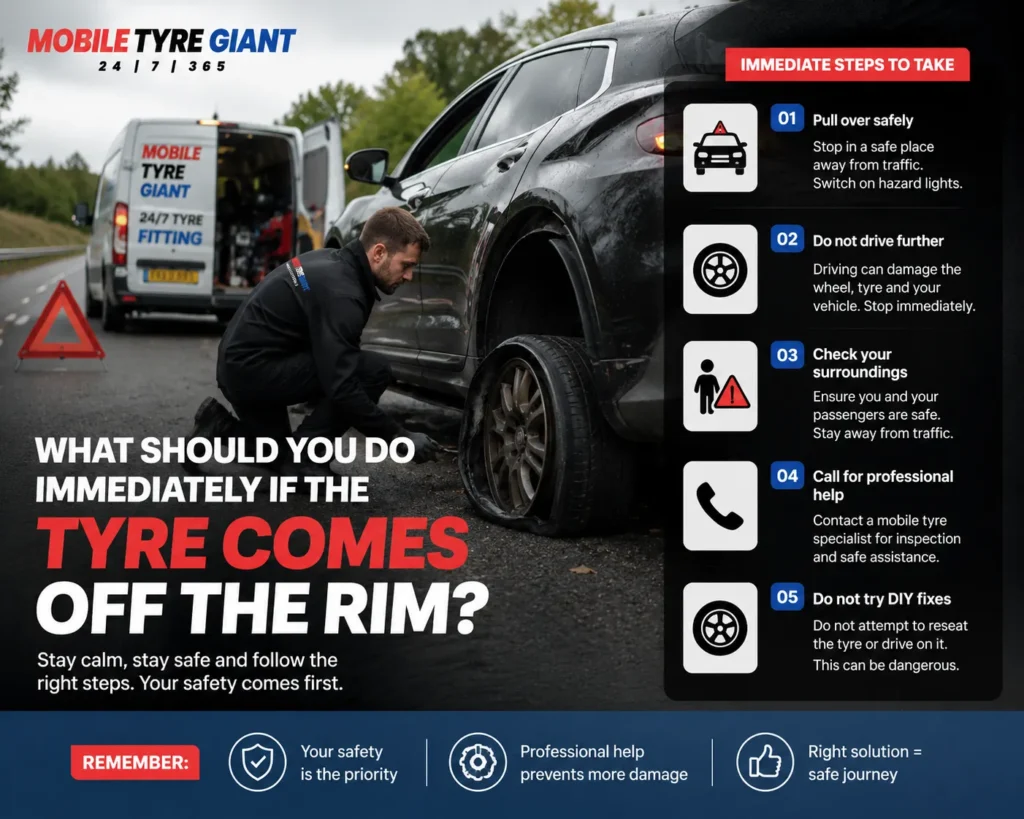
What Should You Do Immediately If the Tyre Comes Off the Rim?
If your tyre has come off the rim while driving, stay calm and avoid sharp steering or harsh braking where possible. Ease off the accelerator, keep the car as steady as you can, and look for a safe place to stop. Once stopped, switch on your hazard lights and make sure everyone in the vehicle is away from traffic. Do not crouch beside the damaged wheel on the traffic side of the car. Do not try to force the tyre back onto the rim with your hands, tools, straps, or roadside tricks you have seen online. This is not the place for guesswork because tyre pressure, bead seating, and rim damage can all create safety risks.
If the vehicle is already parked, the same rule still applies: do not inflate and drive until the tyre and rim have been checked. Take a clear photo if it is safe to do so, check whether the tyre is fully off or partly unseated, and look for obvious signs such as a torn sidewall, bent rim edge, damaged valve, or shredded rubber. When contacting a mobile tyre technician, give your exact location, vehicle registration, tyre size if visible, and explain whether you drove on it after it went flat. These details help the technician understand whether inspection, reseating, repair, or replacement is more likely. The goal is not just to get air back into the tyre. The goal is to make sure the wheel is safe before the car goes back on the road.
Immediate step | Why it matters |
Stop somewhere safe | Prevents further tyre, rim, and handling damage. |
Switch on hazard lights | Warns other drivers that the vehicle is not moving normally. |
Stay away from traffic | Keeps you safer while waiting for help. |
Do not drive to a garage | Driving further can ruin the tyre and damage the rim. |
Do not force the tyre back on | The bead, sidewall, valve, or rim may already be damaged. |
Call a mobile tyre technician | The tyre and rim can be inspected at your location. |
What Causes a Tyre to Come Off the Rim?
A tyre usually does not come away from the rim for no reason. Something has normally changed before the visible failure happens, even if the driver only notices the problem at the final stage. The most common causes include severe under-inflation, driving on a flat tyre, pothole impact, kerb damage, leaking valves, poor bead seating, wrong tyre size, rim corrosion, or previous tyre damage. In simple terms, the tyre needs pressure and a strong seal to stay locked against the wheel rim. If that seal is weakened, the tyre can start to move, fold, collapse, or separate from the bead seat. That is when a normal tyre pressure issue can turn into a roadside problem.
This is why a tyre has come off the rim situation needs proper inspection rather than guesswork. A driver may think the tyre suddenly failed, but the cause may have started days earlier with a slow puncture, a soft tyre, or a pressure warning light that was ignored. In real driver discussions, people often describe the same pattern: “It looked fine, then suddenly it came off.” The harsh truth is that tyres can look acceptable from a distance while still being dangerously low on air, especially if the vehicle is parked on level ground or the tyre has a low-profile sidewall. The better question is not only “what happened?” but “what caused the tyre to lose its safe seal in the first place?”
Severe Under-Inflation
Severe under-inflation is one of the biggest reasons a tyre can separate from the rim. When a tyre does not have enough air, the sidewall has to flex much more than it was designed to. That extra flex creates heat, weakens the tyre structure, and makes the bead less stable against the rim. The tyre can start to squash under the weight of the car, especially when turning, braking, or driving over uneven road surfaces. Once the sidewall collapses enough, the bead may no longer stay seated properly. At that point, the tyre can partly slip away from the rim and lose air even faster.
This is also why slow punctures should not be ignored. A tyre can lose pressure gradually from a small nail, a valve leak, or damage around the rim, and the driver may not notice until the tyre is already unsafe. If you keep topping up the same tyre again and again, that is not a fix. It is a warning sign. Mobile Tyre Giant has a full guide explaining how under-inflated tyres can affect handling, braking, fuel use, and tyre damage. For this topic, the important point is simple: low pressure can weaken the rim seal and increase the chance of a tyre bead unseating.
Driving on a Flat Tyre
Driving on a flat tyre is another major reason a tyre can come off the rim. Once a tyre has lost most of its air, it can no longer hold its shape properly. Instead of rolling smoothly, the sidewall folds, drags, and gets crushed between the road and the wheel. The rim starts carrying weight it should not carry, and the tyre can begin to shred from the inside. This damage may not be obvious from one quick look at the outside. That is what makes it dangerous. A tyre might appear reusable for a moment, but the internal structure may already be destroyed.
This is where many drivers make an expensive mistake. They hear a flapping sound, feel the steering go heavy, and still try to reach home or a nearby garage. That short trip can ruin the tyre completely and scrape the rim edge badly enough to stop a new tyre sealing properly. If a tyre has come off the rim after being driven flat, replacement is often more likely than repair because the sidewall and bead may have suffered structural damage. This does not mean every case is automatically beyond saving, but it does mean the tyre should not be inflated and trusted without inspection. A proper check is the only sensible route.
Pothole or Kerb Impact
A hard pothole hit can force the tyre and rim through a sudden shock. The tyre sidewall compresses quickly, the rim edge can strike the road surface, and the bead area can lose its seal. This is more likely if the tyre was already under-inflated because there is less air pressure helping the tyre hold its shape. The same thing can happen after hitting a kerb at an awkward angle. Sometimes the tyre does not fail instantly, but the rim edge bends slightly or the tyre bead gets damaged, creating a slow leak that becomes a bigger problem later. That delayed failure is one reason drivers often feel confused.
The signs after a pothole or kerb impact can include a sudden bang, steering vibration, pressure loss, a bulge in the sidewall, or a tyre that looks like it is no longer sitting evenly on the wheel. If the rim lip is bent, cracked, or scraped deeply, the tyre may not be able to seal properly again. You should also be careful if the vehicle starts vibrating after the impact because wheel or tyre damage may have affected balance. For related wheel vibration and balance issues, the mobile wheel balancing page is a useful internal reference. The main point here is that impact damage should never be dismissed as “just a bump.”
Faulty Valve or TPMS Valve Problem
A faulty valve can also lead to a tyre coming off the rim, although it usually happens indirectly. The valve is the small part where the tyre is inflated, but it also plays a major role in keeping air inside the tyre. If the valve stem is cracked, loose, damaged, corroded, or leaking, the tyre may lose pressure slowly. On vehicles with TPMS valves, a damaged or ageing valve can also create pressure problems. The tyre may seem fine after being inflated, then lose air again after a few hours or days. If that pressure loss is ignored, the tyre can become badly under-inflated and more likely to unseat.
Drivers often focus only on punctures, but valves are easy to overlook. A tyre pressure warning light, repeated air loss, or a tyre that keeps going soft after inflation should be treated as a real warning. If a tyre has come off the rim and there was a pressure warning before it happened, the valve or TPMS valve should be checked along with the tyre and rim. Replacing or repairing the tyre without checking the source of air loss can leave the same problem waiting to happen again. The safe approach is to inspect the whole air-sealing system: tyre bead, rim seat, valve, and sidewall.
Wrong Tyre Size or Poor Fitment
The wrong tyre size can create serious problems with how the tyre sits on the rim. A tyre must match the correct rim diameter, width range, load rating, and vehicle requirements. If the tyre is not suitable for the wheel, the bead may not seat correctly or may not hold securely under normal driving forces. Poor fitment can also lead to bead seating problems, especially if the tyre was not fitted cleanly, the rim was dirty or corroded, or the bead area was already damaged. A tyre that looks “close enough” is not good enough when the wheel is carrying the weight of a moving car.
This is why checking tyre size properly matters. The size printed on the tyre sidewall is not just a random code. It tells you the tyre width, profile, rim diameter, load rating, and speed rating. If you are unsure what should be fitted to your car, Mobile Tyre Giant’s correct tyre size guide explains why using the right size is important for safety and performance. For this blog topic, the takeaway is direct: if a tyre does not sit correctly on the rim, or if it keeps losing pressure after fitting, the tyre size and fitment should be checked before the car is driven again.
Can a Tyre Be Repaired After Coming Off the Rim?
Sometimes a tyre can be repaired or reseated after coming off the rim, but that decision cannot be made by looking at the outside for two seconds. The tyre bead, sidewall, inner liner, valve and wheel rim all need checking before the tyre is trusted again. If the tyre only lost its seal while parked and there is no bead, sidewall or rim damage, a technician may be able to reseat it safely. If there is a small puncture in the repairable tread area and the tyre structure is still sound, repair may also be possible. The problem is that many drivers only notice the issue after the tyre has already been driven flat. Once that happens, the chance of hidden internal damage becomes much higher.
This is where guessing becomes expensive and unsafe. A common real-world reaction is, “It still looks okay, so can I just inflate it again?” That is the wrong question. The right question is whether the tyre can hold pressure safely after proper inspection. If the bead has been stretched, torn or distorted, it may not seal properly against the rim again. If the sidewall has been crushed, the tyre may be unsafe even if the tread looks fine. This is why arranging proper mobile tyre repair makes sense when the car cannot be driven safely to a garage.
When Repair or Reseating May Be Possible
Repair or reseating may be possible when the tyre came away from the rim without serious structural damage. For example, if the car was parked, the tyre lost pressure from a valve leak, and the bead slipped slightly without being driven on, a technician may be able to inspect it and reseat it. The rim also needs to be clean, round and free from heavy corrosion or damage. The tyre bead must still be intact, not torn, cracked or misshapen. The sidewall should not show cuts, bulges or scuffing from being dragged under the rim. The tyre also needs to be the correct size for the wheel, because a poor fit can cause repeat sealing problems.
Even then, repair is not something to assume. A tyre that has come off the rim has already shown that the air seal failed, so the reason for that failure has to be found. If the cause was a small tread puncture, then a repair may be considered after inspection. If the cause was a leaking valve, valve replacement may solve the pressure loss before the tyre is reseated. If the cause was dirt, corrosion or minor bead-seat contamination, the wheel may need cleaning before the tyre seals properly. The key is that the original fault must be fixed, not hidden. Otherwise, the tyre may lose pressure again and put the driver back in the same situation.
Why Inspection Comes Before Any Repair Decision
Inspection matters because tyre damage is not always visible from the outside. A tyre can look normal on the tread but have sidewall or inner liner damage from being driven flat. When a tyre runs with little or no air, the sidewall folds repeatedly and generates heat. This can weaken the tyre structure, damage the cords, and leave the tyre unsafe even if it inflates again. Some drivers only notice a faint rubber smell, a flapping noise, or rough steering before stopping. Those signs matter because they suggest the tyre may have been moving in a damaged state before it came off the rim.
A technician should check the tyre bead, both sidewalls, the inner surface, the valve area, and the rim edge. The wheel should also be checked for cracks, bends, heavy scraping or corrosion where the tyre bead sits. If the tyre was driven any distance while flat, the inspection should be stricter. A good rule for the reader is simple: if the tyre had to carry the car without air, do not expect it to be safely reusable. The safer choice may be replacement, especially if the car is used daily, carries family passengers, or travels at motorway speeds. Safety has to come before saving one tyre.
When Does the Tyre Need Replacing Instead of Reseating?
A tyre usually needs replacing when the bead, sidewall or inner structure is damaged. The bead is the part that locks against the rim, so if it is torn, stretched, cracked or distorted, the tyre may never seal safely again. Sidewall damage is just as serious because the sidewall carries load and flexes constantly while driving. Cuts, bulges, exposed cords, deep scuff marks and cracking are not cosmetic problems. They are warning signs that the tyre structure may be compromised. If the tyre has come off the rim after being driven flat, replacement is often the safer and more realistic outcome.
This is also where the rim condition matters. If the wheel rim is bent or cracked, simply fitting another tyre may not solve the problem. The tyre needs a clean, even bead seat to hold pressure properly. If that sealing surface is damaged, air can escape and the new tyre may not sit correctly. In that situation, the wheel may need attention before the tyre can be replaced safely. If the tyre is clearly damaged or unsafe to reuse, arranging mobile tyre replacement is the practical next step because the vehicle may not be suitable to drive anywhere.
Damage found | What it usually means | Likely next step |
Torn or distorted tyre bead | Tyre may not seal safely | Replacement likely |
Sidewall cut, bulge or cracking | Structural damage risk | Replacement likely |
Tyre driven flat | Possible hidden internal damage | Strict inspection or replacement |
Bent or cracked rim | Tyre may not seal properly | Wheel inspection needed |
Repeated pressure loss | Original fault still present | Check valve, rim and bead seat |
Small tread puncture only | May be repairable if tyre structure is safe | Professional inspection first |
Signs the Tyre Should Not Be Reused
There are some signs that should make replacement the obvious choice. If the sidewall is split, bulged, heavily rubbed or showing cords, the tyre should not be trusted. If the bead area looks torn or uneven, the tyre may not lock correctly onto the rim. If the rubber looks shredded inside or around the edge, the tyre may have been damaged while flat. If there is a strong burnt rubber smell, that can also suggest heat damage from driving under-inflated. These are not small issues that can be solved with more air.
You should also be cautious if the tyre keeps losing pressure after being reseated. A tyre that cannot hold pressure reliably is not safe for normal driving. The cause may be rim corrosion, valve damage, bead damage or an internal tyre problem. Mobile Tyre Giant’s guide on when to change car tyres is a useful supporting read because it explains when tyre condition moves beyond normal wear. For this topic, the standard should be even stricter. A tyre that has already left the rim has to prove it is safe, not the other way around.
Can Tyre Sealant or an Emergency Kit Fix a Tyre Off the Rim?
Tyre sealant usually cannot fix a tyre that has come off the rim. Sealant works by moving around inside an inflated tyre and helping seal a small puncture while the tyre still sits properly against the rim. If the bead has unseated, the tyre may not be able to hold pressure long enough for the sealant to work. It cannot rebuild a torn bead, straighten a bent rim, repair a damaged valve, or fix a crushed sidewall. This is where many emergency kits create false hope. They are useful for some minor punctures, but they are not magic.
If the tyre is visibly off the wheel rim, do not waste time filling it with sealant and driving away. At best, it may do nothing. At worst, it may make inspection messier while leaving the original danger untouched. One driver-style comment you see often is, “I tried the compressor but the air just came straight out.” That usually means the tyre is not sealed properly to the rim. In that case, the issue is not simply a hole in the tyre. It is a lost bead seal, and that requires inspection rather than a bottle of sealant.
Why DIY Reseating Tricks Are a Bad Idea
Online videos can make tyre bead reseating look simple, but most of those tricks are not suitable for a normal roadside car problem. Fire, flammable sprays, ratchet straps, over-inflation and forcing the tyre by hand are not safe solutions for everyday drivers. A car tyre stores pressure and energy, and if something goes wrong during inflation, the result can be dangerous. Even if a trick appears to work in a video, it does not tell you whether the tyre bead, sidewall, valve or rim is actually safe. That is the part many DIY clips leave out.
The smarter approach is boring but correct: get the tyre and wheel inspected properly. If the tyre can be reseated safely, a technician can handle it with the right equipment. If it cannot, replacement is the safer answer. Trying to save time with a roadside hack can turn one damaged tyre into rim damage, vehicle damage or personal injury. For a daily driver, family car or work vehicle, that risk is not worth it. The goal is not to make the tyre look inflated for ten minutes. The goal is to make sure the car is safe for the next journey.
How Can You Prevent a Tyre Coming Off the Rim Again?
The best way to prevent a tyre coming off the rim is to deal with small tyre problems before they become big ones. A tyre needs the right pressure to hold its shape, support the vehicle, and keep the bead seated tightly against the rim. When pressure drops too low, the sidewall flexes more than it should. That extra flex creates heat, weakens the tyre, and can make the bead less stable on the wheel. This is why slow punctures, repeated air loss, and tyre pressure warning lights should never be treated as minor annoyances. A tyre that keeps going soft is already telling you something is wrong.
You should also check the tyre and rim after potholes, kerb hits, or any heavy impact that makes the car shake, pull, or feel uneven. A tyre may look fine from a distance, but the rim edge, bead seat, valve, or sidewall could still be damaged. If one tyre starts losing air after an impact, do not keep driving normally and hope it settles. Get it checked before the damage becomes worse. Tyre size also matters because a tyre that does not match the wheel properly may not sit correctly on the rim. If you need suitable tyre options for your vehicle, Mobile Tyre Giant’s all tyre brands and sizes page can help you choose the right direction.
Do Not Ignore Slow Punctures or Pressure Warnings
A slow puncture is easy to delay because the vehicle may still feel normal for a while. That is exactly why it becomes risky. If you keep topping up the same tyre every few days, you have not fixed the issue. You have only delayed the moment when the pressure drops again. The cause could be a nail, leaking valve, damaged rim edge, bead-seat problem, or sidewall damage. Once the pressure gets too low, the tyre can lose its shape and start pulling away from the rim.
A tyre pressure warning light should be treated in the same serious way. Do not reset it and carry on without checking the tyre properly. If the warning returns after inflation, the tyre is probably losing pressure for a reason. Many drivers only act when they hear a flapping sound, feel heavy steering, or see the tyre folded away from the wheel. By then, repair may already be less likely. Fixing pressure loss early is much cheaper and safer than waiting until the tyre has come off the rim.
Check Tyres After Potholes, Kerbs and Heavy Impacts
A pothole can damage more than the visible outside of the tyre. The impact can pinch the sidewall, bend the rim edge, disturb the bead seal, or damage the tyre internally. Sometimes the tyre loses air immediately. Other times, the damage causes a slow leak that becomes obvious later. If the car starts vibrating after a pothole, or if the tyre begins losing pressure, do not ignore it. That small change can be the first warning before a bigger tyre failure.
Kerb impacts can cause the same kind of problem, especially when the wheel hits at an awkward angle. The sidewall may get scuffed, the rim lip may be damaged, and the tyre may no longer seal cleanly against the rim. If the tyre looks uneven on the wheel or loses pressure after a kerb hit, it should be checked before normal driving. A tyre coming off the rim can feel sudden, but the damage may have started earlier. The smart move is to inspect the tyre and wheel soon after the impact, not after the vehicle becomes unsafe to drive.
What Should You Tell a Mobile Tyre Fitter?
When you call a mobile tyre fitter, be specific. Do not just say, “I have a flat tyre.” Say clearly that the tyre has come off the rim or looks like it has separated from the wheel. Give your exact location, vehicle registration, make and model, and tyre size if you can read it safely from the sidewall. Tell them whether the tyre is fully off the rim or only partly unseated. Also mention whether you drove on it after it lost pressure, even if it was only for a short distance. That detail matters because driving on a flat tyre can damage the bead, sidewall, and inner tyre structure.
You should also explain what happened before the tyre failed. Did you hit a pothole, clip a kerb, notice a pressure warning light, hear a bang, feel vibration, or experience heavy steering? If the rim looks bent, cracked, scraped, or the valve looks damaged, say that too. If your vehicle has locking wheel nuts, check where the locking wheel nut key is before help arrives. If you are in London and need location-based mobile tyre support, the Mobile Tyre Fitting London page is useful for local service context. Clear information helps the fitter understand whether repair, reseating, or replacement is more likely.
Details That Help Decide Between Repair and Replacement
The fitter needs accurate details because every tyre-off-rim case is different. A tyre that lost pressure while parked is not the same as a tyre that was driven flat on the road. A small tread puncture is not the same as bead damage, sidewall damage, or a bent rim. This is why you should be honest about what happened. Do not hide that you drove on it, tried to inflate it, or hit a pothole. The technician needs the truth to make the safest decision.
If it is safe, take one close photo of the damaged wheel and one wider photo showing where the vehicle is parked. This can help the technician see whether the tyre is fully off the rim, whether the rim edge is exposed, and whether the working area looks safe. Do not step into traffic or put yourself at risk just to take photos. A clear description over the phone is enough if the location is unsafe. If you need to arrange support, use the clean contact page here: Contact Mobile Tyre Giant. The goal is to help the fitter arrive prepared and avoid wasting time on the wrong solution.
Final Words: What to Remember If Your Tyre Has Come Off the Rim
A tyre has come off the rim because the tyre is no longer seated properly against the wheel. The cause may be severe under-inflation, a slow puncture, driving on a flat tyre, pothole impact, kerb damage, valve failure, rim damage, wrong tyre size, or poor bead seating. Whatever caused it, the first response should be the same: do not keep driving. Stop safely, stay away from traffic, and avoid trying to force the tyre back into place. A tyre that has lost its rim seal needs proper inspection before it can be trusted again. Guessing is not a safe repair method.
The safest decision depends on the condition of the tyre and wheel. Sometimes the tyre may be reseated or repaired, but if the bead is torn, the sidewall is damaged, the tyre was driven flat, or the rim is bent, replacement is usually the safer route. Do not rely on sealant, online hacks, or pressure alone when the tyre has already separated from the rim. Give the fitter clear details, act early, and choose the option that keeps the vehicle safe for the next journey. Saving a damaged tyre is not worth risking control, rim damage, or another breakdown. The boring answer is the correct one: stop, check, and fix it properly.
Tyre Come Off the Rim? Don’t Drive Further
If your tyre will not hold pressure or has separated from the rim, get mobile tyre repair or replacement at your location before driving again.
Frequently Asked Questions
Find quick answers to the most common questions our customers ask.
No, you should not drive if your tyre has come off the rim. The tyre may not hold pressure, the rim may be damaged, and the car may become difficult to control. Stop somewhere safe, switch on your hazard lights, stay away from traffic, and arrange professional tyre help instead of trying to drive to a garage.
You should slow down carefully, pull over somewhere safe, switch on your hazard lights, and avoid driving any further. Do not try to force the tyre back onto the rim, and do not rely on pumping it up without inspection. If the vehicle cannot be moved safely, call a mobile tyre technician or breakdown service.
A tyre can come off the rim because of severe under-inflation, driving on a flat tyre, pothole impact, kerb damage, a faulty valve, TPMS valve issue, rim corrosion, wrong tyre size, poor fitting, or bead damage. The exact cause should be checked before the tyre is repaired, reseated, or replaced.
Sometimes, but only after proper inspection. A technician needs to check the tyre bead, sidewall, inner liner, valve, and rim. If the tyre was driven flat, the bead is torn, the sidewall is damaged, or the rim is bent, replacement is usually the safer option.
You should not rely on simply pumping the tyre back up. If the tyre has come away from the rim, the bead seal may be broken and the tyre or wheel may be damaged. Even if it inflates briefly, that does not prove it is safe to drive on.
Usually no. Tyre sealant is designed for some minor punctures where the tyre is still seated properly and can hold air. If the tyre has come off the rim, sealant cannot rebuild the bead seal or fix damage to the bead, valve, sidewall, or rim.
The rim may be damaged, especially if you drove on a flat tyre or hit a pothole or kerb. Damage can include a bent rim edge, cracked alloy, scraped bead seat, or air leak around the wheel. The rim should be inspected before the tyre is reused or replaced.
Yes, low tyre pressure is one of the most common causes. When pressure is too low, the sidewall flexes heavily and the tyre can lose its shape under the weight of the vehicle. If the tyre is driven while very low or flat, the bead can unseat from the rim.
Yes, a tyre that is not correctly seated on the rim is a serious safety issue and should be fixed before the vehicle is driven normally. The tyre needs to sit properly against the wheel to hold air and support the car safely. If it is not seated correctly, inspection is needed.
Tell the fitter your exact location, vehicle registration, tyre size if visible, whether the tyre is fully or partly off the rim, whether you drove on it, and whether you hit a pothole or kerb. Also mention pressure warning lights, rim damage, valve damage, and whether you have locking wheel nuts.