

Tyre pressure sounds straightforward until you are standing beside your car with an inflator in your hand and several different numbers in front of you. One figure may appear on the vehicle label, another may show on the dashboard, while the tyre sidewall carries markings that can easily add to the confusion. The important thing to understand is that there is no single PSI figure that works for every car. The correct pressure depends on factors such as the vehicle, tyre and wheel specification, axle position and how heavily the car is loaded. That is why this tyre pressure guide starts with the manufacturer’s information rather than a generic number copied from another vehicle.
Correct pressure also plays a wider role in tyre condition, handling and everyday driving. A tyre with too little air can flex more than intended, while excessive pressure can change the way the tyre makes contact with the road. Think of it a little like wearing shoes that are either too loose or too tight. Both might still be wearable, but neither works as the designer intended. You do not need specialist mechanical knowledge to check your tyres properly, but you do need to know where to find the correct figure and how to understand it. Mobile Tyre Giant’s tyre safety guide explains how pressure fits alongside tread depth, tyre condition and other routine checks. In this first part, we will focus on finding the correct PSI and understanding the information supplied with your car.
What Should Your Tyre Pressure Be?
Your correct tyre pressure is the figure specified by the vehicle manufacturer for the relevant tyre setup and load. This means advice such as “just put 32 PSI in every tyre” should not be treated as a universal rule. Two cars parked side by side can require different pressures even if their tyres appear similar. The front and rear tyres can also have different recommended figures because each axle may carry a different amount of weight. Some cars provide one set of pressures for normal everyday driving and another set for travelling with more passengers or luggage. The right number is therefore the one that matches your own vehicle and how it is being used.
Manufacturers may display tyre pressure in PSI, bar, kPa or a combination of these units. You should always match the figure to the tyre size and vehicle configuration shown on the label or in the handbook. If your car is available with several wheel sizes, do not assume every version uses the same pressure. A higher trim level, optional alloy wheels or a different tyre specification can change the information shown by the manufacturer. This is why looking at the full specification matters more than memorising one PSI number. A reliable pressure check begins by identifying the right target before you attach the gauge or inflator.
Is There a Standard PSI for Every Car?
No, there is no standard PSI that should automatically be used for every passenger car. You will often see numbers such as 30, 32, 35 or 40 PSI mentioned online, but those figures are only correct when they match the manufacturer’s recommendation for a particular vehicle. Using a popular number because it sounds familiar is a bit like choosing the same shoe size for everyone in a family. It might happen to fit one person perfectly, while being completely unsuitable for someone else. The same principle applies to tyre pressure. The car’s weight distribution, wheel setup, tyre size and intended load all matter.
A better approach is to learn where your vehicle stores its own pressure information. Once you know where to look, checking the correct PSI takes only a few moments and removes most of the guesswork. If the pressure label lists a tyre size that you do not recognise, compare it with the markings on the tyres currently fitted to the vehicle. Mobile Tyre Giant’s correct tyre size guide explains how common tyre markings are structured and what the numbers and letters mean. This can be especially useful on a used car where wheels or tyres may have been changed by a previous owner. The goal is not to find the most common PSI but to confirm the pressure intended for your actual setup.
Where Can You Find the Correct Tyre Pressure for Your Car?
Most vehicles have the recommended tyre pressure displayed somewhere the driver can access without tools. A common place is inside the driver’s door area, either on the door frame, pillar or door shut. Other manufacturers place the information inside the fuel filler flap, while the owner’s handbook normally provides another reference. The label is often small and may show several rows of figures, tyre sizes and simple passenger or luggage symbols. If you have never looked for it before, it is easy to walk past without realising what it is. Once you find it, taking a clear photo with your phone can make future checks much easier.
Finding the label is only the first step because you still need to identify which figures apply to your car. Some stickers show separate values for the front and rear tyres. Others provide different recommendations for normal use and a fully loaded vehicle. Several tyre sizes may also be listed when the same model was sold with different wheel options. Do not simply pick the highest or lowest figure on the sticker. Match the tyre size first, then check the axle and load condition before selecting the pressure. This simple sequence prevents many of the common mistakes drivers make when adjusting tyre pressure.
Is the Tyre Pressure Sticker Inside the Driver’s Door?
The driver’s door area is one of the most common places for a tyre pressure label, although the exact position varies between vehicles. Open the door fully and inspect the vertical pillar, the edge of the door opening and the surrounding painted frame. The label may be white, black or silver and can blend into the surrounding area. Rather than looking only for the words “tyre pressure”, look for tyre sizes and pressure units such as PSI, bar or kPa. You may also see small passenger and luggage symbols. These symbols are there to help distinguish different load settings.
Once you find the sticker, read the relevant row carefully rather than jumping straight to the first number. A pair of pressure figures may represent separate front and rear recommendations rather than two optional settings. Another row may apply when the car is carrying several passengers and luggage. If more than one tyre size appears, make sure the row matches the tyres actually fitted to your vehicle. At first glance the sticker can look like a compact block of codes, but the layout becomes much easier once you know what each symbol represents. A quick phone photo can also help because you can zoom in on the smaller print before using an air machine.
What If the Pressure Label Is Not in the Door Area?
If you cannot find the label around the driver’s door, the fuel filler flap is the next sensible place to check. Open the flap and inspect both its inner surface and the surrounding bodywork for a pressure chart. Some manufacturers place the information there because the area stays protected while remaining easy for the driver to access. If the label is not there either, check the owner’s handbook or the vehicle information supplied by the manufacturer. Avoid replacing missing manufacturer information with a random online pressure figure. A generic chart cannot account for every tyre size, wheel option and load condition fitted to your exact vehicle.
The handbook is also useful when a pressure label is faded, damaged or difficult to understand. It can provide extra detail about different wheel sizes, heavier loads or special operating conditions. If the car was bought used, pay particular attention to whether the wheels and tyres still match the original specification. Previous owners sometimes change alloys or tyre sizes, which can make an old sticker harder to interpret without checking what is currently fitted. Taking a few minutes to confirm the specification is much better than adjusting all four tyres based on an assumption. Once you have identified the correct pressure source, the next step is understanding exactly how to read the sticker.
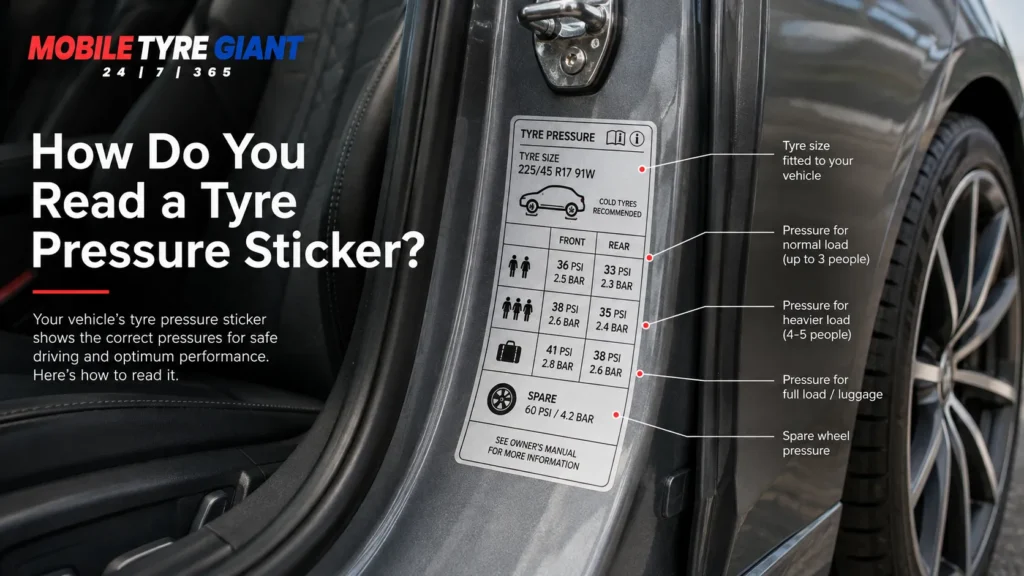
How Do You Read a Tyre Pressure Sticker?
A tyre pressure sticker usually compresses several pieces of information into a very small space. Start by identifying the tyre size that matches your vehicle, then look for the figures assigned to the front and rear axles. Next, check whether the sticker separates normal driving from a heavier passenger or luggage load. Pressure may be displayed in PSI, bar, kPa or more than one unit at the same time. Read across the correct row rather than mixing values from different tyre sizes or load conditions. If separate front and rear figures are listed, use each value on the correct axle instead of averaging them.
The table below explains the most common information you are likely to see. These are descriptions only, not universal pressure recommendations, because the actual figures must come from your own vehicle. Passenger symbols usually represent how heavily the car is loaded, while luggage icons often appear beside the full-load setting. Different tyre sizes may have their own rows, so a pressure shown beside one size should not automatically be copied to another. Once you understand this layout, the label becomes much easier to use during routine checks. It turns a confusing block of numbers into a simple reference you can return to whenever the tyres need checking.
Sticker Information | What It Usually Means | What You Should Do |
Tyre size | The tyre and wheel configuration | Match it with the tyres fitted to your car |
Front pressure | Recommended pressure for the front axle | Use this figure for the front tyres |
Rear pressure | Recommended pressure for the rear axle | Use this figure for the rear tyres |
Passenger icons | Vehicle loading level | Choose the setting that matches the load |
Luggage icon | Heavier or fully loaded use | Follow the loaded setting where applicable |
PSI / bar / kPa | Units used to measure pressure | Use the same unit on your gauge or convert accurately |
Should You Check Tyre Pressure When Tyres Are Hot or Cold?
Tyre pressure should normally be checked when the tyres are cold because driving warms the tyre and the air inside it. As the temperature rises, the pressure reading can increase, which means a measurement taken immediately after a long drive may not match the manufacturer’s cold-pressure recommendation. In practical terms, a cold tyre is one that has not recently been driven far enough to build significant heat. This does not mean you have to wait for a freezing morning or check the car only during cold weather. The word “cold” refers to the condition of the tyre, not the season outside. Checking before you set off for the day is therefore one of the easiest ways to get a useful reading.
If you have already driven to a petrol station before checking the pressure, remember that the tyres may be warmer than they were when the car was parked. Avoid automatically releasing air simply because the reading is slightly higher than the cold figure on the vehicle label. Doing so can leave the tyre below the recommended pressure once it cools again. If the reading is clearly abnormal or the tyre looks noticeably low, deal with the situation safely rather than ignoring it until later. For routine maintenance, however, checking at home with a reliable gauge or inflator before driving removes much of this uncertainty. A consistent routine also makes it easier to notice when one tyre starts behaving differently from the others.
What Does “Cold Tyres” Actually Mean?
One of the most common misunderstandings around tyre pressure is assuming that “cold tyres” means the weather itself must be cold. It simply means the tyres have not recently generated much heat through driving. A car parked overnight is an obvious example, but a vehicle that has been standing for a reasonable period can also provide a useful cold reading. Tyres flex as they roll, and that movement produces heat even on an ordinary journey. The air inside then expands, which is why a gauge can show a higher figure after driving. This temperature effect is normal and does not necessarily mean someone has overinflated the tyre.
Think of checking tyre pressure like weighing yourself on different scales at different times of day. You can still get numbers every time, but the most useful comparison comes from using similar conditions each time. Checking the tyres cold gives you that consistency. It also means you can compare the reading directly with the manufacturer’s cold-pressure specification rather than trying to guess how much heat has changed it. If you use a portable inflator at home, this is particularly convenient because you can check the car before going anywhere. The important habit is consistency rather than obsessing over tiny fluctuations from one reading to the next.
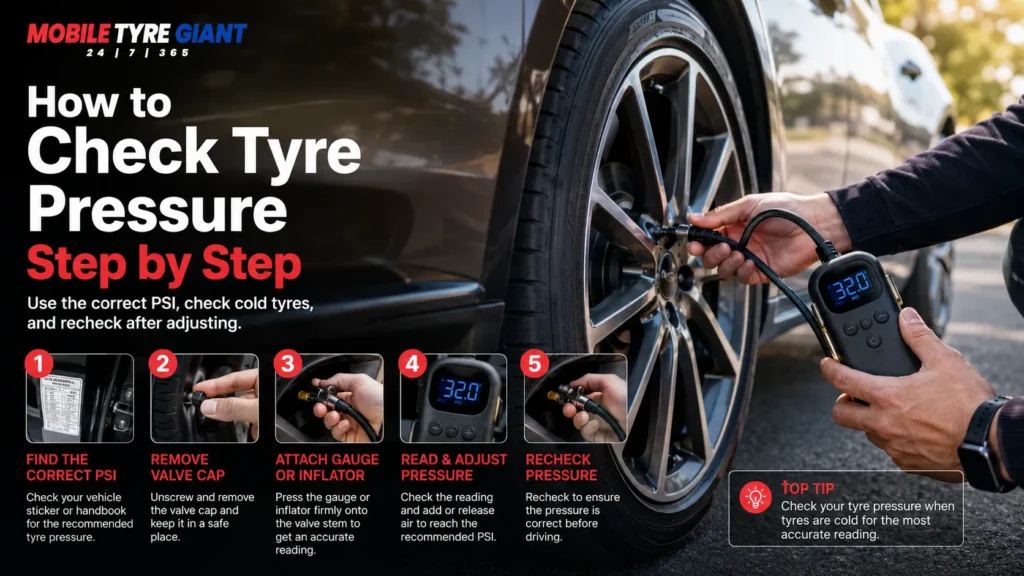
How to Check Tyre Pressure Step by Step
Start by confirming the correct pressure from the vehicle label or handbook before touching the tyre valve. Remove the valve cap and keep it somewhere safe because the small cap is surprisingly easy to lose on a driveway or petrol-station forecourt. Press the pressure gauge or inflator connector firmly onto the valve so that you get a clean seal. A brief hiss as you connect it can be normal, but a continuous rush of air usually means the connector is not seated correctly. Read the pressure in the same unit used by your vehicle information, or make sure any conversion is accurate. Compare the result with the recommended figure for that axle and load condition before deciding whether air needs to be added or released.
Repeat the process for every road tyre rather than checking the one that happens to look soft. Tyres can be underinflated without appearing dramatically flat, especially when viewed casually from above. Once the pressure has been adjusted, check it again rather than assuming the inflator stopped at exactly the intended figure. Replace the valve cap securely when you are finished, but there is no need to overtighten it. If the vehicle carries a conventional inflatable spare, include that in your routine checks where applicable because a forgotten spare is little help when you eventually need it. The entire process becomes quick once you have done it a few times, and the numbers will usually tell you more than judging pressure by sight or pressing the sidewall with your hand.
What Equipment Do You Need to Check Tyre Pressure?
The basic tool is a reliable tyre pressure gauge, which may be digital or analogue. Many portable tyre inflators already contain a built-in digital gauge, allowing you to measure and add air with the same device. A small compressor can be especially useful at home because you can check the tyres before driving, while they are still cold. Petrol-station air machines can also measure and adjust pressure, although the controls and payment systems vary between locations. Whichever equipment you use, make sure you understand whether the display is showing PSI, bar or kPa. Accidentally confusing the units can lead to a much larger error than being one PSI away from the target.
There is no need to buy the most expensive gauge available simply to carry out basic routine checks. What matters is using equipment that is in good condition and gives consistent readings. If one gauge gives a wildly different number from another, do not immediately assume the tyre has changed. Check the connection, confirm the unit being displayed and test again. Valve caps should also be refitted after checking because they help keep dirt and moisture away from the valve area. Keeping a compact gauge or inflator in the car can make regular checks easier, particularly before longer journeys. Convenience matters because maintenance that takes two minutes at home is much more likely to become a habit than something that requires a special trip.
How to Inflate Your Tyres to the Correct PSI
If a tyre is below the manufacturer’s recommended pressure, add air gradually rather than treating inflation as a one-shot task. Connect the inflator firmly to the valve and confirm that the machine is using the correct unit. Many modern portable inflators allow you to enter a target pressure and stop automatically when that figure is reached. Even when the machine has an automatic stop, it is sensible to check the final reading before disconnecting. If your inflator does not have a preset function, add air in short bursts and measure between them. This gives you more control and reduces the chance of overshooting the target.
Do not try to judge the correct pressure by squeezing the tyre with your hand or looking at how rounded the sidewall appears. Modern tyres can feel firm even when they are below the recommended pressure, and visual appearance changes with vehicle weight and tyre construction. Use the actual pressure specification and an actual gauge. If you accidentally add too much air, it can normally be corrected by releasing a small amount and checking again. The aim is not to reach the target at record speed but to finish with the correct pressure for that tyre and load. Once all tyres have been adjusted, a final walk around the car is worthwhile to confirm that every valve cap is back in place and nothing has been left connected.
How to Inflate Tyres at Home
Inflating tyres at home is often the simplest option if you have a suitable portable compressor. Park the car safely on a stable surface, find the correct pressure figures and connect the inflator to its required power source. Some units plug into a 12V socket, while others use rechargeable batteries, so follow the instructions supplied with the device. Remove the valve cap, attach the hose securely and check the current reading before adding air. If the inflator has a preset function, enter the required pressure for that tyre rather than assuming the same figure applies to every wheel. Let the machine complete the inflation and then confirm the result once it stops.
The biggest advantage of checking at home is that the tyres can usually be measured before the car has been driven. That removes much of the uncertainty around warm readings and makes routine pressure checks easier to repeat under similar conditions. A portable inflator is also useful for small top-ups, but it should not become a way of hiding a tyre that repeatedly loses air. If the same tyre needs inflation again and again, the cause should eventually be investigated rather than accepting constant top-ups as normal maintenance. Keep the inflator hose and connector clean, and store the unit where it can be reached without unpacking half the boot. A tool that is easy to access is far more likely to get used regularly.
How to Put Air in Tyres at a Petrol Station
If you have never used a petrol-station air machine before, find the correct tyre pressures before you start rather than trying to read the vehicle sticker while the machine is running. Park close enough for the hose to reach all four tyres without being stretched tightly. Select the required unit, usually PSI or bar, and enter the target pressure if the machine uses a preset system. Remove the valve cap, push the connector firmly onto the valve and allow the machine to take a reading. Many machines will automatically add or release air until the selected pressure is reached. Listen for the confirmation signal or check the display before removing the connector.
Repeat the process around the car using the correct front and rear figures rather than assuming every tyre needs the same setting. If your vehicle has a separate fully loaded recommendation, make sure you are using the setting appropriate for how the car is currently being used. Public machines can have different controls, so take a few seconds to read the instructions printed on the unit instead of copying what the previous driver did. If something seems wrong, such as the pressure falling rapidly or air escaping continuously from the connection, stop and check that the hose is attached properly. Replace every valve cap once finished and make a note if one tyre required noticeably more air than the others. A single unusual reading may be worth watching because repeated pressure loss can point to a problem rather than normal maintenance.
How Do You Safely Release Air From an Overinflated Tyre?
If you accidentally inflate a tyre above the recommended pressure, there is usually no reason to panic. Many digital inflators and pressure gauges have a bleed or pressure-release function that allows small amounts of air to be removed in a controlled way. Release a little air at a time, then check the reading again before continuing. This is much better than holding the valve open for several seconds and guessing how much pressure has escaped. Make sure you are comparing the final reading with the correct manufacturer figure for that tyre and load. Once the required pressure is reached, refit the valve cap securely.
The same principle applies if you discover that a tyre was already above the recommended cold pressure. Do not reduce it simply because another car uses a lower PSI or because the tyre feels unusually firm to the touch. Confirm the correct specification first, then make a measured adjustment. If the tyres are hot from a recent drive, remember that the reading may be naturally higher than it was when cold. Where possible, carry out routine corrections under consistent cold conditions rather than chasing small pressure changes throughout the day. Tyre pressure becomes much easier to manage when you rely on the vehicle specification and a gauge instead of instinct.
Does Hot or Cold Weather Affect Tyre Pressure?
Changes in outside temperature can affect the pressure inside your tyres even when there is no puncture or obvious damage. When temperatures fall, the air inside the tyre contracts and the pressure reading can drop, while warmer conditions can cause the reading to rise. This is one reason drivers sometimes wake up on a cold morning and suddenly see a tyre pressure warning that was not there the previous evening. If several tyres show a similar small change at the same time, a shift in temperature may be contributing. That does not mean the warning should simply be dismissed as “just the weather”, because the actual pressures still need to be checked against the vehicle manufacturer’s recommendation.
Think of it like a sealed bottle left somewhere warm and then moved into a much colder room. Nothing has necessarily leaked out, but the conditions inside have changed. Your tyres respond to temperature in a similar way, which is why regular checks are more useful than waiting for the dashboard to tell you something has changed. Seasonal changes can make this particularly noticeable when daytime and overnight temperatures move sharply in opposite directions. The safest approach is to measure the tyres when they are cold and compare the readings with the correct figures for the vehicle. If one tyre behaves very differently from the other three, however, temperature alone becomes a less convincing explanation.
Can Cold Weather Trigger the TPMS Warning Light?
Yes, colder weather can sometimes reduce tyre pressure enough for the Tyre Pressure Monitoring System, or TPMS, to detect a change and illuminate the warning light. This can feel alarming if the tyres looked perfectly normal the day before. A real-world frustration commonly discussed by UK drivers is a warning appearing after a cold night even though the car seemed fine during the previous journey. One driver jokingly described their vehicle as having “the most sensitive TPMS ever”, which captures how irritating these seasonal warnings can feel. The important response is not to assume the sensor is overreacting, but to check the actual tyre pressures with a reliable gauge.
If all four tyres have dropped slightly after a substantial temperature change, adjusting them to the manufacturer specification may resolve the issue. If one tyre is much lower than the others, or the warning returns soon after the pressures have been corrected, look beyond the weather. A slow leak, valve problem or another issue may be allowing air to escape. The TPMS warning is best treated as a prompt to investigate rather than a diagnosis by itself. Cold weather can explain a pressure change, but it cannot prove that the tyre is free from damage. That distinction becomes especially important when the same wheel repeatedly triggers the warning.
How Often Should You Check Tyre Pressure?
Tyre pressure should be part of your regular vehicle checks rather than something you only think about after a warning appears. For UK drivers, a weekly check is a sensible routine, particularly before starting a journey while the tyres are still cold. You should also make a point of checking before a longer motorway trip, a family holiday or any journey where the vehicle will be carrying substantially more passengers or luggage than usual. A sudden change in weather is another good reason to take a quick reading. The whole process takes only a few minutes once you know the correct figures, and keeping a consistent routine makes unusual pressure loss much easier to recognise.
Regular checks also create a useful baseline for your own car. If three tyres remain close to their recommended pressures but one requires air every couple of weeks, that pattern tells you something more useful than a single isolated reading. It is similar to checking the battery level on a phone you use every day: after a while, you notice immediately when it starts draining unusually quickly. Do not rely entirely on how firm the tyre feels when pressed because visual and hand checks cannot tell you the exact internal pressure. A gauge gives you an actual measurement and allows you to compare all four tyres properly. Consistency is the real advantage, because it helps you separate ordinary small fluctuations from a developing problem.
What Happens if Tyre Pressure Is Too Low?
When a tyre is underinflated, its sidewalls can flex more than intended as the wheel rotates. That additional movement can generate heat and change the way the tread sits against the road. The vehicle may also require more energy to keep the tyre rolling, while steering and handling can feel less precise in more significant cases. Over time, incorrect pressure can contribute to uneven wear and reduce the useful life of the tyre. The exact effects depend on how low the pressure is, how long the car is driven that way and the type of journey being made, so a slightly low reading and a visibly collapsing tyre should not be treated as the same situation.
If you want a deeper explanation of what happens when pressure remains low, Mobile Tyre Giant’s guide to the effects of under-inflated tyres covers the impact in more detail. The important practical lesson is that topping up the tyre is appropriate when it simply needs routine correction, but repeatedly topping up the same tyre is different. If air keeps disappearing, something may be allowing it to escape. Imagine having to refill a leaking water bottle every morning: adding more water solves the immediate shortage but does nothing about the hole. The same logic applies to a tyre that will not maintain its correct pressure. Later in this guide, we will look at how to recognise that pattern and what may be causing it.
What Happens if Tyre Pressure Is Too High?
More air is not automatically better. When tyre pressure is significantly above the manufacturer’s recommendation, the tyre can behave differently because its shape and contact with the road have changed. The ride may feel firmer or harsher, particularly over broken surfaces, potholes and raised road markings. Incorrectly high pressure can also contribute to an undesirable wear pattern over time. This is why the target should be the recommended pressure, not the highest figure you can safely put into the tyre. Inflating beyond the required setting does not create an extra safety margin.
If you accidentally overinflate a tyre while using an air machine, correct it gradually with a suitable pressure-release function and recheck the gauge. Do not let out air simply because the tyre feels firm when you press it with your hand, because that is not an accurate measurement. Also remember the difference between a genuinely overinflated cold tyre and a higher reading caused by heat after driving. The latter can naturally occur as the tyre warms on the road. Comparing readings under similar cold conditions makes the pattern much easier to understand. The aim throughout this tyre pressure guide is balance and accuracy rather than chasing the lowest or highest possible PSI.
Can You Rely on TPMS Instead of Checking Tyre Pressure Manually?
TPMS is useful, but it should not replace routine tyre pressure checks with a gauge. The system is designed to alert the driver when it detects a pressure-related problem, rather than act as permission to ignore the tyres until a warning appears. Depending on the vehicle, TPMS may monitor pressure through sensors fitted at the wheels or use information from other vehicle systems to identify a change in tyre behaviour. This is why different cars can display pressure information differently. Some show individual readings for each tyre, while others simply illuminate a warning symbol when the system detects a problem.
A manual gauge lets you check the actual pressure against the manufacturer’s recommended figure before the situation reaches the point where the car decides to warn you. It also helps when preparing for a heavy load or checking the car before a long journey. Think of TPMS like a smoke alarm: it is extremely useful when something goes wrong, but you would not use it as your only method of deciding whether everything in the house is in good condition. The same principle applies here. Check the tyres routinely and use TPMS as an additional warning system. If the warning behaves unusually even after the tyres are correctly inflated, the monitoring system itself may need further attention.
Why Does My Gauge Show a Different PSI From the TPMS?
Small differences between a handheld pressure gauge and the figure shown by the vehicle’s TPMS do not automatically mean that either device is broken. The readings may have been taken at slightly different tyre temperatures, and the vehicle display may not update at exactly the same moment as your manual measurement. Different gauges can also have small measurement tolerances. This is why drivers sometimes become frustrated after adjusting a tyre precisely with a pump only to see a slightly different number on the dashboard a few minutes later. The best approach is to use a reliable gauge consistently and compare cold readings with the manufacturer’s recommendation.
Large or persistent differences deserve more attention than tiny variations. First confirm that you are comparing the same unit, because PSI and bar are very different numerical scales. Then make sure the inflator connector is sealing properly against the valve and that you are checking the correct tyre. If the dashboard continues showing an unusual reading after the pressures have been verified, consult the vehicle’s instructions for how that TPMS operates. Some systems update after driving, while others may require a vehicle-specific recalibration procedure. Avoid repeatedly adding or removing air simply to force the dashboard number to match a handheld gauge exactly.
What Does the Tyre Pressure Warning Light Mean?
The tyre pressure warning light means the vehicle has detected something that requires attention in the tyre pressure monitoring system. In many cars, the symbol resembles a tyre cross-section or horseshoe shape with an exclamation mark in the centre. Its appearance does not automatically tell you whether you have a puncture, a small pressure change or a monitoring-system fault. Your first response should be to check the tyres visually and measure their pressures as soon as it is safe to do so. If a tyre is visibly flat or rapidly losing air, treat the situation more seriously than a small pressure discrepancy.
Once the tyres have been brought to the correct manufacturer settings, monitor whether the warning disappears and whether it returns. A light that repeatedly comes back deserves investigation rather than endless resetting. The problem may be continued pressure loss, an incorrect setting or an issue within the TPMS itself. Mobile Tyre Giant provides TPMS valve replacement when a compatible valve or sensor-related issue needs professional attention. The important point is to diagnose the cause rather than treating the warning light itself as the problem. A dashboard symbol is information, and the real job is working out what caused it to appear.
Why Is the TPMS Light Still On After Inflating the Tyres?
If the warning remains after inflation, start by checking every tyre again rather than assuming the system has failed. One tyre may still be outside the required range, particularly if the front and rear pressures are supposed to be different. Another possibility is that the vehicle needs to be driven for the monitoring system to update. Some cars also use a reset or recalibration procedure after pressures have been corrected. Because the method varies between manufacturers and models, do not follow a random reset sequence intended for a different vehicle.
A warning that disappears and then returns is particularly worth watching. If the same tyre has lost pressure again, the problem is no longer simply that it needed air once. There may be an underlying leak that needs identifying. Likewise, if all pressures remain correct but the warning will not clear, the TPMS system itself may require diagnosis. Resist the temptation to keep resetting the light without checking what the tyres are actually doing. Resetting a warning can remove the message temporarily, but it cannot stop air escaping from a damaged tyre or leaking valve.
Do You Need to Reset TPMS After Adjusting Tyre Pressure?
Sometimes, but not on every vehicle. Certain cars automatically recognise the corrected pressures after driving, while others ask the driver to store or recalibrate the new tyre pressure values through a dashboard menu or vehicle controls. There are also systems that require a specific relearn procedure after sensor or wheel work. This variation is why a universal “press this button for ten seconds” instruction would be misleading in a general guide. The correct process should come from the instructions for the exact make, model and year of the vehicle.
Before carrying out any reset, make sure the tyres are actually set correctly. Otherwise, you risk teaching the system to accept an incorrect baseline or simply hiding the warning temporarily without dealing with the cause. If you have followed the vehicle procedure and the light still behaves abnormally, further investigation may be needed. A sensor, valve or related component can develop a fault just like other vehicle parts. The safest order is simple: check the tyres first, correct the pressures, follow the manufacturer’s TPMS procedure where required, and only then investigate a persistent warning.
Why Does One Tyre Keep Losing Pressure?
If one tyre repeatedly loses pressure while the other three remain relatively stable, the problem deserves more attention than another quick top-up. Possible causes include a slow puncture, a leaking tyre valve, a problem where the tyre seals against the wheel, or damage to the wheel itself. Temperature changes can affect pressure, but they usually do not explain why the same tyre consistently behaves differently from the others. Keeping a record of the readings can help you spot the pattern instead of relying on memory. For example, if all four tyres are corrected on Monday but only the rear-left tyre is noticeably low again a few days later, that points towards a local problem at that wheel.
Repeatedly adding air may keep the tyre usable temporarily, but it does not repair whatever is allowing the air to escape. Think of a bucket with a small hole in the bottom. You can keep filling it with water, but the level will continue falling until the leak itself is dealt with. The same principle applies to a tyre that refuses to hold its recommended pressure. Inspect the tyre for obvious damage, but remember that not every leak is visible from the outside. A small puncture or valve problem can lose air slowly without producing the dramatic appearance of a completely flat tyre. The pattern of repeated pressure loss is therefore often more useful than how the tyre looks during a quick walk around the car.
Could a Slow Puncture Be Causing the Pressure Loss?
A slow puncture can allow air to escape gradually rather than making the tyre go flat immediately. A small nail or screw in the tread can sometimes remain lodged in place while air leaks around it, so the first sign may simply be a tyre that needs topping up more often than the others. The pressure may look normal immediately after inflation and then gradually fall again over several days. This is why repeated measurements are useful. They give you evidence that the tyre is losing pressure rather than experiencing a one-off fluctuation caused by temperature or a previous incorrect setting.
Do not automatically pull an object out of the tyre if you notice a nail or screw embedded in it. Removing it can sometimes allow air to escape much more quickly, leaving you with a more urgent problem than you had moments earlier. The repairability of a puncture depends on factors such as its location, the condition of the tyre and the nature of the damage. A tyre that keeps losing pressure should therefore be assessed rather than repeatedly inflated and forgotten. Mobile Tyre Giant’s mobile tyre repair service is relevant when a suspected puncture or slow leak needs professional attention at the vehicle’s location. The important point is to deal with the cause before routine topping-up becomes your normal solution.
Could the Tyre Valve Be Leaking?
The tyre itself is not the only place air can escape. The valve and valve core form part of the sealed system, and a fault there can allow pressure to fall even when the tread has no obvious puncture. Valve problems can be particularly confusing because drivers naturally focus on the tyre surface first. You may inspect the tread several times, find no nail or cut, and still see the same pressure warning returning. If the valve is damaged, loose or no longer sealing correctly, simply adding air through it will not correct the underlying fault.
This is another reason repeated pressure loss should be diagnosed rather than guessed at. A damaged valve may produce slow leakage that looks similar to a minor puncture from the driver’s point of view. Mobile Tyre Giant’s guide to tyre valve failure and pressure loss explains the signs and possible causes in more detail. Avoid bending, twisting or experimenting with the valve if you are unsure what is wrong because damage can make the leak worse. Keep the valve cap fitted after routine pressure checks and pay attention if you hear air escaping around the valve area. A professional inspection can separate a valve fault from tyre or wheel damage without relying on guesswork.
How Can You Tell Normal Pressure Change From a Genuine Air Leak?
Small pressure variations can occur naturally because of temperature changes and normal tyre behaviour, so a single slightly different reading does not automatically prove there is a puncture. The more useful clue is the pattern over time. If all four tyres move in a similar direction after a sharp change in temperature, environmental conditions may be contributing. If one tyre consistently loses more pressure than the others after they were all correctly inflated, a local leak becomes more likely. Rapid pressure loss is particularly important because it can indicate more significant damage that should not be treated as routine maintenance.
A simple pressure log can help if the cause is not immediately obvious. Write down the reading for each tyre when cold, adjust them correctly and then check again under similar conditions a few days later. You do not need a complicated spreadsheet or diagnostic tool. Even a note on your phone can reveal whether one tyre is behaving differently. The table below shows how different pressure patterns may guide your next step, although it should not be treated as a substitute for inspecting a tyre that appears damaged or is losing air rapidly.
Pressure Pattern | What It May Suggest | Sensible Next Step |
All tyres slightly lower after colder weather | Temperature-related pressure change | Check and adjust all tyres to the correct cold pressure |
One tyre repeatedly loses pressure | Local tyre, valve or wheel issue | Investigate the affected wheel |
Pressure falls again soon after inflation | Active air leak may be present | Arrange inspection rather than repeatedly topping up |
Tyre becomes visibly low or flat | More significant pressure loss | Stop and deal with the tyre safely |
TPMS warning keeps returning on the same wheel | Pressure loss or monitoring issue | Recheck pressure and investigate the cause |
When Does Topping Up the Tyre Stop Being the Solution?
Adding air is normal when routine checking shows that a tyre needs a small correction, but repeated inflation of the same tyre should not become a maintenance routine. If you keep reaching for the compressor every few days, the question has changed from “What pressure should this tyre have?” to “Where is the air going?” That distinction matters because a compressor can restore pressure but cannot seal a puncture, repair a damaged valve or correct a wheel sealing problem. The tyre may feel perfectly firm again after inflation while the underlying leak continues quietly in the background. Waiting until it becomes completely flat can turn a manageable problem into an inconvenient roadside situation.
Pay attention to how quickly the pressure returns below the recommended level and whether the same wheel is always responsible. A tyre that repeatedly drops while the others stay stable needs investigation even if it still holds air for several days. This does not automatically mean the tyre must be replaced because some faults may be repairable depending on their type and location. Equally, not every damaged tyre is suitable for repair, so the correct decision should follow an assessment rather than an assumption. The practical rule is simple: routine adjustment is maintenance, repeated unexplained pressure loss is a fault-finding problem.
Can You Drive With a Low Tyre Pressure Warning?
A tyre pressure warning should not be ignored, but the correct response depends on what the tyres are actually doing. If the warning appears while driving, remain calm and pay attention to how the vehicle feels. When it is safe, stop somewhere suitable and inspect the tyres before continuing. A tyre that looks normal but is slightly below its recommended pressure presents a very different situation from one that is visibly collapsing or losing air rapidly. Use a pressure gauge whenever possible because appearance alone cannot tell you the exact PSI.
If the tyre is visibly flat, badly damaged or losing pressure quickly, continuing to drive normally can make the situation worse. Driving on a tyre that has lost most of its air can damage the tyre further and may also put the wheel at risk. Do not assume that clearing a dashboard warning means the physical problem has disappeared. Equally, do not panic over every small TPMS alert without checking what caused it. The sensible sequence is to inspect the tyre, measure the pressure and then decide what action is appropriate based on the actual condition rather than the warning symbol alone.
What Are the Most Common Tyre Pressure Mistakes?
One of the biggest mistakes is using a generic PSI figure because somebody else says it works for their car. Another is reading a pressure-related marking on the tyre sidewall and assuming it replaces the vehicle manufacturer’s recommended operating pressure. Drivers also sometimes make all four tyres identical even when the pressure label specifies different front and rear settings. Checking immediately after a long drive can add more confusion because the tyres are warm and the readings may be higher. Ignoring the normal versus fully loaded figures on the vehicle sticker is another common oversight when several passengers and luggage are being carried.
Other mistakes are less obvious but just as easy to avoid. Relying completely on TPMS means you may not check the pressures manually until the car decides something has changed enough to trigger a warning. Judging pressure by squeezing the sidewall with your hand is also unreliable because modern tyres can feel firm while still being below the recommended figure. Repeatedly topping up a tyre without asking why it keeps losing air can hide a puncture or valve issue for longer than necessary. Finally, rushing through the process often leads to forgotten valve caps, incorrect units or pressures copied from the wrong line of the sticker. A few extra seconds of checking usually prevent far more confusion later.
What Is a Quick Tyre Pressure Checklist Before You Drive?
Start with the manufacturer’s pressure information rather than a number from memory. Check the tyres when they are cold and make sure you are using the correct figures for the front and rear axles. If the vehicle is heavily loaded, confirm whether a separate pressure setting applies. Use a reliable gauge, check every road tyre and adjust the pressure gradually where necessary. Recheck the reading after inflation instead of trusting that the machine stopped at exactly the right point. Replace the valve caps when you are finished and include the spare tyre in your routine where the vehicle carries an inflatable spare.
After checking, look at the pattern rather than treating each figure in isolation. If all four tyres are close to their correct values, routine adjustment may be all that is required. If one tyre is significantly lower than the others, make a mental or written note and monitor it. A tyre that falls again soon after being corrected deserves investigation. The same applies if a TPMS warning repeatedly returns despite correct pressures. A good tyre pressure routine should therefore do two things: keep the tyres correctly inflated and help you notice when something unusual begins to develop.
When Should You Get Professional Tyre Help?
Professional help becomes sensible when pressure cannot be maintained, the tyre is visibly damaged, the valve appears faulty or you cannot safely determine why air is escaping. Rapid pressure loss, a tyre that will not inflate properly or a repeated warning from the same wheel should not be treated as endless opportunities to add more air. Likewise, a nail or screw does not automatically mean you should remove it and continue driving. The condition and location of damage matter when deciding whether a tyre can be repaired or requires replacement. If the vehicle is stranded or the tyre cannot be driven on safely, mobile assistance can remove the need to attempt an uncertain journey to a garage.
Routine pressure checks are something most drivers can learn to perform themselves, and that is exactly how it should be. Professional assistance is not required every time a tyre needs one or two PSI of correction. The line is crossed when the pressure problem becomes persistent, unexplained or associated with visible damage. At that point, identifying the cause is more important than simply restoring the number on the gauge. That distinction helps you avoid unnecessary callouts while also preventing a genuine leak from being ignored until it becomes a much bigger problem.
Final Words: Use the Correct PSI Instead of Guessing
Tyre pressure becomes much easier to manage once you stop looking for one universal PSI number. Find the pressure specified for your vehicle, match it to the correct tyre size, axle and load, and check the tyres when they are cold. Use a reliable gauge rather than judging pressure by appearance, and take a few moments to understand the symbols on the vehicle pressure sticker. If the front and rear figures are different, follow them individually. If the vehicle provides a loaded setting, use the manufacturer’s guidance instead of adding an arbitrary amount of pressure yourself.
Regular checks also give you an early warning when something changes. A small adjustment across several tyres can be ordinary maintenance, particularly around temperature changes, but one tyre repeatedly losing air deserves more attention. TPMS can help alert you to a problem, but it does not replace checking the tyres manually. The most useful habit is to treat pressure as a pattern rather than a one-off number. Keep the tyres at the correct manufacturer specification, investigate unexplained pressure loss and avoid repeatedly topping up a tyre that will not stay inflated. That simple approach makes tyre pressure checks more accurate, less confusing and far more useful in everyday driving.
Is Your Tyre Losing Pressure?
If your tyre keeps losing air, has a slow puncture or a faulty valve, Mobile Tyre Giant can provide professional tyre repair or replacement directly at your location.
Frequently Asked Questions
Find quick answers to the most common questions our customers ask.
There is no universal PSI for every car. Use the pressure specified by your vehicle manufacturer for the relevant tyre size, axle and load, usually shown on the driver's door area, fuel filler flap or in the owner's handbook.
Check the manufacturer's tyre pressure label, which is commonly found inside the driver's door area or fuel filler flap, or consult the vehicle handbook. Make sure you use the figures that match the tyre size and load condition.
Not necessarily. The operating pressure for your car should come from the vehicle manufacturer's recommendation rather than using a pressure figure shown on the tyre sidewall as a universal setting.
Tyre pressure should normally be checked when the tyres are cold because driving heats the tyres and can increase the pressure reading. Checking before a journey makes comparison with the manufacturer's cold-pressure figure easier.
Build tyre pressure into your regular vehicle checks and check before longer journeys or when the vehicle's load changes significantly. For UK drivers, a weekly cold-pressure check is a useful routine and makes unusual pressure loss easier to spot.
Not always. Some vehicles have different recommended pressures for the front and rear axles, so follow the separate manufacturer figures rather than automatically inflating all four tyres to the same PSI.
Use the vehicle manufacturer's fully loaded pressure setting where one is provided. Do not simply add an arbitrary number of PSI because the correct adjustment varies according to the vehicle and its specified load conditions.
Repeated pressure loss from one tyre can be caused by a slow puncture, leaking valve, tyre-to-wheel sealing issue or wheel damage. If the same tyre continues losing air after inflation, the underlying cause should be investigated.
First confirm that every tyre is at the correct manufacturer pressure. Depending on the vehicle, the TPMS may need time to update or require a specific reset or recalibration procedure, while a returning warning can also indicate continued pressure loss or a system fault.
Yes, colder temperatures can reduce tyre pressure enough to trigger a TPMS warning. Check the actual pressures rather than assuming the weather is the only cause, particularly if one tyre is much lower than the others or the warning repeatedly returns.