

Winter driving in London rarely means battling through deep snow every morning, but that does not make preparation unimportant. A cold, wet commute can expose tyre, battery and visibility problems that were easy to overlook during warmer months. Overnight temperature drops can change tyre pressure, heavy rain can leave standing water across busy roads, and early darkness makes clean windows and working lights far more important. Think of winter preparation like checking your shoes before walking over a wet pavement, you may be perfectly fine, but worn soles give you less margin when the surface becomes slippery. A few sensible checks before the colder months arrive can therefore prevent an ordinary journey from becoming stressful.
The purpose of this winter driving in London checklist is not to convince every driver that they need specialist equipment or expensive work. Instead, it will help you separate legal requirements from sensible precautions, understand common warning signs and decide when something actually needs attention. We will look closely at tyres first because they are the only parts of the vehicle continuously connecting you to the road. Later sections will cover battery health, windscreen visibility, winter equipment and what to do if a tyre problem stops your journey. The aim is simple, by the end you should know what is normal, what deserves checking and what should not be ignored.
Why Does Winter Driving in London Need Extra Preparation?
London winters can create difficult driving conditions without producing dramatic weather. Cold rain, road spray, fog, frost and occasional ice can all reduce the margin for error, particularly during early morning or evening journeys when visibility is already limited. Wet roads also give tyres more work to do because the tread must move water away from the contact area while maintaining grip. You may notice this most clearly on a busy dual carriageway when spray hangs in the air and the road surface looks almost polished under streetlights. The car may feel normal, but tyre condition, pressure and visibility suddenly matter much more than they did on a warm, dry afternoon.
Cold weather can also expose weaknesses that have been developing quietly for months. A battery that started the engine without hesitation in summer may crank more slowly on a freezing morning, while a tyre that was already slightly under-inflated may trigger its warning light after the temperature drops. Inside the vehicle, moisture can mist the windscreen just when you are trying to leave for work, and worn wiper blades can turn light rain into a smeared grey film across the glass. Winter preparation is therefore less about expecting extreme snow and more about removing small weaknesses before several of them appear at the same time. For most drivers, five minutes spent checking the car at home is far easier than discovering the problem halfway through a dark, wet journey.
What Winter Tyre Checks Should You Make Before Driving?
Start with the basics: pressure, tread depth and visible condition. Walk around the vehicle when the tyres are cold and look for anything unusual, including one tyre sitting lower than the others, cracks, cuts, bulges or objects embedded in the tread. Run your eyes across the full visible tread rather than checking only the outer edge, because uneven wear can sometimes hide farther across the tyre. The legal condition of a tyre is only one part of the picture, because a tyre can still deserve attention if it repeatedly loses pressure or shows structural damage. Mobile Tyre Giant’s tyre safety guide goes into greater detail on tread, pressure and common tyre condition checks if you want to inspect them more thoroughly.
It is also worth paying attention to how the car feels during the first few journeys of colder weather. A steering wheel that suddenly feels different, increased vibration, reduced confidence on wet roads or a pressure warning that keeps returning can all justify a closer inspection. Do not assume that a tyre is fine simply because it still looks round from a few metres away, because pressure and tread problems are often far less obvious than a completely flat tyre. A useful habit is to check your tyres at the same time as filling up with fuel or charging the car, which turns tyre inspection into a routine rather than something you remember only when a warning appears. That routine becomes particularly valuable during winter driving in London, when changing temperatures and wet road conditions can make small tyre problems easier to notice.
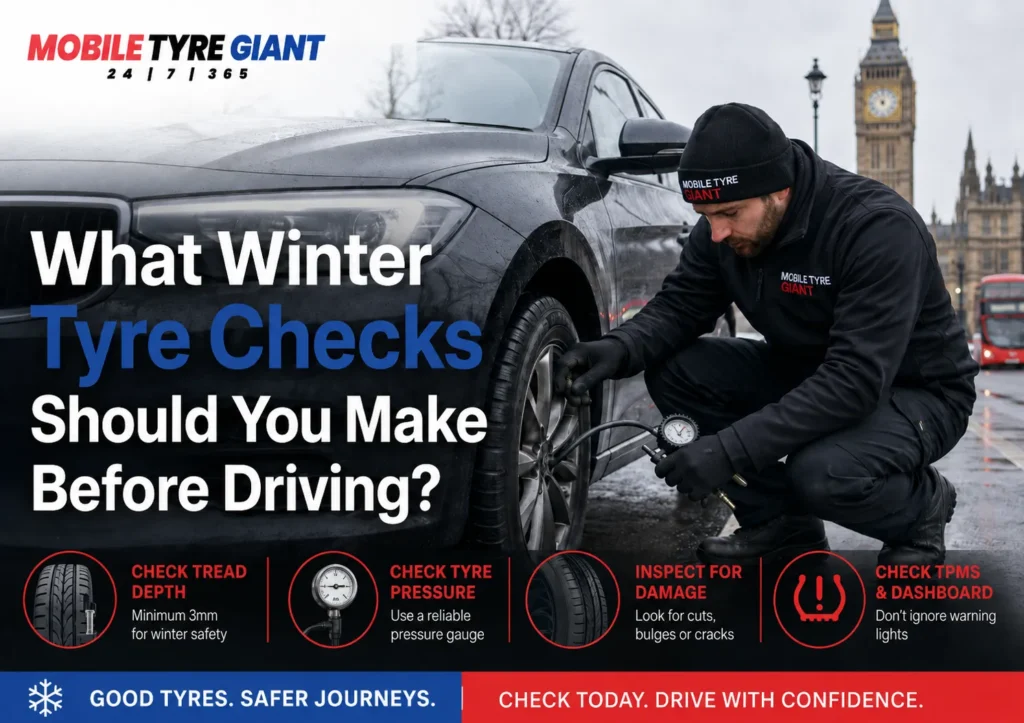
What Tyre Tread Depth Is Safe for Winter Driving?
For cars and light vans in the UK, the legal minimum tyre tread depth is 1.6mm across the central three-quarters of the tread and around the entire circumference. That figure is the legal threshold, but it should not be misunderstood as a target that every tyre ought to be driven down to regardless of conditions. Tread grooves are responsible for helping move water away from beneath the tyre, so available tread becomes particularly relevant during heavy London rain and when standing water collects near kerbs or worn road surfaces. Many drivers choose to consider replacement before reaching the legal minimum, commonly around the 3mm region for winter use, because the aim is not merely to remain legal but to preserve a useful safety margin. The important point is to distinguish clearly between the 1.6mm legal minimum and a higher tread level chosen for additional winter confidence.
You can get a rough indication of tread at home, but a proper tread-depth gauge gives a clearer measurement than judging the tyre by eye. Check several positions around each tyre because tread can wear unevenly, particularly if there is an alignment, suspension or inflation problem. Imagine checking the sole of a walking boot after months of use, one part may still look deep while another has worn almost smooth, and tyre wear can behave in much the same way. If one shoulder is significantly more worn than the centre or the opposite side, simply measuring the deepest groove can give you a false sense of security. Winter driving in London places a premium on wet-road performance, so tread depth should be treated as a practical grip issue as well as a legal measurement.
Does Tyre Pressure Drop in Cold Weather?
Yes, colder temperatures can reduce the pressure inside a tyre, which is why drivers sometimes notice lower readings after a sharp overnight temperature drop. The change may be modest, but it can be enough to matter if the tyre was already close to the lower end of the recommended pressure range. Always use the pressure specified for your vehicle rather than copying a figure from another car or inflating the tyre until it simply looks right. Pressure should normally be checked when the tyres are cold, because driving warms the tyres and can temporarily raise the reading. If you want a deeper explanation of why correct inflation matters, Mobile Tyre Giant also covers the effects of under-inflated tyres.
A useful comparison is a football left outside on a cold morning, it can feel slightly softer even though nobody has deliberately let the air out. Tyres respond to temperature changes too, but that does not mean every pressure loss should automatically be blamed on winter. If one tyre loses pressure repeatedly while the others remain stable, or the pressure falls again soon after inflation, a puncture, valve issue or another leak may be present. Repeatedly topping up the same tyre without investigating the cause only hides the symptom for a while. During winter driving in London, checking pressure regularly gives you a better chance of spotting that difference before a slow leak turns into a flat tyre.
Why Does the TPMS Light Come On When It Gets Cold?
A tyre pressure monitoring system, or TPMS, may illuminate after a cold night because the drop in temperature has reduced one or more tyre pressures enough to cross the warning threshold. This is why some drivers see the light first thing in the morning even though there was no warning the previous evening. A common question in UK driver discussions is essentially, “Is this just the cold, or have I picked up a puncture?” The correct response is not to guess, but to check the pressures and compare all four tyres with the vehicle’s recommended settings. If the warning disappears after correcting the pressures and does not return, temperature may have been part of the explanation.
The situation changes if the warning comes back repeatedly, one tyre needs frequent topping up or you can see obvious damage. Cold weather can explain a pressure change, but it cannot rule out a nail, valve leak or another tyre problem occurring at the same time. Mobile Tyre Giant’s guide on what a TPMS warning light means explains the common causes and why a recurring warning deserves investigation. Treat the light like a smoke alarm rather than an inconvenience, it tells you to check what is happening rather than automatically proving what caused it. That simple distinction can stop a harmless seasonal pressure adjustment from being confused with a tyre problem that actually needs attention.
Do You Need Winter Tyres in London?
Winter tyres are not legally compulsory in the UK, and not every London driver automatically needs a dedicated set. The decision depends more on how, where and when you drive than on the calendar alone. A driver who mainly makes short journeys through central London may face very different conditions from someone regularly travelling out of the city early in the morning on untreated roads. Dedicated winter tyres are designed to work effectively in colder conditions and can provide additional grip when roads become cold, wet, icy or snowy. However, buying a second tyre set also means considering cost, storage and seasonal changeovers. That is why the question should not simply be, “Are winter tyres better?” but rather, “Do they make sense for the journeys I actually make?”
For many drivers, winter driving in London involves rain, road spray, standing water, occasional frost and cold mornings more often than prolonged deep snow. This is one reason some drivers consider all-season tyres instead of changing between dedicated summer and winter sets. Someone who regularly drives outside London, travels through higher or more exposed areas, or cannot avoid journeys during poor weather may place greater value on dedicated winter performance. A driver who stays mostly within the city may prioritise year-round convenience instead. There is no honest one-size-fits-all answer, and claiming that every London driver must buy winter tyres would exaggerate the situation. The better approach is to assess your tyre condition, typical journeys and the weather you genuinely expect to encounter.
Are Winter Tyres Compulsory in the UK?
No, winter tyres are not compulsory for normal driving in the UK. You are legally required to use roadworthy tyres that meet the applicable tread, condition and suitability requirements, but there is no general UK rule forcing drivers to switch to winter tyres during a particular month. That makes the UK different from some European countries where winter equipment can become mandatory during certain seasons or weather conditions. If you plan to drive abroad during winter, you should therefore check the requirements for every country on your route rather than assuming UK rules apply elsewhere. Within London, your main responsibility is to make sure the tyres fitted to your vehicle remain safe, correctly inflated and legally compliant. A tyre does not become unsafe simply because it is not labelled as a winter tyre.
The important distinction is between legal requirement and optional performance choice. Think of it like choosing waterproof footwear on a rainy day, ordinary shoes may still be perfectly usable, but another type may provide advantages under specific conditions. Winter tyres can offer benefits when temperatures fall and roads become more challenging, but whether those benefits justify buying and storing a second set depends on the driver’s situation. This is where marketing can sometimes make the issue sound more absolute than it really is. Drivers should avoid making the decision based purely on fear of snow that may rarely appear. Condition, tread depth and correct pressure often deserve attention before replacing otherwise suitable tyres purely because winter has arrived.
Winter Tyres vs All-Season Tyres for London Driving
Winter tyres and all-season tyres solve slightly different problems. Dedicated winter tyres are engineered with colder weather in mind, while all-season tyres aim to provide a compromise that can remain fitted throughout the year. That year-round convenience appeals to drivers who do not want to store another four tyres or arrange seasonal changeovers. At the same time, a compromise tyre will not necessarily equal a specialised winter tyre in every severe winter condition or a dedicated summer tyre in every warm-weather situation. For London drivers, the relevant question is therefore which compromise best matches the roads they use most often. A realistic comparison should consider rain, cold temperatures, occasional frost, snow exposure, mileage and travel outside London.
Factor | Winter Tyres | All-Season Tyres |
Main purpose | Focused on colder winter conditions | Year-round compromise |
Cold and wet driving | Strong winter-focused performance | Designed to handle varied seasonal conditions |
Snow and ice | More specialised for winter use | Capability varies by tyre model |
Year-round convenience | Seasonal change normally required | Can remain fitted throughout the year |
Storage | Second tyre set may need storage | No seasonal tyre storage normally needed |
Best suited to | Drivers regularly facing colder or more difficult winter conditions | Drivers wanting convenience across changing UK weather |
The table should be treated as a starting point rather than a buying rule. Two drivers living on the same street may make different choices because one drives five miles through London each day while the other regularly travels hundreds of motorway miles into colder regions. Tyre quality, vehicle type, driving style and existing tread condition also matter. If your current tyres are already worn or damaged, replacing them with an appropriate new set may be more important than debating seasonal labels. Likewise, fitting premium winter tyres does not cancel out unsafe driving, poor visibility or excessive speed on a wet road. Tyres improve the vehicle’s connection with the surface, but the driver still has to respond to the conditions sensibly.
Is the Legal Minimum Tread Enough for Winter Conditions?
A tyre can meet the legal minimum tread requirement and still have less tread available for clearing water than it had when new. This is why discussions about winter tread often mention figures above the legal 1.6mm minimum. The legal figure tells you when a tyre falls below the statutory threshold, while a higher replacement point is a judgement about maintaining additional performance margin. These two ideas should never be confused. A driver looking at 2mm of remaining tread may still technically be above the legal threshold, but should also consider how often they drive in heavy rain, how much motorway use they do and whether replacement is already approaching. Waiting until the final fraction of legal tread has disappeared is not automatically the smartest maintenance strategy.
London creates plenty of situations where water clearance matters, from standing water near drains to spray thrown up by buses, vans and other vehicles. As tread becomes shallower, the tyre has less groove depth available to channel water away from the contact area. That does not mean a tyre at 2.9mm suddenly becomes unsafe, or that a tyre at 3.1mm is magically perfect. Tread is one part of the overall condition picture, alongside pressure, damage, age, wear pattern and the quality of the tyre itself. The sensible approach is to inspect tyres before winter and plan replacement rather than waiting for an urgent problem. If tread is already approaching the end of its useful life, colder and wetter months are a logical time to reassess it.
When Should You Replace a Tyre Before Winter Rather Than Keep Using It?
Replacement should be considered when a tyre is legally worn out, structurally damaged or showing a condition that makes continued use unsafe. Obvious examples include serious sidewall bulges, exposed cords, significant cracking or damage that cannot be safely repaired. Persistent pressure loss is another warning sign because repeatedly adding air does not solve whatever is allowing it to escape. Uneven tread can also indicate that one part of the tyre is reaching its limit sooner than the rest. In some cases the tyre itself is only part of the problem, and alignment, suspension or inflation issues may also need attention. That is why inspecting the whole tyre matters more than looking at one convenient groove.
You should also think ahead rather than treating replacement as something that only happens after a flat tyre. If a tyre is close to the end of its usable tread before months of wet winter journeys, replacing it proactively may be more convenient than waiting until the situation becomes urgent. A puncture may sometimes be repairable depending on its location and the tyre’s overall condition, while other damage requires replacement. If you are uncertain whether a damaged tyre can be repaired, Mobile Tyre Giant’s mobile tyre repair service explains the types of tyre problems that can be assessed at your location. The key is not to treat every mark as an emergency, but equally not to ignore damage because the tyre still holds air today. Winter preparation works best when problems are dealt with while you still have options rather than after the car is stranded.
How Can You Tell If Your Car Battery Is Ready for Winter?
A car battery can appear perfectly healthy through summer and then begin struggling as colder mornings arrive. Lower temperatures make starting the engine more demanding, while winter driving often places greater electrical demand on the vehicle through heaters, demisters, lights and heated windows. The first clue is often subtle rather than dramatic, such as the engine turning over slightly more slowly than usual. If you normally hear an immediate, confident start but suddenly hear a slower, heavier cranking sound, it is worth paying attention. Think of it like trying to get out of bed on a freezing morning, the job has not changed, but it suddenly takes more effort. A battery that already has limited capacity can feel that extra strain much more strongly.
You do not need to wait until the vehicle refuses to start before taking action. Notice whether starting performance has changed, whether electrical systems appear weaker than normal and whether the battery has gone flat more than once. Battery condition is particularly worth considering before a long winter journey or after the vehicle has spent several cold days parked. Age can matter too, but age alone does not tell you whether a battery is healthy or failing. Proper testing can give a much clearer picture than simply assuming a battery needs replacing because winter has arrived. Catching the early signs is usually far less disruptive than discovering the problem when you are already late for work on a dark London morning.
What Are the Signs of a Weak Car Battery in Winter?
A slow engine crank is one of the most familiar warning signs of a battery beginning to struggle. Instead of the engine starting almost immediately, you may hear it turn over several times before firing, particularly first thing in the morning. Interior lights or headlights may also appear weaker while the vehicle is trying to start, although electrical symptoms can have several possible causes. Repeated starting difficulty deserves more attention than a single unusual start after an exceptionally cold night. Another warning is a battery that has needed jump-starting more than once without an obvious explanation. If the same problem keeps returning, repeatedly boosting the battery only restores the car temporarily rather than identifying the underlying cause.
Drivers sometimes make the mistake of waiting for complete battery failure because the vehicle still starts eventually. That is similar to ignoring a phone battery that suddenly drops from half charge to empty, the device still works, but the pattern is telling you something has changed. A weak battery can become much more inconvenient when temperatures fall further or the car sits unused for several days. Electrical warning lights, clicking when attempting to start or noticeably sluggish cranking should therefore be treated as information rather than background noise. The exact cause may not always be the battery itself, because charging-system or connection problems can create similar symptoms. If starting behaviour continues to deteriorate, having the system checked is more sensible than relying on repeated jump-starts.
Can Short London Journeys Affect Battery Charge in Winter?
Frequent short journeys can make winter battery problems more noticeable because starting the engine consumes energy that needs to be replenished while you drive. If the vehicle is repeatedly used for very short trips, especially with lights, heaters, blowers and heated windows operating, the charging system may have less opportunity to restore what was used during starting. This does not mean every short London journey damages a battery. Plenty of healthy vehicles handle urban driving without difficulty. The concern becomes greater when short journeys are combined with an ageing battery, long periods parked or repeated cold starts. In that situation, a battery that was already marginal may gradually become less able to cope.
A practical example is a car used mainly for a ten-minute school run, short supermarket trips and occasional weekend travel. During warmer months, the driver may never notice anything unusual. When winter arrives, however, the headlights are on more often, the demister is running and the cabin heater is working harder at the same time the battery is being asked to start a cold engine. That combination can expose limited battery capacity more quickly. If your car is regularly used only for short journeys, paying attention to slower starting or repeated flat-battery incidents is more useful than assuming the driving pattern alone is responsible. The important point is to identify a developing problem before a routine city journey becomes a morning breakdown.
How Do You Maintain Clear Visibility During a London Winter?
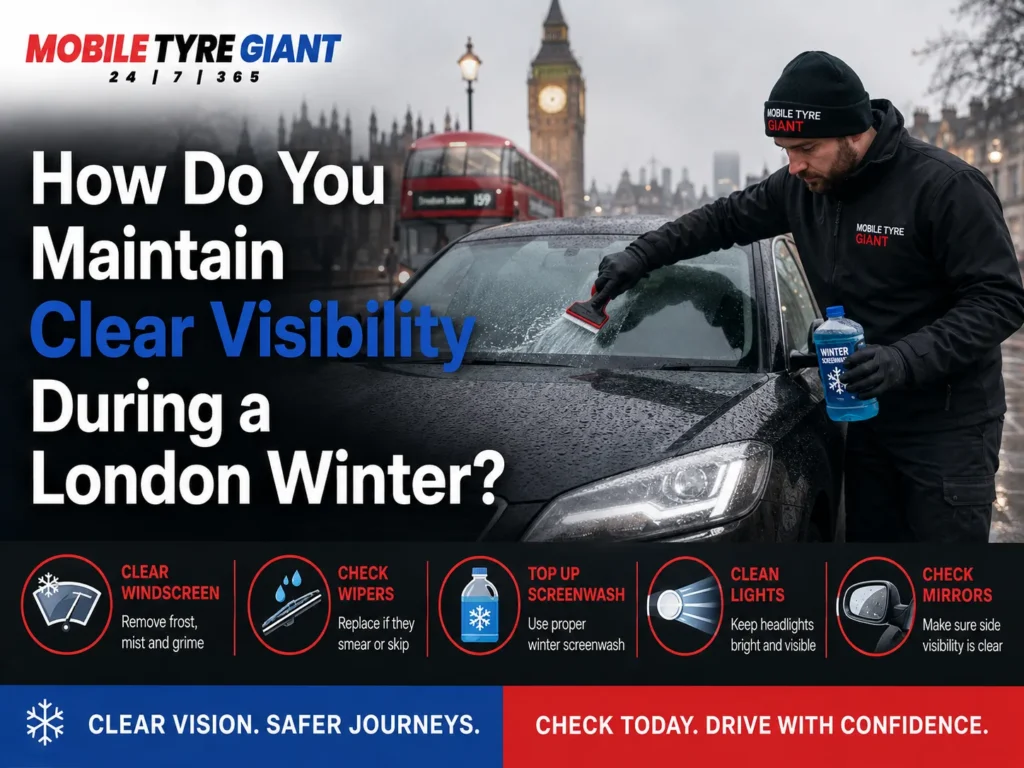
Clear visibility is one of the simplest winter safety requirements to understand, yet it is also one of the easiest to rush when you are trying to leave home. London winter driving often combines darkness, rain, road spray, low sun, fog and moisture inside the vehicle. A windscreen that looks only slightly dirty in daylight can become surprisingly difficult to see through when headlights and streetlights reflect across it at night. Road spray can also coat the outside of the glass quickly, especially when following larger vehicles on wet roads. Good visibility therefore depends on more than simply having functioning headlights. Your windscreen, mirrors, wiper blades, washer system and lights all need to work together.
Before setting off, make sure the windscreen and other essential windows are properly cleared rather than creating a small viewing area and hoping the heater finishes the job while you drive. Moisture inside the glass can scatter light and create glare, while frost outside can block large areas of vision. Dirty headlight lenses can also reduce the effectiveness of otherwise working lights during dark or wet journeys. Consider the driver’s view as one complete system, if the glass is smeared, the wipers are worn and the washer bottle is empty, each problem makes the others more noticeable. A few minutes of preparation at home can prevent you from trying to solve several visibility problems while already moving through traffic. Winter visibility should therefore be treated as a pre-drive check, not something to deal with at the first set of traffic lights.
How Do You Demist a Windscreen Quickly?
When a windscreen mists on the inside, the aim is to remove moisture from the air and raise the glass temperature so condensation can clear. Start the vehicle’s demisting system and direct airflow towards the windscreen, using warm air as the system begins to heat. Air conditioning can also help remove moisture from cabin air where the vehicle is equipped with it. Avoid leaving air recirculation on unnecessarily because continuously reusing humid cabin air can make condensation harder to clear. If the glass is heavily misted, give the system enough time to clear the full driving area rather than wiping one small patch with your sleeve. That quick sleeve wipe often leaves greasy streaks that become even more obvious when oncoming headlights hit the glass.
Persistent condensation can also be a clue that excess moisture is remaining inside the vehicle. Wet coats, umbrellas, damp carpets and snow or rain carried in on footwear all add moisture to the cabin. Keeping the inside surface of the windscreen clean can also help because dirt and residue give condensation something to cling to. If the windows repeatedly become heavily wet inside even in otherwise normal conditions, it may be worth checking whether there is an unusual source of moisture in the cabin. Most importantly, do not begin driving until you have sufficient visibility through the windscreen and other necessary glass. Saving two minutes on the driveway is not worth spending the next ten minutes trying to see properly through a glowing film of condensation.
What Should You Check on Your Wipers, Screenwash and Lights?
Wiper blades should clear water smoothly rather than leaving broad streaks, juddering across the windscreen or missing sections of glass. Run them with washer fluid before winter becomes severe and watch what happens across the full sweep. A blade that looks intact while parked can still perform badly once rain and road grime cover the glass. Washer jets should spray properly, and the reservoir should contain suitable screenwash rather than relying on plain water in freezing conditions. Check that the windscreen itself is reasonably clean inside and outside because even good wipers cannot compensate for greasy residue on the inner surface. These small details become much more noticeable at night when lights reflect through moisture and dirt.
Lighting deserves the same simple walk-around check. Confirm that headlights, rear lights, brake lights and indicators are operating correctly, and clean dirty lenses when winter road grime begins building up. Fog lights should be understood and used appropriately rather than being treated as extra headlights whenever it rains. A useful habit is to check lighting while the car is parked near a wall or reflective surface, which can make failed bulbs easier to notice. If another person is available, ask them to confirm brake-light operation while you press the pedal. Visibility is not only about what you can see, it is also about how clearly other road users can see you. During dark, wet winter journeys through London, that combination of clean glass, effective wipers and working lights can make a significant difference to how comfortable and controlled the drive feels.
What Should You Check Before Every Winter Journey?
A winter check does not need to turn into a full mechanical inspection every time you leave home. Start with the things that can immediately affect whether the journey is safe: tyres, visibility, lights and any warning messages on the dashboard. Walk around the car and make sure no tyre looks noticeably low, damaged or unusually worn, then check whether any TPMS warning has appeared. Look through the windscreen before getting into traffic and make sure frost, condensation or road grime is not restricting your view. Turn on the lights when conditions require them and confirm the wipers clear the glass rather than spreading water into a broad smear. If the engine sounds noticeably slower to start than usual, treat that as useful information rather than waiting for the battery to fail completely. These checks take only a few minutes but can uncover problems while the car is still safely parked.
It also helps to think beyond the condition of the vehicle itself. Check the weather before a longer winter journey, particularly if temperatures are expected to fall sharply or heavy rain, fog or ice is forecast. Give yourself more time when visibility or road conditions are poor because rushing usually makes sensible preparation the first thing people skip. If a dashboard warning remains illuminated, a tyre repeatedly loses pressure or the windscreen cannot be cleared properly, deal with the issue before treating the journey as routine. A simple winter driving checklist should make decisions easier, not create another complicated maintenance routine. The goal is to notice changes early, understand which ones matter and avoid discovering a preventable problem after you have already joined busy London traffic.
5-Minute London Winter Driving Checklist
Use this quick sequence before a cold, wet or potentially icy journey: check that all four tyres look correctly inflated, confirm tread and visible tyre condition, investigate any unexplained TPMS warning, make sure the engine starts normally, clear frost and condensation from the windscreen, check the mirrors, test the wipers and washer jets, confirm you have enough suitable screenwash, check that essential lights are working and review the weather and route. You do not need specialist equipment for every one of these steps. Many problems reveal themselves through simple changes, such as one tyre sitting lower than the others, a wiper leaving a streak directly across your line of sight or the starter motor sounding noticeably more sluggish. Performing the same sequence regularly also makes unusual changes easier to recognise because you know what normal looks and sounds like.
The checklist should become more detailed before a long motorway journey or when particularly poor conditions are forecast. Tyre pressures are best confirmed with a reliable gauge rather than only by appearance, and tread should be checked at several points rather than on one convenient section. Make sure the windscreen is fully clear before moving away rather than expecting the heater to finish the job while you drive. If you have been ignoring a recurring tyre-pressure warning or slow battery symptoms, a winter journey is not the ideal time to keep testing your luck. Preparation is less dramatic than dealing with a breakdown, but that is exactly the point. A good winter routine feels uneventful because it helps prevent the small issues that can otherwise turn into major disruptions.
What Should You Keep in Your Car During Winter?
A sensible winter kit should focus on items that are genuinely useful rather than filling the boot with equipment you are unlikely to need. An ice scraper and suitable de-icer can save time on frosty mornings, while a torch becomes useful if you need to inspect a tyre after dark. Keep a phone charging option available, particularly for longer journeys, and consider carrying a warm layer even if you expect to spend the entire trip inside the car. Suitable screenwash is also worth keeping topped up because road spray can quickly coat the windscreen on wet London roads. If poor weather causes delays, simple items such as water and warm clothing can make an unexpected wait far less uncomfortable. What belongs in the car should ultimately reflect the length and type of journeys you make.
Do not let the presence of emergency equipment create false confidence about the condition of the vehicle. A tyre inflator, for example, does not make a damaged sidewall safe, and repeatedly adding air to a leaking tyre is not a substitute for finding the cause. Likewise, a jump pack can be useful in certain situations but should not become the long-term solution for a battery that regularly fails to start the car. Equipment is there to help you manage an unexpected situation, not to postpone necessary maintenance indefinitely. If a warning sign keeps returning, deal with the problem while you can choose the timing rather than waiting for a cold roadside situation to make the decision for you. Winter preparation works best when practical equipment and proper vehicle checks support each other.
When Should a Winter Tyre Problem Stop You From Driving?
Not every tyre warning means the car must immediately be abandoned, but some signs deserve much more caution than others. A slightly reduced pressure reading after a cold night may simply require the tyres to be checked and corrected to the vehicle manufacturer’s recommended settings. A recurring TPMS warning, gradual loss of pressure or visible object in the tread deserves prompt investigation because there may be an underlying puncture or valve problem. More serious signs include a visibly flat tyre, pronounced sidewall bulge, exposed cords or severe structural damage. Continuing to drive normally on a tyre in that condition can worsen the damage and may compromise control of the vehicle. If you are unsure whether a tyre is safe, treating the uncertainty seriously is better than assuming that because the car still moves, the tyre is suitable for the journey.
Pay attention to how quickly the situation develops. A tyre that loses a small amount of pressure over several weeks presents a different problem from one becoming visibly flat within minutes. Sudden vibration, unusual pulling or a rapid pressure warning while driving should also make you reassess rather than simply carrying on to your destination. If a tyre has sustained damage, avoid experimenting with unnecessary extra mileage to see whether it “holds up”. A proper assessment can determine whether a puncture is safely repairable or whether replacement is necessary. Mobile Tyre Giant’s mobile tyre repair service is relevant when a puncture, slow leak or other tyre problem needs attention at your location. The safest response depends on the actual condition of the tyre, not simply how inconvenient stopping might be.
What Should You Do If a Tyre Problem Stops Your Journey in London?
If a tyre problem develops during a winter journey, your first priority is to get the vehicle into the safest practical position rather than immediately focusing on the tyre itself. Avoid standing in exposed traffic while inspecting the vehicle, especially in darkness, rain or poor visibility. Once it is safe to assess the situation, look for obvious signs such as a completely flat tyre, sidewall damage, an embedded object or a recurring pressure warning. Do not remove nails or screws from the tread at the roadside simply because you can see them, because the object may temporarily be slowing the air loss. If you know your tyre size, vehicle details and exact location, keep that information ready because it can make arranging assistance more straightforward. Taking a clear photograph of the tyre can also help communicate what has happened.
If the tyre cannot be driven on safely, mobile assistance can remove the need to attempt a journey to a garage on a damaged tyre. Mobile Tyre Giant provides mobile tyre fitting in London for drivers who need tyre support at home, work or roadside locations. Whether a tyre can be repaired or needs replacement depends on the position and severity of the damage as well as the overall condition of the tyre. That is why a puncture should not automatically be described as either repairable or irreparable without inspection. The important thing is to avoid turning a manageable tyre problem into wheel damage, a larger tyre failure or a roadside safety risk by continuing farther than is sensible. In winter, when darkness, rain and cold can make an already inconvenient situation harder, early action becomes even more valuable.
Final Words: Stay Ready for Winter Driving in London
Winter driving in London is less about preparing for weeks of deep snow and more about being ready for the cold, wet and low-visibility conditions that occur far more often. Tyre pressure can change as temperatures fall, worn tread becomes more relevant on rain-covered roads, a weak battery may reveal itself on a cold morning and a misted windscreen can make even a short journey difficult. None of these problems requires panic, but they do require attention. The most useful habit is learning what normal looks, sounds and feels like on your own car so that changes become easier to spot. A quick inspection before leaving can give you time to correct something simple before it develops into a more disruptive problem.
The best winter checklist is therefore the one you actually use. Check tyre condition and pressure, take warning lights seriously, notice changes in starting behaviour and make sure visibility is completely clear before joining traffic. Understand the difference between legal minimums and sensible winter preparation, and do not assume that every London driver needs exactly the same tyre setup. If a tyre develops serious damage or cannot maintain pressure, avoid unnecessary driving and arrange appropriate help. With those basics covered, winter preparation becomes less about worrying over every cold morning and more about making informed decisions before, during and after the journey.
Is Your Car Ready for Winter Driving in London?
If your tyres are worn, damaged or losing pressure, Mobile Tyre Giant can bring professional tyre fitting or repair directly to your location.
Frequently Asked Questions
Find quick answers to the most common questions our customers ask.
Winter tyres are not compulsory in the UK, and many London drivers may not need a dedicated set. The best choice depends on your journeys, local conditions, how often you travel outside London and whether you regularly encounter colder, icy or snowy roads.
All-season tyres can be a practical option for drivers who want year-round convenience and regularly encounter mixed UK weather. However, their suitability still depends on the vehicle, tyre model, driving conditions and the journeys you make.
For cars and light vans, the legal minimum is 1.6mm across the central three-quarters of the tread and around the entire circumference. Drivers may choose to replace tyres earlier when additional wet-weather or winter performance is a priority.
Yes, tyre pressure can fall as temperatures decrease. Check pressures when the tyres are cold and use the vehicle manufacturer's recommended settings rather than guessing based on how the tyres look.
Cold temperatures can reduce tyre pressure enough to trigger the TPMS warning. However, a warning that repeatedly returns or affects one tyre more than the others should be checked for a puncture, valve leak or another problem.
No, deliberately reducing tyre pressure is not a sensible way to improve winter grip for normal road driving. Keep tyres at the pressure specified by the vehicle manufacturer unless the manufacturer provides different instructions for a particular situation.
Slow engine cranking, repeated starting difficulty, dim electrical systems or recurring flat-battery problems can indicate that the battery or charging system needs attention. Cold weather often exposes a battery that was already becoming weak.
Direct warm airflow towards the windscreen and use the air conditioning where fitted to help remove moisture from the cabin air. Keep recirculation off when necessary and do not start driving until the windscreen provides clear visibility.
You should not set off with your view restricted by frost, ice or condensation. Clear the windscreen and other necessary windows properly, make sure mirrors are usable and ensure you have sufficient visibility before moving the vehicle.
Move to the safest practical location and avoid continuing unnecessarily on a flat or badly damaged tyre. Check the condition only when it is safe to do so, then arrange suitable repair or replacement assistance if the tyre cannot be driven on safely.