

Finding the correct tyres for your vehicle starts with one simple rule: do not choose a replacement based on wheel diameter alone. Knowing that your car has 16-inch, 17-inch or 18-inch wheels only gives you one part of the information needed to identify the correct tyre. A complete tyre specification normally includes the tyre width, profile, construction, wheel diameter, load index and speed rating. You can usually find this information moulded into the tyre sidewall in a format such as 205/55 R16 91V. Those numbers may look technical at first, but once you know what each part means, they become much easier to understand. The aim is not to turn yourself into a tyre expert. You simply need enough information to identify what is fitted and check that it matches the specification required for your vehicle.
This becomes especially important when you search using your registration and more than one possible tyre size appears. Different versions of the same vehicle may have been supplied with different wheel packages, and some cars are designed with different tyre sizes on the front and rear axles. Used vehicles can add another layer of uncertainty because wheels or tyres may have been changed by a previous owner. For that reason, it is better to cross-check the tyre already fitted with the vehicle’s own information rather than relying on a single source. Think of it like checking a shoe size before ordering online: knowing the brand is not enough if you have not confirmed the actual size and fit. With tyres, the consequences of guessing can be far more expensive and important. This guide will show you how to find the full specification, understand the markings and verify the information before you order a replacement.
What Is the Quickest Way to Find the Correct Tyre Size for Your Car?
The quickest starting point is to look directly at the sidewall of the tyre currently fitted to your vehicle. You should see a sequence similar to 225/45 R17 94W, usually written in larger characters than many of the other markings around the tyre. Take a clear photograph of the full code rather than trying to remember only the first few numbers. This is useful because drivers often remember the wheel diameter but forget the load index or speed rating at the end. Once you have the complete marking, compare it with the tyre information supplied for your vehicle. Depending on the car, that information may be available in the owner’s handbook, on a tyre information label around the driver’s door area or near the fuel filler. If everything agrees, identifying the replacement becomes much more straightforward.
A registration lookup can also help, but it should be treated as a useful starting point rather than unquestionable proof. Some vehicles have more than one approved wheel and tyre configuration, so a registration search may legitimately display several options. If that happens, check which wheels are physically fitted to the vehicle and compare the complete tyre markings on the front and rear. Do not simply click the first size that appears because the wheel diameter looks familiar. A driver looking for “18-inch tyres” could still be choosing between different widths, profiles and load ratings that are not interchangeable simply because they fit an 18-inch rim. If the vehicle is used or has aftermarket wheels, an additional verification step is sensible before ordering. Once the correct specification is confirmed, you can then consider other factors such as tyre type, driving conditions and budget.
Where Can You Find Your Vehicle’s Correct Tyre Size?
The tyre sidewall is usually the easiest place to start, but it should not be the only source you know about. Vehicle manufacturers may provide approved tyre information in several locations, including the owner’s handbook and a label inside the vehicle. On many cars, useful tyre information can be found around the driver’s door opening, door pillar or fuel filler area, although the exact location varies between models. These labels may also contain recommended tyre pressures for different loads, which is separate from the tyre size itself. If you are checking that information, our guide to checking the correct tyre pressure explains how to use vehicle pressure recommendations properly. The important point is to compare information rather than taking one number out of context. If the sidewall, vehicle information and registration lookup all point to the same configuration, you have much stronger confirmation than you would get from one source alone.
You should also check the front and rear of the vehicle separately instead of assuming all four tyres are identical. Many everyday cars do use the same tyre size at each corner, but some vehicles have a staggered setup with wider or differently profiled tyres on the rear axle. This is easy to miss when only one damaged tyre is being replaced. Imagine standing beside the front wheel, reading its specification and then ordering that exact tyre for the rear without checking the rear sidewall. On a staggered vehicle, that simple assumption could give you the wrong size. The same caution applies when an online tyre finder produces several possible combinations. Before ordering, identify the axle you are replacing and compare the markings on that tyre with the relevant vehicle information. This small check takes only a moment but can prevent a costly ordering mistake.
Check the Full Tyre Sidewall Marking
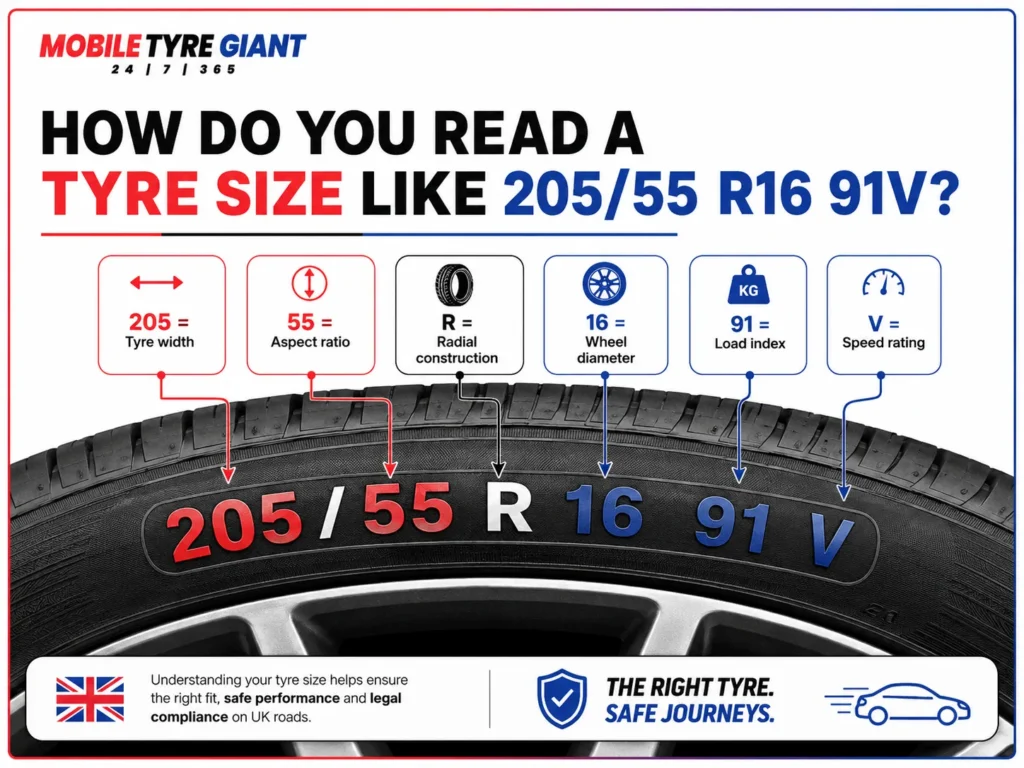
When you inspect the tyre sidewall, look for the complete size and service description rather than stopping when you see the rim diameter. A marking such as 205/55 R16 91V contains several different pieces of information, and each serves a separate purpose. The first number gives the nominal tyre width, while the second describes the sidewall profile as a percentage of that width. The letter R identifies radial construction, which is the normal construction used on modern passenger-car tyres. The number that follows tells you the wheel diameter in inches. After that, the load index and speed rating provide further information about the tyre’s operating specification. This is why two tyres advertised as 205/55 R16 can still have different ratings at the end of the code.
A practical habit is to photograph both the complete sidewall code and the whole wheel before contacting a tyre fitter or ordering online. The photograph gives you something to check again if you forget a number and can also make it easier to identify markings such as XL or run-flat designations. Make sure the image is sharp enough to read, especially if the tyre is dirty or the lettering is close to the ground. If necessary, move the car slightly so the relevant marking is easier to see rather than trying to read it upside down in poor light. You should never crawl beneath an unsafe or unstable vehicle simply to photograph a tyre marking. If the tyre is badly damaged or access is difficult, the vehicle registration and manufacturer information can provide another starting point. The goal is to gather enough accurate information to confirm the replacement, not to take unnecessary risks just to read one sidewall.
Check the Handbook, Vehicle Label and Registration Information
Your vehicle handbook can be particularly useful when the model was offered with more than one wheel size from the factory. Instead of listing one universal tyre size, it may show several approved combinations depending on wheel diameter, engine, trim or vehicle configuration. The important step is to identify which combination corresponds with the wheels actually fitted to your car. A vehicle tyre label can provide another useful cross-check, especially when you are trying to confirm both tyre-related information and recommended pressures. Registration-based search tools are convenient because they narrow the options using vehicle data, but they cannot tell you everything about changes made to a car after it left the factory. If a previous owner fitted replacement or aftermarket wheels, the registration result may not fully describe the setup that is physically on the vehicle. This is one reason real drivers sometimes find different information online and on the tyre itself.
When the information agrees, you can move forward with much greater confidence. When it does not, the sensible response is not to guess which source “looks right”. Check whether several wheel options were approved for the model and whether the wheels have been changed. It is also worth comparing the front and rear tyres because a legitimate staggered setup can initially look like a mismatch. If you are unsure, collect the registration, complete tyre sidewall marking and a clear photo of the wheel before arranging a replacement. That gives a tyre professional much better information than simply saying, “I need an 18-inch tyre.” Later in this guide, we will cover exactly what to do when a registration lookup and the tyre currently fitted do not match. That situation is common enough to deserve its own explanation rather than being dismissed as an online search error.
How Do You Read a Tyre Size Like 205/55 R16 91V?
The code 205/55 R16 91V can be broken down into five useful pieces of information. 205 is the nominal tyre width in millimetres, while 55 is the aspect ratio, meaning the sidewall height is expressed as a percentage of the tyre width. R means the tyre uses radial construction, and 16 means it is designed for a 16-inch wheel. 91 is the tyre’s load index, which relates to the load-carrying capability of the tyre. V is the speed rating and forms part of the tyre’s service description. Once you understand this pattern, most everyday passenger-car tyre markings become far less intimidating. Instead of seeing a random string of numbers and letters, you can read it as a compact description of the tyre’s size and operating specification.
The important detail is that you should not stop after matching the first three numbers. A replacement that shares the same width, profile and wheel diameter can still have a different load index, speed rating or additional marking. You may also see letters such as XL, which indicates Extra Load construction, or tyre-specific markings associated with run-flat technology. Those details become more important when you move from simply reading the sidewall to confirming whether a replacement is suitable for your vehicle. This is why finding the correct tyre is a verification process rather than a quick visual match. The physical dimensions tell you whether you are looking in the right area, while the rest of the specification helps confirm the correct fitment.
Tyre Marking | What It Means | Why It Matters |
205 | Nominal tyre width in millimetres | Helps identify the correct tyre width |
55 | Aspect ratio or profile | Relates sidewall height to tyre width |
R | Radial construction | Identifies the tyre construction type |
16 | Wheel diameter in inches | Must correspond with the wheel size |
91 | Load index | Relates to the tyre’s load-carrying capability |
V | Speed rating | Forms part of the required service specification |
Why Does My Registration Show More Than One Tyre Size?
A vehicle registration lookup can sometimes return two, three or even more possible tyre sizes, and that does not automatically mean the information is wrong. The same make and model may have been sold with different wheel packages depending on trim level, engine, model year or optional equipment. One version might have left the factory with 16-inch wheels, while another version of the same model could have been supplied with 17-inch or 18-inch wheels. Some vehicles also use different tyre sizes on the front and rear axles, which can create several combinations in a tyre database. This is why a registration search should help narrow your options rather than replace a physical check of the vehicle. If several sizes appear, compare them with the complete markings on the tyres currently fitted. You should also check the manufacturer’s vehicle information where available before choosing a replacement.
The easiest way to think about this is that your registration identifies the vehicle, but it does not always describe every detail of the wheels currently fitted to it. Imagine two identical-looking cars parked next to each other, one fitted with the standard factory wheels and the other fitted with an optional larger wheel package. Their registrations may point to the same basic vehicle model while their correct tyre sizes are different. For that reason, do not simply choose the first result because it appears at the top of a tyre search. Check whether the width, profile, wheel diameter, load index and speed rating correspond with your actual vehicle configuration. If you are replacing only one tyre, confirm whether it is on the front or rear axle before ordering. Once the size is confirmed, you can then use our guide to choosing the right tyres for your car to consider tyre type, driving needs and budget without confusing tyre choice with tyre fitment.
What Should You Do if the Tyre Size and Registration Lookup Do Not Match?
If the tyre currently fitted shows a different size from the one returned by a registration lookup, do not immediately assume that either source must be wrong. Start by checking the complete tyre marking again, because it is easy to misread a profile number or confuse the front specification with the rear one. Next, look at the vehicle handbook or tyre information label to see which sizes were approved for that particular vehicle configuration. If the handbook lists several wheel sizes, identify which wheel diameter is actually fitted to the car. You should also inspect all four tyres rather than relying on one wheel, especially if the vehicle may use different front and rear dimensions. A used car may have had replacement wheels fitted at some point, while an online database may still be showing the original factory options. Until you understand why the information differs, ordering a tyre based on guesswork is unnecessary risk.
A useful example is a registration lookup showing 225/45 R17, while the tyre on the car reads 225/40 R18. Those two specifications are not simply slightly different versions of the same tyre because they are designed around different wheel diameters. If the car physically has 18-inch wheels, the 17-inch result clearly needs further investigation before you place an order. On the other hand, both sizes might appear in the vehicle documentation because the model was available with more than one approved wheel package. This is where cross-checking becomes more valuable than trusting one search result. If the vehicle information, current wheels and tyre markings still do not give you a clear answer, have the fitment verified before buying anything. When arranging mobile tyre fitting, providing the registration and a clear photograph of the full sidewall marking can give the fitter much better information than simply stating the wheel diameter.
Should You Trust the Tyres Already Fitted to the Car?
The tyres already fitted are usually the fastest and most practical place to start, but they should not always be treated as final proof of the correct specification. This matters particularly with used vehicles, where you may not know what changes were made before you bought the car. A previous owner could have changed the wheels, selected an alternative approved size or, in some cases, fitted a tyre that was not the appropriate specification. You may also find that one axle has been replaced more recently than the other, leaving different brands or ratings around the vehicle. None of this means you should automatically distrust the tyres on a used car. It simply means the existing sidewall should be compared with the manufacturer’s information when there is any doubt. That extra check is far easier than discovering a problem after replacement tyres have already been purchased.
Think of the existing tyre as one piece of evidence rather than the entire answer. If all four tyres carry matching specifications and those specifications correspond with the vehicle’s approved information, there is usually far less uncertainty. If one tyre is noticeably different, or the front and rear dimensions seem unusual, take a closer look before assuming something is wrong. Some vehicles are intentionally designed with different front and rear tyre sizes, while others should use matching dimensions across both axles. You should also pay attention to the load index, speed rating and markings such as XL or run-flat identifiers rather than comparing only the first part of the size. A tyre that looks almost identical from a distance can carry a different service specification when you read the sidewall closely. If a worn or damaged tyre definitely needs replacing once the correct specification is established, a mobile tyre replacement service can then be arranged using the verified information.
What if Your Vehicle Has Aftermarket or Replacement Wheels?
Aftermarket or replacement wheels make tyre identification more complicated because a registration lookup normally starts from known factory vehicle data. If the wheels have been changed since the vehicle left the manufacturer, the original registration-based tyre size may no longer describe what is physically fitted. You may notice this on a used car with larger alloy wheels, a different wheel design or a size that does not appear to match the basic specification shown online. In this situation, simply copying the original factory tyre size could be incorrect because the replacement wheel may have a different diameter or width. At the same time, you should not assume that whatever tyre is currently mounted on an aftermarket wheel must automatically be suitable. The wheel, tyre and vehicle need to work together as an appropriate combination. If you cannot confirm that combination from reliable vehicle information, professional fitment advice is the sensible next step.
Avoid relying on simple internet formulas that claim a different tyre size is safe because the overall diameter is within a certain percentage. Those calculations can be useful as technical reference points, but they do not account for every factor involved in real vehicle fitment. Wheel width, tyre clearance, load requirements, vehicle systems and manufacturer-approved combinations can all matter. For example, a tyre may appear close in overall diameter while still being unsuitable for the specific wheel width or vehicle setup. This is why this guide focuses on verification rather than encouraging drivers to create their own alternative sizes. If aftermarket wheels are already fitted, record the full tyre markings on both axles and check any information available for the wheels themselves. A tyre professional can then assess the actual setup instead of working only from a registration database that may describe the original wheels.
Can the Front and Rear Tyres Be Different Sizes?
Yes, some vehicles are designed to use different tyre sizes on the front and rear axles, a layout commonly described as a staggered fitment. This is often seen on certain performance, luxury and rear-wheel-drive vehicles, although the exact setup depends on the manufacturer and model. The rear tyres may be wider than the front tyres, and the profile can also differ so that the overall wheel and tyre package works as intended. This means you should never assume that the tyre size you read from the front wheel automatically applies to the rear. If you are replacing one damaged tyre, check the sidewall on that specific axle before ordering. It is also worth comparing the tyre on the opposite side of the same axle to confirm that both sides use the same intended specification. A quick visual check can prevent a surprisingly common mistake.
A staggered arrangement can initially look like somebody has fitted mismatched tyres, especially if you have never owned a vehicle with that setup before. The important difference is that a proper staggered fitment is part of the vehicle’s designed configuration rather than a random mixture of tyre sizes. For example, the front axle might use a narrower tyre while the rear uses a wider tyre to suit the vehicle’s intended handling and drivetrain characteristics. That does not mean drivers should experiment with creating their own front and rear combinations. The correct setup should be confirmed from the vehicle’s approved specification and the wheels actually fitted. When replacing tyres on a staggered vehicle, tell the fitter clearly whether the affected tyre is front-left, front-right, rear-left or rear-right.
Why Do the Tyre Load Index and Speed Rating Matter?
Finding the correct tyre size does not stop once the width, profile and wheel diameter match. The numbers and letters at the end of a marking such as 205/55 R16 91V are also part of the specification you need to check. In this example, 91 is the load index and V is the speed rating. The load index relates to how much weight the tyre is designed to carry under specified conditions, while the speed rating identifies its approved speed capability. This means two tyres can both be advertised as 205/55 R16 but still have different service specifications. From a distance they may look almost identical, which is why this detail is easy for an inexperienced buyer to miss. If you are replacing a tyre, compare the complete marking instead of assuming that matching the first three dimensions is enough. The vehicle manufacturer’s required specification should be your reference point rather than whichever load or speed rating happens to be cheapest online.
There is also no need to turn these ratings into something more complicated than they are. Think of them as part of the tyre’s operating requirements, just as the wheel diameter is part of its physical fit. A higher number or later speed-rating letter does not automatically mean that a tyre is the best choice for every vehicle, and a lower rating should not be selected simply because normal road speeds are far below the tyre’s stated capability. Vehicle manufacturers specify tyres as part of a complete setup that considers weight, performance and intended operation. This becomes particularly important on heavier vehicles, performance cars and models carrying substantial loads. If you are unsure about the required rating, check the vehicle documentation rather than relying on a general internet chart alone. The aim is not to memorise every load-index number or speed-rating letter. It is to recognise that these markings matter and must be included when you verify the correct replacement tyre.
What Is a Tyre Load Index?
The tyre load index is the numerical code that appears near the end of the tyre’s size marking and corresponds to its load-carrying capacity. Using 205/55 R16 91V as an example, the number 91 is the load index. The number itself is a code rather than the tyre’s maximum load written directly in kilograms, so it normally needs to be interpreted using the relevant load-index information. For everyday drivers, the key point is simpler: the replacement tyre needs to provide the load capability required for the vehicle. You should not assume that any tyre with the same width, profile and wheel diameter will automatically meet that requirement. This is especially relevant when several versions of the same tyre are available with different load ratings. Online listings can look almost identical until you reach the last few characters of the description. Reading the full sidewall marking before ordering helps prevent that detail from being overlooked.
Load requirements can also vary between vehicles that happen to use similar tyre dimensions. A relatively light hatchback and a heavier vehicle could potentially use tyres with similar physical dimensions while requiring different operating specifications. That is one reason copying a tyre size from another model, even if the wheel looks similar, is a poor shortcut. If the vehicle carries heavy loads or was designed for a particular load-rated tyre, that requirement should be respected when selecting replacements. You may also encounter Extra Load tyres, commonly marked XL, which we will cover separately because the marking causes a lot of confusion. When checking the correct tyres for your vehicle, record the load index along with the width, profile, rim diameter and speed rating. It only takes a few extra seconds to read the complete code. Those seconds are worthwhile when they help you avoid purchasing a tyre with the right dimensions but the wrong specification.
What Is a Tyre Speed Rating?
The tyre speed rating is normally shown as a letter after the load index, so V is the speed rating in 205/55 R16 91V. It represents the tyre’s approved speed capability under specified conditions, but drivers should not treat it as permission to drive at that speed on public roads. The rating exists as part of the tyre’s technical specification and should be checked against the vehicle manufacturer’s requirements. One common mistake is to assume the speed rating does not matter because the car will never be driven anywhere near the tyre’s maximum capability. That overlooks the fact that the rating is part of how the tyre has been designed and specified for the vehicle. It is also possible to find otherwise identical tyre dimensions carrying different speed ratings. If several versions are available, do not choose one based only on price or availability without first confirming that it meets the required specification.
You may also find a replacement tyre with a higher speed rating than the tyre currently fitted, which can make the decision appear straightforward. Even then, the complete tyre specification should be considered rather than using one letter as the only comparison. The simplest approach is to work from the vehicle manufacturer’s specification and select a tyre that meets the necessary requirements. This avoids trying to create your own rules based on how fast you normally drive or how powerful the car feels. If your current tyres carry different speed ratings around the vehicle, that is another reason to check the approved specification before replacing one of them. A previous replacement may have introduced the difference, particularly on a used car with an unknown tyre history. Matching the correct size is therefore only the first layer of tyre identification. Load index and speed rating complete a much more useful picture of what the vehicle actually requires.
What Does XL Mean on a Tyre, and Do You Need It?
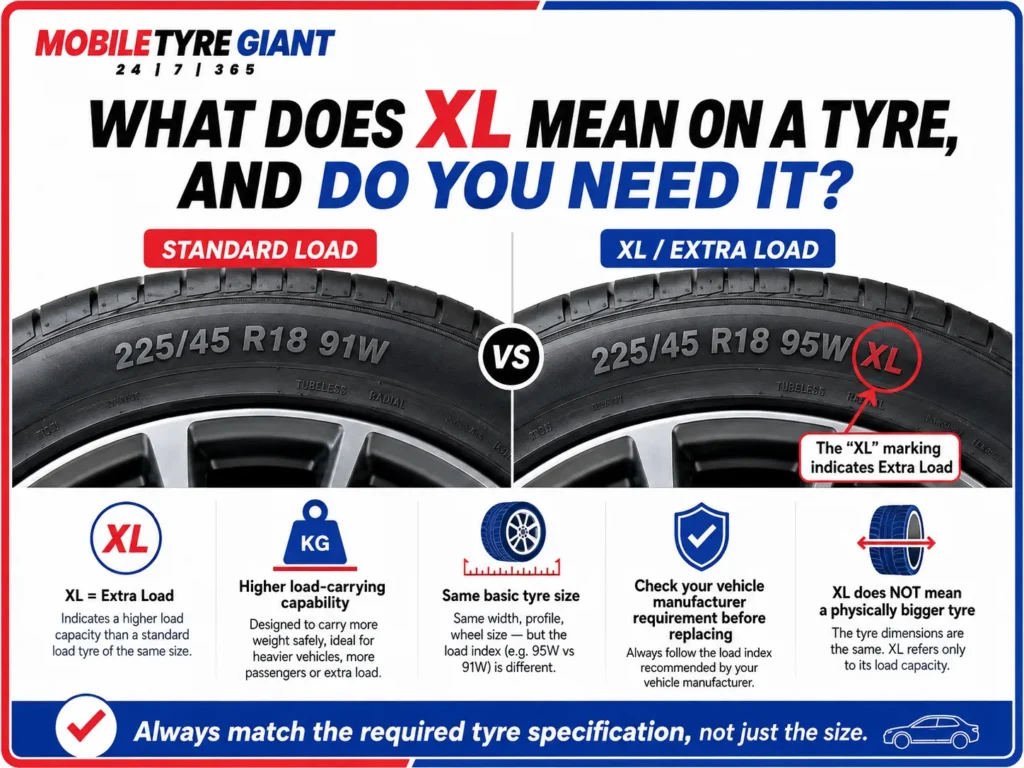
XL stands for Extra Load, and it indicates that the tyre has been designed to provide greater load-carrying capability than the corresponding standard-load version under the appropriate operating conditions. It does not mean that the tyre is physically extra-large, even though the letters can easily give that impression to somebody seeing them for the first time. You might find two tyres with the same basic size, such as 225/45 R18, while one carries an XL marking and the other does not. That is another example of why matching only the width, profile and wheel diameter can be misleading. If your vehicle’s required specification calls for an Extra Load tyre or an equivalent load capability, that requirement needs to be considered when selecting the replacement. Do not remove the XL requirement simply because a standard-load version is cheaper or easier to find. Equally, do not assume that every heavier-looking car automatically needs XL tyres without checking the actual vehicle specification.
Drivers often notice the XL marking only after comparing tyre listings online, at which point it can look like an optional upgrade. A better way to think about it is as part of the tyre specification that needs to be checked, not as a badge indicating that one tyre is automatically superior. If the tyres currently fitted are marked XL, record that information when gathering the size and service description. Then compare it with the manufacturer’s requirements before ordering replacements. This is particularly useful if a registration lookup produces versions of the same tyre size with different load capabilities. A clear sidewall photograph can help because small additional markings are easy to forget when you are reading a tyre while crouched beside the car in poor light. If something in the specification is unclear, verify it before fitting rather than trying to decide from the letters alone. The overall goal remains the same throughout this guide: identify the tyre that matches the actual requirements of the vehicle, not merely one that looks close enough.
How Can You Tell if Your Vehicle Uses Run-Flat Tyres?
Run-flat tyres are designed to allow limited mobility after a loss of pressure under specified conditions, but identifying them is not always as simple as looking for one universal marking. Different tyre manufacturers use different abbreviations and branding for their run-flat technologies, so the sidewall might display markings such as RFT, ROF, SSR, ZP or another manufacturer-specific identifier. This can create confusion when two tyres have the same physical size but one is a run-flat version and the other uses conventional construction. If you suspect your vehicle uses run-flat tyres, inspect the full sidewall rather than only the main size code. Check the vehicle information as well because some models were originally designed around run-flat systems. A registration search can help narrow the options, but again it should be cross-checked with the vehicle and tyres physically in front of you. This is especially important on used cars where the tyre type may have been changed previously. Do not assume that every tyre with a stiff-looking sidewall is a run-flat because appearance alone is not a reliable identification method.
The distinction matters because changing tyre construction is different from simply switching between two brands in the same specification. Vehicle setup, tyre-pressure monitoring and handling characteristics can all be relevant when considering a change from run-flat to conventional tyres or the other way around. If your current tyres carry run-flat markings and you are replacing only one tyre, confirm what is fitted on the rest of the vehicle before ordering. Mixing tyre types without understanding the vehicle requirements can create unnecessary uncertainty about how the car will behave. A clear photo of the complete sidewall is again one of the easiest practical ways to preserve the information before speaking to a fitter. If the marking is unfamiliar, record it rather than assuming it is unimportant. The fitter can then identify whether it refers to run-flat technology, manufacturer approval or another tyre characteristic. This small habit can prevent the common situation where somebody orders the correct physical size but discovers later that they selected the wrong construction type.
Can You Fit a Different Tyre Size to Your Vehicle?
A different tyre size may be suitable in some circumstances, but you should not choose an alternative simply because the numbers look close to the original specification. Vehicles can be approved with more than one wheel and tyre combination, which is why registration searches sometimes display several options. The important distinction is between an approved alternative fitment and a tyre size that someone has calculated or guessed will probably fit. Changing tyre dimensions can influence clearance, steering response, ride characteristics, gearing-related readings and how the wheel and tyre package interacts with the vehicle. Wheel width and diameter also need to be considered, so choosing a different profile or width is not an isolated decision. Online calculators can compare dimensions, but they cannot determine every vehicle-specific requirement on their own. If an alternative size appears in the manufacturer’s approved information for the wheel configuration fitted to your car, that provides a much stronger basis than a generic internet recommendation. Otherwise, the fitment should be checked professionally before you buy.
This is particularly important when drivers want wider tyres because they prefer the appearance or believe a wider tyre will automatically improve grip. Tyre performance depends on far more than width alone, and changing one dimension can affect other parts of the overall setup. The same caution applies when downsizing wheels for comfort or changing to a different wheel package after buying a used car. Rather than searching for a universal percentage rule and treating it as permission to change the tyres, start with the combinations approved for the actual vehicle. Confirm the wheel dimensions, required load capability and speed specification, then establish whether the proposed tyre is suitable for that setup. If you are simply replacing worn or damaged tyres, staying with the verified correct specification is usually much simpler than introducing an unnecessary fitment change.
What Information Should You Give a Mobile Tyre Fitter?
Once you have identified the correct tyre size, giving the fitter complete information can make the replacement process much smoother. Start with your vehicle registration and the full tyre sidewall code rather than simply saying that you need a 17-inch or 18-inch tyre. Tell the fitter which wheel is affected, such as front-left, front-right, rear-left or rear-right, because some vehicles use different tyre sizes on each axle. You should also mention how many tyres need replacing and whether you can see markings such as XL, RFT, ROF or another run-flat identifier. A clear photograph of the sidewall can be particularly useful when you are unsure how to describe what you see. It gives the fitter the complete information in front of them instead of relying on a number remembered from a quick glance.
This becomes even more important if a registration lookup has returned several possible tyre sizes or if the wheels have been changed. Mention any information you already know about aftermarket wheels, different front and rear sizes or unusual markings on the tyre. You do not need to understand every code before contacting a professional, but providing accurate details reduces unnecessary uncertainty. Mobile Tyre Giant’s mobile tyre fitting service can then be considered once the required replacement has been identified. If the tyre is badly damaged, avoid driving simply to make the sidewall easier to inspect. Take the information you can safely access and explain the situation clearly. Accurate vehicle and tyre details are more useful than guessing at a specification just to complete a booking quickly.
What Should You Check Before Ordering Replacement Tyres?
Before placing an order, run through the complete specification one final time. Confirm the tyre width, profile and wheel diameter first, then look at the load index and speed rating rather than stopping after the basic size. Check whether the affected tyre is on the front or rear axle and whether the vehicle uses a staggered setup. Look for additional markings such as XL or any indication that the tyre uses run-flat technology. If your registration lookup produced several results, make sure the option you choose corresponds with the wheels physically fitted to the vehicle. Used cars deserve particular attention because you may not know whether a previous owner changed the wheels or tyres. A two-minute verification is preferable to discovering that the replacement is wrong after it has already arrived.
It is also worth separating tyre fitment from tyre choice. First establish the correct tyre size and required specification, then decide which suitable brand, range or tyre type best matches your driving needs. Trying to make both decisions at the same time can make the process feel more complicated than it needs to be. Once the fitment is confirmed, our guide to choosing the right tyres for your car covers the next part of that decision. If a tyre is already worn beyond use or has damage that requires replacement, you can then consider mobile tyre replacement using the verified details. The table below gives you a final check that can be used before ordering or booking.
| Final Check | What You Need to Confirm |
|---|---|
| Tyre width | Matches the required specification |
| Profile / aspect ratio | Correct for the wheel and vehicle setup |
| Wheel diameter | Matches the wheel physically fitted |
| Load index | Meets the required vehicle specification |
| Speed rating | Meets the required vehicle specification |
| Front or rear axle | Check for staggered tyre sizes |
| XL marking | Confirm if Extra Load capability is required |
| Run-flat type | Check for relevant manufacturer markings |
| Registration lookup | Cross-check if more than one size appears |
| Changed wheels | Verify if aftermarket or replacement wheels are fitted |
What Should You Check After a Replacement Tyre Is Fitted?
A useful final habit is to read the sidewall of the replacement tyre after fitting and compare it with the specification that was confirmed before the work began. Check the width, profile, wheel diameter, load index and speed rating while the information is still fresh in your mind. If an XL or run-flat version was required, confirm that the relevant marking is present as well. This does not mean fitting errors are expected or common. It is simply the tyre equivalent of checking an order before leaving a shop. Drivers regularly inspect fuel receipts, invoices and replacement parts, so giving a newly fitted tyre the same quick attention makes sense. If something looks different from what you expected, ask about it before assuming that the difference is either wrong or harmless.
You should also check the tyre pressure once the replacement has been installed, using the vehicle manufacturer’s recommended pressure rather than the maximum pressure written on the tyre sidewall. Pressures may differ between front and rear axles or between normal and heavily loaded driving conditions. If you are unsure where to find the correct figure, our guide to checking tyre pressure explains the process in more detail. A newly fitted tyre should also be visually inspected for anything obviously unusual around the valve, sidewall or wheel. If a dashboard tyre-pressure warning remains illuminated after fitting, it should not simply be ignored. The fitting process may be finished, but a quick final check helps confirm that the tyre information and vehicle setup are consistent.
Final Words: Confirm the Complete Tyre Specification Before You Order
Finding the correct tyre size for your vehicle is much easier once you stop treating the sidewall code as a random collection of numbers and letters. Start with the tyre physically fitted, read the complete specification and compare it with the vehicle manufacturer’s information. A registration lookup is useful, but several results can appear when a model was supplied with different wheel packages or staggered front and rear fitments. Load index, speed rating, XL markings and run-flat construction can also matter even when the basic tyre dimensions look identical. If the vehicle is used or has aftermarket wheels, take extra care before assuming the current tyre or an online lookup tells the whole story. The goal is not to memorise tyre engineering. It is to gather enough reliable information to avoid guessing.
The simplest rule to remember is verify before you buy. Check the complete sidewall code, confirm the correct axle, compare it with the vehicle information and investigate anything that does not agree. If several possible tyre sizes appear, do not choose one because it is cheaper or appears first in the search results. Once the correct specification has been confirmed, you can make the separate decision about tyre brand, type and budget. When a worn, punctured or damaged tyre needs replacing, accurate information also makes arranging a mobile fitting service more straightforward. A few careful checks at the beginning can save considerably more inconvenience later. The correct tyre is not merely one that fits the wheel, but one that matches the required specification for the vehicle and its actual setup.
Not Sure Which Tyre Fits Your Car?
Send us your vehicle registration and tyre details, and Mobile Tyre Giant can help you confirm the correct specification and arrange mobile tyre fitting at a suitable location.
Frequently Asked Questions
Find quick answers to the most common questions our customers ask.
Check the complete tyre sidewall marking and compare it with the manufacturer’s approved vehicle information. If several sizes appear, confirm the wheel size and axle before ordering a replacement tyre.
Tyre size is moulded into the sidewall, usually as a code such as 205/55 R16 91V. You may also find approved information in the handbook or vehicle tyre placard provided.
In 205/55 R16 91V, 205 is width, 55 is aspect ratio, R means radial construction, 16 is wheel diameter, 91 is load index, and V is speed rating respectively clearly.
A registration lookup may show several sizes because one model can have different factory wheel packages, trims or staggered front and rear fitments. Match the result carefully to your vehicle.
Do not guess. Compare the fitted tyre with the vehicle handbook, tyre placard and actual wheel size. If the information still conflicts, have the fitment verified before ordering replacement tyres.
Yes. Some vehicles use a staggered setup with different front and rear tyre sizes. Check each axle separately and follow the manufacturer-approved specification rather than assuming all four tyres match.
XL means Extra Load. It identifies a tyre designed for greater load capability than the equivalent standard-load version. Check whether your vehicle’s approved specification requires that load capability before buying.
Check the complete tyre sidewall for manufacturer-specific run-flat markings such as RFT, ROF, SSR or ZP. Because markings vary, confirm the tyre type against vehicle information when you are uncertain.
A different tyre size may be suitable where the wheel and tyre combination is approved for the vehicle. Do not rely on appearance, close dimensions or generic online calculations alone.
Provide the vehicle registration, complete tyre sidewall code, affected wheel, number of tyres required and, where possible, a clear sidewall photo showing additional markings such as XL or run-flat clearly.